REVIEW 3 major objections 4 minor 3 cited by
This paper claims the first NNLO-accurate parton-shower-matched event generator for ttH production, built on a pointwise combination of two approximate two-loop amplitudes whose estimated uncertainty stays below the perturbative error.
Reviewed by Pith at T0; open to challenge. T0 means a machine referee read the full paper against a public rubric. the ladder, T0–T4 →
T0 review · deepseek-v4-flash
2026-08-02 18:40 UTC pith:GORHIC3F
load-bearing objection First NNLO+PS generator for ttH with a public code and a sensible pointwise two-loop approximation; the uncertainty band is less conservative than claimed in a few corners, but the central result holds. the 3 major comments →
Next-to-next-to-leading order event generation for tbar{t}H production with approximate two-loop amplitude
The pith
A machine-rendered reading of the paper's core claim, the machinery that carries it, and where it could break.
Core claim
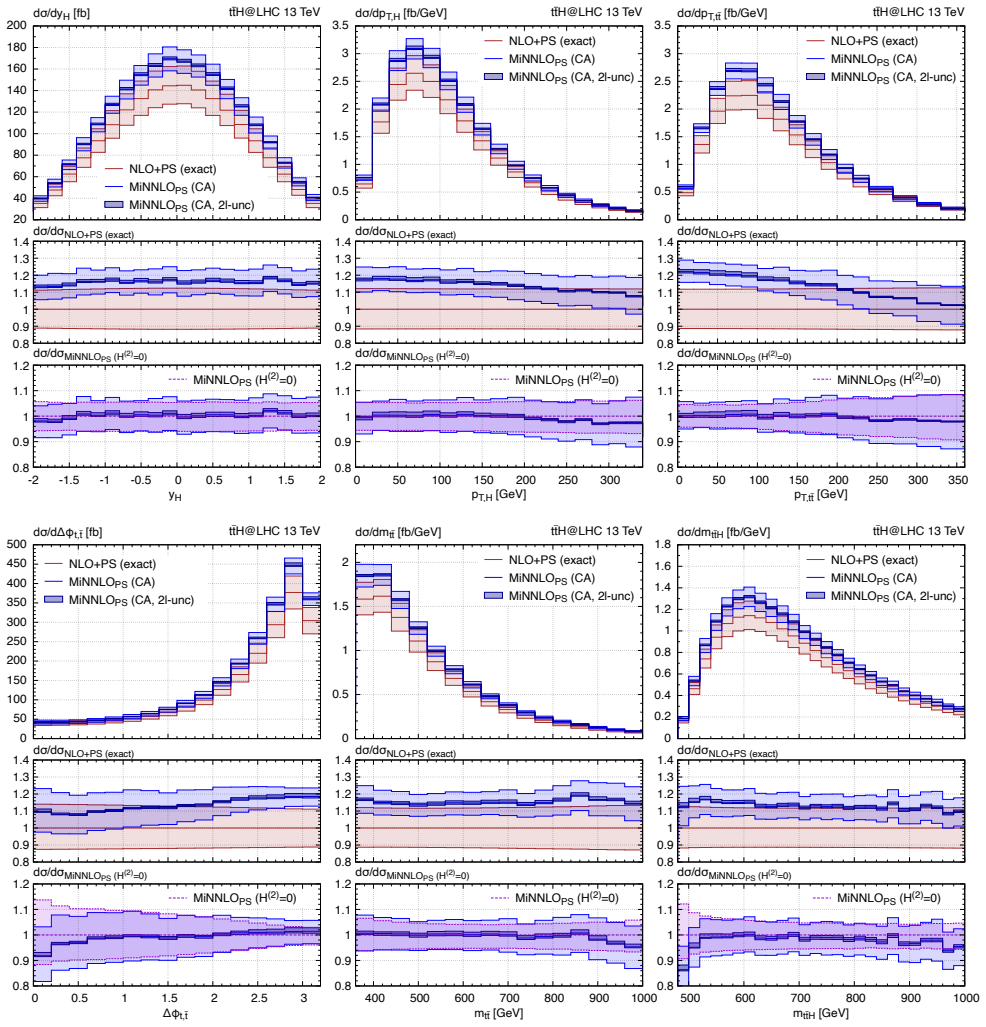
The central claim is that fully exclusive ttH event generation can reach NNLO QCD accuracy today, without the exact two-loop amplitude. The two-loop hard-virtual coefficient — the only non-exact ingredient — is replaced pointwise by a combined approximation (CA): an exponential weight ω = exp(−τ pT,H/mt) blends the soft-Higgs approximation (soft-emission factor times the ttbar amplitude; valid at small Higgs transverse momentum) with the massified high-energy approximation (massive amplitude mapped onto a massless one via log-enhanced factors; valid in the boosted regime), the latter built in full colour for the first time. An eleven-point systematic envelope, varying the subtraction scale,
What carries the argument
The load-bearing object is the combined approximation (CA) of the two-loop hard-virtual coefficient, the number that encodes the unknown two-loop finite remainder normalized to the Born amplitude. Defined pointwise as H_CA = ω H_SA + (1 − ω) H_MA, it interpolates between the soft-Higgs approximation H_SA, obtained by factorizing the amplitude in the limit of a soft Higgs boson, and the massified approximation H_MA, obtained by expanding in the small top-quark mass and connecting the amplitude to its massless counterpart; the interpolation weight ω = exp(−τ pT,H/mt) is a modelling choice with a free sharpness parameter τ. The CA is then fed into the MiNNLOPS matching method, which promotes pa
Load-bearing premise
The load-bearing premise is that the pointwise blend of the soft-Higgs and high-energy approximations, together with its uncertainty envelope, brackets the unknown exact two-loop contribution throughout phase space — a premise extrapolated from one-loop validation, where the paper itself reports that its band is 'visibly underestimated' for Higgs transverse momenta below about 30 GeV.
What would settle it
The decisive check is the exact two-loop amplitude, which the calculation is explicitly designed to host: reweight the released NNLO+PS event sample with the exact two-loop term and compare every published distribution. If in any bin the exact result falls outside the assigned two-loop band — in particular at pT,H below 30 GeV, where the one-loop band is already admitted to be too narrow — the claim that the approximation error is under control fails there. A cheaper partial test: evaluate the soft-Higgs and massified two-loop approximations at the same phase-space points and check whether the
If this is right
- The inclusive ttH cross section increases by about 15% from NLO+PS to NNLO+PS, and the scale uncertainty roughly halves (from about 12% to about 6%), so NNLO corrections are material for the precision era of Higgs-coupling measurements.
- Because the systematic error assigned to the missing two-loop amplitude stays below the perturbative uncertainty (about a percent on the total rate), the released generator is usable for experimental analyses without waiting for the exact two-loop term.
- The full-colour construction of the massified two-loop amplitude changes predictions in the tails: subleading-colour terms shift distributions such as the top-pair transverse-momentum spectrum by a few percent at NNLO+PS level.
- Off-shell top-quark decays with tree-level spin correlations are included in both the dilepton and semileptonic channels, so spin-sensitive observables (dilepton invariant mass, azimuthal separation of the leptons) can be predicted at NNLO+PS accuracy.
- Because every ingredient except the two-loop hard-virtual coefficient is exact, the genuine two-loop amplitude can later be incorporated by reweighting the already-generated event samples, a path the calculation is explicitly built to accommodate.
Where Pith is reading between the lines
- The reliability of the uncertainty band rests on an untested extrapolation from one loop to two loops; a cheap external check would be to compare the eleven-point envelope against the spread obtained by replacing the exponential weight with other smooth interpolations (e.g., a logistic function of pT,H/mt) at the two-loop level.
- In the phase-space corners the paper itself flags as least controlled — Higgs transverse momenta below about 30 GeV and the large-ΔR_H,t / small-Δφ_t,tt regions — analyses that select such configurations should treat the quoted band as provisional and reweight once the exact two-loop result exists.
- The same recipe is transferable to other ttF processes with a colour-singlet final state, but the transfer is not automatic: each process needs its own phase-space weight, its own massless two-loop input, and a one-loop validation to calibrate δ.
- If the one-loop-to-two-loop error scaling holds, the dominant theory uncertainty in ttH becomes the scale uncertainty; reaching the anticipated few-percent experimental precision would then require taming scale systematics rather than the two-loop amplitude itself.
Editorial analysis
A structured set of objections, weighed in public.
Referee Report
Summary. The paper presents the first MiNNLOPS-based NNLO+PS simulation for ttbar+H production at the LHC. All ingredients are exact except the two-loop virtual amplitude, which is approximated by a pointwise combination (CA) of a soft-Higgs approximation and a massified high-energy (small-mt) approximation; the high-energy piece is implemented in full colour for the first time. The authors assign a systematic uncertainty to the CA by varying two interpolation parameters (eta, tau) and rescaling the two-loop hard-virtual coefficient by the one-loop discrepancy delta. They validate the CA at one loop against exact NLO+PS predictions, validate the MiNNLOPS machinery against fixed-order Matrix results with H^(2)=0, and then provide phenomenological predictions for on-shell ttbar+H, H->gamma gamma, and dilepton/semileptonic top decays with tree-level spin correlations. The generator is publicly released in POWHEG-BOX-RES.
Significance. If the claims are substantiated, this is a significant step for ttbar+H phenomenology: it is the first NNLO+PS generator for this process, it includes a full-colour massified two-loop ingredient, it provides a publicly available tool for experimental analyses, and the one-loop validation is a sensible and non-trivial test of the approximation strategy. The fixed-order validation with H^(2)=0 is a genuine check of the MiNNLOPS Q-bar-Q-F extension. The main weakness is that the two-loop systematic uncertainty is calibrated only at one-loop order, and the manuscript itself reports regions where the one-loop CA band is underestimated; the extrapolation of that discrepancy to two loops is an assumption rather than a derived property. The paper is therefore valuable and likely correct in its construction, but the advertised 'conservative' sub-percent two-loop uncertainty needs to be re-scoped or strengthened before the central claim is fully supported.
major comments (3)
- [Section 3.2 and Section 3.3 (Figs. 3, 4; Table 3)] The manuscript admits in Section 3.3 that the CA uncertainty band is 'visibly underestimated' for pT,H <~ 30 GeV and that a tiny subdominant region at small m_ttH is not covered by the one-loop CA band. The two-loop systematic is then built in Section 3.2 from (eta,tau) variations plus the pointwise rescaling (1 +/- delta) H_CA^(2), where delta is the one-loop discrepancy |H_CA^(1)/H_exact^(1) - 1|. This presumes that the one-loop error pattern is a reliable proxy for the unknown two-loop error. No argument is given for that scaling, and in the kinematic bins where the one-loop band already fails, the claimed 'conservative' two-loop envelope is not established. Since the abstract and conclusions advertise a conservative, sub-percent two-loop systematic, this is a load-bearing point. Please either enlarge the two-loop systematic in the regions where the one-loop validation fails (e.g., by
- [Section 4.1 and Conclusions] The fixed-order validation against Matrix in Section 4.1 is performed with H^(2)=0 in both codes. This is an important and valid test of the MiNNLOPS machinery, but it does not test the CA of the two-loop amplitude. The conclusions correctly describe the Matrix comparison as a validation of the MiNNLOPS method, but the abstract and the conclusions may leave readers with the impression that the two-loop approximation itself has been benchmarked at NNLO. Please state explicitly that the two-loop CA is validated only indirectly, through one-loop comparisons, and that the two-loop uncertainty is an estimate rather than a measured coverage.
- [Section 4.4 vs Section 3.2] In Section 3.2 the authors argue that an a posteriori combination of the two approximations is problematic because the underlying Born kinematics cannot be unambiguously reconstructed after showering. However, in Section 4.4 the decayed simulations are described as first generating on-shell weights with H^(2)=0 and then including the hard two-loop contribution 'via an a posteriori reweighting' after off-shell event construction. Please clarify how this reweighting is compatible with the pointwise philosophy, or specify that the reweighting is performed using the on-shell Born kinematics of each event before the off-shell projection. This is not necessarily an error, but it needs explanation to avoid an apparent contradiction.
minor comments (4)
- [Eq. (10) and Eq. (16)] The definition of H^(n)_SA uses mu_R = fM while H^(n)_MA uses mu_R = M, and the notation fM and M is introduced only in Section 3.2. Please define these projected scales already in Section 3.1 to avoid confusion.
- [Section 3.2] The parameter tau in the weight function omega = exp(-tau pT,H/mt) is an ad-hoc interpolation parameter; its central value tau=1 and the factor-of-two variation are motivated empirically by one-loop studies. I suggest stating explicitly that tau is not derived from first principles and that the one-loop validation is the only evidence for the chosen range.
- [Figure 6 and similar] In the lower panels, the curve labelled 'MiNNLOPS (H^(2)=0)' is actually the ratio of the complete MiNNLOPS result to the H^(2)=0 result, but the legend appears to label the curve as if it were a separate prediction. Please adjust captions or legends to make clear that the lower panel is a ratio.
- [Throughout] The text switches between 'a posteriori' and 'pointwise' combination; in the decayed simulations, the phrase 'a posteriori reweighting' is used in a different sense from Section 3.2. Consider using a different term, such as 'event reweighting', to avoid confusion.
Circularity Check
No significant circularity: the two-loop approximation is imported from external factorization/massification results, the CA interpolation is explicit, and the NNLO+PS machinery is validated against fixed order with H(2)=0.
full rationale
The derivation chain is not circular. The two-loop input is built from two external approximations: the soft-Higgs factorization of Ref. [35] (Eq. (9)) and the massification formula of Eq. (11), with the massless two-loop remainder taken from Refs. [92,93]. The combined approximation (CA) in Eq. (18) is an explicit pointwise interpolation omega*H_SA + (1-omega)*H_MA with omega = exp(-tau pT,H/mt) in Eq. (20). No equation in Section 3 inverts a target prediction to infer these inputs. The two-loop uncertainty is a stated prescription rather than a fitted result: an eleven-point envelope over eta and tau plus (1 +/- delta) H_CA(2) (Section 3.2). The one-loop validation is not presented as independent of the choice of omega - the paper says "We performed a comprehensive differential study to validate the different options at one-loop level, finding that this choice yields the best agreement with the exact results" (Section 3.2) - and it explicitly admits that the CA band is "visibly underestimated" for pT,H <~ 30 GeV and that a "tiny, subdominant region at small m_ttH" is not covered (Section 3.3). This is an extrapolation/robustness caveat, not a circular reduction. The MiNNLOPS framework is cited from the authors' prior work, but the implementation is benchmarked in this paper against fixed-order Matrix predictions with H(2)=0 (Section 4.1, Table 2), so the NNLO+PS claim does not reduce to a self-citation. The only mild concern is that the functional form/tuning of omega is selected using the same one-loop data used for validation, which slightly weakens the one-loop validation as independent evidence but does not make the NNLO result equivalent to its inputs.
Axiom & Free-Parameter Ledger
free parameters (4)
- tau =
1 (default)
- eta =
1 (default)
- KQ =
0.25
- Q0 =
2 GeV
axioms (8)
- domain assumption Soft-Higgs factorisation of the two-loop ttH finite remainder (Eq. 9)
- domain assumption Massification relation between massive and massless finite remainders (Eq. 11)
- ad hoc to paper Exponential weight function omega = exp(-tau pT,H/mt) interpolates the two approximations
- ad hoc to paper One-loop discrepancy delta can be used to rescale the two-loop uncertainty (1 +/- delta) H2_CA
- domain assumption External full-colour massless two-loop amplitude for q qbar H (Ref [93]) is correct
- domain assumption Colour-space IR anomalous dimension Gamma and finite soft operator h-bar for Q-bar-Q-F are known and implemented
- domain assumption MiNNLOPS extension to Q-bar-Q-F with a colour-singlet final state provides NNLO accuracy when the hard-virtual coefficient is exact
- domain assumption On-shell top-Yukawa scheme conversion (Eqs. 12-15)
read the original abstract
We study Higgs-boson production in association with a top-quark pair ($t\bar{t}H$) at hadron colliders and present the first matching of next-to-next-to-leading order (NNLO) QCD corrections to parton showers using the MiNNLOPS method. For the two-loop amplitude, we employ two established approximations, based on the soft Higgs-boson and high-energy limits, respectively. For the first time, we also construct the latter in full colour and propose a pointwise combination of the two approximations across phase space. By assigning a conservative uncertainty estimate, which remains well below the perturbative uncertainties, we ensure robust and reliable differential predictions, explicitly validated at the one-loop level. Apart from the two-loop amplitude, all remaining ingredients of the MiNNLOPS calculation are included exactly. After thorough validation, we present a series of phenomenological results illustrating the impact of NNLO corrections and parton-shower effects. We consider fiducial predictions for the Higgs-boson decay into photons and include off-shell top-quark decays with tree-level spin correlations in both the dilepton and semileptonic channels. Our $t\bar{t}H$ MiNNLOPS generator is publicly available within the POWHEG framework.
Figures




Forward citations
Cited by 3 Pith papers
-
NNLO+PS Higgs-pair production in MiNNLOPS
NNLO+PS matching for gluon-fusion Higgs pair production is implemented in MiNNLOPS with approximate top-mass effects, validated against fixed-order NNLO and compared to GENEVA, with results for decay channels and tril...
-
Top-associated Higgs-boson production using perturbative fragmentation functions at next-to-leading-order
Perturbative fragmentation functions reproduce the leading top-mass dependence of the exact NLO ttH cross section in the hybrid prescription at LHC energies.
-
Top-associated Higgs-boson production using perturbative fragmentation functions at next-to-leading-order
Perturbative fragmentation functions approximate ttH production at NLO and yield reliable results in the hybrid prescription at LHC energies.
Reference graph
Works this paper leans on
-
[1]
G. Aad et al. (ATLAS), Phys. Lett. B716, 1 (2012), arXiv:1207.7214 [hep-ex]. 31
Pith/arXiv arXiv 2012
-
[2]
S. Chatrchyan et al. (CMS), Phys. Lett. B716, 30 (2012), arXiv:1207.7235 [hep-ex]
Pith/arXiv arXiv 2012
-
[3]
G. Aad et al. (ATLAS), Nature607, 52 (2022), [Erratum: Nature 612, E24 (2022)], arXiv:2207.00092 [hep-ex]
Pith/arXiv arXiv 2022
-
[4]
A. Tumasyan et al. (CMS), Nature607, 60 (2022), [Erratum: Nature 623, (2023)], arXiv:2207.00043 [hep-ex]
Pith/arXiv arXiv 2022
-
[5]
M. Aaboud et al. (ATLAS), Phys. Lett. B784, 173 (2018), arXiv:1806.00425 [hep-ex]
Pith/arXiv arXiv 2018
-
[6]
A. M. Sirunyan et al. (CMS), Phys. Rev. Lett.120, 231801 (2018), arXiv:1804.02610 [hep-ex]
Pith/arXiv arXiv 2018
-
[7]
Cepeda et al., CERN Yellow Rep
M. Cepeda et al., CERN Yellow Rep. Monogr.7, 221 (2019), arXiv:1902.00134 [hep-ph]
Pith/arXiv arXiv 2019
-
[8]
J. Altmann et al., ECF A Higgs, electroweak, and top Factory Study, CERN Yellow Reports: Monographs, Vol. 5/2025 (2025) arXiv:2506.15390 [hep-ex]
arXiv 2025
- [9]
-
[10]
de Blas et al., (2025), 10.17181/CERN.35CH.2O2P, arXiv:2511.03883 [hep-ex]
J. de Blas et al., (2025), 10.17181/CERN.35CH.2O2P, arXiv:2511.03883 [hep-ex]
arXiv 2025
- [11]
-
[12]
J. N. Ng and P. Zakarauskas, Phys. Rev. D29, 876 (1984)
1984
-
[13]
Kunszt, Nucl
Z. Kunszt, Nucl. Phys. B247, 339 (1984)
1984
-
[14]
W. Beenakker, S. Dittmaier, M. Kramer, B. Plumper, M. Spira and P. M. Zerwas, Phys. Rev. Lett. 87, 201805 (2001), arXiv:hep-ph/0107081
Pith/arXiv arXiv 2001
-
[15]
W. Beenakker, S. Dittmaier, M. Kramer, B. Plumper, M. Spira and P. M. Zerwas, Nucl. Phys. B 653, 151 (2003), arXiv:hep-ph/0211352
Pith/arXiv arXiv 2003
-
[16]
L. Reina and S. Dawson, Phys. Rev. Lett.87, 201804 (2001), arXiv:hep-ph/0107101
Pith/arXiv arXiv 2001
-
[17]
L. Reina, S. Dawson and D. Wackeroth, Phys. Rev. D65, 053017 (2002), arXiv:hep-ph/0109066
Pith/arXiv arXiv 2002
- [18]
-
[19]
S. Dawson, C. Jackson, L. H. Orr, L. Reina and D. Wackeroth, Phys. Rev. D68, 034022 (2003), arXiv:hep-ph/0305087
Pith/arXiv arXiv 2003
-
[20]
S. Frixione, V. Hirschi, D. Pagani, H. S. Shao and M. Zaro, JHEP09, 065 (2014), arXiv:1407.0823 [hep-ph]
Pith/arXiv arXiv 2014
-
[21]
Y. Zhang, W.-G. Ma, R.-Y. Zhang, C. Chen and L. Guo, Phys. Lett. B738, 1 (2014), arXiv:1407.1110 [hep-ph]
Pith/arXiv arXiv 2014
-
[22]
S. Frixione, V. Hirschi, D. Pagani, H. S. Shao and M. Zaro, JHEP06, 184 (2015), arXiv:1504.03446 [hep-ph]
Pith/arXiv arXiv 2015
-
[23]
R. Frederix, S. Frixione, V. Hirschi, D. Pagani, H. S. Shao and M. Zaro, JHEP07, 185 (2018), [Erratum: JHEP 11, 085 (2021)], arXiv:1804.10017 [hep-ph]
Pith/arXiv arXiv 2018
-
[24]
A. Denner and R. Feger, JHEP11, 209 (2015), arXiv:1506.07448 [hep-ph]
Pith/arXiv arXiv 2015
-
[25]
D. Stremmer and M. Worek, JHEP02, 196 (2022), arXiv:2111.01427 [hep-ph]
Pith/arXiv arXiv 2022
-
[26]
A. Denner, J.-N. Lang, M. Pellen and S. Uccirati, JHEP02, 053 (2017), arXiv:1612.07138 [hep-ph]
Pith/arXiv arXiv 2017
-
[27]
A. Kulesza, L. Motyka, T. Stebel and V. Theeuwes, JHEP03, 065 (2016), arXiv:1509.02780 [hep-ph]
Pith/arXiv arXiv 2016
-
[28]
A. Broggio, A. Ferroglia, B. D. Pecjak, A. Signer and L. L. Yang, JHEP03, 124 (2016), arXiv:1510.01914 [hep-ph]
Pith/arXiv arXiv 2016
-
[29]
A. Broggio, A. Ferroglia, B. D. Pecjak and L. L. Yang, JHEP02, 126 (2017), arXiv:1611.00049 [hep-ph]
Pith/arXiv arXiv 2017
-
[30]
A. Kulesza, L. Motyka, T. Stebel and V. Theeuwes, Phys. Rev. D97, 114007 (2018), arXiv:1704.03363 [hep-ph]. 32
Pith/arXiv arXiv 2018
-
[31]
A. Broggio, A. Ferroglia, R. Frederix, D. Pagani, B. D. Pecjak and I. Tsinikos, JHEP08, 039 (2019), arXiv:1907.04343 [hep-ph]
Pith/arXiv arXiv 2019
-
[32]
W.-L. Ju and L. L. Yang, JHEP06, 050 (2019), arXiv:1904.08744 [hep-ph]
Pith/arXiv arXiv 2019
-
[33]
A. Kulesza, L. Motyka, D. Schwartl¨ ander, T. Stebel and V. Theeuwes, Eur. Phys. J. C80, 428 (2020), arXiv:2001.03031 [hep-ph]
Pith/arXiv arXiv 2020
-
[34]
S. Catani, I. Fabre, M. Grazzini and S. Kallweit, Eur. Phys. J. C81, 491 (2021), arXiv:2102.03256 [hep-ph]
Pith/arXiv arXiv 2021
-
[35]
S. Catani, S. Devoto, M. Grazzini, S. Kallweit, J. Mazzitelli and C. Savoini, Phys. Rev. Lett.130, 111902 (2023), arXiv:2210.07846 [hep-ph]
Pith/arXiv arXiv 2023
-
[36]
S. Devoto, M. Grazzini, S. Kallweit, J. Mazzitelli and C. Savoini, JHEP03, 189 (2025), arXiv:2411.15340 [hep-ph]
Pith/arXiv arXiv 2025
-
[37]
Balsach et al., (2025), 10.21468/SciPostPhysCommRep.10, arXiv:2503.15043 [hep-ph]
R. Balsach et al., (2025), 10.21468/SciPostPhysCommRep.10, arXiv:2503.15043 [hep-ph]
Pith/arXiv arXiv 2025
-
[38]
F. Febres Cordero, G. Figueiredo, M. Kraus, B. Page and L. Reina, JHEP07, 084 (2024), arXiv:2312.08131 [hep-ph]
Pith/arXiv arXiv 2024
-
[39]
B. Agarwal, G. Heinrich, S. P. Jones, M. Kerner, S. Y. Klein, J. Lang, V. Magerya and A. Olsson, JHEP05, 013 (2024), [Erratum: JHEP 06, 142 (2024)], arXiv:2402.03301 [hep-ph]
Pith/arXiv arXiv 2024
-
[40]
G. Wang, T. Xia, L. L. Yang and X. Ye, JHEP07, 121 (2024), arXiv:2402.00431 [hep-ph]
Pith/arXiv arXiv 2024
-
[41]
R. Frederix, S. Frixione, V. Hirschi, F. Maltoni, R. Pittau and P. Torrielli, Phys. Lett. B701, 427 (2011), arXiv:1104.5613 [hep-ph]
Pith/arXiv arXiv 2011
-
[42]
H. B. Hartanto, B. Jager, L. Reina and D. Wackeroth, Phys. Rev. D91, 094003 (2015), arXiv:1501.04498 [hep-ph]
Pith/arXiv arXiv 2015
-
[43]
P. F. Monni, P. Nason, E. Re, M. Wiesemann and G. Zanderighi, JHEP05, 143 (2020), arXiv:1908.06987 [hep-ph]
Pith/arXiv arXiv 2020
-
[44]
P. F. Monni, E. Re and M. Wiesemann, Eur. Phys. J. C80, 1075 (2020), arXiv:2006.04133 [hep-ph]
Pith/arXiv arXiv 2020
-
[45]
J. Mazzitelli, P. F. Monni, P. Nason, E. Re, M. Wiesemann and G. Zanderighi, Phys. Rev. Lett. 127, 062001 (2021), arXiv:2012.14267 [hep-ph]
Pith/arXiv arXiv 2021
-
[46]
J. Mazzitelli, V. Sotnikov and M. Wiesemann, Phys. Rev. D112, 056031 (2025), arXiv:2404.08598 [hep-ph]
Pith/arXiv arXiv 2025
-
[47]
D. Lombardi, M. Wiesemann and G. Zanderighi, JHEP06, 095 (2021), arXiv:2010.10478 [hep-ph]
Pith/arXiv arXiv 2021
-
[48]
D. Lombardi, M. Wiesemann and G. Zanderighi, JHEP11, 230 (2021), arXiv:2103.12077 [hep-ph]
Pith/arXiv arXiv 2021
-
[49]
J. Mazzitelli, P. F. Monni, P. Nason, E. Re, M. Wiesemann and G. Zanderighi, JHEP04, 079 (2022), arXiv:2112.12135 [hep-ph]
Pith/arXiv arXiv 2022
-
[50]
L. Buonocore, G. Koole, D. Lombardi, L. Rottoli, M. Wiesemann and G. Zanderighi, JHEP01, 072 (2022), arXiv:2108.05337 [hep-ph]
Pith/arXiv arXiv 2022
-
[51]
D. Lombardi, M. Wiesemann and G. Zanderighi, Phys. Lett. B824, 136846 (2022), arXiv:2108.11315 [hep-ph]
Pith/arXiv arXiv 2022
-
[52]
S. Zanoli, M. Chiesa, E. Re, M. Wiesemann and G. Zanderighi, JHEP07, 008 (2022), arXiv:2112.04168 [hep-ph]
Pith/arXiv arXiv 2022
-
[53]
A. Gavardi, C. Oleari and E. Re, JHEP09, 061 (2022), arXiv:2204.12602 [hep-ph]
Pith/arXiv arXiv 2022
-
[54]
U. Haisch, D. J. Scott, M. Wiesemann, G. Zanderighi and S. Zanoli, JHEP07, 054 (2022), arXiv:2204.00663 [hep-ph]
Pith/arXiv arXiv 2022
-
[55]
J. M. Lindert, D. Lombardi, M. Wiesemann, G. Zanderighi and S. Zanoli, JHEP11, 036 (2022), arXiv:2208.12660 [hep-ph]
Pith/arXiv arXiv 2022
-
[56]
J. Mazzitelli, A. Ratti, M. Wiesemann and G. Zanderighi, Phys. Lett. B843, 137991 (2023), 33 arXiv:2302.01645 [hep-ph]
Pith/arXiv arXiv 2023
-
[57]
C. Biello, A. Sankar, M. Wiesemann and G. Zanderighi, Eur. Phys. J. C84, 479 (2024), arXiv:2402.04025 [hep-ph]
Pith/arXiv arXiv 2024
-
[58]
M. Niggetiedt and M. Wiesemann, Phys. Lett. B858, 139043 (2024), arXiv:2407.01354 [hep-ph]
Pith/arXiv arXiv 2024
-
[59]
C. Biello, J. Mazzitelli, A. Sankar, M. Wiesemann and G. Zanderighi, JHEP04, 088 (2025), arXiv:2412.09510 [hep-ph]
Pith/arXiv arXiv 2025
-
[60]
T. Jeˇ zo and P. Nason, JHEP12, 065 (2015), arXiv:1509.09071 [hep-ph]
Pith/arXiv arXiv 2015
-
[61]
M. Ebert, L. Rottoli, M. Wiesemann, G. Zanderighi and S. Zanoli, JHEP07, 085 (2024), arXiv:2402.00596 [hep-ph]
Pith/arXiv arXiv 2024
-
[62]
S. Frixione, P. Nason and C. Oleari, JHEP11, 070 (2007), arXiv:0709.2092 [hep-ph]
Pith/arXiv arXiv 2007
-
[63]
K. Hamilton, P. Nason, C. Oleari and G. Zanderighi, JHEP05, 082 (2013), arXiv:1212.4504 [hep-ph]
Pith/arXiv arXiv 2013
-
[64]
K. Hamilton, P. Nason and G. Zanderighi, JHEP10, 155 (2012), arXiv:1206.3572 [hep-ph]
Pith/arXiv arXiv 2012
-
[65]
H. X. Zhu, C. S. Li, H. T. Li, D. Y. Shao and L. L. Yang, Phys. Rev. Lett.110, 082001 (2013), arXiv:1208.5774 [hep-ph]
Pith/arXiv arXiv 2013
-
[66]
H. T. Li, C. S. Li, D. Y. Shao, L. L. Yang and H. X. Zhu, Phys. Rev. D88, 074004 (2013), arXiv:1307.2464 [hep-ph]
Pith/arXiv arXiv 2013
-
[67]
S. Catani, M. Grazzini and A. Torre, Nucl. Phys.B890, 518 (2014), arXiv:1408.4564 [hep-ph]
Pith/arXiv arXiv 2014
-
[68]
T. Becher and M. Neubert, Phys. Rev. Lett.102, 162001 (2009), [Erratum: Phys.Rev.Lett. 111, 199905 (2013)], arXiv:0901.0722 [hep-ph]
Pith/arXiv arXiv 2009
-
[69]
T. Becher and M. Neubert, JHEP06, 081 (2009), [Erratum: JHEP 11, 024 (2013)], arXiv:0903.1126 [hep-ph]
Pith/arXiv arXiv 2009
-
[70]
T. Becher and M. Neubert, Phys. Rev. D79, 125004 (2009), [Erratum: Phys.Rev.D 80, 109901 (2009)], arXiv:0904.1021 [hep-ph]
Pith/arXiv arXiv 2009
-
[71]
A. Ferroglia, M. Neubert, B. D. Pecjak and L. L. Yang, JHEP11, 062 (2009), arXiv:0908.3676 [hep-ph]
Pith/arXiv arXiv 2009
-
[72]
S. Catani, S. Devoto, M. Grazzini and J. Mazzitelli, (2023), arXiv:2301.11786 [hep-ph]
Pith/arXiv arXiv 2023
- [73]
-
[74]
Z. L. Liu and P. F. Monni, JHEP03, 096 (2025), arXiv:2411.13466 [hep-ph]
Pith/arXiv arXiv 2025
-
[75]
Z. L. Liu and P. F. Monni, (2025), arXiv:2511.23280 [hep-ph]
arXiv 2025
-
[76]
L. Buonocore, S. Devoto, M. Grazzini, S. Kallweit, J. Mazzitelli, L. Rottoli and C. Savoini, Phys. Rev. Lett.131, 231901 (2023), arXiv:2306.16311 [hep-ph]
Pith/arXiv arXiv 2023
-
[77]
L. Buonocore, S. Devoto, S. Kallweit, J. Mazzitelli, L. Rottoli and C. Savoini, Phys. Rev. D107, 074032 (2023), arXiv:2212.04954 [hep-ph]
Pith/arXiv arXiv 2023
-
[78]
C. Brancaccio, M. Czakon, T. Generet and M. Kr¨ amer, JHEP08, 145 (2021), arXiv:2106.06516 [hep-ph]
Pith/arXiv arXiv 2021
-
[79]
J. R. Ellis, M. K. Gaillard and D. V. Nanopoulos, Nucl. Phys. B106, 292 (1976)
1976
-
[80]
M. A. Shifman, A. I. Vainshtein, M. B. Voloshin and V. I. Zakharov, Sov. J. Nucl. Phys.30, 711 (1979)
1979
discussion (0)
Sign in with ORCID, Apple, or X to comment. Anyone can read and Pith papers without signing in.