REVIEW 1 major objections 15 references
A single shared pipeline with DINOv3 and patch-wise augmentations segments anomalies across object classes without training or per-class tuning.
Reviewed by Pith at T0; open to challenge. T0 means a machine referee read the full paper against a public rubric. the ladder, T0–T4 →
T0 review · grok-4.3
2026-06-30 21:12 UTC pith:GPEUZ6KV
load-bearing objection This is a workshop challenge entry that swaps DINOv3 and a few processing tweaks into SuperAD for higher F1 on MVTec AD 2 under one shared config, but the hyperparameter selection process is not described. the 1 major comments →
SuperADD: Training-free Class-agnostic Anomaly Segmentation -- CVPR 2026 VAND 4.0 Workshop Challenge Industrial Track
The pith
A machine-rendered reading of the paper's core claim, the machinery that carries it, and where it could break.
Core claim
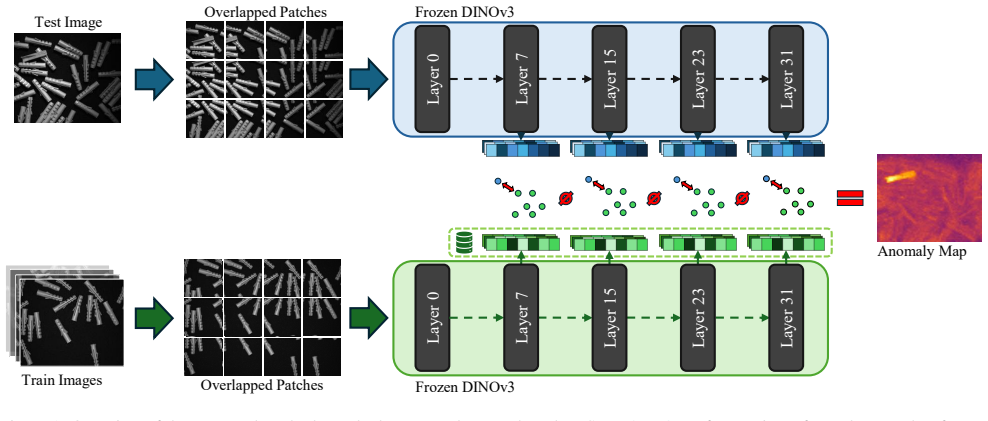
The central claim is that the listed modifications to the SuperAD pipeline—DINOv3 features, overlapping patch processing, intensity augmentations, improved memory-bank subsampling, and iterative morphological closing—yield higher segmentation F1 scores on MVTec AD 2 under distribution shifts while remaining training-free and using a single architecture plus one shared hyperparameter configuration across all classes.
What carries the argument
The end-to-end pipeline that extracts features with DINOv3 on overlapping patches, augments intensities, builds and subsamples a memory bank, computes anomaly maps, and cleans them with iterative morphological closing.
Load-bearing premise
The reported gains come from the listed changes and the shared hyperparameter set works across classes and shifts rather than from hidden per-class adjustments or dataset-specific overfitting.
What would settle it
Apply the exact same code and single hyperparameter set to a new industrial dataset recorded under different lighting or camera conditions and measure whether the F1 scores stay above those of SuperAD and other listed baselines.
If this is right
- Segmentation F1 reaches 62.61 percent public, 57.42 percent private, and 54.35 percent private mixed on MVTec AD 2.
- The method outperforms SuperAD and other state-of-the-art approaches while using one architecture for all classes.
- No per-class hyperparameter search or retraining is required when product variants or acquisition conditions change.
- The approach is positioned for industrial use where minimal adaptation effort is needed.
Where Pith is reading between the lines
- Simple post-processing steps such as morphological closing may substitute for more complex class-specific models in many inspection settings.
- The shared-hyperparameter design could be tested on additional datasets that contain similar but unseen distribution shifts to check broader robustness.
- If the memory-bank subsampling proves stable, the same pipeline might transfer to other feature backbones without further retuning.
Editorial analysis
A structured set of objections, weighed in public.
Referee Report
Summary. The manuscript introduces SuperADD, a training-free class-agnostic anomaly segmentation pipeline extending SuperAD for the VAND 4.0 Industrial Track challenge. It incorporates a DINOv3 backbone, overlapping patch-wise processing, intensity-based augmentations, improved memory-bank subsampling, and iterative morphological closing. The approach uses a single architecture and one shared hyperparameter configuration across all classes on MVTec AD 2, reporting segmentation F1 scores of 62.61%, 57.42%, and 54.35% on the public, private, and private-mixed test sets while outperforming SuperAD and other SOTA methods. Code is released at the provided GitHub link.
Significance. If the shared hyperparameter configuration proves to have been selected without reference to evaluation splits and the performance gains hold under the claimed conditions, the result would support practical deployment of anomaly segmentation in industrial settings with minimal per-class adaptation. The explicit release of code is a clear strength for reproducibility.
major comments (1)
- [Methods] The procedure used to select the single shared hyperparameter configuration is not described (Methods section). This detail is load-bearing for the central claim that the pipeline achieves class-agnostic robustness, because any post-hoc tuning or validation on the public test split would mean the reported outperformance on private splits cannot be interpreted as evidence of generalization without per-class adjustment.
Simulated Author's Rebuttal
We thank the referee for the constructive feedback. We address the major comment below and will revise the manuscript to incorporate the requested clarification.
read point-by-point responses
-
Referee: [Methods] The procedure used to select the single shared hyperparameter configuration is not described (Methods section). This detail is load-bearing for the central claim that the pipeline achieves class-agnostic robustness, because any post-hoc tuning or validation on the public test split would mean the reported outperformance on private splits cannot be interpreted as evidence of generalization without per-class adjustment.
Authors: We agree that the procedure for selecting the shared hyperparameter configuration is not described in the current Methods section and that this detail is important for supporting the class-agnostic claim. We will revise the manuscript to add an explicit description of the selection process. The revised text will confirm that a single configuration was used across all classes with no per-class adjustments and that selection did not involve the private test sets. revision: yes
Circularity Check
No circularity: empirical pipeline evaluation with no derivation chain
full rationale
The paper presents a training-free anomaly segmentation method built from modifications to prior work (SuperAD), with results consisting of direct F1-score evaluations on the MVTec AD 2 benchmark under a single shared hyperparameter set. No equations, predictions, or first-principles claims are made that reduce to inputs by construction, and no self-citation forms a load-bearing justification for uniqueness or ansatz. The central claims are empirical comparisons, which remain independent of any fitted reduction.
Axiom & Free-Parameter Ledger
free parameters (1)
- shared hyperparameter configuration
axioms (1)
- domain assumption DINOv3 features are suitable for anomaly detection in industrial images.
read the original abstract
Visual anomaly detection (AD) for industrial inspection is a highly relevant task in modern production environments. The problem becomes particularly challenging when training and deployment data differ due to changes in acquisition conditions during production. In the VAND 4.0 Industrial Track, models must remain robust under distribution shifts such as varying illumination and their performance is assessed on the MVTec AD 2 dataset. To address this setting, we propose a training-free and class-agnostic anomaly detection pipeline based on the work of SuperAD. Our approach improves generalization through several modifications designed to enhance robustness under distribution shifts. These adaptations include using a DINOv3 backbone, overlapping patch-wise processing, intensity-based augmentations, improved memory-bank subsampling for better coverage of the data distribution, and iterative morphological closing for cleaner and more spatially consistent anomaly maps. Unlike methods that rely on class-specific architectures or per-class hyperparameter tuning, our method uses a single architecture and one shared hyperparameter configuration across all object classes. This makes the approach well suited for industrial deployment, where product variants and appearance changes must be handled with minimal adaptation effort. We achieve segmentation F1 scores of $62.61\%$, $57.42\%$, and $54.35\%$ on test public, private, and private mixed of MVTec AD 2 respectively, thereby outperforming SuperAD and other state-of-the-art methods. Code is available at https://github.com/LukasRoom/SuperADD.
Figures


Reference graph
Works this paper leans on
-
[1]
Zhuo Li, Yuhao Yan, Xiangheng Wang, Yifei Ge, and Lin Meng. A survey of deep learning for industrial visual anomaly detection.Artificial Intelligence Review, 58(9):279,
-
[2]
Lars Heckler-Kram, Jan-Hendrik Neudeck, Ulla Scheler, Re- becca K ¨onig, and Carsten Steger. The mvtec ad 2 dataset: Advanced scenarios for unsupervised anomaly detection.In- ternational Journal of Computer Vision, 134(4):175, 2026. 1
work page 2026
-
[3]
Lars Heckler-Kram, Ashwin Vaidya, Jan-Hendrik Neudeck, Ulla Scheler, Dick Ameln, Samet Akcay, and Paula Ramos. From benchmarks to reality: Advancing visual anomaly detection by the vand 3.0 challenge.arXiv preprint arXiv:2509.17615, 2025. 1, 2
-
[4]
Mvtec ad–a comprehensive real-world dataset for unsupervised anomaly detection
Paul Bergmann, Michael Fauser, David Sattlegger, and Carsten Steger. Mvtec ad–a comprehensive real-world dataset for unsupervised anomaly detection. InProceedings of the IEEE/CVF conference on computer vision and pattern recognition, pages 9592–9600, 2019. 2
work page 2019
-
[5]
Accurate anomaly localization in challenging industrial settings via a hybrid detection frame- work
Xingao Wang, Shuying Xia, Zhaohong Liao, Mengjie Xie, Handa Wang, and Zhi Gao. Accurate anomaly localization in challenging industrial settings via a hybrid detection frame- work. InProceedings of the CVPR Workshop on Adapt & Detect (Track I). Wuhan University, 2025. 2, 5, 6, 7
work page 2025
-
[6]
Xurui Li, Zhonesheng Jiang, Tingxuan Ai, and Yu Zhou. Ro- bis: Robust binary segmentation for high-resolution indus- trial images.arXiv preprint arXiv:2505.21152, 2025. 2, 6
-
[7]
Exploring intrinsic normal prototypes within a single im- age for universal anomaly detection
Wei Luo, Yunkang Cao, Haiming Yao, Xiaotian Zhang, Jianan Lou, Yuqi Cheng, Weiming Shen, and Wenyong Yu. Exploring intrinsic normal prototypes within a single im- age for universal anomaly detection. InProceedings of the 7 Computer Vision and Pattern Recognition Conference, pages 9974–9983, 2025. 2
work page 2025
-
[8]
Huaiyuan Zhang, Hang Chen, Yu Cheng, Shunyi Wu, Ling- hao Sun, Linao Han, Zeyu Shi, and Lei Qi. Superad: A training-free anomaly classification and segmentation method for cvpr 2025 vand 3.0 workshop challenge track 1: Adapt & detect.arXiv preprint arXiv:2505.19750, 2025. 2, 3, 4, 6, 7
-
[9]
Towards to- tal recall in industrial anomaly detection
Karsten Roth, Latha Pemula, Joaquin Zepeda, Bernhard Sch¨olkopf, Thomas Brox, and Peter Gehler. Towards to- tal recall in industrial anomaly detection. InProceedings of the IEEE/CVF conference on computer vision and pattern recognition, pages 14318–14328, 2022. 2, 6
work page 2022
-
[10]
DINOv2: Learning Robust Visual Features without Supervision
Maxime Oquab, Timoth ´ee Darcet, Th ´eo Moutakanni, Huy V o, Marc Szafraniec, Vasil Khalidov, Pierre Fernandez, Daniel Haziza, Francisco Massa, Alaaeldin El-Nouby, et al. Dinov2: Learning robust visual features without supervision. arXiv preprint arXiv:2304.07193, 2023. 2
work page internal anchor Pith review Pith/arXiv arXiv 2023
-
[11]
Oriane Sim ´eoni, Huy V V o, Maximilian Seitzer, Federico Baldassarre, Maxime Oquab, Cijo Jose, Vasil Khalidov, Marc Szafraniec, Seungeun Yi, Micha ¨el Ramamonjisoa, et al. Dinov3.arXiv preprint arXiv:2508.10104, 2025. 2
work page internal anchor Pith review Pith/arXiv arXiv 2025
-
[12]
Efficien- tad: Accurate visual anomaly detection at millisecond-level latencies
Kilian Batzner, Lars Heckler, and Rebecca K ¨onig. Efficien- tad: Accurate visual anomaly detection at millisecond-level latencies. InProceedings of the IEEE/CVF winter confer- ence on applications of computer vision, pages 128–138,
-
[13]
An ensemble method for industrial anomaly detection and localization
Jie Wang, Yanming Zhang, Ting Wang, Yunlong Li, and Jing Chen. An ensemble method for industrial anomaly detection and localization. Technical Report ASEG, GitHub, 2023. Accessed: 2026-05-10. 6
work page 2023
-
[14]
Dmad: Dual memory bank for real-world anomaly detection.arXiv preprint arXiv:2403.12362, 2024
Jianlong Hu, Xu Chen, Zhenye Gan, Jinlong Peng, Shengchuan Zhang, Jiangning Zhang, Yabiao Wang, Chengjie Wang, Liujuan Cao, and Rongrong Ji. Dmad: Dual memory bank for real-world anomaly detection.arXiv preprint arXiv:2403.12362, 2024. 6
-
[15]
Training-free indus- trial defect generation with diffusion models
Ruyi Xu, Yen-Tzu Chiu, Tai-I Chen, Oscar Chew, Yung- Yu Chuang, and Wen-Huang Cheng. Training-free indus- trial defect generation with diffusion models. InProceedings of the IEEE/CVF International Conference on Computer Vi- sion, pages 24214–24223, 2025. 6 8
work page 2025
discussion (0)
Sign in with ORCID, Apple, or X to comment. Anyone can read and Pith papers without signing in.