REVIEW 3 major objections 4 minor 75 references
Oscillations of Dissipative Neutron Stars: The Impact of Hyperonic Reaction Rates
T0 review · 3 major / 4 minor · reviewed 2026-08-10 · deepseek-v4-flash
Pith's one-line read Finite hyperon reaction rates damp neutron-star oscillation modes and erase composition g-modes from the spectrum.
desk verdict A credible finite-rate framework for hyperonic stellar oscillations, but the advertised g-mode disappearance is not supported by the paper's own damping numbers and needs a root-following analysis before it is sold as a result. read the letter →
The pith
A machine-rendered reading of the paper's core claim, the machinery that carries it, and where it could break.
The reading
What carries the argument
The central object is the complex dynamical sound speed $c_{\rm dy}^2$, whose real part is $c_{\rm eq}^2 + (c_{\rm ad}^2 - c_{\rm eq}^2)\omega^2/(\omega^2 + \gamma^2)$ and whose imaginary part is $(c_{\rm ad}^2 - c_{\rm eq}^2)\omega\gamma/(\omega^2 + \gamma^2)$, where $\gamma$ is the inverse chemical equilibration time for the non-leptonic strangeness-changing reactions. It enters the perturbation equations through the closure $\Delta P = c_{\rm dy}^2 \Delta \varepsilon$, so the real part controls the buoyancy restoring force that supports g-modes while the imaginary part generates bulk-viscous damping; the mode problem then returns complex frequencies whose imaginary parts are the damping rates.
What would settle it
Compute $\Delta \varepsilon$ from the perturbed first law together with the reaction-coupled composition evolution instead of imposing $\Delta P = c_{\rm dy}^2 \Delta \varepsilon$; if the f-mode of a $2\,M_\odot$ hyperonic star is not damped by roughly 30% near $T \sim 4 \times 10^7$ K, or if the $g_1$-mode at about 853 Hz survives beyond $T \sim 6 \times 10^6$ K, the paper's central claim is refuted.
Extended reading notes
Core claim
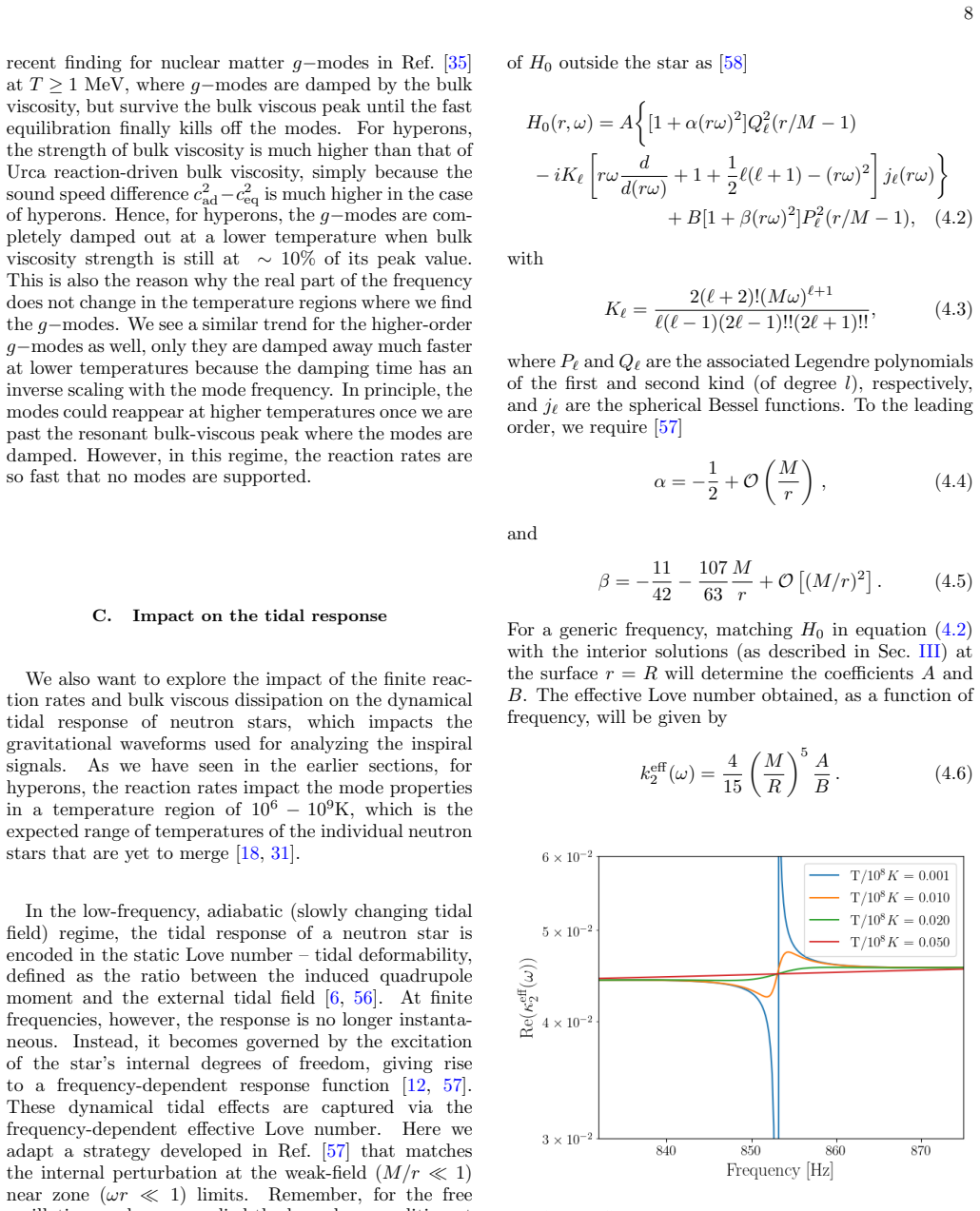
The paper claims that finite strangeness-changing weak interaction rates in hyperonic matter, encoded through a complex, frequency-dependent dynamical sound speed $c_{\rm dy}^2 = (P/(P+\varepsilon))\Gamma$, replace the usual one-sound-speed closure of relativistic stellar perturbation theory. The real part of $c_{\rm dy}^2$ interpolates between the frozen-composition (adiabatic) and strangeness-equilibrium sound speeds, while the imaginary part acts as a bulk viscosity $\zeta = (\varepsilon+P)\,\mathrm{Im}(c_{\rm dy}^2)/\omega$. Solving the resulting quasi-normal mode problem for the GM1'B hyperonic equation of state, the authors find that thermal reaction rates damp the f-mode by up to 30% near $T \sim 4 \times 10^7$ K without changing its real frequency, and that the first three hyperonic g-modes (with $g_1 \sim 853$ Hz for a $1.92\,M_\odot$ star) are damped away by $T \sim 6 \times 10^6$ K, before the buoyancy restoring force proportional to $c_{\rm ad}^2 - c_{\rm eq}^2$ vanishes. Matching interior perturbations to near-zone exterior solutions yields a frequency-dependent effective Love number and a tidal lag $\tau_d \approx -2\gamma_f/\sigma_f^2$.
Load-bearing premise
The calculation assumes that the perturbed pressure and perturbed energy density are locked together by $\Delta P = c_{\rm dy}^2 \Delta \varepsilon$ using the same complex sound speed built from the baryon-density perturbation, without separately deriving $\Delta \varepsilon$ or proving the first-law relation along the non-equilibrium path with changing chemical-potential mismatch; if that thermodynamic relation fails at finite mismatch, the computed damping rates and the temperature where the g-modes vanish would shift.
Editorial extensions
If this is right
- For a $2\,M_\odot$ hyperonic star the f-mode damping time shortens by up to 30% near $T \sim 4 \times 10^7$ K while the real frequency remains fixed at about 2154 Hz.
- The hyperonic $g_1$-mode at about 853 Hz disappears from the spectrum near $T \sim 6 \times 10^6$ K, with higher-order g-modes vanishing at lower temperatures, so the modes are removed by damping before the buoyancy restoring force vanishes.
- In the frozen-composition limit the hyperonic g-mode damping times are hours, but near the bulk-viscous peak they drop to roughly a millisecond.
- The effective Love number's mode resonances are broadened and suppressed by viscous damping, and the dissipative part of the tidal response is captured by a tidal lag $\tau_d \approx -2\gamma_f/\sigma_f^2$.
- Because the dissipated energy heats the star and the reaction rates grow with temperature, the damping parameters and tidal lag change during the inspiral; the paper leaves a fully coupled thermal treatment as future work.
Reading between the lines
- This suggests the same complex-sound-speed construction should apply to any slowly equilibrating composition variable, such as isospin or deconfined quark fraction, predicting analogous g-mode suppression wherever the sound-speed gap $c_{\rm ad}^2 - c_{\rm eq}^2$ is large.
- If hyperonic g-modes vanish from the tidal response before they can resonate, the observable signature may be their absence rather than a resonant peak; a null search with third-generation detectors could then bound the hyperon reaction rates.
- This also implies the tidal-lag formula could be absorbed into a shifted effective tidal deformability in waveform models, which would require a parameter-estimation study that the paper does not carry out.
- Since the rates scale as $T^2$ and the damping peaks around a few times $10^7$ K, mildly heated inspiral stars sit near the most dissipative temperatures, so tidal heating and viscous damping may feed back on each other during the inspiral.
Editorial analysis
A structured set of objections, weighed in public.
Referee Report
Summary. This paper develops a framework for incorporating finite hyperonic chemical equilibration rates into the general-relativistic perturbation theory of neutron stars. The authors calculate the dominant non-leptonic weak interaction rates using a relativistic mean-field equation of state, encode the resulting finite-rate response in a complex, frequency-dependent dynamical sound speed, and use it to compute quasi-normal f- and g-modes as well as the effective tidal Love number. The paper claims that finite reaction rates damp the f-mode by up to 30%, that hyperonic g-modes disappear from the spectrum at T≈6×10^6 K due to viscous damping before the buoyancy restoring force vanishes, and that the same dissipation produces a tidal lag approximated by τ_d ≈ -2γ_f/σ_f^2.
Significance. If the central claims hold, this work provides a valuable microphysical foundation for dissipative tidal modeling in binary neutron-star inspirals. The rate calculation in Appendix A is explicit and parameter-free, and the framework correctly recovers the frozen-composition and fast-equilibrium limits. The connection between microscopic reaction rates, bulk viscosity, mode damping, and tidal response is timely for third-generation gravitational-wave detectors. The paper's strengths include a self-contained derivation of the rates and a clear physical interpretation of the complex sound speed. However, two load-bearing points require substantiation: the assumed closure between pressure and energy-density perturbations, and the claimed disappearance of the g-modes, which is not fully supported by the tabulated damping rates.
major comments (3)
- [Sec. II / Sec. III, Eq. (3.7)] The closure relation ΔP = c_dy^2 Δε is asserted rather than derived. Section II computes ΔP in terms of Δn_B (Eq. 2.16) but never computes Δε or proves the first-law relation Δε = ((ε+P)/n_B) Δn_B along the non-equilibrium path with changing δμ. Since the complex sound speed is used as input to the pulsation equations, any correction to the relation between ΔP and Δε directly shifts the computed damping rates and the temperature at which the g-modes disappear. Please derive Δε consistently from the same perturbation expansion, or state and justify the thermodynamic assumption explicitly.
- [Sec. IVB, Table II] The reported disappearance of the hyperonic g-modes at T≈6×10^6 K is not supported by the table's own damping rates. At T=5×10^6 K, the g1-mode has f=853 Hz and τ=5×10^-3 s, giving Re(ω)≈5360 s^-1 and Im(ω)=200 s^-1, i.e. Q≈13.4. Since the reaction rate scales as T^2 (Eq. 2.24), the next tabulated step would give τ≈1.3 ms and Q≈3.3, still underdamped. No critical-damping transition appears in the reported sequence, so the dash at T=10^7 K may reflect a failure of the unstated root-finding procedure rather than the physical removal of the mode. Please provide a root-locus, continuation from the low-temperature solution, or an exceptional-point analysis to demonstrate that the modes genuinely leave the spectrum.
- [Sec. II, Eqs. (2.4)-(2.6)] Eq. (2.5) lists 'n+Λ↔p+Ξ−' as a strong-interaction decay, but this is identical to the first reaction in Eq. (2.4), which is counted among the weak non-leptonic channels. The equilibrium condition Eq. (2.6), μ_Ξ = -μ_p + 2μ_Λ, corresponds to Λ+Λ ↔ p+Ξ−, not to n+Λ ↔ p+Ξ− (the latter would give μ_Ξ = μ_n + μ_Λ - μ_p). This mislabeling affects the identification of the single chemical-potential difference δμ and the subsequent rate calculation; please correct the reaction and the notation.
minor comments (4)
- [Sec. II, Eq. (2.7)] The last term contains ∂P/∂x_μ |_{T,n_B,δμ,x_e} ∆n_B, which should be ∆x_μ; as written, the expression is dimensionally inconsistent and the subsequent neglect of lepton-fraction changes is unclear.
- [Sec. III / Sec. IVB] The numerical method used to solve the eigenvalue problem is not described. Please state the root-finding procedure used to obtain the mode frequencies in Tables I and II, and explain how the 'no mode found' entries in Table II are determined.
- [Table II] The temperature spacing in Table II jumps from T=5×10^6 K to T=10^7 K, and the text states that the g1-mode vanishes at T≈6×10^6 K. A row at T=6×10^6 K or a statement of how the vanishing temperature was obtained would make the claim more transparent.
- [Fig. 2] The horizontal axis of Fig. 2 is not labeled with units; it appears to be T/(10^8 K), but this should be stated explicitly in the caption to match the notation used in Tables I and II.
Circularity Check
No significant circularity: the dissipative mode calculation is driven by microphysical reaction rates and an external EOS, not by fitted targets.
full rationale
The central derivation chain is self-contained. The complex dynamical sound speed in Eqs. (2.19)-(2.20) follows from an explicit linear-response calculation: the rates λ_i from the Fermi-surface weak-interaction integrals in Appendix A enter the inverse equilibration time γ via Eq. (2.14), and the mode equations are then solved with the Detweiler-Lindblom/Krüger framework using ΔP=c_dy^2 Δε as closure. The f-mode damping times and the g-mode damping and disappearance temperatures are outputs of this eigenvalue problem, not parameters tuned to reproduce Table I or II; no mode quantity is fitted to the predicted damping or mode removal. The self-citations used in the paper (e.g., [31], [35], [55], [57]) are motivational, methodological, or comparative, and they are not load-bearing: the rate coefficients come from the external microphysics of [32] and [41], and the tidal matching ansatz is also attributed to [58]. The main caveat is that Eq. (3.7) assumes ΔP=c_dy^2 Δε without an independent derivation of Δε along the non-equilibrium path with changing δμ; this is a missing thermodynamic justification and a correctness risk, but it is not a circular reduction of the claimed results to their inputs. Similarly, the skeptical concern that the dashes in Table II may reflect a root-finding failure rather than physical mode removal is a numerical-robustness and interpretation question, not a circularity.
Assumptions & free parameters
assumptions (5)
- domain assumption The strong interaction (presumably Lambda + Lambda <-> p + Xi^-) is in equilibrium, enforcing mu_Xi = -mu_p + 2 mu_Lambda (Eq. 2.6), reducing the independent chemical potentials.
- domain assumption Leptonic and Urca processes are frozen on f- and g-mode timescales at inspiral temperatures, so xe and x_mu are fixed during perturbations.
- domain assumption The equation of state is temperature-independent and given by the GM1'B relativistic mean-field model from Ref [41].
- domain assumption The Fermi-surface approximation gives the rate scaling lambda_i = T^2 A_i / (6144 pi^6), with angular integrals computed from the matrix elements of Ref [32].
- ad hoc to paper The perturbation is closed by Delta P = c_dy^2 Delta epsilon (Eq. 3.7), with the same complex sound speed derived from the pressure response.
Cite this review
Pith. "Pith review of Oscillations of Dissipative Neutron Stars: The Impact of Hyperonic Reaction Rates." pith.science (2026). https://pith.science/paper/GPFNIHNM
@misc{pith2026260807311,
  author       = {Pith},
  title        = {Pith review of: Oscillations of Dissipative Neutron Stars: The Impact of Hyperonic Reaction Rates},
  year         = {2026},
  howpublished = {\url{https://pith.science/paper/GPFNIHNM}},
  note         = {Machine review of arXiv:2608.07311}
}
abstract
Tidal excitations of stellar oscillation modes during binary neutron-star inspirals offer a powerful probe of the composition of dense matter at supranuclear densities. Chemical equilibration plays a crucial, but often neglected, role in stellar perturbation calculations. If the chemical equilibration timescale is comparable to the oscillation timescale, then viscous effects can damp the modes. If the reactions are fast, some modes can completely disappear since their restoring force vanishes. Typically, these calculations, however, assume either instantaneous chemical equilibrium or no equilibration (frozen composition). Motivated by this, we investigate the effects of finite reaction rates on the oscillation spectrum of neutron stars containing hyperonic matter. We calculate the dominant non-leptonic weak interaction rates and incorporate them into the relativistic perturbation equations through a complex, frequency-dependent dynamical sound speed. We show that finite-rate effects naturally manifest as bulk-viscous dissipation, modifying the properties of both the fundamental ($f$) and gravity ($g$) modes. We further examine the impact on the tidal response by matching stellar perturbations to near-zone boundary conditions, demonstrating how viscous dissipation gives rise to a tidal lag. These results provide a consistent framework connecting microscopic reaction rates and the resulting bulk viscosity to the tidal dynamics of compact binaries, and represent a step towards incorporating viscous dissipation into gravitational-wave models of binary neutron-star inspirals.
Figures


Figures from the paper (4 more)



Reference graph
Works this paper leans on
-
[1]
They are determined by using the Tay- lor series expansion method described in Section II of Ref
At the center of the star,r= 0, the solutions must be regular. They are determined by using the Tay- lor series expansion method described in Section II of Ref. [27]
-
[2]
The perturbed pressure should vanish at the stel- lar surface, which is equivalent to the condition X(R) = 0. These boundary conditions are sufficient to determine (H1, K, W, X) in the stellar interior for any given fre- quency, up to an arbitrary amplitude. To close the fluid perturbation problem inside the star, we need to provide a matter equation of s...
work page 2000
-
[3]
B. Abbott, R. Abbott, T. Abbott, F. Acernese, K. Ack- ley, C. Adams, T. Adams, P. Addesso, R. Adhikari, V. Adya, and et al., Gw170817: Observation of gravi- tational waves from a binary neutron star inspiral, Phys- ical Review Letters119, 10.1103/physrevlett.119.161101 (2017)
- [4]
-
[5]
B. Abbott, R. Abbott, T. Abbott, F. Acernese, K. Ack- ley, C. Adams, T. Adams, P. Addesso, R. Adhikari, V. Adya, and et al., Gw170817: Measurements of neu- tron star radii and equation of state, Physical Review Letters121, 10.1103/physrevlett.121.161101 (2018)
- [7]
-
[8]
Hinderer, Tidal love numbers of neutron stars, The Astrophysical Journal677, 1216–1220 (2008)
T. Hinderer, Tidal love numbers of neutron stars, The Astrophysical Journal677, 1216–1220 (2008)
work page 2008
-
[9]
F. ¨Ozel and P. Freire, Masses, Radii, and the Equation of State of Neutron Stars, Ann. Rev. Astron. Astrophys. 54, 401 (2016), arXiv:1603.02698 [astro-ph.HE]
arXiv 2016
Show all 75 references
-
[10]
Oertel, M
M. Oertel, M. Hempel, T. Kl¨ ahn, and S. Typel, Equa- tions of state for supernovae and compact stars, Reviews of Modern Physics89, 10.1103/revmodphys.89.015007 (2017)
2017 doi
-
[11]
G. Baym, T. Hatsuda, T. Kojo, P. D. Powell, Y. Song, and T. Takatsuka, From hadrons to quarks in neutron stars: a review, Reports on Progress in Physics81, 056902 (2018)
2018
-
[12]
Alford, M
M. Alford, M. Braby, M. Paris, and S. Reddy, Hybrid stars that masquerade as neutron stars, The Astrophys- ical Journal629, 969–978 (2005)
2005
-
[13]
Pnigouras, N
P. Pnigouras, N. Andersson, F. Gittins, and A. R. Coun- sell, Dynamical neutron star tides: the signature of a mode resonance, Mon. Not. Roy. Astron. Soc.542, 1375 (2025), arXiv:2508.06416 [gr-qc]
2025 arXiv
-
[14]
Andersson and P
N. Andersson and P. Pnigouras, Exploring the effective tidal deformability of neutron stars, Phys. Rev. D101, 083001 (2020), arXiv:1906.08982 [astro-ph.HE]
2020 arXiv
-
[15]
Yu and N
H. Yu and N. N. Weinberg, Dynamical tides in coalescing superfluid neutron star binaries with hyperon cores and their detectability with third-generation gravitational- wave detectors, Monthly Notices of the Royal Astronom- ical Society470, 350–360 (2017)
2017
-
[16]
Steinhoff, T
J. Steinhoff, T. Hinderer, A. Buonanno, and A. Tarac- chini, Dynamical Tides in General Relativity: Effective Action and Effective-One-Body Hamiltonian, Phys. Rev. D94, 104028 (2016), arXiv:1608.01907 [gr-qc]
2016 arXiv
-
[17]
Steinhoff, T
J. Steinhoff, T. Hinderer, T. Dietrich, and F. Foucart, Spin effects on neutron star fundamental-mode dynami- cal tides: Phenomenology and comparison to numerical simulations, Phys. Rev. Res.3, 033129 (2021)
2021
-
[18]
Pratten, P
G. Pratten, P. Schmidt, and N. Williams, Impact of dy- 13 namical tides on the reconstruction of the neutron star equation of state, Phys. Rev. Lett.129, 081102 (2022)
2022
-
[19]
A. Abac, T. Dietrich, A. Buonanno, J. Steinhoff, and M. Ujevic, New and robust gravitational-waveform model for high-mass-ratio binary neutron star systems with dy- namical tidal effects, Phys. Rev. D109, 024062 (2024)
2024
-
[20]
Lai, Resonant oscillations and tidal heating in coalesc- ing binary neutron stars, Mon
D. Lai, Resonant oscillations and tidal heating in coalesc- ing binary neutron stars, Mon. Not. Roy. Astron. Soc. 270, 611 (1994), arXiv:astro-ph/9404062
1994 arXiv
-
[21]
A. R. Counsell, F. Gittins, N. Andersson, and I. Tews, Interface Modes in Inspiralling Neutron Stars: A Gravitational-Wave Probe of First-Order Phase Transitions, Phys. Rev. Lett.135, 081402 (2025), arXiv:2504.06181 [gr-qc]
2025 arXiv
-
[22]
A. R. Counsell, F. Gittins, N. Andersson, and P. Pnigouras, Neutron star g modes in the relativistic cowling approximation, Monthly Notices of the Royal As- tronomical Society536, 1967–1979 (2024)
2024
-
[23]
Gittins, H
F. Gittins, H. Narola, T. Wouters, P. T. H. Pang, T. Hin- derer, and C. Van Den Broeck, Detecting tidal resonances in binary neutron stars, arXiv:2606.06376 [gr-qc]
-
[24]
H.-J. Kuan, A. G. Suvorov, and K. D. Kokkotas, General-relativistic treatment of tidal g-mode reso- nances in coalescing binaries of neutron stars – i. theoretical framework and crust breaking, Monthly Notices of the Royal Astronomical Society506, 2985 (2021), https://academic...
2021
-
[25]
Tak´ atsy, L
J. Tak´ atsy, L. Zwick, P. Saini, and J. Samsing, Orbital eccentricity can make neutron starg-mode resonances ob- servable with current gravitational-wave detectors, Phys. Rev. D113, 103047 (2026)
2026
-
[26]
Evans, R
M. Evans, R. X. Adhikari, C. Afle, S. W. Ballmer, S. Biscoveanu, S. Borhanian, D. A. Brown, Y. Chen, R. Eisenstein, A. Gruson, A. Gupta, E. D. Hall, R. Hux- ford, B. Kamai, R. Kashyap, J. S. Kissel, K. Kuns, P. Landry, A. Lenon, G. Lovelace, L. McCuller, K. K. Y. Ng, A. H. Nit...
2021 arXiv
-
[27]
Evanset al., Cosmic explorer: A submission to the nsf mpsac nggw subcommittee (2023), arXiv:2306.13745 [astro-ph.IM]
M. Evanset al., Cosmic explorer: A submission to the nsf mpsac nggw subcommittee (2023), arXiv:2306.13745 [astro-ph.IM]
2023 arXiv
-
[28]
A. Abac, R. Abramo, S. Albanesi, A. Albertini, A. Agapito, M. Agathos, C. Albertus, N. Andersson, and et al., The Science of the Einstein Telescope, Journal of Cosmology and Astroparticle Physics2026(3), 081, arXiv:2503.12263 [gr-qc]
-
[29]
Detweiler and L
S. Detweiler and L. Lindblom, On the nonradial pulsa- tions of general relativistic stellar models, Astrophys. J. 292, 12 (1985)
1985
-
[30]
R. F. Sawyer, Bulk viscosity of hot neutron-star matter and the maximum rotation rates of neutron stars, Phys. Rev. D39, 3804 (1989)
1989
-
[31]
M. G. Alford, A. Haber, and Z. Zhang, Beyond modi- fied urca: The nucleon width approximation for flavor- changing processes in dense matter, Phys. Rev. C110, L052801 (2024)
2024
-
[32]
Lindblom and B
L. Lindblom and B. J. Owen, Effect of hyperon bulk vis- cosity on neutron-star r-modes, Phys. Rev. D65, 063006 (2002)
2002
-
[33]
Ghosh, B
S. Ghosh, B. K. Pradhan, and D. Chatterjee, Tidal heat- ing as a direct probe of strangeness inside neutron stars, Phys. Rev. D109, 103036 (2024), arXiv:2306.14737 [gr- qc]
2024 arXiv
-
[34]
M. G. Alford and A. Haber, Strangeness-changing rates and hyperonic bulk viscosity in neutron star mergers, Phys. Rev. C103, 045810 (2021)
2021
-
[35]
Andersson and P
N. Andersson and P. Pnigouras, The g-mode spectrum of reactive neutron star cores, Monthly Notices of the Royal Astronomical Society 10.1093/mnras/stz2449 (2019)
2019 doi
-
[36]
E. R. Most, A. Haber, S. P. Harris, Z. Zhang, M. G. Al- ford, and J. Noronha, Emergence of Microphysical Bulk Viscosity in Binary Neutron Star Postmerger Dynamics, Astrophys. J. Lett.967, L14 (2024), arXiv:2207.00442 [astro-ph.HE]
2024 arXiv
-
[37]
T. Zhao, P. B. Rau, A. Haber, S. P. Harris, C. Con- stantinou, and S. Han, Suppression of Composition g- modes in Chemically Equilibrating Warm Neutron Stars, Astrophys. J.993, 161 (2025), arXiv:2504.12230 [astro- ph.HE]
2025
-
[38]
Bussi` eres, J
S. Bussi` eres, J. Redondo-Yuste, J. J. O. G´ omez, and V. Cardoso, Axial oscillations of viscous neutron stars (2026), arXiv:2604.13208 [gr-qc]
2026 arXiv
-
[39]
L. S. Keeble and J. Redondo-Yuste, Radial oscillations of viscous stars, Physical Review D113, 10.1103/41kq-fj3h (2026)
2026 doi
-
[40]
Redondo–Yuste, Perturbations of relativistic dissipa- tive stars, Classical and Quantum Gravity42, 075012 (2025)
J. Redondo–Yuste, Perturbations of relativistic dissipa- tive stars, Classical and Quantum Gravity42, 075012 (2025)
2025
-
[41]
Katagiri, V
T. Katagiri, V. Guedes, and K. Yagi, Out-of-Equilibrium Effects in Non-Radial Relativistic Stellar Perturba- tions: A Model-Agnostic Formulation and Mode Analysis (2026), arXiv:2606.20957 [gr-qc]
2026 arXiv
-
[42]
M. G. Alford, A. Haber, and Z. Zhang, Isospin equilibra- tion in neutron star mergers, Phys. Rev. C109, 055803 (2024), arXiv:2306.06180 [nucl-th]
2024 arXiv
-
[43]
M. E. Gusakov, P. Haensel, and E. M. Kantor, Physics in- put for modelling superfluid neutron stars with hyperon cores, Mon. Not. Roy. Astron. Soc.439, 318 (2014), arXiv:1401.2827 [astro-ph.HE]
2014 arXiv
-
[44]
Prakash, M
M. Prakash, M. Prakash, J. M. Lattimer, and C. J. Pethick, Rapid cooling of neutron stars by hyperons and Delta isobars, Astrophys. J. Lett.390, L77 (1992)
1992
-
[45]
D. G. Yakovlev, A. D. Kaminker, O. Y. Gnedin, and P. Haensel, Neutrino emission from neutron stars, Phys. Rept.354, 1 (2001), arXiv:astro-ph/0012122
2001 arXiv
-
[46]
M. G. Alford and G. Good, Leptonic contribution to the bulk viscosity of nuclear matter, Phys. Rev. C82, 055805 (2010), arXiv:1003.1093 [nucl-th]
2010 arXiv
-
[47]
S. P. Harris, Bulk Viscosity in Dense Nuclear Matter (2024) arXiv:2407.16157 [nucl-th]
2024 arXiv
-
[48]
E. N. E. van Dalen and A. E. L. Dieperink, Bulk viscosity in neutron stars from hyperons, Phys. Rev. C69, 025802 (2004), arXiv:nucl-th/0311103
2004 arXiv
-
[49]
D. D. Ofengeim, M. E. Gusakov, P. Haensel, and M. Fortin, Bulk viscosity in neutron stars with hy- peron cores, Phys. Rev. D100, 103017 (2019), arXiv:1911.08407 [astro-ph.HE]
2019 arXiv
-
[50]
Kr¨ uger, W
C. Kr¨ uger, W. Ho, and N. Andersson, Seismology of adolescent neutron stars: Accounting for thermal effects and crust elasticity, Physical Review D92, 10.1103/phys- revd.92.063009 (2015)
2015 doi
-
[51]
F. J. Zerilli, Effective potential for even-parity regge- wheeler gravitational perturbation equations, Phys. Rev. 14 Lett.24, 737 (1970)
1970
-
[52]
Andersson and K
N. Andersson and K. D. Kokkotas, Gravitational waves and pulsating stars: What can we learn from future ob- servations?, Phys. Rev. Lett.77, 4134 (1996)
1996
-
[53]
B. K. Pradhan, D. Chatterjee, M. Lanoye, and P. Jaiku- mar, General relativistic treatment of f-mode oscillations of hyperonic stars, Phys. Rev. C106, 015805 (2022), arXiv:2203.03141 [astro-ph.HE]
2022 arXiv
-
[54]
P. N. McDermott, H. M. van Horn, and J. F. Scholl, Non- radial g-mode oscillations of warm neutron stars, Astro- phys. J.268, 837 (1983)
1983
-
[55]
Reisenegger and P
A. Reisenegger and P. Goldreich, A New Class of g-Modes in Neutron Stars, Astrophys. J.395, 240 (1992)
1992
-
[56]
A. R. Counsell, F. Gittins, and N. Andersson, The impact of nuclear reactions on the neutron-star g-mode spec- trum, Mon. Not. Roy. Astron. Soc.531, 1721 (2024), arXiv:2310.13586 [astro-ph.HE]
2024 arXiv
-
[57]
V. Tran, S. Ghosh, N. Lozano, D. Chatterjee, and P. Jaikumar, g-mode oscillations in neutron stars with hyperons, Phys. Rev. C108, 015803 (2023), arXiv:2212.09875 [nucl-th]
2023 arXiv
-
[58]
Binnington and E
T. Binnington and E. Poisson, Relativistic theory of tidal love numbers, Phys. Rev. D80, 084018 (2009)
2009
-
[59]
Andersson, A
N. Andersson, A. Counsell, F. Gittins, and S. Ghosh, Tidal response of a relativistic star, Physical Review D 113, 10.1103/x4yr-x1c4 (2026)
2026 doi
-
[60]
Lindblom, G
L. Lindblom, G. Mendell, and J. R. Ipser, Relativistic stellar pulsations with near-zone boundary conditions, Phys. Rev. D56, 2118 (1997)
1997
-
[61]
N. A. Suprovo Ghosh and F. Gittins, The mode-sum ap- proach to dynamical neutron-star tides: The impact of dissipation (2026), in preparation
2026
-
[62]
Ghosh, J
S. Ghosh, J. L. Hern´ andez, B. K. Pradhan, C. Manuel, D. Chatterjee, and L. Tolos, Tidal heating in binary in- spiral of strange quark stars, Phys. Rev. D112, 084072 (2025), arXiv:2504.07659 [gr-qc]
2025
-
[63]
Ghosh, S
S. Ghosh, S. Mukherjee, S. Bose, and D. Chatterjee, Tidal dissipation in binary neutron star inspirals from hyperon bulk viscosity: phase modelling and parameter estimation bias, Mon. Not. Roy. Astron. Soc.543, 2987 (2025), arXiv:2503.14606 [gr-qc]
2025
-
[64]
Yu and S
H. Yu and S. Y. Lau, Effective-one-body model for coa- lescing binary neutron stars: Incorporating tidal spin and enhanced radiation from dynamical tides, Phys. Rev. D 111, 084029 (2025), arXiv:2501.13064 [gr-qc]
2025 arXiv
-
[65]
Poisson, Tidal interaction of black holes and Newto- nian viscous bodies, Phys
E. Poisson, Tidal interaction of black holes and Newto- nian viscous bodies, Phys. Rev. D80, 064029 (2009), arXiv:0907.0874 [gr-qc]
2009 arXiv
-
[66]
J. L. Ripley, A. Hegade K. R., and N. Yunes, Probing internal dissipative processes of neutron stars with grav- itational waves during the inspiral of neutron star bina- ries, Phys. Rev. D108, 103037 (2023), arXiv:2306.15633 [gr-qc]
2023 arXiv
-
[67]
Haensel, K
P. Haensel, K. Levenfish, and D. Yakovlev, Bulk viscos- ity in superfluid neutron star cores. II. Modified Urca processes in npe mu matter, Astronomy & Astrophysics 372, 130 (2001), arXiv:astro-ph/0103290 [astro-ph]
2001 arXiv
-
[68]
Haensel, K
P. Haensel, K. Levenfish, and D. Yakovlev, Bulk viscosity in superfluid neutron star cores. III. Effects of Sigma − hyperons, Astronomy & Astrophysics381, 1080 (2002), arXiv:astro-ph/0110575 [astro-ph]
2002 arXiv
-
[69]
Andersson and G
N. Andersson and G. L. Comer, Relativistic fluid dynam- ics: Physics for many different scales, Living Reviews in Relativity10, 10.12942/lrr-2007-1 (2007)
2007 doi
-
[70]
Hegade K
A. Hegade K. R., Y. Yang, M. Hippert, J. Noronha- Hostler, J. Noronha, and N. Yunes, Dynamical tidal re- sponse of neutron stars as a probe of dense-matter prop- erties (2026), arXiv:2603.26886 [gr-qc]
2026
-
[71]
M. V. S. Saketh, S. Ghosh, and N. Andersson, Dynamical tidal response of neutron stars via scattering amplitudes (2026), arXiv:2606.14405 [gr-qc]
2026 arXiv
-
[72]
M. K. Mandal, P. Mastrolia, H. O. Silva, R. Patil, and J. Steinhoff, Renormalizing love: tidal effects at the third post-newtonian order, Journal of High Energy Physics 2024, 10.1007/jhep02(2024)188 (2024)
2024 doi
-
[73]
D. J. Griffiths,Introduction to elementary particles, Physics textbook (Wiley, New York, NY, 2008)
2008
-
[74]
L. F. Roberts and S. Reddy, Charged current neutrino interactions in hot and dense matter, Phys. Rev. C95, 045807 (2017), arXiv:1612.02764 [astro-ph.HE]
2017 arXiv
-
[75]
A. D. Kaminker, D. G. Yakovlev, and P. Haensel, The- ory of neutrino emission from nucleon–hyperon matter in neutron stars: angular integrals, Astrophys. Space Sci. 361, 267 (2016), arXiv:1607.05265 [astro-ph.HE]
2016 arXiv
-
[76]
S. L. Shapiro and S. A. Teukolsky,Black holes, white dwarfs, and neutron stars: The physics of compact ob- jects(Wiley, 1983)
1983
Reviewed August 10, 2026 · model on record in the stance chip above.
Discussion (0). Continue with ORCID to comment.