REVIEW 3 major objections 4 minor 90 references
Coherence is the part of measurement randomness that survives any classical explanation of the source, and a Bures-distance trade-off quantifies it exactly.
Reviewed by Pith at T0; open to challenge. T0 means a machine referee read the full paper against a public rubric. the ladder, T0–T4 →
T0 review · deepseek-v4-flash
2026-08-01 14:30 UTC pith:GPZJRZB2
load-bearing objection A clean convex-roof coherence measure with a valid but narrowly scoped QRNG claim; the math holds, the abstract oversells. the 3 major comments →
Trade-off between predictability and quantum coherence for multi-path interferometry and its operational interpretation
The pith
A machine-rendered reading of the paper's core claim, the machinery that carries it, and where it could break.
Core claim
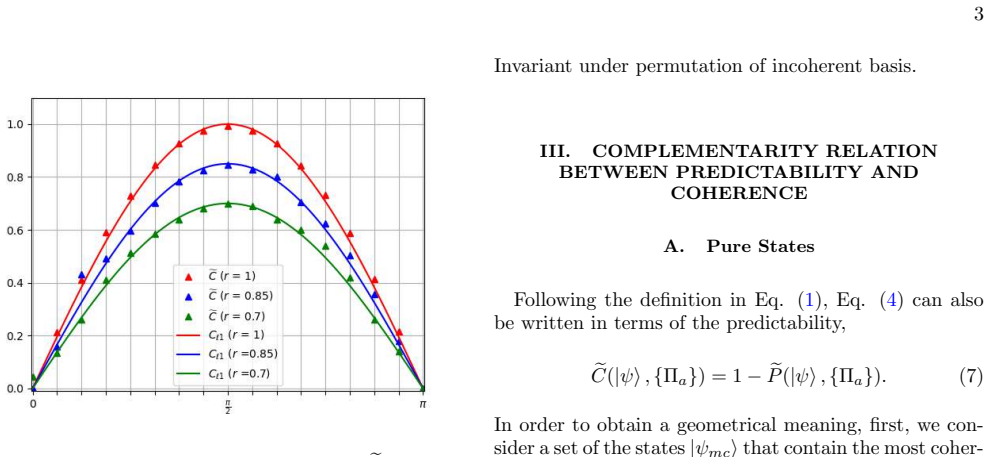
The central claim is the identity C̃ + P̃ = 1 for pure states (normalized Kirkwood–Dirac coherence equals the complement of normalized Bures predictability in the same basis), and its mixed-state extension C̃ + P̃ ≤ 1 via convex-roof coherence. The author argues that this identity gives coherence an operational meaning as 'classically irreducible randomness': if a user is told which pure state from an ensemble decomposition of ρ was prepared, the unpredictability of a fixed-basis measurement that remains is exactly the convex-roof coherence. Theorem 1 converts this into a worst-case min-entropy bound H^cl_min(A|I) ≥ −log Q_d(1+C(ρ,{Π_a})) with an explicit quadratic function Q_d, valid for ev
What carries the argument
The load-bearing objects are the normalized Bures predictability P̃(ρ,{Π_a}) = (√d − Σ_a√p_a)/(√d−1), evaluated on the dephased state Δ_a(ρ) and so depending only on the observed basis statistics, and the convex-roof KD coherence C(ρ,{Π_a}) = inf_{decomp} Σ_i p_i(−1+Σ_a√|⟨a|ψ_i⟩|²). Both reduce to the same Bhattacharyya overlap Σ_a√p_a, which is why pure states saturate the trade-off while mixed states inherit the inequality from Jensen applied to fidelity. The min-entropy result is carried by the concave function Q_d(s)=[(s+√((d−s²)(d−1)))/d]², which upper-bounds the label-assisted guessing probability and converts coherence into a certified randomness yield.
Load-bearing premise
The security interpretation rests on the premise that adversarial side information in source-independent QRNG is fully represented by a classical label attached to a pure-state decomposition of the emitted state ρ; the paper explicitly excludes quantum side information, so if an adversary's relevant knowledge is quantum, the claimed min-entropy bound does not apply.
What would settle it
Numerically compute the normalized Bures predictability and the convex-roof KD coherence for a grid of mixed states in dimension d=3, e.g. ρ=p|0⟩⟨0|+(1−p)|+⟩⟨+| with the computational basis as measurement; solving the convex-roof optimization exactly for each p, any instance with C̃+P̃>1 would falsify the paper's central inequality (Eq. 9).
If this is right
- In any d-path interferometer, pure states obey the exact complementarity C̃+P̃=1, while mixed states obey C̃+P̃≤1, generalizing two-path duality to arbitrary dimensions and arbitrary projective measurement bases.
- The coherence measure is a valid resource-theoretic coherence monotone: convex, faithful, non-increasing under dephasing decoherence and partial trace, and unitarily covariant, so it can play the role of a wave-like quantifier in interferometry.
- The convex-roof coherence has a concrete operational content: it is the part of fixed-basis measurement randomness that cannot be removed by conditioning on any classical preparation label (classically irreducible randomness).
- Theorem 1 yields a state-universal, dimension-dependent min-entropy bound for source-independent QRNG with classical side information; higher coherence guarantees more certified min-entropy, and the bound is worst-case because the source may choose the decomposition that maximizes label-assisted guessing.
- The result gives an experimentally accessible path: predictability depends only on path statistics, so the certified randomness bound can be evaluated without interferometric visibility measurements.
Where Pith is reading between the lines
- The QRNG bound is stated for classical-label side information; whether a similar relation holds for the fully general quantum side-information quantity H_min(A|E) is left open, and closing it would require controlling entanglement between source and adversary rather than only convex-roof decompositions.
- Because the trade-off is an equality for pure states, a natural experimental test is to prepare a range of pure states in a d-slit interferometer and compare the measured path statistics with independently characterized coherence; any deviation from C̃+P̃=1 would indicate either non-ideal preparation or a flaw in the model.
- The exact linear form of the trade-off is tied to the choice of Bures/Bhattacharyya geometry; switching to another distance would preserve the qualitative duality but almost surely break the equality, so C̃+P̃=1 is a property of this particular geometric pairing rather than of wave–particle duality in general.
Editorial analysis
A structured set of objections, weighed in public.
Referee Report
Summary. The paper introduces a basis-dependent predictability P, defined as the squared Bures distance between the dephased state and the maximally mixed state, and pairs it with a Kirkwood-Dirac-type coherence measure C. For pure states the normalized quantities satisfy the exact relation \tilde C + \tilde P = 1 (Eq. 7); for mixed states a convex-roof extension gives \tilde C + \tilde P \le 1 (Eq. 9). Theorem 1 (Sec. IV.B) converts this into a lower bound on the conditional min-entropy H^cl_min(A|I) for guessing a measurement outcome A when classical preparation-label side information I is available, yielding H^cl_min(A|I) \ge -\log Q_d(1+C(\rho,\{\Pi_a\})). The paper interprets this as 'classically irreducible randomness' and claims relevance to source-independent QRNG. Sec. IV.B explicitly disclaims bounds on H_min(A|E) for quantum side information E.
Significance. The mathematical core is sound. Eq. (7) follows directly from the definitions, the mixed-state inequality (9) is a valid convex-roof/Jensen argument, and the proof of Theorem 1 in App. VI.D is coherent. The convex-roof coherence has a clean operational reading for classical ensemble labels, and the min-entropy bound is explicit and monotone in the coherence. However, the advertised significance as a source-independent QRNG result is materially overstated: the theorem bounds only H^cl_min(A|I), not the standard adversarial quantity H_min(A|E), and the paper itself acknowledges this limitation. In addition, the pure-state relation is a definitional identity rather than an independent trade-off. The paper is a useful formal contribution on classical-label-assisted randomness bounds, but the abstract and parts of Sec. IV need recalibration.
major comments (3)
- [Abstract; Sec. IV.B, Eqs. (12)-(14)] The abstract promises 'a tight worst-case bound on the guessing probability in source-independent QRNG' without the qualifier 'classical'. The theorem actually bounds H^cl_min(A|I), where the side information I is a classical preparation label drawn from a pure-state decomposition, not H_min(A|E) for an adversary holding arbitrary quantum side information. Sec. IV.B explicitly states that the result does not address the full composable SI-QRNG setting. This is not a mathematical error, but it is a load-bearing mismatch between the proven statement and the central advertised application. The abstract, title, and any unqualified 'source-independent QRNG' statements should be revised to 'classical-label source model' or equivalent, and the text should explain why this model is relevant despite not covering H_min(A|E).
- [Sec. IV.B, Theorem 1 (Eq. 14)] Even within the classical-label model, the protocol-level claim needs an additional certification step that the paper does not supply. The bound is a function of C(\rho,\{\Pi_a\}), but the fixed measurement {\Pi_a} alone yields only the statistics p_a = Tr(\rho\Pi_a). For any observed p_a, the dephased state \Delta(\rho) has the same statistics and zero coherence, so without an independent lower bound or certificate for C, the adversary could choose a state with C=0 and the bound becomes vacuous. A source-independent QRNG protocol must specify how C is certified (e.g., additional measurements or structural assumptions). The present manuscript gives an information-theoretic bound for a known \rho, not a complete source-independent certification protocol.
- [Sec. III.A, Eqs. (4)-(7)] The pure-state trade-off \tilde C + \tilde P = 1 is a definitional identity rather than an independently derived complementarity constraint. The normalized KD coherence is defined (and normalized via max_\rho C) so that it exactly equals 1-\tilde P. The paper should state this explicitly and avoid presenting Eq. (7) as a 'remarkable' derived wave-particle relation. The genuinely non-trivial content is the convex-roof extension in Eq. (9) and the operational min-entropy consequence, and the framing should reflect that.
minor comments (4)
- [Sec. II.B, Eq. (4)] The displayed formula for C^KD_{NCl}(|\psi\rangle,\{\Pi_a\}) contains a stray 'p' and is confusingly typeset. It should read -1 + \sum_a |\langle a|\psi\rangle| (equivalently -1 + \sum_a \sqrt{p_a}).
- [Theorem 1; App. VI.D] Eq. (14) writes the bound as Q_d(1+C(\rho,\{\Pi_a\})) using the unnormalized coherence C, while the proof in App. VI.D works with the normalized \tilde C and the quantity \bar s. The relationship \bar s = 1+C should be stated explicitly near the theorem to avoid confusion about which normalization appears in Q_d.
- [App. VI.B] The paper calls C a 'coherence monotone' and lists resource-theoretic properties, but the proofs in App. VI.B cover convexity, faithfulness, a specific decoherence map, partial trace, unitary covariance, and permutation invariance. Monotonicity under general incoherent operations (and the usual strong monotonicity axiom) is not proven. If the resource-theoretic status is important, this should be added; otherwise the claim should be qualified.
- [Abstract; Eq. (15)] The word 'tight' in the abstract is not demonstrated in the text. While the bound is plausible tight per value of s (saturation by distributions of the form (q,(1-q)/(d-1),...)), a one-line saturation example or a remark on tightness would be useful.
Circularity Check
The main complementarity equality is a definitional identity; the QRNG theorem is non-circular but its advertised operational meaning and source-independence claim are overstated.
specific steps
-
self definitional
[Sec. III.A, Eq. (7), with Eqs. (3), (4), (6)]
"Following the definition in Eq. (1), Eq. (4) can also be written in terms of the predictability, C̃(|ψ⟩,{Π_a}) = 1 − P̃(|ψ⟩,{Π_a}). (7)"
With Eq. (3), P̃ = (√d − Σ_a √p_a)/(√d − 1); with Eqs. (4) and (6), C̃ = (Σ_a √p_a − 1)/(√d − 1). Their sum is identically 1 for every pure state, with both sides depending only on the diagonal statistics p_a = |⟨a|ψ⟩|². The 'trade-off' is therefore not an independently derived complementarity law but an algebraic identity produced by defining the KD coherence as the complement of the Bures predictability. Calling it 'Remarkably' presents a tautology as a derived wave–particle duality.
-
self definitional
[Sec. IV.A, Eq. (10) and following paragraph]
"C(ρ,{Π_a}) / max_ρ C(ρ,{Π_a}) = 1 − sup_{...} Σ_i p_i P(|ψ_i⟩,{Π_a}) / max_{|ψ⟩} P(|ψ⟩,{Π_a}). (10) ... From the above illustration, our quantity operationally measures the part of the measurement unpredictability that cannot be removed by conditioning on any classical label specifying a pure-state decomposition of ρ."
Eq. (10) is exactly the convex-roof definition (5) rewritten, since the pure-state coherence was defined as the complement of normalized predictability. The statement that C measures 'classically irreducible randomness' is therefore a restatement of how C was defined, not an independent operational derivation. Theorem 1 supplies a real additional inequality connecting this quantity to label-assisted guessing probability, but the advertised operational meaning is built into the definition.
full rationale
The central pure-state relation C̃ + P̃ = 1 (Eq. 7) is a definitional identity: the normalized KD coherence is defined via Eq. (4) as (−1 + Σ√p_a)/(√d−1), which is algebraically the complement of the Bures predictability (Eq. 3). Thus the paper's headline trade-off, presented as a derived duality, reduces by construction to the chosen definitions. The mixed-state inequality (Eq. 9) is a genuine convex-roof consequence with a valid Jensen-based proof in App. VI.C, but it is also shaped by the same construction. The QRNG content is more substantive: Theorem 1 and its proof in App. VI.D are self-contained and do not reduce to the definitions; they give a nontrivial bound on the classical-label guessing probability in terms of C. No load-bearing self-citation was found: the KD coherence is explicitly defined and proved from stated properties, and the Budiyono citations [44,45] are not used to forbid alternatives or supply the main result. However, the paper itself limits the QRNG claim in Sec. IV.B: 'This should be distinguished from a full composable security proof for SI QRNG, where the adversary may hold arbitrary quantum side information E ... The present result addresses the classical-label layer.' The abstract's unqualified 'source-independent QRNG' overstates this restricted scope, but that is an interpretation/overclaim issue rather than a circularity. Overall, the derivation chain is self-contained and the min-entropy theorem is not circular, but the primary wave–particle relation and its 'classically irreducible randomness' interpretation are definitional, giving partial circularity.
Axiom & Free-Parameter Ledger
axioms (7)
- standard math Standard quantum mechanics: states as density operators, projective measurements, fidelity, Bures distance.
- domain assumption The dephased maximally coherent state Δ_a(|ψ_mc⟩) = I/d.
- standard math Carathéodory's theorem for existence of finite decompositions.
- standard math Jensen's inequality applied to concave functions in Appendices VI A and VI C.
- standard math Min-entropy and guessing probability definitions from König–Renner–Schaffner.
- standard math Q_d(s) is concave and monotonically non-increasing on the domain, used in App. VI D.
- ad hoc to paper The step Σ_i p_i s(|ψ_i⟩) ≥ s̄(ρ) in App. VI D.
read the original abstract
The complementarity principle is a cornerstone of quantum mechanics. In this work, we investigate a complementarity relation between the predictability and quantum coherence, respectively, representing the particle-like and wave-like behaviour in wave--particle duality, in a multi-path setup. We introduce a basis-dependent predictability defined by the Bures distance between the state dephased in the chosen basis and the maximally mixed state. The predictability depends only on the observed basis statistics and admits a closed form in terms of the Bhattacharyya overlap. We derive a trade-off relation between the predictability and a coherence measure defined based on the nonclassicality of the Kirkwood--Dirac quasiprobability. For pure states, the trade-off relation is an exact equality. Remarkably, this wave--particle duality relation endows the coherence measure with an operational interpretation as the classically irreducible part of measurement randomness, yielding a tight worst-case bound on the guessing probability in source-independent QRNG.
Figures


Reference graph
Works this paper leans on
-
[1]
Let the measurement be performed in the computational basis
The maximally mixed stateρ=I/2 This is the classically maximal random state. Let the measurement be performed in the computational basis. One possible pure-state decomposition is ρ= 1 2 |+⟩ ⟨+|+1 2 |−⟩ ⟨−|, where|±⟩= 1√ 2 (|0⟩ ± |1⟩). If this decomposition is cho- sen, the average predictability with respect to the compu- tational basis is zero because|+⟩...
-
[2]
Thus, in this sense, the ran- domness is purely generated by the quantumness of the state and isclassically irreducible
The maximally coherent stateρ=|+⟩ ⟨+| The resulting average predictability of this explicit ex- pression is zero, and, since for a pure state there is no non-trivial decomposition, there is no alternative decom- position to reduce and ‘explain away’ the randomness by classical side information. Thus, in this sense, the ran- domness is purely generated by ...
-
[3]
This state can be decomposed as ρ= 1 2 |ψ+⟩ ⟨ψ+|+ 1 2 |ψ−⟩ ⟨ψ−|, where|ψ ±⟩= √ 3 2 |0⟩+ 1 2 e±iarctan √ 2 |1⟩
Consider the following state, ρ= 3/4 1/4 1/4 1/4 . This state can be decomposed as ρ= 1 2 |ψ+⟩ ⟨ψ+|+ 1 2 |ψ−⟩ ⟨ψ−|, where|ψ ±⟩= √ 3 2 |0⟩+ 1 2 e±iarctan √ 2 |1⟩. Note that 1− P(|ψ +⟩)/Pmax = 1−P(|ψ −⟩)/Pmax = 0.366, thus giving the average unpredictability 1−P avg = 0.366. Another way to decompose it is ρ= 1 2 |+⟩ ⟨+|+1 2 |0⟩ ⟨0|, which gives 1−P avg /Pma...
-
[4]
Bohr,The quantum postulate and the recent development of atomic theory,Nature121(1928) 580
N. Bohr,The quantum postulate and the recent development of atomic theory,Nature121(1928) 580
1928
-
[5]
Wootters and W.H
W.K. Wootters and W.H. Zurek,Complementarity in the double-slit experiment: Quantum nonseparability and a quantitative statement of bohr’s principle, Physical Review D19(1979) 473
1979
-
[6]
Greenberger and A
D.M. Greenberger and A. Yasin,Simultaneous wave and particle knowledge in a neutron interferometer,Physics Letters A128(1988) 391
1988
-
[7]
Englert,Fringe visibility and which-way information: An inequality,Physical Review Letters77 (1996) 2154
B.-G. Englert,Fringe visibility and which-way information: An inequality,Physical Review Letters77 (1996) 2154
1996
-
[8]
Z. Wang, Y. Tian, C. Yang, P. Zhang, G. Li and T. Zhang,Loss-based Experimental Test of Bohr’s Complementarity Principle with Single Neutral Atom, 1608.01450
-
[9]
Norrman, K
A. Norrman, K. Blomstedt, T. Set¨ al¨ a and A.T. Friberg, Complementarity and polarization modulation in photon interference,Phys. Rev. Lett.119(2017) 040401. 8
2017
-
[10]
Y. Yuan, Z. Hou, Y.-Y. Zhao, H.-S. Zhong, G.-Y. Xiang, C.-F. Li et al.,Experimental demonstration of wave-particle duality relation based on coherence measure,Opt. Express26(2018) 4470 [1702.06308]
Pith/arXiv arXiv 2018
-
[11]
J. Gao, Z.-Q. Jiao, C.-Q. Hu, L.-F. Qiao, R.-J. Ren, Z.-H. Ma et al.,Experimental Test of Relation between Coherence and Path Information,Commun. Phys.1 (2018) 89 [1703.08026]
Pith/arXiv arXiv 2018
-
[12]
T.H. Yoon and M. Cho,Quantitative Complementarity of Wave-Particle Duality,2104.04230
-
[13]
D.-X. Chen, Y. Zhang, J.-L. Zhao, Q.-C. Wu, Y.-L. Fang, C.-P. Yang et al.,Experimental investigation of wave-particle duality relations in asymmetric beam interference,npj Quantum Inf.8 (2022) 101 [2209.02473]
Pith/arXiv arXiv 2022
-
[14]
X.-J. Huang et al.,Entanglement-interference complementarity and experimental demonstration in a superconducting circuit,npj Quantum Inf.9(2023) 43 [2203.06549]
Pith/arXiv arXiv 2023
-
[15]
Z. Ding, Y. Deng, S.-M. Fei, S.-Q. Zhou, X. Chen, Z. Rui et al.,Universal conservation laws of the wave–particle–entanglement triad: theory and experiment,Light: Science & Applications14(2025) 82
2025
-
[16]
Koashi,Simple security proof of quantum key distribution based on complementarity,New J
M. Koashi,Simple security proof of quantum key distribution based on complementarity,New J. Phys.11 (2009) 045018 [quant-ph/0505108]
Pith/arXiv arXiv 2009
-
[17]
A. Mizutani, T. Sasaki, G. Kato, Y. Takeuchi and K. Tamaki,Information-theoretic security proof of differential-phase-shift quantum key distribution protocol based on complementarity,Quantum Sci. Technol.3 (2017) 014003 [1705.00171]
Pith/arXiv arXiv 2017
-
[18]
R.-Q. Gao, Y.-M. Xie, J. Gu, W.-B. Liu, C.-X. Weng, B.-H. Li et al.,Simple security proof of coherent-one-way quantum key distribution,Opt. Express30(2022) 23783 [2107.09329]
Pith/arXiv arXiv 2022
-
[19]
D. Spegel-Lexne, S. G´ omez, J. Argillander, M. Paw lowski, P.R. Dieguez, A. Alarc´ on et al., Experimental demonstration of the equivalence of entropic uncertainty with wave-particle duality,Sci. Adv.10(2024) adr2007 [2407.03797]
Pith/arXiv arXiv 2024
-
[20]
C. Raj et al.,Certifying semi-device-independent security via wave-particle duality experiments,npj Quantum Inf.12(2026) 7 [2507.00679]
Pith/arXiv arXiv 2026
-
[21]
D.A. Kalashnikov, A.V. Paterova, S.P. Kulik and L.A. Krivitsky,Infrared Spectroscopy with Visible Light, Nature Photon.10(2016) 98 [1506.07223]
Pith/arXiv arXiv 2016
-
[22]
A.V. Paterova, H. Yang, C. An, D.A. Kalashnikov and L.A. Krivitsky,Tunable Optical Coherence Tomography in the Infrared Range Using Visible Photons,Quantum Sci. Technol.3(2018) 025008 [1710.02343]
Pith/arXiv arXiv 2018
-
[23]
M. Kutas, B. Haase, P. Bickert, F. Riexinger, D. Molter and G. von Freymann,Terahertz quantum sensing, Science Advances6(2020) eaaz8065 [https://www.science.org/doi/pdf/10.1126/sciadv.aaz8065]
-
[24]
I. Kviatkovsky, H.M. Chrzanowski, E.G. Avery, H. Bartolomaeus and S. Ramelow,Microscopy with undetected photons in the mid-infrared,Science Advances6(2020) eabd0264 [https://www.science.org/doi/pdf/10.1126/sciadv.abd0264]
-
[25]
N.R. Gemmell, J. Florez, E. Pearce, O. Czerwinski, C.C. Phillips, R.F. Oulton et al.,Loss-Compensated and Enhanced Midinfrared Interaction-Free Sensing with Undetected Photons,Phys. Rev. Applied19(2023) 054019 [2205.08832]
Pith/arXiv arXiv 2023
-
[26]
Sorkin,Quantum mechanics as quantum measure theory,Mod
R.D. Sorkin,Quantum mechanics as quantum measure theory,Mod. Phys. Lett. A9(1994) 3119 [gr-qc/9401003]
Pith/arXiv arXiv 1994
-
[27]
U. Sinha, C. Couteau, T. Jennewein, R. Laflamme and G. Weihs,Ruling Out Multi-Order Interference in Quantum Mechanics,Science329(2010) 418 [1007.4193]
Pith/arXiv arXiv 2010
-
[28]
Qureshi and M.A
T. Qureshi and M.A. Siddiqui,Wave-particle duality in N-path interference,Annals of Physics385(2017) 598
2017
-
[29]
Roy and T
P. Roy and T. Qureshi,Path predictability and quantum coherence in multi-slit interference,Physica Scripta94 (2019) 095004
2019
-
[30]
Qureshi,Interference visibility and wave-particle duality in multi-path interference,Physical Review A 100(2019) 042105
T. Qureshi,Interference visibility and wave-particle duality in multi-path interference,Physical Review A 100(2019) 042105
2019
-
[31]
Giordani, F
T. Giordani, F. Hoch, G. Carvacho, N. Spagnolo and F. Sciarrino,Integrated photonics in quantum technologies,La Rivista del Nuovo Cimento46(2023) 71
2023
-
[32]
Streltsov, G
A. Streltsov, G. Adesso and M.B. Plenio,Quantum coherence as a resource,Reviews of Modern Physics89 (2017) 041003
2017
-
[33]
M.N. Bera, T. Qureshi, M.A. Siddiqui and A.K. Pati, Duality of quantum coherence and path distinguishability,Physical Review A92(2015) 012118
2015
-
[34]
Coles,Entropic framework for wave-particle duality in multipath interferometers,Phys
P.J. Coles,Entropic framework for wave-particle duality in multipath interferometers,Phys. Rev. A93(2016) 062111 [1512.09081]
Pith/arXiv arXiv 2016
-
[35]
Bagan, J.A
E. Bagan, J.A. Bergou and M. Hillery, Wave–particle-duality relations based on entropic bounds for which-way information,Physical Review A 102(2020) 022224
2020
-
[36]
L.F. Melo, O. Jim´ enez and L. Neves,Quantitative wave-particle duality in uniform multipath interferometers with symmetric which-path detector states,2601.13083
-
[37]
Z. Liu, C. Zhu, H.-L. Yin and X. Wang,Quantum coherence and distinguishability as complementary resources: A resource-theoretic perspective from wave-particle duality,Phys. Rev. A111(2025) 062215 [2404.14323]
Pith/arXiv arXiv 2025
-
[38]
Yang, Z.-X
K.-K. Yang, Z.-X. Wang and S.-M. Fei,Coherence and entropy complementarity relations of generalized wave–particle duality,Physical Review A110(2024) 042413
2024
-
[39]
Jakob and J.A
M. Jakob and J.A. Bergou,Complementarity and entanglement in bipartite qudit systems,Physical Review A76(2007) 052107
2007
-
[40]
Qian, A.N
X.F. Qian, A.N. Vamivakas and J.H. Eberly, Entanglement limits duality and vice versa,Optica5 (2018) 942
2018
-
[41]
X.F. Qian, K. Konthasinghe, S.K. Manikandan, D. Spiecker, A.N. Vamivakas and J.H. Eberly,Turning off quantum duality,Physical Review Research2(2020) 012016
2020
-
[42]
Basso and J
M.L.W. Basso and J. Maziero,Complete complementarity relations: Connections with EPR realism and decoherence and extension to mixed quantum states,EPL (Europhysics Letters)135(2021) 60002
2021
-
[43]
Maziero, M.L.W
J. Maziero, M.L.W. Basso and L.C. C´ eleri,Local predictability and coherence versus distributed entanglement in entanglement swapping from partially entangled pure states,Physics Letters A457(2023) 9 128576
2023
-
[44]
Bagan, J
E. Bagan, J. Calsamiglia, J.A. Bergou and M. Hillery, Duality games and operational duality relations, Physical Review Letters120(2018) 050402
2018
-
[45]
Z. Cao, H. Zhou, X. Yuan and X. Ma, Source-Independent Quantum Random Number Generation,Phys. Rev. X6(2016) 011020 [1508.04880]
Pith/arXiv arXiv 2016
-
[46]
J. Ma, X. Yuan, A. Hakande and X. Ma,Coherence as a resource for source-independent quantum random-number generation,Phys. Rev. A99(2019) 022328 [1704.06915]
Pith/arXiv arXiv 2019
-
[47]
Budiyono and H.K
A. Budiyono and H.K. Dipojono,Quantifying quantum coherence via kirkwood–dirac quasiprobability,Physical Review A107(2023) 022408
2023
-
[48]
Budiyono, J.F
A. Budiyono, J.F. Sumbowo, M.K. Agusta and B.E.B. Nurhandoko,Quantum coherence from kirkwood–dirac nonclassicality, some bounds, and operational interpretation,Journal of Physics A: Mathematical and Theoretical57(2024) 255301
2024
-
[49]
S. Roy, A. Kalaiselvan, C. Radhakrishnan and M.M. Ali,Environment engineering to protect quantum coherence in tripartite systems under dephasing noise, International Journal of Theoretical Physics64(2025) 132
2025
-
[50]
Basso and J
M.L.W. Basso and J. Maziero,Predictability as a quantum resource,Quantum Information Processing21 (2022) 187
2022
-
[51]
Bhattacharyya,On a measure of divergence between two statistical populations defined by probability distributions,Bulletin of the Calcutta Mathematical Society35(1943) 99
A. Bhattacharyya,On a measure of divergence between two statistical populations defined by probability distributions,Bulletin of the Calcutta Mathematical Society35(1943) 99
1943
-
[52]
Fuchs and J
C.A. Fuchs and J. van de Graaf,Cryptographic distinguishability measures for quantum-mechanical states,IEEE Transactions on Information Theory45 (1999) 1216
1999
-
[53]
W. Roga, D. Spehner and F. Illuminati,Geometric measures of quantum correlations: characterization, quantification, and comparison by distances and operations,Journal of Physics A: Mathematical and Theoretical49(2016) 235301
2016
-
[54]
Markham, J.A
D. Markham, J.A. Miszczak, Z. Pucha la and K. ˙Zyczkowski,Quantum state discrimination: a geometric approach,Physical Review A77(2008) 042111
2008
-
[55]
Pucha la, L
Z. Pucha la, L. Pawela and K. ˙Zyczkowski, Distinguishability of generic quantum states,Physical Review A93(2016) 062112
2016
-
[56]
D¨ urr,Quantitative wave–particle duality in multibeam interferometers,Physical Review A64(2001) 042113
S. D¨ urr,Quantitative wave–particle duality in multibeam interferometers,Physical Review A64(2001) 042113
2001
-
[57]
Englert, D
B.-G. Englert, D. Kaszlikowski, L.C. Kwek and H.W. Chee,Fringe visibility and which-way information: An inequality,International Journal of Quantum Information6(2008) 129
2008
-
[58]
Baumgratz, M
T. Baumgratz, M. Cramer and M.B. Plenio,Quantifying coherence,Physical Review Letters113(2014) 140401
2014
-
[59]
A. Winter and D. Yang,Operational resource theory of coherence,Physical Review Letters116(2016) 120404 [1506.07975]
Pith/arXiv arXiv 2016
-
[60]
V.S. Indrajith, R. Muthuganesan and R. Sankaranarayanan,Fidelity-based purity and coherence for quantum states,Int. J. Quant. Inf.20 (2022) 2250016 [2104.03844]
Pith/arXiv arXiv 2022
-
[61]
L¨ u,Geometric coherence and path distinguishability, New Journal of Physics27(2025) 094511
X. L¨ u,Geometric coherence and path distinguishability, New Journal of Physics27(2025) 094511
2025
-
[62]
C.L. Liu, D.-J. Zhang, X.-D. Yu, Q.-M. Ding and L. Liu,A new coherence measure based on fidelity, Quant. Inf. Proc.16(2017) 198 [1706.07941]
Pith/arXiv arXiv 2017
-
[63]
Uhlmann,Roofs and convexity,Entropy12(2010) 1799
A. Uhlmann,Roofs and convexity,Entropy12(2010) 1799
2010
-
[64]
Gour,Resources of the quantum world, 2024
G. Gour,Resources of the quantum world, 2024
2024
-
[65]
Carmeli, T
C. Carmeli, T. Heinosaari and A. Toigo,Quantum guessing games with posterior information,Reports on Progress in Physics85(2022) 074001
2022
-
[66]
M.-J. Zhao, R. Pereira, T. Ma and S.-M. Fei,Coherence of assistance and assisted maximally coherent states, Scientific Reports11(2021) 5935
2021
-
[67]
H. Dai, B. Chen, X. Zhang and X. Ma,Intrinsic randomness under general quantum measurements, Physical Review Research5(2023) 033081
2023
-
[68]
Rarity, P.C.M
J.G. Rarity, P.C.M. Owens and P.R. Tapster,Quantum random-number generation and key sharing,Journal of Modern Optics41(1994) 2435
1994
-
[69]
Stefanov, N
A. Stefanov, N. Gisin, O. Guinnard, L. Giunnard and H. Zbinden,Optical quantum random number generator, Journal of Modern Optics47(2000) 595
2000
-
[70]
Jennewein, U
T. Jennewein, U. Achleitner, G. Weihs, H. Weinfurter and A. Zeilinger,A fast and compact quantum random number generator,Review of Scientific Instruments71 (2000) 1675
2000
-
[71]
X. Ma, F. Xu, H. Xu, X. Tan, B. Qi and H.-K. Lo, Postprocessing for quantum random-number generators: Entropy evaluation and randomness extraction,Physical Review A87(2013) 062327
2013
-
[72]
X. Ma, X. Yuan, Z. Cao, B. Qi and Z. Zhang,Quantum random number generation,npj Quantum Information2 (2016) 16021
2016
-
[73]
D.G. Marangon, G. Vallone and P. Villoresi, Source-device-independent ultrafast quantum random number generation,Phys. Rev. Lett.118(2017) 060503 [1509.07390]
Pith/arXiv arXiv 2017
-
[74]
M. Avesani, D.G. Marangon, G. Vallone and P. Villoresi,Source-device-independent heterodyne-based quantum random number generator at 17 gbps,Nature Communications9(2018) 5365 [1801.04139]
Pith/arXiv arXiv 2018
-
[75]
T. Michel, J.Y. Haw, D.G. Marangon, O. Thearle, G. Vallone, P. Villoresi et al.,Real-time source-independent quantum random-number generator with squeezed states,Phys. Rev. Applied12(2019) 034017 [1903.01071]
Pith/arXiv arXiv 2019
-
[76]
Massey,Guessing and entropy, inProc
J.L. Massey,Guessing and entropy, inProc. 1994 IEEE Int. Symp. Inf. Theory, p. 204, 1994, DOI
1994
-
[77]
S. Boztas,On r´ enyi entropies and their applications to guessing attacks in cryptography,IEICE Transactions on Fundamentals of Electronics, Communications and Computer SciencesE97-A(2014) 2542
2014
-
[78]
Rioul,Variations on a theme by massey,IEEE Transactions on Information Theory68(2022) 2813
O. Rioul,Variations on a theme by massey,IEEE Transactions on Information Theory68(2022) 2813
2022
-
[80]
Herrero-Collantes and J.C
M. Herrero-Collantes and J.C. Garcia-Escartin, Quantum random number generators,Reviews of Modern Physics89(2017) 015004
2017
-
[81]
Turan, E
M.S. Turan, E. Barker, J. Kelsey, K. McKay, M. Baish and M. Boyle,Recommendation for the entropy sources used for random bit generation, Tech. Rep. NIST 10 Special Publication 800-90B, National Institute of Standards and Technology (2018), DOI
2018
discussion (0)
Sign in with ORCID, Apple, or X to comment. Anyone can read and Pith papers without signing in.