REVIEW 3 major objections 4 minor 62 references
Multi-Exit Kolmogorov-Arnold Networks: enhancing accuracy and parsimony
T0 review · 3 major / 4 minor · reviewed 2026-08-07 · deepseek-v4-flash
Pith's one-line read Multi-exit KANs improve accuracy and parsimony: a network with a prediction branch after every layer consistently beats the standard single-exit version and often does so at an earlier, simpler exit.
desk verdict A genuinely useful idea—early exits for KANs—but the headline consistency claim is padded by test-set exit selection; worth refereeing after the protocol is fixed. read the letter →
The pith
A machine-rendered reading of the paper's core claim, the machinery that carries it, and where it could break.
The reading
What carries the argument
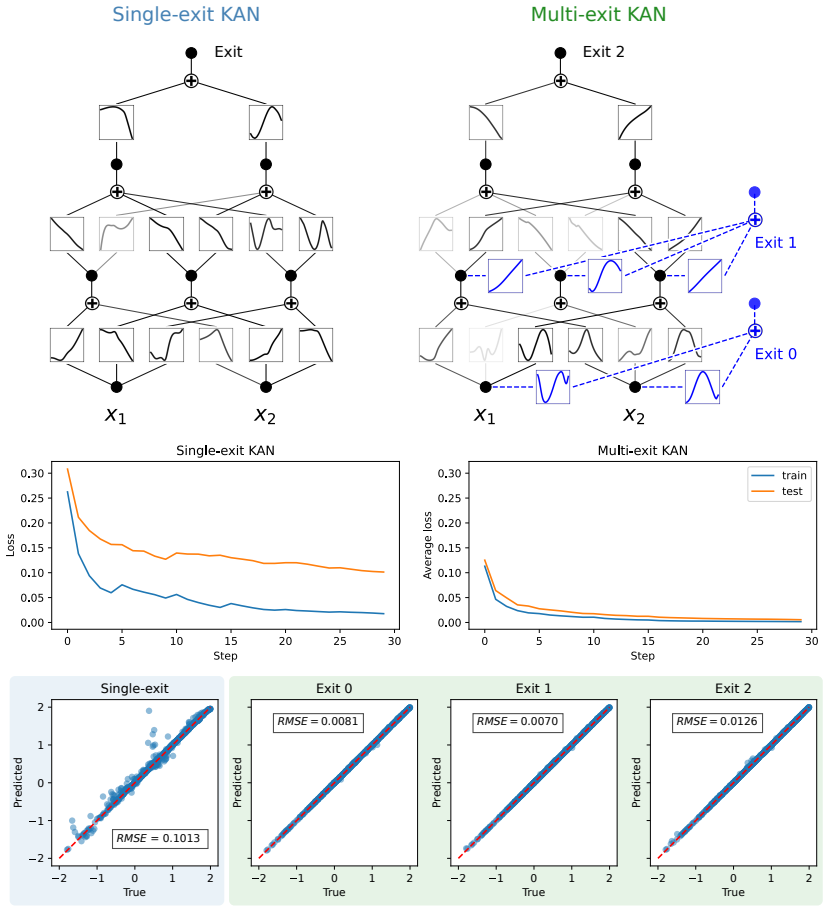
The central object is the multi-exit KAN: a standard KAN of shape [N0, N1, ..., NL] augmented with an additional KAN branch of shape [N_l, m] after each layer, so the network emits predictions at several depths. The data loss is the weighted average of per-exit MSE losses, and these exit weights live on a simplex whose vertices correspond to each shallower single-exit KAN. This single mechanism provides deep supervision during training, enables the network to discover parsimony by favoring early exits, and makes depth selection a continuous, differentiable choice instead of a discrete search. The learning-to-exit variant replaces fixed weights with softmax-normalized logits optimized jointly with the network parameters.
What would settle it
On the same benchmarks, hold out a validation set, select exit weights and the best exit on validation only, then evaluate on untouched test data; also grid-search single-exit KANs over all depths with the same hyperparameter budget. If multi-exit KANs no longer beat the best single-exit KAN, the central comparison is an artifact of test-set selection.
Extended reading notes
Core claim
The central claim is that adding an exit branch to every layer of a KAN and training all exits jointly with a weighted sum of their losses improves predictive performance while also revealing the right depth for the task. Because a one-hot weight vector reproduces each shallower single-exit KAN as a special case, the multi-exit network contains a whole family of architectures inside one training run, and the learned weights can fall in the interior of the simplex and outperform any individual depth. The experiments are the evidence: nine of ten Feynman equations improve, the Ikeda map is tracked about twice as long, the ecosystem model captures the chaotic attractor better, and all three real-world datasets show lower RMSE. The paper attributes the gains to deep supervision feeding gradients directly into earlier layers, plus an implicit regularizing effect from the L-BFGS curvature approximation.
Load-bearing premise
The paper reports the best RMSE across exits and selects exit weights using test labels, while single-exit KANs are not given the same best-of-depth selection; if that selection advantage drives the gap, the multi-exit claim weakens.
Editorial extensions
If this is right
- Nine of ten Feynman equations achieve lower RMSE with multi-exit KANs, and in half of those the best exit is not the final one, so shallower networks are sufficient for those problems.
- On the Ikeda map the multi-exit network tracks the chaotic trajectory for roughly twice as many steps as the single-exit KAN before diverging.
- On all three real-world datasets the three-exit KAN beats the same-size single-exit KAN; the learning-to-exit variant beats the previous best result on two of the three datasets.
- The same multi-exit benefit appears for Fourier-parameterized KANs, suggesting the advantage is not specific to B-spline activation functions.
- Because every shallower KAN is a vertex of the exit-weight simplex, architecture search reduces to picking a point in that simplex, and interior points can outperform depth-tuned single-exit networks.
Reading between the lines
- Beyond the paper: because the exit-weight simplex contains every shallower KAN and interior solutions can beat the vertices, multi-exit KANs can be viewed as a continuous relaxation of depth selection, and the same idea could extend to selecting width or spline grid resolution.
- Beyond the paper: the reported per-exit RMSEs are chosen after seeing test labels, so a stricter protocol would select the best exit on a validation split and then evaluate on untouched test data; we would expect the multi-exit advantage to persist on most benchmarks but shrink in magnitude.
- Beyond the paper: the paper's hypothesis that L-BFGS adds implicit regularization is testable by training the same architectures with Adam or SGD; if the gains mostly vanish, the mechanism is optimizer-specific rather than architectural.
- Beyond the paper: because exits are strongly correlated, naively ensembling them should underperform a de-correlated ensemble; adding an exit-diversity penalty could turn multi-exit KANs into an uncertainty-quantification tool.
Editorial analysis
A structured set of objections, weighed in public.
Referee Report
Summary. The paper introduces multi-exit KANs, a variant of Kolmogorov-Arnold Networks in which several layers are augmented with auxiliary prediction branches, trained with a weighted sum of per-exit losses. The central claim is that this architecture consistently outperforms standard single-exit KANs in accuracy while also identifying shallower, more parsimonious solutions, and that a proposed learning-to-exit algorithm can learn the exit weights automatically. Evidence includes regression benchmarks (sinc, a 2D function, ten Feynman equations), two dynamical systems, a continual-learning toy task, three real-world datasets, and a preliminary Fourier-KAN variant. The paper also provides a parameter-count analysis of exit overhead and releases source code.
Significance. If the headline claim were established, the contribution would be useful: it appears to be the first multi-exit treatment of KANs, it provides a natural deep-supervision mechanism, it offers a concrete way to discover parsimonious submodels, and the learning-to-exit algorithm addresses the extra hyperparameter introduced by the architecture. The paper is honest in including negative instances and in discussing limitations, and it ships code and detailed training settings. However, the current evaluation protocol does not yet support the 'consistently outperform' claim: the best-exit reporting and the absence of a documented validation procedure create an asymmetric comparison against single-exit baselines. The central idea remains defensible and the paper is a solid basis for revision, but the evidence is suggestive rather than conclusive.
major comments (3)
- [§4.1, Table 1; §4.4, Table 2] Multi-exit performance is reported as the best exit selected on the test set, while single-exit baselines receive no equivalent selection. For Table 1 the text says it 'reports the smallest RMSE across its exits'; for Table 2 the 'optimal exit' is the one that performed best on the test data, and the Wilcoxon test in §4.4 evaluates that same exit on an additional test set rather than a validation-selected exit. This gives multi-exit networks a multiple-comparisons advantage and can inflate the reported improvements. A fair protocol would either fix the exit rule before seeing test data, select exits on validation data, or report all exits individually; without this, the headline accuracy comparisons are not selection-free.
- [§4, opening paragraph; Appendix A] The manual architecture search is not documented in a way that rules out test-set leakage. The text says 'a manual architecture search identifies good KAN shapes and exit weights' and, for the real-world data, 'Experimentation led to exit weights w that performed well' (§4.4), but no validation split, number of configurations tried, or selection criterion is given. Because it is not stated whether the test set was used to choose shapes and weights, the RMSE values in Tables 1 and 2 are likely optimistic for both architectures, and the single-versus-multi comparison is not a clean held-out evaluation. Please specify how shapes and weights were chosen and report variability over repeated runs or seeds.
- [§4.2, §5.3, and Table 1] The word 'consistently' in the abstract and conclusion is stronger than the paper's own evidence. The multi-exit ecosystem model has worse one-step RMSE (3.774e-4) than the single-exit (3.171e-4); the learning-to-exit variant is worse still (5.18e-4); and Feynman equation I.6.20b is one of ten cases where the multi-exit RMSE (1.16e-3) exceeds the single-exit RMSE (1.12e-3). The paper should either document the fraction and conditions of improvement, or replace 'consistently' with 'often' in the abstract and conclusion.
minor comments (4)
- [§5.3, logits initialization] The learning-to-exit results depend on the initialization of the exit logits: the 2D regression needed a decreasing initialization to work, and the ecosystem needed an increasing one. The paper should discuss or evaluate sensitivity to this choice, since it is a new hyperparameter of the proposed method.
- [Fig. 1, Table 1, and Table 2] The RMSE values are reported for a single train/test split with no standard errors or repeated runs; given the small differences in some comparisons, reporting variability would help assess whether the improvements are meaningful.
- [§6, Limitations paragraph] The manuscript already concedes that exit-weight tuning is the 'most serious concern' and that interpretability gains are indirect; these concessions should be reflected in the abstract, which currently presents parsimony and interpretability as more automatic benefits.
- [Appendix B] The Fourier-KAN generalization rests on a single polynomial benchmark; the text should label it more clearly as a proof-of-concept rather than evidence of generalizable improvement.
Circularity Check
No significant circularity: the paper is an empirical architecture comparison with a disclosed best-exit selection protocol, not a derivation that reduces to its inputs.
full rationale
This paper makes no formal derivation claim; it is an empirical study comparing multi-exit KANs to single-exit KANs. The multi-exit training objective (Eq. 9) is a weighted sum of per-exit MSE losses, and the reported performance in Table 1 is 'the smallest RMSE across its exits,' with Table 2 likewise identifying the best-performing exit. This is a legitimate methodological concern about test-set selection or multiple comparisons, but it is not circular: the min over exits is not asserted to equal the training objective, the single-exit baseline is an independently trained network rather than a term in the multi-exit loss, and the core comparison is against external benchmarks (Feynman equations, UCI datasets, Ikeda map, ecosystem model). The paper also reports a second-test-set Wilcoxon evaluation (Sec. 4.4) using the exit identified on the first test set, which partially mitigates selection bias. All load-bearing references are external (KAN [15], multi-exit networks [21-24], benchmarks [42,43,48-53]); there are no self-citations by the authors. The Sec. 6 limitation statement—'Perhaps the most serious concern is the extra need to set the exit weights when fitting a multi-exit KAN'—and the ecosystem result with 'slightly worse one-step prediction' (RMSE 3.774e-4 vs 3.171e-4) are disclosed in the text. No step reduces by construction to its own input, so the circularity score is 0.
Assumptions & free parameters
free parameters (7)
- Exit weights w (sinc) =
[1,2,3,4] (unnormalized)
- Exit weights w (2D regression) =
[1,2,1]
- Exit weights w (Feynman) =
[0,0,1,1,3/2]
- Exit weights w (Ikeda) =
[0,0,1,2]
- Exit weights w (ecosystem) =
[2,1,1/2]
- Exit weights w (real-world datasets) =
Various, e.g., [1e3,100,1] for Airfoil, [5,2] for Power, [10,8] for Superconductivity
- Learning-to-exit logits initialization =
Uniform zero logits (or decreasing logits [1,0,-1] for 2D)
assumptions (3)
- standard math Kolmogorov-Arnold Representation Theorem (KART) holds for the functions considered
- domain assumption The PyKAN B-spline KAN implementation and its default training settings are suitable baselines
- domain assumption Reporting the smallest RMSE across exits gives an unbiased estimate of multi-exit performance
Cite this review
Pith. "Pith review of Multi-Exit Kolmogorov-Arnold Networks: enhancing accuracy and parsimony." pith.science (2026). https://pith.science/paper/GS44COTM
@misc{pith2026250603302,
  author       = {Pith},
  title        = {Pith review of: Multi-Exit Kolmogorov-Arnold Networks: enhancing accuracy and parsimony},
  year         = {2026},
  howpublished = {\url{https://pith.science/paper/GS44COTM}},
  note         = {Machine review of arXiv:2506.03302}
}
read the original abstract
Kolmogorov-Arnold Networks (KANs) uniquely combine high accuracy with interpretability, making them valuable for scientific modeling. However, it is unclear a priori how deep a network needs to be for any given task, and deeper KANs can be difficult to optimize and interpret. Here we introduce multi-exit KANs, where each layer includes its own prediction branch, enabling the network to make accurate predictions at multiple depths simultaneously. This architecture provides deep supervision that improves training while discovering the right level of model complexity for each task. Multi-exit KANs consistently outperform standard, single-exit versions on synthetic functions, dynamical systems, and real-world datasets. Remarkably, the best predictions often come from earlier, simpler exits, revealing that these networks naturally identify smaller, more parsimonious and interpretable models without sacrificing accuracy. To automate this discovery, we develop a differentiable "learning-to-exit" algorithm that balances contributions from exits during training. Our approach offers scientists a practical way to achieve both high performance and interpretability, addressing a fundamental challenge in machine learning for scientific discovery.
Figures


Figures from the paper (2 more)


Reference graph
Works this paper leans on
-
[1]
Machine learning and the physical sciences,
G. Carleo, I. Cirac, K. Cranmer, L. Daudet, M. Schuld, N. Tishby, L. Vogt-Maranto, and L. Zdeborov´a, “Machine learning and the physical sciences,” Reviews of Modern Physics, vol. 91, no. 4, p. 045002, 2019. 1
work page 2019
-
[2]
Explainable machine learning for scientific insights and discoveries,
R. Roscher, B. Bohn, M. F. Duarte, and J. Garcke, “Explainable machine learning for scientific insights and discoveries,”IEEE Access, vol. 8, pp. 42200–42216, 2020. 1
work page 2020
-
[3]
Artificial intelligence: A powerful paradigm for scientific research,
Y. Xu, X. Liu, X. Cao, C. Huang, E. Liu, S. Qian, X. Liu, Y. Wu, F. Dong, C.-W. Qiu,et al., “Artificial intelligence: A powerful paradigm for scientific research,” The Innovation, vol. 2, no. 4,
-
[4]
Scientific discovery in the age of artificial intelligence,
H. Wang, T. Fu, Y. Du, W. Gao, K. Huang, Z. Liu, P. Chandak, S. Liu, P. Van Katwyk, A. Deac, et al., “Scientific discovery in the age of artificial intelligence,” Nature, vol. 620, no. 7972, pp. 47–60, 2023. 1
work page 2023
-
[5]
Physics-informed machine learning,
G. E. Karniadakis, I. G. Kevrekidis, L. Lu, P. Perdikaris, S. Wang, and L. Yang, “Physics-informed machine learning,” Nature Reviews Physics, vol. 3, no. 6, pp. 422–440, 2021. 1
work page 2021
-
[6]
Physics-informed machine learning: case studies for weather and climate modelling,
K. Kashinath, M. Mustafa, A. Albert, J. Wu, C. Jiang, S. Es- maeilzadeh, K. Azizzadenesheli, R. Wang, A. Chattopadhyay, A. Singh, et al., “Physics-informed machine learning: case studies for weather and climate modelling,”Philosophical Trans- actions of the Royal Society A, vol. 379, no. 2194, p. 20200093,
-
[7]
Learning skillful medium-range global weather forecasting,
R. Lam, A. Sanchez-Gonzalez, M. Willson, P. Wirnsberger, M. Fortunato, F. Alet, S. Ravuri, T. Ewalds, Z. Eaton-Rosen, W. Hu, A. Merose, S. Hoyer, G. Holland, O. Vinyals, J. Stott, A. Pritzel, S. Mohamed, and P. Battaglia, “Learning skillful medium-range global weather forecasting,”Science, vol. 382, no. 6677, pp. 1416–1421, 2023. 1
work page 2023
-
[8]
Highly accurate protein structure prediction with al- phafold,
J. Jumper, R. Evans, A. Pritzel, T. Green, M. Figurnov, O. Ron- neberger, K. Tunyasuvunakool, R. Bates, A.ˇZ´ıdek, A. Potapenko, et al., “Highly accurate protein structure prediction with al- phafold,” Nature, vol. 596, no. 7873, pp. 583–589, 2021. 1
work page 2021
Show all 62 references
-
[9]
Data-driven modeling and learning in science and engineering,
F. J. Mont´ans, F. Chinesta, R. G´omez-Bombarelli, and J. N. Kutz, “Data-driven modeling and learning in science and engineering,” Comptes Rendus M ´ecanique, vol. 347, no. 11, pp. 845–855,
-
[10]
Perspectives on the integration between first-principles and data-driven modeling,
W. Bradley, J. Kim, Z. Kilwein, L. Blakely, M. Eydenberg, J. Jalvin, C. Laird, and F. Boukouvala, “Perspectives on the integration between first-principles and data-driven modeling,” Computers & Chemical Engineering, vol. 166, p. 107898, 2022. 1
2022
-
[11]
It’s just not that simple: an empirical study of the accuracy-explainability trade-off in machine learning for public policy,
A. Bell, I. Solano-Kamaiko, O. Nov, and J. Stoyanovich, “It’s just not that simple: an empirical study of the accuracy-explainability trade-off in machine learning for public policy,” in Proceedings of the 2022 ACM conference on fairness, accountability, and transparency, pp. ...
2022
-
[12]
How explainability contributes to trust in ai,
A. Ferrario and M. Loi, “How explainability contributes to trust in ai,” in Proceedings of the 2022 ACM conference on fairness, accountability, and transparency, pp. 1457–1466, 2022. 1
2022
-
[13]
Ai and science: what 1,600 researchers think,
R. Van Noorden and J. M. Perkel, “Ai and science: what 1,600 researchers think,” Nature, vol. 621, no. 7980, pp. 672–675,
-
[14]
Can we open the black box of AI?,
D. Castelvecchi, “Can we open the black box of AI?,”Nature News, vol. 538, no. 7623, p. 20, 2016. 1
2016
-
[15]
KAN: Kolmogorov–Arnold net- works,
Z. Liu, Y. Wang, S. Vaidya, F. Ruehle, J. Halverson, M. Soljacic, T. Y. Hou, and M. Tegmark, “KAN: Kolmogorov–Arnold net- works,” inThe Thirteenth International Conference on Learning Representations, 2025. 1, 2, 4, 7, 11, 12
2025
-
[16]
KAN 2.0: Kolmogorov–Arnold Networks meet science,
Z. Liu, P. Ma, Y. Wang, W. Matusik, and M. Tegmark, “KAN 2.0: Kolmogorov–Arnold Networks meet science,” arXiv preprint arXiv:2408.10205, 2024. 1, 4, 5, 11
2024 arXiv
-
[17]
From PINNs to PIKANs: Recent advances in physics-informed machine learning,
J. D. Toscano, V. Oommen, A. J. Varghese, Z. Zou, N. Ah- madi Daryakenari, C. Wu, and G. E. Karniadakis, “From PINNs to PIKANs: Recent advances in physics-informed machine learning,” Machine Learning for Computational Science and Engineering, vol. 1, no. 1, pp. 1–43, 2025. 1
2025
-
[18]
KAN-ODEs: Kolmogorov– Arnold network ordinary differential equations for learning dynamical systems and hidden physics,
B. C. Koenig, S. Kim, and S. Deng, “KAN-ODEs: Kolmogorov– Arnold network ordinary differential equations for learning dynamical systems and hidden physics,”Computer Methods in Applied Mechanics and Engineering, vol. 432, p. 117397, 2024. 1, 2
2024
-
[19]
Data-driven model discovery with Kolmogorov–Arnold networks,
S. Panahi, M. Moradi, E. M. Bollt, and Y.-C. Lai, “Data-driven model discovery with Kolmogorov–Arnold networks,” Phys. Rev. Res., vol. 7, p. 023037, Apr 2025. 1, 2, 6, 12
2025
-
[20]
Neural architecture search: A survey,
T. Elsken, J. H. Metzen, and F. Hutter, “Neural architecture search: A survey,” Journal of Machine Learning Research , vol. 20, no. 55, pp. 1–21, 2019. 2
2019
-
[21]
Deeply- supervised nets,
C.-Y. Lee, S. Xie, P. Gallagher, Z. Zhang, and Z. Tu, “Deeply- supervised nets,” inArtificial intelligence and statistics, pp. 562– 570, Pmlr, 2015. 2, 4, 5
2015
-
[22]
BranchyNet: Fast inference via early exiting from deep neural networks,
S. Teerapittayanon, B. McDanel, and H. Kung, “BranchyNet: Fast inference via early exiting from deep neural networks,” in 2016 23rd International Conference on Pattern Recognition (ICPR), pp. 2464–2469, 2016. 2, 4
2016
-
[23]
Conditional deep learning for energy-efficient and enhanced pattern recognition,
P. Panda, A. Sengupta, and K. Roy, “Conditional deep learning for energy-efficient and enhanced pattern recognition,” in Pro- ceedings of the 2016 Conference on Design, Automation & Test in Europe, DATE ’16, (San Jose, CA, USA), p. 475–480, EDA Consortium, 2016. 2, 4
2016
-
[24]
Why should we add early exits to neural networks?,
S. Scardapane, M. Scarpiniti, E. Baccarelli, and A. Uncini, “Why should we add early exits to neural networks?,”Cognitive Computation, vol. 12, no. 5, pp. 954–966, 2020. 2, 4
2020
-
[25]
Deep residual learning for image recognition,
K. He, X. Zhang, S. Ren, and J. Sun, “Deep residual learning for image recognition,” in Proceedings of the IEEE conference on computer vision and pattern recognition, pp. 770–778, 2016. 2, 3, 11
2016
-
[26]
Multilayer feedfor- ward networks are universal approximators,
K. Hornik, M. Stinchcombe, and H. White, “Multilayer feedfor- ward networks are universal approximators,”Neural Networks, vol. 2, no. 5, pp. 359–366, 1989. 2
1989
-
[27]
A. N. Kolmogorov,On the representation of continuous func- tions of several variables by superpositions of continuous func- tions of a smaller number of variables. American Mathematical Society, 1961. 2
1961
-
[28]
On functions of three variables,
V. I. Arnold, “On functions of three variables,”Collected Works: Representations of Functions, Celestial Mechanics and KAM Theory, 1957–1965, pp. 5–8, 2009. 2
1957
-
[29]
On the representations of continuous functions of many variables by superposition of continuous functions of one variable and addition,
A. N. Kolmogorov, “On the representations of continuous functions of many variables by superposition of continuous functions of one variable and addition,” in Dokl. Akad. Nauk USSR, vol. 114, pp. 953–956, 1957. 2
1957
-
[30]
Kolmogorov–Arnold networks are Radial Basis Function networks,
Z. Li, “Kolmogorov–Arnold networks are Radial Basis Function networks,” arXiv preprint arXiv:2405.06721, 2024. 3
2024 arXiv
-
[31]
FourierKAN-GCF: Fourier Kolmogorov–Arnold network–an effective and efficient feature transformation for graph collaborative filtering,
J. Xu, Z. Chen, J. Li, S. Yang, W. Wang, X. Hu, and E. C.- H. Ngai, “FourierKAN-GCF: Fourier Kolmogorov–Arnold network–an effective and efficient feature transformation for graph collaborative filtering,” arXiv preprint arXiv:2406.01034,
-
[32]
SineKAN: Kolmogorov–Arnold networks using sinusoidal activation func- tions,
E. Reinhardt, D. Ramakrishnan, and S. Gleyzer, “SineKAN: Kolmogorov–Arnold networks using sinusoidal activation func- tions,” Frontiers in Artificial Intelligence , vol. 7, 2025. 3, 13
2025
-
[33]
Cheby- shev polynomial-based Kolmogorov–Arnold networks: An efficient architecture for nonlinear function approximation,
S. Sidharth, A. Keerthana, R. Gokul, and K. Anas, “Cheby- shev polynomial-based Kolmogorov–Arnold networks: An efficient architecture for nonlinear function approximation,” arXiv preprint arXiv:2405.07200, 2024. 3
2024 arXiv
-
[34]
Wav-KAN: Wavelet Kolmogorov– Arnold networks,
Z. Bozorgasl and H. Chen, “Wav-KAN: Wavelet Kolmogorov– Arnold networks,” arXiv preprint arXiv:2405.12832, 2024. 3
2024 arXiv
-
[35]
On the limited memory BFGS method for large scale optimization,
D. C. Liu and J. Nocedal, “On the limited memory BFGS method for large scale optimization,”Mathematical program- ming, vol. 45, no. 1, pp. 503–528, 1989. 4, 12
1989
-
[36]
Adam: A method for stochastic optimization,
D. P. Kingma and J. Ba, “Adam: A method for stochastic optimization,” arXiv preprint arXiv:1412.6980, 2014. 4, 11
2014 arXiv
-
[37]
Bert loses patience: Fast and robust inference with early exit,
W. Zhou, C. Xu, T. Ge, J. McAuley, K. Xu, and F. Wei, “Bert loses patience: Fast and robust inference with early exit,” in Ad- vances in Neural Information Processing Systems(H. Larochelle, M. Ranzato, R. Hadsell, M. Balcan, and H. Lin, eds.), vol. 33, pp. 18330–18341, Curran ...
2020
-
[38]
BERxiT: Early exiting for BERT with better fine-tuning and extension to regression,
J. Xin, R. Tang, Y. Yu, and J. Lin, “BERxiT: Early exiting for BERT with better fine-tuning and extension to regression,” in Proceedings of the 16th Conference of the European Chapter of the Association for Computational Linguistics: Main Volume (P. Merlo, J. Tiedemann, and R....
2021
-
[39]
Adaptive inference through early-exit networks: Design, challenges and directions,
S. Laskaridis, A. Kouris, and N. D. Lane, “Adaptive inference through early-exit networks: Design, challenges and directions,” in Proceedings of the 5th International Workshop on Embedded and Mobile Deep Learning, EMDL ’21, (New York, NY, USA), p. 1–6, Association for Computin...
2021
-
[40]
Early-exit deep neural network - a comprehensive survey,
H. Rahmath P, V. Srivastava, K. Chaurasia, R. G. Pacheco, and R. S. Couto, “Early-exit deep neural network - a comprehensive survey,”ACM Comput. Surv., vol. 57, Nov. 2024. 4
2024
-
[41]
Densely connected convolutional networks,
G. Huang, Z. Liu, L. Van Der Maaten, and K. Q. Weinberger, “Densely connected convolutional networks,” inProceedings of the IEEE conference on computer vision and pattern recognition, pp. 4700–4708, 2017. 4, 11
2017
-
[42]
AI Feynman: A physics- inspired method for symbolic regression,
S.-M. Udrescu and M. Tegmark, “AI Feynman: A physics- inspired method for symbolic regression,” Science advances, vol. 6, no. 16, p. eaay2631, 2020. 6, 12 14
2020
-
[43]
AI Feynman 2.0: Pareto-optimal symbolic regression exploiting graph modularity,
S.-M. Udrescu, A. Tan, J. Feng, O. Neto, T. Wu, and M. Tegmark, “AI Feynman 2.0: Pareto-optimal symbolic regression exploiting graph modularity,” Advances in Neural Information Processing Systems, vol. 33, pp. 4860–4871, 2020. 6
2020
-
[44]
Multiple-valued stationary state and its instabil- ity of the transmitted light by a ring cavity system,
K. Ikeda, “Multiple-valued stationary state and its instabil- ity of the transmitted light by a ring cavity system,” Optics communications, vol. 30, no. 2, pp. 257–261, 1979. 6
1979
-
[45]
Global dynamical behavior of the optical field in a ring cavity,
S. Hammel, C. Jones, and J. V. Moloney, “Global dynamical behavior of the optical field in a ring cavity,” Journal of the Optical Society of America B, vol. 2, no. 4, pp. 552–564, 1985. 6
1985
-
[46]
Nonlinear dynamics and population disappearances,
K. McCann and P. Yodzis, “Nonlinear dynamics and population disappearances,” The American Naturalist , vol. 144, no. 5, pp. 873–879, 1994. 6
1994
-
[47]
Distal interference: Ex- ploring the limits of model-based continual learning,
H. van Deventer and A. S. Bosman, “Distal interference: Ex- ploring the limits of model-based continual learning,” arXiv preprint arXiv:2402.08255, 2024. 7
2024 arXiv
-
[48]
Airfoil self-noise and prediction,
T. F. Brooks, D. S. Pope, and M. A. Marcolini, “Airfoil self-noise and prediction,” Tech. Rep. NASA-RP-1218, NASA Langley Research Center, July 1989. NASA Reference Publication 1218. 8
1989
-
[49]
Local and global learning methods for predicting power of a combined gas & steam turbine,
H. Kaya, P. T¨ ufekci, and F. S. G¨ urgen, “Local and global learning methods for predicting power of a combined gas & steam turbine,” in Proceedings of the international conference on emerging trends in computer and electronics engineering ICETCEE, pp. 13–18, 2012. 8
2012
-
[50]
Prediction of full load electrical power output of a base load operated combined cycle power plant using machine learning methods,
P. T¨ ufekci, “Prediction of full load electrical power output of a base load operated combined cycle power plant using machine learning methods,” International Journal of Electrical Power & Energy Systems, vol. 60, pp. 126–140, 2014. 8
2014
-
[51]
A data-driven statistical model for predicting the critical temperature of a superconductor,
K. Hamidieh, “A data-driven statistical model for predicting the critical temperature of a superconductor,” Computational Materials Science, vol. 154, pp. 346–354, 2018. 8
2018
-
[52]
MDR SuperCon datasheet ver.240322
C. for Basic Research on Materials, “MDR SuperCon datasheet ver.240322.” 8
-
[53]
The UCI machine learning repository,
M. Kelly, R. Longjohn, and K. Nottingham, “The UCI machine learning repository,” n.d. Accessed: 23 May 2025. 8
2025
-
[54]
Ensemble learning: A survey,
O. Sagi and L. Rokach, “Ensemble learning: A survey,” Wiley interdisciplinary reviews: data mining and knowledge discovery, vol. 8, no. 4, p. e1249, 2018. 12
2018
-
[55]
R. C. Smith, Uncertainty Quantification: Theory, Implementa- tion, and Applications. Philadelphia, PA: Society for Industrial and Applied Mathematics, 2013. 12
2013
-
[56]
A review of uncertainty quantification in deep learning: Techniques, applications and challenges,
M. Abdar, F. Pourpanah, S. Hussain, D. Rezazadegan, L. Liu, M. Ghavamzadeh, P. Fieguth, X. Cao, A. Khosravi, U. R. Acharya, et al., “A review of uncertainty quantification in deep learning: Techniques, applications and challenges,”Information fusion, vol. 76, pp. 243–297, 2021. 12
2021
-
[57]
Bayesian Kolmogorov–Arnold Networks (Bayesian-KANs): A probabilistic approach to enhance ac- curacy and interpretability,
M. M. Hassan, “Bayesian Kolmogorov–Arnold Networks (Bayesian-KANs): A probabilistic approach to enhance ac- curacy and interpretability,” arXiv preprint arXiv:2408.02706,
-
[58]
Conformalized-KANs: Uncertainty quantifica- tion with coverage guarantees for Kolmogorov–Arnold Net- works (KANs) in scientific machine learning,
A. Mollaali, C. B. Moya, A. A. Howard, A. Heinlein, P. Stinis, and G. Lin, “Conformalized-KANs: Uncertainty quantifica- tion with coverage guarantees for Kolmogorov–Arnold Net- works (KANs) in scientific machine learning,” arXiv preprint arXiv:2504.15240, 2025. 12
2025 arXiv
-
[59]
DARTS: Differentiable architecture search,
H. Liu, K. Simonyan, and Y. Yang, “DARTS: Differentiable architecture search,” in International Conference on Learning Representations, 2019. 12
2019
-
[60]
PyTorch: An imperative style, high-performance deep learning library,
A. Paszke, “PyTorch: An imperative style, high-performance deep learning library,” arXiv preprint arXiv:1912.01703, 2019. 12
1912 arXiv
-
[61]
FourierKAN
GistNoesis, “FourierKAN.” https://github.com/GistNoesis/ FourierKAN, 2024. Accessed: 2025-07-07. 13 15
2024
-
[2019]
Data-Based Engineering Science and Technology. 1
Reviewed August 7, 2026 · model on record in the stance chip above.
Discussion (0). Sign in to comment.