REVIEW 4 major objections 4 minor 40 references
ResQ: A Novel Framework to Implement Residual Neural Networks on Analog Rydberg Atom Quantum Computers
T0 review · 4 major / 4 minor · reviewed 2026-08-06 · deepseek-v4-flash
Pith's one-line read RESQ maps residual networks onto Rydberg atoms and claims a 56% edge over classical peers.
desk verdict Useful Rydberg pulse-encoding scheme, but the quantum-ResNet framing and the outperformance claim don't survive close reading. read the letter →
The pith
A machine-rendered reading of the paper's core claim, the machinery that carries it, and where it could break.
The reading
What carries the argument
The load-bearing object is the parameterized analog Hamiltonian $$H(t)=\frac{\$\Omega$(t)}{2}\sum_i(e^{i\$\varphi$(t)}|g\rangle_i\langle r|_i+e^{-i\$\varphi$(t)}|r\rangle_i\langle g|_i)-\$\Delta$(t)\sum_i \hat n_i+\sum_{i<j}\frac{C_6}{|\vec p_i-\vec p_j|^6}\hat n_i\hat n_j-\delta(t)\sum_i h_i \hat n_i,$$ with $\Omega(t)$, $\Delta(t)$, and $\delta(t)$ specified as piecewise-linear pulses. RESQ's central parameterization sets each pulse strength at a holding time to $\theta_j \omega_i+\theta_{j+1}$, so a single input feature $\omega_i$ is scaled and offset by learned parameters throughout the evolution, while alternating local couplings $h_i$ lift further features and parameters into the computation. This turns the hardware's continuous-time evolution into the residual/neural-ODE structure: the input is not fed through fixed layers but shapes the entire state trajectory, and the final averaged $\langle|1\rangle$ probability is the classifier output. The stochastic pulse-gradient method supplies unbiased gradients of this analog program with respect to the Hamiltonian parameters.
What would settle it
Train the same classical feedforward, residual, and neural-ODE classifiers on the same five PCA features but let them run to convergence (for example, 1,000 or 10,000 Adam iterations instead of 75) and compare final test accuracy; if any reaches or exceeds RESQ's reported accuracy, the claimed 56%, 57%, and 36% improvements are artifacts of the training-time cutoff rather than a property of the quantum model.
Extended reading notes
Core claim
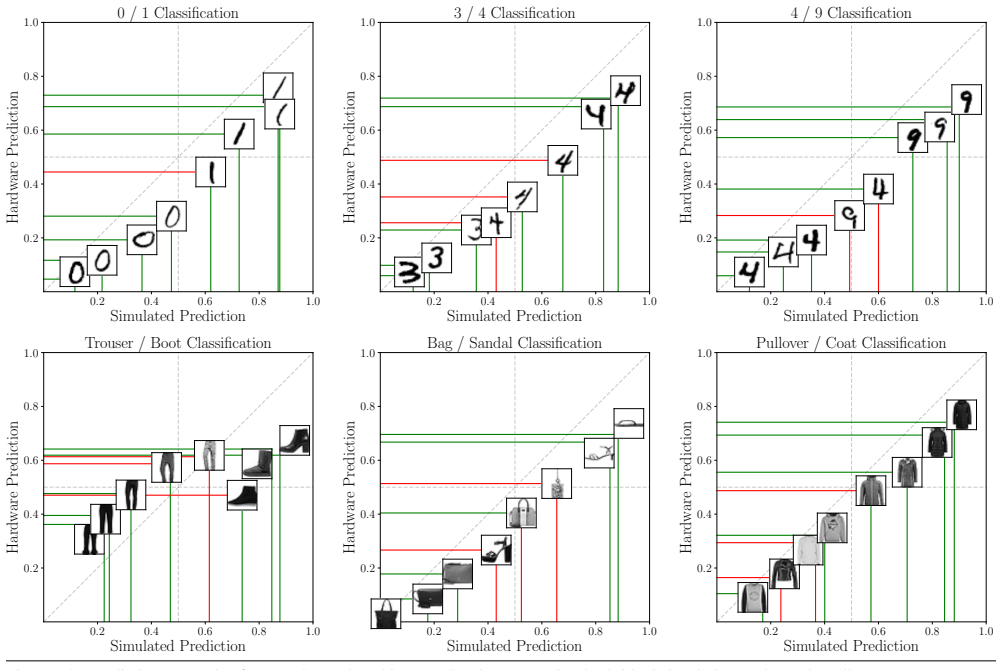
RESQ claims that an analog Rydberg-atom quantum computer can implement residual neural networks directly, without gates, by treating the Schrödinger evolution itself as a trainable neural ODE. The framework encodes each input feature $\omega_i$ into the pulse heights of the global Rabi frequency, global detuning, and local detuning, with each height written as $\theta_j\omega_i+\theta_{j+1}$ for learned parameters $\theta_j, \theta_{j+1}$, and encodes additional features and parameters into alternating site-dependent couplings $h_i$ of the local detuning term. After evolving the $N$-atom system for a fixed time, the averaged probability of measuring atoms in the $|1\rangle$ state is the soft label, and the parameters are trained by backpropagating cross-entropy loss through an unbiased stochastic pulse-gradient estimator. With $N=4$ atoms and three pulse intervals, this gives 20 trainable parameters and five input features; on binary MNIST, FashionMNIST, and diabetes tasks the paper reports 56%, 57%, and 36% accuracy improvements over similarly sized classical feedforward, residual, and neural-ODE networks, respectively, with accuracy and F1 within about 1% of ideal when pulse and position noise is simulated. Real-hardware inference on Aquila is reported to be largely robust except for samples near the decision boundary.
Load-bearing premise
The headline 'similarly sized classical models' comparison assumes that a classical network trained on the same five PCA features for the same 75 iterations is a meaningful baseline; if classical models are instead given raw data, more features, or longer training, RESQ's reported improvements are not established.
Editorial extensions
If this is right
- RESQ gives current analog hardware a usable classification recipe: with four atoms it uses 20 trainable parameters and five input features, and inference on Aquila is reported to stay within about 1% of ideal accuracy under simulated noise.
- Because features enter through pulse heights and local couplings, the number of input features grows linearly with qubit count ($3+N/2$ for $N$ atoms) while the evolution time stays fixed, so larger atom arrays could handle richer inputs without deeper circuits.
- Residual structure is realized natively as continuous Hamiltonian evolution, which means analog Rydberg systems can bypass the discrete-step decomposition that gate-based quantum ResNet proposals require.
- The framework is not tied to images: the same pipeline is demonstrated on a tabular healthcare dataset, suggesting generality across binary classification tasks.
- If the results hold, RESQ is the first fully quantum-native neural-ODE classifier, and the mapping from model parameters to Hamiltonian pulses becomes a general template for other continuous-time models.
Reading between the lines
- In our reading, the reported advantage is more plausibly a statement about baseline starvation than about quantum expressivity: classical architectures trained on the full images, or on the five PCA features with many more iterations, would likely close most of the gap. We would test this before treating the 56% figure as a quantum speedup.
- The residual block analogy is conceptual, not literal: Schrödinger evolution is unitary, so RESQ implements a continuous-time integration of a linear operator rather than the additive nonlinear skip layer of the original ResNet; the natural frame for the result is analog quantum neural ODEs.
- A direct scaling test would run RESQ with $N>4$ atoms on Aquila to see whether the linear feature-scaling claim survives real interaction graphs and noise; the paper's hardware evaluation is limited to the same $N=4$ configuration used in simulation.
- Because the gradient estimator is unbiased and hardware-agnostic, the same piecewise-pulse parameterization could be transferred to other controllable analog platforms, so the framework's value may outlive Rydberg-specific hardware.
Editorial analysis
A structured set of objections, weighed in public.
Referee Report
Summary. The paper introduces RESQ, a framework that encodes PCA-reduced input features and trainable parameters into the time-dependent pulse sequences of an analog Rydberg atom quantum computer. The dynamics are governed by the Schrödinger equation with a globally and locally addressed Hamiltonian (Eqs. (1)-(2)), and classification is performed by measuring the average excited-state probability. The authors claim that this constitutes the first implementation of residual neural networks (ResNets) and neural ODEs on analog Rydberg hardware, and that RESQ outperforms similarly sized classical feedforward networks, ResNets, and neural ODE classifiers by 56%, 57%, and 36%, respectively, while remaining robust to hardware noise. Evaluation is performed on MNIST, FashionMNIST, and the Pima Indians Diabetes dataset using classical simulation, with a small set of inference runs on the QuEra Aquila device.
Significance. If the central claims were valid, the paper would represent a notable advance in analog quantum machine learning, combining continuous Hamiltonian evolution with a residual-network-style architecture and demonstrating a practical advantage over classical models. The paper also has concrete strengths: the code and data are open-sourced, the authors use a real 256-qubit Rydberg device for inference, and they explore several lattice geometries and spacings. However, the significance is substantially weakened by two load-bearing problems: (i) the residual-network interpretation is not formally justified, since the Hamiltonian evolution is linear and state-independent, and (ii) the classical baselines are handicapped by receiving the same 5 PCA features and only 75 training iterations, making the reported improvements unsurprising. The hardware robustness claim rests on only 8 samples per task, which cannot support the stated conclusion. The result, as presented, does not establish a quantum advantage or a genuine implementation of residual networks.
major comments (4)
- [§4.1, Eq. (1)] The central architectural claim is that RESQ implements residual neural networks, but the dynamics in Eq. (1) do not contain a residual function F(x, θ) of the form defined in §2.2. The Hamiltonian H(t) depends on the input features ω_i and on trainable parameters, but not on the instantaneous quantum state |ψ(t)⟩. Consequently, the Trotterized update |ψ(t+dt)⟩ ≈ (I - iH(t)dt)|ψ(t)⟩ is a linear, state-independent map; the only nonlinearity in the entire model is the final Born-rule measurement. Calling this an implementation of ResNets or neural ODEs is an analogy, not a derivation. This undermines the abstract's primary claim of being 'the first framework to implement residual neural networks on analog Rydberg atom quantum computers.'
- [§5, 'Comparative Classical Techniques'] The performance comparison is not fair. The classical baselines C-NN, C-ResNet, and C-NODE receive the same 5 PCA features as RESQ and are trained for only 75 full-batch iterations with no minibatching and no hyperparameter tuning. Under these conditions, near-chance accuracies such as 51% on MNIST 0/1 (Figure 6) indicate severe undertraining, so the reported improvements of 56%, 57%, and 36% in Section 6.1 are artifacts of weak baselines rather than evidence of a quantum advantage. A meaningful comparison would allow classical models to use the raw data or a reasonable feature representation, and would use standard training budgets with hyperparameter selection.
- [§6.4, 'Real Hardware Executions'] The robustness claim on real hardware is based on only 8 samples per classification task. With n=8, the observation that some points near the decision boundary flip under noise is anecdotal and cannot support the conclusion that 'RESQ has excellent resilience to noise.' The simulated-noise analysis reportedly shows accuracy within 1% of ideal, but no error bars, confidence intervals, or detailed statistics are provided. This is insufficient support for the paper's robustness claim.
- [§4.4 and §6.1] The paper does not ablate the choice of 5 PCA features or compare against classical models using more features or raw pixel inputs. Since the classical baselines are restricted to the same 5 features, the comparison conflates the feature representation with the model architecture. Without such ablations, the statement that RESQ 'outperforms similarly sized classical models' is not meaningful, because the classical models are artificially limited in their input information.
minor comments (4)
- [Throughout] The name 'RESQ' is typeset inconsistently as 'R ESQ' in several places; please use a consistent notation.
- [Figure 5 caption] The caption says 'Pluses used by RESQ'; this should read 'Pulses used by RESQ.'
- [§1] The statement that Rydberg atom systems 'are currently the only hardware that supports continuous-time Hamiltonian evolution and local/global control' is too strong and unsubstantiated; other quantum platforms (e.g., trapped ions) also offer continuous control, and the claim should be qualified or removed.
- [§5, 'Software and Simulation Setup'] The training hyperparameters are underspecified. The paper mentions Adam and 20 gradient samples but does not report learning rate, number of gradient steps per iteration, or initialization details beyond 'all parameters initialized to 1.0,' which would be needed to reproduce the results.
Circularity Check
No significant circularity: the derivation is self-contained and the reported predictions are measured on held-out data, not reconstructed from fitted parameters.
full rationale
RESQ's derivation chain is self-contained: the Hamiltonian in Eq. (1) is the standard Rydberg Hamiltonian; inputs and trainable parameters enter only through the piecewise-linear pulse parameterization θ_j ω_i + θ_{j+1} (Sec. 4.3) and the local couplings h_i; and the prediction is the Born-rule average P(|1⟩) over all measured qubits on a held-out test set (Sec. 4.5). No parameter is fitted to the test labels, no test-set statistic is renamed as a prediction, and no uniqueness theorem from the authors is invoked to force the design. The claim that RESQ implements residual networks rests on the standard continuous-time equivalence between ResNets and neural ODEs (dx/dt = F(x,θ), Sec. 2.2) applied to the Schrödinger equation; this is an analogy that the paper asserts rather than derives at the equation level, but it is not a circular reduction of the result to its inputs. The only self-citation ([12]) supplies standard Rydberg background and a noise model; it is not load-bearing, and the gradient method and noise model are independently supported by external references [23] and [26]. Concerns about the weak classical baselines (same 5 PCA features, only 75 iterations, near-chance accuracies) are evaluation-quality issues, not circularity.
Assumptions & free parameters
free parameters (8)
- Pulse and local coupling parameters (total 6M + N/2) =
20 for M=3, N=4
- Number of PCA features =
5
- Pulse interval count M =
3
- Lattice spacing =
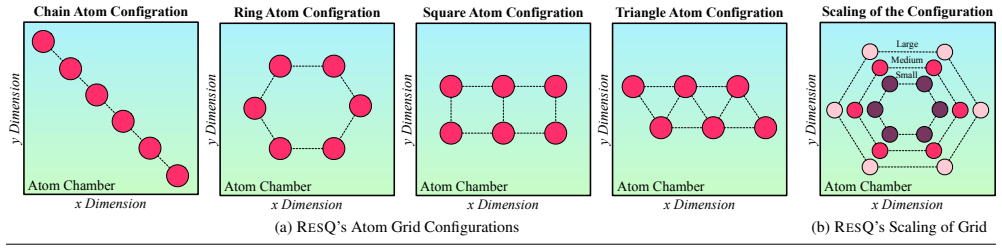
12 micrometers or similar moderate spacing
- Lattice configuration =
square or chain for most tasks
- Gradient samples per update =
20
- Training iterations =
75
- Input scaling ranges =
Omega and Delta in [pi/2, 2pi], h_i in [0,1]
assumptions (6)
- domain assumption The Rydberg Hamiltonian (Eq. 1) with global and local detuning accurately describes the Aquila hardware and its noise.
- ad hoc to paper Continuous Schrödinger evolution under a time-dependent Hamiltonian is equivalent to a residual neural network or neural ODE.
- domain assumption Averaging the measured |1> probabilities over all qubits yields a meaningful scalar class score for binary classification.
- ad hoc to paper The piecewise-linear pulse parameterization theta_j omega_i + theta_{j+1} has sufficient expressivity for the classification tasks.
- domain assumption PCA features with MinMax scaling preserve class-discriminative information for the quantum encoding.
- standard math Schrödinger equation i hbar d|psi>/dt = H(t)|psi> governs the atom array.
Cite this review
Pith. "Pith review of ResQ: A Novel Framework to Implement Residual Neural Networks on Analog Rydberg Atom Quantum Computers." pith.science (2026). https://pith.science/paper/GSGZZA4N
@misc{pith2026250621537,
  author       = {Pith},
  title        = {Pith review of: ResQ: A Novel Framework to Implement Residual Neural Networks on Analog Rydberg Atom Quantum Computers},
  year         = {2026},
  howpublished = {\url{https://pith.science/paper/GSGZZA4N}},
  note         = {Machine review of arXiv:2506.21537}
}
read the original abstract
Research in quantum machine learning has recently proliferated due to the potential of quantum computing to accelerate machine learning. An area of machine learning that has not yet been explored is neural ordinary differential equation (neural ODE) based residual neural networks (ResNets), which aim to improve the effectiveness of neural networks using the principles of ordinary differential equations. In this work, we present our insights about why analog Rydberg atom quantum computers are especially well-suited for ResNets. We also introduce ResQ, a novel framework to optimize the dynamics of Rydberg atom quantum computers to solve classification problems in machine learning using analog quantum neural ODEs.
Figures


Figures from the paper (7 more)


Reference graph
Works this paper leans on
-
[1]
https://www.kaggle.com/datasets/ uciml/pima-indians-diabetes-database, 2024
Pima Indians Diabetes Database. https://www.kaggle.com/datasets/ uciml/pima-indians-diabetes-database, 2024. Accessed: 2024-10-01. 7
work page 2024
-
[2]
Quantum computing optimization technique for iot platform using modified deep residual approach
Rasha M Abd El-Aziz, Ahmed I Taloba, and Fahad A Al- ghamdi. Quantum computing optimization technique for iot platform using modified deep residual approach. Alexandria Engineering Journal, 61(12):12497–12509, 2022. 4
work page 2022
-
[3]
Amazon-Braket. AWS Aquila Interface. https : / / github . com / amazon - braket / amazon - braket - examples / blob / main / examples / analog _ hamiltonian _ simulation / 01 _ Introduction _ to _ Aquila . ipynb, 2024. Ac- cessed: 2024-11-01. 7
work page 2024
-
[4]
Qure: Qubit re-allocation in noisy intermediate-scale quan- tum computers
Abdullah Ash-Saki, Mahabubul Alam, and Swaroop Ghosh. Qure: Qubit re-allocation in noisy intermediate-scale quan- tum computers. In Proceedings of the 56th Annual Design Automation Conference (DAC), pages 1–6, 2019. 2
work page 2019
-
[5]
Measuring analytic gradients of general quantum evolution with the stochastic parameter shift rule
Leonardo Banchi and Gavin E Crooks. Measuring analytic gradients of general quantum evolution with the stochastic parameter shift rule. Quantum, 5:386, 2021. 4, 6
work page 2021
-
[6]
Muqut: Multi-constraint quantum circuit mapping on nisq computers
Debjyoti Bhattacharjee, Abdullah Ash Saki, Mahabubul Alam, Anupam Chattopadhyay, and Swaroop Ghosh. Muqut: Multi-constraint quantum circuit mapping on nisq computers. In 2019 IEEE/ACM international conference on computer-aided design (ICCAD), pages 1–7. IEEE, 2019. 2
work page 2019
-
[7]
Jacob Biamonte, Peter Wittek, Nicola Pancotti, Patrick Rebentrost, Nathan Wiebe, and Seth Lloyd. Quantum ma- chine learning. Nature, 549(7671):195–202, 2017. 1
work page 2017
-
[8]
Challenges and opportu- nities in quantum machine learning
Marco Cerezo, Guillaume Verdon, Hsin-Yuan Huang, Lukasz Cincio, and Patrick J Coles. Challenges and opportu- nities in quantum machine learning. Nature Computational Science, 2(9):567–576, 2022. 1
work page 2022
Show all 40 references
-
[9]
Neural ordinary differential equa- tions
Ricky TQ Chen, Yulia Rubanova, Jesse Bettencourt, and David K Duvenaud. Neural ordinary differential equa- tions. Advances in neural information processing systems , 31, 2018. 1, 3
2018
-
[10]
Learning quantum dynamics with la- tent neural ordinary differential equations.Phys
Matthew Choi, Daniel Flam-Shepherd, Thi Ha Kyaw, and Al´an Aspuru-Guzik. Learning quantum dynamics with la- tent neural ordinary differential equations.Phys. Rev. A, 105: 042403, 2022. 4
2022
-
[11]
The MNIST Database of Handwritten Digit Images for Machine Learning Research
Li Deng. The MNIST Database of Handwritten Digit Images for Machine Learning Research. IEEE Signal Processing Magazine, 29(6):141–142, 2012. 2, 7
2012
-
[12]
DiBrita, Daniel Leeds, Yuqian Huo, Jason Lud- mir, and Tirthak Patel
Nicholas S. DiBrita, Daniel Leeds, Yuqian Huo, Jason Lud- mir, and Tirthak Patel. ReCon: Reconfiguring Analog Ry- dberg Atom Quantum Computers for Quantum Generative Adversarial Networks. In Proceedings of the 43rd Inter- national Conference on Computer-Aided Design (ICCAD) ,
-
[13]
Quantum reinforcement learning
Daoyi Dong, Chunlin Chen, Hanxiong Li, and Tzyh-Jong Tarn. Quantum reinforcement learning. IEEE Transactions on Systems, Man, and Cybernetics, Part B (Cybernetics), 38 (5):1207–1220, 2008. 1
2008
-
[14]
Aug- mented neural odes
Emilien Dupont, Arnaud Doucet, and Yee Whye Teh. Aug- mented neural odes. Advances in neural information pro- cessing systems, 32, 2019. 7
2019
-
[15]
Deep residual learning in spiking neural networks
Wei Fang, Zhaofei Yu, Yanqi Chen, Tiejun Huang, Timoth´ee Masquelier, and Yonghong Tian. Deep residual learning in spiking neural networks. Advances in Neural Information Processing Systems, 34:21056–21069, 2021. 3
2021
-
[16]
Deep residual learning for image recognition
Kaiming He, Xiangyu Zhang, Shaoqing Ren, and Jian Sun. Deep residual learning for image recognition. In Proceed- ings of the IEEE conference on computer vision and pattern recognition, pages 770–778, 2016. 1, 3
2016
-
[17]
Power of data in quantum machine learning
Hsin-Yuan Huang, Michael Broughton, Masoud Mohseni, Ryan Babbush, Sergio Boixo, Hartmut Neven, and Jarrod R McClean. Power of data in quantum machine learning. Na- ture communications, 12(1):2631, 2021. 1
2021
-
[18]
Learning to predict arbitrary quantum processes
Hsin-Yuan Huang, Sitan Chen, and John Preskill. Learning to predict arbitrary quantum processes. PRX Quantum, 4(4): 040337, 2023. 1
2023
-
[19]
Resqnets: a residual approach for mitigating barren plateaus in quantum neural networks
Muhammad Kashif and Saif Al-Kuwari. Resqnets: a residual approach for mitigating barren plateaus in quantum neural networks. EPJ Quantum Technology, 11(1):4, 2024. 4
2024
-
[20]
Resqunns: Towards enabling deep learning in quantum convolution neu- ral networks
Muhammad Kashif and Muhammad Shafique. Resqunns: Towards enabling deep learning in quantum convolution neu- ral networks. arXiv preprint arXiv:2402.09146, 2024. 1
2024 arXiv
-
[21]
Continuous-variable quantum neural networks
Nathan Killoran, Thomas R Bromley, Juan Miguel Ar- razola, Maria Schuld, Nicol ´as Quesada, and Seth Lloyd. Continuous-variable quantum neural networks. Physical Re- view Research, 1(3):033063, 2019. 1, 4
2019
-
[22]
Large- scale Quantum Reservoir Learning with an Analog Quantum Computer
Milan Kornja ˇca, Hong-Ye Hu, Chen Zhao, Jonathan Wurtz, Phillip Weinberg, Majd Hamdan, Andrii Zhdanov, Sergio H Cantu, Hengyun Zhou, Rodrigo Araiza Bravo, et al. Large- scale Quantum Reservoir Learning with an Analog Quantum Computer. arXiv preprint arXiv:2407.02553, 2024. 1, 3
2024 arXiv
-
[23]
Differentiable analog quantum computing for opti- mization and control
Jiaqi Leng, Yuxiang Peng, Yi-Ling Qiao, Ming Lin, and Xi- aodi Wu. Differentiable analog quantum computing for opti- mization and control. Advances in Neural Information Pro- cessing Systems, 35:4707–4721, 2022. 4, 6
2022
-
[24]
Quantum reinforcement learning during human decision-making
Ji-An Li, Daoyi Dong, Zhengde Wei, Ying Liu, Yu Pan, Franco Nori, and Xiaochu Zhang. Quantum reinforcement learning during human decision-making. Nature human be- haviour, 4(3):294–307, 2020. 1
2020
-
[25]
A hybrid quantum–classical neural network with deep residual learning
Yanying Liang, Wei Peng, Zhu-Jun Zheng, Olli Silv ´en, and Guoying Zhao. A hybrid quantum–classical neural network with deep residual learning. Neural Networks, 143:133–147,
-
[26]
Digital-analog Quan- tum Learning on Rydberg Atom Arrays
Jonathan Z Lu, Lucy Jiao, Kristina Wolinski, Milan Kornjaˇca, Hong-Ye Hu, Sergio Cantu, Fangli Liu, Su- sanne F Yelin, and Sheng-Tao Wang. Digital-analog Quan- tum Learning on Rydberg Atom Arrays. arXiv preprint arXiv:2401.02940, 2024. 3, 8
2024 arXiv
-
[27]
Digital–analog quantum learn- ing on rydberg atom arrays
Jonathan Z Lu, Lucy Jiao, Kristina Wolinski, Milan Ko- rnjaˇca, Hong-Ye Hu, Sergio Cantu, Fangli Liu, Susanne F Yelin, and Sheng-Tao Wang. Digital–analog quantum learn- ing on rydberg atom arrays. Quantum Science and Technol- ogy, 10(1):015038, 2024. 4
2024
-
[28]
Opportunities in quantum reservoir com- puting and extreme learning machines
Pere Mujal, Rodrigo Mart ´ınez-Pe˜na, Johannes Nokkala, Jorge Garc´ıa-Beni, Gian Luca Giorgi, Miguel C Soriano, and Roberta Zambrini. Opportunities in quantum reservoir com- puting and extreme learning machines. Advanced Quantum Technologies, 4(8):2100027, 2021. 1 10
2021
-
[29]
Neural schr ¨odinger equation: Physical law as deep neural network
Mitsumasa Nakajima, Kenji Tanaka, and Toshikazu Hashimoto. Neural schr ¨odinger equation: Physical law as deep neural network. IEEE Transactions on Neural Net- works and Learning Systems, 33(6):2686–2700, 2022. 4
2022
-
[30]
Disq: a novel quantum output state classification method on ibm quantum comput- ers using openpulse
Tirthak Patel and Devesh Tiwari. Disq: a novel quantum output state classification method on ibm quantum comput- ers using openpulse. InProceedings of the 39th International Conference on Computer-Aided Design, pages 1–9, 2020. 2
2020
-
[31]
OPTIC: A Practical Quantum Binary Classifier for Near-term Quan- tum Computers
Tirthak Patel, Daniel Silver, and Devesh Tiwari. OPTIC: A Practical Quantum Binary Classifier for Near-term Quan- tum Computers. In 2022 Design, Automation & Test in Europe Conference & Exhibition (DATE) , pages 334–339. IEEE, 2022. 2
2022
-
[32]
Quantum convolutional neural networks (qcnn) using deep learning for computer vision applications
Varadi Rajesh, Umesh Parameshwar Naik, et al. Quantum convolutional neural networks (qcnn) using deep learning for computer vision applications. In 2021 International confer- ence on recent trends on electronics, information, communi- cation & technology (RTEICT), pages 728–73...
2021
-
[33]
ProxiML: Building Machine Learning Classifiers for Photonic Quantum Computing
Aditya Ranjan, Tirthak Patel, Daniel Silver, Harshitta Gandhi, and Devesh Tiwari. ProxiML: Building Machine Learning Classifiers for Photonic Quantum Computing. In Proceedings of the 29th ACM International Conference on Architectural Support for Programming Languages and Op- e...
2024
-
[34]
MosaiQ: Quantum Generative Adversarial Networks for Image Generation on NISQ Computers
Daniel Silver, Tirthak Patel, William Cutler, Aditya Ranjan, Harshitta Gandhi, and Devesh Tiwari. MosaiQ: Quantum Generative Adversarial Networks for Image Generation on NISQ Computers. In Proceedings of the IEEE/CVF Inter- national Conference on Computer Vision, pages 7030–7039,
-
[35]
SliQ: Quantum Image Similarity Networks on Noisy Quantum Computers
Daniel Silver, Tirthak Patel, Aditya Ranjan, Harshitta Gandhi, William Cutler, and Devesh Tiwari. SliQ: Quantum Image Similarity Networks on Noisy Quantum Computers. In Proceedings of the AAAI Conference on Artificial Intelli- gence, pages 9846–9854, 2023. 1
2023
-
[36]
Quantumnat: quantum noise-aware training with noise injection, quantization and normalization
Hanrui Wang, Jiaqi Gu, Yongshan Ding, Zirui Li, Frederic T Chong, David Z Pan, and Song Han. Quantumnat: quantum noise-aware training with noise injection, quantization and normalization. In Proceedings of the 59th ACM/IEEE design automation conference, pages 1–6, 2022. 2
2022
-
[37]
Enhancing the expressivity of quantum neural networks with residual connections
Jingwei Wen, Zhiguo Huang, Dunbo Cai, and Ling Qian. Enhancing the expressivity of quantum neural networks with residual connections. Communications Physics , 7(1):220,
-
[38]
Non-native Quantum Generative Optimization with Adversarial Autoencoders
Blake A Wilson, Jonathan Wurtz, Vahagn Mkhitaryan, Michael Bezick, Sheng-Tao Wang, Sabre Kais, Vladimir M Shalaev, and Alexandra Boltasseva. Non-native Quantum Generative Optimization with Adversarial Autoencoders. arXiv preprint arXiv:2407.13830, 2024. 3
2024 arXiv
-
[39]
Aquila: QuEra’s 256-Qubit Neutral-Atom Quantum Com- puter
Jonathan Wurtz, Alexei Bylinskii, Boris Braverman, Jesse Amato-Grill, Sergio H Cantu, Florian Huber, Alexander Lukin, Fangli Liu, Phillip Weinberg, John Long, et al. Aquila: QuEra’s 256-Qubit Neutral-Atom Quantum Com- puter. arXiv preprint arXiv:2306.11727, 2023. 3, 7
2023 arXiv
-
[40]
Fashion- mnist: a novel image dataset for benchmarking machine learning algorithms
Han Xiao, Kashif Rasul, and Roland V ollgraf. Fashion- mnist: a novel image dataset for benchmarking machine learning algorithms. arXiv preprint arXiv:1708.07747, 2017. 7 11
2017 arXiv
Reviewed August 6, 2026 · model on record in the stance chip above.
Discussion (0). Sign in to comment.