LUNAR: a Monte Carlo generator for bound-nucleon decay in liquid argon
Pith reviewed 2026-07-01 01:19 UTC · model grok-4.3
The pith
A Monte Carlo generator shows final-state interactions in argon preserve the supersymmetry-favored proton decay signal while halving other rates.
A machine-rendered reading of the paper's core claim, the machinery that carries it, and where it could break.
Core claim
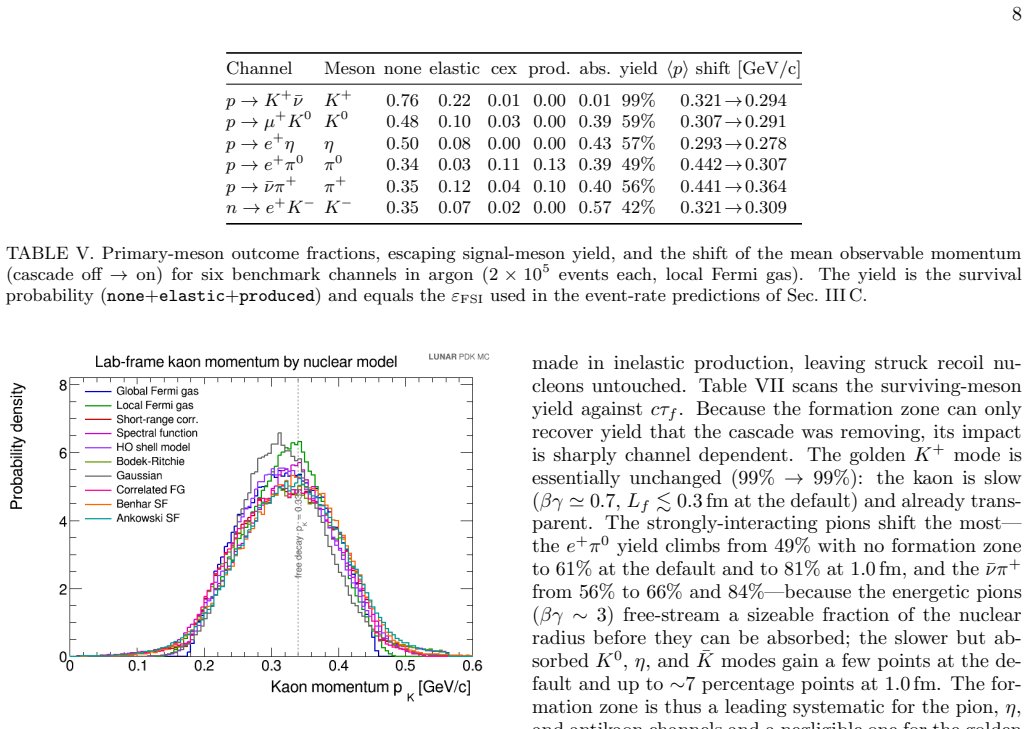
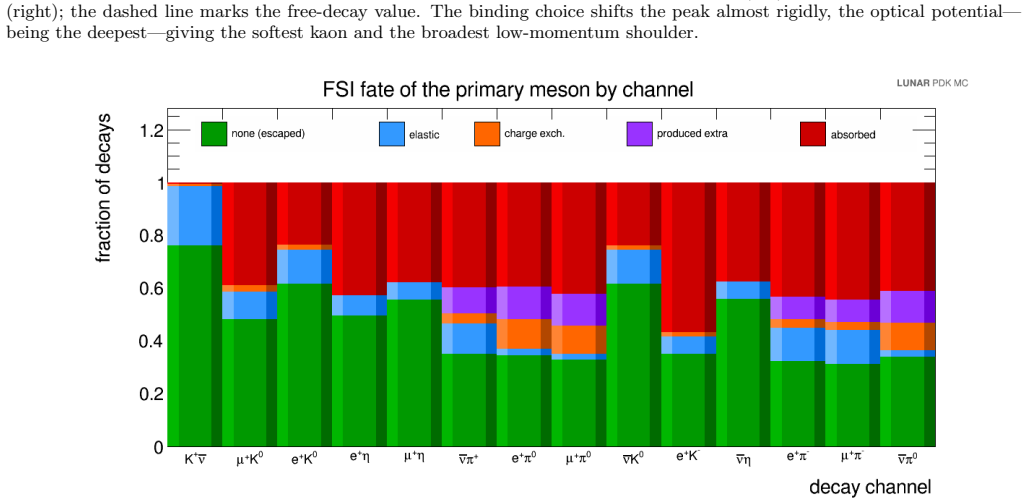
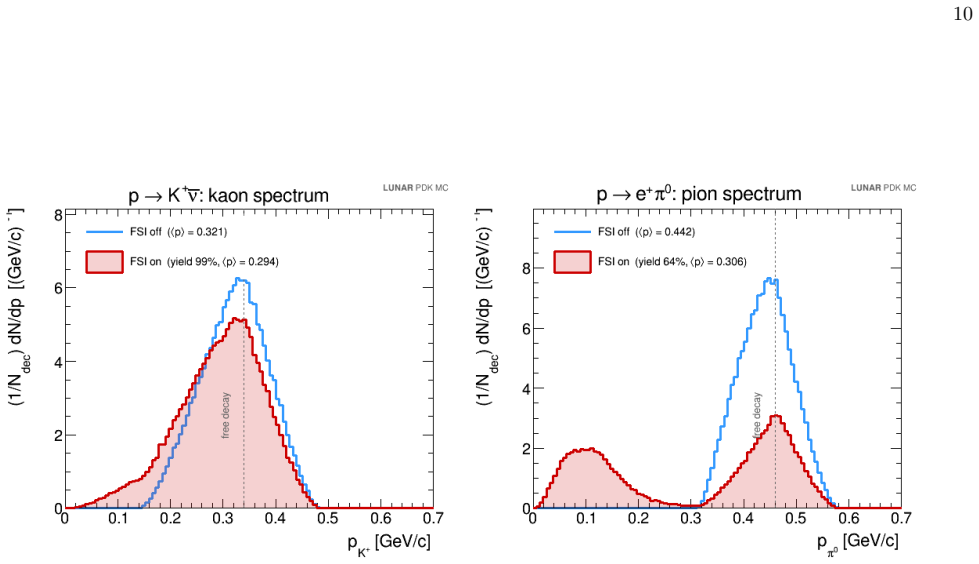
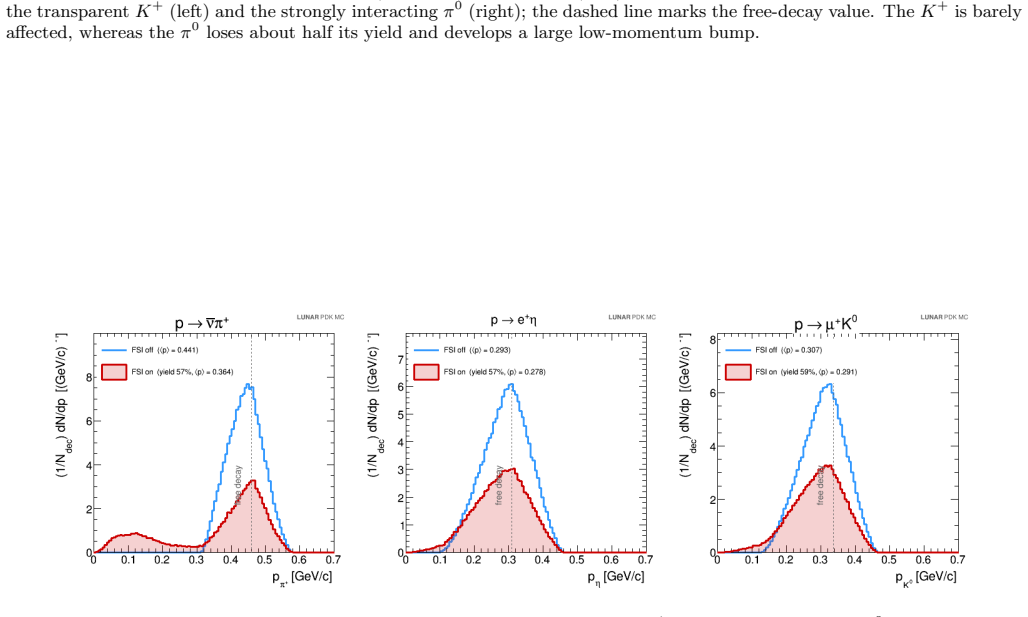
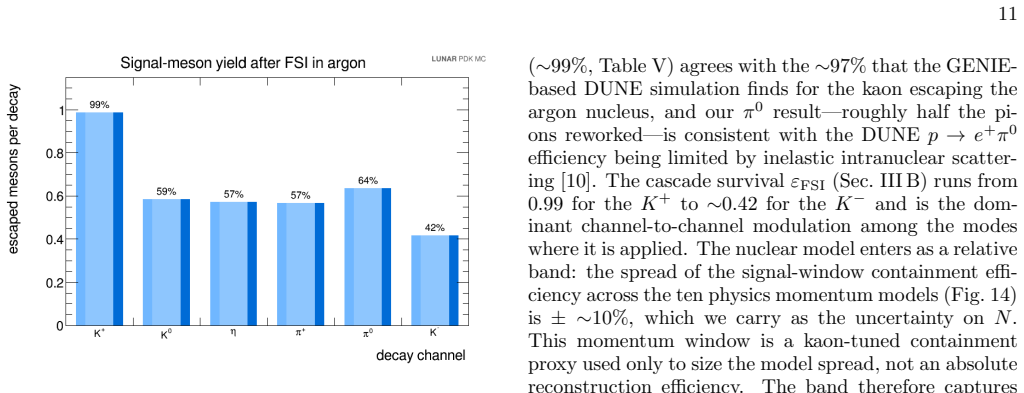
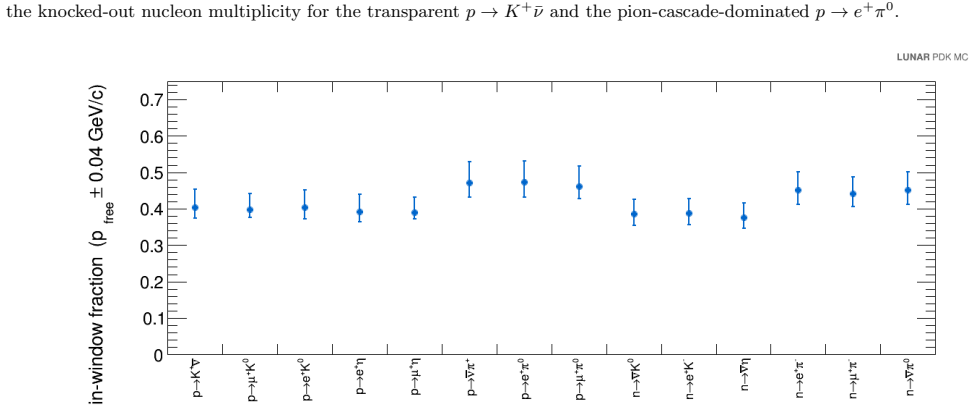
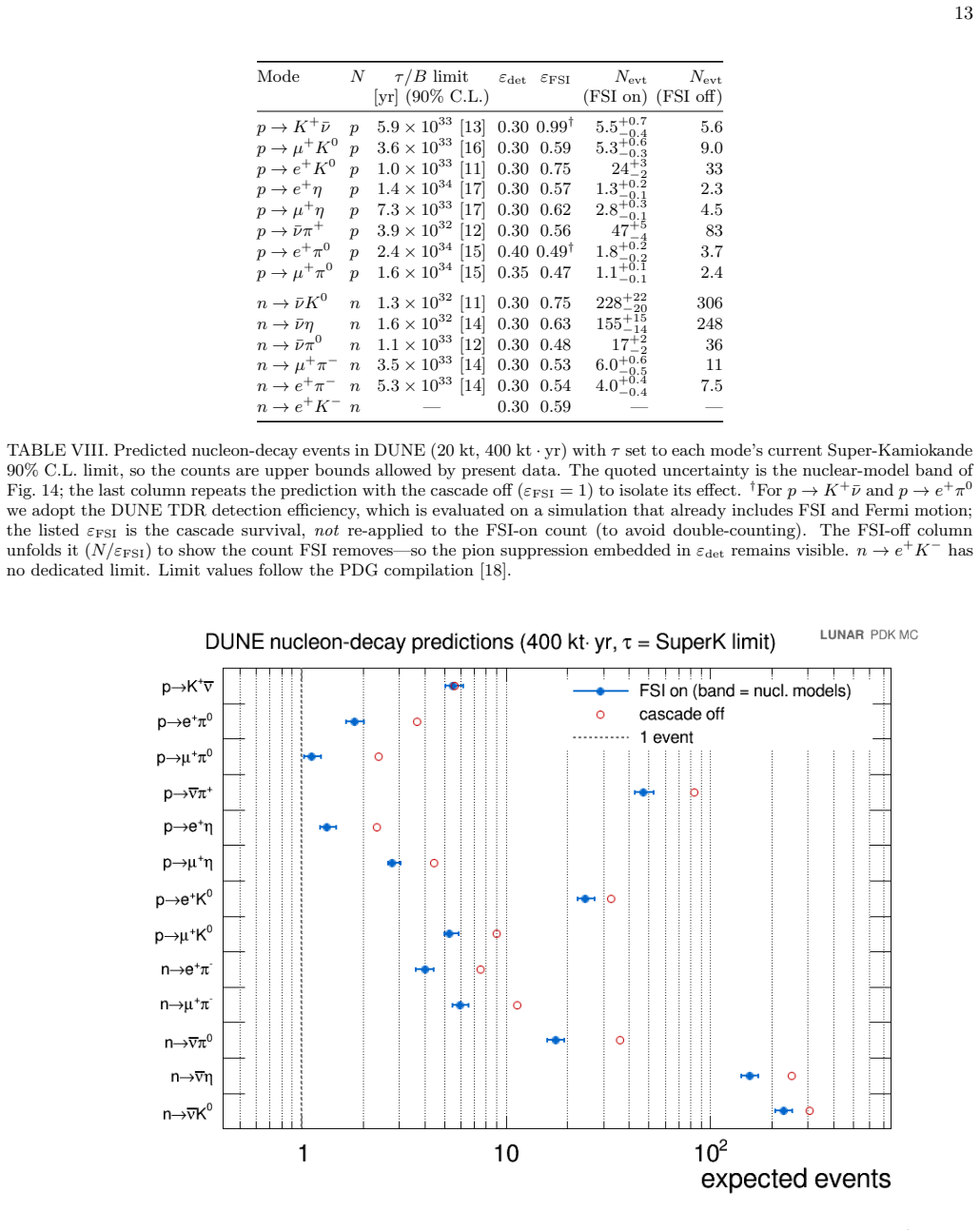
LUNAR generates bound-nucleon decays by selecting from ten momentum distributions and three removal-energy prescriptions, executes the two-body decay off-shell then boosts to the lab frame, and applies a semi-classical intranuclear cascade with optional formation zone to the daughter meson, yielding the result that final-state interactions leave the supersymmetry-favored p to K+ anti-nu signal essentially intact while roughly halving the pion, eta, and antikaon rates—an effect that dominates over the plus or minus 10 percent spread from nuclear model choice.
What carries the argument
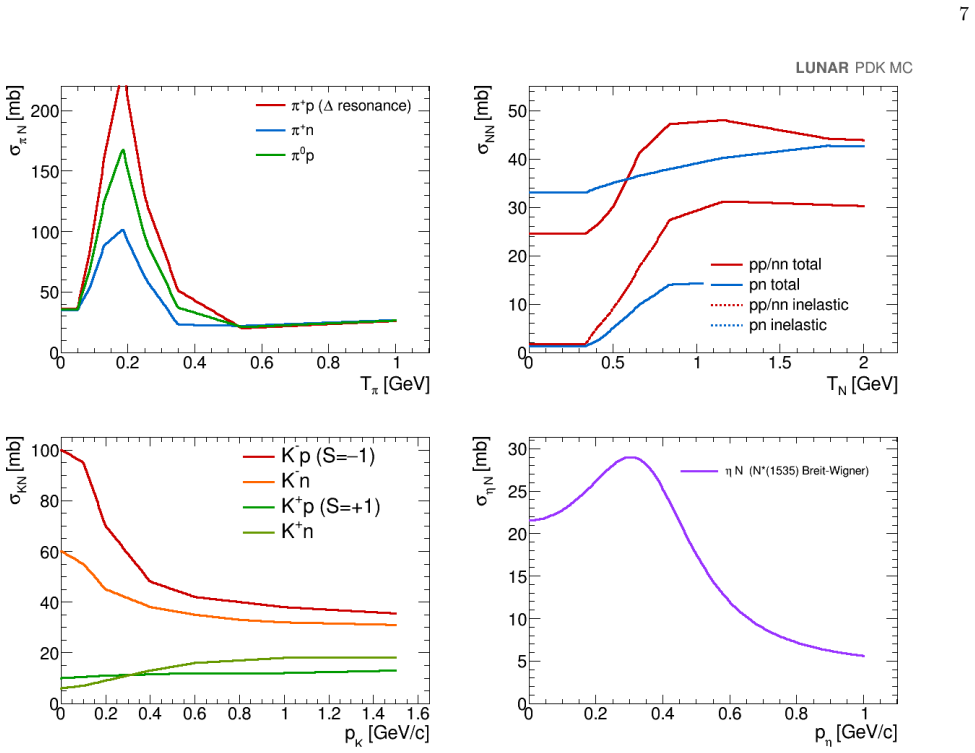
The semi-classical intranuclear cascade with optional formation zone that propagates the daughter meson out of the argon nucleus after the off-shell decay is generated from selectable nuclear ground states.
If this is right
- Allows translation of Super-Kamiokande limits into expected DUNE event yields across standard decay modes.
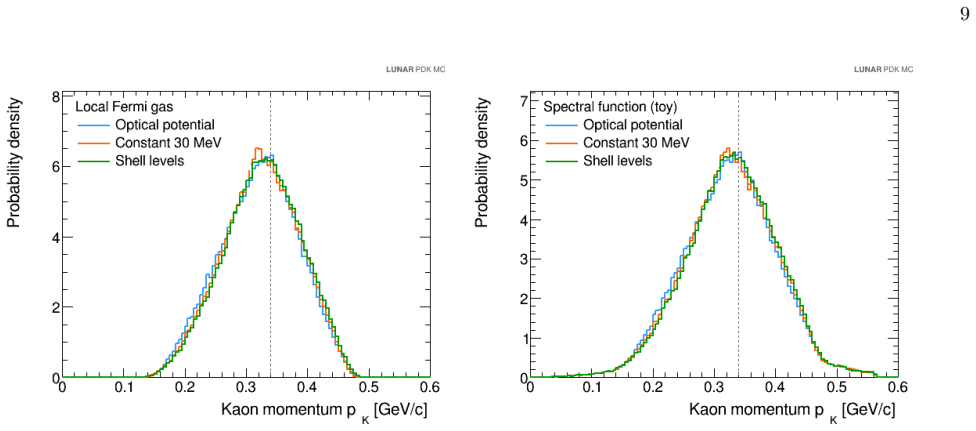
- Separates the distinct contributions of Fermi motion and binding energy to the observable meson spectrum.
- Quantifies final-state interaction effects separately for each decay channel.
- Shows that nuclear model choice induces only a plus or minus 10 percent variation, smaller than the final-state interaction impact.
Where Pith is reading between the lines
- The differential impact on channels suggests DUNE analyses can retain higher efficiency for the K+ nu mode than for pion modes.
- Open release of the code supports community-wide studies of signal efficiency and systematic uncertainties in nucleon decay searches.
- The framework could be applied to assess similar final-state effects in other nuclei used by different experiments.
Load-bearing premise
The semi-classical intranuclear cascade with optional formation zone accurately models the propagation of the daughter meson through the argon nucleus.
What would settle it
A high-statistics measurement of the detected meson momentum spectra or channel-by-channel rate ratios in argon that deviates markedly from the predictions of LUNAR would indicate that the cascade treatment of final-state interactions is inaccurate.
Figures

read the original abstract
The search for nucleon decay in liquid-argon time-projection chambers requires a quantitative description of how the bound nuclear environment reshapes the decay-product kinematics. We present LUNAR, a fast, openly available Monte Carlo generator dedicated to two-body decays of protons and neutrons bound in argon-40, the target nucleus of the DUNE far detector. The parent nucleon is drawn from a selectable nuclear ground state -- ten momentum distributions ranging from mean-field Fermi gases to argon spectral functions -- and bound off the mass shell by one of three removal-energy prescriptions, including the momentum-dependent optical potential of Juszczak \textit{et al}. The two-body decay is performed off-shell and boosted to the laboratory frame, and the daughter meson is then propagated out of the nucleus by a semi-classical intranuclear cascade with an optional formation zone for the freshly produced meson. We use the generator to separate the distinct roles of Fermi motion and binding in shaping the observable meson spectrum, to quantify final-state interactions channel by channel, and to translate present Super-Kamiokande limits into expected DUNE event yields for the full set of standard decay modes. Final-state interactions leave the supersymmetry-favored $p\to K^{+}\bar\nu$ signal essentially intact while roughly halving the pion, $\eta$, and antikaon rates -- an effect that dominates over the $\pm10\%$ spread induced by the choice of nuclear model. The code is released to the community as a lightweight, extensible tool for signal efficiency and systematics studies.
Editorial analysis
A structured set of objections, weighed in public.
Referee Report
Summary. The paper introduces LUNAR, a Monte Carlo generator for two-body bound-nucleon decays (p and n) in 40Ar. It samples the parent nucleon from one of ten nuclear momentum distributions and three removal-energy prescriptions (including the Juszczak et al. optical potential), performs the decay off-shell, boosts to the lab frame, and propagates the daughter meson via a semi-classical intranuclear cascade that includes an optional formation zone. The generator is used to isolate Fermi-motion versus binding effects on meson spectra, to compute channel-by-channel FSI survival probabilities, and to convert existing Super-Kamiokande limits into expected DUNE yields. The central quantitative claim is that FSI leaves the SUSY-favored p → K+ ν-bar mode essentially intact while suppressing pion, η, and antikaon rates by roughly a factor of two—an effect stated to dominate the ±10 % variation arising from choice of nuclear model.
Significance. If validated, LUNAR supplies a lightweight, openly released tool tailored to liquid-argon detectors that cleanly separates nuclear initial-state and final-state effects for nucleon-decay searches. The explicit release of the code and the systematic exploration of multiple nuclear prescriptions are positive features that facilitate community use and systematic studies. The reported differential FSI survival (K+ preserved versus other mesons halved) would, if robust, be directly relevant to DUNE sensitivity projections.
major comments (2)
- [Abstract, §3.2, §4] Abstract and §4 (results on FSI): The claim that FSI “roughly halving the pion, η, and antikaon rates” while leaving the K+ mode “essentially intact” and dominating the ±10 % nuclear-model spread rests entirely on the semi-classical intranuclear cascade described in §3.2. No comparison is shown to measured meson-nucleus attenuation lengths, resonance absorption cross sections, or to established transport codes (GiBUU, NEUT, GENIE FSI) for 40Ar. Without such benchmarks the channel-dependent suppression factors cannot be assessed as robust predictions rather than artifacts of the chosen transport model.
- [§3.2] §3.2 (cascade implementation): The optional formation zone is introduced without a quantitative study of its impact on low-momentum mesons or a demonstration that the formation-time parameter choice does not alter the reported factor-of-two suppression hierarchy. Because the differential FSI effect is load-bearing for the DUNE-yield translation, this parameter freedom must be explored and its uncertainty propagated.
minor comments (2)
- [Abstract, §2] The abstract states that ten momentum distributions are implemented but does not list their explicit functional forms or reference the original papers for each; a compact table in §2 would improve reproducibility.
- [§4 figures] Figure captions (presumably in §4) should explicitly state the number of generated events per curve and whether statistical uncertainties are shown; the current description leaves the precision of the quoted “roughly halving” factors unclear.
Simulated Author's Rebuttal
We thank the referee for the careful reading of the manuscript and for the constructive comments on the validation of the final-state interaction modeling. We address each major comment below and outline the revisions that will be made to strengthen the paper.
read point-by-point responses
-
Referee: [Abstract, §3.2, §4] Abstract and §4 (results on FSI): The claim that FSI “roughly halving the pion, η, and antikaon rates” while leaving the K+ mode “essentially intact” and dominating the ±10 % nuclear-model spread rests entirely on the semi-classical intranuclear cascade described in §3.2. No comparison is shown to measured meson-nucleus attenuation lengths, resonance absorption cross sections, or to established transport codes (GiBUU, NEUT, GENIE FSI) for 40Ar. Without such benchmarks the channel-dependent suppression factors cannot be assessed as robust predictions rather than artifacts of the chosen transport model.
Authors: We agree that explicit benchmarks would improve the robustness assessment. The LUNAR cascade employs standard semi-classical propagation with total and absorption cross sections drawn from established compilations in the literature. In the revised manuscript we will expand §3.2 to include a direct comparison of the effective attenuation lengths for pions, kaons, and etas in 40Ar against available experimental data on meson-nucleus transmission, together with a brief qualitative comparison to results from GiBUU for comparable kinematics. This addition will show that the reported differential survival (K+ largely preserved, other mesons suppressed by ~2) follows from the well-known momentum dependence of the relevant cross sections rather than from model-specific artifacts. revision: yes
-
Referee: [§3.2] §3.2 (cascade implementation): The optional formation zone is introduced without a quantitative study of its impact on low-momentum mesons or a demonstration that the formation-time parameter choice does not alter the reported factor-of-two suppression hierarchy. Because the differential FSI effect is load-bearing for the DUNE-yield translation, this parameter freedom must be explored and its uncertainty propagated.
Authors: We accept that the sensitivity to the formation-zone parameter requires explicit quantification. The revised §3.2 will contain a dedicated parameter scan over a physically motivated range of formation times, showing the resulting variation in low-momentum meson spectra and in the channel-by-channel survival probabilities. The uncertainty arising from this choice will be propagated into the DUNE event-yield estimates of §4, confirming that the factor-of-two hierarchy between the K+ mode and the other channels remains stable within the explored range. revision: yes
Circularity Check
No circularity: generator assembles external nuclear distributions and standard cascade; FSI outputs are simulation results, not fitted inputs
full rationale
The paper describes LUNAR as a Monte Carlo tool that draws parent nucleons from literature momentum distributions (ten options ranging from Fermi gases to spectral functions) and applies removal energies from external references including Juszczak et al. The two-body decay is performed off-shell and the daughter meson is propagated via a semi-classical intranuclear cascade with optional formation zone. The reported channel-dependent FSI survival probabilities (K+ intact, pions/η halved) are direct outputs of this propagation step rather than quantities fitted or defined inside the paper. No equations reduce these factors to self-referential inputs, no uniqueness theorems are imported via self-citation, and no ansatz is smuggled through prior work by the same authors. The central claims rest on established external models and are therefore self-contained against benchmarks outside the present work.
Axiom & Free-Parameter Ledger
free parameters (2)
- nuclear momentum distributions
- removal-energy prescriptions
axioms (2)
- domain assumption The parent nucleon is off the mass shell and the two-body decay is performed off-shell before boosting to the laboratory frame.
- domain assumption A semi-classical intranuclear cascade with optional formation zone models the final-state interactions of the daughter meson.
Reference graph
Works this paper leans on
-
[1]
Georgi and S
H. Georgi and S. L. Glashow, Phys. Rev. Lett.32, 438 (1974)
1974
-
[2]
J. C. Pati and A. Salam, Phys. Rev. D10, 275 (1974); 11, 703(E) (1975)
1974
-
[3]
Weinberg, Phys
S. Weinberg, Phys. Rev. Lett.43, 1566 (1979)
1979
-
[4]
Wilczek and A
F. Wilczek and A. Zee, Phys. Rev. Lett.43, 1571 (1979)
1979
-
[5]
Sakai and T
N. Sakai and T. Yanagida, Nucl. Phys. B197, 533 (1982)
1982
-
[6]
Dimopoulos, S
S. Dimopoulos, S. Raby, and F. Wilczek, Phys. Lett. B 112, 133 (1982)
1982
-
[7]
Proton stability in grand unified theories, in strings, and in branes
P. Nath and P. Fileviez P´ erez, Phys. Rept.441, 191 (2007), arXiv:hep-ph/0601023
work page internal anchor Pith review Pith/arXiv arXiv 2007
-
[8]
K. S. Babuet al., “Working Group Report: Baryon Num- ber Violation,” arXiv:1311.5285
work page internal anchor Pith review Pith/arXiv arXiv
-
[9]
D. G. Phillips IIet al., Phys. Rept.612, 1 (2016), arXiv:1410.1100
work page internal anchor Pith review Pith/arXiv arXiv 2016
-
[10]
DUNE Collaboration (B. Abiet al.), “DUNE Far Detec- tor Technical Design Report, Volume II: DUNE Physics,” arXiv:2002.03005
-
[11]
Super-Kamiokande Collaboration (K. Kobayashiet al.), Phys. Rev. D72, 052007 (2005), arXiv:hep-ex/0502026
work page internal anchor Pith review Pith/arXiv arXiv 2005
-
[12]
Super-Kamiokande Collaboration (K. Abeet al.), Phys. Rev. Lett.113, 121802 (2014), arXiv:1305.4391
work page internal anchor Pith review Pith/arXiv arXiv 2014
-
[13]
Super-Kamiokande Collaboration (K. Abeet al.), Phys. Rev. D90, 072005 (2014), arXiv:1408.1195
work page internal anchor Pith review Pith/arXiv arXiv 2014
-
[14]
Super-Kamiokande Collaboration (K. Abeet al.), Phys. Rev. D96, 012003 (2017), arXiv:1705.07221
work page internal anchor Pith review Pith/arXiv arXiv 2017
-
[15]
Super-Kamiokande Collaboration (A. Takenakaet al.), Phys. Rev. D102, 112011 (2020), arXiv:2010.16098
-
[16]
Super-Kamiokande Collaboration (A. Takenakaet al.), Phys. Rev. D106, 072003 (2022), arXiv:2208.13188
-
[17]
Super-Kamiokande Collaboration (N. Taniuchiet al.), Phys. Rev. D110, 112011 (2024), arXiv:2409.19633
-
[18]
Navaset al.), Phys
Particle Data Group (S. Navaset al.), Phys. Rev. D110, 030001 (2024)
2024
-
[19]
Spectrum of outgoing nucleons in quasielastic neutrino-nucleus interactions
C. Juszczak, J. A. Nowak, and J. T. Sobczyk, Eur. Phys. J. C39, 195 (2005), arXiv:nucl-th/0311051
work page internal anchor Pith review Pith/arXiv arXiv 2005
-
[20]
Bodek and J
A. Bodek and J. L. Ritchie, Phys. Rev. D24, 1400 (1981); see also23, 1070 (1981)
1981
-
[21]
Jefferson Lab Hall A Collaboration (L. Jianget al.), Phys. Rev. D105, 112002 (2022), arXiv:2203.01748
- [22]
-
[23]
Developments in NuWro Monte Carlo generator,
H. Prasadet al.(NuWro), “Developments in NuWro Monte Carlo generator,” arXiv:2501.11470
-
[24]
Metropoliset al., Phys
N. Metropoliset al., Phys. Rev.110, 185 (1958)
1958
-
[25]
Metropoliset al., Phys
N. Metropoliset al., Phys. Rev.110, 204 (1958)
1958
-
[26]
L. L. Salcedo, E. Oset, M. J. Vicente-Vacas, and C. Garcia-Recio, Nucl. Phys. A484, 557 (1988). 16
1988
-
[27]
Final State Interactions Effects in Neutrino-Nucleus Interactions
T. Golan, C. Juszczak, and J. T. Sobczyk, Phys. Rev. C 86, 015505 (2012), arXiv:1202.4197
work page internal anchor Pith review Pith/arXiv arXiv 2012
-
[28]
Oset and L
E. Oset and L. L. Salcedo, Nucl. Phys. A468, 631 (1987)
1987
-
[29]
The GENIE Neutrino Monte Carlo Generator
C. Andreopouloset al., Nucl. Instrum. Meth. A614, 87 (2010), arXiv:0905.2517
work page internal anchor Pith review Pith/arXiv arXiv 2010
-
[30]
Transport-theoretical Description of Nuclear Reactions
O. Busset al., Phys. Rept.512, 1 (2012), arXiv:1106.1344
work page internal anchor Pith review Pith/arXiv arXiv 2012
- [31]
-
[32]
Understanding the impact of nuclear effects on proton decay searches with the GiBUU model
Q. Yan, A. Takenaka, K. Gallmeister, X.-G. Lu, U. Mosel, and Y. Zheng, “Understanding the impact of nuclear effects on proton decay searches with the GiBUU model,” Phys. Rev. D113, 095039 (2026), arXiv:2602.23063
work page internal anchor Pith review Pith/arXiv arXiv 2026
-
[33]
Nuclear effects in proton decay,
D. Barbu, M. Parvu, and I. Lazanu, “Nuclear effects in proton decay,” Mod. Phys. Lett. A40, 2550038 (2025), arXiv:2502.13981
-
[34]
C. B. Dover and G. E. Walker, Phys. Rept.89, 1 (1982)
1982
-
[35]
In-medium nuclear interactions of low-energy hadrons
E. Friedman and A. Gal, Phys. Rept.452, 89 (2007), arXiv:0705.3965
work page internal anchor Pith review Pith/arXiv arXiv 2007
-
[36]
Buenoet al., JHEP04, 041 (2007), arXiv:hep- ph/0701101
A. Buenoet al., JHEP04, 041 (2007), arXiv:hep- ph/0701101
-
[37]
A. Buckleyet al., Comput. Phys. Commun.260, 107310 (2021), arXiv:1912.08005
-
[38]
NuHepMC: A standardized event record format for neu- trino event generators,
S. Gardiner, J. Isaacson, and L. Pickering (NuHepMC), “NuHepMC: A standardized event record format for neu- trino event generators,” SciPost Phys. Codebases57 (2025), arXiv:2310.13211
discussion (0)
Sign in with ORCID, Apple, or X to comment. Anyone can read and Pith papers without signing in.