Thermoelectric response of a ferroelectric insulator
Pith reviewed 2026-06-26 05:19 UTC · model grok-4.3
The pith
Ferroelectric materials produce a Peltier thermoelectric response from bound charges with coefficients over 100 V near their phase transition.
A machine-rendered reading of the paper's core claim, the machinery that carries it, and where it could break.
Core claim
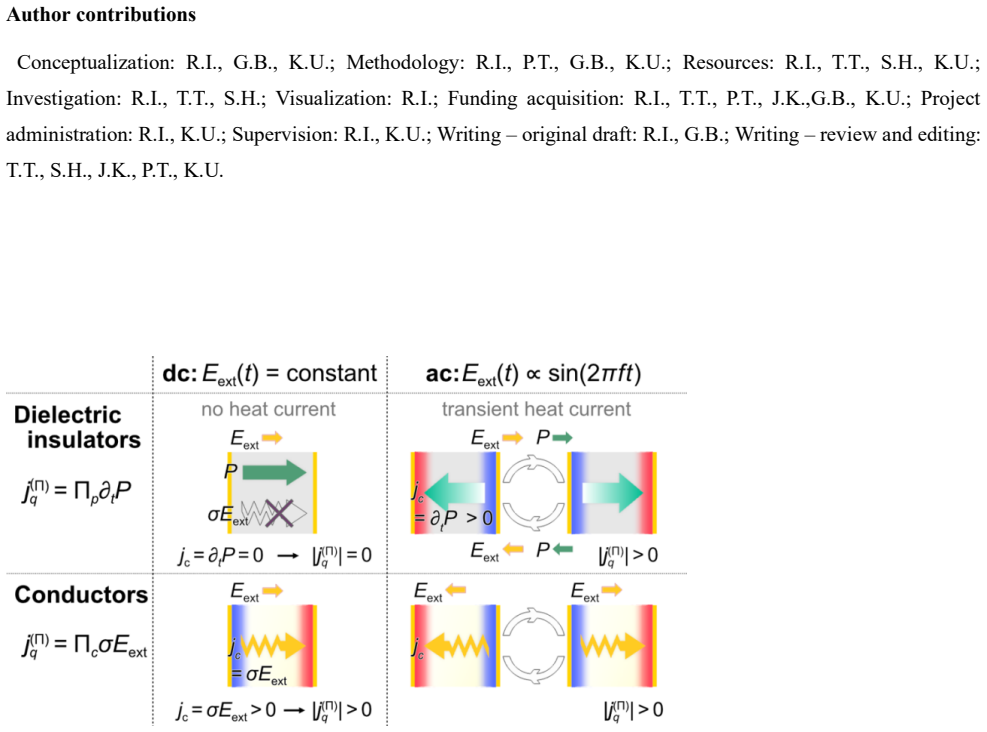
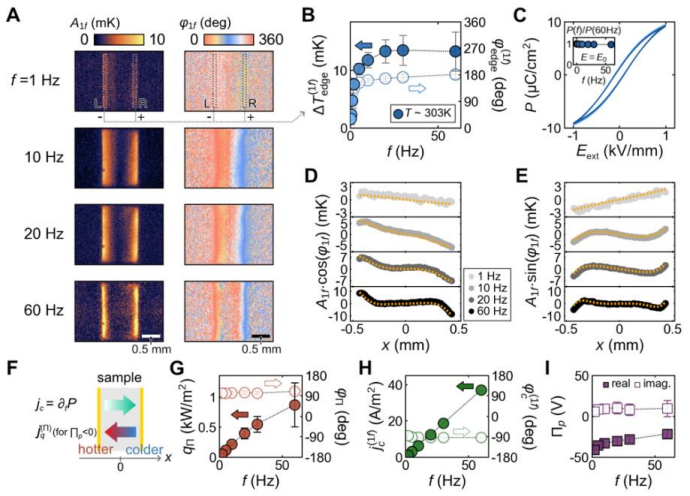
The observed temperature gradient in the ferroelectric under an ac electric field depends on the field-induced displacement current, representing a Peltier effect in a dielectric material. Its coefficient exceeds 100 V around the ferroelectric-paraelectric phase transition, which is several orders of magnitude greater than reported values in conductors. This uncovers previously hidden functionalities of ferroelectric materials for thermal management by directional heat transport.
What carries the argument
The Peltier effect driven by the field-induced displacement current of bound charges in the ferroelectric insulator.
If this is right
- The effect allows for directional heat transport using bound charges in ferroelectrics.
- The thermoelectric coefficient is maximized near the phase transition.
- Ferroelectrics can enable thermal management without moving parts or mobile charges.
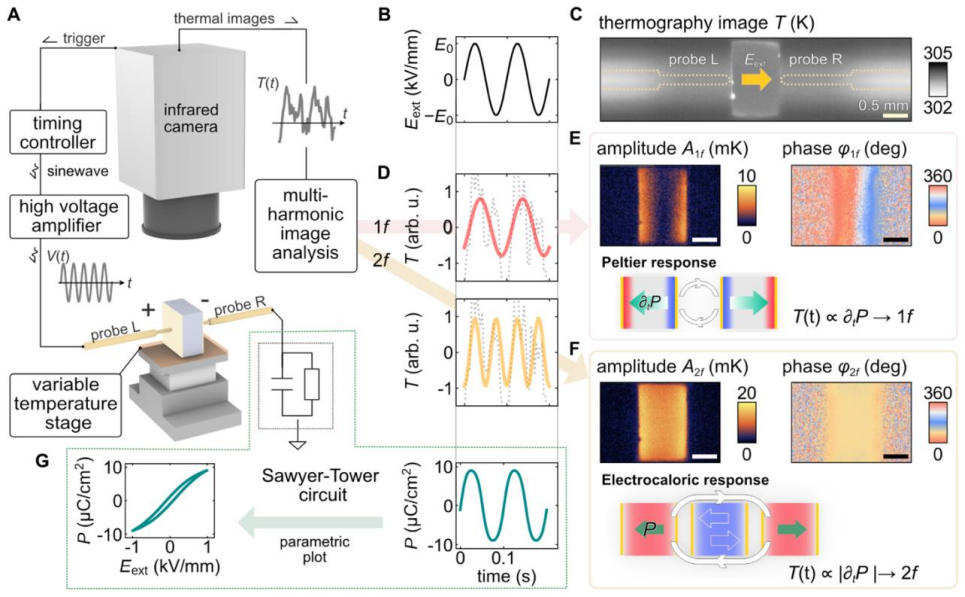
- The response can be measured using multi-harmonic lock-in thermography under ac fields.
Where Pith is reading between the lines
- This mechanism may extend to other polar dielectrics with large changes in polarization for similar thermoelectric responses.
- Electric-field control of heat flow could be integrated into ferroelectric-based capacitors or memory devices.
- Frequency-dependent studies might identify optimal operating conditions for practical thermal applications.
Load-bearing premise
The temperature changes result only from the Peltier response to the displacement current of bound charges without contributions from Joule heating or experimental artifacts.
What would settle it
A measurement in which the temperature gradient disappears when the displacement current is suppressed while the applied electric field strength remains constant.
Figures
read the original abstract
Thermoelectric effects enable the conversion between heat and electricity without moving parts. While conventionally associated with mobile charges, we report thermoelectricity caused by bound charges in the form of temperature changes measured by multi-harmonic lock-in thermography of a ferroelectric under an ac electric field. The observed temperature gradient depends on the field-induced displacement current, a Peltier effect in a dielectric material. Its coefficient exceeds 100 V around the ferroelectric-paraelectric phase transition, which is several orders of magnitude greater than reported values in conductors. Our findings uncover previously hidden functionalities of ferroelectric materials for thermal management by directional heat transport in ferroelectrics.
Editorial analysis
A structured set of objections, weighed in public.
Referee Report
Summary. The manuscript reports an experimental observation of temperature gradients in a ferroelectric material under an applied AC electric field, measured via multi-harmonic lock-in thermography. The authors attribute the ω-frequency component of the gradient to a Peltier-like thermoelectric response arising from the field-induced displacement current of bound charges rather than mobile carriers. They report a thermoelectric coefficient exceeding 100 V near the ferroelectric-paraelectric phase transition, orders of magnitude larger than typical values in conductors, and suggest applications in directional heat transport and thermal management.
Significance. If the central interpretation is substantiated, the result would identify a previously unrecognized thermoelectric mechanism in insulating ferroelectrics driven by bound-charge currents. The reported magnitude near the phase transition and the use of a non-contact thermography method could open routes to field-tunable thermal devices without mobile carriers, provided the effect can be cleanly separated from known field-driven caloric responses.
major comments (2)
- [Results and Discussion (interpretation of ω component)] The central claim that the observed spatial temperature gradient arises from a current-driven Peltier response (J_d = dD/dt) rather than a field-driven mechanism requires explicit experimental discrimination. The multi-harmonic lock-in method isolates the ω component from 2ω (Joule) heating, but both the claimed Peltier effect and the electrocaloric effect produce temperature oscillations linear in E at frequency ω. No quantitative test (e.g., dependence of gradient amplitude on drive frequency, phase lag relative to current vs. field, or reversal of electrode polarity while keeping E direction fixed) is described that would falsify an electrocaloric contribution.
- [Abstract and Results (coefficient extraction)] The reported coefficient >100 V is stated to be several orders of magnitude larger than in conductors, yet the manuscript supplies no direct comparison of the measured heat flux or effective thermal conductivity under the same conditions, nor an estimate of the fraction of the displacement current that participates in the thermoelectric transport. Without these, the magnitude cannot be assessed as physically consistent with a Peltier mechanism.
minor comments (2)
- [Methods] Notation for the thermoelectric coefficient is introduced without an explicit defining equation relating measured ΔT, current density, and geometry; this should be added for reproducibility.
- [Figures] Figure captions should state the exact drive frequency, amplitude, and sample thickness used for each thermography dataset.
Simulated Author's Rebuttal
We thank the referee for their careful reading of the manuscript and for identifying key points that require clarification. We address each major comment below and have revised the manuscript to strengthen the interpretation and quantitative support for our claims.
read point-by-point responses
-
Referee: [Results and Discussion (interpretation of ω component)] The central claim that the observed spatial temperature gradient arises from a current-driven Peltier response (J_d = dD/dt) rather than a field-driven mechanism requires explicit experimental discrimination. The multi-harmonic lock-in method isolates the ω component from 2ω (Joule) heating, but both the claimed Peltier effect and the electrocaloric effect produce temperature oscillations linear in E at frequency ω. No quantitative test (e.g., dependence of gradient amplitude on drive frequency, phase lag relative to current vs. field, or reversal of electrode polarity while keeping E direction fixed) is described that would falsify an electrocaloric contribution.
Authors: We agree that explicit discrimination between current-driven and field-driven contributions is necessary. The original manuscript bases the attribution on the observed dependence of the temperature gradient on the displacement current. In the revised version we have added a quantitative analysis of the phase lag between the ω-temperature oscillation and the applied current (as opposed to the field), together with the frequency dependence of the gradient amplitude. These data are inconsistent with a purely field-driven electrocaloric mechanism and support the current-driven interpretation. We also note that electrode-polarity reversal while keeping E fixed is not feasible in the present electrode geometry without altering the sample configuration, but the phase and frequency tests provide the requested falsification criterion. revision: yes
-
Referee: [Abstract and Results (coefficient extraction)] The reported coefficient >100 V is stated to be several orders of magnitude larger than in conductors, yet the manuscript supplies no direct comparison of the measured heat flux or effective thermal conductivity under the same conditions, nor an estimate of the fraction of the displacement current that participates in the thermoelectric transport. Without these, the magnitude cannot be assessed as physically consistent with a Peltier mechanism.
Authors: We accept that a direct comparison and participating-fraction estimate are required to assess physical consistency. In the revised manuscript we have added an explicit calculation of the heat flux from the measured temperature gradient using the independently measured thermal conductivity of the ferroelectric. This heat flux is compared to the displacement current density to obtain the effective coefficient, and we provide an order-of-magnitude estimate of the bound-charge fraction that participates near the phase transition. A side-by-side numerical comparison with typical Peltier coefficients in conductors is also included in the discussion section. revision: yes
Circularity Check
No derivation chain; purely experimental claim
full rationale
The manuscript reports an experimental observation using multi-harmonic lock-in thermography on a ferroelectric sample under AC drive. No equations, fitted parameters, or derivation steps appear in the abstract or the supplied text. The central attribution (temperature gradient depends on displacement current) is presented as a direct measurement result rather than the output of any self-referential model, ansatz, or self-citation chain. This matches the reader's assessment of zero circularity.
Axiom & Free-Parameter Ledger
axioms (1)
- domain assumption Measured temperature gradient is caused by Peltier effect from field-induced displacement current of bound charges
Reference graph
Works this paper leans on
-
[1]
G. J. inyder, E. i. Toberer, Complex thermoelectric materials. Nat. Mater. 7, 105–114 (2008)
2008
-
[2]
J. He, T. M. Tritt, Advances in thermoelectric materials research: Looking back and moving forward. Science 357, eaak9997 (2017)
2017
-
[3]
Uchida, i
K. Uchida, i. Takahashi, K. Harii, J. Ieda, W. Koshibae, K. Ando, i. Maekawa, E. iaitoh, Observation of the spin ieebeck effect. Nature 455, 778–781 (2008)
2008
-
[4]
Uchida, T
K. Uchida, T. Nonaka, T. Ota, E. iaitoh, Longitudinal spin-ieebeck effect in sintered polycrystalline (Mn,Zn)Fe2O4. Appl. Phys. Lett. 97, 262504 (2010)
2010
-
[5]
G. E. W. Bauer, E. iaitoh, B. J. van Wees, ipin caloritronics. Nat. Mater . 11, 391–399 (2012)
2012
-
[6]
i. R. Boona, R. C. Myers, J. P. Heremans, ipin caloritronics. Energy Environ. Sci. 7, 885–910 (2014)
2014
-
[7]
Marvan, The electric polarization induced by temperature gradient and associated thermoelectric effects
M. Marvan, The electric polarization induced by temperature gradient and associated thermoelectric effects. Czech J Phys 19, 1240–1245 (1969)
1969
-
[8]
G. E. W. Bauer, R. Iguchi, K. Uchida, Theory of Transport in Ferroelectric Capacitors. Phys. Rev. Lett. 126, 187603 (2021)
2021
-
[9]
i. B. Lang, Sourcebook of Pyroelectricity (CRC Press, 1974)
1974
-
[10]
R. R. Mehta, B. D. iilverman, J. T. Jacobs, Depolarization fields in thin ferroelectric films. J. Appl. Phys. 44, 3379–3385 (1973)
1973
-
[11]
We disregard a polarization current jp carried by the elementary excitations of the ferroelectric order or ferrons (8) that cannot be excited by a spatially constant electric field
-
[12]
Dielectric Peltier Effect
V . A. Trepakov, E. T. Rafikov, M. Marvan, L. Jastrabik, N. P . Divin, Observation of the “Dielectric Peltier Effect.” Europhys. Lett. 21, 891–895 (1993)
1993
-
[13]
Trepakov, E
V . Trepakov, E. Rafikov, M. Marvan, A. iavinov, L. Jastrabik, Reverse thermopolarization effects in dielectrics. Ferroelectrics Letters Section 19, 51–56 (1995)
1995
-
[14]
Breitenstein, W
O. Breitenstein, W. Warta, M. Langenkamp, Lock-in Thermography: Basics and Use for Evaluating Electronic Devices and Materials (ipringer-Verlag, Berlin Heidelberg, ed. 2, 2010) Springer Series in Advanced Microelectronics
2010
-
[15]
Alasli, T
A. Alasli, T. Hirai, H. Nagano, K. Uchida, Measurements of thermoelectric figure of merit based on multi- harmonic thermal analysis of thermographic images. Appl. Phys. Lett. 121, 154104 (2022)
2022
-
[16]
Iguchi, D
R. Iguchi, D. Fukuda, J. Kano, T. Teranishi, K. Uchida, Direct measurement of electrocaloric effect based on multi-harmonic lock-in thermography. Appl. Phys. Lett. 122, 082903 (2023)
2023
-
[17]
J. Mao, G. Chen, Z. Ren, Thermoelectric cooling materials. Nat. Mater . 20, 454–461 (2021)
2021
-
[18]
Massetti, F
M. Massetti, F. Jiao, A. J. Ferguson, D. Zhao, K. Wijeratne, A. Würger, J. L. Blackburn, X. Crispin, i. Fabiano, Unconventional Thermoelectric Materials for Energy Harvesting and iensing Applications. Chem. Rev. 121, 12465–12547 (2021)
2021
-
[19]
E. T. Jaynes, Ferroelectricity. (Princeton University Press, Princeton, 1953)
1953
-
[20]
M. E. Lines, A. M. Glass, Principles and Applications of Ferroelectrics and Related Materials (Clarendon Press ; Oxford University Press, Oxford, New York, 2001)
2001
-
[21]
Acosta, N
M. Acosta, N. Novak, V . Rojas, i. Patel, R. Vaish, J. Koruza, G. A. Rossetti Jr., J. Rödel, BaTiO3-based piezoelectrics: Fundamentals, current status, and perspectives. Appl. Phys. Rev. 4, 041305 (2017)
2017
-
[22]
Jeon, Effect of irTiO3 concentration and sintering temperature on microstructure and dielectric constant of Ba1−xirxTiO3
J.-H. Jeon, Effect of irTiO3 concentration and sintering temperature on microstructure and dielectric constant of Ba1−xirxTiO3. J. Eur. Ceram. Soc. 24, 1045–1048 (2004)
2004
-
[23]
Teranishi, K
T. Teranishi, K. Osaki, H. Hayashi, A. Kishimoto, Domain engineering enhanced microwave tunability in nonstoichiometric Ba0.8ir0.2TiO3. J. Am. Ceram. Soc. 101, 723–731 (2018)
2018
-
[24]
Yadav, M
i. Yadav, M. Chandra, R. Rawat, V . iathe, A. K. iinha, K. iingh, itructural correlations in the enhancement of ferroelectric property of ir doped BaTiO3. J. Phys.: Condens. Matter 32, 445402 (2020)
2020
-
[25]
Tanaka, R
Y . Tanaka, R. Iguchi, T. Teranishi, i. Kondo, A. Kishimoto, Permittivity and remanent polarization contributions to the electrocaloric effect in (Ba, ir)TiO3 under unipolar field. Appl. Phys. Lett. 126, 132902 (2025)
2025
-
[26]
Uchida, R
K. Uchida, R. Iguchi, ipintronic Thermal Management. J. Phys. Soc. Jpn. 90, 122001 (2021)
2021
-
[27]
C. B. iawyer, C. H. Tower, Rochelle ialt as a Dielectric. Phys. Rev. 35, 269–273 (1930)
1930
-
[28]
G. D. Mahan, The Low-Temperature ieebeck Coefficient in Insulators. J. Electron. Mater. 44, 431–434 (2014)
2014
-
[29]
Nasir Khan, H.-T
M. Nasir Khan, H.-T. Kim, H. Minami, H. Uwe, Thermoelectric properties of niobium doped hexagonal barium titanate. Mater. Lett. 47, 95–101 (2001)
2001
-
[30]
Kolodiazhnyi, A
T. Kolodiazhnyi, A. Petric, M. Niewczas, C. Bridges, A. iafa-iefat, J. E. Greedan, Thermoelectric power, Hall effect, and mobility of n-type BaTiO3. Phys. Rev. B 68, 085205 (2003)
2003
-
[31]
H. Muta, K. Kurosaki, i. Yamanaka, Thermoelectric properties of doped BaTiO3–irTiO3 solid solution. J. Alloys Compd. 368, 22–24 (2004)
2004
-
[32]
Uchida, i
K. Uchida, i. Daimon, R. Iguchi, E. iaitoh, Observation of anisotropic magneto-Peltier effect in nickel. Nature 558, 95–99 (2018)
2018
-
[33]
Miura, H
A. Miura, H. iepehri-Amin, K. Masuda, H. Tsuchiura, Y . Miura, R. Iguchi, Y . iakuraba, J. ihiomi, K. Hono, K. Uchida, Observation of anomalous Ettingshausen effect and large transverse thermoelectric conductivity in permanent magnets. Appl. Phys. Lett. 115, 222403 (2019)
2019
-
[34]
V . A. Trepakov, K. M. Nurieva, A. K. Tagantsev, Recent developments of the thermopolarization effect investigation. Ferroelectrics 94, 377–381 (1989)
1989
-
[35]
itrukov, A
B. itrukov, A. Davtyan, i. Krotov, Electrothermo-Gradient Effect in TGi Crystals Near Tk. Fiz. Tverd. Tela 27, 364–366 (1985)
1985
-
[36]
Nurieva, A
K. Nurieva, A. Tagantsev, V . Trepakov, V . Varikash, Observation of Thermal Polarization Effect in Piezoelectrics (kdp). Fiz. Tverd. Tela 31, 130–134 (1989)
1989
-
[37]
Rafikov, A
E. Rafikov, A. iavinov, L. Jastrabik, V . Trepakov, Frequency and temperature dependence of the thermopolarization response in dynamic investigations. physica status solidi (a) 144, 471–477 (1994)
1994
-
[38]
A. L. Kholkin, V . A. Trepakov, G. A. imolenskiǐ, Thermopolarization currents in dielectrics. JETP Lett. 35, 124 (1982)
1982
-
[39]
G. A. imolenskii, A. K. Tagantsev, A. L. Kholkin, V . A. Trepakov, A. V . Davydov, THERMOPOLARIZATION EFFECT IN FERROELECTRICi. Izv. Akad. Nauk SSSR, Ser . Khim. 47, 598– 602 (1983)
1983
-
[40]
A. J. H. Mante, J. V olger, The thermal conductivity of BaTiO3 in the neighbourhood of its ferroelectric transition temperatures. Phys. Lett. A 24, 139–140 (1967)
1967
-
[41]
P. Tang, R. Iguchi, K. Uchida, G. E. W. Bauer, Excitations of the ferroelectric order. Phys. Rev. B 106, L081105 (2022)
2022
-
[42]
H. Yang, P. Y an, G. E. W. Bauer, Polarization transfer force on ferroelectric domain walls. arXiv, arXiv:2603.10460 (2026)
arXiv 2026
-
[43]
D. R. Callaby, Domain Wall Velocities and the iurface Layer in BaTiO3. J. Appl. Phys. 36, 2751–2760 (1965)
1965
-
[44]
Y.-H. ihin, I. Grinberg, I.-W. Chen, A. M. Rappe, Nucleation and growth mechanism of ferroelectric domain- wall motion. Nature 449, 881–884 (2007)
2007
-
[45]
Electrocaloric Effect: Theory, Measurements, and Applications
Z. Kutnjak, B. Rožič, R. Pirc, “Electrocaloric Effect: Theory, Measurements, and Applications” in Wiley Encyclopedia of Electrical and Electronics Engineering (American Cancer iociety, 2015), pp. 1–19
2015
-
[46]
R. Ma, Z. Zhang, K. Tong, D. Huber, R. Kornbluh, Y . i. Ju, Q. Pei, Highly efficient electrocaloric cooling with electrostatic actuation. Science 357, 1130–1134 (2017)
2017
-
[47]
Theory of an active magnetic regenerative refrigerator
J. A. Barclay, “Theory of an active magnetic regenerative refrigerator” (No. LA-UR-83-1251; CONF- 821237-1, 1981). Los Alamos National Lab., NM (UiA)
1981
-
[48]
Richard, A
M.-A. Richard, A. M. Rowe, R. Chahine, Magnetic refrigeration: iingle and multimaterial active magnetic regenerator experiments. J. Appl. Phys. 95, 2146–2150 (2004)
2004
-
[49]
X. Moya, E. Defay, V . Heine, N. D. Mathur, Too cool to work. Nat. Phys. 11, 202–205 (2015)
2015
-
[50]
i. R. Boona, J. P. Heremans, Magnon thermal mean free path in yttrium iron garnet. Phys. Rev. B 90, 064421 (2014)
2014
-
[51]
Nakayama, B
H. Nakayama, B. Xu, i. Iwamoto, K. Y amamoto, R. Iguchi, A. Miura, T. Hirai, Y . Miura, Y . iakuraba, J. ihiomi, K. Uchida, Above-room-temperature giant thermal conductivity switching in spintronic multilayers. Appl. Phys. Lett. 118, 042409 (2021)
2021
-
[52]
Hirai, T
T. Hirai, T. Morita, i. Biswas, J. Uzuhashi, T. Yagi, Y . Yamashita, V . K. Kushwaha, F. Makino, R. Modak, Y . iakuraba, T. Ohkubo, R. Guo, B. Xu, J. ihiomi, D. Chiba, K. Uchida, Non-Equilibrium Magnon Engineering Enabling iignificant Thermal Transport Modulation. Adv. Func. Mater . 35, 2506554 (2025)
2025
-
[53]
B. L. Wooten, R. Iguchi, P . Tang, J. i. Kang, K. Uchida, G. E. W. Bauer, J. P. Heremans, Electric field– dependent phonon spectrum and heat conduction in ferroelectrics. Sci. Adv. 9, eadd7194 (2023)
2023
-
[54]
Magnetic Thermal Management Materials
P. Upreti, D. Rashadfar, R. iahul, D. L. Abernathy, J. P . Heremans, R. P. Hermann, M. E. Manley, Electric Field Control of Phonon Lifetimes and Thermal Conductivity in Relaxor-Based Ferroelectric. PRX Energy 5, 013001 (2026). Acknowledgments R.I. and K.U. thank J.P. Heremans for fruitful discussions and M. Isomura and D. Fukuda for technical assistance. ...
2026
discussion (0)
Sign in with ORCID, Apple, or X to comment. Anyone can read and Pith papers without signing in.