REVIEW 4 major objections 5 minor 38 references
The paper claims that a per-layer statistical profile based on the Center of Gravity of weight tensors can detect and correct random bit-flip faults, improving fault tolerance by up to 230x at a bit error rate of 1e-3 without retraining.
Reviewed by Pith at T0; open to challenge. T0 means a machine referee read the full paper against a public rubric. the ladder, T0–T4 →
T0 review · deepseek-v4-flash
2026-08-01 22:26 UTC pith:GUU5WS4Q
load-bearing objection The CoG-guided weight correction idea is new and cheap, but the main results are fitted on the test set, so the claimed 230x/49.55x gains are not yet credible. the 4 major comments →
CoG-Guided Weight Correction for Fault-Tolerant Deep Neural Networks
The pith
A machine-rendered reading of the paper's core claim, the machinery that carries it, and where it could break.
Core claim
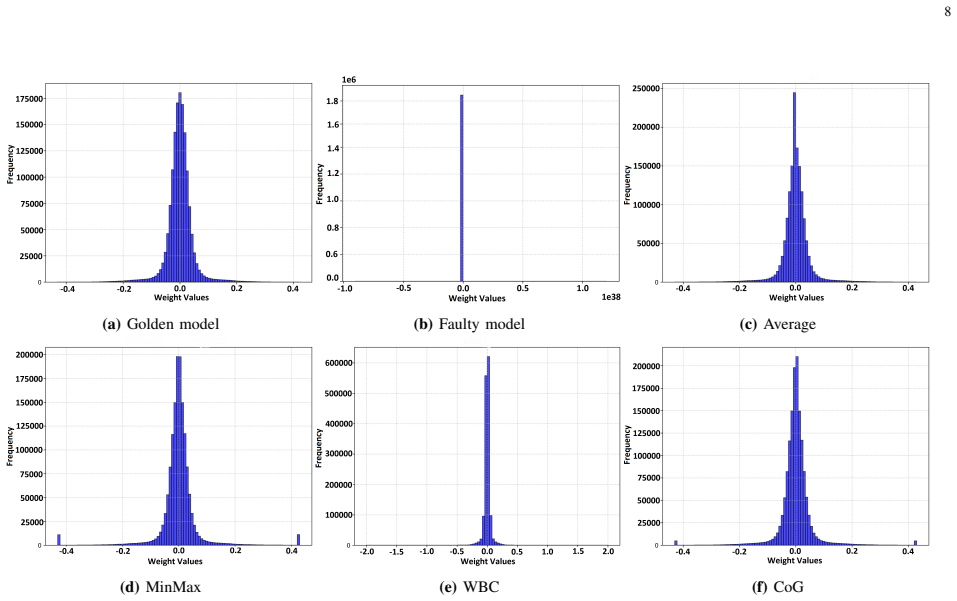
The central claim is that a single per-layer point—the Center of Gravity, the magnitude-weighted centroid of the weight tensor—plus four scalars (min, max, mean, optimal radius) is sufficient to correct random weight bit-flips during inference. Faulty weights are first detected by range violation. The correction is distance-aware: weights inside the optimal radius around the CoG are clamped to min/max; weights outside are set to the layer mean. The radius is chosen offline by exhaustive or binary search that injects faults at BER 1e-2 and measures post-correction performance. On StageNet, MTFNet, ResNet-18, and VGG-16, the paper reports that this reduces critical errors relative to an unprot
What carries the argument
The Center of Gravity (CoG) of a weight tensor: the row and column indices weighted by absolute weight magnitudes (Eqs. 1-2). It is used to define Near and Far regions via a per-layer optimal radius d_opt. Correction rules: near-CoG faulty weights clamp to profiled min/max; far-from-CoG faulty weights are replaced by profiled mean. The radius is selected offline by exhaustive or binary search maximizing post-correction accuracy under fault injection.
Load-bearing premise
The load-bearing premise is that a weight's Euclidean distance from the layer's Center of Gravity is a meaningful index of how critical an error in that weight is; if that spatial relationship is not real, the distance-aware correction is arbitrary.
What would settle it
Take a trained network, replace the CoG in the protection rule with the tensor's geometric center or a fixed random point, and repeat the same fault-injection and radius-optimization protocol; if the reliability improvements are unchanged, the CoG itself is not the active ingredient. Separately, split the data so the radius is selected on one subset and measured on another; if the 230x/49x gains collapse, they are artifacts of optimizing on the evaluation set.
If this is right
- If correct, DNNs can be hardened at inference time with only five scalars stored per layer, with no retraining and no architectural modification.
- The same five-scalar profile appears to protect both recurrent healthcare models and convolutional image classifiers, suggesting generality across layer types, while linear layers default to mean replacement.
- Binary search approximates exhaustive radius selection within roughly 5-10% distance error while cutting profiling time by 4-5x, and it is the only practical route for larger CNNs.
- Detection is element-wise and local, so correction latency is in the microsecond range (182 us per single-bit correction), making online deployment plausible.
- The reported gains are largest at high BER (1e-3), where clipping-based and activation-clipping alternatives degrade sharply, indicating a specific advantage in severe fault regimes.
Where Pith is reading between the lines
- The CoG location for a layer may be an artifact of the arbitrary ordering of filters or hidden units, since permuting neurons leaves the network function identical but moves the magnitude centroid; if so, the spatial partition could be replicated by any fixed reference point, and a control experiment swapping CoG for the tensor's geometric center would settle this.
- The optimal radius is selected under fault injection using test data in the paper's Algorithms 1 and 2, so the reported BER 1e-3 improvements may partly reflect selection bias; a fully held-out protocol where the radius is tuned on one split and evaluated on another would quantify the true gain.
- The paper itself notes that Linear layers did not show a meaningful optimal distance and default to mean replacement, which suggests the method's benefit depends on layer structure and may reduce to simple mean correction in layers without spatial organization.
- A natural extension is to apply the five-scalar CoG profile to quantized or low-precision weights, where bit-flips are more consequential and clamping/mean replacement would interact with quantization grids in nontrivial ways.
Editorial analysis
A structured set of objections, weighed in public.
Referee Report
Summary. The paper proposes a 'Center of Gravity' (CoG) guided weight correction method for fault-tolerant DNN inference. In an offline phase, each layer's weights are profiled into five scalars: min, max, mean, CoG, and an optimal distance d_opt. At runtime, weights outside [min,max] are flagged as faulty and corrected according to their Euclidean distance from the layer's CoG: near weights are clamped to min/max, far weights are replaced by the layer mean. The optimal distance is selected per layer by exhaustive or binary search, using the test set to maximize post-correction AAA. The method is evaluated on LSTM-based StageNet and MTFNet and on ResNet-18 and VGG-16, reporting large improvements (up to 230x and 6.41x at BER=1e-3 for the two LSTM networks, and up to 49.55x and 20.79x for the CNNs). The authors claim this is the first CoG-based weight-correction scheme for DNN reliability.
Significance. If the reported results are genuine hold-out measurements, the paper introduces a simple, low-overhead fault-correction scheme that could be attractive for safety-critical deployment: it requires no retraining, stores only a handful of scalars per layer, and the binary-search variant substantially reduces profiling cost (4.46x and 5.07x speedups in the reported experiments). The paper also covers multiple network families and uses 1000 repeated fault injections. However, the central significance is conditional on the evaluation being out-of-sample. As presented, the per-layer d_opt values are fitted on the same test set used for the final reliability tables, which makes the headline improvements values of the optimized objective rather than predictions. In addition, the spatial-CoG hypothesis itself is not validated with any ablation, and the paper's own tables and text contain inconsistencies (negative AAA drops, non-negligible MTFNet drops, and many d_opt values at the edge of the distance range). These issues must be resolved before the claimed fault-tolerance improvements can be assessed.
major comments (4)
- [Sec. III.B.2 (Algorithms 1-2), Tables VI and IX] The per-layer optimal distance d_opt is selected by maximizing post-correction AAA on the test set (Algorithm 1 line 15; Algorithm 2 line 16). The same test set is then used in Tables VI and IX to report the AAA drop for the fitted d_opt. This is an in-sample evaluation: the reported numbers are the values of the optimized objective. Baselines such as Average, MinMax, WBC, and AVC have no per-layer hyperparameter tuned on the test set, biasing the comparison in CoG's favor. The headline 230x/49.55x improvements are therefore not out-of-sample predictions. Please select d_opt on a held-out validation set (or via cross-validation), then report the test-set results with those fixed profiles, and show the sensitivity of the final metric to the chosen d_opt.
- [Sec. IV.C, Tables VI(a)-(d)] Several reported AAA drops are negative. For example, StageNet CoG_e is -2.38 at BER=1e-7 and MTFNet (CPSC) CoG_e is -0.07 at BER=1e-7. At BER=1e-7, the expected number of flipped weights in StageNet is about 0.23, so applying correction to an essentially fault-free model should not improve over the fault-free baseline. No BER=0 control is reported, and the exact normalization for AAA is not given (Sec. IV.A only says metrics are 'normalized relative to the fault-free baseline'). These negative values suggest a measurement artifact or an unstated normalization. Please add a BER=0 control, state the normalization formula explicitly, and report the mean and variance/confidence intervals over the 1000 injections.
- [Sec. III.B.1 (Eq. 4, Fig. 3), Sec. IV.B, Tables II-III] The core premise is that Euclidean distance from a layer's CoG in index space is a meaningful proxy for a weight's fault criticality. This premise is never validated. Table II shows many optimal distances at or near the maximum possible distance (e.g., fgrk 277/281, ogrk 253/275, cgrk 267/272), so the 'Near' region covers almost the entire tensor and the spatial partition degenerates to 'clamp all flagged weights'. The paper also states that Linear layers showed no meaningful optimal distance and default to mean replacement (Sec. IV.B), an in-paper admission that the spatial signal is absent there. Moreover, the hidden-unit permutation symmetry of DNN layers means the CoG is not a canonical object in index space. Please add an ablation comparing the CoG-based rule against (a) a fixed/random center and (b) the same correction rules applied without any spatial partitioning, and report per-
- [Abstract and Table VI(b)-(d)] The abstract states that the method achieves 'negligible accuracy loss' at BER=1e-3 for StageNet and MTFNet. However, Table VI shows CoG_e AAA drops of 7.85, 11.20, and 10.15 for MTFNet on CPSC, CPSCExtra, and Shaoxing at BER=1e-3. These are not negligible, and they are also inconsistent with the magnitude of the 6.41x improvement ratio, which is dominated by the unprotected model's much larger drop. Please reconcile the claim with the tables and define 'negligible' quantitatively, or qualify the claim to the specific layers/regimes where it holds.
minor comments (5)
- [Eqs. (1)-(2)] The CoG definition uses indices i and j starting at 1, but the convention for array indices in PyTorch is 0-based. Please clarify the indexing convention and how the formulas generalize to 3D/4D convolution tensors; currently the extension to higher-rank tensors is described only in words.
- [Sec. IV.A] The AAA metric is defined only verbally. Please give the exact formula, including how AUROC, AUPRC, Accuracy, and Challenge Metric are normalized and averaged. Also clarify whether the 'AAA drop' for a given BER is computed as baseline AAA minus post-fault AAA or as a relative change; the negative values in Table VI suggest ambiguity.
- [Sec. IV.C] The paper states that each experiment is repeated 1000 times, but none of the tables report error bars, standard deviations, or confidence intervals. Reporting only the mean makes it impossible to assess the statistical significance of differences among methods, especially where the AAA drops are close (e.g., CoG_e vs Average in Table IX).
- [Algorithm 2] The binary search in Algorithm 2 assumes the post-correction metric is unimodal in d, which is not justified. Lines 10-14 can discard a better endpoint if the midpoint is not larger than both endpoints; consider replacing the update rule with a procedure that brackets a local maximum more rigorously or justify the unimodality with an experiment.
- [Sec. IV.E and Table IX] For the CNN experiments, only CoG_b is evaluated; the abstract and Section IV. D quote 49.55x and 20.79x improvements for ResNet-18 and VGG-16 without specifying that these are for the binary-search variant rather than the exhaustive CoG_e. Please state this explicitly and clarify whether the optimal distances for the CNN layers are selected on the test set in the same way.
Circularity Check
Per-layer distance d_opt is selected on the test set by maximizing post-correction AAA (Alg. 1 line 15; Alg. 2 line 16), so the reported AAA drops and 230x/49.55x improvements are in-sample values of the fitted objective, not hold-out predictions.
specific steps
-
fitted input called prediction
[Sec. III.B.2 (Optimization of the Distance), Algorithms 1 and 2; evaluation in Sec. IV.C/IV.D, Tables VI, VII, IX]
"In each iteration, faults are injected into weights with a constant BER, the CoG-based protection is applied, and the model is evaluated on the test data. The metric for each trial is stored and averaged over N iterations to obtain the average performance for that distance (line 13). After evaluating all candidate distances, the distance yielding the highest average metric is selected as the optimal d_opt_l (line 15)."
d_opt is a per-layer hyperparameter selected by maximizing post-correction AAA on the test data (Algorithm 1 lines 9/13/15; Algorithm 2 line 16). The headline reliability tables then report AAA drop for CoG_e/CoG_b using exactly those fitted d_opt values on the same test data. The reported improvement is therefore the value of the fitted objective, not an out-of-sample result. The comparison is also biased because the baselines (Average, MinMax, WBC, AVC) have no equivalent per-layer parameter tuned on the test set. Table VII converts the same in-sample numbers into the 230x/49.55x ratios, so the central quantitative claim reduces to test-set selection by construction.
full rationale
The main circularity is the tuning/evaluation overlap: Algorithms 1 and 2 take Test data as input and set d_opt to the value maximizing post-correction AAA under injected faults; Tables VI and IX report AAA drop for exactly those fitted radii on the same test set, and Table VII converts the same measurements into 230x/49.55x mitigation ratios. The claimed improvements are thus in-sample evaluations of the tuned objective, not independent predictions. The rest of the derivation is self-contained: CoG (Eqs. 1-2) is a standard weighted centroid, detection (Eq. 3) and correction (Eq. 4) are simple rules, and no uniqueness theorem or self-citation chain forces the method. Self-citations [15] and [17] are used as baselines, not as load-bearing support for the CoG mechanism. I also flag the paper's own limitations: Sec. IV.B admits Linear layers showed no consistent or meaningful optimal distance and fall back to mean replacement, weakening the spatial premise for those layers; Table VI(b)-(d) shows MTFNet AAA drops of 7.85, 11.20, and 10.15 at BER 1e-3, contradicting 'negligible accuracy loss'; and negative AAA drops at BER 1e-7 (StageNet -2.38) are unexplained, with no error bars or BER=0 control. These are correctness/reporting concerns rather than additional circular steps. Weighing the demonstrated test-set selection against the partially independent CoG mechanism and different BERs, the circularity is partial and concentrated in the headline quantitative claim: score 6.
Axiom & Free-Parameter Ledger
free parameters (4)
- per-layer optimal distance d_opt (StageNet, 13 layers) =
e.g., fmrk 190, imrk 29, cgrk 267, ogk 5 (Table II)
- per-layer optimal distance d_opt (MTFNet, 8 layers) =
e.g., ih 5, hh 10, Norm 0 (Table III)
- per-layer d_opt for ResNet-18 / VGG-16 =
not tabulated
- binary-search threshold theta =
0.01 (Tables IV-V)
axioms (4)
- standard math CoG definition: weighted average of weight indices using |w_ij| as mass (Eqs. 1-2).
- domain assumption Pre-trained DNN weights are bounded, zero-mean, bell-shaped with localized large-magnitude clusters.
- ad hoc to paper Euclidean distance from the layer CoG in index space is a meaningful proxy for a weight's fault criticality.
- domain assumption Any weight outside the golden [w_min, w_max] range is faulty; in-range bit flips need no correction.
read the original abstract
Deep Neural Networks (DNNs) used in safety-critical applications are vulnerable to hardware and memory faults that corrupt network weights and degrade reliability. In this paper, we propose a Center of Gravity (CoG) guided weight correction method that restores faulty weights based on their spatial characteristics within each layer. The proposed approach detects and corrects weight faults using distance-aware correction rules, eliminating the need for retraining or architectural modification. The effectiveness of the proposed method in terms of the capability of tolerating hardware faults has been evaluated through performing fault injection at different Bit Error Rates (BERs). Experiments on safety-critical LSTM-based Networks, including StageNet for disease progression tracking and MTFNet for cardiac anomaly detection, demonstrate fault tolerance improvements of up to 230x and 6.41x, respectively, at a BER of 10^{-3}, with negligible accuracy loss. When extended to Convolutional Neural Networks (CNNs), the method achieves up to 49.55x and 20.79x improvements under comparable fault conditions on ResNet-18 and VGG-16, respectively. To the best of our knowledge, this is the first work to apply the CoG concept to neural network weight tensors for enhancing model reliability.
Figures


Reference graph
Works this paper leans on
-
[1]
Deep learning for computer vision: A brief review,
A. V oulodimos, N. Doulamis, A. Doulamis, and E. Protopapadakis, “Deep learning for computer vision: A brief review,”Computational intelligence and neuroscience, vol. 2018, 2018
2018
-
[2]
Mcunet: Tiny deep learning on iot devices,
J. Lin, W.-M. Chen, Y . Lin, J. Cohn, C. Gan, and S. Han, “Mcunet: Tiny deep learning on iot devices,”arXiv preprint arXiv:2007.10319, 2020
Pith/arXiv arXiv 2007
-
[3]
Tas: ternarized neural architecture search for resource-constrained 9 edge devices,
M. Loni, H. Mousavi, M. Riazati, M. Daneshtalab, and M. Sj ¨odin, “Tas: ternarized neural architecture search for resource-constrained 9 edge devices,” in2022 Design, Automation & Test in Europe Conference & Exhibition (DATE). IEEE, 2022, pp. 1115–1118
2022
-
[4]
Testability and depend- ability of ai hardware: Survey, trends, challenges, and perspectives,
F. Su, C. Liu, and H.-G. Stratigopoulos, “Testability and depend- ability of ai hardware: Survey, trends, challenges, and perspectives,” IEEE Design & Test, 2023
2023
-
[5]
A systematic literature review on hardware reliability assessment methods for deep neural networks,
M. H. Ahmadilivani, M. Taheri, J. Raik, M. Daneshtalab, and M. Jenihhin, “A systematic literature review on hardware reliability assessment methods for deep neural networks,”ACM Computing Surveys, vol. 56, no. 6, pp. 1–39, 2024
2024
-
[6]
Resilience of deep learning applications: A systematic literature review of analysis and hard- ening techniques,
C. Bolchini, L. Cassano, and A. Miele, “Resilience of deep learning applications: A systematic literature review of analysis and hard- ening techniques,”Computer Science Review, vol. 54, p. 100682, 2024
2024
-
[7]
Soft errors in dnn accelerators: A comprehensive review,
Y . Ibrahim, H. Wang, J. Liu, J. Wei, L. Chen, P. Rech, K. Adam, and G. Guo, “Soft errors in dnn accelerators: A comprehensive review,”Microelectronics Reliability, vol. 115, p. 113969, 2020
2020
-
[8]
Fast and accurate error simulation for cnns against soft errors,
C. Bolchini, L. Cassano, A. Miele, and A. Toschi, “Fast and accurate error simulation for cnns against soft errors,”IEEE Trans- actions on Computers, 2022
2022
-
[9]
Impact of scaling on neutron-induced soft error in srams from a 250 nm to a 22 nm design rule,
E. Ibe, H. Taniguchi, Y . Yahagi, K.-i. Shimbo, and T. Toba, “Impact of scaling on neutron-induced soft error in srams from a 250 nm to a 22 nm design rule,”IEEE Transactions on Electron Devices, vol. 57, no. 7, pp. 1527–1538, 2010
2010
-
[10]
The impact of faults on dnns: A case study,
E. Malekzadeh, N. Rohbani, Z. Lu, and M. Ebrahimi, “The impact of faults on dnns: A case study,” in2021 IEEE International Sym- posium on Defect and Fault Tolerance in VLSI and Nanotechnology Systems (DFT). IEEE, 2021, pp. 1–6
2021
-
[11]
Are cnns reliable enough for critical applications? an exploratory study,
M. A. Neggaz, I. Alouani, S. Niar, and F. Kurdahi, “Are cnns reliable enough for critical applications? an exploratory study,” IEEE Design & Test, vol. 37, no. 2, pp. 76–83, 2019
2019
-
[12]
Application of artificial intelligence in healthcare: chances and challenges,
R. Manne and S. C. Kantheti, “Application of artificial intelligence in healthcare: chances and challenges,”Current Journal of Applied Science and Technology, vol. 40, no. 6, pp. 78–89, 2021
2021
-
[13]
A survey of human gait-based artificial intelli- gence applications,
E. J. Harriset al., “A survey of human gait-based artificial intelli- gence applications,”Frontiers in Robotics and AI, vol. 8, p. 749274, 2022
2022
-
[14]
Time-series forecasting with deep learning: a survey,
B. Lim and S. Zohren, “Time-series forecasting with deep learning: a survey,”Philosophical Transactions of the Royal Society A, vol. 379, no. 2194, pp. 202–209, 2021
2021
-
[15]
Analysis and improvement of resilience for long short-term mem- ory neural networks,
M. H. Ahmadilivani, J. Raik, M. Daneshtalab, and A. Kuusik, “Analysis and improvement of resilience for long short-term mem- ory neural networks,” in2023 IEEE International Symposium on Defect and Fault Tolerance in VLSI and Nanotechnology Systems (DFT). IEEE, 2023, pp. 1–4
2023
-
[16]
Analysis and enhancement of resilience for lstm accelerators using residue-based ceds,
N. Nosrati and Z. Navabi, “Analysis and enhancement of resilience for lstm accelerators using residue-based ceds,”IEEE Access, 2024
2024
-
[17]
Zero-memory- overhead clipping-based fault tolerance for lstm deep neural net- works,
B. Parchekani, S. Nazari, M. H. Ahmadilivani, A. Azarpeyvand, J. Raik, T. Ghasempouri, and M. Daneshtalab, “Zero-memory- overhead clipping-based fault tolerance for lstm deep neural net- works,” in2024 IEEE International Symposium on Defect and Fault Tolerance in VLSI and Nanotechnology Systems (DFT). IEEE, 2024, pp. 1–4
2024
-
[18]
Soft error resilience analysis of lstm networks,
C. P. Vasquez, T. Lecompte, X. Yuan, N. Tzeng, and L. Peng, “Soft error resilience analysis of lstm networks,” inProceedings of the Great Lakes Symposium on VLSI 2024, 2024, pp. 328–332
2024
-
[19]
Learning both weights and connections for efficient neural network,
S. Han, J. Pool, J. Tran, and W. Dally, “Learning both weights and connections for efficient neural network,”Advances in neural information processing systems, vol. 28, 2015
2015
-
[20]
Under- standing deep learning requires rethinking generalization,
C. Zhang, S. Bengio, M. Hardt, B. Recht, and O. Vinyals, “Under- standing deep learning requires rethinking generalization,”arXiv preprint arXiv:1611.03530, 2016
Pith/arXiv arXiv 2016
-
[21]
Zhang, Z
A. Zhang, Z. C. Lipton, M. Li, and A. J. Smola,Dive into Deep Learning. MIT Press, 2020, https://d2l.ai/chapter multilayer-perceptrons/numerical-stability-and-init.html
2020
-
[22]
Autoinit: Analytic signal- preserving weight initialization for neural networks,
Z. Yao, H. Wu, and K. He, “Autoinit: Analytic signal- preserving weight initialization for neural networks,”arXiv preprint arXiv:2109.08958, 2021. [Online]. Available: https: //arxiv.org/abs/2109.08958
Pith/arXiv arXiv 2021
-
[23]
Understanding the difficulty of training deep feedforward neural networks,
X. Glorot and Y . Bengio, “Understanding the difficulty of training deep feedforward neural networks,” inProceedings of the thirteenth international conference on artificial intelligence and statistics. JMLR Workshop and Conference Proceedings, 2010, pp. 249–256
2010
-
[24]
Goodfellow, Y
I. Goodfellow, Y . Bengio, and A. Courville,Deep Learning. MIT Press, 2016. [Online]. Available: http://www.deeplearningbook.org
2016
-
[25]
Inception- v4, inception-resnet and the impact of residual connections on learning,
C. Szegedy, S. Ioffe, V . Vanhoucke, and A. Alemi, “Inception- v4, inception-resnet and the impact of residual connections on learning,” inProceedings of the AAAI conference on artificial intelligence, vol. 31, no. 1, 2017
2017
-
[26]
Delving deep into rectifiers: Surpassing human-level performance on imagenet classification,
K. He, X. Zhang, S. Ren, and J. Sun, “Delving deep into rectifiers: Surpassing human-level performance on imagenet classification,” inProceedings of the IEEE international conference on computer vision, 2015, pp. 1026–1034
2015
-
[27]
Understanding neural networks through deep visualization,
J. Yosinski, J. Clune, A. Nguyen, T. Fuchs, and H. Lipson, “Understanding neural networks through deep visualization,”arXiv preprint arXiv:1506.06579, 2015
Pith/arXiv arXiv 2015
-
[28]
The lottery ticket hypothesis: Finding sparse, trainable neural networks. arxiv 2018,
J. Frankle and M. Carbin, “The lottery ticket hypothesis: Finding sparse, trainable neural networks. arxiv 2018,”arXiv preprint arXiv:1803.03635, 1810
Pith/arXiv arXiv 2018
-
[29]
Deep learning,
Y . LeCun, Y . Bengio, and G. Hinton, “Deep learning,”nature, vol. 521, no. 7553, pp. 436–444, 2015
2015
-
[30]
Reliability improvement of circular k-out-of-n: G balanced systems through center of gravity,
Y . Cho, S. M. Baik, and Y . M. Ko, “Reliability improvement of circular k-out-of-n: G balanced systems through center of gravity,” arXiv preprint arXiv:2305.06919, 2023. [Online]. Available: https://arxiv.org/abs/2305.06919
Pith/arXiv arXiv 2023
-
[31]
R. C. Gonzalez,Digital image processing. Pearson education india, 2009
2009
-
[32]
Under- standing error propagation in deep learning neural network (dnn) accelerators and applications,
G. Li, K. Pattabiraman, S. R. Nassif, and S. Vrudhula, “Under- standing error propagation in deep learning neural network (dnn) accelerators and applications,” inProceedings of the International Conference for High Performance Computing, Networking, Storage and Analysis (SC). IEEE, 2017, pp. 1–12
2017
-
[33]
Minerva: Enabling low-power, highly-accurate deep neural network accelerators,
B. Reagen, R. Adolf, P. N. Whatmough, G.-Y . W. Rama, H.-H. S. Lee, S. K. Lee, D. Brooks, and G.-Y . Wei, “Minerva: Enabling low-power, highly-accurate deep neural network accelerators,” in Proceedings of the 43rd International Symposium on Computer Architecture (ISCA). IEEE, 2016, pp. 267–278
2016
-
[34]
Improving the fault tolerance of neural networks through weight clipping,
J. Zhang, Y . Chen, G. Sun, G. Chen, Y . Li, and Y . Xie, “Improving the fault tolerance of neural networks through weight clipping,” inProceedings of the 55th Annual Design Automation Conference (DAC). ACM, 2018, pp. 1–6
2018
-
[35]
Mimic-iii, a freely accessible critical care database,
A. E. W. Johnson, T. J. Pollard, and Shen, “Mimic-iii, a freely accessible critical care database,”Scientific Data, vol. 3, no. 1, p. 160035, 2016
2016
-
[36]
A data-driven framework for evaluating the robustness of ecg diagnosis algorithms,
Q. L. Weixuan Wang, “A data-driven framework for evaluating the robustness of ecg diagnosis algorithms,”PhysioNet/Computing in Cardiology Challenge 2018, 2018. [Online]. Available: https://physionetchallenges.org/2018/
2018
-
[37]
A 12-lead electrocardiogram database for arrhythmia research covering more than 10,000 pa- tients,
J. Zheng, J. Zhang, and Danioko, “A 12-lead electrocardiogram database for arrhythmia research covering more than 10,000 pa- tients,”Scientific Data, vol. 7, no. 1, p. 48, 2020
2020
-
[38]
A low-cost fault corrector for deep neural networks through range restriction,
Z. Chen, G. Li, and K. Pattabiraman, “A low-cost fault corrector for deep neural networks through range restriction,” in2021 51st An- nual IEEE/IFIP International Conference on Dependable Systems and Networks (DSN). IEEE, 2021, pp. 1–13
2021
discussion (0)
Sign in with ORCID, Apple, or X to comment. Anyone can read and Pith papers without signing in.