REVIEW 3 major objections 4 minor 32 references
Fine-tuning on teacher-built prefix-to-prefix targets makes a decoder-only speech LLM translate simultaneously without architectural changes, lifting streaming quality by +1.54 COMETKiwi at only +0.15s extra lag.
Reviewed by Pith at T0; open to challenge. T0 means a machine referee read the full paper against a public rubric. the ladder, T0–T4 →
Teacher-built bounded-waiting prefix targets let a chunked streaming speech LLM improve simultaneous translation quality by +1.54 COMETKiwi at +0.15 s latency.
T0 review reviewed 2026-08-02 challenge →
load-bearing objection A promising streaming recipe and an interesting label-generation idea, but the headline +1.54 COMETKiwi gain is confounded by an extra fine-tuning stage the baseline lacks; the paper needs a same-data offline-reference control before the claim can be trusted. the 3 major comments →
Do LLMs Need Architectural Changes for Simultaneous Speech Translation? A Prefix-to-Prefix Data Driven Approach
The pith
A machine-rendered reading of the paper's core claim, the machinery that carries it, and where it could break.
The reading
Core claim
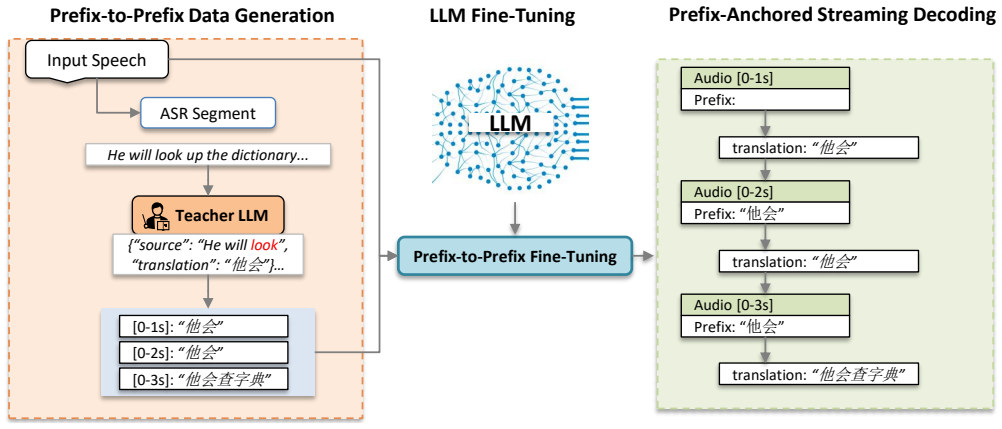
The paper's central claim is that the dominant bottleneck for decoder-only LLM-based simultaneous speech translation is the training data, not the architecture. With fixed-length chunks of speech fed cumulatively to the model, and a rewind boundary that lets the last k tokens stay hidden and editable, the model can be anchored to a monotonically growing committed prefix. The key discovery is that fine-tuning the model on teacher-labeled prefix-to-prefix targets—where a strong instruction-following LLM plans a bounded-waiting emission schedule over chunk-level transcriptions—teaches the model when to emit and when to wait, without adding policy heads or latency-prediction modules. The result
What carries the argument
The load-bearing objects are: (1) CSSEL, a decoder-only speech LLM with a chunked streaming speech encoder whose self-attention sees only a bounded left context; (2) cumulative chunk decoding with rewind-based prefix anchoring, where at each step the decoder is forced to continue from the previously emitted prefix minus the last k tokens; and (3) teacher-labeled prefix-to-prefix supervision, in which a teacher LLM prompted with all chunks produces, for each chunk, a translation prefix or an empty wait, subject to a maximum waiting budget of K=3. The P2P targets are the mechanism that encodes emission timing directly into the model's learned behavior, aligning training with the no-revision st
Load-bearing premise
The whole approach rests on the teacher LLM's prefix-to-prefix labels being genuinely commit-ready and correctly timed; if the teacher commits prematurely or waits wrongly at chunk boundaries, the student will learn mis-timed emission behavior.
What would settle it
A controlled ablation replacing the teacher LLM with a naive monotone truncation of the offline reference (no bounded-waiting, no global planning) would decide the matter: if truncation labels recover similar gains, the paper's specific label construction is not the active ingredient; if they do not, the teacher's planning is. A complementary quantitative check is to re-score each committed prefix by asking the full-utterance model how much of the reference's continuation is already contradicted; high contradiction rates would signal premature commit-ready labels.
If this is right
- P2P fine-tuning improves streaming COMETKiwi by +1.54 over the streaming baseline (70.50 vs 68.96) at only +0.15s more Average Lagging.
- Gains are largest for reordering-heavy directions: EN→JA +3.96, EN→ZH +2.74, and ZH→JA +3.94.
- Improvements appear even on directions that were not directly supervised (e.g., ZH→JA), suggesting the method shapes general streaming behavior rather than performing language-pair-specific tuning.
- Chunk size Δ and rewind length k act as controllable knobs on the quality–latency frontier, giving practitioners a simple way to trade latency for quality.
- On a public CoVoST2 diagnostic set, P2P fine-tuning recovers more than half of the offline-to-streaming degradation in BLEU.
Where Pith is reading between the lines
- If the result holds, streaming capability can be decoupled from model architecture: any decoder-only speech LLM with causal inference could, in principle, be made simultaneous by re-labeling its training data this way, a cheaper path than redesigning with read/write heads.
- A natural testable extension is to apply the same teacher-labeled bounded-waiting construction to text-only simultaneous machine translation; if the gains reproduce, it would suggest the P2P target form, not the speech interface, is the core mechanism.
- Because the teacher LLM plans with full access to all chunks, replacing it with a strictly causal teacher that never sees future chunks would reveal how much of the benefit comes from offline planning versus the bounded-waiting constraint itself.
- The labels come from a proprietary teacher; an open question is whether an open-weights or weaker teacher would yield similar gains, which would determine how cheaply this recipe scales to more languages and domains.
Editorial analysis
A structured set of objections, weighed in public.
Referee Report
Summary. The paper asks whether decoder-only LLMs need architectural/policy changes for simultaneous speech translation (SimulST) and proposes a data-driven alternative. It introduces CSSEL, a Phi-4-MM backbone with a chunked streaming speech encoder, and CSSEL-P2P, obtained by fine-tuning CSSEL on teacher-labeled prefix-to-prefix (P2P) targets. The P2P labels are produced by prompting GPT-o3-mini over the full chunk sequence with a bounded-waiting instruction, and inference uses cumulative chunk decoding with a rewind-based committed prefix. The main claim is in Table I: CSSEL-P2P improves streaming COMETKiwi from 68.96 to 70.50 at comparable average lagging (+0.15 s), and Table II on a CoVoST2 subset shows recovery of more than half of the offline-to-streaming degradation. The paper argues that P2P supervision, not architectural changes, is the main lever for SimulST.
Significance. If the central comparison is valid, the result is a useful contribution: it provides a fixed-chunk streaming recipe with explicit quality-latency knobs (chunk size Δ, rewind length k) and a concrete teacher-labeling protocol for commit-ready prefix targets, and it shows that such targets can be used to fine-tune a decoder-only LLM without adding policy heads. The paper includes a public diagnostic evaluation, a trade-off analysis over Δ and k, and an honest discussion of limitations (teacher-label quality, tuning knobs). These are strengths. The main weakness is that the headline gain is not established as caused by the P2P labels, because the comparison is confounded by an additional fine-tuning stage, and no statistical significance is reported. The paper's contribution would be solid if the missing control is supplied and the result persists.
major comments (3)
- [§IV-A2, Table I; §III-C] The headline +1.54 COMETKiwi gain is not a matched comparison. CSSEL-P2P is obtained by fine-tuning CSSEL on an additional 200 hours per direction of teacher-labeled P2P data (Sec. III-C, IV-A1), whereas the CSSEL streaming baseline receives no additional fine-tuning. The paper does not report a control in which CSSEL is fine-tuned on the same 200 hours with ordinary offline full-sentence references and then evaluated under the same streaming decoder. Without such a control, the gain could reflect generic adaptation to the conversational domain or to 4-s chunked inputs. The absence of an offline CSSEL-P2P row in Table I also leaves open the possibility that P2P fine-tuning improves translation quality in general rather than streaming-specific behavior. This control is load-bearing for the central claim and must be added.
- [Table I; Table II] All reported quality scores are point estimates with no confidence intervals or significance tests. The per-direction differences in Table I are often small (e.g., 0.19-0.34 COMETKiwi), and the overall +1.54 average could be driven by a few large gains on reordering-heavy pairs. The paper should report bootstrap confidence intervals or at least a paired significance test for the CSSEL vs. CSSEL-P2P comparison, and ideally for the diagnostic Table II as well. Without this, the 'consistent improvements' claim is not quantitatively supported.
- [§III-B.2; §IV-C] The teacher labels are the sole source of P2P supervision, but their quality is not independently verified. The teacher is prompted to simulate a causal translator while being given the full chunk sequence, and the paper itself lists 'dependence on teacher-label quality' as a limitation. Since all P2P training data depend on these labels, the paper should provide some evidence that the labels are actually commit-ready (e.g., human judgments on a sample, comparison with an alternative labeling strategy such as wait-k, or analysis of label waiting behavior). This is not a fatal flaw, but it is necessary to validate the central mechanism.
minor comments (4)
- [§IV-B] Typo: 'BELU' should be 'BLEU' in the text of the diagnostic evaluation section.
- [Fig. 2] The right panel is labeled 'CSSEL DE→EN' while the left panel uses 'CSSEL-P2P EN→DE'; please clarify in the caption or the text whether the Δ sweep is performed on the base CSSEL or on CSSEL-P2P, as this affects the interpretation of the trade-off.
- [Title and Abstract] The phrase 'without architectural changes' is overstated: CSSEL itself introduces a chunked streaming speech encoder with causal convolutions and a chunk-wise attention mask (Sec. IV-A1). The claim that is actually supported is that, within a fixed streaming architecture, P2P supervision is sufficient and no policy heads or explicit read/write tokens are needed. Recommend rewording to avoid confusion.
- [§IV-A1] The description of the main in-house evaluation is thin: the test set sizes, the number of utterances per direction, and the selection/domain composition are not given. This is important for interpreting the average scores and for assessing whether the 'in-house conversational speech' claim generalizes.
Circularity Check
No circularity found: P2P gains are measured with external COMETKiwi/SacreBLEU against a teacher-independent baseline, and self-citations are not load-bearing.
full rationale
The claimed chain is: CSSEL offline baseline -> cumulative chunk decoding with rewind anchoring (Eqs. 1-3) -> teacher LLM generates bounded-waiting P2P targets (Eqs. 4-5) -> P2P fine-tuning (Sec. III-C) -> streaming evaluation (Tables I-II). I checked each link for reduction to its own inputs. The teacher labels are produced by an external system (GPT-o3-mini) under an explicit bounded-waiting protocol; they are not a fitted parameter of the student, and the target metrics (COMETKiwi, SacreBLEU) are not used in label construction, so the Table I gain is not forced by construction. The rewind decoding is a fixed interface, not a learned function of the evaluation score. The only author self-citations ([21], [22], [24]) motivate chunk streaming, P2P supervision, and the streaming encoder, but the central claim is supported by the CSSEL vs. CSSEL-P2P contrast under identical decoding with external metrics; these citations are not load-bearing. The paper's own limitation statement (Sec. IV-C: 'dependence on teacher-label quality') is a validity caveat, not a circularity. The reviewer-noted confound that CSSEL-P2P receives an additional 200h/pair fine-tuning stage relative to CSSEL streaming is an experimental-attribution concern, not a definitional or statistical reduction, so it does not change the circularity score.
Axiom & Free-Parameter Ledger
free parameters (4)
- chunk size Delta =
4 s
- rewind length k =
5 tokens
- teacher waiting budget K =
3 chunks
- P2P fine-tuning data size per direction =
200 h
axioms (5)
- domain assumption Fixed-chunk cumulative decoding with a no-revision committed prefix is the right interface for SimulST.
- domain assumption Teacher LLM instructed with bounded waiting over full chunks yields valid commit-ready P2P targets.
- domain assumption Forced alignment provides accurate chunk-level transcriptions.
- domain assumption Gains are caused by P2P supervision rather than extra fine-tuning on 200h of data.
- domain assumption COMETKiwi on in-house conversational speech tracks user-perceived streaming quality.
Cite this review
Pith. "Pith review of Do LLMs Need Architectural Changes for Simultaneous Speech Translation? A Prefix-to-Prefix Data Driven Approach." pith.science (2026). https://pith.science/paper/GVEVEDLS
@misc{pith2026260713158,
  author       = {Pith},
  title        = {Pith review of: Do LLMs Need Architectural Changes for Simultaneous Speech Translation? A Prefix-to-Prefix Data Driven Approach},
  year         = {2026},
  howpublished = {\url{https://pith.science/paper/GVEVEDLS}},
  note         = {Machine review of arXiv:2607.13158}
}
read the original abstract
Simultaneous speech translation (SimulST) requires incremental translation under strict latency constraints, yet remains challenging for decoder-only LLM systems due to limited context and cross-lingual reordering. Recent approaches often introduce architectural changes or explicit read/write policies to control output timing, which can be brittle in conversational speech where segmentation boundaries are ambiguous. We present a simple data-driven alternative: fixed-length chunks for cumulative streaming decoding with a rewind-based committed prefix, and teacher-labeled prefix-to-prefix (P2P) targets with bounded waiting for fine-tuning, yielding CSSEL-P2P, where CSSEL is our proposed chunked streaming speech encoder LLM. In our in-house conversational speech evaluation, CSSEL-P2P improves streaming quality by +1.54 COMETKiwi over the CSSEL streaming baseline at comparable latency (+0.15s Average Lagging), suggesting effective SimulST without architectural changes via P2P supervision.
Figures

Reference graph
Works this paper leans on
-
[1]
Simulmt to simulst: Adapting simul- taneous text translation to end-to-end simultaneous speech translation,
X. Ma, J. Pino, and P. Koehn, “Simulmt to simulst: Adapting simul- taneous text translation to end-to-end simultaneous speech translation,” inProceedings of the 1st Conference of the Asia-Pacific Chapter of the Association for Computational Linguistics and the 10th International Joint Conference on Natural Language Processing, 2020, pp. 582–587
2020
-
[2]
Streaming simultaneous speech translation with augmented memory transformer,
X. Ma, Y . Wang, M. J. Dousti, P. Koehn, and J. Pino, “Streaming simultaneous speech translation with augmented memory transformer,” inICASSP 2021-2021 IEEE International Conference on Acoustics, Speech and Signal Processing (ICASSP). IEEE, 2021, pp. 7523–7527
2021
-
[3]
J. Achiam, S. Adler, S. Agarwal, L. Ahmad, I. Akkaya, F. L. Aleman, D. Almeida, J. Altenschmidt, S. Altman, S. Anadkatet al., “Gpt-4 technical report,”arXiv preprint arXiv:2303.08774, 2023
Pith/arXiv arXiv 2023
-
[4]
Llama 2: Open foundation and fine-tuned chat models,
H. Touvron, L. Martin, K. Stone, P. Albert, A. Almahairi, Y . Babaei, N. Bashlykov, S. Batra, P. Bhargava, S. Bhosaleet al., “Llama 2: Open foundation and fine-tuned chat models,”arXiv preprint arXiv:2307.09288, 2023
Pith/arXiv arXiv 2023
-
[5]
A. Liu, B. Feng, B. Xue, B. Wang, B. Wu, C. Lu, C. Zhao, C. Deng, C. Zhang, C. Ruanet al., “Deepseek-v3 technical report,”arXiv preprint arXiv:2412.19437, 2024
Pith/arXiv arXiv 2024
-
[6]
G. Team, A. Kamath, J. Ferret, S. Pathak, N. Vieillard, R. Merhej, S. Perrin, T. Matejovicova, A. Ram ´e, M. Rivi `ereet al., “Gemma 3 technical report,”arXiv preprint arXiv:2503.19786, 2025
Pith/arXiv arXiv 2025
-
[7]
A. Yang, A. Li, B. Yang, B. Zhang, B. Hui, B. Zheng, B. Yu, C. Gao, C. Huang, C. Lvet al., “Qwen3 technical report,”arXiv preprint arXiv:2505.09388, 2025
Pith/arXiv arXiv 2025
-
[8]
Stacl: Simultaneous translation with implicit anticipation and controllable latency using prefix-to-prefix framework,
M. Ma, L. Huang, H. Xiong, R. Zheng, K. Liu, B. Zheng, C. Zhang, Z. He, H. Liu, X. Liet al., “Stacl: Simultaneous translation with implicit anticipation and controllable latency using prefix-to-prefix framework,” inProceedings of the 57th Annual Meeting of the Association for Computational Linguistics, 2019, pp. 3025–3036
2019
-
[9]
Monotonic infinite lookback attention for simulta- neous machine translation,
N. Arivazhagan, C. Cherry, W. Macherey, C.-C. Chiu, S. Yavuz, R. Pang, W. Li, and C. Raffel, “Monotonic infinite lookback attention for simulta- neous machine translation,” inProceedings of the 57th Annual Meeting of the Association for Computational Linguistics, 2019, pp. 1313–1323
2019
-
[10]
Monotonic chunkwise attention,
C.-C. Chiu and C. Raffel, “Monotonic chunkwise attention,”arXiv preprint arXiv:1712.05382, 2017
Pith/arXiv arXiv 2017
-
[11]
Monotonic multihead attention,
X. Ma, J. Pino, J. Cross, L. Puzon, and J. Gu, “Monotonic multihead attention,”arXiv preprint arXiv:1909.12406, 2019
Pith/arXiv arXiv 1909
-
[12]
Re-translation versus streaming for simultaneous translation,
N. Arivazhagan, C. Cherry, W. Macherey, and G. Foster, “Re-translation versus streaming for simultaneous translation,” inProceedings of the 17th International Conference on Spoken Language Translation, 2020, pp. 220–227
2020
-
[13]
Re-translation strategies for long form, simultaneous, spoken language translation,
N. Arivazhagan, C. Cherry, I. Te, W. Macherey, P. Baljekar, and G. Foster, “Re-translation strategies for long form, simultaneous, spoken language translation,” inICASSP 2020-2020 IEEE International Con- ference on Acoustics, Speech and Signal Processing (ICASSP). IEEE, 2020, pp. 7919–7923
2020
-
[15]
Infinisst: Simultaneous translation of unbounded speech with large language model,
S. Ouyang, X. Xu, and L. Li, “Infinisst: Simultaneous translation of unbounded speech with large language model,” inFindings of the Association for Computational Linguistics: ACL 2025, 2025, pp. 3032– 3046
2025
-
[16]
Fasst: Fast llm-based si- multaneous speech translation,
S. Ouyang, X. Xu, C. Dandekar, and L. Li, “Fasst: Fast llm-based si- multaneous speech translation,”arXiv preprint arXiv:2408.09430, 2024
Pith/arXiv arXiv 2024
-
[17]
Cometkiwi: Ist-unbabel 2022 submission for the quality estimation shared task,
R. Rei, M. Treviso, N. M. Guerreiro, C. Zerva, A. C. Farinha, C. Maroti, J. G. De Souza, T. Glushkova, D. Alves, L. Coheuret al., “Cometkiwi: Ist-unbabel 2022 submission for the quality estimation shared task,” in Proceedings of the Seventh Conference on Machine Translation (WMT), 2022, pp. 634–645
2022
-
[18]
Simuleval: An evaluation toolkit for simultaneous translation,
X. Ma, M. J. Dousti, C. Wang, J. Gu, and J. Pino, “Simuleval: An evaluation toolkit for simultaneous translation,” inProceedings of the 2020 Conference on Empirical Methods in Natural Language Process- ing: System Demonstrations, 2020, pp. 144–150
2020
-
[19]
Simulspeech: End-to-end simultaneous speech to text translation,
Y . Ren, J. Liu, X. Tan, C. Zhang, T. Qin, Z. Zhao, and T.-Y . Liu, “Simulspeech: End-to-end simultaneous speech to text translation,” inProceedings of the 58th Annual Meeting of the Association for Computational Linguistics, 2020, pp. 3787–3796
2020
-
[20]
Align, write, re-order: Explainable end-to-end speech translation via operation sequence generation,
M. Omachi, B. Yan, S. Dalmia, Y . Fujita, and S. Watanabe, “Align, write, re-order: Explainable end-to-end speech translation via operation sequence generation,” inICASSP 2023-2023 IEEE International Con- ference on Acoustics, Speech and Signal Processing (ICASSP). IEEE, 2023, pp. 1–5
2023
-
[21]
Direct simultaneous speech- to-text translation assisted by synchronized streaming asr,
J. Chen, M. Ma, R. Zheng, and L. Huang, “Direct simultaneous speech- to-text translation assisted by synchronized streaming asr,” inFindings of the Association for Computational Linguistics: ACL-IJCNLP 2021, 2021, pp. 4618–4624
2021
-
[22]
Improving simultaneous translation by incorporating pseudo-references with fewer reorderings,
J. Chen, R. Zheng, A. Kita, M. Ma, and L. Huang, “Improving simultaneous translation by incorporating pseudo-references with fewer reorderings,” inProceedings of the 2021 Conference on Empirical Methods in Natural Language Processing, 2021, pp. 5857–5864
2021
-
[23]
Phi-4-mini technical report: Compact yet powerful multimodal language models via mixture- of-LoRAs,
A. Abouelenin, A. Ashfaq, A. Atkinson, H. Awadalla, N. Bach, J. Bao, A. Benhaim, M. Cai, V . Chaudhary, C. Chenet al., “Phi-4-mini technical report: Compact yet powerful multimodal language models via mixture- of-LoRAs,”arXiv preprint arXiv:2503.01743, 2025
Pith/arXiv arXiv 2025
-
[24]
Large-scale streaming end-to-end speech translation with neural transducers,
J. Xue, P. Wang, J. Li, M. Post, and Y . Gaur, “Large-scale streaming end-to-end speech translation with neural transducers,”arXiv preprint arXiv:2204.05352, 2022
Pith/arXiv arXiv 2022
-
[25]
Conformer: Convolution- augmented Transformer for speech recognition,
A. Gulati, J. Qin, C.-C. Chiu, N. Parmar, Y . Zhang, J. Yu, W. Han, S. Wang, Z. Zhang, Y . Wu, and R. Pang, “Conformer: Convolution- augmented Transformer for speech recognition,” inProc. Interspeech, 2020
2020
-
[26]
Tradition or innova- tion: A comparison of modern asr methods for forced alignment,
R. Rousso, E. Cohen, J. Keshet, and E. Chodroff, “Tradition or innova- tion: A comparison of modern asr methods for forced alignment,”arXiv preprint arXiv:2406.19363, 2024
Pith/arXiv arXiv 2024
-
[27]
Covost 2 and massively mul- tilingual speech translation,
C. Wang, A. Wu, J. Gu, and J. Pino, “Covost 2 and massively mul- tilingual speech translation,”Proc. Interspeech 2021, pp. 2247–2251, 2021
2021
-
[28]
A call for clarity in reporting BLEU scores,
M. Post, “A call for clarity in reporting BLEU scores,” in Proceedings of the Third Conference on Machine Translation: Research Papers. Belgium, Brussels: Association for Computational Linguistics, Oct. 2018, pp. 186–191. [Online]. Available: https: //www.aclweb.org/anthology/W18-6319
2018
-
[29]
Low-latency sequence-to-sequence speech recognition and translation by partial hypothesis selection,
D. Liu, G. Spanakis, and J. Niehues, “Low-latency sequence-to-sequence speech recognition and translation by partial hypothesis selection,” in Proceedings of Interspeech 2020, 2020, pp. 3620–3624
2020
-
[30]
CUNI-KIT system for simultaneous speech translation task at IWSLT 2022,
P. Pol ´ak, N.-Q. Pham, T. N. Nguyen, D. Liu, C. Mullov, J. Niehues, O. Bojar, and A. Waibel, “CUNI-KIT system for simultaneous speech translation task at IWSLT 2022,” inProceedings of the 19th Inter- national Conference on Spoken Language Translation (IWSLT 2022). Dublin, Ireland: Association for Computational Linguistics, 2022, pp. 277–285
2022
-
[31]
Re-translation versus streaming for simultaneous translation,
N. Arivazhagan, C. Cherry, W. Macherey, and G. Foster, “Re-translation versus streaming for simultaneous translation,” inProceedings of the 17th International Conference on Spoken Language Translation, M. Federico, A. Waibel, K. Knight, S. Nakamura, H. Ney, J. Niehues, S. St ¨uker, D. Wu, J. Mariani, and F. Yvon, Eds. Online: Association for Computational...
2020
-
[32]
Simultaneous neural machine translation with prefix alignment,
Y . Kano, K. Sudoh, and S. Nakamura, “Simultaneous neural machine translation with prefix alignment,” inProceedings of the 19th Inter- national Conference on Spoken Language Translation (IWSLT 2022). Dublin, Ireland: Association for Computational Linguistics, 2022, pp. 22–31
2022
-
[33]
Efficient and adaptive simultaneous speech translation with fully unidirectional architecture,
B. Fu, D. Yu, M. Liao, C. Li, Y . Chen, K. Fan, and X. Shi, “Efficient and adaptive simultaneous speech translation with fully unidirectional architecture,”arXiv preprint arXiv:2504.11809, 2025
Pith/arXiv arXiv 2025
This paper was first reviewed by deepseek-v4-flash on August 2, 2026.
discussion (0)
Sign in with ORCID, Apple, or X to comment. Anyone can read and Pith papers without signing in.