REVIEW 3 major objections 5 minor 36 references
First Measurement of the $K^-$ Escape Cross Section in the ${}^{12}{\rm C}(K^{-},p)$ Reaction
T0 review · 3 major / 5 minor · reviewed 2026-08-02 · deepseek-v4-flash
Pith's one-line read The first exclusive K- escape measurement in the 12C(K-,p) reaction yields W0 = -100 MeV, far more absorptive than one-nucleon models predict.
desk verdict First K- escape measurement is a genuinely new observable and a real step forward on the shallow-vs-deep question, but the W0 = -100 MeV headline rests on a fixed model framework the systematic budget doesn't yet cover. read the letter →
The pith
A machine-rendered reading of the paper's core claim, the machinery that carries it, and where it could break.
The reading
What carries the argument
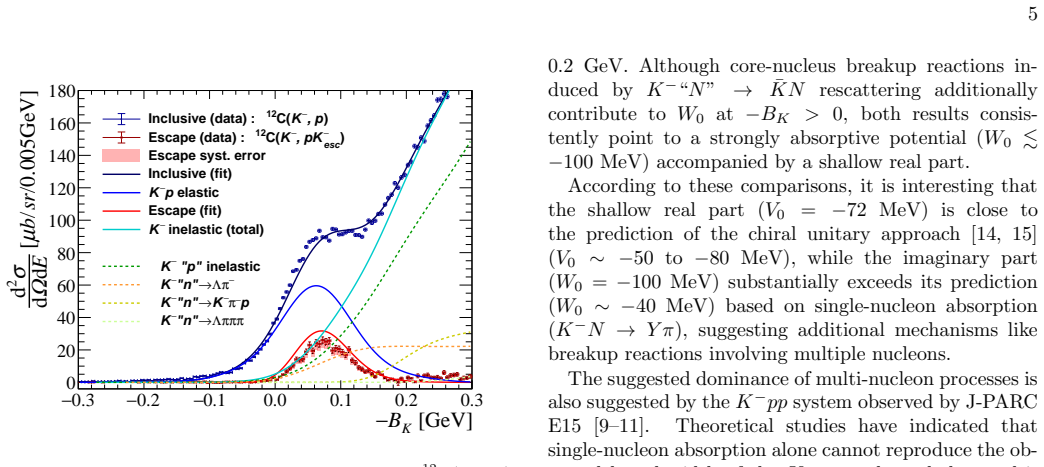
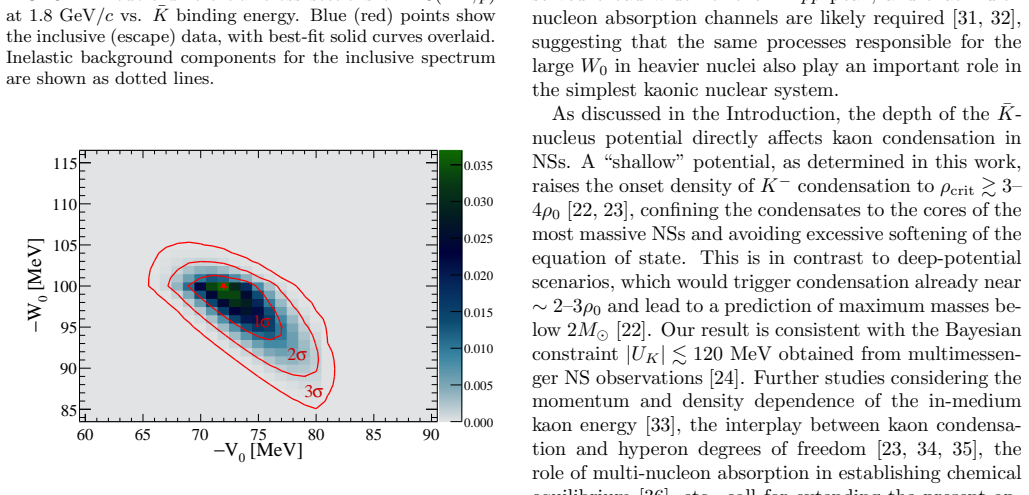
The key object is the antikaon-nucleus optical potential U_opt(r) = (V0 + iW0) rho(r)/rho(0), parametrized by a real strength V0 and an imaginary strength W0. The analysis uses the Green's function method with a distorted-wave impulse approximation (DWIA) to compute both the inclusive missing-mass spectrum and the exclusive K- escape spectrum for a grid of (V0, W0). The escape spectrum is uniquely sensitive to W0 because the probability that the quasi-free recoil K- survives final-state absorption depends on the imaginary potential; a simultaneous likelihood fit to both spectra locates a clear minimum in the (V0, W0) plane and yields the quoted values.
What would settle it
A direct test would be to measure the K- escape cross section on a nucleus with well-known density (e.g., 4He) at the same beam momentum: a value of W0 close to -40 MeV would contradict the claim, while a value near -100 MeV would confirm the strong absorption.
Extended reading notes
Core claim
The central discovery is that the K- escape cross section in the 12C(K-,p) reaction at 1.8 GeV/c, measured here for the first time, forces an imaginary optical-potential strength of W0 = -100^{+7}_{-1}(stat)^{+0}_{-16}(syst) MeV at nuclear density, with a real part V0 = -72 MeV. The escape probability of the recoil K- is governed directly by the absorptive strength of the nuclear medium, so the exclusive measurement breaks the degeneracy that made the inclusive measurement alone weakly sensitive to W0. The derived W0 is significantly more absorptive than the predictions of chiral one-nucleon models (around -40 MeV), and it reconciles with the strong absorption deduced from kaonic atom data w
Load-bearing premise
The extraction assumes a single optical potential of the form U_opt(r) = (V0 + iW0) rho(r)/rho(0) with a fixed density profile, and that the Green's function/DWIA calculation correctly predicts both the inclusive and escape spectra; if the density shape or the energy dependence of the self-energy differs, the quoted W0 is biased.
Editorial extensions
If this is right
- The absorptive strength W0 = -100 MeV is significantly larger than the -40 MeV predicted by one-nucleon absorption models, indicating that multi-nucleon absorption processes are important in the nuclear medium.
- The real potential V0 = -72 MeV is consistent with the shallow chiral-unitary predictions (about -50 to -80 MeV), supporting a shallow rather than deep antikaon-nucleus potential.
- The result resolves the long-standing ambiguity from kaonic atom analyses, which could accommodate both shallow and deep potentials; the direct reaction measurement breaks the degeneracy.
- A shallow potential with strong absorption raises the threshold density for kaon condensation in neutron stars to about 3-4 times normal nuclear density, consistent with modern neutron-star mass constraints.
Reading between the lines
- If multi-nucleon absorption indeed dominates the imaginary potential, then theoretical approaches that sum only one-nucleon amplitudes (t-rho type) are incomplete; future data on heavier nuclei could trace how W0 scales with density and reveal the microscopic multi-nucleon mechanisms.
- The same escape-technique could be applied to other absorbed mesons (e.g., anti-protons or eta mesons) to measure their imaginary potentials, providing a general tool for probing in-medium absorption.
- The strong W0 may affect the interpretation of kaonic atom level widths and shifts, suggesting that a re-analysis of global kaonic atom data with this W0 could refine the density dependence of the potential.
Editorial analysis
A structured set of objections, weighed in public.
Referee Report
Summary. The paper reports the first measurement of the exclusive K^- escape cross section in the 12C(K^-,p) reaction at 1.8 GeV/c at J-PARC E42, obtained in coincidence with the inclusive 12C(K^-,p) spectrum. Using a simultaneous likelihood fit of Green's function/DWIA spectral templates to both datasets, the authors extract a K^- optical potential of V0 = -72 +3/-5 (stat) +0/-8 (syst) MeV and W0 = -100 +7/-1 (stat) +0/-16 (syst) MeV at nuclear center. The extracted W0 is considerably stronger than the ~-40 MeV expected from one-nucleon absorption models, and the paper interprets this as evidence for multi-nucleon absorption processes. The measured exclusive escape cross section is 436 ± 6 (stat) ± 44 (syst) μb/sr.
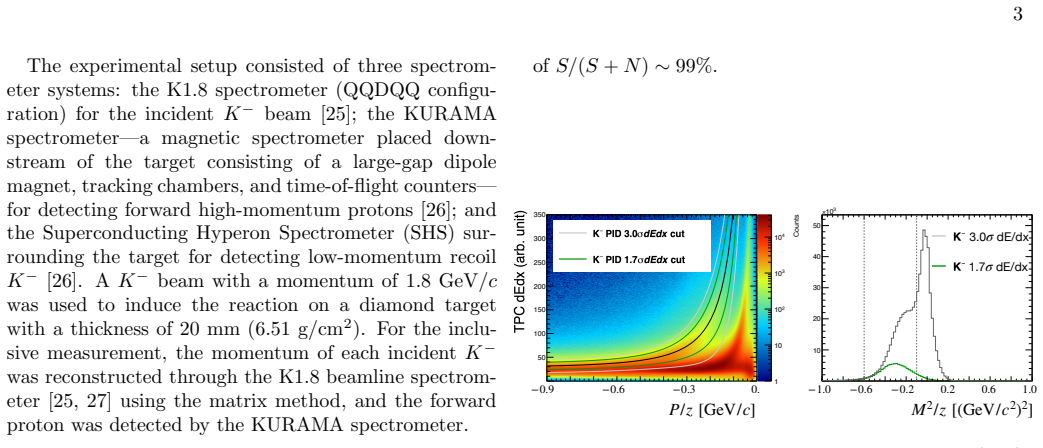
Significance. If the extraction is robust, this is a new and potentially important experimental constraint on the antikaon-nucleus optical potential, providing sensitivity to the absorptive part that is complementary to kaonic atom X-ray data and to the previous inclusive E05 measurement. The experiment itself appears carefully performed: the K^- PID is clean, the efficiency is cross-checked with CH2 and diamond targets with a 5.3% agreement, and the 10.2% total systematic on the escape cross section is documented. The main significance, however, resides in the W0 value, and that value is obtained within a specific theoretical model; the paper's claim of a 'direct experimental determination' overstates the model independence of the result.
major comments (3)
- [Analysis, 'To determine the \bar K-nucleus optical potential...'; Abstract] The phrase 'direct experimental determination of the imaginary part of the K^- optical potential' is too strong. W0 is not measured directly; it is the result of a fit within the Green's function/DWIA framework of Ref. [18], which assumes U_opt(r)=(V0+iW0)ρ(r)/ρ(0), a fixed density profile, and an impulse-approximation vertex for K^-'p' quasi-free scattering. The escape spectrum is essentially a survival probability, so the conversion to W0 is entirely model-dependent. A density-dependent W0(ρ)=W0(ρ/ρ0)^α, a different ρ(r), or two-step contributions could shift the central value beyond the quoted systematic. Please provide a quantitative model-dependence study (varying ρ(r), the density exponent, the energy dependence) or explicitly reframe the result as an extraction under the assumed optical-model form.
- [Results and Discussion, systematic uncertainties] The systematic uncertainties on V0 and W0 are evaluated only by rescaling the escape-spectrum normalization within its ±10.2% uncertainty and repeating the fit. Model uncertainties—the optical-potential functional form, nuclear density, and reaction mechanism—are not propagated. Since the central physics claim is that W0≈-100 MeV is far from the one-nucleon expectation of ≈-40 MeV, a model uncertainty of a few tens of MeV would affect the conclusion. Please report the model-systematic shifts or state clearly that the quoted uncertainties are conditional on the model.
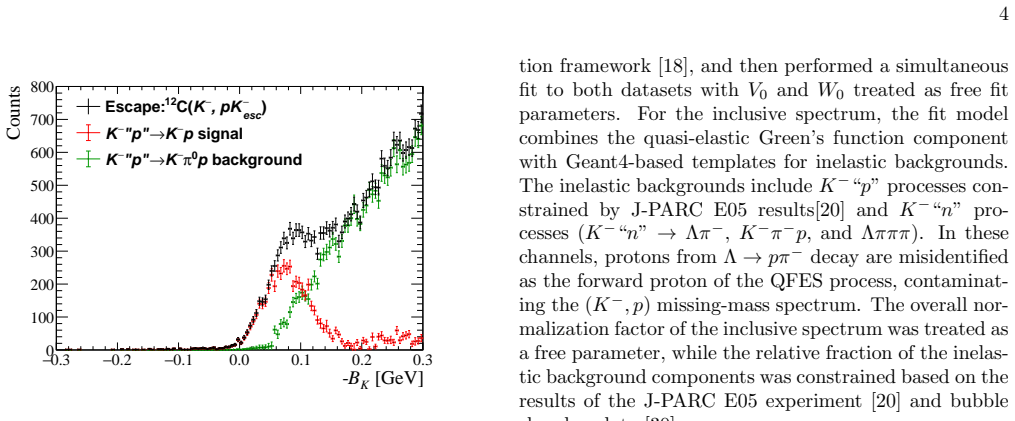
- [Analysis, inclusive fit normalization] The overall normalization of the inclusive spectrum is treated as a free parameter. This means the absolute normalization of the inclusive cross section does not constrain the fit. While the escape spectrum provides an absolute normalization, the inclusive spectrum's shape alone may not uniquely fix V0 and W0. Please discuss what the absolute inclusive cross section would add, or demonstrate that the fitted parameters are insensitive to normalizing the inclusive model to the data.
minor comments (5)
- [Abstract / Conclusion] 'Direct experimental determination' and 'first direct constraint' should be replaced with wording that reflects the model dependence noted above.
- [Analysis, background discussion] The sentence about the exclusive K^-π^- state being the only significant background with extra charged particles (27.2% relative to the exclusive K^- yield) is confusing if later 'rejecting events with any additional charged tracks strictly selects the exclusive K^- channel.' Clarify whether the 27.2% refers to the sample before the veto or to a different phase-space region.
- [Fig. 3 and quoted cross section] Please state explicitly the -B_K integration range corresponding to the quoted escape differential cross section 436 ± 6 ± 44 μb/sr. The figure shows double-differential spectra, so the range of the integrated number should be specified.
- [Statistical method] The text uses both 'likelihood fit' and 'highest posterior density.' Clarify whether the contours in Fig. 4 are Bayesian posterior contours or frequentist likelihood-ratio contours, and state the prior assumptions if Bayesian.
- [Throughout] A careful proofread is needed for minor grammatical issues, e.g., 'contains the reactions such as' should be 'contains reactions such as', and some equation/notation spacing is inconsistent.
Circularity Check
No significant circularity; W0 is determined by fitting a new exclusive measurement within a published model, not by construction.
full rationale
The paper's central result is the first measurement of the K- escape cross section (436 ± 6 ± 44 μb/sr) and a simultaneous likelihood fit of V0 and W0 to the new inclusive and exclusive spectra. W0 is not an input renamed as an output: the escape spectrum is newly measured data, and W0 is a free parameter constrained by that data within the Green's-function DWIA framework of Ref. [18]. The inclusive/exclusive spectral templates are model inputs, but using a model to extract a parameter is ordinary inference, not a circular derivation. Self-citations to Refs. [18], [20], and [17] supply the theoretical framework, the f_phase energy dependence, and background constraints; these are published, externally checkable calculations by overlapping authors, but the central claim (new exclusive cross section and fitted W0) is not reduced to those citations. The phrase 'direct experimental determination' may overstate model-independence—the extraction assumes a local optical potential U=(V0+iW0)ρ/ρ0, a fixed density profile, the impulse approximation, and that all multi-nucleon absorption is encoded in W0—but this is model-dependence/correctness risk, not input=output circularity. No equation in the paper defines the fitted W0 by construction, and no 'prediction' is simply a renamed fit parameter. A modest score of 2 reflects only the presence of same-group theoretical citations in the analysis chain.
Assumptions & free parameters
free parameters (3)
- V0 (real optical potential depth) =
-72 MeV (best fit)
- W0 (imaginary optical potential depth) =
-100 MeV (best fit)
- Inclusive spectrum normalization =
not quoted
assumptions (5)
- domain assumption The K- nucleon optical potential has the form U_opt(r) = (V0 + iW0) rho(r)/rho(0)
- domain assumption The Green's function method with DWIA (Ref. [18]) correctly describes the inclusive (K-,p) and exclusive (K-,pK-esc) spectra
- domain assumption The nuclear density distribution rho(r) of 12C is known from external electron-scattering data
- domain assumption Multi-nucleon absorption processes (e.g., K- NN -> YN, core breakup) are fully represented by the imaginary part W0 of the optical potential
- domain assumption Geant4 simulation reliably models detector response, energy loss, hadronic interactions, and kaon decay
Cite this review
Pith. "Pith review of First Measurement of the $K^-$ Escape Cross Section in the ${}^{12}{\rm C}(K^{-},p)$ Reaction." pith.science (2026). https://pith.science/paper/GWHVHJVZ
@misc{pith2026260618398,
  author       = {Pith},
  title        = {Pith review of: First Measurement of the $K^-$ Escape Cross Section in the $^12\rm C(K^-,p)$ Reaction},
  year         = {2026},
  howpublished = {\url{https://pith.science/paper/GWHVHJVZ}},
  note         = {Machine review of arXiv:2606.18398}
}
abstract
We investigated the $\bar{K}$-nucleus interaction through the simultaneous measurement of the inclusive $^{12}{\rm C}(K^-, p)$ and exclusive $K^-$-escape $^{12}{\rm C}(K^-, p K^-_{esc})$ reactions at $1.8$ GeV/$c$ at J-PARC. The present measurement explicitly focuses on the $K^-$ escape process for the first time, successfully accomplishing a direct experimental determination of the imaginary part of the $K^-$ optical potential. The differential cross section for the $K^-$-escape reaction was determined to be $436 \pm 6\:(\text{stat.}) \pm 44\:(\text{syst.})~\mu\text{b/sr}$. A simultaneous likelihood fit yielded real and imaginary potential strengths of $V_0 = -72\:^{+3}_{-5}\:(\text{stat.})\:^{+0}_{-8}\:(\text{syst.})~\text{MeV}$ and $W_0 = -100\:^{+7}_{-1}\:(\text{stat.})\:^{+0}_{-16}\:(\text{syst.})~\text{MeV}$ at the nuclear center, respectively. The derived $W_0$ is significantly stronger than that predicted by theoretical models based on one-nucleon processes, suggesting possible contribution of multi-nucleon involving processes.
Figures
Figures from the paper (1 more)
Reference graph
Works this paper leans on
-
[18]
Yamagata, H
J. Yamagata, H. Nagahiro, and S. Hirenzaki, In-flight (K −, p) reactions for the formation of kaonic atoms and kaonic nuclei using the green function method, Phys. Rev. C74, 014604 (2006)
2006
-
[1]
A. D. Martin, Kaon-nucleon parameters, Nuclear Physics B179, 33 (1981)
1981
-
[2]
Hyodo, Antikaon-nucleon dynamics and its applica- tion to few-body systems, Nuclear Physics A914, 260 (2013)
T. Hyodo, Antikaon-nucleon dynamics and its applica- tion to few-body systems, Nuclear Physics A914, 260 (2013)
2013
-
[3]
Iwasakiet al., Observation of kaonic hydrogenK α X Rays, Phys
M. Iwasakiet al., Observation of kaonic hydrogenK α X Rays, Phys. Rev. Lett.78, 3067 (1997)
1997
-
[4]
Bazziet al., A new measurement of kaonic hydrogen X-rays, Physics Letters B704, 113 (2011)
M. Bazziet al., A new measurement of kaonic hydrogen X-rays, Physics Letters B704, 113 (2011)
2011
-
[5]
Beeret al.(DEAR Collaboration), Measurement of the Kaonic Hydrogen X-Ray Spectrum, Phys
G. Beeret al.(DEAR Collaboration), Measurement of the Kaonic Hydrogen X-Ray Spectrum, Phys. Rev. Lett. 94, 212302 (2005)
2005
-
[6]
Ikeda, T
Y. Ikeda, T. Hyodo, and W. Weise, Chiral SU(3) theory of antikaon-nucleon interactions with improved threshold constraints, Nuclear Physics A881, 98 (2012)
2012
-
[7]
D. Jido, J. A. Oller, E. Oset, A. Ramos, and U. G. Meiss- ner, Chiral dynamics of the two Λ(1405) states, Nucl. Phys. A725, 181 (2003)
2003
Show all 36 references
-
[8]
Akaishi and T
Y. Akaishi and T. Yamazaki, Nuclear ¯Kbound states in light nuclei, Physical Review C65, 044005 (2002)
2002
-
[9]
Ajimuraet al.(J-PARC E15), TheK −ppbound state observed in the 3He(K −, Λp)nreaction, Phys
S. Ajimuraet al.(J-PARC E15), TheK −ppbound state observed in the 3He(K −, Λp)nreaction, Phys. Lett. B 743, 305 (2015), arXiv:1408.5768 [nucl-ex]
2015 arXiv
-
[10]
Hashimotoet al.(J-PARC E15), Search for the “K −pp”-like structure in the 3He(K −, n) reaction at 1.0 GeV/c, Prog
T. Hashimotoet al.(J-PARC E15), Search for the “K −pp”-like structure in the 3He(K −, n) reaction at 1.0 GeV/c, Prog. Theor. Exp. Phys.2015, 061D01 (2015)
2015
-
[11]
Yamagaet al.(J-PARC E15), Observation of a ¯KN N bound state in the 3He(K −, n) reaction, Phys
T. Yamagaet al.(J-PARC E15), Observation of a ¯KN N bound state in the 3He(K −, n) reaction, Phys. Rev. C 102, 044002 (2020)
2020
-
[12]
Batty, E
C. Batty, E. Friedman, and A. Gal, Strong interaction physics from hadronic atoms, Physics Reports287, 385 (1997)
1997
-
[13]
Friedman and A
E. Friedman and A. Gal, In-medium nuclear interactions of low-energy hadrons, Physics Reports452, 89 (2007)
2007
-
[14]
Kaiser, P
N. Kaiser, P. B. Siegel, and W. Weise, Chiral dynam- ics and the low-energy kaon-nucleon interaction, Nuclear Physics A594, 325 (1995)
1995
-
[15]
Waas and W
T. Waas and W. Weise, S-wave interactions of ¯Kandη mesons in nuclear matter, Nuclear Physics A625, 287 (1997)
1997
-
[16]
Hashimotoet al.(J-PARC E62 Collaboration), Mea- surements of Strong-Interaction Effects in Kaonic-Helium Isotopes at Sub-eV Precision with X-Ray Microcalorime- ters, Phys
T. Hashimotoet al.(J-PARC E62 Collaboration), Mea- surements of Strong-Interaction Effects in Kaonic-Helium Isotopes at Sub-eV Precision with X-Ray Microcalorime- ters, Phys. Rev. Lett.128, 112503 (2022)
2022
-
[17]
Yamagata-Sekihara, Y
J. Yamagata-Sekihara, Y. Iizawa, D. Jido, N. Ikeno, T. Hashimoto, S. Okada, and S. Hirenzaki, Investigation of Kaonic Atom Optical Potential by the High-Precision Data of Kaonic 3He and 4He Atoms, Progress of Theo- retical and Experimental Physics2025, 013D02 (2024)
2024
-
[19]
Kishimotoet al., Search for deeply bound kaonic nu- clear states by in-flightk − reactions, Prog
T. Kishimotoet al., Search for deeply bound kaonic nu- clear states by in-flightk − reactions, Prog. Theor. Phys. 118, 181 (2007)
2007
-
[20]
Y. Ichikawaet al.(J-PARC E05 collaboration), An event excess observed in the deeply bound region of the 12C(K −, p) missing-mass spectrum, Progress of Theoret- ical and Experimental Physics2020, 123D01 (2020)
2020
-
[21]
Iizawa, D
Y. Iizawa, D. Jido, N. Ikeno, J. Yamagata-Sekihara, and S. Hirenzaki, Origin of energy shift in kaonic atom and kaon-nucleus interaction, arXiv preprint arXiv:1907.05626 (2019), arXiv:1907.05626 [nucl-th]
1907 arXiv
-
[22]
Hong and Z
B. Hong and Z. Ren, Probing kaon meson condensations through gravitational waves during neutron star inspiral phases, Physics Letters B858, 139076 (2024)
2024
-
[23]
T. Muto, T. Maruyama, and T. Tatsumi, Effects of three- baryon forces on kaon condensation in hyperon-mixed matter, Phys. Lett. B821, 136587 (2021)
2021
-
[24]
Guha Roy and S
D. Guha Roy and S. Banik, Signatures ofK − condensa- tion on neutron star structure andf-mode frequencies, Physics Letters B871, 139990 (2025)
2025
-
[25]
Takahashiet al., Beam and sks spectrometers at the k1.8 beam line, Progress of Theoretical and Experimental Physics2012, 02B012 (2012)
T. Takahashiet al., Beam and sks spectrometers at the k1.8 beam line, Progress of Theoretical and Experimental Physics2012, 02B012 (2012)
2012
-
[26]
W. S. Junget al.(J-PARC E42 Collaboration), Cross Section Measurements for 12C(K −, K+Ξ−) and 12C(K −, K+ΛΛ) Reactions at 1.8 GeV/c, Progress of Theoretical and Experimental Physics2025, 091D01 (2025)
2025
-
[27]
Agariet al., Secondary charged beam lines at the j- parc hadron experimental hall, Progress of Theoretical and Experimental Physics2012, 10.1093/ptep/pts038 (2012)
K. Agariet al., Secondary charged beam lines at the j- parc hadron experimental hall, Progress of Theoretical and Experimental Physics2012, 10.1093/ptep/pts038 (2012)
2012 doi
-
[28]
J. Ahn, S. Choi, S. Hasegawa, S. Hayakawa, J. Hong, Y. Ichikawa, K. Imai, S. Kim, Y. Makida, H. Ohhata, H. Sako, K. Sasaki, S. Sato, T. Takahashi, K. Tanida, and J. Yoshida, Superconducting dipole magnet for hy- peron spectrometer, Nuclear Instruments and Methods in Physics Re...
2023
-
[29]
S. Kim, Y. Ichikawa, H. Sako, J. Ahn, T. Akaishi, S. Ashikaga, S. Choi, H. Ekawa, S. Hasegawa, S. Hayakawa, W. Jung, B. Kang, J. Lee, T. Nanamura, S. Sato, K. Shirotori, K. Suzuki, K. Tanida, S. Yang, and J. Yoshida, High-rate performance of a time projection chamber for an h-...
2019
-
[30]
C. V. Velde-Wilquet, J. Sacton, J. H. Wickens, D. N. Tovee, and D. H. Davis, Determination of the branch- ing fractions forK − meson absorption at rest in carbon nuclei, Nuovo Cimento A39, 538 (1977)
1977
-
[31]
Sekihara, E
T. Sekihara, E. Oset, and A. Ramos, On the structure of theK −ppresonance in the 3He(K −,Λp)n reaction, Prog. Theor. Exp. Phys.2016, 123D03 (2016)
2016
-
[32]
Dot´ e, T
A. Dot´ e, T. Inoue, and T. Myo, Investigation of the K −ppbound state with a coupled-channel complex scal- ing method, Phys. Lett. B784, 197 (2018). 7
2018
-
[33]
Muto, Kaonic modes in hyperonic matter and p-wave kaon condensation, Nuclear Physics A697, 225 (2002)
T. Muto, Kaonic modes in hyperonic matter and p-wave kaon condensation, Nuclear Physics A697, 225 (2002)
2002
-
[34]
T. Muto, T. Maruyama, and T. Tatsumi, Kaon-baryon coupling schemes and kaon condensation in hyperon- mixed matter, Prog. Theor. Exp. Phys.2022, 093D03 (2022)
2022
-
[35]
Tolos and L
L. Tolos and L. Fabbietti, Strangeness in nuclei and neu- tron stars, Prog. Part. Nucl. Phys.112, 103770 (2020)
2020
-
[36]
Ramos and E
A. Ramos and E. Oset, The properties of antikaons in the nuclear medium, Nuclear Physics A671, 481 (2000)
2000
Reviewed August 2, 2026 · model on record in the stance chip above.
Discussion (0). Continue with ORCID to comment.