REVIEW 3 major objections 5 minor 26 references
3D-PointZshotS: Geometry-Aware 3D Point Cloud Zero-Shot Semantic Segmentation Narrowing the Visual-Semantic Gap
T0 review · 3 major / 5 minor · reviewed 2026-08-16 · deepseek-v4-flash
Pith's one-line read A shared set of learned geometric prototypes can close the semantic-visual gap in zero-shot 3D point-cloud segmentation and improve harmonic-mean IoU on ScanNet, SemanticKITTI, and S3DIS.
desk verdict A plausible LGP-based extension of generative 3D zero-shot segmentation that beats imported baselines on HmIoU, but the evidence is thinner than the claims. read the letter →
The pith
A machine-rendered reading of the paper's core claim, the machinery that carries it, and where it could break.
The reading
What carries the argument
The engine is the set of M latent geometric prototypes: M learnable vectors in feature space that encode recurring local geometric structures, such as the building blocks of cones, cylinders, and cuboids. In feature generation, class semantic embeddings are cross-attended to these prototypes so the synthesized features carry geometric detail; in alignment, both point features and class embeddings are converted into softmax similarity distributions over the same prototypes, creating a shared representation where a nearest-neighbor classifier can operate. The prototypes carry the argument because they are shared across all classes, so geometric patterns learned from seen classes are the mechanism through which unseen classes become reachable.
What would settle it
Take a test set of unseen classes, run the frozen feature extractor and LGP re-representation, and compute a distribution distance, such as the same MMD kernel used in training, between real unseen-class features and the synthetic unseen-class features produced by the generator. If the two distributions do not substantially overlap, the reported HmIoU gains cannot be coming from the claimed geometric transfer. A second check: hold out unseen classes whose local geometry is deliberately unlike anything in the seen classes; if HmIoU does not drop sharply relative to a geometry-matched split, the geometric-transfer story is wrong.
Extended reading notes
Core claim
The paper's central claim is that the bottleneck in zero-shot 3D point cloud segmentation is not only the quality of generated unseen-class features but also the mismatch between the visual space of point features and the semantic space of class names, and that both can be remedied by a common set of latent geometric prototypes. The proposed pipeline works in three stages: a point feature extractor and classifier are pretrained on seen classes; a generator is trained to synthesize visual features by cross-attending class text embeddings to the prototypes, with maximum mean discrepancy matching real feature distributions and an InfoNCE self-consistency loss stabilizing the synthesized features under random point sampling; and, with the generator frozen, both visual and semantic features are re-represented as softmax similarity vectors over the shared prototypes and aligned with an InfoNCE loss. At test time, each point is labeled by nearest-neighbor matching in this prototype-based space. The paper reports the best harmonic-mean IoU among four generalized zero-shot baselines on all three datasets, with larger unseen-class gains on S3DIS and SemanticKITTI and smaller gains on ScanNet.
Load-bearing premise
The load-bearing premise is that synthetic unseen-class features, baked from seen-class geometry and text embeddings alone, land in the same region of the prototype-based shared space as real unseen-class point features at test time, even though no real unseen point is ever seen during training.
Editorial extensions
If this is right
- Unseen classes can be segmented at test time using only their semantic names and the shared geometric codebook, with no unseen-class labels and no RGB images, under the inductive generalized ZSS protocol.
- Replacing the linear seen-class classifier with a nearest-neighbor rule in the LGP space directly improves transfer, which is why the method beats even a supervised ZSL backbone on SemanticKITTI.
- Removing the self-consistency loss mainly hurts unseen classes (S3DIS unseen mIoU drops from 12.8 to 10.5), so robustness of generated features to point sampling is a genuine contributor to zero-shot transfer.
- The prototype count is a real hyperparameter: 128 gives the best HmIoU, while 192 begins to overfit seen classes, so the codebook must be large enough to express geometry but small enough to stay transferable.
Reading between the lines
- A testable prediction follows from the geometric-transfer story: performance should track geometric overlap between seen and unseen classes, so a held-out split where unseen classes share local shapes with seen classes should show larger gains than a split with entirely novel geometries.
- The LGP representation turns both modalities into probability distributions over a finite codebook, which means the learned prototypes can be inspected after training; the prototypes that fire for a given class should correspond to recognizable local 3D shapes, giving a human-readable account of correct and erroneous predictions.
- Because the extractor and semantic embeddings are frozen while the generator and alignment are trained, upgrades to either component, such as better self-supervised point-cloud backbones or richer text embeddings, should drop into the pipeline without redesigning the alignment.
Signed reviews
Editorial analysis
A structured set of objections, weighed in public.
Referee Report
Summary. The paper proposes 3D-PointZshotS, a zero-shot 3D point cloud semantic segmentation framework built on a generative approach. It introduces Latent Geometric Prototypes (LGPs), which are used in two places: a cross-attention generator that enriches class semantic embeddings with geometric information before synthesizing unseen-class visual features, and a shared re-representation space in which both point features and class semantic embeddings are expressed as similarity distributions over the LGPs. Training combines MMD distribution matching, an InfoNCE-based self-consistency loss, and an InfoNCE visual-semantic alignment loss. The method is evaluated on S3DIS, ScanNet, and SemanticKITTI in terms of mIoU and harmonic mIoU against four zero-shot baselines, with additional ablations in the supplementary material. The paper claims superior performance over the baselines on all three datasets and state-of-the-art HmIoU.
Significance. If the reported results are reproducible under controlled conditions, the paper makes a useful contribution: the idea of using learnable, shared geometric prototypes in both feature generation and visual-semantic alignment is coherent and reasonably motivated, and the ablations in the supplementary material (Tables 2-4) give some evidence that each component matters. The public code release and the use of three scene-level datasets are strengths. However, the empirical support for the headline claim is currently fragile. The baseline numbers are imported from prior work rather than re-run, no error bars or multiple seeds are reported, and the ScanNet margin over the strongest baseline is only 0.5 HmIoU points, which may be within run-to-run noise. The text also contains an arithmetic inconsistency in the S3DIS comparison. These issues are local and fixable, so the central mechanism remains defensible, but the current manuscript does not yet establish the claimed superiority.
major comments (3)
- [§4.3, Table 1] The headline empirical claim is not robustly supported. The text states that "All baseline results are taken from [13]", but Table 1 includes SV-Seg [20], which was published after 3DGenZ [13], so this provenance statement cannot be correct as written. Moreover, no error bars, confidence intervals, or number of seeds are reported for any row, including the authors' own method. The unseen-class mIoU values are in the 7-15 range, and the ScanNet HmIoU margin over SV-Seg is only 0.5 points (20.7 vs. 20.2), which is plausibly within run-to-run noise. Without re-running the baselines in the same codebase or at least clearly separating which numbers come from which paper and reporting variance, the claims of "superior performance over four baselines" and "state-of-the-art performance" are not established.
- [§4.3, S3DIS paragraph] The sentence "our method significantly surpasses SV-Seg by 10.6% and 3.1% in mIoU on seen and unseen classes" is inconsistent with Table 1. For S3DIS, the seen-class mIoU is 68.3 for the proposed method and 58.9 for SV-Seg, a difference of 9.4 points, not 10.6. The value 10.6 matches no entry in Table 1. The unseen-class difference of 3.1 points is correct, but the seen-class arithmetic needs to be corrected.
- [§3.4] The self-consistency loss is described in the abstract as enforcing "feature robustness against point-wise perturbations" and in §3.4 as enforcing "feature consistency across different augmentations of the same point cloud," but the implementation randomly samples two subsets of point features from the already-generated synthetic features \hat F_c and treats them as a positive pair. This does not perturb input point clouds or real point features, nor does it apply any augmentation to the visual encoder. The stated contribution of robustness to point-wise perturbations is therefore not supported by the loss formulation as written; either the method should be revised to operate on real point features under perturbations, or the claim should be rephrased to describe subset-sampling consistency.
minor comments (5)
- [§3.4-§3.6, Eq. (2)] The similarity function D(·,·) is used in L_self, L_align, and the inference rule but is never defined. If it is cosine similarity, this should be stated explicitly; without this definition the losses and the classifier are not fully specified.
- [§3.4] The weight λ1 in the final generator loss L_G is introduced but no value is given. Please report the value used in the experiments, or state that it was tuned and provide the chosen setting.
- [Table 1] The table header is malformed: it appears to list six numeric columns per dataset, but each dataset actually has four values (mIoU on seen classes, mIoU on unseen classes, mIoU on all classes, and HmIoU). Please reformat the header so that each dataset has one mIoU triplet and one HmIoU value.
- [Supplementary Material, Tables 2-4] The ablations are reported only on S3DIS. Adding at least one ablation on ScanNet or SemanticKITTI would strengthen the claim that the components generalize across datasets, since the main result is dataset-dependent (e.g., the ScanNet margin is much smaller than the S3DIS margin).
- [§5, Conclusion] The statement "Our method achieves state-of-the-art performance on three scene-level point cloud datasets" overstates what a comparison against four baselines from one or two prior papers can establish, especially given the issues with baseline provenance and the absence of error bars. Please temper the conclusion to match the evidence.
Circularity Check
No circularity: the method is an empirical pipeline; baseline import and hyperparameter choice affect reliability, not derivation.
full rationale
This paper makes an empirical claim (HmIoU superiority over four baselines) and does not purport to derive a result from first principles. The training procedure is standard metric learning: the InfoNCE alignment optimizes the same cosine-similarity scoring rule that is later used at inference, which is a consistency between training objective and test criterion, not a circular definition. The LGP-based re-representation is a learned embedding; using LGPs both inside the generator and in the alignment module does not make the output equal to the input by construction. Hyperparameters such as M=128, tau1=0.5, and tau2=0.2 are chosen by the authors, but no target metric value is fit and no reported HmIoU number is the direct result of an optimized parameter in a way that would make the evaluation equivalent to the input. The fact that baseline results are taken from [13] and no error bars are reported is a legitimate concern about comparability and statistical reliability, but it is an external-validity issue, not circularity. No load-bearing step reduces to its own inputs through the paper's equations, and the authors do not invoke prior work of their own as the justification for a central premise. Accordingly, no circular step is identified and the score is 0.
Assumptions & free parameters
free parameters (5)
- Number of LGPs M =
128
- InfoNCE temperature tau1 =
0.5
- InfoNCE temperature tau2 =
0.2
- Self-consistency loss weight lambda1 =
not reported
- Per-dataset learning rate =
0.0002 / 0.0001 / 0.007
assumptions (5)
- standard math MMD with a Gaussian kernel matches generated and real feature distributions
- domain assumption Word2Vec and GloVe semantic embeddings contain transferable information about 3D geometry for both seen and unseen classes
- domain assumption LGPs learned from seen classes are shared and transferable to unseen classes
- domain assumption Pre-trained backbone features are fixed and informative enough for MMD-based generation
- ad hoc to paper Random point sampling twice yields two valid augmentations for self-consistency
invented entities (1)
-
Latent Geometric Prototypes (LGPs)
Cite this review
Pith. "Pith review of 3D-PointZshotS: Geometry-Aware 3D Point Cloud Zero-Shot Semantic Segmentation Narrowing the Visual-Semantic Gap." pith.science (2026). https://pith.science/paper/GXM62WCR
@misc{pith2026250412442,
  author       = {Pith},
  title        = {Pith review of: 3D-PointZshotS: Geometry-Aware 3D Point Cloud Zero-Shot Semantic Segmentation Narrowing the Visual-Semantic Gap},
  year         = {2026},
  howpublished = {\url{https://pith.science/paper/GXM62WCR}},
  note         = {Machine review of arXiv:2504.12442}
}
read the original abstract
Existing zero-shot 3D point cloud segmentation methods often struggle with limited transferability from seen classes to unseen classes and from semantic to visual space. To alleviate this, we introduce 3D-PointZshotS, a geometry-aware zero-shot segmentation framework that enhances both feature generation and alignment using latent geometric prototypes (LGPs). Specifically, we integrate LGPs into a generator via a cross-attention mechanism, enriching semantic features with fine-grained geometric details. To further enhance stability and generalization, we introduce a self-consistency loss, which enforces feature robustness against point-wise perturbations. Additionally, we re-represent visual and semantic features in a shared space, bridging the semantic-visual gap and facilitating knowledge transfer to unseen classes. Experiments on three real-world datasets, namely ScanNet, SemanticKITTI, and S3DIS, demonstrate that our method achieves superior performance over four baselines in terms of harmonic mIoU. The code is available at \href{https://github.com/LexieYang/3D-PointZshotS}{Github}.
Figures


Reference graph
Works this paper leans on
-
[13]
B. Michele, A. Boulch, G. Puy, M. Bucher, and R. Marlet. Generative zero-shot learning for semantic segmentation of 3d point clouds. In 2021 Int’l Conf. on 3D Vision (3DV), pp. 992–1002. IEEE, 2021
work page 2021
-
[20]
Y . Yang, M. Hayat, Z. Jin, H. Zhu, and Y . Lei. Zero-shot point cloud segmentation by semantic-visual aware synthe- sis. In Proceedings of the IEEE/CVF Int’l Conf. on Computer Vision, pp. 11586–11596, 2023. 3D-PointZshotS: Geometry-Aware 3D Point Cloud Zero-Shot Semantic Segmentation Narrowing the Visual-Semantic Gap Supplementary Material In this supple...
work page 2023
-
[1]
I. Armeni. Joint 2d-3d semantic data for indoor scene under- standing. arXiv preprint arXiv:1702.01105, 2017
arXiv 2017
- [2]
-
[3]
A. Boulch. Convpoint: Continuous convolutions for point cloud processing. Computers & Graphics, 88:24–34, 2020. Figure 2. Qualitative comparison on three datasets: the first column shows the ground truth; the second, 3DGenZ predictions; the third, SV-Seg predictions; and the fourth, our predictions. Red rectangles indicate regions where our method perform...
work page 2020
- [4]
-
[5]
R. Chen, X. Zhu, N. Chen, W. Li, Y . Ma, R. Yang, and W. Wang. Bridging language and geometric primitives for zero-shot point cloud segmentation. In Proceedings of the 31st ACM Int’l Conf. on Multimedia, pp. 5380–5388, 2023
work page 2023
-
[6]
A. Cheraghian, S. Rahman, and L. Petersson. Zero-shot learning of 3d point cloud objects. In2019 16th Int’l Conf. on Machine Vision Applications (MVA), pp. 1–6. IEEE, 2019
work page 2019
Show all 26 references
-
[7]
A. Dai, A. X. Chang, M. Savva, M. Halber, T. Funkhouser, and M. Nießner. Scannet: Richly-annotated 3d reconstruc- tions of indoor scenes. In Proc. of the IEEE Conf. on Com- puter Vision and Pattern recognition, pp. 5828–5839, 2017
2017
-
[8]
Frome, G
A. Frome, G. S. Corrado, J. Shlens, S. Bengio, J. Dean, M. Ranzato, and T. Mikolov. Devise: A deep visual-semantic embedding model. Advances in neural information proc. sys- tems, 26, 2013
2013
-
[9]
S. He, H. Ding, and W. Jiang. Primitive generation and semantic-related alignment for universal zero-shot segmen- tation. In Proceedings of the IEEE/CVF Conf. on Computer Vision and Pattern Recognition, pp. 11238–11247, 2023
2023
-
[10]
D. P. Kingma. Adam: A method for stochastic optimization. arXiv preprint arXiv:1412.6980, 2014
2014 arXiv
-
[11]
Y . Li, K. Swersky, and R. Zemel. Generative moment match- ing networks. In Int’l conf. on machine learning, pp. 1718–
-
[12]
H. Liu, J. Zhuo, C. Liang, J. Chen, and H. Ma. Affin- ity3d: Propagating instance-level semantic affinity for zero- shot point cloud semantic segmentation. In Proc. of the 32nd ACM Int’l Conf. on Multimedia, pp. 9019–9028, 2024
2024
-
[14]
Mikolov, I
T. Mikolov, I. Sutskever, K. Chen, G. S. Corrado, and J. Dean. Distributed representations of words and phrases and their compositionality. Advances in neural information proc. systems, 26, 2013
2013
-
[15]
S. Peng, K. Genova, C. Jiang, A. Tagliasacchi, M. Pollefeys, T. Funkhouser, et al. Openscene: 3d scene understanding with open vocabularies. In Proc. of the IEEE/CVF Conf. on Comp. Vision and Pattern Recogn., pp. 815–824, 2023
2023
-
[16]
Pennington, R
J. Pennington, R. Socher, and C. D. Manning. Glove: Global vectors for word representation. In Empirical Methods in Natural Language Proc. (EMNLP), pp. 1532–1543, 2014
2014
-
[17]
Radford, J
A. Radford, J. W. Kim, C. Hallacy, A. Ramesh, G. Goh, S. Agarwal, G. Sastry, A. Askell, P. Mishkin, J. Clark, et al. Learning transferable visual models from natural language supervision. In Int’l conf. on machine learning , pp. 8748–
-
[18]
Thomas, C
H. Thomas, C. R. Qi, J.-E. Deschaud, B. Marcotegui, F. Goulette, and L. J. Guibas. Kpconv: Flexible and de- formable convolution for point clouds. InProc. of IEEE/CVF Int’l Conf. on Comp. Vision, pp. 6411–6420, 2019
2019
-
[19]
Y . Xu, C. Hu, N. Zhao, and G. H. Lee. Generalized few-shot point cloud segmentation via geometric words. In Proceed- ings of the IEEE/CVF Int’l Conf. on Computer Vision , pp. 21506–21515, 2023
2023
-
[21]
As shown in Tab
Effect of integrating LGPs in the generator To demonstrate the effectiveness of using LGPs, we only use the semantic features and the random noise as input to the generator. As shown in Tab. 2, although the model without the geometry-aware generator (1st row) can achieve simil...
-
[22]
As shown in the second row of Tab
Effect of cohesive visual-semantic representation To demonstrate the necessity of transforming semantic features to the latent geometric space, we conduct another experiment, where semantic features are projected into the same dimensional space as the visual features using a l...
-
[23]
As indicated in the third row of Tab
Effect of adding the self-consistency loss We remove the loss termLself , which is designed to im- prove the self-consistency of synthetic visual features. As indicated in the third row of Tab. 2, the seen mIoU drops to 67.7%, while the unseen class mIoU drops to10.5%, show- i...
-
[24]
beam” and “wall
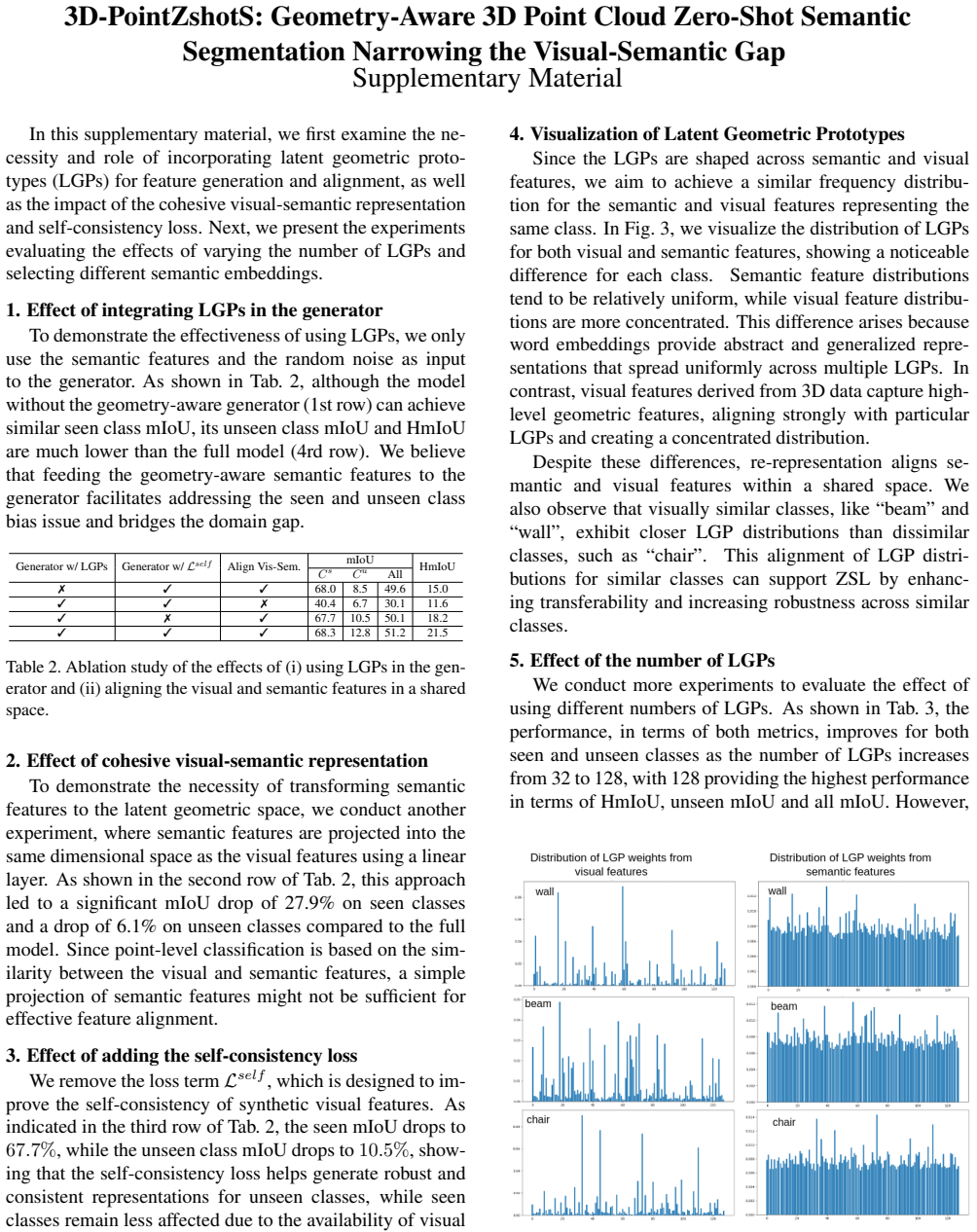
Visualization of Latent Geometric Prototypes Since the LGPs are shaped across semantic and visual features, we aim to achieve a similar frequency distribu- tion for the semantic and visual features representing the same class. In Fig. 3, we visualize the distribution of LGPs f...
-
[25]
As shown in Tab
Effect of the number of LGPs We conduct more experiments to evaluate the effect of using different numbers of LGPs. As shown in Tab. 3, the performance, in terms of both metrics, improves for both seen and unseen classes as the number of LGPs increases from 32 to 128, with 128...
-
[26]
As shown in Tab
Effect of semantic embeddings To verify the effectiveness of semantic features, we con- duct experiments using Word2Vec [14] and GloVe [16] as 300-dimensional features by themselves, as well as concate- nating them. As shown in Tab. 4, the mIoU for unseen classes decreases whe...
Reviewed August 16, 2026 · model on record in the stance chip above.
Discussion (0). Continue with ORCID to comment.