REVIEW 3 major objections 4 minor 60 references
Flopping for FLOPs: Leveraging equivariance for computational efficiency
T0 review · 3 major / 4 minor · reviewed 2026-08-08 · deepseek-v4-flash
Pith's one-line read Making vision networks equivariant to horizontal mirroring (flopping) lets ResMLP, ConvNeXt and ViT classifiers match or beat their ImageNet-1K baselines at scale while using about half the FLOPs and half the parameters.
desk verdict The block-diagonal FLOPs construction is correct and useful, but the accuracy-parity claim at scale rests on uncontrolled baselines and single runs and is not yet established. read the letter →
The pith
A machine-rendered reading of the paper's core claim, the machinery that carries it, and where it could break.
The reading
What carries the argument
The engine is the block-diagonalization identity (2): in a basis split between mirror-invariant and mirror-antisymmetric channels, equivariant linear maps act as $\mathrm{diag}(W_{1,1}, W_{-1,-1})$, a special case of Schur's lemma stating that equivariant maps between distinct irreducible representations must vanish. Around that identity the paper fits the remaining layers: an equivariant GELU computed as $\sigma((x_1+x_{-1})/\sqrt{2})$ and $\sigma((x_1-x_{-1})/\sqrt{2})$ recombined with a $1/\sqrt{2}$ factor (Eq. 3), invariant attention logits formed by pairing invariant with invariant and sign-flip with sign-flip features (Eq. 4), and symmetric/antisymmetric kernels in the patch embedding and depthwise convolutions. The reason the savings show up in wall-clock time, unlike earlier steerable-convolution implementations that reused ordinary convolution routines, is that the chosen backbones are dominated by dense linear layers — fully connected layers, 1x1 convolutions and attention projections — where the block-diagonal split halves FLOPs directly.
What would settle it
Train a large flopping-equivariant model (say, the ViT-H or ResMLP-L24 variant) in which the fraction of invariant versus sign-flip channels is learned per layer rather than fixed at 50/50; if the learned allocation departs strongly from equality and simultaneously improves top-1 accuracy by more than about a point, the premise that the fixed equal split is harmless at scale would be refuted. A weaker test: rerun the largest models with the second half of the network also equivariantized, since the paper's hybrid design equivariantizes only the first half of blocks, and check whether accuracy drops.
Extended reading notes
Core claim
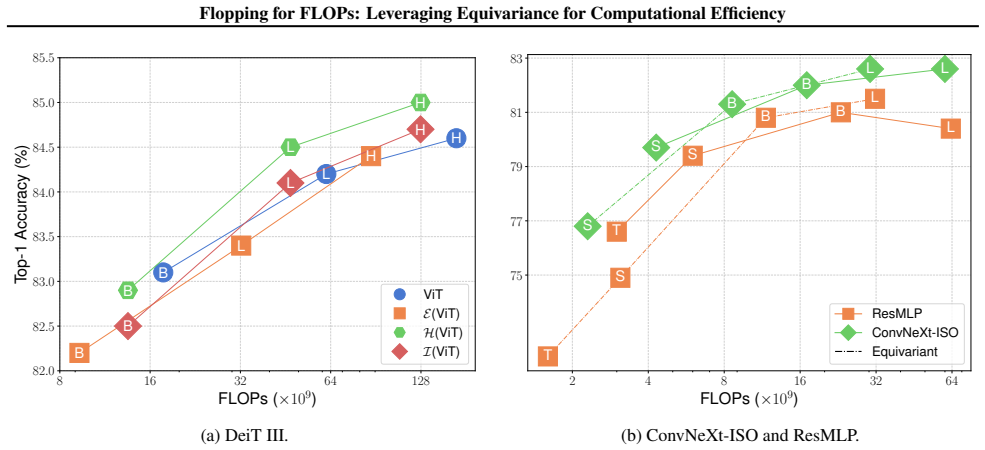
Horizontal mirroring is the two-element group $D_2$, whose only irreducible representations are the trivial one ($+1$, mirror-invariant features) and the sign-flip one ($-1$, mirror-antisymmetric features). The paper's central discovery is that parametrizing every feature map as half invariant and half $(-1)$-equivariant channels forces every equivariant linear layer into block-diagonal form, $W = \mathrm{diag}(W_{1,1}, W_{-1,-1})$, by Schur's lemma: a $d \times c$ matrix-vector product becomes two $(d/2) \times (c/2)$ products, halving FLOPs while also halving trainable parameters, so the equivariant network keeps the same FLOPs-per-parameter ratio as an ordinary network even though its total compute is cut in half. Around this core the paper assembles the rest of an equivariant network: patch embeddings built from symmetric and antisymmetric filters, an equivariant GELU that applies the nonlinearity in a mirrored sum/difference basis and transforms back, attention scores that are invariant because they pair like features, and mirror-adapted positional encodings and class tokens for transformers. Applied to ResMLP, ViT and isotropic ConvNeXt, the recipe yields on ImageNet-1K a set of equivariant models that at L/H scale match or beat their baselines — E(ResMLP-L24) reaches 81.5% against 80.4%, E(ConvNeXt-L) ties 82.6% using 30.3 vs 60.0 GFLOPs, and H(ViT-H) reaches 85.0% against 84.6% — leading the authors to conclude that equivariant networks can be simple models that scale well.
Load-bearing premise
Forcing every layer to commit exactly half its channels to mirror-unchanged features and half to mirror-flipped features — with no freedom to learn a better split — must not meaningfully reduce what the network can learn once it is large, and the paper's own small-model results (3 to 5 point losses) show the premise is not automatically true.
Editorial extensions
If this is right
- Equivariance need not cost compute: for the two-element flop group in linear-layer-dominated architectures, FLOPs per parameter match ordinary networks while total FLOPs and parameters are halved.
- At scale, hard-coding flopping does not cost accuracy: the largest equivariant models match or beat their baselines on ImageNet-1K (E(ResMLP-L24) 81.5 vs 80.4; E(ConvNeXt-L) 82.6 vs 82.6; E(ViT-H) 84.4 vs 84.6), and the hybrid H(ViT-H) at 85.0 is the best model reported.
- Throughput gains widen with model size, since dense linear layers come to dominate runtime; the paper reports throughput improvements up to roughly 59% for the largest equivariant ResMLP, while small models can be slightly slower.
- The block-diagonal construction generalizes to any finite symmetry group via Schur's lemma and Maschke's theorem, with savings set by the number, dimension and type of the group's irreps; the paper singles out $D_8$, the symmetry group of the square grid, as a promising next step.
- Equivariant backbones run on the unmodified training recipes of their baselines, so the efficiency gain comes without new training procedures or hyperparameter tuning.
Reading between the lines
- An extrapolation the authors do not make: on a fixed compute budget, adopting a flopping-equivariant backbone resembles doubling the effective model size, since half the FLOPs and half the parameters buy the same ImageNet accuracy at scale.
- The recipe should transfer wherever a feature extractor is dominated by dense linear layers — self-supervised visual pretraining, dense prediction heads, or keypoint descriptors — but nothing in the paper measures those settings, so the efficiency gain outside classification is untested.
- The small-versus-large divergence (3–5 point losses at S/T sizes, parity at L/H, and the failure of E(ViT-S) to converge) suggests that the standard heavy regularization recipes over-constrain heavily symmetrized small networks; tuning the invariant/equivariant split or the recipe per model size is a concrete follow-up experiment.
- The exact factor-of-two saving is specific to two-element mirror symmetry, because both $D_2$ irreps are one-dimensional; for rotation groups with higher-dimensional irreps the per-parameter compute ratio worsens, so the headline result should not be assumed to carry over to full rotational equivariance.
Editorial analysis
A structured set of objections, weighed in public.
Referee Report
Summary. The paper introduces flopping-equivariant versions of ResMLP, ViT, and ConvNeXt for image classification. The core construction is to split every feature space into D2-invariant and (-1)-equivariant channels, so that equivariant linear maps between these spaces are block-diagonal (Eq. 2). The paper shows that this block structure halves the FLOPs of the dense linear layers, gives an equivariant patch embedding, normalization, GELU, and attention mechanism, and supports hybrid models in which only the first half of the blocks is equivariant. On ImageNet-1K, the equivariant models are reported to reach comparable or better accuracy than the baselines at roughly half the parameters and FLOPs, with increasing throughput gains at larger scales. The authors are candid that baselines were not rerun, that each configuration is a single run, that E(ViT-S) failed to converge, and that the equal split between invariant and equivariant features is not known to be optimal.
Significance. The analytical contribution is valuable and appears sound: the FLOPs-per-parameter parity is a direct, parameter-free consequence of block-diagonalizing linear maps between D2 irreps, not a number fitted to data. If the accuracy-parity claim held under controlled comparisons, this would be an important practical result, since equivariant networks are often assumed to be compute-inefficient per parameter. The paper also demonstrates the value of separating the equivariant-design question from the training-recipe question, and it reports negative small-scale results honestly. However, the empirical evidence for the headline claim is currently not at the standard needed for a journal publication: the large-scale comparisons rest on single runs against literature baselines, with differences that are comparable to typical ImageNet run-to-run noise. The significance of the paper is therefore conditional on a controlled experimental verification.
major comments (3)
- [Section 6, Table 1, Section 6.2] The central claim in Section 1 and Figure 5, that scaled equivariant models achieve comparable or improved accuracy at half FLOPs, is not supported by a controlled comparison. Table 1 states that baselines were not rerun, and Section 6.2 states that each configuration was run once. The large-scale differences are small: E(ViT-H) is 84.4 vs. 84.6, E(ConvNeXt-L) is 82.6 vs. 82.6, H(ViT-H) is 85.0 vs. 84.6, and E(ResMLP-L24) is 81.5 vs. 80.4 against a baseline that the authors themselves call unexpectedly low. With ImageNet-1K run-to-run standard deviations typically around 0.2-0.3 points, these gaps are within noise. Please rerun the baselines under the same training recipe, hardware, and compiler settings, and report means and standard deviations over multiple seeds; without this, the accuracy-parity conclusion is unverified.
- [Section 3.5, Table 1] The assumption that a fixed 1:1 split of channels into invariant and (-1)-equivariant features does not materially limit accuracy is load-bearing for the scaling claim, and the paper's own data show it can fail. Section 3.5 acknowledges that it is not obvious that the equal split is optimal, and the small models lose substantial accuracy: E(ResMLP-T12) is 72.0 vs. 76.6, E(ConvNeXt-S) is 76.8 vs. 79.7, and E(ViT-S) fails to converge. Because the large-scale comparisons are uncontrolled, the paper does not establish that the split becomes harmless at scale; the apparent improvement could equally be explained by baseline underperformance or by noise. Please provide a sensitivity analysis over the invariant/equivariant channel ratio, or otherwise give evidence from trained large models that the equal split is capacity-preserving.
- [Section B, Table 1 caption, Figure 6] The wall-clock time claim is confounded by implementation and hardware differences. Section B states that the baselines were trained on V100 GPUs by their respective authors, while the reported throughput and peak memory are measured on a single A100-40GB GPU with PyTorch 2.5.1, Apex, torch.compile, and FlashAttention. It is unclear from the Table 1 caption whether the baseline throughput numbers were also measured on the same A100 machine under the same compilation and mixed-precision settings. If they were not, the throughput gains in Figure 6 may reflect the measurement harness rather than the equivariant construction. Please state explicitly whether all throughput and memory numbers were measured in one environment for both E(X) and X, and if not, provide such same-environment measurements.
minor comments (4)
- [Eq. (4)] The last expression in Eq. (4) appears to have a typo: it should use the same index on the key as on the query, e.g., q_{i,-1} · k_{j,-1} = (-q_{i,-1}) · (-k_{j,-1}); the current text writes -k_{i,-1} with the query index.
- [Section C] The four tensors x_{1,1}, x_{1,-1}, x_{-1,1}, and x_{-1,-1} are easy to confuse; a small table or a more systematic naming scheme with explicit signs would improve readability.
- [Table 2] Several learning-rate entries such as "3.10−3" and "5.10−3" are ambiguous; please use standard scientific notation such as 3×10⁻³.
- [Section 6.2] The failed convergence of E(ViT-S) is reported only in the table footnote; since this is one of the smallest-scale points and directly relevant to the scaling argument, it deserves at least a sentence in the main text and a marker in Figure 5 if included there.
Circularity Check
No significant circularity: the half-FLOPs property is an analytic consequence of D2 block-diagonalization; the self-citations in Section 3.5 are explicitly hedged and not load-bearing.
full rationale
The central FLOPs claim is derived, not fitted. Equation (2) follows from the definition of D2-equivariant linear maps (or Schur's lemma, Lemma A.2): off-diagonal blocks would break the sign transformation law, so an equivariant linear layer is block-diagonal by construction. No data-dependent parameter is fitted and then renamed as a prediction; the half-parameters/half-FLOPs relation is an architectural identity. The accuracy-parity claim at scale is an empirical assertion based on Table 1, whose limitations the paper discloses in Section 6.2: baselines are not rerun, hardware and software differ, and each configuration is a single run. Those are evidence-quality concerns, not circularity. The only author self-citations occur in Section 3.5, where Bökman & Kahl (2023) and Bökman et al. (2024) are used to note that learned representations may have more invariant than equivariant features and that the equal split is not obviously optimal. The paper explicitly states 'it is not obvious that the choice with an equal number of invariant and (-1)-equivariant features is optimal' and defers optimal design to future work. The FLOPs derivation does not depend on that split being optimal, so the self-citation is not load-bearing. No uniqueness theorem from the authors' prior work is imported, no ansatz is smuggled via citation, and known steerable-CNN results are attributed rather than renamed. Score 2 reflects the presence of non-load-bearing self-citation without any circular derivation.
Assumptions & free parameters
free parameters (2)
- Invariant/equivariant channel split ratio =
1:1
- Hybrid equivariant layer split =
first half of residual blocks equivariant, second half ordinary
assumptions (6)
- standard math Maschke's theorem: every real representation of a finite group decomposes into a direct sum of irreps.
- standard math Schur's lemma: linear equivariant maps between non-isomorphic irreps vanish.
- standard math D2 has exactly two one-dimensional real irreps, the trivial and sign-flip representations.
- domain assumption Upright image classification is invariant to horizontal mirroring.
- domain assumption Ordinary networks trained on symmetric data become approximately equivariant, so hard-coding equivariance does not limit representational power.
- domain assumption The same training recipes as the non-equivariant baselines transfer to the equivariant variants without retuning.
Cite this review
Pith. "Pith review of Flopping for FLOPs: Leveraging equivariance for computational efficiency." pith.science (2026). https://pith.science/paper/GXSQSUQD
@misc{pith2026250205169,
  author       = {Pith},
  title        = {Pith review of: Flopping for FLOPs: Leveraging equivariance for computational efficiency},
  year         = {2026},
  howpublished = {\url{https://pith.science/paper/GXSQSUQD}},
  note         = {Machine review of arXiv:2502.05169}
}
read the original abstract
Incorporating geometric invariance into neural networks enhances parameter efficiency but typically increases computational costs. This paper introduces new equivariant neural networks that preserve symmetry while maintaining a comparable number of floating-point operations (FLOPs) per parameter to standard non-equivariant networks. We focus on horizontal mirroring (flopping) invariance, common in many computer vision tasks. The main idea is to parametrize the feature spaces in terms of mirror-symmetric and mirror-antisymmetric features, i.e., irreps of the flopping group. This decomposes the linear layers to be block-diagonal, requiring half the number of FLOPs. Our approach reduces both FLOPs and wall-clock time, providing a practical solution for efficient, scalable symmetry-aware architectures.
Figures


Figures from the paper (3 more)


Reference graph
Works this paper leans on
-
[1]
Ba, J. L., Kiros, J. R., and Hinton, G. E. Layer normalization. arXiv preprint arXiv:1607.06450, 2016
arXiv 2016
-
[2]
Neural machine translation by jointly learning to align and translate
Bahdanau, D., Cho, K., and Bengio, Y. Neural machine translation by jointly learning to align and translate. ICLR, 2015
work page 2015
-
[3]
Bekkers, E. J., Lafarge, M. W., Veta, M., Eppenhof, K. A., Pluim, J. P., and Duits, R. Roto-translation covariant convolutional networks for medical image analysis. In Medical Image Computing and Computer Assisted Intervention--MICCAI 2018: 21st International Conference, Granada, Spain, September 16-20, 2018, Proceedings, Part I, pp.\ 440--448. Springer, 2018
work page 2018
-
[4]
J., Vadgama, S., Hesselink, R., der Linden, P
Bekkers, E. J., Vadgama, S., Hesselink, R., der Linden, P. A. V., and Romero, D. W. Fast, expressive \ mathrm\ SE \ (n)\ equivariant networks through weight-sharing in position-orientation space. In The Twelfth International Conference on Learning Representations, 2024. URL https://openreview.net/forum?id=dPHLbUqGbr
work page 2024
- [5]
-
[6]
B\" o kman, G. and Kahl, F. Investigating how relu-networks encode symmetries. In Advances in Neural Information Processing Systems, volume 36, pp.\ 13720--13744. Curran Associates, Inc., 2023
work page 2023
-
[7]
Steerers: A framework for rotation equivariant keypoint descriptors
B \"o kman, G., Edstedt, J., Felsberg, M., and Kahl, F. Steerers: A framework for rotation equivariant keypoint descriptors. In Proceedings of the IEEE/CVF Conference on Computer Vision and Pattern Recognition, pp.\ 4885--4895, 2024
work page 2024
-
[8]
Brehmer, J., de Haan, P., Behrends, S., and Cohen, T. S. Geometric algebra transformer. In Advances in Neural Information Processing Systems, volume 36, pp.\ 35472--35496. Curran Associates, Inc., 2023
work page 2023
Show all 60 references
-
[9]
Does equivariance matter at scale? arXiv preprint arXiv:2410.23179, 2024
Brehmer, J., Behrends, S., de Haan, P., and Cohen, T. Does equivariance matter at scale? arXiv preprint arXiv:2410.23179, 2024
2024 arXiv
-
[10]
M., Bruna, J., Cohen, T., and Veli c kovi \'c , P
Bronstein, M. M., Bruna, J., Cohen, T., and Veli c kovi \'c , P. Geometric Deep Learning : Grids, Groups , Graphs , Geodesics , and Gauges . arXiv:2104.13478 [cs, stat], May 2021
2021 arXiv
-
[11]
Bruintjes, R.-J., Motyka, T., and van Gemert, J. What affects learned equivariance in deep image recognition models? In Proceedings of the IEEE/CVF Conference on Computer Vision and Pattern Recognition (CVPR) Workshops, pp.\ 4838--4846, June 2023
2023
-
[12]
and Welling, M
Cohen, T. and Welling, M. Group equivariant convolutional networks. In Int. Conf. Machine Learning, 2016
2016
-
[13]
and Welling, M
Cohen, T. and Welling, M. Steerable CNN s. In Int. Conf. Learn. Represent., 2017
2017
-
[14]
Flashattention-2: Faster attention with better parallelism and work partitioning, 2023
Dao, T. Flashattention-2: Faster attention with better parallelism and work partitioning, 2023. URL https://arxiv.org/abs/2307.08691
2023 arXiv
-
[15]
Imagenet: A large-scale hierarchical image database
Deng, J., Dong, W., Socher, R., Li, L.-J., Li, K., and Fei-Fei, L. Imagenet: A large-scale hierarchical image database. In 2009 IEEE Conference on Computer Vision and Pattern Recognition, pp.\ 248--255, 2009. doi:10.1109/CVPR.2009.5206848
2009
-
[16]
Exploiting cyclic symmetry in convolutional neural networks
Dieleman, S., De Fauw, J., and Kavukcuoglu, K. Exploiting cyclic symmetry in convolutional neural networks. In International conference on machine learning, pp.\ 1889--1898. PMLR, 2016
2016
-
[17]
An image is worth 16x16 words: Transformers for image recognition at scale
Dosovitskiy, A., Beyer, L., Kolesnikov, A., Weissenborn, D., Zhai, X., Unterthiner, T., Dehghani, M., Minderer, M., Heigold, G., Gelly, S., Uszkoreit, J., and Houlsby, N. An image is worth 16x16 words: Transformers for image recognition at scale. In International Conference on...
2021
-
[18]
Cognitron: A self-organizing multilayered neural network
Fukushima, K. Cognitron: A self-organizing multilayered neural network. Biological cybernetics, 20 0 (3): 0 121--136, 1975
1975
-
[19]
Learning and leveraging world models in visual representation learning
Garrido, Q., Assran, M., Ballas, N., Bardes, A., Najman, L., and LeCun, Y. Learning and leveraging world models in visual representation learning. arXiv preprint arXiv:2403.00504, 2024
2024 arXiv
-
[20]
E., Aronsson, J., Carlsson, O., Linander, H., Ohlsson, F., Petersson, C., and Persson, D
Gerken, J. E., Aronsson, J., Carlsson, O., Linander, H., Ohlsson, F., Petersson, C., and Persson, D. Geometric deep learning and equivariant neural networks. Artificial Intelligence Review, 56 0 (12): 0 14605--14662, 2023
2023
-
[21]
A., Goldblum, M., and Wilson, A
Gruver, N., Finzi, M. A., Goldblum, M., and Wilson, A. G. The lie derivative for measuring learned equivariance. In The Eleventh International Conference on Learning Representations, 2023. URL https://openreview.net/forum?id=JL7Va5Vy15J
2023
-
[22]
Deep residual learning for image recognition
He, K., Zhang, X., Ren, S., and Sun, J. Deep residual learning for image recognition. In Proceedings of the IEEE conference on computer vision and pattern recognition, pp.\ 770--778, 2016 a
2016
-
[23]
Identity mappings in deep residual networks
He, K., Zhang, X., Ren, S., and Sun, J. Identity mappings in deep residual networks. CoRR, abs/1603.05027, 2016 b . URL http://arxiv.org/abs/1603.05027
2016 arXiv
-
[24]
and Gimpel, K
Hendrycks, D. and Gimpel, K. Gaussian error linear units (gelus). arXiv preprint arXiv:1606.08415, 2016
2016 arXiv
-
[25]
B., Chess, B., Child, R., Gray, S., Radford, A., Wu, J., and Amodei, D
Kaplan, J., McCandlish, S., Henighan, T., Brown, T. B., Chess, B., Child, R., Gray, S., Radford, A., Wu, J., and Amodei, D. Scaling laws for neural language models. arXiv preprint arXiv:2001.08361, 2020
2001 arXiv
-
[26]
Y., Platt, R., and Walters, R
Klee, D., Park, J. Y., Platt, R., and Walters, R. A comparison of equivariant vision models with imagenet pre-training. In NeurIPS 2023 Workshop on Symmetry and Geometry in Neural Representations, 2023. URL https://openreview.net/forum?id=3ItzNHPov9
2023
-
[27]
M., Romero, D
Knigge, D. M., Romero, D. W., and Bekkers, E. J. Exploiting redundancy: Separable group convolutional networks on lie groups. In International Conference on Machine Learning, pp.\ 11359--11386. PMLR, 2022
2022
-
[28]
Clebsch gordan nets: a fully fourier space spherical convolutional neural network
Kondor, R., Lin, Z., and Trivedi, S. Clebsch gordan nets: a fully fourier space spherical convolutional neural network. In Advances in Neural Information Processing Systems, volume 31. Curran Associates, Inc., 2018
2018
-
[29]
and Kondor, R
Kundu, S. and Kondor, R. Steerable transformers, 2024. URL https://arxiv.org/abs/2405.15932
2024
-
[30]
S., Henderson, D., Howard, R
LeCun, Y., Boser, B., Denker, J. S., Henderson, D., Howard, R. E., Hubbard, W., and Jackel, L. D. Backpropagation applied to handwritten zip code recognition. Neural Computation, 1 0 (4): 0 541--551, 1989
1989
-
[31]
Learning rotation-equivariant features for visual correspondence
Lee, J., Kim, B., Kim, S., and Cho, M. Learning rotation-equivariant features for visual correspondence. In Proceedings of the IEEE/CVF Conference on Computer Vision and Pattern Recognition, pp.\ 21887--21897, 2023
2023
-
[32]
and Vedaldi, A
Lenc, K. and Vedaldi, A. Understanding image representations by measuring their equivariance and equivalence. In Proceedings of the IEEE conference on computer vision and pattern recognition, pp.\ 991--999, 2015
2015
-
[33]
and van Gemert, J
Lengyel, A. and van Gemert, J. Exploiting learned symmetries in group equivariant convolutions. In 2021 IEEE International Conference on Image Processing (ICIP), pp.\ 759--763. IEEE, 2021
2021
-
[34]
A convnet for the 2020s
Liu, Z., Mao, H., Wu, C.-Y., Feichtenhofer, C., Darrell, T., and Xie, S. A convnet for the 2020s. In Proceedings of the IEEE/CVF conference on computer vision and pattern recognition, pp.\ 11976--11986, 2022
2022
-
[35]
Lowe, D. G. Distinctive Image Features from Scale - Invariant Keypoints . Int. J. Comput. Vis., 60 0 (2): 0 91--110, November 2004. doi:10/bqrmsp
2004
-
[36]
and Eklundh, J.-O
Loy, G. and Eklundh, J.-O. Detecting symmetry and symmetric constellations of features. In Computer Vision--ECCV 2006: 9th European Conference on Computer Vision, Graz, Austria, May 7-13, 2006. Proceedings, Part II 9, pp.\ 508--521. Springer, 2006
2006
-
[37]
L., Hillar, C
Marchetti, G. L., Hillar, C. J., Kragic, D., and Sanborn, S. Harmonics of learning: Universal fourier features emerge in invariant networks. In The Thirty Seventh Annual Conference on Learning Theory, pp.\ 3775--3797. PMLR, 2024
2024
-
[38]
Do you even need attention? a stack of feed-forward layers does surprisingly well on imagenet
Melas-Kyriazi, L. Do you even need attention? a stack of feed-forward layers does surprisingly well on imagenet. arXiv preprint arXiv:2105.02723, 2021
2021 arXiv
-
[39]
Naturally occurring equivariance in neural networks
Olah, C., Cammarata, N., Voss, C., Schubert, L., and Goh, G. Naturally occurring equivariance in neural networks. Distill, 2020. doi:10.23915/distill.00024.004. https://distill.pub/2020/circuits/equivariance
2020 doi
-
[40]
Pytorch: An imperative style, high-performance deep learning library
Paszke, A., Gross, S., Massa, F., Lerer, A., Bradbury, J., Chanan, G., Killeen, T., Lin, Z., Gimelshein, N., Antiga, L., Desmaison, A., Kopf, A., Yang, E., DeVito, Z., Raison, M., Tejani, A., Chilamkurthy, S., Steiner, B., Fang, L., Bai, J., and Chintala, S. Pytorch: An impera...
2019
-
[41]
Improving equivariant model training via constraint relaxation
Pertigkiozoglou, S., Chatzipantazis, E., Trivedi, S., and Daniilidis, K. Improving equivariant model training via constraint relaxation. In The Thirty-eighth Annual Conference on Neural Information Processing Systems, 2024
2024
-
[42]
Do imagenet classifiers generalize to imagenet? CoRR, abs/1902.10811, 2019
Recht, B., Roelofs, R., Schmidt, L., and Shankar, V. Do imagenet classifiers generalize to imagenet? CoRR, abs/1902.10811, 2019. URL http://arxiv.org/abs/1902.10811
1902 arXiv
-
[43]
Attentive group equivariant convolutional networks
Romero, D., Bekkers, E., Tomczak, J., and Hoogendoorn, M. Attentive group equivariant convolutional networks. In International Conference on Machine Learning, pp.\ 8188--8199. PMLR, 2020
2020
-
[44]
and Kroon, R
Roos, L. and Kroon, R. S. On fairly comparing group equivariant networks. In preprintX 2024 Workshop on Geometry-grounded Representation Learning and Generative Modeling, 2024
2024
-
[45]
Imagenet large scale visual recognition challenge
Russakovsky, O., Deng, J., Su, H., Krause, J., Satheesh, S., Ma, S., Huang, Z., Karpathy, A., Khosla, A., Bernstein, M., et al. Imagenet large scale visual recognition challenge. International journal of computer vision, 115: 0 211--252, 2015
2015
-
[46]
Linear representations of finite groups
Serre, J.-P. Linear representations of finite groups. Springer, 1977
1977
-
[47]
K., Greff, K., and Schmidhuber, J
Srivastava, R. K., Greff, K., and Schmidhuber, J. Training very deep networks. Advances in neural information processing systems, 28, 2015
2015
-
[48]
The bitter lesson
Sutton, R. The bitter lesson. Incomplete Ideas (blog), 2019
2019
-
[49]
O., Houlsby, N., Kolesnikov, A., Beyer, L., Zhai, X., Unterthiner, T., Yung, J., Steiner, A., Keysers, D., Uszkoreit, J., et al
Tolstikhin, I. O., Houlsby, N., Kolesnikov, A., Beyer, L., Zhai, X., Unterthiner, T., Yung, J., Steiner, A., Keysers, D., Uszkoreit, J., et al. Mlp-mixer: An all-mlp architecture for vision. Advances in neural information processing systems, 34: 0 24261--24272, 2021
2021
-
[50]
Going deeper with image transformers, 2021
Touvron, H., Cord, M., Sablayrolles, A., Synnaeve, G., and Jégou, H. Going deeper with image transformers, 2021. URL https://arxiv.org/abs/2103.17239
2021 arXiv
-
[51]
Deit iii: Revenge of the vit
Touvron, H., Cord, M., and J \'e gou, H. Deit iii: Revenge of the vit. In European conference on computer vision, pp.\ 516--533. Springer, 2022
2022
-
[52]
Resmlp: Feedforward networks for image classification with data-efficient training
Touvron, H., Bojanowski, P., Caron, M., Cord, M., El-Nouby, A., Grave, E., Izacard, G., Joulin, A., Synnaeve, G., Verbeek, J., and Jégou, H. Resmlp: Feedforward networks for image classification with data-efficient training. IEEE Transactions on Pattern Analysis and Machine In...
2023
-
[53]
N., Kaiser, ., and Polosukhin, I
Vaswani, A., Shazeer, N., Parmar, N., Uszkoreit, J., Jones, L., Gomez, A. N., Kaiser, ., and Polosukhin, I. Attention is All you Need . In Adv. Neural Inform. Process. Syst., 2017
2017
-
[54]
and Cesa, G
Weiler, M. and Cesa, G. General E(2) -equivariant steerable CNN s. In Adv. Neural Inform. Process. Syst., 2019. URL https://proceedings.neurips.cc/paper/2019/file/45d6637b718d0f24a237069fe41b0db4-Paper.pdf
2019
-
[55]
Equivariant and Coordinate Independent Convolutional Networks
Weiler, M., Forré, P., Verlinde, E., and Welling, M. Equivariant and Coordinate Independent Convolutional Networks . 2023
2023
-
[56]
Pytorch image models
Wightman, R. Pytorch image models. https://github.com/rwightman/pytorch-image-models, 2019
2019
-
[57]
Arithmetic complexity of computations, volume 33
Winograd, S. Arithmetic complexity of computations, volume 33. Siam, 1980
1980
-
[58]
and Shawe-Taylor , J
Wood, J. and Shawe-Taylor , J. Representation theory and invariant neural networks. Discrete Applied Mathematics, 69 0 (1-2): 0 33--60, August 1996. ISSN 0166218X. doi:10/c3qmr6
1996
-
[59]
e (2) -equivariant vision transformer
Xu, R., Yang, K., Liu, K., and He, F. e (2) -equivariant vision transformer. In Uncertainty in Artificial Intelligence, pp.\ 2356--2366. PMLR, 2023
2023
-
[60]
write newline
" write newline "" before.all 'output.state := FUNCTION n.dashify 't := "" t empty not t #1 #1 substring "-" = t #1 #2 substring "--" = not "--" * t #2 global.max substring 't := t #1 #1 substring "-" = "-" * t #2 global.max substring 't := while if t #1 #1 substring * t #2 gl...
Reviewed August 8, 2026 · model on record in the stance chip above.
Discussion (0). Continue with ORCID to comment.