REVIEW 4 major objections 4 minor 63 references
CoVar: Confidence-Variance-Guided Pseudo-Label Selection for Semi-Supervised Learning
T0 review · 4 major / 4 minor · reviewed 2026-08-03 · deepseek-v4-flash
Pith's one-line read Pseudo-label reliability needs both high confidence and low residual-class variance, not confidence alone.
desk verdict Useful plug-in heuristic with a broken theoretical derivation—the sign error in the CE expansion means the claimed entropy-minimization justification doesn't hold, but the empirical RCV signal is believable. read the letter →
The pith
A machine-rendered reading of the paper's core claim, the machinery that carries it, and where it could break.
The reading
What carries the argument
The load-bearing object is the per-sample cross-entropy decomposition CE ≈ -log p_j(k') + [(K-1)^2/(2(1-p_j(k')))] v_j, obtained by Taylor-expanding log p_j(k) around the mean residual probability under the choice ε = μ_j. The residual-class variance (RCV) v_j measures how unevenly probability mass is spread across non-maximum classes. The confidence-dependent coefficient g_j(p_j(k')) = (K-1)^2/(2(1-p_j(k'))) makes the variance penalty grow as confidence approaches 1, which is what corrects overconfident but unstable predictions. This decomposition motivates the two-dimensional feature embedding [log p_j(k'), -((K-1)^2/(2(1-p_j(k')))) v_j], which is then partitioned by spectral relaxation (S
What would settle it
Measure the accuracy of pseudo-labels split by MC and RCV on a benchmark: if samples with high MC but high RCV are as accurate as those with high MC and low RCV, the central claim is wrong. A direct computational check is to compute, during training, the correlation between pseudo-label correctness and v_j within fixed confidence bins; the paper's criterion predicts a strong negative correlation inside high-confidence bins.
Extended reading notes
Core claim
On the paper's own terms, the central discovery is that the cross-entropy used to train on pseudo-labels can be decomposed, to second order, as -log p_j(k') + [(K-1)^2 / (2(1-p_j(k')))] v_j, where p_j(k') is the maximum confidence and v_j is the variance of the remaining class probabilities around their mean. This decomposition implies that reliable predictions are exactly those that jointly maximize confidence and minimize residual-class variance, with an adaptive penalty that diverges as confidence goes to 1. The paper further claims that partitioning predictions in this confidence-variance plane by SVD-based spectral relaxation separates reliable from unreliable pseudo-labels without hand
Load-bearing premise
The whole reliability criterion depends on the choice to set the ideal distribution's residual-class probability ε equal to the model's own residual mean μ_j, so that 'high confidence plus low residual variance' follows algebraically from assuming the ideal residual allocation is uniform across non-maximum classes.
Editorial extensions
If this is right
- Fixed confidence thresholds systematically over-select majority-class and overconfident-but-wrong pseudo-labels; jointly using MC and RCV reduces this bias.
- The joint criterion can be added as a plug-in module to existing semi-supervised segmentation and classification methods with no inference-time overhead.
- Gains are largest in low-label and class-imbalanced regimes, and even strong backbones continue to benefit from the added residual-dispersion check.
- Replacing RCV with entropy, margin, or other scalar reliability metrics degrades performance, indicating that residual-class dispersion carries information these metrics miss.
Reading between the lines
- The same cross-entropy decomposition could plausibly extend to other uncertainty-aware settings such as semi-supervised object detection or domain adaptation, though the paper only validates segmentation and classification.
- Because the variance penalty diverges as confidence approaches 1, the method implicitly imposes a strict uniformity constraint on near-certain predictions; a testable question is whether this over-penalizes genuinely confident easy samples.
- The spectral separation is performed within each batch; a temporal or online variant that accumulates statistics across epochs might stabilize selection further, especially in the early training phase.
- The adaptive choice ε = μ_j embeds an assumption that the ideal residual allocation is uniform; on tasks with a skewed class structure, reweighting residual classes by their plausibility could improve the criterion further.
Editorial analysis
A structured set of objections, weighed in public.
Referee Report
Summary. The paper proposes CoVar, a pseudo-label selection framework for semi-supervised learning that jointly uses Maximum Confidence (MC) and Residual-Class Variance (RCV). The authors claim to derive this criterion from entropy minimization via a second-order Taylor expansion of cross-entropy, yielding an adaptive penalty that grows as confidence approaches one. They then cast pseudo-label selection as a spectral relaxation problem in the MC-RCV feature space and apply it to semantic segmentation (VOC, Cityscapes) and image classification (CIFAR-10, Mini-ImageNet) within existing SSL pipelines. Experiments report consistent gains over strong baselines, especially in low-label regimes.
Significance. If the theoretical derivation were sound, the paper would offer a principled, plug-in reliability module with no inference overhead, and the reported gains on DINOv2-B segmentation and Mini-ImageNet classification are notable. The manuscript also includes a limitations section and provides code. However, the central derivation contains a sign error that invalidates Eqs. (11) and (13) as approximations to cross-entropy, and the 'ideal distribution' choice introduces a circular element into the claimed entropy-minimization foundation. The qualitative conclusion (high MC + low RCV is good) survives a corrected derivation, but the paper's theoretical claims must be substantially repaired.
major comments (4)
- [Sec. III-B, Eq. (11)] The Taylor expansion sign is wrong. Substituting Eq. (10) into Eq. (9) gives CE = -log p + (K-1)ε log(p/μ) + (K-1)ε v/(2μ^2) + ... = -log p + (K-1)ε log(p/(1-p)) + ... , not -log p - (K-1)ε log(p/(1-p)). For K=2, p=0.9, ε=0.1, true CE = 0.325 but Eq. (11) returns -0.324. This equation is the foundation of the MC-RCV criterion, so the derivation as presented is invalid.
- [Sec. III-B, Eq. (13)] The term KL((1-p)/p) is not a well-defined KL divergence (the argument is a scalar) and is negative for p>0.5, so the claimed lower bound is wrong. With ε=μ_j, the correct simplification is CE ≈ -p log p - (1-p)log(1-p) + (K-1)^2/(2(1-p)) v, i.e., a binary entropy term plus the variance penalty. The paper's expression CE ≈ -log p + ... is not a lower bound and the subsequent batch-level decomposition inherits this error.
- [Sec. III-B.1] Setting ε=μ_j makes the ideal target distribution q depend on the model's own prediction. The statement 'reliable predictions have high MC and low RCV' then follows from the chosen surrogate (uniform residual allocation) rather than from an independent entropy-minimization principle. This is not necessarily fatal, but the paper should present ε=μ_j as a modeling choice and temper the claim that the criterion is 'derived from entropy minimization' without additional assumptions.
- [Sec. III-C and Algorithm 1] The abstract and Sec. III claim 'without hand-tuned confidence thresholds,' but the method uses hyperparameters λ=0.25 in the cluster-selection score and τ_c=0.95 in the classification setup. The paper should clarify which parts are truly threshold-free and which rely on manually chosen constants; otherwise the 'threshold-free' claim is overstated.
minor comments (4)
- [Eq. (13)] The KL term appears outside the summation but depends on j; the notation is ambiguous. If it is meant to be summed, parentheses are missing.
- [Supplementary Lemma 1] The remainder bound C'_j = (K-1)^{3/2}/(3(1-ρ)^3 μ_j^2) diverges as p_j(k')→1 (μ_j→0), so the 'uniform cubic bound' is not uniform over the range of interest. This should be stated explicitly.
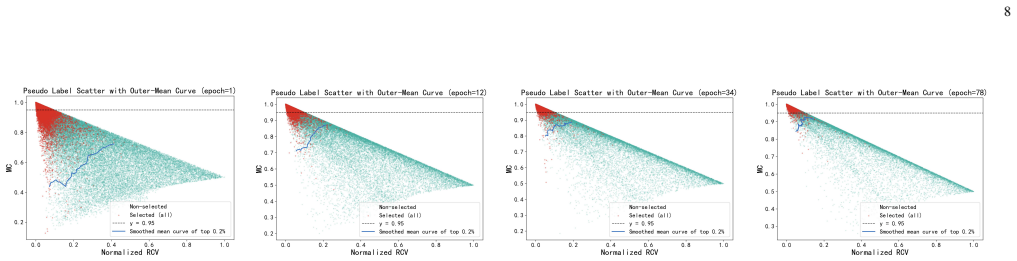
- [Fig. 1] The caption text seems to describe the axes inconsistently ('vertical axis represents the mean of the maximum confidence' but the horizontal axis is 'computed using the validation set'). Please clarify.
- [General] Several citations (e.g., [1], [8]) are from the authors' own prior work; please ensure that the novelty relative to these works is clear, especially regarding the theoretical contribution.
Circularity Check
CoVar's MC-RCV criterion is not derived from entropy minimization; it is built in by setting ε=μ_j, so the central theoretical claim reduces to the chosen surrogate.
-
self definitional
[Sec. III-B.1 ('Setting the Ideal Residual-Class Confidence ε'), Eq. (13); cf. Eq. (8) and Supplementary Corollary 1]
"Since concrete numerical values must be used in computation and ε would otherwise vary across samples and classes, we set ε in the ideal distribution q equal to the residual-class mean of the model prediction itself, i.e., ε = µj = 1−pj(k′) K−1 . Combined with Eq. 12, this yields the simplified form adopted in Eq. 13."
The paper claims to derive 'high MC and low RCV' from entropy minimization, but the ideal target distribution q in Eq. (8) is defined with residual mass ε, and Sec. III-B.1 then sets ε equal to the model's own residual-class mean μ_j. The surviving cross-entropy terms are therefore -log p_j(k') plus a variance term, with the total residual-mass discrepancy removed by construction. If the paper had kept the actual entropy-minimization target (ε→0), the variance term would vanish and Eq. (11) would reduce to -log p_j(k'). Thus the central reliability criterion is the algebraic image of the ε=μ_j choice, not an independent consequence of entropy minimization. The supplementary 'Corollary 1' repeats the same substitution as if it were a proof.
full rationale
The experimental comparisons (PASCAL VOC, Cityscapes, CIFAR-10, Mini-ImageNet, etc.) are genuine external benchmarks and are not circular; CoVar's gains are evaluated against published baselines, and no load-bearing self-citation chain was found (CSL [8] is a baseline, not a premise). However, the theoretical derivation in Sec. III-B is partially circular in a specific, quotable way: the 'ideal' distribution q is built from the model's own residual-class mean. Eq. (13) sets ε=μ_j, so the decomposition CE ≈ -log p + [(K-1)^2/(2(1-p))]v is a consequence of that construction, and the conclusion that reliable pseudo-labels require low RCV follows by construction rather than from an independent first-principles argument. The spectral-relaxation module inherits this same construction through the embedding in Eq. (16), although the ablations (Tables V-VII) provide independent empirical evidence for the usefulness of the resulting weight. Separately, the sign of the middle term in Eqs. (11)/(13) appears to be incorrect, so the claimed CE approximation is invalid; that is a correctness risk rather than an additional circularity. Overall: central theory partially reduces to its own surrogate; score 6.
Assumptions & free parameters
free parameters (2)
- λ (cluster-selection score weight) =
0.25
- τ_c (confidence threshold in classification setup) =
0.95
assumptions (5)
- ad hoc to paper Residual-scale boundedness: |δ_j(k)| ≤ ρ μ_j for all non-maximum classes (Supplementary Assumption 1).
- ad hoc to paper The ideal target distribution q has ε = μ_j, the model's own residual-class mean (Sec. III-B.1, Eq. 13).
- ad hoc to paper Uniform allocation of residual-class probability is the ideal allocation.
- domain assumption Predictions are separable into two reliable/unreliable clusters in the MC-RCV feature space.
- domain assumption Entropy minimization is a valid SSL principle.
invented entities (1)
-
Residual-Class Variance (RCV) v_j
Cite this review
Pith. "Pith review of CoVar: Confidence-Variance-Guided Pseudo-Label Selection for Semi-Supervised Learning." pith.science (2026). https://pith.science/paper/GYDTI7OC
@misc{pith2026260111670,
  author       = {Pith},
  title        = {Pith review of: CoVar: Confidence-Variance-Guided Pseudo-Label Selection for Semi-Supervised Learning},
  year         = {2026},
  howpublished = {\url{https://pith.science/paper/GYDTI7OC}},
  note         = {Machine review of arXiv:2601.11670}
}
read the original abstract
Pseudo-label selection in semi-supervised learning is commonly driven by maximum-confidence thresholds, yet confidence alone can be unreliable under model overconfidence and class imbalance. We propose CoVar, a confidence--variance framework that assesses pseudo-label reliability by jointly modeling Maximum Confidence (MC) and Residual-Class Variance (RCV). Starting from entropy minimization, we derive a second-order cross-entropy approximation showing that low-loss pseudo-labels are favored when MC is high and RCV is low, with a confidence-dependent penalty that becomes stronger for near-certain predictions. Based on this criterion, CoVar embeds predictions into a two-dimensional confidence--variance space and uses SVD-based spectral relaxation to separate reliable and unreliable predictions without hand-tuned confidence thresholds. Cluster-wise Gaussian weighting then converts this separation into per-sample training weights. The resulting weights can be integrated into existing semi-supervised segmentation and classification pipelines during training and introduce no inference-time overhead. Experiments on PASCAL VOC 2012, Cityscapes, CIFAR-10, CIFAR-100, SVHN, and STL-10 show clear gains on VOC and Cityscapes under matched backbones, as well as competitive or improved error rates on standard classification benchmarks. These results indicate that residual-class dispersion provides a useful signal complementary to confidence for robust pseudo-label selection.
Figures


Figures from the paper (7 more)




Reference graph
Works this paper leans on
-
[1]
L. Yang, Z. Zhao, and H. Zhao, ``Unimatch v2: Pushing the limit of semi-supervised semantic segmentation,'' IEEE TPAMI, 2025
2025
-
[2]
J. Wu, Z. Li, W. Sun, J. Yin, L. Nie, and Z. Lin, ``Clusmatch: Improving deep clustering by unified positive and negative pseudo-label learning,'' IEEE Transactions on Pattern Analysis and Machine Intelligence, 2025
2025
-
[3]
Tarubinga and J
E. Tarubinga and J. Kalafatovich Espinoza, ``Confidence-weighted boundary-aware learning for semi-supervised semantic segmentation,'' arXiv e-prints, pp. arXiv--2502, 2025
2025
-
[4]
H. Li, N. Wang, X. Yang, X. Wang, and X. Gao, ``An enhanced adaptive confidence margin for semi-supervised facial expression recognition,'' IEEE Transactions on Pattern Analysis and Machine Intelligence, 2025
2025
-
[5]
Q. Xie, Z. Dai, E. Hovy, T. Luong, and Q. Le, ``Unsupervised data augmentation for consistency training,'' NeurIPS, vol. 33, pp. 6256--6268, 2020
2020
-
[6]
J. Kim, Y. Min, D. Kim, G. Lee, J. Seo, K. Ryoo, and S. Kim, ``Conmatch: Semi-supervised learning with confidence-guided consistency regularization,'' in ECCV. 1em plus 0.5em minus 0.4em Springer, 2022, pp. 674--690
2022
-
[7]
Y. Wang, H. Chen, Y. Fan, W. Sun, R. Tao, W. Hou, R. Wang, L. Yang, Z. Zhou, L.-Z. Guo et al., ``Usb: A unified semi-supervised learning benchmark for classification,'' NeurIPS, vol. 35, pp. 3938--3961, 2022
2022
-
[8]
Liu and J
P. Liu and J. Liu, ``When confidence fails: Revisiting pseudo-label selection in semi-supervised semantic segmentation,'' in ICCV, October 2025, pp. 21\,874--21\,884
2025
Show all 63 references
-
[9]
Xie, M.-T
Q. Xie, M.-T. Luong, E. Hovy, and Q. V. Le, ``Self-training with noisy student improves imagenet classification,'' in CVPR, 2020, pp. 10\,687--10\,698
2020
-
[10]
B. Zoph, G. Ghiasi, T.-Y. Lin, Y. Cui, H. Liu, E. D. Cubuk, and Q. Le, ``Rethinking pre-training and self-training,'' NeurIPS, vol. 33, pp. 3833--3845, 2020
2020
-
[11]
J. Liu, Z. Jiang, W. Gui, Z. Chen, and C. Zhang, ``Occlusion segmentation: Restore and segment invisible areas for particle objects,'' IEEE TASE, 2024
2024
-
[12]
Tarvainen and H
A. Tarvainen and H. Valpola, ``Mean teachers are better role models: Weight-averaged consistency targets improve semi-supervised deep learning results,'' NeurIPS, vol. 30, 2017
2017
-
[13]
K. Sohn, D. Berthelot, N. Carlini, Z. Zhang, H. Zhang, C. A. Raffel, E. D. Cubuk, A. Kurakin, and C.-L. Li, ``Fixmatch: Simplifying semi-supervised learning with consistency and confidence,'' NeurIPS, vol. 33, pp. 596--608, 2020
2020
-
[14]
Zhang, Y
B. Zhang, Y. Wang, W. Hou, H. Wu, J. Wang, M. Okumura, and T. Shinozaki, ``Flexmatch: Boosting semi-supervised learning with curriculum pseudo labeling,'' NeurIPS, vol. 34, pp. 18\,408--18\,419, 2021
2021
-
[15]
Y. Wang, H. Chen, Q. Heng, W. Hou, Y. Fan, Z. Wu, J. Wang, M. Savvides, T. Shinozaki, B. Raj et al., ``Freematch: Self-adaptive thresholding for semi-supervised learning,'' in ICLR, 2023
2023
-
[16]
H. Chen, R. Tao, Y. Fan, Y. Wang, J. Wang, B. Schiele, X. Xie, B. Raj, and M. Savvides, ``Softmatch: Addressing the quantity-quality tradeoff in semi-supervised learning,'' in ICLR, 2023
2023
-
[17]
C. Guo, G. Pleiss, Y. Sun, and K. Q. Weinberger, ``On calibration of modern neural networks,'' in Proceedings of the 34th International Conference on Machine Learning (ICML). 1em plus 0.5em minus 0.4em PMLR, 2017, pp. 1321--1330
2017
-
[18]
J. C. Platt, ``Probabilistic outputs for support vector machines and comparisons to regularized likelihood methods,'' Advances in large margin classifiers, vol. 10, no. 3, pp. 61--74, 1999
1999
-
[19]
Zadrozny and C
B. Zadrozny and C. Elkan, ``Obtaining calibrated probability estimates from decision trees and naive bayesian classifiers,'' in Proceedings of the 18th International Conference on Machine Learning (ICML). 1em plus 0.5em minus 0.4em Morgan Kaufmann, 2001, pp. 609--616
2001
-
[20]
Szegedy, V
C. Szegedy, V. Vanhoucke, S. Ioffe, J. Shlens, and Z. Wojna, ``Rethinking the inception architecture for computer vision,'' in Proceedings of the IEEE Conference on Computer Vision and Pattern Recognition (CVPR), 2016, pp. 2818--2826
2016
-
[21]
T.-Y. Lin, P. Goyal, R. Girshick, K. He, P. Doll \'a r et al., ``Focal loss for dense object detection,'' in Proceedings of the IEEE International Conference on Computer Vision (ICCV), 2017, pp. 2980--2988
2017
-
[22]
Zhang, M
H. Zhang, M. Cisse, Y. N. Dauphin, and D. Lopez-Paz, ``mixup: Beyond empirical risk minimization,'' in International Conference on Learning Representations (ICLR), 2018
2018
-
[23]
S. Yun, D. Han, S. Chun, S. J. Oh, Y. Yoo, and J. Choe, ``Cutmix: Regularization strategy to train strong classifiers with localizable features,'' in Proceedings of the IEEE International Conference on Computer Vision (ICCV), 2019, pp. 6023--6032
2019
-
[24]
M. N. Rizve, K. Duarte, Y. S. Rawat, and M. Shah, ``In defense of pseudo-labeling: An uncertainty-aware pseudo-label selection framework for semi-supervised learning,'' arXiv preprint arXiv:2101.06329, 2021
2021 arXiv
-
[25]
K. Wang, Y. Nie, C. Fang, C. Han, X. Wu, X. Wang, L. Lin, F. Zhou, and G. Li, ``Double-check soft teacher for semi-supervised object detection.'' in IJCAI, 2022, pp. 1430--1436
2022
-
[26]
S. Li, W. Jin, Z. Wang, F. Wu, Z. Liu, C. Tan, and S. Z. Li, ``Semireward: A general reward model for semi-supervised learning,'' in ICLR, 2024
2024
-
[27]
Z. Wang, Z. Chen, C. Liu, Y. Zhao, X. Zhu, and Q. J. Wu, ``Diversity augmentation and multi-fuzzy label for semi-supervised semantic segmentation,'' Neurocomputing, p. 129681, 2025
2025
-
[28]
Y. Liu, Y. Tian, Y. Chen, F. Liu, V. Belagiannis, and G. Carneiro, ``Perturbed and strict mean teachers for semi-supervised semantic segmentation,'' in CVPR, 2022, pp. 4258--4267
2022
-
[29]
L. Yang, L. Qi, L. Feng, W. Zhang, and Y. Shi, ``Revisiting weak-to-strong consistency in semi-supervised semantic segmentation,'' in CVPR, 2023, pp. 7236--7246
2023
-
[30]
J. Liu, Z. Jiang, T. Cao, Z. Chen, C. Zhang, and W. Gui, ``Generated pseudo-labels guided by background skeletons for overcoming under-segmentation in overlapping particle objects,'' TCSVT, vol. 33, no. 6, pp. 2906--2919, 2022
2022
-
[31]
H. Hu, F. Wei, H. Hu, Q. Ye, J. Cui, and L. Wang, ``Semi-supervised semantic segmentation via adaptive equalization learning,'' NeurIPS, vol. 34, pp. 22\,106--22\,118, 2021
2021
-
[32]
R. Sun, H. Mai, T. Zhang, and F. Wu, ``Daw: exploring the better weighting function for semi-supervised semantic segmentation,'' NeurIPS, vol. 36, 2024
2024
-
[33]
J. Ma, C. Wang, Y. Liu, L. Lin, and G. Li, ``Enhanced soft label for semi-supervised semantic segmentation,'' in CVPR, 2023, pp. 1185--1195
2023
-
[34]
Y. Wang, H. Wang, Y. Shen, J. Fei, W. Li, G. Jin, L. Wu, R. Zhao, and X. Le, ``Semi-supervised semantic segmentation using unreliable pseudo-labels,'' in CVPR, 2022, pp. 4248--4257
2022
-
[35]
B. Sun, Y. Yang, L. Zhang, M.-M. Cheng, and Q. Hou, ``Corrmatch: Label propagation via correlation matching for semi-supervised semantic segmentation,'' in CVPR, 2024, pp. 3097--3107
2024
-
[36]
X. Wang, M. Long, J. Wang, and M. Jordan, ``Transferable calibration with lower bias and variance in domain adaptation,'' Advances in Neural Information Processing Systems, vol. 33, pp. 19\,212--19\,223, 2020
2020
-
[37]
Hoyer, D
L. Hoyer, D. Dai, H. Wang, and L. Van Gool, ``Mic: Masked image consistency for context-enhanced domain adaptation,'' in CVPR, 2023, pp. 11\,721--11\,732
2023
-
[38]
Thulasidasan, G
S. Thulasidasan, G. Chennupati, J. A. Bilmes, T. Bhattacharya, and S. Michalak, ``On mixup training: Improved calibration and predictive uncertainty for deep neural networks,'' Advances in neural information processing systems, vol. 32, 2019
2019
-
[39]
Verma, K
V. Verma, K. Kawaguchi, A. Lamb, J. Kannala, A. Solin, Y. Bengio, and D. Lopez-Paz, ``Interpolation consistency training for semi-supervised learning,'' Neural Networks, vol. 145, pp. 90--106, 2022
2022
-
[40]
Olsson, A
C. Olsson, A. P. Eriksson, and F. Kahl, ``Improved spectral relaxation methods for binary quadratic optimization problems,'' Computer Vision and Image Understanding, vol. 112, no. 1, pp. 3--13, 2008
2008
-
[41]
Tian, ``Generalized kkm theorems, minimax inequalities, and their applications,'' Journal of Optimization Theory and Applications, vol
G. Tian, ``Generalized kkm theorems, minimax inequalities, and their applications,'' Journal of Optimization Theory and Applications, vol. 83, pp. 375--389, 1994
1994
-
[42]
Everingham, S
M. Everingham, S. A. Eslami, L. Van Gool, C. K. Williams, J. Winn, and A. Zisserman, ``The pascal visual object classes challenge: A retrospective,'' IJCV, vol. 111, pp. 98--136, 2015
2015
-
[43]
Cordts, M
M. Cordts, M. Omran, S. Ramos, T. Rehfeld, M. Enzweiler, R. Benenson, U. Franke, S. Roth, and B. Schiele, ``The cityscapes dataset for semantic urban scene understanding,'' in CVPR, 2016, pp. 3213--3223
2016
-
[44]
Hariharan, P
B. Hariharan, P. Arbeláez, L. Bourdev, S. Maji, and J. Malik, ``Semantic contours from inverse detectors,'' in ICCV, 2011, pp. 991--998
2011
-
[45]
Krizhevsky, G
A. Krizhevsky, G. Hinton et al., ``Learning multiple layers of features from tiny images,'' 2009
2009
-
[46]
Vinyals, C
O. Vinyals, C. Blundell, T. Lillicrap, D. Wierstra et al., ``Matching networks for one shot learning,'' Advances in neural information processing systems, vol. 29, 2016
2016
-
[47]
L. Yang, W. Zhuo, L. Qi, Y. Shi, and Y. Gao, ``St++: Make self-trainingwork better for semi-supervised semantic segmentation,'' in CVPR, 2022, pp. 4258--4267
2022
-
[48]
X. Lai, Z. Tian, L. Jiang, S. Liu, H. Zhao, L. Wang, and J. Jia, ``Semi-supervised semantic segmentation with directional context-aware consistency,'' in CVPR, 2021, pp. 1205--1214
2021
-
[49]
S. Li, Y. He, W. Zhang, W. Zhang, X. Tan, J. Han, E. Ding, and J. Wang, ``Cfcg: Semi-supervised semantic segmentation via cross-fusion and contour guidance supervision,'' in CVPR, 2023, pp. 16\,348--16\,358
2023
-
[50]
Z. Wang, Z. Zhao, X. Xing, D. Xu, X. Kong, and L. Zhou, ``Conflict-based cross-view consistency for semi-supervised semantic segmentation,'' in CVPR, 2023, pp. 19\,585--19\,595
2023
-
[51]
P. Li, P. Purkait, T. Ajanthan, M. Abdolshah, R. Garg, H. Husain, C. Xu, S. Gould, W. Ouyang, and A. Van Den Hengel, ``Semi-supervised semantic segmentation under label noise via diverse learning groups,'' in CVPR, 2023, pp. 1229--1238
2023
-
[52]
H. Mai, R. Sun, T. Zhang, and F. Wu, ``Rankmatch: Exploring the better consistency regularization for semi-supervised semantic segmentation,'' in CVPR, 2024, pp. 3391--3401
2024
-
[53]
X. Wang, B. Zhang, L. Yu, and J. Xiao, ``Hunting sparsity: Density-guided contrastive learning for semi-supervised semantic segmentation,'' in CVPR, 2023, pp. 3114--3123
2023
-
[54]
H. Wang, Q. Zhang, Y. Li, and X. Li, ``Allspark: Reborn labeled features from unlabeled in transformer for semi-supervised semantic segmentation,'' in CVPR, 2024, pp. 3627--3636
2024
-
[55]
X. Wang, H. Bai, L. Yu, Y. Zhao, and J. Xiao, ``Towards the uncharted: Density-descending feature perturbation for semi-supervised semantic segmentation,'' in CVPR, 2024, pp. 3303--3312
2024
-
[56]
Y. Jin, J. Wang, and D. Lin, ``Semi-supervised semantic segmentation via gentle teaching assistant,'' NeurIPS, vol. 35, pp. 2803--2816, 2022
2022
-
[57]
Z. Zhao, L. Yang, S. Long, J. Pi, L. Zhou, and J. Wang, ``Augmentation matters: A simple-yet-effective approach to semi-supervised semantic segmentation,'' in CVPR, 2023, pp. 11\,350--11\,359
2023
-
[58]
X. Chen, Y. Yuan, G. Zeng, and J. Wang, ``Semi-supervised semantic segmentation with cross pseudo supervision,'' in CVPR, 2021, pp. 2613--2622
2021
-
[59]
Hoyer, D
L. Hoyer, D. J. Tan, M. F. Naeem, L. Van Gool, and F. Tombari, ``Semivl: semi-supervised semantic segmentation with vision-language guidance,'' in European Conference on Computer Vision. 1em plus 0.5em minus 0.4em Springer, 2024, pp. 257--275
2024
-
[60]
P. Qiao, Z. Wei, Y. Wang, Z. Wang, G. Song, F. Xu, X. Ji, C. Liu, and J. Chen, ``Fuzzy positive learning for semi-supervised semantic segmentation,'' in CVPR, 2023, pp. 15\,465--15\,474
2023
-
[61]
L.-C. Chen, Y. Zhu, G. Papandreou, F. Schroff, and H. Adam, ``Encoder-decoder with atrous separable convolution for semantic image segmentation,'' in ECCV, 2018, pp. 801--818
2018
-
[62]
K. He, X. Zhang, S. Ren, and J. Sun, ``Deep residual learning for image recognition,'' in CVPR, 2016, pp. 770--778
2016
-
[63]
S. Yun, D. Han, S. Chun, S. J. Oh, Y. Yoo, and J. Choe, ``Cutmix: Regularization strategy to train strong classifiers with localizable features,'' in ICCV, 2019, pp. 6022--6031
2019
Reviewed August 3, 2026 · model on record in the stance chip above.
Discussion (0). Sign in to comment.