REVIEW 3 major objections 5 minor 20 references
Tractable Representation Learning with Probabilistic Circuits
T0 review · 3 major / 5 minor · reviewed 2026-08-06 · deepseek-v4-flash
Pith's one-line read Modeling data and embeddings inside one probabilistic circuit makes autoencoders robust to missing data.
desk verdict A genuinely new way to make probabilistic circuits learn representations, with strong missing-data robustness claims that mostly hold up; the missing code and unexamined embedding-placement heuristic are the main points to press. read the letter →
The pith
A machine-rendered reading of the paper's core claim, the machinery that carries it, and where it could break.
The reading
What carries the argument
The load-bearing object is a smooth and decomposable probabilistic circuit $\mathcal{C}$ that contains embedding random variables $Z$ as first-class input units alongside data inputs $X$, with Gaussian input units for embeddings. Smoothness and decomposability guarantee that marginals, conditionals, and samples can be computed exactly in time linear in the circuit size; encoding is a two-pass procedure that caches per-input likelihoods and reweights sum-unit weights, then samples a path using SIMPLE, a $k$-subset gradient estimator (with $k=1$) that keeps the forward pass discrete and the backward pass differentiable. This differentiable sampling is what lets the neural decoder's gradients reach the circuit encoder. The neural decoder is the second half of the machinery: it maps sampled embeddings back to data, and because the encoder always returns a complete embedding even from partial evidence, the decoder never sees missing entries.
What would settle it
Train an APC on an image dataset with deliberately adversarial pairings, such as pairing every embedding variable with a fixed pixel or with pixels that carry no class information, and re-run the reconstruction and downstream experiments; if performance collapses to near the VAE baseline, the robustness claim depends on the random-coupling heuristic rather than on the tractable-conditional mechanism itself. Alternatively, measure the conditional mutual information $I(X;Z)$ under the learned circuit; if it is close to zero at high corruption levels while reconstruction still succeeds, the information must flow through the decoder rather than the encoder, which would contradict the paper's attribution.
Extended reading notes
Core claim
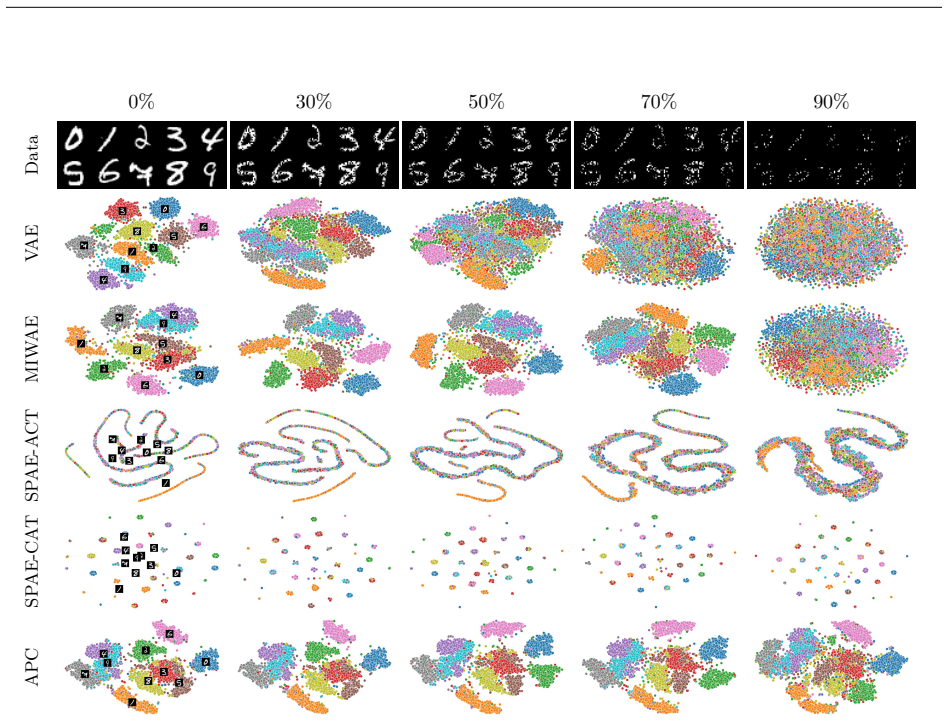
The central claim is that explicit random variables for embeddings, placed as input units inside a smooth and decomposable probabilistic circuit, turn the circuit into an autoencoder whose encoder is an exact conditional distribution. Concretely, APCs build a single PC over data and embeddings, obtain embeddings by tractable conditional sampling $z\sim p_{\mathcal{C}}(Z\mid X_o=x_o)$ for any observed subset $X_o$, and train end to end against a neural decoder using a three-term loss: reconstruction log-likelihood, KL divergence of the sampled embedding distribution to a prior, and joint data-embedding negative log-likelihood. The paper reports that APCs outperform SPAE, VAE, MIWAE, and missForest in reconstruction under MCAR and MAR corruptions across eight image datasets and 18 of 20 tabular datasets, keep downstream classification accuracy high under missingness, and can distill a pretrained VAE's knowledge without the original data. In the authors' framing, the encoder is the joint distribution itself, so no separate inference network is needed.
Load-bearing premise
The whole result rests on the heuristic that randomly pairing each embedding input with one data input at the circuit's bottom layer produces a conditional distribution $p_{\mathcal{C}}(Z\mid X=x)$ informative enough for reconstruction; the paper gives no rule for how strong or deep that coupling should be.
Editorial extensions
If this is right
- Autoencoders can be built with a tractable probabilistic encoder, so encoding queries like $p(Z\mid X_o=x_o)$ are exact rather than approximate.
- Missing data at test time requires no imputation: the marginalization at the input units is a native operation of the circuit.
- End-to-end training with a neural decoder is possible through differentiable sampling, and the ablation identifies all three losses plus the neural decoder as necessary for the reported performance.
- A pretrained VAE can be distilled into an APC without the training data, transferring the teacher's distribution while gaining missing-data robustness.
- Embedding likelihoods $\log p_{\mathcal{C}}(Z)$ are tractable, giving a principled score for out-of-distribution detection.
Reading between the lines
- The random local coupling of each embedding unit to one data unit is the weakest design choice; a principled placement rule, such as learned or information-theoretic coupling, could either strengthen the claim or reveal its limits.
- The framework's missing-data claim should transfer to structured corruptions beyond images, but the MAR experiments cover only geometric patterns; heterogeneous tabular missingness is a natural stress test.
- Tractable embedding likelihoods suggest a direct test of representation quality: measuring how well $p_{\mathcal{C}}(Z)$ separates classes or domains, rather than relying only on reconstruction or downstream accuracy.
- Because the encoder is a circuit, the same machinery could support probabilistic retrieval or active querying, where the model chooses which variables to observe next based on exact conditional information.
Editorial analysis
A structured set of objections, weighed in public.
Referee Report
Summary. The paper introduces autoencoding probabilistic circuits (APCs), a framework in which a smooth and decomposable probabilistic circuit explicitly models the joint distribution pC(X, Z) over data and embedding variables. Encoding is performed by tractable conditional sampling z ~ pC(Z | X = x), which natively handles missing inputs through exact marginalization, and decoding is performed by a neural network trained end-to-end with a weighted combination of reconstruction, KLD-prior, and joint-likelihood losses, using SIMPLE-based differentiable sampling. The empirical sections compare APCs with SPAE, VAE, MIWAE, and missForest on eight image datasets and twenty DEBD tabular datasets, evaluate downstream linear classification and embedding visualizations, report ablations of each loss and decoder component, and explore data-free knowledge distillation and embedding-based OOD likelihood separation.
Significance. If the reported results hold, APCs provide a genuinely different way to build autoencoders: the encoder is a tractable probabilistic model rather than a neural network, which yields exact conditional inference and intrinsic handling of missing data without imputation. The paper's strengths are its broad empirical coverage (eight image and twenty tabular datasets), the use of the same neural decoder across APC and VAE comparisons, consistent ablations in Table 1, and the improvement of differentiable PC sampling via SIMPLE, which is validated in a controlled experiment. The main weakness is that the core embedding-placement mechanism is heuristic and is never varied or measured, and the code is not actually available, so the generality of the central claim remains partially open.
major comments (3)
- [§3.1, Appendix B.1] The central mechanism of the framework is the placement of embedding variables as leaf units randomly paired with data input units, but the manuscript contains no experiment that varies this design choice. Since the authors explicitly state that 'the circuit structures employed in this work were selected heuristically' (Section 6), the headline claim that a tractable PC encoder is responsible for the observed missing-data robustness is not yet separated from the specific random-coupling heuristic. I ask for ablations that vary (i) the number of data units each embedding is coupled with (e.g., 1 vs. k vs. all), (ii) the depth at which embeddings are inserted, and (iii) random vs. structured pairing, measuring reconstruction MSE and downstream accuracy under MCAR corruption; this would establish whether the reported advantages are a property of the framework or of one architecture.
- [Appendix B, 'Missing Data'] The vanilla VAE baseline is evaluated with constant zero imputation, and although the text states that mean imputation was also explored, no quantitative results are reported for it. Because zero imputation is known to be a particularly weak treatment of missing inputs, the comparisons in Figs. 5-7 and Tables 2-3 may overstate the gap between APCs and neural autoencoders. The authors should report the mean-imputation VAE results, add a masked or missing-data-specific neural baseline such as mDAE or not-MIWAE, and clarify whether reconstruction MSE is computed only on missing entries or on the full image, since this metric choice directly affects the interpretation of the robustness curves.
- [Appendix B] The implementation link is given as 'https://github.com/placeholder-url', so no runnable code or complete configuration files are available to the reader. Given that the empirical evaluation is the main support for the paper's claims and that several architecture details are delegated to source files, this placeholder makes the results impossible to verify. Please provide a working code release or, failing that, full hyperparameter tables, circuit construction parameters (including the embedding-pairing rule), and dataset preprocessing details in the appendix.
minor comments (5)
- [§3.4] The word 'mechansim' should be 'mechanism'.
- [Figure 7 caption] The caption contains a typo: 'linearly seperable' should be 'linearly separable'.
- [Appendix B, 'Downstream Task Training'] The text '100,0000 iterations' appears to be a typo and should read '100,000 iterations'.
- [Eq. (2)] The reconstruction loss is written as a negative log-likelihood, but the text says MSE is used as L_REC; please clarify the connection (e.g., a Gaussian observation model) and define how the reconstruction \hat{x}_i is computed from the sampled embedding z_i.
- [Appendix Algorithm 1] In the pseudocode, the conditions 'if n == ' and 'if n == ⊗' appear to have missing symbols due to formatting; please restore the unit-type predicates so the algorithm is readable.
Circularity Check
No significant circularity: the APC framework's claims are supported by external baseline comparisons and standard probabilistic inference, not by self-fulfilling definitions or fitted parameters.
full rationale
The paper's central claim is empirical: a smooth and decomposable PC modeling a joint distribution pC(X,Z), followed by exact conditional sampling z ~ pC(Z|X_o=x_o) and a neural decoder, yields accurate reconstructions, useful embeddings, and native missing-data robustness. The derivation chain is: (1) construct a PC over data and embedding leaves; (2) encode by tractable conditional sampling; (3) train end-to-end with LREC on external data reconstructions, LKLD between the induced embedding posterior and a fixed Gaussian prior, and LNLL on the joint pC(x,z) with z self-sampled from pC(z|x). None of these steps reduces to its own inputs: the reconstruction target x is held-out data, not model output; the embedding posterior is a model quantity, not a fitted constant renamed as a prediction; and the missing-data robustness follows from the mathematical smoothness/decomposability properties of PCs, which are independently established in the cited background literature and are not supplied by the present paper's fitted values. The differentiable sampling relies on Lang et al. (2022) and SIMPLE (Ahmed et al., 2023); although Lang et al. shares authors with this paper, it is a gradient-estimation tool rather than the load-bearing claim, and the paper validates it against Gumbel-Softmax on a synthetic task, providing external evidence. The random coupling of embedding leaves to data leaves is explicitly acknowledged as a heuristic ('the circuit structures employed in this work were selected heuristically') and is an architectural design choice, not a circular argument: the paper does not fit a parameter from the target metric and then report that metric as a prediction. The ablation study further isolates each component against external baselines. No equation in the paper equates a predicted quantity with a fitted input by construction, and no load-bearing result rests on an unverified self-citation. Therefore no significant circularity is present.
Assumptions & free parameters
free parameters (2)
- Loss weights lambda_REC, lambda_KLD, lambda_NLL =
1, 1, 1
- Embedding dimension d =
64 (MNIST/F-MNIST), 256 (other image datasets), 4-64 for tabular
assumptions (4)
- standard math A smooth and decomposable PC supports exact tractable marginalization and conditional sampling in O(|C|) time.
- domain assumption SIMPLE is a faithful gradient estimator for categorical sampling at sum units.
- standard math Gaussian embedding input units allow closed-form KLD to a standard normal prior.
- standard math Conditional independence Z_j ⊥ Z_k | X=x, H=h holds after conditioning on sampled hidden variables.
Cite this review
Pith. "Pith review of Tractable Representation Learning with Probabilistic Circuits." pith.science (2026). https://pith.science/paper/GYGLVKWJ
@misc{pith2026250704385,
  author       = {Pith},
  title        = {Pith review of: Tractable Representation Learning with Probabilistic Circuits},
  year         = {2026},
  howpublished = {\url{https://pith.science/paper/GYGLVKWJ}},
  note         = {Machine review of arXiv:2507.04385}
}
read the original abstract
Probabilistic circuits (PCs) are powerful probabilistic models that enable exact and tractable inference, making them highly suitable for probabilistic reasoning and inference tasks. While dominant in neural networks, representation learning with PCs remains underexplored, with prior approaches relying on external neural embeddings or activation-based encodings. To address this gap, we introduce autoencoding probabilistic circuits (APCs), a novel framework leveraging the tractability of PCs to model probabilistic embeddings explicitly. APCs extend PCs by jointly modeling data and embeddings, obtaining embedding representations through tractable probabilistic inference. The PC encoder allows the framework to natively handle arbitrary missing data and is seamlessly integrated with a neural decoder in a hybrid, end-to-end trainable architecture enabled by differentiable sampling. Our empirical evaluation demonstrates that APCs outperform existing PC-based autoencoding methods in reconstruction quality, generate embeddings competitive with, and exhibit superior robustness in handling missing data compared to neural autoencoders. These results highlight APCs as a powerful and flexible representation learning method that exploits the probabilistic inference capabilities of PCs, showing promising directions for robust inference, out-of-distribution detection, and knowledge distillation.
Figures


Figures from the paper (14 more)




Reference graph
Works this paper leans on
-
[2]
In contrast, the APC framework allows embedding random variables to appear at arbitrary positionsin the circuit graph represented byarbitrary distributions. This comparison highlights the flexibility of APCs compared to the prior autoencoding scheme introduced in Vergari et al. (2018). 38 E Knowledge Distillation: Algorithm & Additional Results Algorithm ...
work page 2018
-
[5]
demonstrate that APCs significantly outperform all other compared methods in preserving image fidelity across all datasets, even as the proportion of missing data increases. C.4 Additional Reconstruction Visualizations To provide further visual insights and extend the quantitative reconstructions presented in Fig. 6, we additionally show MCAR-style corrup...
work page 2018
-
[6]
Lorenzo Loconte, Antonio Mari, Gennaro Gala, Robert Peharz, Cassio de Campos, Erik Quaeghebeur, Gennaro Vessio, and Antonio Vergari. What is the relationship between tensor factorizations and circuits (and how can we exploit it)?Transactions on Machine Learning Research (TMLR), 2025a. Lorenzo Loconte, Stefan Mengel, and Antonio Vergari. Sum of squares cir...
-
[8]
Full Evidence: APCs are successfully distilling the knowledge from their teacher
39 Table 8:APCs successfully distill the knowledge from a pre-trained VAE in a data-free setting and exceed their teachers robustness against missing data.Input reconstruction mean squared error (↓) and downstream task accuracy (↑) performance comparison between VAE teacher and distilled APC student models, evaluated with full evidence (Full Evi.) and und...
work page 2022
-
[10]
Raphael Tang, Yao Lu, Linqing Liu, Lili Mou, Olga Vechtomova, and Jimmy Lin. Distilling task-specific knowledge from bert into simple neural networks.arXiv preprint arXiv:1903.12136,
arXiv 1903
-
[11]
Z. Wang. Data-free knowledge distillation with soft targeted transfer set synthesis. InAssociation for the Advancement of Artificial Intelligence (AAAI), 2021a. Zi Wang. Zero-shot knowledge distillation from a decision-based black-box model. InInternational Conference on Machine Learning (ICML), 2021b. Christopher KI Williams, Charlie Nash, and Alfredo Na...
-
[13]
Fisher Yu, Yinda Zhang, Shuran Song, Ari Seff, and Jianxiong Xiao. LSUN: construction of a large-scale image dataset using deep learning with humans in the loop.arXiv preprint arXiv:1506.03365,
-
[14]
Shuchang Zhou, Yuxin Wu, Zekun Ni, Xinyu Zhou, He Wen, and Yuheng Zou. DoReFa-Net: Training low bitwidth convolutional neural networks with low bitwidth gradients.arXiv preprint arXiv:1606.06160,
Show all 20 references
-
[15]
Our implementation is available as open-source software athttps: //github.com/placeholder-url
and PyTorch Lightning (Falcon & The PyTorch Lightning team, 2019). Our implementation is available as open-source software athttps: //github.com/placeholder-url. Datasets We evaluate our models on various image and tabular datasets. For image data, we include MNIST (LeCun et a...
2019
-
[16]
convolutional
and missForest (Stekhoven & Bühlmann, 2011). For all autoencoding models, we use an embedding dimensiond of 64 for MNIST and F-MNIST, 256 for all other image-based datasets, and 4,8,16,32, and 64 for tabular datasets, depending on their number of features to ensured≪| X|. All ...
2018
-
[18]
can be interpreted as a special case of APCs. They are the result of runningMaxProdMPE on the circuit ¯C over V = (X, H) where H are sum unit indicator random variables obtained from the latent variable interpretation introduced in Peharz et al. (2017) and described in Section
2017
-
[2006]
not-miwae: Deep generative modelling with missing not at random data
20 Niels Bruun Ipsen, Pierre-Alexandre Mattei, and Jes Frellsen. not-miwae: Deep generative modelling with missing not at random data. InICLR 2021-International Conference on Learning Representations,
2021
-
[2014]
Learning invariant features through local space contraction.arXiv preprint arXiv:1104.4153,
Salah Rifai, Xavier Muller, Xavier Glorot, Grégoire Mesnil, Yoshua Bengio, and Pascal Vincent. Learning invariant features through local space contraction.arXiv preprint arXiv:1104.4153,
-
[2015]
22 Lili Mou, Ran Jia, Yan Xu, Ge Li, Lu Zhang, and Zhi Jin
URL https://ai.googleblog.com/2015/06/inceptionism-going-deeper-into-neural.html. 22 Lili Mou, Ran Jia, Yan Xu, Ge Li, Lu Zhang, and Zhi Jin. Distilling word embeddings: An encoding approach. In International Conference on Information and Knowledge Management (CIKM),
2015
-
[2016]
Learning markov network structure with decision trees.2010 IEEE International Conference on Data Mining,
Daniel Lowd and Jesse Davis. Learning markov network structure with decision trees.2010 IEEE International Conference on Data Mining,
2010
-
[2018]
Fashion-mnist: a novel image dataset for benchmarking machine learning algorithms.arXiv preprint arXiv:1708.07747,
Han Xiao, Kashif Rasul, and Roland Vollgraf. Fashion-mnist: a novel image dataset for benchmarking machine learning algorithms.arXiv preprint arXiv:1708.07747,
-
[2019]
Very deep vaes generalize autoregressive models and can outperform them on images.arXiv preprint arXiv:2011.10650, abs/2011.10650,
Rewon Child. Very deep vaes generalize autoregressive models and can outperform them on images.arXiv preprint arXiv:2011.10650, abs/2011.10650,
2011 arXiv
-
[2020]
mdae : modified denoising autoencoder for missing data imputation
Mariette Dupuy, Marie Chavent, and Remi Dubois. mdae : modified denoising autoencoder for missing data imputation. arXiv preprint arXiv:2411.12847, abs/2411.12847,
-
[2024]
Tractable probabilistic graph representation learning with graph-induced sum-product networks
Federico Errica and Mathias Niepert. Tractable probabilistic graph representation learning with graph-induced sum-product networks. arXiv preprint arXiv:2305.10544,
-
[2025]
Grammar variational autoencoder
Matt J Kusner, Brooks Paige, and José Miguel Hernández-Lobato. Grammar variational autoencoder. In International conference on machine learning, pp. 1945–1954. PMLR,
1945
Reviewed August 6, 2026 · model on record in the stance chip above.
Discussion (0). Sign in to comment.