REVIEW 2 major objections 5 minor 35 references
Price of Fairness in Bandits: A Tight Minimax Characterization
T0 review · 2 major / 5 minor · reviewed 2026-08-02 · deepseek-v4-flash
Pith's one-line read This paper proves that in k-armed bandits where welfare is the negative-power mean of per-round rewards, the minimax regret is Θ~(σ√(k^{max(1,q)}/T)), so for fairness strength q>1 the k^{q/2} penalty is information-theoretically unavoidable
desk verdict Solid lower-bound machinery and a clever schedule, but the claimed minimax rate is undefined over the stated class because means are unbounded. read the letter →
The pith
A machine-rendered reading of the paper's core claim, the machinery that carries it, and where it could break.
The reading
What carries the argument
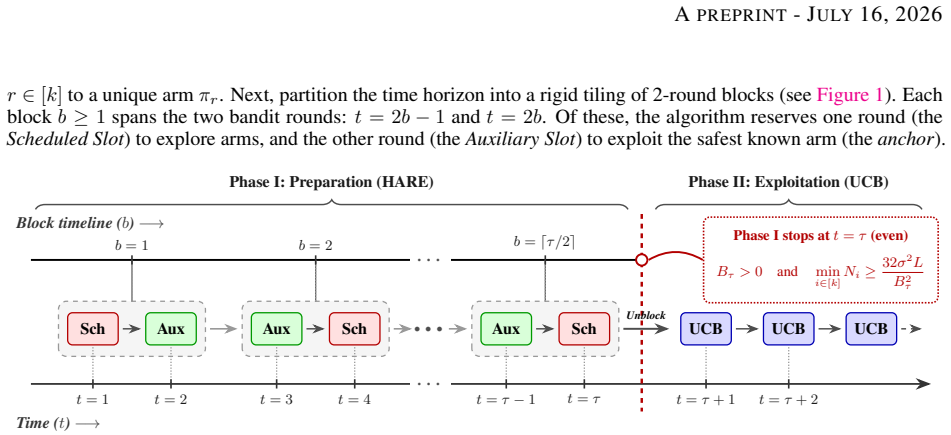
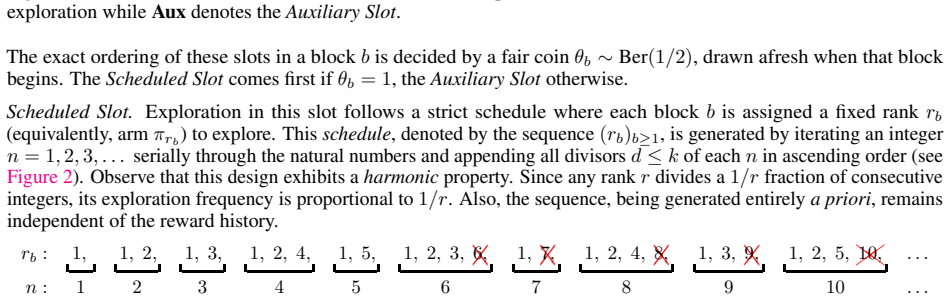
The argument turns on two constructions. First, the needle-in-haystack instance family (all means zero except one arm with mean μ>0), together with the information-cost inequality (Lemma 4.7) that converts the rate at which an algorithm can raise its probability of pulling the optimal arm into a lower bound on the cumulative inverse-power penalty. Second, the UCB-HARE algorithm, whose exploration phase uses a harmonic rank schedule—pulling arms with frequency proportional to 1/r—and pairs each risky exploration pull with a certified anchor pull, an arm whose lower confidence bound is strictly positive. The schedule's prefix-balance property (Lemma 3.6) guarantees every arm is adequately samp
What would settle it
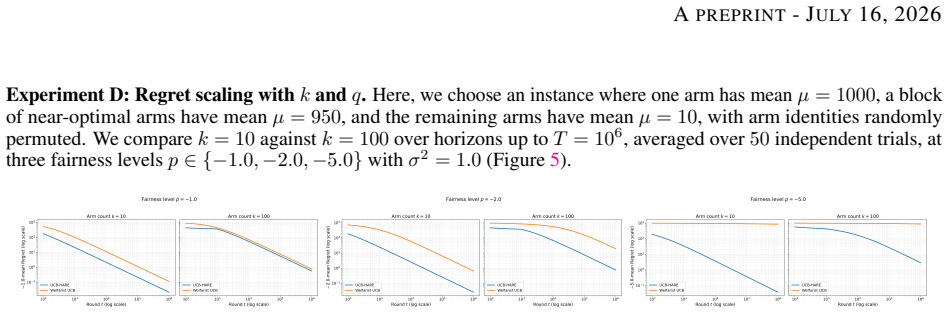
Simulate the needle-in-haystack family used in the paper for a fixed q>1 (say q=3) across k=10,30,100 with T large, and fit the scaling of the best achievable regret in k: an exponent of (q+1)/2≈2 rather than q/2=1.5 would contradict the claimed minimax lower bound.
Extended reading notes
Core claim
On the paper's own terms, the central discovery is that the minimax (−q)-mean regret over the class of σ-sub-Gaussian bandits with nonnegative means is Ω(σ√(k^{max(1,q)}/T)) (Theorem 1.1), and the UCB-HARE algorithm achieves O~(σ√(k^{max(1,q)}/T)) (Theorem 1.2). For 0<q≤1 the classical √(k/T) rate persists; for q>1 the rate becomes √(k^q/T). The lower bound is obtained from a needle-in-haystack family of instances in which only one arm has positive mean, and the proof is distilled into a general information-cost inequality that lower-bounds the cumulative penalty of any fairness-sensitive objective whose welfare is bottlenecked by the rate of identifying the optimal arm. The upper bound repl
Load-bearing premise
The result depends on the assumption that every arm's expected reward is nonnegative and the best arm's mean is strictly positive; if any arm could have a negative mean, the negative-power welfare objective (which is set to zero when any round's expected reward is zero) and the algorithm's anchor-certification safety argument would both break.
Editorial extensions
If this is right
- For q>1, the classical √(k/T) regret rate is superseded by √(k^q/T); this is the exact minimax rate up to log factors.
- Algorithms based on uniform early exploration (the prior state of the art) are provably suboptimal in their k-dependence: they incur k^{(q+1)/2}/√T whereas the fundamental limit is k^{q/2}/√T.
- The price of strict fairness is zero for 0<q≤1 in the minimax scaling: the classical rate is attainable, so fairness up to Nash/geometric strength comes for free in k.
- The same information-cost inequality applies beyond negative-power means and is in principle adaptable to other bandit models, such as linear bandits, as the authors note.
- The regret bound is gap-free: it holds uniformly over instances without knowledge of suboptimality gaps, with only the optimal mean and sub-Gaussian parameter entering the bound.
Reading between the lines
- The harmonic schedule's success suggests a design principle the authors leave implicit: any fair-exploration scheme must allocate exploration roughly inversely to rank to raise the optimal arm's selection probability from 1/k without paying the full k^{q} penalty; other inverse-frequency schedules might achieve the same endpoint with smaller constants.
- The nonnegativity assumption is doing more work than the fairness framing suggests: if arm means are merely lower-bounded by a known negative constant, one could shift all rewards, but the anchor-certification argument and the zero-round convention for the negative-power mean would need reworking. A testable extension is to quantify how the minimax rate degrades as the mean lower bound approaches
- The paper's lower bound construction uses one good arm; instances with many good arms are likely easier. An editor's guess is that a constant fraction of near-optimal arms would yield a smaller k-exponent, so the worst-case rate may only bite in the sparse-optimal-arm regime.
- The information-cost inequality could serve as a general tool for sequential decision problems with bottleneck objectives (e.g., minimax regret under constraints on worst-round reward), connecting naturally to the Rawlsian maximin ideal in welfare economics.
Editorial analysis
A structured set of objections, weighed in public.
Referee Report
Summary. The paper studies the strictly fair regime p=-q<0 of the generalized p-mean regret in stochastic k-armed bandits with nonnegative means and sigma-sub-Gaussian rewards. It claims a tight minimax rate sigma*sqrt(k^{max(1,q)}/T): a needle-in-haystack lower bound and a matching upper bound for a new algorithm, UCB-HARE, which combines a harmonic rank schedule with a certified positive-mean anchor. The main technical contributions are an information-cost inequality (Lemma 4.7) and a two-phase analysis that carefully handles the stopping time and the dependence between the block coin flips and the stopping event. The internal derivations appear consistent, but the minimax formulation is not valid as stated because the class ESG(k,sigma)+ has no upper bound on the optimal mean, making the finite-horizon minimax regret infinite.
Significance. If the unbounded-mean issue is repaired by an explicit bound on mu_* or by rephrasing the claims as instance-dependent/asymptotic, the paper would make a substantial contribution. The information-cost abstraction is clean and general, the lower bound is derived from first principles, and UCB-HARE's harmonic anchored exploration is a genuine algorithmic idea with a careful formal analysis. The predicted k^{q/2} penalty for q>1 is crisp and falsifiable. I did not find an internal gap in the main proof chain, but the discrepancy between the claimed 'minimax' rate and the actual theorems is central and must be fixed before publication.
major comments (2)
- [Section 1.2, Assumption 1.1, Theorem 1.1] The minimax regret over ESG(k,sigma)+ is infinite as stated. Since Assumption 1.1 imposes no upper bound on mu_*, take any algorithm and any k>=2, T=1. Let p_i=P(I_1=i) and choose i* with p_i*<=1/k. Set mu_*=M and all other means 0. Then m_1=M p_i*<=M/k and R_{1,-q}>=M(1-1/k), which is unbounded as M goes to infinity. Hence R_{T,-q}(k,sigma)=infinity for every T>=1, so no finite rate of the form sigma*sqrt(k^{max(1,q)}/T) can be a uniform upper bound over the stated class. The lower bound in Theorem 1.1 is not false, but it is vacuous as a 'minimax rate' statement, and the claimed matching upper bound cannot hold. The paper needs either (a) an explicit bounded-mean assumption (e.g., mu_i in [0,U]) with asymptotic statements for T sufficiently large, or (b) an explicit reframing of all upper bounds as instance-dependent, keeping the mu_*-dependent term.
- [Abstract, Theorem 1.2, Corollary 5.2] The advertised clean rate suppresses a mu_*-dependent term that is load-bearing. Theorem 5.1 gives R_{T,-q} <= C_q [ sigma*sqrt(H_k K_q(k) L/T) + mu_* H_k K_q(k)/T + mu_* delta ], and Corollary 5.2 for q>1 retains the term mu_* k^q/T. This term is not bounded uniformly over ESG(k,sigma)+ because mu_* is unbounded; it is also not dominated by sigma k^{q/2}/sqrt(T) for all T,k. Thus the abstract's claim that UCB-HARE achieves O_tilde(sigma*sqrt(k^{max(1,q)}/T)) is not a consequence of the stated theorems. The clean rate is only valid for a fixed instance and T large relative to mu_* (and, under a bounded-mean fix, for T sufficiently large). The authors should either state this qualification explicitly or prove a genuinely uniform bound over a bounded class.
minor comments (5)
- [Title/Abstract] The title line 'PRICE OFFAIRNESS INBANDITS' is missing spaces. The abstract also uses O_tilde without defining it; define it in Section 1 or 3.
- [Algorithm 1, line 7] The loop 'for slot h in (theta_b,1-theta_b) do' is cryptic. It presumably means iterating over the scheduled and auxiliary slots in an order determined by theta_b; please spell this out in pseudocode or in the caption.
- [Lemma 3.1] The handling of zero coordinates for negative-order means is by convention set to zero, but the proof says 'follows by continuity'. Since the convention is discontinuous for p<0, please state explicitly that Lemma 3.1 is applied only where all coordinates are positive, or handle the zero case separately.
- [Lemma 6.5] The event names A_t and F_t are introduced with the same letter A as the algorithm in the statement 'Fix an arbitrary algorithm A'. Rename the events (e.g., cal A_t, cal F_t) to avoid confusion.
- [Section 7] The text references Figures 3-6 but the final version should ensure the plots are included with axes and legend labels readable. Experiment D's description says 'we eventually have' in the proof sketch; this is informal and should be aligned with the formal proof.
Circularity Check
No circularity: lower bound from first-principles information-cost inequality, upper bound from self-contained algorithm analysis; self-citations are baselines only.
full rationale
The central derivation is self-contained. The lower bound (Theorem 4.1/1.1) is built from the definition of negative-power welfare M_{-q}, a needle-in-haystack family of Gaussian instances, Jensen's inequality (Lemma 4.3), and a general information-cost inequality (Lemmas 4.4-4.7); the choice mu = sigma sqrt(k^q/T) is standard rate balancing of a derived bound, not an input assumption. The upper bound (Theorem 5.1) is analyzed from the algorithm's own definitions: harmonic-schedule prefix balance (Lemma 3.6), concentration (Lemma 6.1), anchor certification (Lemma 6.2), the ex-ante reward floor (Lemma 6.5), and UCB pseudo-regret (Lemma 6.8). No fitted parameter is renamed as a prediction. Self-citations [SPR25] and [SPC26] appear only as prior-work comparisons and a remark about linear-bandit extensions; neither supports the lower bound, the UCB-HARE algorithm, or the claimed matching rate. The unbounded-mean issue with class ESG(k,sigma)+ is a correctness concern about the stated minimax formulation, not a circularity in the derivation chain; for a fixed instance the instance-dependent upper bound remains independently meaningful. Score 0.
Assumptions & free parameters
free parameters (1)
- δ =
1/T
assumptions (4)
- domain assumption Assumption 1.1: all arm means are nonnegative and μ*>0.
- domain assumption σ-sub-Gaussian noise with known σ.
- standard math Standard bandit lower bound Ω(σ√(k/T)) [BC12] for average regret.
- standard math Hoeffding/sub-Gaussian concentration and union bound for the good event E.
Cite this review
Pith. "Pith review of Price of Fairness in Bandits: A Tight Minimax Characterization." pith.science (2026). https://pith.science/paper/GYP5ACYT
@misc{pith2026260713402,
  author       = {Pith},
  title        = {Pith review of: Price of Fairness in Bandits: A Tight Minimax Characterization},
  year         = {2026},
  howpublished = {\url{https://pith.science/paper/GYP5ACYT}},
  note         = {Machine review of arXiv:2607.13402}
}
abstract
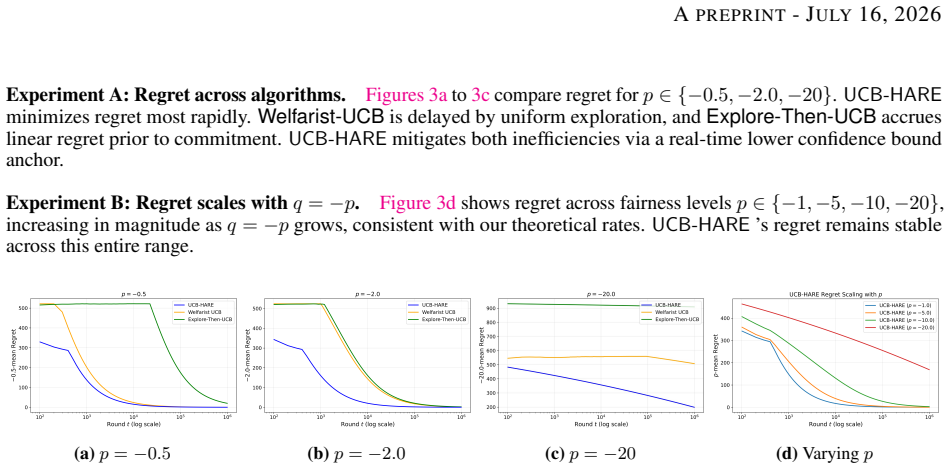
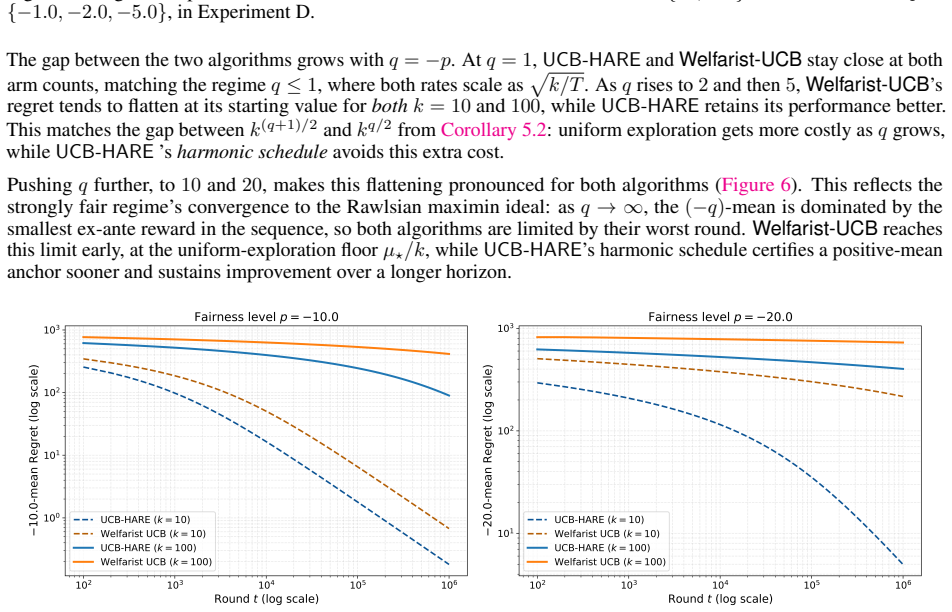
In bandit problems, standard regret-minimizing algorithms treat exploration as an amortized cost, which can expose early participants to unfair ex-ante losses in settings such as clinical trials. Recent work addresses this by evaluating the sequence of per-round expected rewards through the generalized $p$-mean, interpolating between utilitarian welfare ($p=1$), Nash welfare ($p\to0$), and Rawlsian fairness ($p\to-\infty$). Although tight guarantees are known for $p\ge0$, the strictly fair regime $q=-p>0$ remains unresolved because negative-power means are dominated by the smallest per-round rewards. For $\sigma$-sub-Gaussian rewards with nonnegative means, the best prior algorithm relied on uniform early exploration and achieved regret $O(k^{(q+1)/2}/\sqrt{T})$, while the only general lower bound was the classical $\Omega(\sigma\sqrt{k/T})$. Thus it was unclear whether the extra dependence on $k$ was intrinsic to strict fairness or an artifact of uniform exploration. We close this gap by identifying the exact polynomial price of strict fairness. Using a needle-in-haystack construction, we prove an algorithm-independent lower bound $\Omega(\sigma\sqrt{k^{\max(1,q)}/T})$; for $q>1$, this shows that the penalty $k^{q/2}$ is information-theoretically unavoidable. We then introduce \textsf{UCB-HARE} (Harmonic Anchored Rank Exploration), which replaces uniform exploration with an inverse-weighted harmonic rank schedule protected by a certified positive-mean anchor. Its regret is $\widetilde{O}(\sigma\sqrt{k^{\max(1,q)}/T})$, matching the lower bound up to logarithmic factors. Experiments on synthetic instances confirm that \textsf{UCB-HARE} improves over uniform-exploration baselines, with gains increasing as $q$ grows.
Figures
Figures from the paper (3 more)

Reference graph
Works this paper leans on
-
[1]
Advances in neural information processing systems , volume=
Improved algorithms for linear stochastic bandits , author=. Advances in neural information processing systems , volume=
-
[2]
2026 , eprint=
Improved Algorithms for Nash Welfare in Linear Bandits , author=. 2026 , eprint=
2026
-
[3]
Proceedings of the 37th
Fairness and Welfare Quantification for Regret in Multi-Armed Bandits , author=. Proceedings of the 37th
-
[4]
Foundations and Trends
Regret Analysis of Stochastic and Nonstochastic Multi-armed Bandit Problems , author=. Foundations and Trends
-
[5]
Krishna, Anand and John, Philips George and Barik, Adarsh and Tan, Vincent Y. F. , booktitle=
-
[6]
Fair Division and Collective Welfare , author=
-
[7]
Revisiting Social Welfare in Bandits:
Sarkar, Dhruv and Pandey, Nishant and Ray Chowdhury, Sayak , journal=. Revisiting Social Welfare in Bandits:
-
[8]
Biometrika , volume=
On the Likelihood that One Unknown Probability Exceeds Another in View of the Evidence of Two Samples , author=. Biometrika , volume=. 1933 , publisher=
1933
Show all 35 references
-
[9]
Econometrica , volume=
The Bargaining Problem , author=. Econometrica , volume=. 1950 , doi=
1950
-
[10]
Journal of Economic Theory , volume=
On the Measurement of Inequality , author=. Journal of Economic Theory , volume=. 1970 , doi=
1970
-
[11]
The Annals of Mathematical Statistics , volume=
Consensus of Subjective Probabilities: The Pari-Mutuel Method , author=. The Annals of Mathematical Statistics , volume=. 1959 , doi=
1959
-
[12]
Journal of Economic Theory , volume=
Equity, Envy, and Efficiency , author=. Journal of Economic Theory , volume=. 1974 , doi=
1974
-
[13]
Journal of the Operational Research Society , volume=
Rate Control for Communication Networks: Shadow Prices, Proportional Fairness and Stability , author=. Journal of the Operational Research Society , volume=. 1998 , doi=
1998
-
[14]
2000 , doi=
Fair End-to-End Window-Based Congestion Control , author=. 2000 , doi=
2000
-
[15]
Proceedings of the 29th
An Axiomatic Theory of Fairness in Network Resource Allocation , author=. Proceedings of the 29th. 2010 , doi=
2010
-
[16]
Operations Research , volume=
The Price of Fairness , author=. Operations Research , volume=. 2011 , doi=
2011
-
[17]
Proceedings of the 47th Annual
Approximating the Nash Social Welfare with Indivisible Items , author=. Proceedings of the 47th Annual. 2015 , doi=
2015
-
[18]
Proceedings of the 8th Innovations in Theoretical Computer Science Conference (
Nash Social Welfare, Matrix Permanent, and Stable Polynomials , author=. Proceedings of the 8th Innovations in Theoretical Computer Science Conference (. 2017 , doi=
2017
-
[19]
Proceedings of the 2017
Convex Program Duality, Fisher Markets, and Nash Social Welfare , author=. Proceedings of the 2017. 2017 , doi=
2017
-
[20]
2019 , doi=
The Unreasonable Fairness of Maximum Nash Welfare , author=. 2019 , doi=
2019
-
[21]
Proceedings of the Twenty-Ninth Annual
Approximating Nash Social Welfare under Budget-Additive Valuations , author=. Proceedings of the Twenty-Ninth Annual. 2018 , doi=
2018
-
[22]
Proceedings of the Twenty-Ninth Annual
Nash Social Welfare for Indivisible Items under Separable, Piecewise-Linear Concave Utilities , author=. Proceedings of the Twenty-Ninth Annual. 2018 , doi=
2018
-
[23]
Proceedings of the 2018
Finding Fair and Efficient Allocations , author=. Proceedings of the 2018. 2018 , doi=
2018
-
[24]
Proceedings of the 17th International Conference on Autonomous Agents and Multiagent Systems (
Greedy Algorithms for Maximizing Nash Social Welfare , author=. Proceedings of the 17th International Conference on Autonomous Agents and Multiagent Systems (
-
[25]
Proceedings of the 62nd
A Constant-Factor Approximation Algorithm for Nash Social Welfare with Submodular Valuations , author=. Proceedings of the 62nd
-
[26]
Proceedings of the Twenty-Ninth International Joint Conference on Artificial Intelligence (
Uniform Welfare Guarantees Under Identical Subadditive Valuations , author=. Proceedings of the Twenty-Ninth International Joint Conference on Artificial Intelligence (. 2020 , doi=
2020
-
[27]
, booktitle=
Barman, Siddharth and Bhaskar, Umang and Krishna, Anand and Sundaram, Ranjani G. , booktitle=. Tight Approximation Algorithms for. 2020 , doi=
2020
-
[28]
Proceedings of the 36th
Universal and Tight Online Algorithms for Generalized-Mean Welfare , author=. Proceedings of the 36th. 2022 , doi=
2022
-
[29]
Proceedings of the 2018
Fair Allocation of Indivisible Public Goods , author=. Proceedings of the 2018. 2018 , doi=
2018
-
[30]
Proceedings of the 18th International Conference on Web and Internet Economics (
Nash Welfare Guarantees for Fair and Efficient Coverage , author=. Proceedings of the 18th International Conference on Web and Internet Economics (
-
[31]
Proceedings of the 38th International Conference on Machine Learning (
Regularized Online Allocation Problems: Fairness and Beyond , author=. Proceedings of the 38th International Conference on Machine Learning (
-
[32]
On the Fairness of Normalized
Eckart, Owen and Psomas, Alexandros and Verma, Paritosh , booktitle=. On the Fairness of Normalized. 2024 , doi=
2024
-
[33]
Proceedings of the 38th
Maximizing Nash Social Welfare under Two-Sided Preferences , author=. Proceedings of the 38th. 2024 , doi=
2024
-
[34]
Advances in Neural Information Processing Systems 37 (
Learning Social Welfare Functions , author=. Advances in Neural Information Processing Systems 37 (. 2024 , doi=
2024
-
[35]
The Long Arm of Nashian Allocation in Online
Huang, Zhiyi and Lee, Chui Shan and Shu, Xinkai and Wang, Zhaozi , booktitle=. The Long Arm of Nashian Allocation in Online. 2025 , doi=
2025
Reviewed August 2, 2026 · model on record in the stance chip above.
Discussion (0). Sign in to comment.