REVIEW 4 major objections 4 minor 36 references
Univariate to Multivariate: LLMs as Zero-Shot Predictors for Time-Series Forecasting
T0 review · 4 major / 4 minor · reviewed 2026-08-07 · deepseek-v4-flash
Pith's one-line read Frequency split lets frozen LLMs cut forecasting error by 26.8 percent
desk verdict The paper is a hybrid pipeline with a trained MLP, not a zero-shot LLM forecaster, and the current framing overstates the LLM's contribution. read the letter →
The pith
A machine-rendered reading of the paper's core claim, the machinery that carries it, and where it could break.
The reading
What carries the argument
The mechanism that carries the argument is the frequency decomposition with a per-feature cut-off chosen by a weighted MSE-cosine score: the low-frequency component preserves the trend that Transformers model well, while the high-frequency component isolates noise that the LLM is then asked to continue separately. This split is what turns the text-continuation task into two simpler tasks. The multivariate extension is carried by a second mechanism: shifting each channel into its own numeric range and laying one time step per line converts cross-variable dependencies into a table-like structure the LLM can continue in both directions. Two post-processors complete the machinery: a small MLP that refines the low-frequency prediction, and a Gaussian rescaling that aligns the high-frequency prediction's distribution with history.
What would settle it
Run LLMPred with the MLP post-processor removed and Gaussian rescaling disabled, and compare the raw LLM text continuation against the same benchmark baselines; if the raw continuation no longer shows the reported 26.8% univariate MSE advantage (or performs at the level of a trivial baseline), the central claim that the LLM is a zero-shot forecaster would be falsified. A second check is to train the MLP alone, with no LLM, on the same decomposed inputs and compare its error directly.
Extended reading notes
Core claim
LLMPred's central claim is that the language model alone, frozen and prompted with text, can serve as the predictor once the input is reorganized and the output is lightly corrected. For each channel $X^c$, a Butterworth filter splits the history into a low-frequency part $X^c_l$ and a high-frequency part $X^c_h$; the per-feature cut-off is chosen by minimizing the weighted score $m=\alpha\,\mathrm{MSE}(X^c,X^{c,f}_l)+(1-\alpha)/\cos(X^c,X^{c,f}_h)$, with $\alpha=0.7$. The LLM continues each text-encoded component, the low-frequency continuation is refined by a five-layer MLP, and the high-frequency continuation is shifted through a Gaussian transformation to match the historical mean and variance. Multivariate data are handled by shifting each channel into a disjoint interval, e.g. $[0,1]$, $[1,2]$, $[2,3]$, and writing one time step per comma-separated row, which lets the model continue rows like a structured text pattern. The paper reports that this pipeline with GPT-4o-mini achieves the lowest univariate MSE of $0.08 \pm 0.01$ across the compared benchmarks, a 26.8% improvement, and that its multivariate form outperforms its own univariate form by 17.4%.
Load-bearing premise
The load-bearing premise is that the frozen LLM is the predictor doing the forecasting; the actual reported accuracy depends on a task-trained MLP post-processor and a Gaussian rescaling, so if the LLM alone produces the gain the zero-shot claim stands, but if the post-processors are the source of the gain, the paper's central 'zero-shot LLM predictor' claim is not supported.
Editorial extensions
If this is right
- If LLMPred's results hold, a frozen LLM with a short prompt and two lightweight corrections can match dedicated transformer forecasters, removing the need for task-specific training runs.
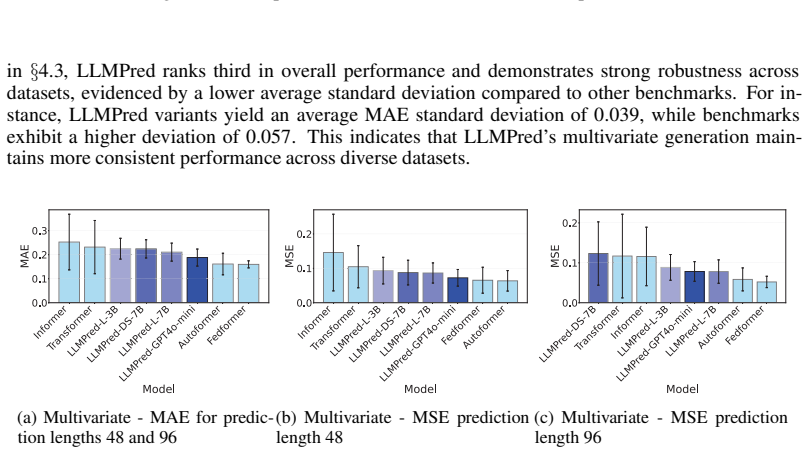
- The decomposition makes predictions more stable: the paper reports that the MLP post-processor cuts low-frequency MSE by 22.7% and reduces the standard deviation of the MSE across datasets by 82.0%.
- The multivariate pipeline is limited by context length: models with 4,096-token contexts degrade once the prompt exceeds roughly half that budget, which happens around 5 to 9 features for 48- and 96-step forecasts.
- Moving from univariate to multivariate inputs is expected to help, not hurt, because the row layout lets the LLM exploit cross-feature structure; the paper reports a 17.4% average MSE improvement in that direction.
Reading between the lines
- Because the reported best numbers include the trained MLP post-processor, the 'zero-shot' label is doing less work than it appears; the fair test of the LLM's contribution is the raw text continuation before post-processing.
- The dependence on GPT-4o-mini's tokenizer behavior, which groups digits into larger chunks, suggests tokenizer design may matter more than model scale or reasoning; comparing LLMPred across tokenizers that treat numbers differently would settle this.
- The same frequency-split-plus-prompt design could transfer to other structured numeric prediction tasks, such as energy load or traffic flow, where the Gaussian high-frequency assumption fails; an adaptive distributional model would be a natural next step.
Editorial analysis
A structured set of objections, weighed in public.
Referee Report
Summary. The paper proposes LLMPred, a pipeline for univariate and multivariate time-series forecasting that converts numeric sequences into text and prompts frozen LLMs in a zero-shot manner. Each univariate series is decomposed into low- and high-frequency components with a Butterworth filter, with per-feature cutoff frequencies selected using the metric in Eq. (1); the components are predicted separately by the LLM, after which the low-frequency prediction is refined by a per-dataset trained MLP and the high-frequency prediction is moment-matched to the historical distribution via a Gaussian transformation. The approach is extended to multivariate data by shifting each feature into a distinct numerical range in the prompt. Experiments on six standard datasets with GPT-4o-mini, Llama-2-7B, Llama-3.2-3B, and DeepSeek-7B report a 26.8% univariate MSE reduction over baselines for GPT-4o-mini, comparable multivariate performance, and an extensive ablation study. The appendix honestly reports that the high-frequency post-processing degrades pointwise MSE and MAE, and that the low-frequency MLP is responsible for large gains.
Significance. If the system were genuinely zero-shot and the reported gains came from the frozen LLM, the paper would be a useful contribution to the under-explored area of LLM-based forecasting on noisy, multivariate data. The paper has real strengths: it releases code, includes detailed ablations, and transparently reports negative results in the appendix such as the pointwise degradation from high-frequency post-processing and the MLP's large effect in Table 2. However, the central advertised claim is that LLMs act as zero-shot predictors, and the reported state-of-the-art univariate result is produced by a full pipeline that includes an MLP trained on each dataset. Table 2 indicates that this MLP reduces low-frequency MSE by 22.7% on average and 32.9% for GPT-4o-mini, so the contribution of the frozen LLM alone is not established. Without an LLM-only end-to-end evaluation, the paper's main claim is not supported; as a hybrid system, the novelty is considerably reduced.
major comments (4)
- [§3.3, §4.2, Table 2] The headline univariate improvement (26.8% average MSE reduction for GPT-4o-mini) is reported for the full LLMPred pipeline, which includes an MLP trained on each dataset (70/30 split, Adam, up to 128 epochs; Appendix A.3.1). The abstract and title describe the method as zero-shot, but only the frozen LLM is zero-shot. Table 2 shows that the MLP postprocessor reduces low-frequency MSE by 22.7% on average and 32.9% for GPT-4o-mini, and reduces the standard deviation across datasets by 82.0%, so the LLM alone cannot be assumed to be the source of the reported gain. The paper should report end-to-end MSE with the MLP disabled and re-state its claims accordingly, since as written the 'zero-shot' characterization is not accurate for the evaluated system.
- [§4.5.3, Appendix C.3.2, Tables 5–6] The Gaussian post-processing for the high-frequency component is evaluated primarily with the KS statistic, and Appendix C.3.2 reports that this step worsens pointwise high-frequency MSE by 11.0% and MAE by 3.9%. Because the final output is the sum of the low- and high-frequency components, a distributional improvement measured by the KS statistic does not establish that final pointwise forecasts improve. The paper should quantify the effect of the Gaussian transformation on the final combined MSE and MAE; as written, the claim of high-frequency 'improvement' is not supported by the pointwise metrics.
- [§4.4.2] The multivariate evaluation is restricted to six features in order to stay within the LLMs' context limits. The text says this is done 'to ensure a fair comparison between all models,' but it is not stated whether the transformer baselines were also restricted to the same six-feature subset or were given their usual full-feature inputs. If the baselines used full features, the comparison is unfair; if they were also restricted to six features, that is a substantial deviation from the standard benchmark setting and should be documented, with full-feature results reported for at least the baselines.
- [§3.1, Appendix A.1] The frequency decomposition assumes a 100 Hz sampling rate and searches cut-off frequencies from 2.5 to 15 Hz, but the datasets used (e.g., ETTh1 and ETTm1 are hourly, Weather is 10-minute) do not have meaningful signal content at those physical frequencies. The paper should state whether the sequences were resampled to 100 Hz or whether the quoted 'Hz' values refer to a normalized discrete-time frequency; without this clarification, the decomposition's physical interpretation and reproducibility are unclear, and this is load-bearing because the cutoff selection is part of the method's core preprocessing.
minor comments (4)
- [Abstract and Introduction] There are several typos, including 'm any' in the abstract and 'Lanugage Modles' in the first paragraph of the introduction; the manuscript should be proofread.
- [§3] In the problem setup, 'where L is the number of samples and C is th number of channels' contains a typo ('th' should be 'the').
- [Table 2 caption] The caption reads 'before and after the proposed method fir Low frequency component'; 'fir' should be 'for'.
- [§B.5] The baseline is referred to as 'LLMTimes [9]' in the benchmark description while the main text and references use 'LLMTime'; the naming should be consistent.
Circularity Check
High-frequency 'improvement' is forced by a moment-matching transform, and the headline MSE gain is delivered by a trained MLP, not the zero-shot LLM.
-
self definitional
[Section 3.3 (Gaussian transformation for predicted X_c^h); Section 4.5.3, Table 3; Appendix C.3.2]
"We compute the mean ( µ) and standard deviation ( σ) for both historical ( µh, σh) and predicted ( µp, σp) sequences, and use the transformation xnew = ((x − µp)/σp) · σh + µh to adjust the predicted X_c^h to match its historical X_c^f distribution."
The transform is an affine rescaling of the LLM output using the historical mean and standard deviation. By construction, the post-processed sequence has mean µh and variance σh^2. The paper invokes the KS statistic only after the pointwise metrics fail (Appendix C.3.2 reports −11.0% MSE and −3.9% MAE), and Section 4.5.3 reports the 22.7% KS reduction as evidence of improved alignment. Since the paper itself assumes the high-frequency component is approximately Gaussian, matching its first two moments to the historical values defines the output distribution to be the target distribution; the KS improvement is therefore an arithmetic consequence of the transformation, not a measured skill of the LLM.
-
fitted input called prediction
[Section 3.3 (Simple MLP model for predicted X_c^l); Section 4.2; Section 4.5.3; Appendix A.3.1]
"We train a simple Multi-Layer Perceptron (MLP) to further refine X_c^l predictions ... During MLP training we apply a 70/30% train/test splits ... Overall, the post-processing using MLP yields a 22.7% reduction in MSE, with the GPT-4o-mini model achieving the highest improvement of 32.9% across all six datasets."
The paper's central empirical claim ('LLMPred-GPT4o-mini ... lowest average MSE of 0.08±0.01, representing a 26.8% reduction') is reported for the full pipeline, which includes an MLP post-processor trained per dataset (70/30 split, up to 128 epochs, Adam). The paper itself shows this MLP is responsible for 22.7% of the low-frequency MSE reduction (32.9% for GPT-4o-mini). Since the MLP is fitted to the same datasets on which the 'zero-shot' result is measured, the reported MSE cannot be read as a property of the frozen LLM; the fitted component is effectively part of the reported predictor. The ablation does disclose the MLP, but the headline and abstract still call the method zero-shot, so the evaluation conflates fitted post-processing with LLM prediction.
full rationale
The frequency-decomposition and prompt-engineering components are not circular: the decomposition is evaluated by ablation against no-decomposition, and the multivariate extension is tested against transformer baselines. No load-bearing self-citation was found; references such as [9] and [21] are independent prior work, and the authors' own earlier citations are not used to justify the central mechanism. The clearest circularity is in the high-frequency post-processing evaluation: the transformation in Section 3.3 is defined so that the post-processed output has the historical mean and standard deviation, so the KS-statistic improvement in Section 4.5.3 is a mathematical consequence of the transform, not evidence of forecasting ability. Appendix C.3.2 confirms that raw MSE and MAE worsen after the transform, yet the paper reports the KS reduction as the success criterion. The second issue is attribution, close to fitted-input-called-prediction: the univariate 26.8% MSE claim is computed for the full pipeline, and the pipeline trains an MLP on a 70/30 split of each dataset's low-frequency component; the ablation attributes 22.7% of the low-frequency MSE reduction to that MLP. Describing the system as a zero-shot LLM predictor while reporting numbers that depend on this trained post-processor makes the headline result not a clean test of the frozen LLM. Overall, the paper contains one by-construction result (the high-frequency KS gain) and one fitted component that is bundled into the claimed zero-shot performance, warranting a score of 6.
Assumptions & free parameters
free parameters (5)
- α weighting factor in cut-off metric =
0.7
- Cut-off frequency range F =
2.5 to 15.0 Hz
- Per-feature cut-off frequency f_cut =
selected per feature via Eq. 1
- MLP weights =
trained
- Gaussian transformation statistics =
μ_h, σ_h, μ_p, σ_p computed from data
assumptions (4)
- ad hoc to paper A 100 Hz sampling rate and the 2.5 to 15 Hz cut-off band are appropriate for the datasets.
- domain assumption The high-frequency component follows a Gaussian distribution.
- domain assumption LLMs can extrapolate numerical sequences from text prompts.
- ad hoc to paper The metric m in Eq. 1 is a sensible way to choose cut-off frequencies.
Cite this review
Pith. "Pith review of Univariate to Multivariate: LLMs as Zero-Shot Predictors for Time-Series Forecasting." pith.science (2026). https://pith.science/paper/GYRX5IT2
@misc{pith2026250602389,
  author       = {Pith},
  title        = {Pith review of: Univariate to Multivariate: LLMs as Zero-Shot Predictors for Time-Series Forecasting},
  year         = {2026},
  howpublished = {\url{https://pith.science/paper/GYRX5IT2}},
  note         = {Machine review of arXiv:2506.02389}
}
read the original abstract
Time-series prediction or forecasting is critical across many real-world dynamic systems, and recent studies have proposed using Large Language Models (LLMs) for this task due to their strong generalization capabilities and ability to perform well without extensive pre-training. However, their effectiveness in handling complex, noisy, and multivariate time-series data remains underexplored. To address this, we propose LLMPred which enhances LLM-based time-series prediction by converting time-series sequences into text and feeding them to LLMs for zero shot prediction along with two main data pre-processing techniques. First, we apply time-series sequence decomposition to facilitate accurate prediction on complex and noisy univariate sequences. Second, we extend this univariate prediction capability to multivariate data using a lightweight prompt-processing strategy. Extensive experiments with smaller LLMs such as Llama 2 7B, Llama 3.2 3B, GPT-4o-mini, and DeepSeek 7B demonstrate that LLMPred achieves competitive or superior performance compared to state-of-the-art baselines. Additionally, a thorough ablation study highlights the importance of the key components proposed in LLMPred.
Figures


Figures from the paper (17 more)






Reference graph
Works this paper leans on
-
[1]
Deepseek llm: Scaling open-source languag e models with longtermism
DeepSeek AI. Deepseek llm: Scaling open-source languag e models with longtermism. arXiv preprint arXiv:2401.02954, 2024
arXiv 2024
-
[2]
Llama 3.2: Multilingual large language models
Meta AI. Llama 3.2: Multilingual large language models. https://huggingface.co/meta-llama/Llama-3.2-3B , 2024. Accessed: 2025-04- 15
work page 2024
-
[3]
Subhadeep Basu and Samiul Mamud. Comparative study on th e effect of order and cut off frequency of butterworth low pass filter for removal of noise in ecg signal. In 2020 IEEE 1st International Conference for Convergence in Engineeri ng (ICCE), pages 156–160. IEEE, 2020. 10
work page 2020
-
[4]
Selection of the most suit able decomposition filter for the mea- surement of fluctuating harmonics
Jorge Bruna and Julio J Melero. Selection of the most suit able decomposition filter for the mea- surement of fluctuating harmonics. IEEE Transactions on Instrumentation and Measurement , 65(11):2587–2594, 2016
work page 2016
-
[5]
Llm4ts: Aligning pre- trained llms as data-efficient time-series forecasters
Ching Chang, Wei-Y ao Wang, Wen-Chih Peng, and Tien-Fu Ch en. Llm4ts: Aligning pre- trained llms as data-efficient time-series forecasters. arXiv preprint arXiv:2308.08469 , 2023
arXiv 2023
-
[6]
Sd- former: Similarity-driven discrete transformer for time s eries generation
Zhicheng Chen, FENG SHIBO, Zhong Zhang, Xi Xiao, Xingyu G ao, and Peilin Zhao. Sd- former: Similarity-driven discrete transformer for time s eries generation. Advances in Neural Information Processing Systems, 37:132179–132207, 2024
work page 2024
-
[7]
How numerical precision affects mathema tical reasoning capabilities of llms
Guhao Feng, Kai Y ang, Y untian Gu, Xinyue Ai, Shengjie Luo , Jiacheng Sun, Di He, Zhenguo Li, and Liwei Wang. How numerical precision affects mathema tical reasoning capabilities of llms. arXiv preprint arXiv:2410.13857 , 2024
-
[8]
Deep learning wi th long short-term memory net- works for financial market predictions
Thomas Fischer and Christopher Krauss. Deep learning wi th long short-term memory net- works for financial market predictions. European journal of operational research, 270(2):654– 669, 2018
work page 2018
Show all 36 references
-
[9]
Large language models are zero- shot time series forecasters
Nate Gruver, Marc Finzi, Shikai Qiu, and Andrew G Wilson. Large language models are zero- shot time series forecasters. Advances in Neural Information Processing Systems , 36:19622– 19635, 2023
2023
-
[10]
SOF TS: Efficient multivariate time series forecasting with series-core fusion
Lu Han, Xu-Y ang Chen, Han-Jia Y e, and De-Chuan Zhan. SOF TS: Efficient multivariate time series forecasting with series-core fusion. In The Thirty-eighth Annual Conference on Neural Information Processing Systems, 2024
2024
-
[11]
An intelligent network t raffic prediction method based on butterworth filter and cnn–lstm
Xueyan Hu, Wei Liu, and Hua Huo. An intelligent network t raffic prediction method based on butterworth filter and cnn–lstm. Computer Networks, 240:110172, 2024
2024
-
[12]
Time-ll m: Time series forecasting by reprogramming large language models
Ming Jin, Shiyu Wang, Lintao Ma, Zhixuan Chu, James Y Zha ng, Xiaoming Shi, Pin-Y u Chen, Y uxuan Liang, Y uan-Fang Li, Shirui Pan, et al. Time-ll m: Time series forecasting by reprogramming large language models. arXiv preprint arXiv:2310.01728 , 2023
-
[13]
Back to basics: The power of the multilayer perceptron in financial time series foreca sting
Ana Lazcano, Miguel A Jaramillo-Morán, and Julio E Sand ubete. Back to basics: The power of the multilayer perceptron in financial time series foreca sting. Mathematics, 12(12):1920, 2024
1920
-
[14]
Autotimes: Au- toregressive time series forecasters via large language models
Y ong Liu, Guo Qin, Xiangdong Huang, Jianmin Wang, and Mi ngsheng Long. Autotimes: Au- toregressive time series forecasters via large language models. Advances in Neural Information Processing Systems, 37:122154–122184, 2024
2024
-
[15]
Traffic flow predic- tion with big data: A deep learning approach
Yisheng Lv, Y anjie Duan, Wenwen Kang, Zhengxi Li, and Fe i-Y ue Wang. Traffic flow predic- tion with big data: A deep learning approach. Ieee transactions on intelligent transportation systems, 16(2):865–873, 2014
2014
-
[16]
Videotrain++: Gan-based adap tive framework for synthetic video traffic generation
Chamara Madarasingha, Shashika R Muramudalige, Guill aume Jourjon, Anura Jayasumana, and Kanchana Thilakarathna. Videotrain++: Gan-based adap tive framework for synthetic video traffic generation. Computer Networks, 206:108785, 2022
2022
-
[17]
Gpt-4o mini: Advancing cost-efficient intelli gence
OpenAI. Gpt-4o mini: Advancing cost-efficient intelli gence. https://openai.com/index/gpt-4o-mini-advancing-cost -efficient-intelligence/,
-
[18]
Fred- former: Frequency debiased transformer for time series for ecasting
Xihao Piao, Zheng Chen, Taichi Murayama, Y asuko Matsub ara, and Y asushi Sakurai. Fred- former: Frequency debiased transformer for time series for ecasting. In Proceedings of the 30th ACM SIGKDD Conference on Knowledge Discovery and Data M ining, pages 2400–2410, 2024
2024
-
[19]
Large language models in numberland: A quick test of their numerical reasoning abilities
Roussel Rahman. Large language models in numberland: A quick test of their numerical reasoning abilities. arXiv preprint arXiv:2504.00226 , 2025
2025 arXiv
-
[20]
Weatherbench: a benchmark data set for dat a-driven weather forecasting
Stephan Rasp, Peter D Dueben, Sebastian Scher, Jonatha n A Weyn, Soukayna Mouatadid, and Nils Thuerey. Weatherbench: a benchmark data set for dat a-driven weather forecasting. Journal of Advances in Modeling Earth Systems , 12(11):e2020MS002203, 2020
2020
-
[21]
Llm processes: Numerical predictive distributions condition ed on natural language
James Requeima, John Bronskill, Dami Choi, Richard Tur ner, and David K Duvenaud. Llm processes: Numerical predictive distributions condition ed on natural language. Advances in Neural Information Processing Systems, 37:109609–109671, 2024. 11
2024
-
[22]
Netdiffus : Network traffic generation by diffusion models through time-series imaging
Nirhoshan Sivaroopan, Dumindu Bandara, Chamara Madar asingha, Guillaume Jourjon, Anura P Jayasumana, and Kanchana Thilakarathna. Netdiffus : Network traffic generation by diffusion models through time-series imaging. Computer Networks, 251:110616, 2024
2024
-
[23]
A survey of transformer enabled time series synthesis
Alexander Sommers, Logan Cummins, Sudip Mittal, Shahr am Rahimi, Maria Seale, Joseph Jaboure, and Thomas Arnold. A survey of transformer enabled time series synthesis. In 2024 IEEE 10th International Conference on Collaboration and In ternet Computing (CIC) , pages 60–69. IEEE, 2024
2024
-
[24]
Llama 2: Open foundation and fine-tuned chat models
Hugo Touvron, Louis Martin, Kevin Stone, et al. Llama 2: Open foundation and fine-tuned chat models. arXiv preprint arXiv:2307.09288 , 2023
2023 arXiv
-
[25]
From words to numbers: Y our large language model is secretly a capable reg ressor when given in-context examples
Robert V acareanu, Vlad-Andrei Negru, V asile Suciu, an d Mihai Surdeanu. From words to numbers: Y our large language model is secretly a capable reg ressor when given in-context examples. arXiv preprint arXiv:2404.07544 , 2024
2024 arXiv
-
[26]
Learning latent seasonal-trend representations for time s eries forecasting
Zhiyuan Wang, Xovee Xu, Weifeng Zhang, Goce Trajcevski , Ting Zhong, and Fan Zhou. Learning latent seasonal-trend representations for time s eries forecasting. Advances in Neu- ral Information Processing Systems, 35:38775–38787, 2022
2022
-
[27]
A utoformer: Decomposition transformers with auto-correlation for long-term series f orecasting
Haixu Wu, Jiehui Xu, Jianmin Wang, and Mingsheng Long. A utoformer: Decomposition transformers with auto-correlation for long-term series f orecasting. In Advances in Neural Information Processing Systems (NeurIPS) , 2021
2021
-
[28]
Adversarial sparse transformer for time series forecasting
Sifan Wu, Xi Xiao, Qianggang Ding, Peilin Zhao, Ying Wei , and Junzhou Huang. Adversarial sparse transformer for time series forecasting. Advances in neural information processing systems, 33:17105–17115, 2020
2020
-
[29]
Promptcast: A new prompt-base d learning paradigm for time series forecasting
Hao Xue and Flora D Salim. Promptcast: A new prompt-base d learning paradigm for time series forecasting. IEEE Transactions on Knowledge and Data Engineering , 36(11):6851– 6864, 2023
2023
-
[30]
Fouriergnn: Rethinking multivariate time se ries forecasting from a pure graph perspective
Kun Yi, Qi Zhang, Wei Fan, Hui He, Liang Hu, Pengyang Wang , Ning An, Longbing Cao, and Zhendong Niu. Fouriergnn: Rethinking multivariate time se ries forecasting from a pure graph perspective. Advances in neural information processing systems , 36:69638–69660, 2023
2023
-
[31]
Frequency-domain MLPs are m ore effective learners in time series forecasting
Kun Yi, Qi Zhang, Wei Fan, Shoujin Wang, Pengyang Wang, H ui He, Ning An, Defu Lian, Longbing Cao, and Zhendong Niu. Frequency-domain MLPs are m ore effective learners in time series forecasting. In Thirty-seventh Conference on Neural Information Processi ng Sys- tems, 2023
2023
-
[32]
Multivariate proba bilistic time series forecasting with correlated errors
Vincent Zhihao Zheng and Lijun Sun. Multivariate proba bilistic time series forecasting with correlated errors. arXiv preprint arXiv:2402.01000 , 2024
2024 arXiv
-
[33]
Informer: Beyond efficient transformer for long s equence time-series forecasting
Haoyi Zhou, Shanghang Zhang, Jieqi Peng, Shuai Zhang, J ianxin Li, Hui Xiong, and Wan- cai Zhang. Informer: Beyond efficient transformer for long s equence time-series forecasting. In Proceedings of the Thirty-Fifth AAAI Conference on Artifici al Intelligence (AAAI-21) , vol- um...
2021
-
[34]
Fedformer: Frequency enhanced decomposed transformer for long-term s eries forecasting
Tian Zhou, Ziqing Ma, Qingsong Wen, Xue Wang, Liang Sun, and Rong Jin. Fedformer: Frequency enhanced decomposed transformer for long-term s eries forecasting. In Proceedings of the 39th International Conference on Machine Learning (I CML 2022), pages 27268–27286. PMLR, 2022
2022
-
[35]
Consider the distribution. Predict the next few lines. INT EGER component of the value SHOULD be SAME as the train data. ONLY provide numerica l values
Fangwei Zhu, Damai Dai, and Zhifang Sui. Language model s encode the value of numbers linearly. In Proceedings of the 31st International Conference on Comput ational Linguistics , pages 693–709, 2025. A Further details on LLMPred methodology Here, we provide further details of...
2025
-
[2024]
Accessed: 2025-04-15
2025
Reviewed August 7, 2026 · model on record in the stance chip above.
Discussion (0). Sign in to comment.