REVIEW 4 major objections 4 minor 72 references
Meta-Learning and Knowledge Discovery based Physics-Informed Neural Network for Remaining Useful Life Prediction
T0 review · 4 major / 4 minor · reviewed 2026-08-16 · deepseek-v4-flash
Pith's one-line read MKDPINN combines meta-learning with a data-discovered PDE to predict machine remaining life from a few samples.
desk verdict A clever architecture and real industrial data, but the physics term is circular—Eq. (27) lets the PGR learn the identity on d u/dt—so the load-bearing claim that discovered PDEs improve few-shot RUL is not supported. read the letter →
The pith
A machine-rendered reading of the paper's core claim, the machinery that carries it, and where it could break.
The reading
What carries the argument
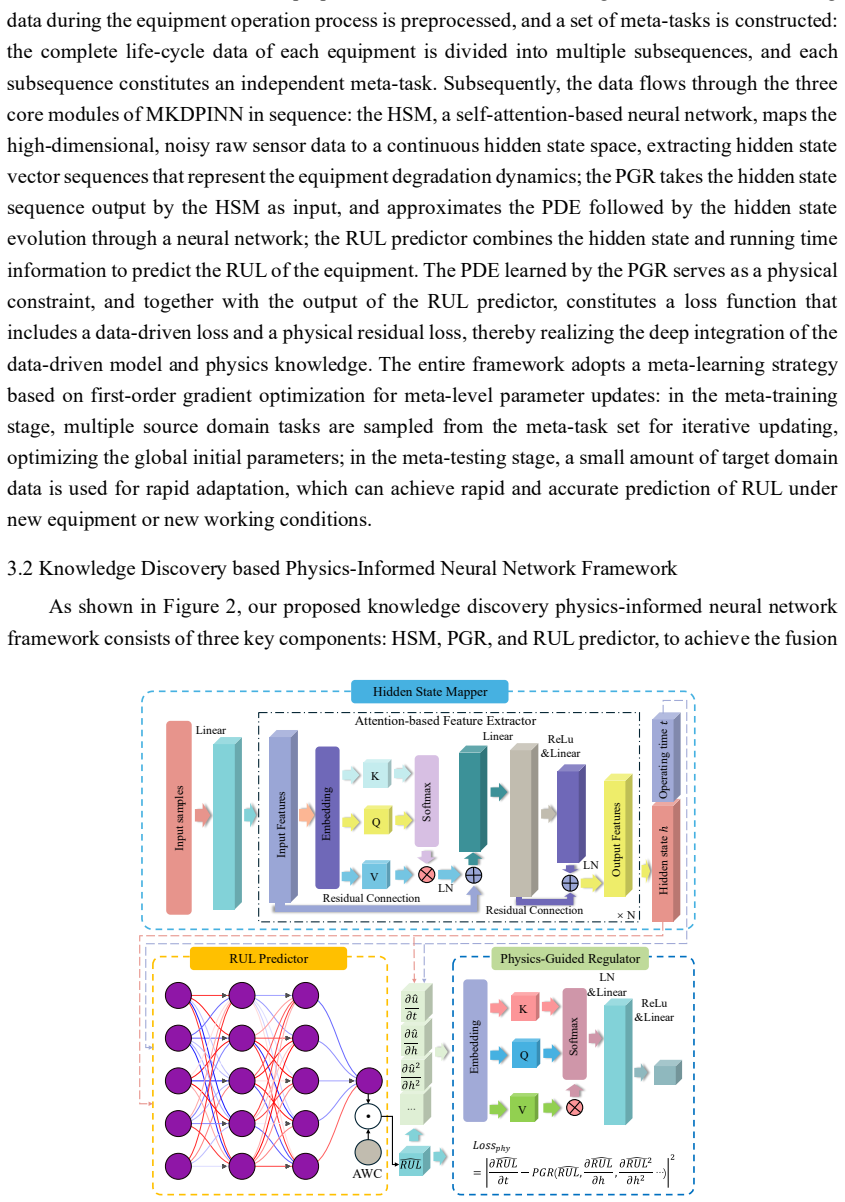
The load-bearing machinery is the joint regularized objective of three modules. The Hidden State Mapper (HSM) is a self-attention network that converts high-dimensional noisy sensor windows into a low-dimensional smooth hidden state; the RUL predictor is a four-layer network on the concatenation of that state and running time; and the Physics-Guided Regulator (PGR) is a neural network that maps the predicted state and its spatial derivatives to the time derivative, thereby approximating the unknown nonlinear operator $\mathcal{N}$. The physics loss in Eq. (27) is the MSE between the regulator output and the time derivative of the predicted state computed by automatic differentiation, and this term is added to the data loss to form the total loss in Eq. (29). On top of that objective, the meta-update rule in Eq. (33) moves the shared initialization toward the average of the per-task adapted parameters, which the paper shows is an implicit combination of average-loss minimization and in-task gradient alignment without second-order derivatives.
What would settle it
Train MKDPINN on synthetic run-to-failure data generated from a known nonlinear PDE, then inspect whether the PGR recovers the generating equation and whether removing the physics loss changes test error; if accurate predictions persist while the recovered operator is wrong, the physical guidance is not doing the load-bearing work.
Extended reading notes
Core claim
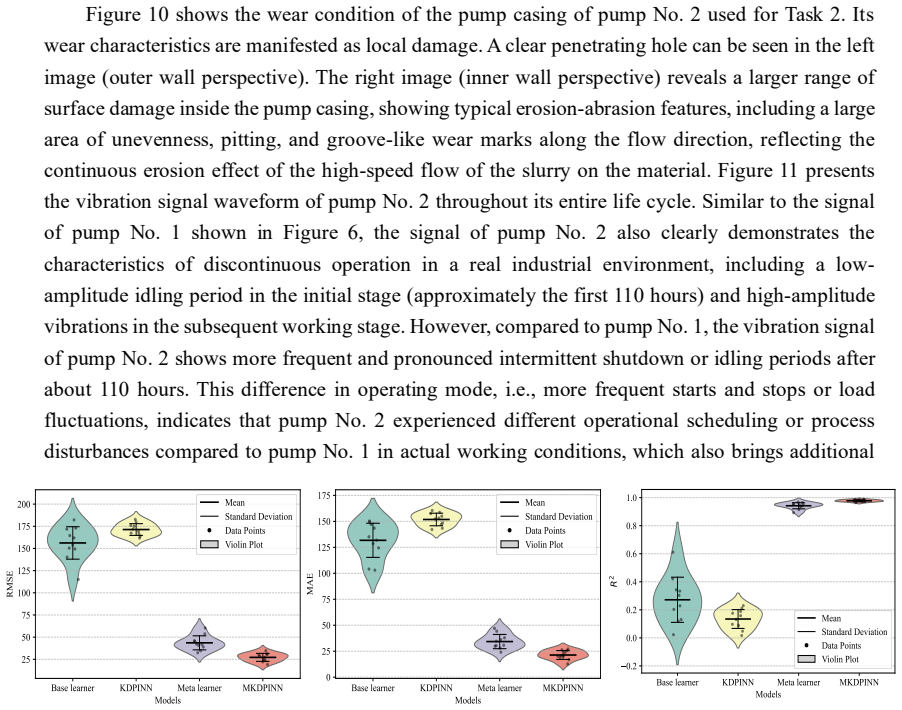
The paper's central claim is that the unknown dynamics of equipment degradation can be learned as an effective PDE over a hidden state, and that embedding this discovered PDE into a first-order meta-learner improves few-shot RUL prediction beyond using either component alone. The claim is supported by two experimental regimes: cross-life-cycle and cross-machine prediction on real slurry pumps, where MKDPINN reaches RMSE 27.19 and 25.62 respectively, and a 0-shot evaluation on C-MAPSS, where its average RMSE is 12.71. The authors further claim that the model can produce meaningful RUL trends even when the 15 adaptation samples contain no degradation information, and that accuracy improves as more or later-stage samples are added.
Load-bearing premise
The method assumes that the PGR's supervised fit to time derivatives computed from training data has recovered the true PDE of degradation, and that this learned operator carries genuine physical content; if the operator is a poor model of the real dynamics, the physics loss adds little or can degrade prediction.
Editorial extensions
If this is right
- A machine with no failure history can still receive a useful RUL estimate after a few labeled samples, because the meta-learned initialization encodes degradation priors from source machines.
- Few-shot adaptation improves predictably with data: in the cross-machine task, RMSE drops from 43.35 at 5-shot to 19.05 at 20-shot, so users can trade labeling effort against accuracy.
- The framework makes PINN-style constraints available for systems whose governing equations are unknown, since the PDE is discovered rather than hand-derived.
- Because the meta-update is first-order, adapting to a new task avoids the Hessian-vector products of second-order meta-learning, reducing the computational burden relative to that class of meta-learners.
Reading between the lines
- If the PGR's learned operator does not reflect true degradation physics, the regularizer may still help by acting as a data-dependent smoothing term; the paper's own ablation, where KDPINN without meta-learning raises RMSE above the Base Learner, is consistent with the regularizer being beneficial mainly inside the meta-learning loop.
- A direct test of the physics claim would be to generate synthetic degradation data from a known nonlinear PDE and check whether the PGR recovers the generating operator; the paper does not inspect the discovered PDE itself.
- The 0-shot C-MAPSS evaluation measures generalization from large training sets, not the few-shot adaptation regime the method is designed for, so reporting few-shot splits on C-MAPSS would separate the contribution of the meta-initialization from that of the physics term.
Signed reviews
Editorial analysis
A structured set of objections, weighed in public.
Referee Report
Summary. The paper proposes MKDPINN, a framework for remaining-useful-life (RUL) prediction that combines a hidden-state mapper, a physics-guided regulator (PGR) that learns a PDE from data, an RUL predictor, and a first-order Reptile-style meta-learning loop. The authors claim that the discovered PDE regularizer improves accuracy and generalization in few-shot settings, and they report experiments on an industrial slurry-pump dataset and on C-MAPSS. The central scientific claim is that adding a data-discovered physics constraint to a meta-learner yields better RUL prediction than either component alone.
Significance. If the claims were valid, the paper would make a useful contribution to few-shot RUL prediction by coupling meta-learning with learned physical constraints, and the authors deserve credit for providing source code and a real industrial case study with two full life cycles. However, the central claim is not supported by the manuscript's own evidence: Eq. (27) defines the physics loss so that the PGR can trivially fit the target derivative from an input coordinate, the ablation results in Tables 1 and 2 show that the physics-only variant is worse than the base learner, and the reported C-MAPSS average SCORE claim is contradicted by Table 7. These are load-bearing issues, not presentation problems.
major comments (4)
- [Sec. 3.2.3, Eqs. (25)-(27)] As written, the PGR input in Eq. (27) includes the target time derivative ∂û_j/∂t itself, and the loss is the squared difference between the PGR output and that same target. The network can therefore drive L_phys to zero by approximately learning the identity map on that coordinate, so the 'physics' constraint has no independent constraining content. Even if the ∂û_j/∂t coordinate were removed, L_phys would still be a supervised regression to a derivative estimated from the training samples rather than a PDE residual evaluated at independent collocation points, so no external physical information would enter the model.
- [Tables 1 and 2] The ablation results contradict the claim that the PINN constraint improves accuracy. In Table 1, KDPINN has RMSE 171.33 and R² 0.13, which is worse than the Base Learner's RMSE 149.39 and R² 0.34; in Table 2, KDPINN again has higher RMSE (140.39 vs. 126.58) and lower R² (0.21 vs. 0.36) than the Base Learner. Consequently, the better performance of MKDPINN relative to the Meta Learner cannot be attributed to the physics-guided regularizer, and the paper's contribution claim that embedding the PGR 'improves' accuracy and generalization is unsupported by its own results.
- [Sec. 4.2.3 and Table 7] The statement that 'MKDPINN achieved the lowest average RMSE (12.71) and the lowest average SCORE (622.15) among all the compared models' is false for SCORE: the DAM model in Table 7 reports an average SCORE of 557.75, which is lower than 622.15. The average RMSE claim is arithmetically consistent with the table, but the paper should correct the SCORE claim and re-evaluate any conclusions that rely on it.
- [Sec. 3.3.3, Eqs. (34)-(37)] The theoretical analysis of the meta-update direction is derived for SGD, but the actual method uses Adam in the inner loop. The paper asserts that Adam's update 'can be expected' to have a structure similar to the SGD Taylor expansion, but provides no derivation or empirical verification of this equivalence. Since the first-order meta-learning update rule is central to the method, this gap leaves the theoretical justification of Eq. (33) incomplete.
minor comments (4)
- [Reference [50]] The arXiv identifier for the Reptile paper is malformed: it reads 'arXiv preprint arXiv:.02999' and should be 'arXiv:1803.02999'.
- [Sec. 4.2.2] The C-MAPSS evaluation is described as a 0-shot testing scenario because no target-domain samples are used for adaptation, but the paper elsewhere emphasizes few-shot adaptation; the relationship between the 0-shot C-MAPSS protocol and the few-shot claim should be clarified.
- [Eq. (42)] The SCORE formula contains confusing notation in the exponents; the subscripts and superscripts for predicted and true RUL should be cleaned up so the piecewise definition is unambiguous.
- [General] Several equations contain apparent OCR errors (for example, the feature vector in Eq. (26) uses ∇_d where the time derivative is presumably intended), and the text would benefit from a careful proofreading pass.
Circularity Check
Physics constraint is tautological: ∂u/∂t is both the operator input and the regression target in Eqs. (22) and (27).
-
self definitional
[Section 3.2.3, Eq. (22)]
"the dynamic evolution of the equipment degradation process can be expressed as the following PDE form: ∂u(h,t)/∂t − N(u, ∂u/∂t, ∇_h u, ∇_h^2 u, …, ∇_h^k u) = 0, h ∈ Ω, t ∈ [0,T] (22)"
The claimed PDE has ∂u/∂t both as the left-hand side and as an argument of the operator N. For any trajectory, the equation is satisfied by choosing N to return its ∂u/∂t argument. The 'discovered physical law' is therefore a tautology: it imposes no independent constraint on the hidden-state evolution or on the RUL prediction.
-
fitted input called prediction
[Section 3.2.3, Eq. (27)]
"L_phys(θ) = 1/M Σ (P_θ(u_j, ∂u_j/∂t, ∇_h u_j, ∇_h^2 u_j, …, ∇_h^k u_j) − ∂u_j/∂t)^2 (27)"
The physics loss is defined as the squared error between P_θ's output and ∂u/∂t, while ∂u/∂t is also one of P_θ's listed inputs. Thus P_θ can drive L_phys to zero by learning the identity map on that coordinate. The 'physics constraint' is a supervised fit to the same data-derived derivative used as the target, not a PDE residual evaluated at independent collocation points, so no independent physical information enters the model.
full rationale
The paper's central novelty is the Physics-Guided Regulator discovering a PDE that then constrains RUL prediction. That chain is circular at both the formulation and loss levels. Eq. (22) writes ∂u/∂t − N(u, ∂u/∂t, ∇_h u, …)=0, so the PDE is satisfiable for any trajectory by letting N copy its ∂u/∂t argument. Eq. (27) then defines L_phys as the MSE between P_θ's output and ∂u/∂t while ∂u/∂t is listed among P_θ's inputs, so the physics loss can be minimized to zero by learning the identity on that coordinate. The 'discovered' operator is thus a supervised fit to the same data derivative, not an independent PDE residual at collocation points; it cannot supply the physical information the paper claims. Consistent with this, the ablation KDPINN (PGR without meta-learning) has higher RMSE than the Base Learner in Tables 1 and 2. The empirical C-MAPSS comparisons are external benchmarks and are not themselves circular, but the physics-discipline contribution claimed in the abstract and Section 4.1.3 reduces to a mathematical tautology. Self-citations [15] and [35] are present but not load-bearing because the meta-update is attributed to Reptile [50].
Assumptions & free parameters
free parameters (4)
- PGR network weights (learned PDE operator) =
not reported
- Hidden state dimension d_h =
not specified
- Order of derivatives k in PGR input =
not specified
- Loss weights w_d and w_p =
implicitly 1 and 1
assumptions (4)
- domain assumption The degradation process can be represented by a PDE in a low-dimensional hidden state (Eq. 22).
- domain assumption The PGR neural network can approximate the true differential operator accurately enough for the residual to be a useful constraint.
- ad hoc to paper Adam inner-loop updates behave similarly to SGD for the Taylor expansion in Section 3.3.3.
- domain assumption Source-domain meta-tasks and target-domain tasks share enough structure for Reptile-style adaptation to transfer.
invented entities (1)
-
Low-dimensional hidden state h
Cite this review
Pith. "Pith review of Meta-Learning and Knowledge Discovery based Physics-Informed Neural Network for Remaining Useful Life Prediction." pith.science (2026). https://pith.science/paper/GZ4MAMGU
@misc{pith2026250413797,
  author       = {Pith},
  title        = {Pith review of: Meta-Learning and Knowledge Discovery based Physics-Informed Neural Network for Remaining Useful Life Prediction},
  year         = {2026},
  howpublished = {\url{https://pith.science/paper/GZ4MAMGU}},
  note         = {Machine review of arXiv:2504.13797}
}
read the original abstract
Predicting the remaining useful life (RUL) of rotating machinery is critical for industrial safety and maintenance, but existing methods struggle with scarce target-domain data and unclear degradation dynamics. We propose a Meta-Learning and Knowledge Discovery-based Physics-Informed Neural Network (MKDPINN) to address these challenges. The method first maps noisy sensor data to a low-dimensional hidden state space via a Hidden State Mapper (HSM). A Physics-Guided Regulator (PGR) then learns unknown nonlinear PDEs governing degradation evolution, embedding these physical constraints into the PINN framework. This integrates data-driven and physics-based approaches. The framework uses meta-learning, optimizing across source-domain meta-tasks to enable few-shot adaptation to new target tasks. Experiments on industrial data and the C-MAPSS benchmark show MKDPINN outperforms baselines in generalization and accuracy, proving its effectiveness for RUL prediction under data scarcity
Figures


Figures from the paper (18 more)




Reference graph
Works this paper leans on
-
[1]
We propose a hierarchical learning framework consisting of an HSM and a PGR, where the HSM is responsible for extracting smooth hidden states from raw sensor data, and the PGR can adaptively learn the non-linear PDE dynamics equation followed by the latent states
-
[2]
We embed the PGR as a physical constraint into the PINN framework, guiding the training of the neural network through a regularized loss function, realizing the collaborative optimization of data-driven and physics knowledge, and improving the generalization ability of the model and its compliance with physical rules
-
[3]
The model is further extended into a meta-learning framework, enabling it to quickly adjust model parameters with only a small amount of data from new equipment or new working conditions, achieving accurate prediction of new tasks, and avoiding the calculation of second-order derivatives based on MAML
-
[4]
Comprehensive experimental validation is performed on real industrial scenarios and the publicly available CMAPSS dataset. The results show that MKDPINN exhibits superior performance in predicting RUL of the same equipment in different life cycles and across different equipment in the scenario of scarce target domain samples, verifying the effectiveness a...
-
[5]
Problem Formulation 2.1 Physics-Informed Neural Networks PINNs are a deep learning framework that embeds prior physical knowledge into neural networks, providing a promising approach to address the problem of missing physics -informed information during model training[38] . The core idea of PINNs is to incorporate PDEs that govern the behavior of control ...
-
[6]
Proposed method 3.1 Overall framework of the proposed method The overall workflow of the proposed MKDPINN is shown in Figure 1. First, the monitoring data during the equipment operation process is preprocessed, and a set of meta-tasks is constructed: the complete life -cycle data of each equipment is divided into multiple subsequences, and each subsequenc...
-
[7]
Task Batch Sampling: Randomly sample a mini -batch containing 𝐵𝐵 tasks from the source domain task distribution 𝑃𝑃(𝒯𝒯): {𝒯𝒯𝑝𝑝}𝑝𝑝=1 𝐵𝐵
-
[8]
Initialize task parameters: 𝜽𝜽𝒑𝒑 (𝟎𝟎) = 𝜱𝜱 (using the latest meta-parameters)
Parallel Inner Loop Adaptation: For each task 𝒯𝒯𝑝𝑝(𝑝𝑝 = 1, … , 𝐵𝐵) in the batch, independently perform the following operations: ( a. Initialize task parameters: 𝜽𝜽𝒑𝒑 (𝟎𝟎) = 𝜱𝜱 (using the latest meta-parameters). ( b. Use the Adam optimizer (with a learning rate of α) to perform 𝑘𝑘 steps of updates on the training data 𝒟𝒟𝑝𝑝 𝑑𝑑𝑡𝑡 of task 𝒯𝒯𝑝𝑝 to minimize t...
Show all 72 references
-
[9]
task update vector
Outer Loop Meta -Parameter Update: Based on the adaptation results of all tasks in the batch, calculate the update amount of the meta-parameter 𝜱𝜱. The update rule is: 𝜱𝜱𝒏𝒏𝒏𝒏𝒏𝒏 = 𝜱𝜱𝒐𝒐𝒐𝒐𝒅𝒅 + 𝜂𝜂 1 𝐵𝐵 � �𝜽𝜽𝒑𝒑 (𝒌𝒌) − 𝜱𝜱𝒐𝒐𝒐𝒐𝒅𝒅� 𝐵𝐵 𝑝𝑝=1������������� Average update direction Δ𝜱𝜱 �33�...
-
[10]
The experimental objects are two 150ZJ -I-A65 type slurry pumps, which have a rated power of 178kW, a designed head of 63.2m, a rated flow of 470m³/h, and a working speed of 980rpm
Experiment 4.1 Case study 1: Real Industrial Scenarios To validate the proposed RUL prediction methodology in a relevant industrial setting, experiments were conducted on critical assets within a large- scale iron ore processing system (an iron ore concentrator). The experimen...
-
[11]
1, and the target domain data is the second life cycle of the pump
Task 1 (Cross -Life Cycle RUL Prediction): The source domain data comes from the first life cycle of pump No. 1, and the target domain data is the second life cycle of the pump
-
[12]
The source domain data also comes from the first life cycle of pump No
Task 2 (Cross -Machine Few-Shot RUL Prediction): This task represents a more challenging scenario and evaluates the model's RUL prediction performance for completely new equipment. The source domain data also comes from the first life cycle of pump No. 1, but the target domain...
-
[13]
Its performance represents the baseline level of relying solely on data -driven learning
Base Learner: Serves as the basic model and adopts the same core network architecture and parameter configuration as MKDPINN, but does not integrate the PINN framework or the meta- learning strategy. Its performance represents the baseline level of relying solely on data -driv...
-
[14]
By comparing it with the Base Learner, the effect of PINN constraints on improving prediction accuracy can be evaluated
KDPINN: This model introduces the knowledge discovery -based PINN framework on the basis of the Base Learner. By comparing it with the Base Learner, the effect of PINN constraints on improving prediction accuracy can be evaluated
-
[15]
run -to-failure
Meta Learner: This model applies our proposed meta -learning framework on the Base Learner architecture, but omits the PINN part. Comparing it with the Base Learner and MKDPINN can reveal the contribution of the meta -learning strategy in improving the m odel's adaptability an...
2022
-
[16]
Conclusion We proposed MKDPINN to address two major challenges in practical industrial applications of rotating machinery RUL prediction in manufacturing systems: target domain sample scarcity and the difficulty of effectively incorporating physical laws due to a lack of expli...
-
[17]
Prediction of Remaining Useful Life of Rolling Bearings Based on Multiscale Efficient Channel Attention CNN and Bidirectional GRU,
P . Ma, G. Li, H. Zhang, C. Wang, and X. Li, "Prediction of Remaining Useful Life of Rolling Bearings Based on Multiscale Efficient Channel Attention CNN and Bidirectional GRU," IEEE Transactions on Instrumentation and Measurement, vol. 73, pp. 1- 13, 2024, doi: 10.1109/tim.20...
2024
-
[18]
Time-varying trajectory modeling via dynamic governing network for remaining useful life prediction,
Z. Zhou et al., "Time-varying trajectory modeling via dynamic governing network for remaining useful life prediction," Mech Syst Signal Pr , vol. 182, 2023, doi: 10.1016/j.ymssp.2022.109610
2023
-
[19]
Optimized Online Remaining Useful Life Prediction for Nuclear Circulating Water Pump Considering Time -Varying Degradation Mechanism,
X. Liu et al. , "Optimized Online Remaining Useful Life Prediction for Nuclear Circulating Water Pump Considering Time -Varying Degradation Mechanism," IEEE Transactions on Industrial Informatics, vol. 20, no. 9, pp. 11057- 11068, 2024, doi: 10.1109/tii.2024.3399878
2024
-
[20]
Sensor -aware CapsNet: Towards trustworthy multisensory fusion for remaining useful life prediction,
D. Li, J. Chen, R. Huang, Z. Chen, and W. Li, "Sensor -aware CapsNet: Towards trustworthy multisensory fusion for remaining useful life prediction," 2025, vol. 72, pp. 26-37, 2024, doi: 10.1016/j.jmsy.2023.11.009
2025 doi
-
[21]
A method for remaining useful life prediction of milling cutter using multi- scale spatial data feature visualization and domain separation prediction network,
Q. Liu et al., "A method for remaining useful life prediction of milling cutter using multi- scale spatial data feature visualization and domain separation prediction network," Mech Syst Signal P r, vol. 225, 2025, doi: 10.1016/j.ymssp.2024.112251
2025
-
[22]
Interactive Hybrid Model for Remaining Useful Life Prediction With Uncertainty Quantification of Bearing in Nuclear Circulating Water Pump,
W. Cheng et al., "Interactive Hybrid Model for Remaining Useful Life Prediction With Uncertainty Quantification of Bearing in Nuclear Circulating Water Pump," IEEE Transactions on Industrial Informatics, vol. 20, no. 2, pp. 2154-2166, 2024, doi: 10.1109/tii.2023.3288225
2024
-
[23]
Multi -Scale Temporal -Spatial Feature -Based Hybrid Deep Neural Network for Remaining Useful Life Prediction of Aero-Engine,
Z. Liu, X. Zheng, A. Xue, and M. Ge, "Multi -Scale Temporal -Spatial Feature -Based Hybrid Deep Neural Network for Remaining Useful Life Prediction of Aero-Engine," ACS Omega, vol. 9, no. 48, pp. 47410-47427, Dec 3 2024, doi: 10.1021/acsomega.4c03873
2024 doi
-
[24]
A dual attention LSTM lightweight model based on exponential smoothing for remaining useful life prediction,
J. Shi, J. Zhong, Y . Zhang, B. Xiao, L. Xiao, and Y . Zheng, "A dual attention LSTM lightweight model based on exponential smoothing for remaining useful life prediction," Reliability Engineering & System Safety, vol. 243, 2024, doi: 10.1016/j.ress.2023.109821
2024
-
[25]
Remaining useful life prediction of rolling bearing based on multi-region hypergraph self-attention network,
J. Zhong, H. Jiang, K. Gu, J. Zhong, and S. Zhong, "Remaining useful life prediction of rolling bearing based on multi-region hypergraph self-attention network," Mech Syst Signal Pr , vol. 225, 2025, doi: 10.1016/j.ymssp.2025.112331
2025
-
[26]
A dual-path architecture based on time series decomposition and degradation correction for remaining useful life prediction of aero- engine,
C. Wu, J. He, L. Wang, C. Ma, and Y . Liu, "A dual-path architecture based on time series decomposition and degradation correction for remaining useful life prediction of aero- engine," Computers & Industrial Engineering, vol. 203, 2025, doi: 10.1016/j.cie.2025.110964
2025
-
[27]
Remaining useful life prediction of machinery based on performance evaluation and online cross -domain health indicator under unknown working conditions,
X. Pei, L. Gao, and X. Li, "Remaining useful life prediction of machinery based on performance evaluation and online cross -domain health indicator under unknown working conditions," Journal of Manufacturing Systems, vol. 75, pp. 213- 227, 2024, doi: 10.1016/j.jmsy.2024.06.005
2024 doi
-
[28]
Machinery Probabilistic Few- Shot Prognostics Considering Prediction Uncertainty,
P . Ding, M. Jia, Y . Ding, Y. Cao, J. Zhuang, and X. Zhao, "Machinery Probabilistic Few- Shot Prognostics Considering Prediction Uncertainty," IEEE/ASME Transactions on Mechatronics, vol. 29, no. 1, pp. 106-118, 2024, doi: 10.1109/tmech.2023.3270901
2024
-
[29]
A joint classification- regression method for multi- stage remaining useful life prediction,
J.-Y . Wu, M. Wu, Z. Chen, X. Li, and R. Yan, "A joint classification- regression method for multi- stage remaining useful life prediction," Journal of Manufacturing Systems, vol. 58, pp. 109-119, 2021, doi: 10.1016/j.jmsy.2020.11.016
2021 doi
-
[30]
Few-shot RUL estimation based on model -agnostic meta-learning,
Y . Mo, L. Li, B. Huang, and X. Li, "Few-shot RUL estimation based on model -agnostic meta-learning," Journal of Intelligent Manufacturing, 2022, doi: 10.1007/s10845 -022-01929-w
2022 doi
-
[31]
Few -Shot Probabilistic RUL Prediction With Uncertainty Quantification of Slurry Pumps,
Y . Wang, S. Liu, S. Lv, and G. Liu, "Few -Shot Probabilistic RUL Prediction With Uncertainty Quantification of Slurry Pumps," IEEE Sensors Journal, vol. 25, no. 4, pp. 6122-6132, 2025, doi: 10.1109/jsen.2024.3523335
2025
-
[32]
Interpretable physics -informed domain adaptation paradigm for cross -machine transfer diagnosis,
C. He, H. Shi, X. Liu, and J. Li, "Interpretable physics -informed domain adaptation paradigm for cross -machine transfer diagnosis," Knowledge -Based Systems, vol. 288, 2024, doi: 10.1016/j.knosys.2024.111499
2024
-
[33]
Transfer learning algorithms for bearing remaining useful life prediction: A comprehensive review from an industrial application perspective,
J. Chen, R. Huang, Z. Chen, W. Mao, and W. Li, "Transfer learning algorithms for bearing remaining useful life prediction: A comprehensive review from an industrial application perspective," Mech Syst Signal Pr , vol. 193, 2023, doi: 10.1016/j.ymssp.2023.110239
2023
-
[34]
Meta -learning as a promising approach for few -shot cross- domain fault diagnosis: Algorithms, applications, and prospects,
Y . Feng, J. Chen, J. Xie, T. Zhang, H. Lv, and T. Pan, "Meta -learning as a promising approach for few -shot cross- domain fault diagnosis: Algorithms, applications, and prospects," Knowledge-Based Systems, vol. 235, 2022, doi: 10.1016/j.knosys.2021.107646
2022
-
[35]
Remaining useful life prediction model of cross -domain rolling bearing via dynamic hybrid domain adaptation and attention contrastive learning,
X. Lu, X. Yao, Q. Jiang, Y . Shen, F. Xu, and Q. Zhu, "Remaining useful life prediction model of cross -domain rolling bearing via dynamic hybrid domain adaptation and attention contrastive learning," Computers in Industry, vol. 164, 2025, doi: 10.1016/j.compind.2024.104172
2025
-
[36]
Cross-domain fault diagnosis of bearing using improved semi -supervised meta-learning towards interference of out-of-distribution samples,
J. Lin et al., "Cross-domain fault diagnosis of bearing using improved semi -supervised meta-learning towards interference of out-of-distribution samples," Knowledge-Based Systems, vol. 252, 2022, doi: 10.1016/j.knosys.2022.109493
2022
-
[37]
Deep transfer multi-wavelet auto- encoder for intelligent fault diagnosis of gearbox with few target training samples,
Z. He, H. Shao, P . Wang, J. Lin, J. Cheng, and Y . Yang, "Deep transfer multi-wavelet auto- encoder for intelligent fault diagnosis of gearbox with few target training samples," Knowledge - Based Systems, vol. 191, 2020, doi: 10.1016/j.knosys.2019.105313
2020
-
[38]
Micro Transfer Learning Mechanism for Cross - Domain Equipment RUL Prediction,
S. Xiang, P . Li, J. Luo, and Y . Qin, "Micro Transfer Learning Mechanism for Cross - Domain Equipment RUL Prediction," IEEE Transactions on Automation Science and Engineering, vol. 22, pp. 1460-1470, 2025, doi: 10.1109/tase.2024.3366288
2025
-
[39]
Multi-feature spaces cross adaption transfer learning -based bearings piece- wise remaining useful life prediction under unseen degradation data,
Z.-J. Li, D.- J. Cheng, H. -B. Zhang, K. -L. Zhou, and Y .-F. Wang, "Multi-feature spaces cross adaption transfer learning -based bearings piece- wise remaining useful life prediction under unseen degradation data," Advanced Engineering Informatics, vol. 60, 2024, doi: 10.1016...
2024
-
[40]
A novel transfer learning approach based on deep degradation feature adaptive alignment for remaining useful life prediction with multi -condition data,
Y . Lyu, Z. Wen, and A. Chen, "A novel transfer learning approach based on deep degradation feature adaptive alignment for remaining useful life prediction with multi -condition data," Journal of Intelligent Manufacturing, vol. 36, no. 1, pp. 619-637, 2023, doi: 10.1007/s10845...
2023 doi
-
[41]
A double -layer attention based adversarial network for partial transfer learning in machinery fault diagnosis,
Y . Deng, D. Huang, S. Du, G. Li, C. Zhao, and J. Lv, "A double -layer attention based adversarial network for partial transfer learning in machinery fault diagnosis," Computers in Industry, vol. 127, 2021, doi: 10.1016/j.compind.2021.103399
2021
-
[42]
Advances and Challenges in Meta-Learning: A Technical Review,
A. Vettoruzzo, M.-R. Bouguelia, J. Vanschoren, T. Rögnvaldsson, and K. J. a. p. a. Santosh, "Advances and Challenges in Meta-Learning: A Technical Review," 2023
2023
-
[43]
A meta -weighted network equipped with uncertainty estimations for remaining useful life prediction of turbopump bearings,
T. Pan, J. Chen, and Z. Liu, "A meta -weighted network equipped with uncertainty estimations for remaining useful life prediction of turbopump bearings," Expert Systems with Applications, vol. 252, 2024, doi: 10.1016/j.eswa.2024.124161
2024
-
[44]
Human- like systematic generalization through a meta - learning neural network,
B. M. Lake and M. Baroni, "Human- like systematic generalization through a meta - learning neural network," Nature, vol. 623, no. 7985, pp. 115-121, 2023, doi: 10.1038/s41586-023- 06668-3
2023 doi
-
[45]
Model-agnostic meta-learning for fast adaptation of deep networks,
C. Finn, P . Abbeel, and S. Levine, "Model-agnostic meta-learning for fast adaptation of deep networks," in International conference on machine learning, 2017: PMLR, pp. 1126- 1135
2017
-
[46]
Meta-learning-based approach for tool condition monitoring in multi-condition small sample scenarios,
B. Zhang, X. Liu, C. Yue, S. Y . Liang, and L. Wang, "Meta-learning-based approach for tool condition monitoring in multi-condition small sample scenarios," Mech Syst Signal Pr , vol. 216, 2024, doi: 10.1016/j.ymssp.2024.111444
2024
-
[47]
A Novel Cross -Scenario Transferable RUL Prediction Network With Multisource Domain Meta Transfer Learning for Wind Turbine Bearings,
L. Cao, X. Wang, H. Zhang, Z. Meng, J. Li, and M. Liu, "A Novel Cross -Scenario Transferable RUL Prediction Network With Multisource Domain Meta Transfer Learning for Wind Turbine Bearings," IEEE Transactions on Instrumentation and Measurement, vol. 74, pp. 1-9, 2025, doi: 10....
2025
-
[48]
Graph structure few-shot prognostics for machinery remaining useful life prediction under variable operating conditions,
P . Ding, J. Xia, X. Zhao, and M. Jia, "Graph structure few-shot prognostics for machinery remaining useful life prediction under variable operating conditions," Advanced Engineering Informatics, vol. 60, 2024, doi: 10.1016/j.aei.2024.102360
2024
-
[49]
A novel feature adaptive meta- model for efficient remaining useful life prediction of lithium -ion batteries,
A. Rai and J. Liu, "A novel feature adaptive meta- model for efficient remaining useful life prediction of lithium -ion batteries," Journal of Energy Storage, vol. 114, 2025, doi: 10.1016/j.est.2025.115715
2025
-
[50]
Few -shot remaining useful life prediction based on Bayesian meta-learning with predictive uncertainty calibration,
L. Chang and Y .-H. Lin, "Few -shot remaining useful life prediction based on Bayesian meta-learning with predictive uncertainty calibration," Engineering Applications of Artificial Intelligence, vol. 142, 2025, doi: 10.1016/j.engappai.2024.109980
2025
-
[51]
Few-Shot Rotating Machinery RUL Prediction Based on Reptile Framework and Transformer,
Y . Wang, S. Liu, S. Lv, and G. Liu, "Few-Shot Rotating Machinery RUL Prediction Based on Reptile Framework and Transformer," presented at the 2024 Global Reliability and Prognostics and Health Management Conference (PHM-Beijing), 2024
2024
-
[52]
A systematic method of remaining useful life estimation based on physics - informed graph neural networks with multisensor data,
Y. H e et al., "A systematic method of remaining useful life estimation based on physics - informed graph neural networks with multisensor data," Reliability Engineering & System Safety, vol. 237, 2023, doi: 10.1016/j.ress.2023.109333
2023
-
[53]
A Physics-Informed Hybrid Multitask Learning for Lithium-Ion Battery Full -Life Aging Estimation at Early Lifetime,
S. Zhang, Z. Liu, Y . Xu, and H. Su, "A Physics-Informed Hybrid Multitask Learning for Lithium-Ion Battery Full -Life Aging Estimation at Early Lifetime," IEEE Transactions on Industrial Informatics, vol. 21, no. 1, pp. 415- 424, 2025, doi: 10.1109/tii.2024.3452273
2025
-
[54]
A review on physics -informed data-driven remaining useful life prediction: Challenges and opportunities,
H. Li, Z. Zhang, T. Li, and X. Si, "A review on physics -informed data-driven remaining useful life prediction: Challenges and opportunities," Mech Syst Signal Pr , vol. 209, 2024, doi: 10.1016/j.ymssp.2024.111120
2024
-
[55]
Physics -informed neural network for lithium-ion battery degradation stable modeling and prognosis,
F. Wang, Z. Zhai, Z. Zhao, Y . Di, and X. Chen, "Physics -informed neural network for lithium-ion battery degradation stable modeling and prognosis," Nat Commun, vol. 15, no. 1, p. 4332, May 21 2024, doi: 10.1038/s41467-024-48779-z
2024 doi
-
[56]
A Physics-informed Neural Network for Wind Turbine Main Bearing Fatigue,
Y . A. Yucesan and F. A. C. Viana, "A Physics-informed Neural Network for Wind Turbine Main Bearing Fatigue," International Journal of Prognostics and Health Management, vol. 11, no. 1, 2023, doi: 10.36001/ijphm.2020.v11i1.2594
2023 doi
-
[57]
Physics-informed multi-state temporal frequency network for RUL prediction of rolling bearings,
S. Yang, B. Tang, W. Wang, Q. Yang, and C. Hu, "Physics-informed multi-state temporal frequency network for RUL prediction of rolling bearings," Reliability Engineering & System Safety, vol. 242, 2024, doi: 10.1016/j.ress.2023.109716
2024
-
[58]
Phyformer: A degradation physics-informed self -data driven approach to machinery prognostics,
Y . Wang, M. Li, L. Zheng, M. Shi, Z. Zheng, and X. Pei, "Phyformer: A degradation physics-informed self -data driven approach to machinery prognostics," Advanced Engineering Informatics, vol. 62, 2024, doi: 10.1016/j.aei.2024.102772
2024
-
[59]
Remaining Useful Life prediction based on physics-informed data augmentation,
M. Hervé de Beaulieu, M. S. Jha, H. Garnier, and F. Cerbah, "Remaining Useful Life prediction based on physics-informed data augmentation," Reliability Engineering & System Safety, vol. 252, 2024, doi: 10.1016/j.ress.2024.110451
2024
-
[60]
Controlled physics-informed data generation for deep learning-based remaining useful life prediction under unseen operation conditions,
J. Xiong, O. Fink, J. Zhou, and Y . Ma, "Controlled physics-informed data generation for deep learning-based remaining useful life prediction under unseen operation conditions," Mech Syst Signal Pr , vol. 197, 2023, doi: 10.1016/j.ymssp.2023.110359
2023
-
[61]
Physics-informed learning under epistemic uncertainty with an application to system health modeling,
L. Sánchez, N. Costa, J. Otero, and I. Couso, "Physics-informed learning under epistemic uncertainty with an application to system health modeling," International Journal of Approximate Reasoning, vol. 161, 2023, doi: 10.1016/j.ijar.2023.108988
2023
-
[62]
Physics -Informed Neural Networks With Weighted Losses by Uncertainty Evaluation for Accurate and Stable Prediction of Manufacturing Systems,
J. Hua, Y . Li, C. Liu, P. Wan, and X. Liu, "Physics -Informed Neural Networks With Weighted Losses by Uncertainty Evaluation for Accurate and Stable Prediction of Manufacturing Systems," IEEE Trans Neural Netw Learn Syst, vol. PP , Mar 7 2023, doi: 10.1109/TNNLS.2023.3247163
2023
-
[63]
Physics -informed interpretable wavelet weight initialization and balanced dynamic adaptive threshold for intelligent fault diagnosis of rolling bearings,
C. He, H. Shi, J. Si, and J. Li, "Physics -informed interpretable wavelet weight initialization and balanced dynamic adaptive threshold for intelligent fault diagnosis of rolling bearings," Journal of Manufacturing Systems, vol. 70, pp. 579- 592, 2023, doi: 10.1016/j.jmsy.2023.08.014
2023 doi
-
[64]
Deep hidden physics models: Deep learning of nonlinear partial differential equations,
M. J. J. o. M. L. R. Raissi, "Deep hidden physics models: Deep learning of nonlinear partial differential equations," vol. 19, no. 25, pp. 1-24, 2018
2018
-
[65]
Remaining useful life with self-attention assisted physics-informed neural network,
X. Liao, S. Chen, P . Wen, and S. Zhao, "Remaining useful life with self-attention assisted physics-informed neural network," Advanced Engineering Informatics, vol. 58, 2023, doi: 10.1016/j.aei.2023.102195
2023
-
[66]
On first-order meta-learning algorithms,
A. Nichol, J. Achiam, and J. Schulman, "On first-order meta-learning algorithms," arXiv preprint arXiv:.02999, 2018
2018
-
[67]
Turbofan engine degradation simulation data set,
A. Saxena and K. Goebel, "Turbofan engine degradation simulation data set," NASA ames prognostics data repository, vol. 18, pp. 878-887, 2008
2008
-
[68]
Variational encoding approach for interpretable assessment of remaining useful life estimation,
N. Costa and L. Sánchez, "Variational encoding approach for interpretable assessment of remaining useful life estimation," Reliability Engineering & System Safety, vol. 222, 2022, doi: 10.1016/j.ress.2022.108353
2022
-
[69]
Health indicators for remaining useful life prediction of complex systems based on long short-term memory network and improved particle filter,
Y . Zhang, C. Zhang, S. Wang, H. Dui, and R. Chen, "Health indicators for remaining useful life prediction of complex systems based on long short-term memory network and improved particle filter," Reliability Engineering & System Safety, vol. 241, 2024, doi: 10.1016/j.ress.2023.109666
2024
-
[70]
Using transformer and a reweighting technique to develop a remaining useful life estimation method for turbofan engines,
G. Kim, J. G. Choi, and S. Lim, "Using transformer and a reweighting technique to develop a remaining useful life estimation method for turbofan engines," Engineering Applications of Artificial Intelligence, vol. 133, 2024, doi: 10.1016/j.engappai.2024.108475
2024
-
[71]
Remaining useful life prediction integrating working conditions and uncertainty quantification based on multilayer graph neural networks,
S. Liu, C. Lv, F. Song, X. Liu, and D. Chen, "Remaining useful life prediction integrating working conditions and uncertainty quantification based on multilayer graph neural networks," Journal of the Brazilian Society of Mechanical Sciences and Engineering, vol. 47, no. 2, 202...
2025 doi
-
[72]
A Deep-Learning Method for Remaining Useful Life Prediction of Power Machinery via Dual -Attention Mechanism,
F. Wang, A. Liu, C. Qu, R. Xiong, and L. Chen, "A Deep-Learning Method for Remaining Useful Life Prediction of Power Machinery via Dual -Attention Mechanism," Sensors (Basel), vol. 25, no. 2, Jan 16 2025, doi: 10.3390/s25020497
2025 doi
Reviewed August 16, 2026 · model on record in the stance chip above.
Discussion (0). Continue with ORCID to comment.