REVIEW 2 major objections 4 minor 54 references
Expert Sample Consensus Applied to Camera Re-Localization
T0 review · 2 major / 4 minor · reviewed 2026-08-14 · deepseek-v4-flash
Pith's one-line read A mixture-of-experts pose estimator that splits its hypothesis budget by gating and picks the winner by sample consensus reaches 88.1% re-localization on 19 combined rooms.
desk verdict A coherent and well-motivated ensembling method for DSAC, with solid experiments; the main caveat is an unmeasured sensitivity to gating misses. read the letter →
The pith
A machine-rendered reading of the paper's core claim, the machinery that carries it, and where it could break.
The reading
What carries the argument
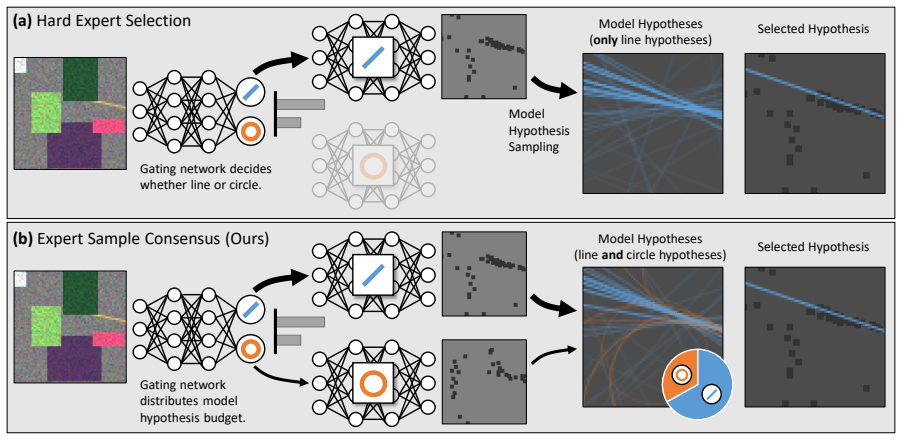
The central mechanism is the multinomial hypothesis split combined with a cross-expert softmax selection. Given M expert networks, each predicting scene coordinates, and a gating distribution g(e, I; w), ESAC draws a split H = (n_1, ..., n_M) with sum n_e = N from a multinomial distribution, gives expert e a budget of n_e pose hypotheses, and then selects the final pose by softmax over the soft inlier scores s(h_{e,j}, Y_e) of all N hypotheses. This makes the gating network's role one of resource allocation: as long as the correct expert receives a nonzero share, a good hypothesis can still win on geometric consistency. Training minimizes the expected task loss over both the split and the selection, with gradients approximated by sampling, including the log-derivative term for the split probability.
What would settle it
On a held-out subset of 19Scenes, force the gating probabilities so that the true scene's expert receives zero hypotheses on images the gating network currently gets wrong. If ESAC's accuracy does not fall below the reported 88.1% by a substantial margin, the paper's explanation that consensus rescues gating errors is not what is driving the result; if instead the accuracy collapses, the claim is supported.
Extended reading notes
Core claim
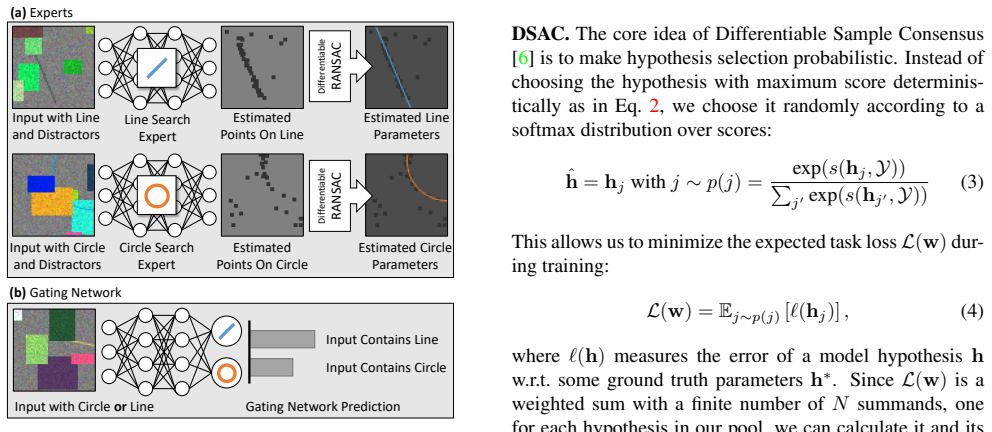
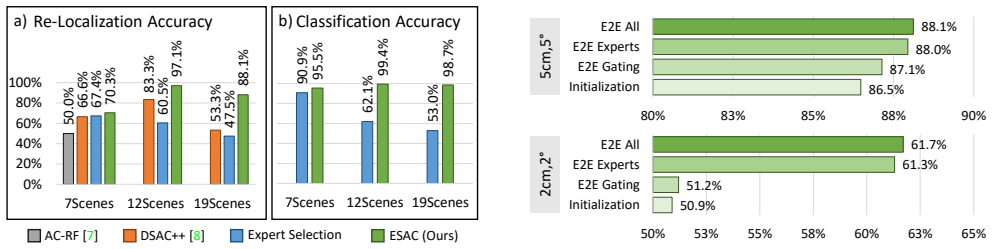
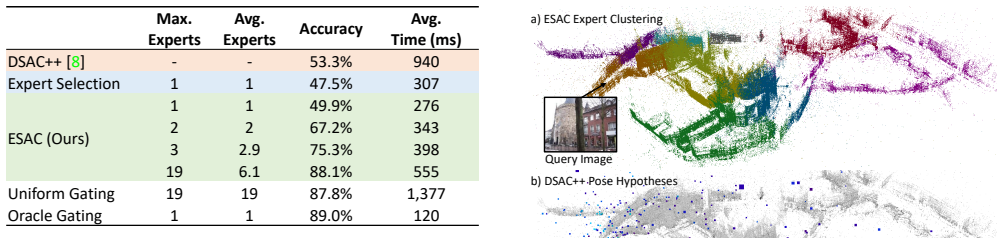
Expert Sample Consensus (ESAC) claims that the correct way to combine a mixture of experts with differentiable RANSAC is not to let the gating network choose a single expert, nor to average expert outputs, but to convert gating probabilities into a multinomial split of a fixed hypothesis budget and then to select the final pose by sample consensus across all experts' hypotheses. The gating network therefore only decides how many of the N pose hypotheses each expert may propose; the geometric consistency score decides which hypothesis wins. On the combined 19-room indoor benchmark (7Scenes plus 12Scenes), ESAC re-localizes 88.1% of test images within 5 cm and 5 degrees, compared with 53.3% for the single-network DSAC++ baseline and 47.5% for hard expert selection, and it nearly matches an oracle that is told the correct scene (89.0%). The authors also report large gains over DSAC++ on outdoor datasets Dubrovnik and Aachen Day, while noting that sparse feature-based localization remains more accurate there.
Load-bearing premise
The load-bearing premise is that the gating network gives the correct expert at least some of the hypothesis budget on every test image, and that the soft inlier score is a fair, comparable measure of hypothesis quality across different experts.
Editorial extensions
If this is right
- On the combined 19-room environment, distributing hypotheses by gating reaches 88.1% correct re-localization versus 53.3% for a single network and 47.5% for hard expert selection, with the gap growing as the environment becomes larger.
- Training the ensemble end-to-end with the ESAC objective matters most for precision: at a stricter 2 cm / 2 degree threshold, joint end-to-end training improves accuracy by more than 10 percentage points over the initialization.
- Because experts with zero assigned hypotheses do not need to run, ESAC is faster than the monolithic baseline (555 ms versus 940 ms per image on 19Scenes) and can cap the number of active experts, gaining 19.7 percentage points over hard selection when only the top two experts are used.
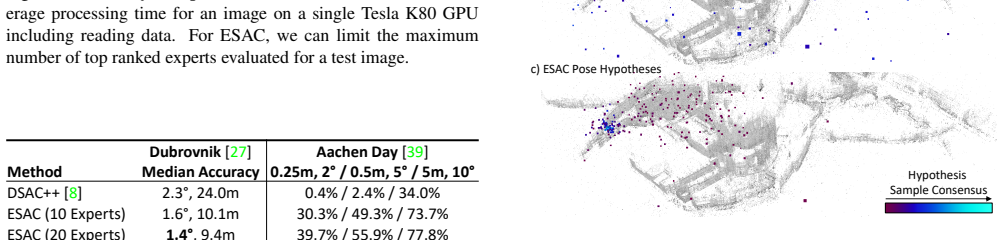
- The same formulation transfers to large outdoor scenes by dividing the environment into clusters and training an expert per cluster; on the Aachen Day benchmark ESAC raises correct localization from 0.4% to 42.6% at the strictest threshold as the number of experts grows, while still trailing sparse feature-based methods.
Reading between the lines
- The same budget-splitting idea should apply to other robust-fitting tasks with a discrete gate, such as object pose estimation or fundamental-matrix estimation, where the gating signal is weak or ambiguous.
- Since only a nonzero share to the correct expert is needed, the gating network can be trained with substantially weaker supervision than a hard classifier; one testable consequence is that ESAC should tolerate noisier scene labels than expert selection.
- The outdoor results suggest the remaining gap to feature-based localization is driven less by the ensemble design and more by the quality of the structure-from-motion ground truth used for training; filtering outlier 3D points before training is a natural follow-up.
- The toy experiment's high model-type classification accuracy hints that ESAC could serve as a differentiable model-selection procedure, choosing not only parameters but the family of model, by letting experts compete through sample consensus.
Signed reviews
Editorial analysis
A structured set of objections, weighed in public.
Referee Report
Summary. The paper proposes Expert Sample Consensus (ESAC), which combines a Mixture-of-Experts architecture with Differentiable Sample Consensus (DSAC) for robust model fitting. Rather than letting a gating network select a single expert or averaging expert outputs, ESAC samples a multinomial split of a fixed hypothesis budget across experts and then selects the final hypothesis by sample consensus across all experts. The full ensemble, including the gating network, is trained end-to-end by minimizing the expected task loss with a K=1 gradient estimator. The method is evaluated on a synthetic line/circle toy problem, on indoor camera re-localization using 7Scenes, 12Scenes and their union 19Scenes, and on outdoor Dubrovnik and Aachen. On 19Scenes, ESAC re-localizes 88.1% of test images compared to 53.3% for DSAC++ and 47.5% for hard expert selection. A limitation paragraph in the appendix discusses remaining gaps to classical feature-based localization outdoors.
Significance. The paper makes a simple but effective conceptual contribution: distributing hypotheses according to gating probabilities while performing final selection by geometric consensus. This is a natural synthesis of MoE and DSAC, and the experiments provide strong evidence for its practical value. The oracle-gating and uniform-gating ablations in Fig. 8 cleanly bracket the performance of the gating network, and the end-to-end training ablation in Fig. 7 shows the benefit of joint optimization. The authors also honestly discuss the limitations of scene-coordinate regression on SfM-based outdoor ground truth. The main threat to the paper's conclusions is empirical: all reported numbers are single runs without error bars, and the claimed robustness to gating errors is not directly measured.
major comments (2)
- [5.2, Fig. 6 and Fig. 8] All accuracy numbers in the main comparison (Fig. 6) and in the speed/accuracy trade-off (Fig. 8) appear to be single-run point estimates; no error bars, confidence intervals, or significance tests are reported. This is particularly relevant for the toy experiment in Fig. 4, where the improvement of ESAC over Expert Selection is only +3.9%, and for the 19Scenes comparison where the margin is large but still subject to training stochasticity. Please report mean and standard deviation over multiple training runs, or at least a paired significance test, for the key comparisons (ESAC vs DSAC++ vs Expert Selection on 19Scenes, and ESAC vs Expert Selection on the toy problem).
- [3.3, Eqs. (10)-(11); 5.2, Fig. 8] The paper's central robustness argument is that 'as long as the gating network attributes some probability to the correct expert' (Introduction), ESAC can recover from gating errors by giving that expert a nonzero share of the N hypotheses and selecting by consensus. This premise is never directly measured: the paper does not report the distribution of gating probabilities assigned to the ground-truth expert, the top-k recall of the gating network, or the frequency with which the correct expert receives zero hypotheses. For N=256, an expert with gating probability p=0.01 is excluded from the hypothesis pool with probability 7.6%, and with p=0.005 with probability 27.7%, so the operating regime matters. The comparison with Oracle Gating (89.0% vs 88.1%) shows that the total penalty for not knowing the scene ID is small, but it does not decompose that penalty into gating misses versus consensus-score errors when the correct expert did receive hypotheses. Adding this failure analysis would directly validate the claimed mechanism.
minor comments (4)
- [5.2] The sentence 'It looses 3.5% accuracy' contains a typo: 'looses' should be 'loses'.
- [Fig. 6b] Please define how 'Classification Accuracy' is computed for ESAC in Fig. 6b; it appears to be the scene label of the expert that produced the selected hypothesis, but the text should state this explicitly.
- [Appendix B, Eq. (16)] In Eq. (16), the similarity measure has a slightly confusing arrangement of the exponent; please check that the formula as printed matches the intended Gaussian (e.g., whether sigma_e should be squared).
- [Appendix B] The phrase 'we me minimize the KL-divergence' contains a typo; it should read 'we minimize'.
Circularity Check
No significant circularity: ESAC's hypothesis allocation and consensus selection are trained by an independent expected-loss objective, and self-citations to DSAC/DSAC++ serve as prior, independently evaluated building blocks.
full rationale
The paper's derivation chain is self-contained and empirically grounded. ESAC defines a gating distribution p(e), allocates a fixed budget of N hypotheses via the multinomial distribution in Eq. 10, selects the final pose by a softmax over sample-consensus scores across all experts in Eq. 11, and trains the ensemble by minimizing the expected task loss in Eq. 12. No equation reduces the target result to an input: the reported 88.1% accuracy on 19Scenes is a measured held-out result, not a fitted parameter renamed as a prediction. The gating network and experts are pretrained with scene labels and scene-coordinate supervision, but the ESAC objective then fine-tunes them end-to-end via gradients of Eq. 12, so the final accuracy is not forced by the initialization. Self-citations to DSAC [6] and DSAC++ [8] provide the differentiable RANSAC machinery and network design; these are prior, externally benchmarked building blocks rather than unverified premises that import the conclusion. The Oracle Gating baseline (89.0% vs. 88.1%) is an upper-bound comparison, not a circular construction. The skeptic's concern that gating top-k recall and zero-allocation probabilities are unreported is a legitimate empirical robustness or falsifiability limitation, but it is not a circularity: the paper's equations do not define the result in terms of itself. Accordingly, no specific circular step can be exhibited, and the appropriate finding is no significant circularity.
Assumptions & free parameters
free parameters (6)
- inlier threshold tau =
10 px
- task loss weight gamma =
100 (degrees vs meters)
- soft score hyperparameters alpha, beta =
inherited from DSAC++ [8]
- number of experts M =
7, 12, 19 indoor; 10, 20, 50 outdoor
- cluster softness gamma (outdoor) =
5
- hypothesis budget N =
64 (toy), 256 (relocalization)
assumptions (4)
- domain assumption The gating distribution p(e) reflects true scene identity well enough that the correct expert receives a nonzero share of hypotheses.
- domain assumption The soft inlier score s(h,Y) is comparable across different experts' hypotheses.
- ad hoc to paper A single Monte Carlo sample (K=1) of the gating split gives useful gradients for joint training.
- domain assumption SfM ground truth for outdoor training images is accurate enough for dense scene coordinate regression.
Cite this review
Pith. "Pith review of Expert Sample Consensus Applied to Camera Re-Localization." pith.science (2026). https://pith.science/paper/GZOUBGR3
@misc{pith2026190802484,
  author       = {Pith},
  title        = {Pith review of: Expert Sample Consensus Applied to Camera Re-Localization},
  year         = {2026},
  howpublished = {\url{https://pith.science/paper/GZOUBGR3}},
  note         = {Machine review of arXiv:1908.02484}
}
read the original abstract
Fitting model parameters to a set of noisy data points is a common problem in computer vision. In this work, we fit the 6D camera pose to a set of noisy correspondences between the 2D input image and a known 3D environment. We estimate these correspondences from the image using a neural network. Since the correspondences often contain outliers, we utilize a robust estimator such as Random Sample Consensus (RANSAC) or Differentiable RANSAC (DSAC) to fit the pose parameters. When the problem domain, e.g. the space of all 2D-3D correspondences, is large or ambiguous, a single network does not cover the domain well. Mixture of Experts (MoE) is a popular strategy to divide a problem domain among an ensemble of specialized networks, so called experts, where a gating network decides which expert is responsible for a given input. In this work, we introduce Expert Sample Consensus (ESAC), which integrates DSAC in a MoE. Our main technical contribution is an efficient method to train ESAC jointly and end-to-end. We demonstrate experimentally that ESAC handles two real-world problems better than competing methods, i.e. scalability and ambiguity. We apply ESAC to fitting simple geometric models to synthetic images, and to camera re-localization for difficult, real datasets.
Figures

Figures from the paper (7 more)



Reference graph
Works this paper leans on
-
[1]
Network of experts for large-scale image categoriza- tion
Karim Ahmed, Mohammad Haris Baig, and Lorenzo Torre- sani. Network of experts for large-scale image categoriza- tion. In ECCV, 2016. 2
work page 2016
-
[2]
A new look at the statistical model identi- fication
Hirotugu Akaike. A new look at the statistical model identi- fication. TAC, 1974. 3
work page 1974
-
[3]
Expert gate: Lifelong learning with a network of experts
Rahaf Aljundi, Punarjay Chakravarty, and Tinne Tuytelaars. Expert gate: Lifelong learning with a network of experts. In CVPR, 2017. 2, 3 Dubrovnik Aachen Figure 13. Ground Truth SfM Reconstructions. Both datasets contain outlier 3D points in the ground truth reconstruction. The outlier ratio is substantial for Dubrovnik, and still noticeable for Aachen
work page 2017
-
[4]
NetVLAD: CNN architecture for weakly supervised place recognition
Relja Arandjelovi ´c, Petr Gronat, Akihiko Torii, Tomas Pa- jdla, and Josef Sivic. NetVLAD: CNN architecture for weakly supervised place recognition. In CVPR, 2016. 3
work page 2016
-
[5]
RelocNet: Continuous metric learning relocalisation using neural nets
Vassileios Balntas, Shuda Li, and Victor Adrian Prisacariu. RelocNet: Continuous metric learning relocalisation using neural nets. In ECCV, 2018. 3
work page 2018
-
[6]
DSAC-Differentiable RANSAC for camera localiza- tion
Eric Brachmann, Alexander Krull, Sebastian Nowozin, Jamie Shotton, Frank Michel, Stefan Gumhold, and Carsten Rother. DSAC-Differentiable RANSAC for camera localiza- tion. In CVPR, 2017. 1, 2, 3, 4, 5, 9
work page 2017
-
[7]
Yang, Stefan Gumhold, and Carsten Rother
Eric Brachmann, Frank Michel, Alexander Krull, Michael Y . Yang, Stefan Gumhold, and Carsten Rother. Uncertainty- driven 6D pose estimation of objects and scenes from a sin- gle RGB image. In CVPR, 2016. 3
work page 2016
-
[8]
Learning less is more- 6D camera localization via 3D surface regression
Eric Brachmann and Carsten Rother. Learning less is more- 6D camera localization via 3D surface regression. In CVPR,
Show all 54 references
-
[9]
Geometry-aware learning of maps for camera localization
Samarth Brahmbhatt, Jinwei Gu, Kihwan Kim, James Hays, and Jan Kautz. Geometry-aware learning of maps for camera localization. In CVPR, 2018. 3
2018
-
[10]
Random forests
Leo Breiman. Random forests. Machine Learning, 2001. 2
2001
-
[11]
Graph-based discriminative learning for location recognition
Song Cao and Noah Snavely. Graph-based discriminative learning for location recognition. In CVPR, 2013. 3
2013
-
[12]
On- the-fly adaptation of regression forests for online camera re- localisation
Tommaso Cavallari, Stuart Golodetz, Nicholas A Lord, Julien Valentin, Luigi Di Stefano, and Philip HS Torr. On- the-fly adaptation of regression forests for online camera re- localisation. In CVPR, 2017. 3
2017
-
[13]
Statistical Adjustment of Data
William Edwards Deming. Statistical Adjustment of Data
-
[14]
Fischler and Robert C
Martin A. Fischler and Robert C. Bolles. Random Sample Consensus: A paradigm for model fitting with applications to image analysis and automated cartography. Commun. ACM,
-
[15]
Schapire
Yoav Freund and Robert E. Schapire. A short introduction to boosting. In IJCAI, 1999. 2 11
1999
-
[16]
Complete solution classification for the perspective-three-point problem
Xiao-Shan Gao, Xiao-Rong Hou, Jianliang Tang, and Hang-Fei Cheng. Complete solution classification for the perspective-three-point problem. TPAMI, 2003. 1, 6
2003
-
[17]
Multi-output learning for camera relocalization
Abner Guzman-Rivera, Pushmeet Kohli, Ben Glocker, Jamie Shotton, Toby Sharp, Andrew Fitzgibbon, and Shahram Izadi. Multi-output learning for camera relocalization. In CVPR, 2014. 3
2014
-
[18]
Deep residual learning for image recognition
Kaiming He, Xiangyu Zhang, Shaoqing Ren, and Jian Sun. Deep residual learning for image recognition. In CVPR,
-
[19]
Hinton, Oriol Vinyals, and Jeffrey Dean
Geoffrey E. Hinton, Oriol Vinyals, and Jeffrey Dean. Distill- ing the knowledge in a neural network. In NIPS Workshops,
-
[20]
Jacobs, Michael I
Robert A. Jacobs, Michael I. Jordan, Steven J. Nowlan, and Geoffrey E. Hinton. Adaptive mixtures of local experts.Neu- ral Computation, 1991. 2, 3, 4
1991
-
[21]
A solution for the best rotation to re- late two sets of vectors
Wolfgang Kabsch. A solution for the best rotation to re- late two sets of vectors. Acta Crystallographica Section A: Crystal Physics, Diffraction, Theoretical and General Crys- tallography, 1976. 1
1976
-
[22]
Geometric loss functions for camera pose regression with deep learning
Alex Kendall and Roberto Cipolla. Geometric loss functions for camera pose regression with deep learning. In CVPR,
-
[23]
PoseNet: A convolutional network for real-time 6-DoF cam- era relocalization
Alex Kendall, Matthew Grimes, and Roberto Cipolla. PoseNet: A convolutional network for real-time 6-DoF cam- era relocalization. In ICCV, 2015. 3, 6
2015
-
[24]
Kingma and Jimmy Ba
Diederik P. Kingma and Jimmy Ba. Adam: A method for stochastic optimization. In ICLR, 2015. 7
2015
-
[25]
Alex Krizhevsky, Ilya Sutskever, and Geoffrey E. Hinton. ImageNet classification with deep convolutional neural net- works. In NIPS, 2012. 2
2012
-
[26]
EPnP: An accurate O(n) solution to the PnP problem
Vincent Lepetit, Francesc Moreno-Noguer, and Pascal Fua. EPnP: An accurate O(n) solution to the PnP problem. IJCV,
-
[27]
Huttenlocher
Yunpeng Li, Noah Snavely, and Daniel P. Huttenlocher. Lo- cation recognition using prioritized feature matching. In ECCV, 2010. 8, 10
2010
-
[28]
Sinha, Michael F
Hyon Lim, Sudipta N. Sinha, Michael F. Cohen, and Matthew Uyttendaele. Real-time image-based 6-DoF local- ization in large-scale environments. In CVPR, 2012. 3
2012
-
[29]
Fully convolutional networks for semantic segmentation
Jonathan Long, Evan Shelhamer, and Trevor Darrell. Fully convolutional networks for semantic segmentation. In CVPR, 2015. 6
2015
-
[30]
Mixture of ex- perts: A literature survey
Saeed Masoudnia and Reza Ebrahimpour. Mixture of ex- perts: A literature survey. Artificial Intelligence Review ,
-
[31]
Daniela Massiceti, Alexander Krull, Eric Brachmann, Carsten Rother, and Philip H. S. Torr. Random forests ver- sus neural networks - What’s best for camera localization? In ICRA, 2017. 3
2017
-
[32]
Little, Julien Valentin, and Clarence W
Lili Meng, Jianhui Chen, Frederick Tung, James J. Little, Julien Valentin, and Clarence W. de Silva. Backtracking re- gression forests for accurate camera relocalization. In IROS,
-
[33]
Little, Julien Valentin, and Clarence W
Lili Meng, Frederick Tung, James J. Little, Julien Valentin, and Clarence W. de Silva. Exploiting points and lines in re- gression forests for RGB-D camera relocalization. In IROS,
-
[34]
Automatic differentiation in PyTorch
Adam Paszke, Sam Gross, Soumith Chintala, Gregory Chanan, Edward Yang, Zachary DeVito, Zeming Lin, Al- ban Desmaison, Luca Antiga, and Adam Lerer. Automatic differentiation in PyTorch. In NIPS-W, 2017. 6
2017
-
[35]
Deep fundamental matrix estimation
Ren ´e Ranftl and Vladlen Koltun. Deep fundamental matrix estimation. In ECCV, 2018. 1
2018
-
[36]
Hyperpoints and fine vocab- ularies for large-scale location recognition
Torsten Sattler, Michal Havlena, Filip Radenovic, Konrad Schindler, and Marc Pollefeys. Hyperpoints and fine vocab- ularies for large-scale location recognition. In ICCV, 2015. 3
2015
-
[37]
Large-scale location recognition and the geomet- ric burstiness problem
Torsten Sattler, Michal Havlena, Konrad Schindler, and Marc Pollefeys. Large-scale location recognition and the geomet- ric burstiness problem. In CVPR, 2016. 3
2016
-
[38]
Efficient & effective prioritized matching for large-scale image-based localization
Torsten Sattler, Bastian Leibe, and Leif Kobbelt. Efficient & effective prioritized matching for large-scale image-based localization. TPAMI, 2016. 3, 9, 11
2016
-
[39]
Benchmarking 6DoF outdoor visual localiza- tion in changing conditions
Torsten Sattler, Will Maddern, Carl Toft, Akihiko Torii, Lars Hammarstrand, Erik Stenborg, Daniel Safari, Masatoshi Okutomi, Marc Pollefeys, Josef Sivic, Fredrik Kahl, and Tomas Pajdla. Benchmarking 6DoF outdoor visual localiza- tion in changing conditions. In CVPR, 2018. 8, 10
2018
-
[40]
Are large-scale 3D models really necessary for accurate visual localization? In CVPR, 2017
Torsten Sattler, Akihiko Torii, Josef Sivic, Marc Pollefeys, Hajime Taira, Masatoshi Okutomi, and Tomas Pajdla. Are large-scale 3D models really necessary for accurate visual localization? In CVPR, 2017. 3
2017
-
[41]
City-scale location recognition
Grant Schindler, Matthew Brown, and Richard Szeliski. City-scale location recognition. In CVPR, 2007. 3
2007
-
[42]
Estimating the dimension of a model
Gideon Schwarz. Estimating the dimension of a model. An- nals of Statistics, 1978. 3
1978
-
[43]
Le, Geoffrey E
Noam Shazeer, Azalia Mirhoseini, Krzysztof Maziarz, Andy Davis, Quoc V . Le, Geoffrey E. Hinton, and Jeff Dean. Outrageously large neural networks: The sparsely-gated mixture-of-experts layer. In ICLR, 2017. 2
2017
-
[44]
Scene co- ordinate regression forests for camera relocalization in RGB- D images
Jamie Shotton, Ben Glocker, Christopher Zach, Shahram Izadi, Antonio Criminisi, and Andrew Fitzgibbon. Scene co- ordinate regression forests for camera relocalization in RGB- D images. In CVPR, 2013. 3, 6, 7
2013
-
[45]
Very deep convo- lutional networks for large-scale image recognition
Karen Simonyan and Andrew Zisserman. Very deep convo- lutional networks for large-scale image recognition. CoRR,
-
[46]
InLoc: Indoor visual localization with dense matching and view synthesis
Hajime Taira, Masatoshi Okutomi, Torsten Sattler, Mircea Cimpoi, Marc Pollefeys, Josef Sivic, Tomas Pajdla, and Ak- ihiko Torii. InLoc: Indoor visual localization with dense matching and view synthesis. In CVPR, 2018. 3
2018
-
[47]
Seman- tic match consistency for long-term visual localization
Carl Toft, Erik Stenborg, Lars Hammarstrand, Lucas Brynte, Marc Pollefeys, Torsten Sattler, and Fredrik Kahl. Seman- tic match consistency for long-term visual localization. In ECCV, 2018. 3
2018
-
[48]
Learn- ing to navigate the energy landscape
Julien Valentin, Angela Dai, Matthias Nießner, Pushmeet Kohli, Philip Torr, Shahram Izadi, and Cem Keskin. Learn- ing to navigate the energy landscape. CoRR, 2016. 7
2016
-
[49]
Julien Valentin, Matthias Nießner, Jamie Shotton, Andrew Fitzgibbon, Shahram Izadi, and Philip H. S. Torr. Exploiting uncertainty in regression forests for accurate camera relocal- ization. In CVPR, 2015. 3
2015
-
[50]
Image- based localization with spatial LSTMs
Florian Walch, Caner Hazirbas, Laura Leal-Taix ´e, Torsten Sattler, Sebastian Hilsenbeck, and Daniel Cremers. Image- based localization with spatial LSTMs. In ICCV, 2017. 3 12
2017
-
[51]
HD-CNN: hierarchical deep con- volutional neural network for image classification
Zhicheng Yan, Vignesh Jagadeesh, Dennis DeCoste, Wei Di, and Robinson Piramuthu. HD-CNN: hierarchical deep con- volutional neural network for image classification. In ICCV,
-
[52]
Hierarchical mixture of classification experts uncovers inter- actions between brain regions
Bangpeng Yao, Dirk Walther, Diane Beck, and Li Fei-fei. Hierarchical mixture of classification experts uncovers inter- actions between brain regions. In NIPS, 2009. 2
2009
-
[53]
Learning to find good correspondences
Kwang Moo Yi, Eduard Trulls, Yuki Ono, Vincent Lepetit, Mathieu Salzmann, and Pascal Fua. Learning to find good correspondences. In CVPR, 2018. 1 13
2018
-
[2018]
3, 4, 6, 7, 9, 10, 11
Reviewed August 14, 2026 · model on record in the stance chip above.
Discussion (0). Continue with ORCID to comment.