REVIEW 3 major objections 4 minor 23 references
Modeling shopper interest broadness with entropy-driven dialogue policy in the context of arbitrarily large product catalogs
T0 review · 3 major / 4 minor · reviewed 2026-08-04 · deepseek-v4-flash
Pith's one-line read Normalized entropy of top-k product-score rankings can tell a shopping agent when a request is specific enough to recommend versus when it should ask clarifying questions, and routing on it increases shopper engagement.
desk verdict A plausible production trick undermined by a false mathematical claim and underpowered AB testing; worth a workshop referee, not a citation. read the letter →
The pith
A machine-rendered reading of the paper's core claim, the machinery that carries it, and where it could break.
The reading
What carries the argument
The central object is the broadness score B_N_k(q), the normalized entropy of the probability distribution formed by renormalizing the calibrated top-k reranker scores: B_N_k(q) = -sum_i P_i log P_i / log k. This single scalar summarizes the shape of the retrieval score distribution and converts the shopper's unobservable interest breadth into an observable routing decision. It is paired with a focused/exploratory query generator and a merchant-tunable threshold tau_merchant, which can be set to educational, balanced, or pushy presets. The same signal doubles as an empirical predictor of recall at 10. The paper does not derive convergence bounds for the k-to-N estimator and relies on empiric
What would settle it
Re-run the paper's recall-at-10 versus entropy-bin measurement on a fresh merchant catalog: if recall does not show the reported plateaus (roughly 0.6 below entropy 0.3, 0.4 between 0.3 and 0.8, and 0.2 above 0.8), then the entropy proxy is not reliably tracking intent breadth for that catalog.
Extended reading notes
Core claim
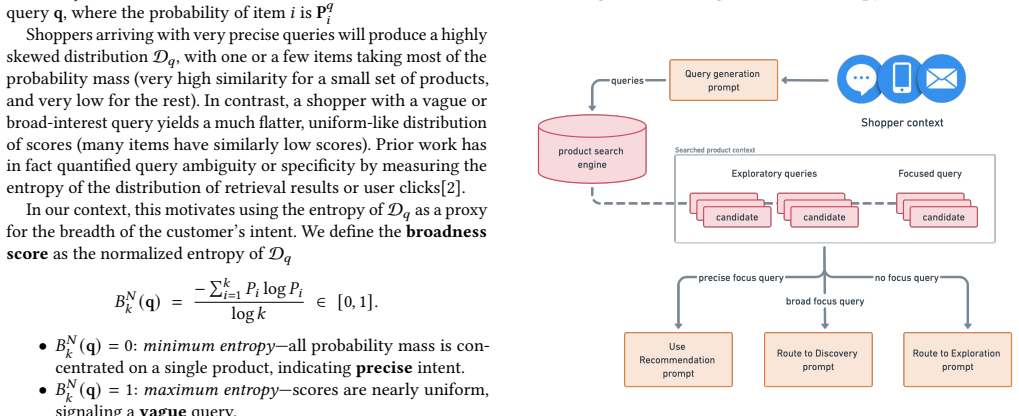
On each sales turn, the assistant's LLM generates a focused identification query from the shopper's latest utterance plus session context. Running that query through a two-stage neural search pipeline yields a calibrated relevance score s(q,p_i) for the top k = 50 items; normalizing these scores into a probability distribution and taking Shannon entropy divided by log k defines the broadness score B_N_k(q) in [0,1]. Low B_N_k means the scores concentrate on one or a few products (precise intent), high B_N_k means they are nearly uniform (vague intent). The dialogue policy routes as follows: if no focused query can be generated, explore; if B_focus < tau_merchant, recommend the top result or
Load-bearing premise
The whole policy rests on the assumption that the spread of the top-50 reranked scores for an LLM-generated focused query correctly reflects how broad the shopper's interest is relative to the entire catalog; the paper does not prove convergence bounds for this estimator.
Editorial extensions
If this is right
- An agent using this policy is continuously catalog-aware: newly indexed products change the score distribution and can alter routing immediately, without retraining or context injection.
- The LLM no longer needs to classify the shopper's interest stage, removing an extra classifier call and its failure mode on catalog-relative specificity.
- Merchants can express sales strategy through a threshold preset, trading discovery depth against conversion pressure.
- The routing decision is explainable: a single entropy value and its score distribution justify why the agent asked versus recommended.
- If the engagement result generalizes, longer conversations give the agent more turns to surface relevant products and recover sales opportunities.
Reading between the lines
- Inference: the same entropy signal could choose the content of the clarifying question — for example, ask the shopper to pick among clusters of the candidate score distribution, directly targeting the largest reduction in next-turn entropy.
- Inference: because thresholds are set per merchant and catalogs drift, the recall-vs-entropy curve could be monitored online; a shift in the curve would flag catalog or model drift and trigger threshold recalibration.
- Inference: the result suggests a general pattern for LLM agents operating over large knowledge bases: use retrieval-score geometry as a cheap external uncertainty signal instead of the LLM's self-reported confidence.
- Inference: comparing this router against an oracle that selects exactly one question to maximize expected entropy reduction would isolate how much of the engagement gain comes from routing alone versus question quality.
Editorial analysis
A structured set of objections, weighed in public.
Referee Report
Summary. The paper describes a production conversational e-commerce agent that routes between two dialogue tactics, Discovery (ask clarifying questions) and Recommendation (suggest a product), based on a broadness score derived from retrieval scores. For each sales-oriented turn, an LLM generates exploratory and focused queries; the focused query is run through a two-stage neural retrieval pipeline (embedding ANN followed by a transformer reranker). The normalized entropy B^N_k(q) of the top-50 reranked scores is used as the broadness score. If B_focus < tau_merchant, the agent recommends; otherwise it asks clarifying questions. The threshold tau_merchant is set from recall-at-10 plateaus on organic storefront-search queries. The authors report a production deployment and an AB test showing longer conversations under the entropy-driven policy, while the observed conversion-rate increase is admitted to be statistically insignificant.
Significance. If the claims are correct, the paper offers a practical, computationally lightweight alternative to LLM-based interest classification: a catalog-relative broadness signal computed from retrieval scores, with no need to inject the full catalog into the LLM context. The production setting (roughly 200K shopper messages/day) and the use of real AB data are strengths. The core proxy is not circular: the entropy is computed directly from retrieval scores, and the threshold is a separate tuning parameter. However, the empirical validation is currently too thin to support the central claim. The AB test lacks sample sizes, confidence intervals, and significance tests; the threshold selection is based on organic data rather than the deployed LLM-generated queries; and the mathematical justification for the top-k entropy estimator contains a false statement. The idea is promising and the paper is worth revising, but the evidence as presented does not yet establish the headline result.
major comments (3)
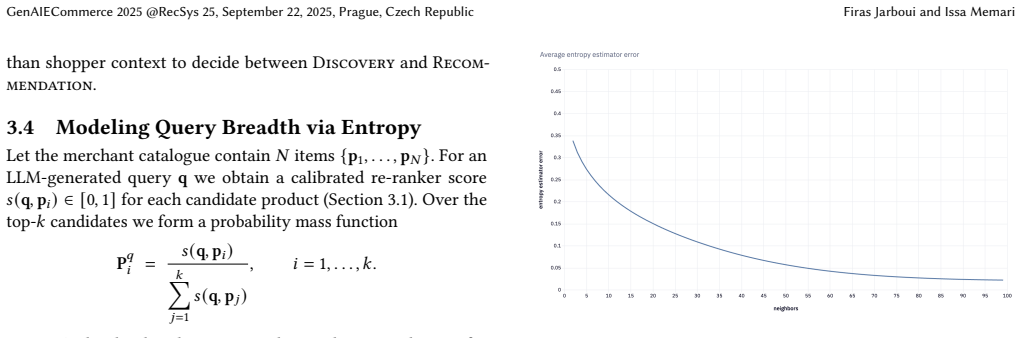
- [Section 3.4, 'Entropy estimator'] The paragraph claims that the top-k broadness B^N_k(q) 'will always over-estimate' the full-catalog broadness B^N_N(q) because the long tail consists of lower-scored items. This is mathematically false: adding lower-scored items can increase normalized entropy. For example, with scores [0.9, 0.1] and 98 additional items at 0.01, the top-2 normalized entropy is about 0.47 while the full 100-item normalized entropy is about 0.68, so the top-k estimator under-estimates. Since Figure 3 reports only an unspecified 'average error' and no convergence bounds, the monotonicity and calibration on which the thresholds rely are unestablished. The authors should either correct this claim, provide bounds, or empirically demonstrate that the top-k estimator preserves the rank ordering of queries relative to full-catalog entropy.
- [Section 3.5, Figure 5] The thresholds tau_merchant are chosen from plateaus in recall-at-10 computed on 'organically collected user search queries' mapped to landing pages. However, the deployed policy computes broadness on LLM-generated focused queries, not organic storefront queries. No evidence is provided that these two query distributions have similar entropy-recall relationships. Because the decision rule branches entirely on B_focus relative to tau_merchant, this distribution shift is load-bearing. The authors should validate threshold selection on the deployed query distribution, or at least report a transferability check between organic and LLM-generated queries.
- [Section 4, Figure 6] The central empirical claim—'the entropy driven policy led to more engaging conversations'—rests on an AB test reported only as a distribution plot. The paper gives no sample sizes, confidence intervals, significance tests, or pre-registration details, and the conversion-rate increase is stated to be 'statistically insignificant' without reporting numbers. Moreover, the engagement metric (number of dialogue rounds) may be mechanically inflated by the Discovery tactic, which by design asks clarifying questions. The authors should report the effect size with uncertainty, a statistical test (or Bayesian posterior), and ideally discuss why the observed change in conversation length is not merely an artifact of the policy's question-asking behavior.
minor comments (4)
- [Throughout] Typographical and grammatical errors: 'the its behavior' (Section 2), 'purshasing' (Section 3.2), 'if Figure 5' should be 'in Figure 5', 'o.3' should be '0.3', 'presents mentionned' should be 'presets mentioned', 'distrcting' should be 'distracting'. A careful proofread is needed.
- [Figure 6] The figure lacks axis labels and legend details. The reader cannot tell what the distributions represent or whether the comparison is statistically meaningful.
- [Section 3.1] The reranker is described as yielding a 'calibrated relevance score.' Calibration is not otherwise demonstrated; if the scores are not well-calibrated, the entropy computation may be sensitive to the score scale. Please clarify what calibration means here and how it was verified.
- [Section 3.3] The phrase 'addressable market among organic shopper interactions' is not formally defined. It would help to clarify how the 1M-sample intent distribution connects to the subsequent design decisions.
Circularity Check
No circularity: entropy proxy is a direct computation, thresholds are calibrated, and the AB test is empirical; weaknesses are correctness risks, not definitional reductions.
full rationale
The paper's central quantity B_N_k(q) is defined directly from reranker scores (Section 3.4), not from the policy outcome or from the engagement metric. The routing threshold tau_merchant is calibrated on an independent organic-search recall curve (Figure 5) and used as an educated preset, so the policy is not fitted to the reported engagement result. The AB test (Figure 6) is an empirical policy comparison, not a quantity derived from the entropy definition. There are no self-citations: refs [1], [2], and [21] are external query-performance prediction works, and the authors' own prior work is not invoked as a load-bearing premise. The main weaknesses are empirical and mathematical: the claim that top-k entropy 'will always over-estimate' full-catalog entropy is false in general (adding many low-scoring items can increase normalized entropy), no convergence bound is supplied, and thresholds are transferred from organic storefront queries to LLM-generated focused queries without distributional evidence. These are correctness risks, not circular reductions. The engagement metric (average conversation rounds) is partly aligned with the policy's question-asking action, but this is a confound/validity issue, not a definitional equivalence, since asking questions does not by itself guarantee longer shopper engagement. Accordingly, the derivation is self-contained and no circular step can be exhibited.
Assumptions & free parameters
free parameters (2)
- merchant threshold tau_merchant =
three presets; boundary values near 0.3 and 0.8
- top-k neighborhood size k =
50
assumptions (4)
- domain assumption Normalized entropy of the top-k reranker score distribution is a valid proxy for the broadness of shopper interest.
- domain assumption Reranker scores s(q,p_i) are calibrated enough that normalizing them yields a meaningful probability distribution.
- domain assumption Top-k entropy over-estimates full-catalog entropy and converges quickly enough that k=50 is reliable.
- domain assumption The LLM-generated focused query is an accurate representation of the shopper's immediate target.
Cite this review
Pith. "Pith review of Modeling shopper interest broadness with entropy-driven dialogue policy in the context of arbitrarily large product catalogs." pith.science (2026). https://pith.science/paper/H2S233AK
@misc{pith2026250906185,
  author       = {Pith},
  title        = {Pith review of: Modeling shopper interest broadness with entropy-driven dialogue policy in the context of arbitrarily large product catalogs},
  year         = {2026},
  howpublished = {\url{https://pith.science/paper/H2S233AK}},
  note         = {Machine review of arXiv:2509.06185}
}
read the original abstract
Conversational recommender systems promise rich interactions for e-commerce, but balancing exploration (clarifying user needs) and exploitation (making recommendations) remains challenging, especially when deploying large language models (LLMs) with vast product catalogs. We address this challenge by modeling the breadth of user interest via the entropy of retrieval score distributions. Our method uses a neural retriever to fetch relevant items for a user query and computes the entropy of the re-ranked scores to dynamically route the dialogue policy: low-entropy (specific) queries trigger direct recommendations, whereas high-entropy (ambiguous) queries prompt exploratory questions. This simple yet effective strategy allows an LLM-driven agent to remain aware of an arbitrarily large catalog in real-time without bloating its context window.
Figures


Figures from the paper (3 more)


Reference graph
Works this paper leans on
-
[2]
Huizhong Duan, Emre Kiciman, and ChengXiang Zhai. 2012. Click patterns: An empirical representation of complex query intents. InProceedings of the 21st ACM international conference on Information and knowledge management. 1035–1044
work page 2012
-
[21]
Oleg Zendel, Binsheng Liu, J Shane Culpepper, and Falk Scholer. 2023. Entropy- based query performance prediction for neural information retrieval systems. (2023)
work page 2023
-
[1]
Steve Cronen-Townsend, Yun Zhou, and W Bruce Croft. 2002. Predicting query performance. InProceedings of the 25th annual international ACM SIGIR conference on Research and development in information retrieval. 299–306
2002
-
[3]
Song Feng, Hui Wan, Chulaka Gunasekara, Siva Sankalp Patel, Sachindra Joshi, and Luis A Lastras. 2020. doc2dial: A goal-oriented document-grounded dialogue dataset.arXiv preprint arXiv:2011.06623(2020)
work page Pith review arXiv 2020
-
[4]
Yue Feng, Shuchang Liu, Zhenghai Xue, Qingpeng Cai, Lantao Hu, Peng Jiang, Kun Gai, and Fei Sun. 2023. A large language model enhanced conversational recommender system.arXiv preprint arXiv:2308.06212(2023)
arXiv 2023
-
[5]
Niklas Freymuth, Dong Liu, Thomas Ricatte, and Saab Mansour. 2025. Hierar- chical Multi-field Representations for Two-Stage E-commerce Retrieval.arXiv preprint arXiv:2501.18707(2025)
arXiv 2025
-
[6]
Rashmi Gangadharaiah and Balakrishnan Narayanaswamy. 2019. Joint Multiple Intent Detection and Slot Labeling for Goal-Oriented Dialog. InProceedings of the 2019 Conference of the North American Chapter of the Association for Computa- tional Linguistics: Human Language Technologies, Volume 1 (Long and Short Papers), Jill Burstein, Christy Doran, and Thamar...
-
[7]
Claudia Hauff, Djoerd Hiemstra, and Franciska de Jong. 2008. A survey of pre- retrieval query performance predictors. InProceedings of the 17th ACM conference on Information and knowledge management. 1419–1420
work page 2008
Show all 23 references
-
[8]
Dietmar Jannach, Ahtsham Manzoor, Wanling Cai, and Li Chen. 2021. A survey on conversational recommender systems.ACM Computing Surveys (CSUR)54, 5 (2021), 1–36
2021
-
[9]
Patrick Lewis, Ethan Perez, Aleksandra Piktus, Fabio Petroni, Vladimir Karpukhin, Naman Goyal, Heinrich Küttler, Mike Lewis, Wen-tau Yih, Tim Rocktäschel, et al. 2020. Retrieval-augmented generation for knowledge-intensive nlp tasks. Advances in neural information processing s...
2020
-
[10]
Feng-Lin Li, Minghui Qiu, Haiqing Chen, Xiongwei Wang, Xing Gao, Jun Huang, Juwei Ren, Zhongzhou Zhao, Weipeng Zhao, Lei Wang, et al. 2017. Alime as- sist: An intelligent assistant for creating an innovative e-commerce experience. InProceedings of the 2017 ACM on Conference on...
2017
-
[11]
Sen Li, Fuyu Lv, Taiwei Jin, Guli Lin, Keping Yang, Xiaoyi Zeng, Xiao-Ming Wu, and Qianli Ma. 2021. Embedding-based product retrieval in taobao search. In Proceedings of the 27th ACM SIGKDD Conference on Knowledge Discovery & Data Mining. 3181–3189
2021
-
[12]
Juexin Lin, Sachin Yadav, Feng Liu, Nicholas Rossi, Praveen R Suram, Satya Chem- bolu, Prijith Chandran, Hrushikesh Mohapatra, Tony Lee, Alessandro Magnani, et al. 2024. Enhancing Relevance of Embedding-based Retrieval at Walmart. In Proceedings of the 33rd ACM International C...
2024
-
[13]
Yinhan Liu, Myle Ott, Naman Goyal, Jingfei Du, Mandar Joshi, Danqi Chen, Omer Levy, Mike Lewis, Luke Zettlemoyer, and Veselin Stoyanov. 2019. Roberta: A robustly optimized bert pretraining approach.arXiv preprint arXiv:1907.11692 (2019)
2019 arXiv
-
[14]
Yuanxing Liu, Weinan Zhang, Yifan Chen, Yuchi Zhang, Haopeng Bai, Fan Feng, Hengbin Cui, Yongbin Li, and Wanxiang Che. 2023. Conversational Recommender System and Large Language Model Are Made for Each Other in E-commerce Pre-sales Dialogue. InFindings of the Association for C...
2023 doi
-
[15]
Yu A Malkov and Dmitry A Yashunin. 2018. Efficient and robust approximate nearest neighbor search using hierarchical navigable small world graphs.IEEE transactions on pattern analysis and machine intelligence42, 4 (2018), 824–836
2018
-
[16]
Xuhui Ren, Hongzhi Yin, Tong Chen, Hao Wang, Zi Huang, and Kai Zheng
-
[17]
Zhaochun Ren, Xiangnan He, Dawei Yin, Maarten de Rijke, et al. 2024. Informa- tion Discovery in E-commerce.Foundations and Trends®in Information Retrieval 18, 4-5 (2024), 417–690
2024
-
[18]
Nicholas Rossi, Juexin Lin, Feng Liu, Zhen Yang, Tony Lee, Alessandro Magnani, and Ciya Liao. 2024. Relevance filtering for embedding-based retrieval. InPro- ceedings of the 33rd ACM International Conference on Information and Knowledge Management. 4828–4835
2024
-
[19]
Ashish Vaswani, Noam Shazeer, Niki Parmar, Jakob Uszkoreit, Llion Jones, Aidan N Gomez, Łukasz Kaiser, and Illia Polosukhin. 2017. Attention is all you need.Advances in neural information processing systems30 (2017)
2017
-
[20]
Liang Wang, Nan Yang, Xiaolong Huang, Linjun Yang, Rangan Majumder, and Furu Wei. 2024. Multilingual e5 text embeddings: A technical report.arXiv preprint arXiv:2402.05672(2024)
2024 arXiv
-
[22]
Yongfeng Zhang, Xu Chen, Qingyao Ai, Liu Yang, and W Bruce Croft. 2018. Towards conversational search and recommendation: System ask, user respond. In Proceedings of the 27th acm international conference on information and knowledge management. 177–186. Received 10 July 2025; ...
2018
-
[2021]
InProceedings of the 44th international ACM SIGIR conference on research and development in information retrieval
Learning to ask appropriate questions in conversational recommendation. InProceedings of the 44th international ACM SIGIR conference on research and development in information retrieval. 808–817
Reviewed August 4, 2026 · model on record in the stance chip above.
Discussion (0). Sign in to comment.