Constraints on Line-of-Sight Acceleration from O1-O4
Pith reviewed 2026-06-25 21:08 UTC · model grok-4.3
The pith
All compact binaries observed in O1-O4 show line-of-sight accelerations consistent with zero.
A machine-rendered reading of the paper's core claim, the machinery that carries it, and where it could break.
Core claim
A new method models the LOS acceleration by directly applying the time-varying Doppler shift in the time domain to the signal produced in the binary's frame; this method can be applied to any waveform model including those with higher order modes, eccentricity, and precession. We find the LOS acceleration for all known binaries to date is consistent with zero. We find that the effects of eccentricity and LOS acceleration are partially degenerate as observed in binaries such as GW200105. Current ground-based observatories are sensitive enough to only constrain scenarios that produce high accelerations, e.g ∼10^{-2}(10^{-5}) c/s for BBH (BNS) sources, however, next-generation observatories may
What carries the argument
Direct time-domain application of a time-varying Doppler shift to the binary-frame gravitational waveform, enabling extraction of line-of-sight acceleration for arbitrary waveform models.
Load-bearing premise
Any residual mismatch between the waveform model and data after the Doppler shift is applied can be absorbed by other parameters without biasing the acceleration posterior.
What would settle it
A future event whose acceleration posterior peaks significantly away from zero even after marginalizing over eccentricity and waveform modeling uncertainties.
Figures
read the original abstract
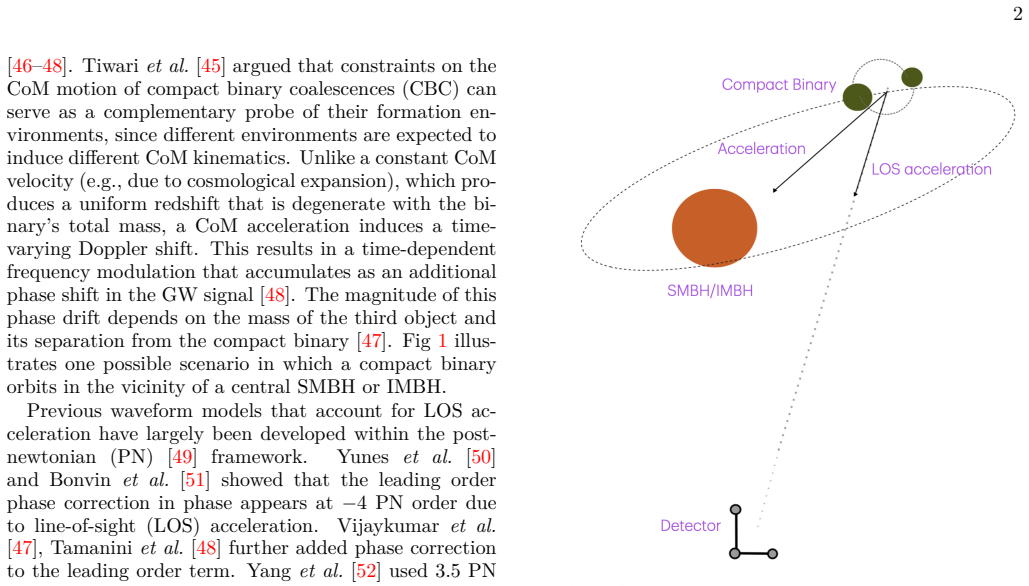
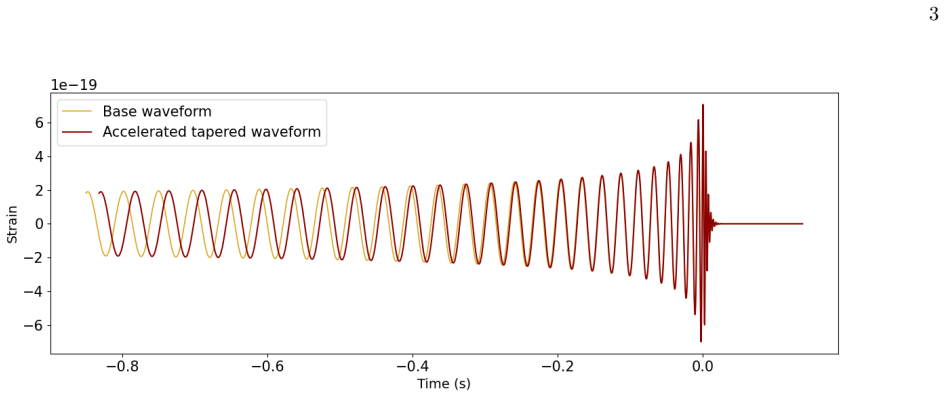
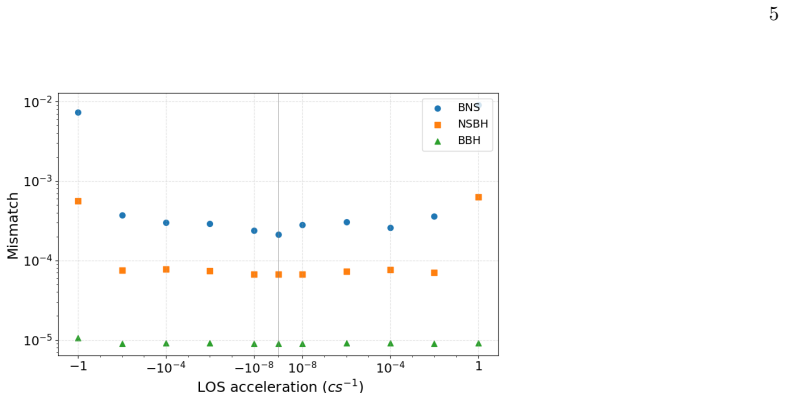
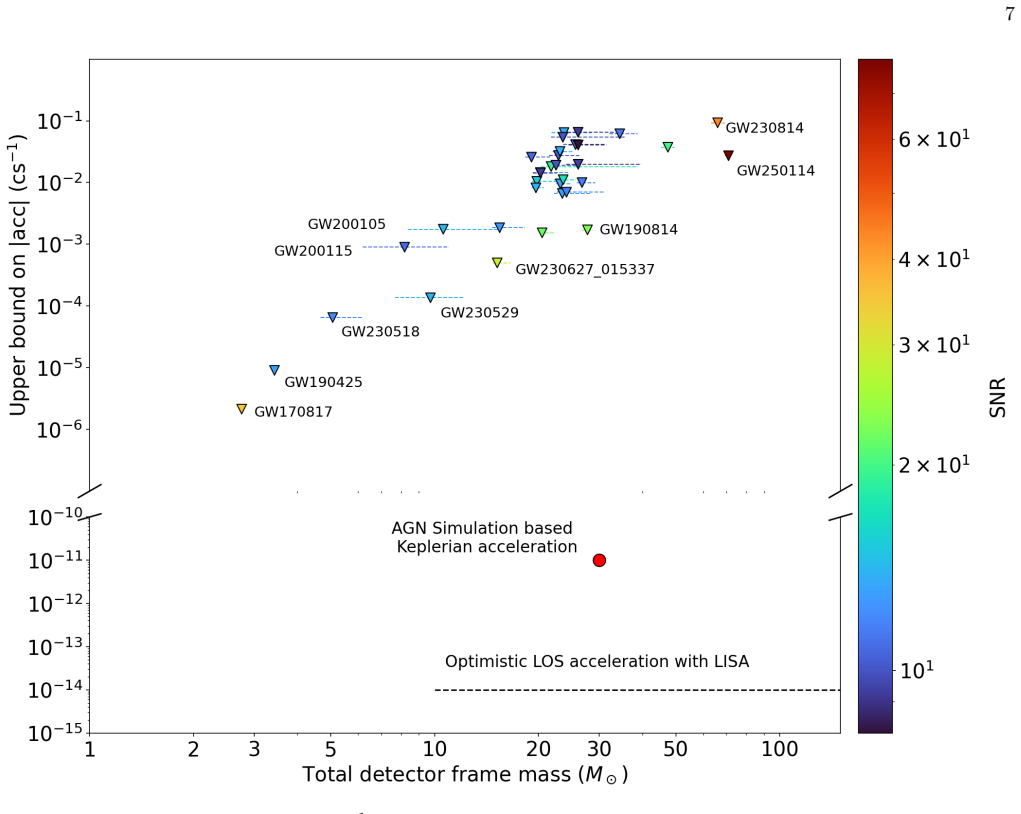
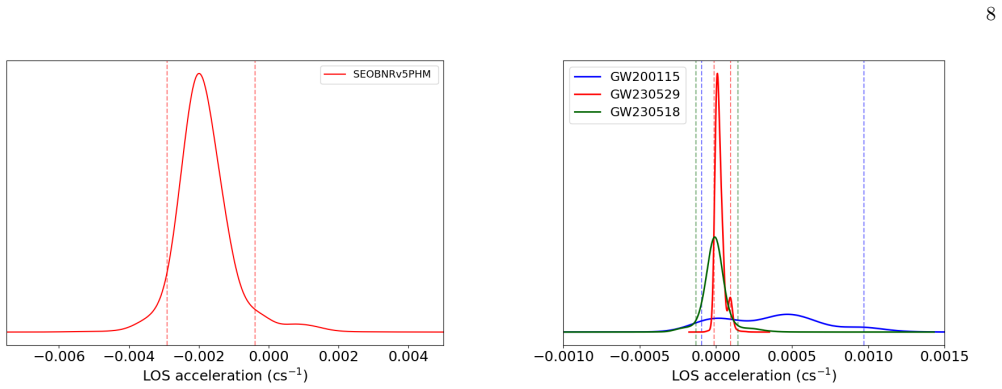
A compact binary will experience a center-of-mass (CoM) acceleration in the vicinity of a massive third object. The line-of-sight (LOS) component of this acceleration is imprinted on gravitational waves produced by the compact binary as a time-varying Doppler shift. The observation of a non-zero LOS acceleration may indicate the binary is in a dense environment, such as an active galactic nucleus (AGN) disk or nuclear star cluster, etc. We measure the LOS acceleration of all compact binaries observed through the first part of the fourth observing run (O1-O4a) of Advanced LIGO and Virgo in addition to select binaries from later observing runs. We introduce a new method to model the LOS acceleration by directly applying the time-varying Doppler shift in the time domain to the signal produced in the binary's frame; this method can be applied to any waveform model including those with higher order modes, eccentricity, and precession. We find the LOS acceleration for all known binaries to date is consistent with zero. We find that the effects of eccentricity and LOS acceleration are partially degenerate as observed in binaries such as GW200105. Current ground-based observatories are sensitive enough to only constrain scenarios that produce high accelerations, e.g $\sim 10^{-2~}(10^{-5})~\textrm{c}/s$ for BBH (BNS) sources, however, next-generation observatories may be able to constrain the accelerations expected in some dense environments.
Editorial analysis
A structured set of objections, weighed in public.
Referee Report
Summary. The paper introduces a method to model line-of-sight (LOS) acceleration of compact binaries by directly applying a time-varying Doppler shift in the time domain to any base gravitational waveform. It applies the method to all O1-O4a events (plus select later ones) and reports that all measured LOS accelerations are consistent with zero, while noting partial degeneracy with eccentricity (e.g., GW200105) and limited sensitivity of current detectors to high-acceleration environments.
Significance. If robust, the zero result constrains binary environments by ruling out high LOS accelerations (~10^{-2} c/s for BBH) expected in some dense settings such as AGN disks. The method's claimed generality to waveforms with higher modes, eccentricity, and precession is a technical strength, as is its direct application to public strain data rather than self-generated signals.
major comments (2)
- [Method (abstract and results discussion)] The central claim that all O1-O4a LOS accelerations are consistent with zero rests on the modeling assumption that any residual mismatch between the base waveform and data (from unmodeled eccentricity, precession, higher modes, or calibration) is absorbed without biasing the a_LOS posterior. This assumption is explicitly flagged as partial degeneracy for GW200105 but receives no quantitative bias assessment via mismatched injections on real-event-like data.
- [Results section] The abstract states that posteriors for all events are consistent with zero, yet the manuscript provides neither the full analysis pipeline details, data selection criteria, nor the acceleration posterior plots. Without these, it cannot be verified whether the zero result is data-driven or influenced by prior volume.
minor comments (1)
- [Method] Clarify the exact prior range and sampling details used for a_LOS in the time-domain implementation to allow reproduction.
Simulated Author's Rebuttal
We thank the referee for their constructive comments. We address each major comment below and will incorporate revisions to improve the manuscript's clarity and robustness.
read point-by-point responses
-
Referee: [Method (abstract and results discussion)] The central claim that all O1-O4a LOS accelerations are consistent with zero rests on the modeling assumption that any residual mismatch between the base waveform and data (from unmodeled eccentricity, precession, higher modes, or calibration) is absorbed without biasing the a_LOS posterior. This assumption is explicitly flagged as partial degeneracy for GW200105 but receives no quantitative bias assessment via mismatched injections on real-event-like data.
Authors: We agree that a quantitative bias assessment is needed to support the robustness of the zero-acceleration results. In the revised version, we will add a section presenting results from mismatched injections: simulated signals with unmodeled eccentricity, precession, or higher modes will be injected into real detector noise resembling the analyzed events, and the recovered a_LOS posteriors will be examined for systematic shifts. This will directly address potential biases for cases like GW200105. revision: yes
-
Referee: [Results section] The abstract states that posteriors for all events are consistent with zero, yet the manuscript provides neither the full analysis pipeline details, data selection criteria, nor the acceleration posterior plots. Without these, it cannot be verified whether the zero result is data-driven or influenced by prior volume.
Authors: We acknowledge that the initial submission omitted some details to maintain brevity. The revised manuscript will include an expanded methods/results section describing the full analysis pipeline (including sampling settings and likelihood implementation), explicit data selection criteria for the O1-O4a events (and later ones), and representative posterior plots for a_LOS across all events. These additions will allow verification that the consistency with zero is data-driven rather than prior-dominated. revision: yes
Circularity Check
No circularity in derivation chain
full rationale
The paper introduces a time-domain method for applying LOS acceleration via Doppler shift to any waveform model and directly fits this parameter to public O1-O4 strain data for known binaries, reporting posteriors consistent with zero. No equation reduces the reported acceleration to a quantity defined by the same data or fit; the central result is an external measurement on catalog events rather than a self-generated prediction. No load-bearing self-citation, uniqueness theorem, or ansatz smuggling is present in the provided derivation steps.
Axiom & Free-Parameter Ledger
free parameters (1)
- line-of-sight acceleration a_LOS
axioms (1)
- domain assumption The gravitational-wave signal can be transformed by a time-dependent Doppler shift without altering the intrinsic binary dynamics
Reference graph
Works this paper leans on
-
[1]
The uniform acceleration ap- proximation is valid only when the observation duration is sufficiently short that the acceleration does not vary appreciably over the signal
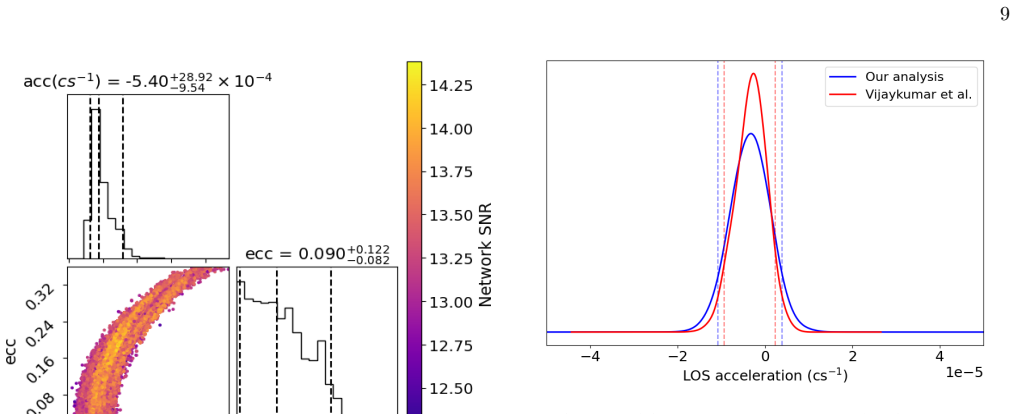
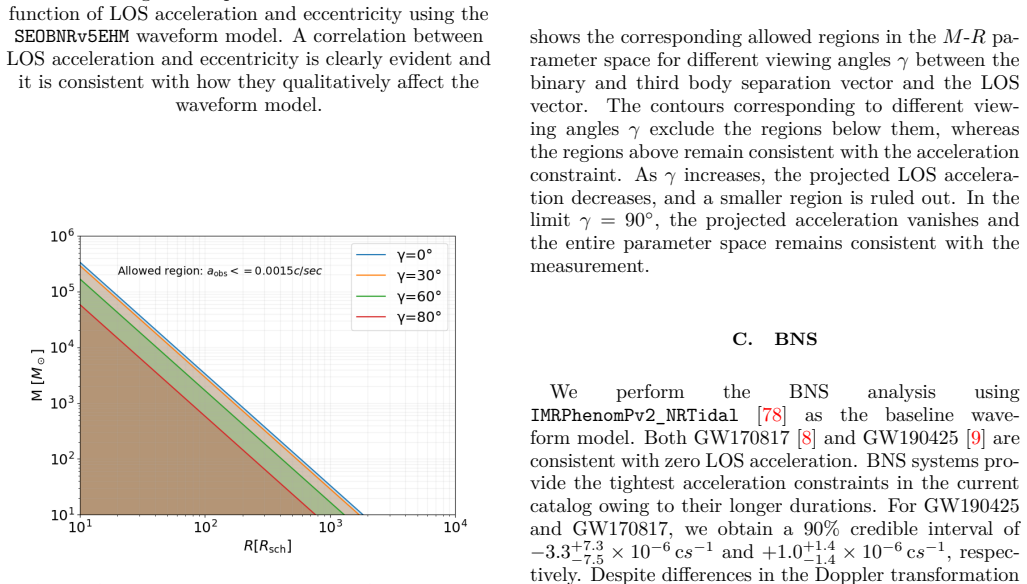
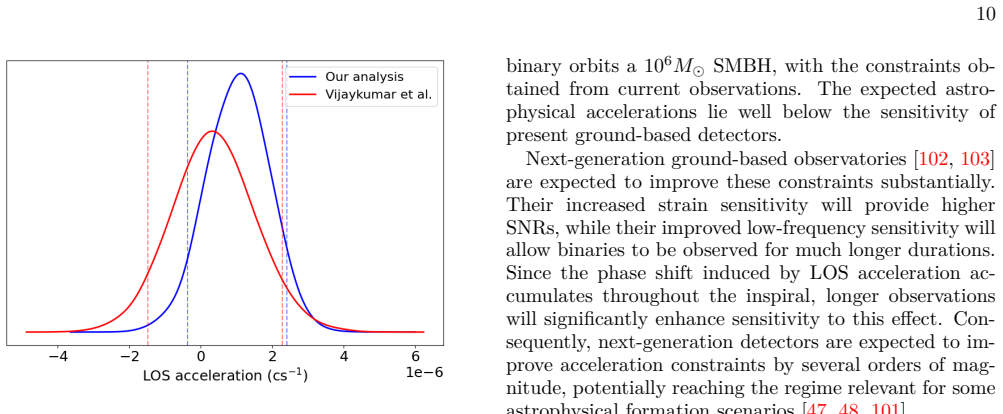
expansions: the binary undergoes uniform acceler- ation during the observation, while tidal perturbations fromthetertiaryobjectandotherrelativisticeffects(e.g., lensing [59]) are neglected. The uniform acceleration ap- proximation is valid only when the observation duration is sufficiently short that the acceleration does not vary appreciably over the sig...
-
[2]
The event contains measurable higher-order mode contributions and has attracted considerable in- terest because of its unusual mass configuration
GW190814 GW190814is aBBHmergerconsistent withthecoales- cence of a22.2−24.3M⊙ black hole and a2.50−2.67M⊙ compact object, indicating a significantly asymmetric mass ratio, detected with a signal-to-noise ratio (SNR) of 25 [53]. The event contains measurable higher-order mode contributions and has attracted considerable in- terest because of its unusual ma...
-
[3]
Its com- ponent masses are similar to those of GW150914 [86]
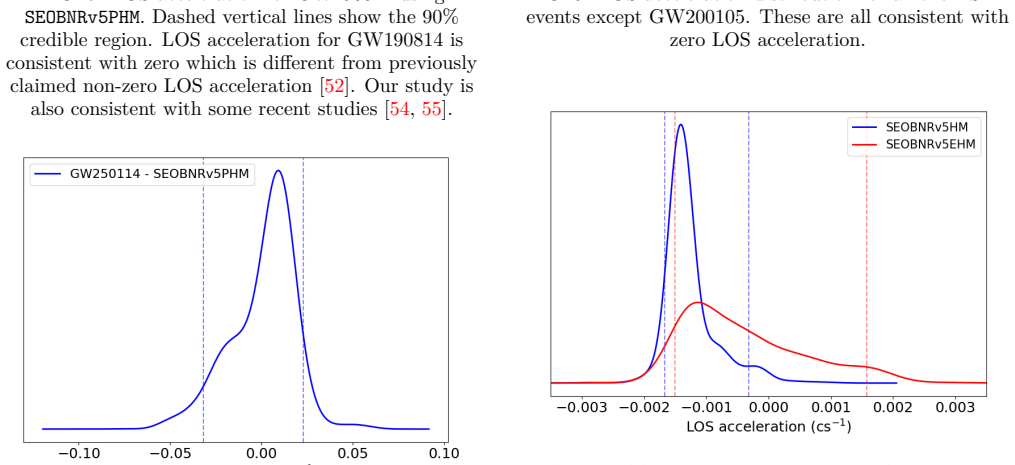
GW250114 GW250114 is the loudest GW event with an SNR of approximately 80 detected to date [80, 81, 85]. Its com- ponent masses are similar to those of GW150914 [86]. We analyse this event usingSEOBNRv5PHM[75] wave- form model. The acceleration probability distribution is shown in Fig. 8. The high SNR yields tighter acceler- ation constraints than those o...
-
[4]
GW200105 Among the NSBH events, GW200105 [12] is claimed to be eccentric [41, 89–92]. This GW event is consis- tent with the coalescence of a8.9+1.2 −1.5M⊙ black hole and a1.9 +0.3 −0.2M⊙ neutron star, detected in a single detector with a signal-to-noise ratio (SNR) of 13.2 [12]. We anal- yse this event with both non-eccentric (IMRPhenomNSBH [65],SEOBNRv5...
-
[5]
B. P. Abbottet al.(LIGO Scientific, Virgo), Phys. Rev. Lett.116, 061102 (2016), arXiv:1602.03837 [gr-qc]
Pith/arXiv arXiv 2016
-
[6]
Aasiet al.(LIGO Scientific), Class
J. Aasiet al.(LIGO Scientific), Class. Quant. Grav.32, 074001 (2015), arXiv:1411.4547 [gr-qc]
Pith/arXiv arXiv 2015
-
[7]
F. Acerneseet al.(VIRGO), Class. Quant. Grav.32, 024001 (2015), arXiv:1408.3978 [gr-qc]
Pith/arXiv arXiv 2015
-
[8]
A. H. Nitz, S. Kumar, Y.-F. Wang, S. Kastha, S. Wu, M. Schäfer, R. Dhurkunde, and C. D. Capano, As- trophys. J.946, 59 (2023), arXiv:2112.06878 [astro- ph.HE]
arXiv 2023
-
[9]
Abbottet al.(KAGRA, VIRGO, LIGO Scientific), Phys
R. Abbottet al.(KAGRA, VIRGO, LIGO Scientific), Phys. Rev. X13, 041039 (2023), arXiv:2111.03606 [gr- qc]
Pith/arXiv arXiv 2023
-
[10]
A. G. Abacet al.(LIGO Scientific, VIRGO, KAGRA), (2025), arXiv:2508.18082 [gr-qc]
Pith/arXiv arXiv 2025
-
[11]
Abacet al.(LIGO Scientific, VIRGO, KAGRA), (2026), arXiv:2605.27223 [gr-qc]
N. Abacet al.(LIGO Scientific, VIRGO, KAGRA), (2026), arXiv:2605.27223 [gr-qc]
Pith/arXiv arXiv 2026
-
[12]
B. P. Abbottet al.(LIGO Scientific, Virgo), Phys. Rev. Lett.119, 161101 (2017), arXiv:1710.05832 [gr-qc]
Pith/arXiv arXiv 2017
-
[13]
B. P. Abbottet al.(LIGO Scientific, Virgo), Astrophys. J.Lett.892,L3(2020),arXiv:2001.01761[astro-ph.HE]
arXiv 2020
-
[14]
B. P. Abbottet al.(LIGO Scientific, Virgo, Fermi GBM, INTEGRAL, IceCube, AstroSat Cadmium Zinc Telluride Imager Team, IPN, Insight-Hxmt, ANTARES, Swift, AGILE Team, 1M2H Team, Dark Energy Camera GW-EM, DES, DLT40, GRAWITA, Fermi-LAT, ATCA, ASKAP, Las Cumbres Observa- tory Group, OzGrav, DWF (Deeper Wider Faster Program), AST3, CAASTRO, VINROUGE, MAS- TER,...
Pith/arXiv arXiv 2017
-
[15]
B. P. Abbottet al.(LIGO Scientific, Virgo, Fermi- GBM, INTEGRAL), Astrophys. J. Lett.848, L13 (2017), arXiv:1710.05834 [astro-ph.HE]
Pith/arXiv arXiv 2017
-
[16]
Abbottet al.(LIGO Scientific, KAGRA, VIRGO), Astrophys
R. Abbottet al.(LIGO Scientific, KAGRA, VIRGO), Astrophys. J. Lett.915, L5 (2021), arXiv:2106.15163 [astro-ph.HE]
arXiv 2021
-
[17]
A. G. Abacet al.(LIGO Scientific, VIRGO, KAGRA), (2025), arXiv:2508.18083 [astro-ph.HE]
Pith/arXiv arXiv 2025
-
[18]
M. Mapelli, Front. Astron. Space Sci.7, 38 (2020), arXiv:2105.12455 [astro-ph.HE]
arXiv 2020
-
[19]
G. Caneva Santoro, S. Roy, R. Vicente, M. Haney, O. J. Piccinni, W. Del Pozzo, and M. Martinez, Phys. Rev. Lett.132, 251401 (2024), arXiv:2309.05061 [gr-qc]
arXiv 2024
-
[20]
B. M. Ziosi, M. Mapelli, M. Branchesi, and G. Tor- men, Mon. Not. Roy. Astron. Soc.441, 3703 (2014), arXiv:1404.7147 [astro-ph.GA]
Pith/arXiv arXiv 2014
-
[21]
C. L. Rodriguez, M. Morscher, B. Pattabiraman, S. Chatterjee, C.-J. Haster, and F. A. Rasio, Phys. Rev. Lett.115, 051101 (2015), [Erratum: Phys.Rev.Lett. 116, 029901 (2016)], arXiv:1505.00792 [astro-ph.HE]
Pith/arXiv arXiv 2015
-
[22]
M. Mapelli, Y. Bouffanais, F. Santoliquido, M. A. Sedda, and M. C. Artale, Mon. Not. Roy. Astron. Soc. 511, 5797 (2022), arXiv:2109.06222 [astro-ph.HE]
arXiv 2022
-
[23]
Formation Channels of Single and Binary Stellar-Mass Black Holes,
M. Mapelli, “Formation Channels of Single and Binary Stellar-Mass Black Holes,” (2021) arXiv:2106.00699 [astro-ph.HE]
arXiv 2021
-
[24]
S. Torniamenti, S. Rastello, M. Mapelli, U. N. Di Carlo, A. Ballone, and M. Pasquato, Monthly Notices of the Royal Astronomical Society517, 2953 (2022), arXiv:2203.08163 [astro-ph.GA]
arXiv 2022
-
[25]
U. N. Di Carloet al., Mon. Not. Roy. Astron. Soc.498, 495 (2020), arXiv:2004.09525 [astro-ph.HE]
arXiv 2020
-
[26]
M. A. Sedda, S. Naoz, and B. Kocsis, Universe9, 138 (2023), arXiv:2302.14071 [astro-ph.GA]
arXiv 2023
- [27]
-
[28]
W. Ishibashi and M. Gröbner, Astron. Astrophys.639, A108 (2020), arXiv:2006.07407 [astro-ph.GA]
arXiv 2020
-
[29]
G.-P. Li and X.-L. Fan, Astrophys. J.984, 63 (2025), arXiv:2502.11489 [astro-ph.HE]
arXiv 2025
-
[30]
A. Loeb, Astrophys. J. Lett.819, L21 (2016), arXiv:1602.04735 [astro-ph.HE]
Pith/arXiv arXiv 2016
-
[31]
B. McKernan, K. E. S. Ford, I. Bartos, M. J. Graham, W. Lyra, S. Marka, Z. Marka, N. P. Ross, D. Stern, and Y. Yang, Astrophys. J. Lett.884, L50 (2019), arXiv:1907.03746 [astro-ph.HE]
arXiv 2019
-
[32]
R. Perna, D. Lazzati, and W. Farr, Astrophys. J.875, 49 (2019), arXiv:1901.04522 [astro-ph.HE]
Pith/arXiv arXiv 2019
-
[33]
M. J. Grahamet al., Phys. Rev. Lett.124, 251102 12 (2020), arXiv:2006.14122 [astro-ph.HE]
arXiv 2020
-
[34]
C. L. Rodriguez, M. Zevin, C. Pankow, V. Kalogera, and F. A. Rasio, Astrophys. J. Lett.832, L2 (2016), arXiv:1609.05916 [astro-ph.HE]
Pith/arXiv arXiv 2016
-
[35]
V.Kalogera,Astrophys.J.541,319(2000),arXiv:astro- ph/9911417
arXiv 2000
- [36]
-
[37]
M. Arca Sedda and M. Benacquista, Mon. Not. Roy. Astron. Soc.482, 2991 (2019), arXiv:1806.01285 [astro- ph.GA]
Pith/arXiv arXiv 2019
-
[38]
K. Belczynski, D. E. Holz, T. Bulik, and R. O’Shaughnessy, Nature534, 512 (2016), arXiv:1602.04531 [astro-ph.HE]
Pith/arXiv arXiv 2016
-
[39]
M. Mapelli, N. Giacobbo, E. Ripamonti, and M. Spera, Mon. Not. Roy. Astron. Soc.472, 2422 (2017), arXiv:1708.05722 [astro-ph.GA]
Pith/arXiv arXiv 2017
-
[40]
M. Zevin, C. Pankow, C. L. Rodriguez, L. Sampson, E. Chase, V. Kalogera, and F. A. Rasio, Astrophys. J. 846, 82 (2017), arXiv:1704.07379 [astro-ph.HE]
Pith/arXiv arXiv 2017
-
[41]
I. M. Romero-Shaw, P. D. Lasky, and E. Thrane, Mon. Not. Roy. Astron. Soc.490, 5210 (2019), arXiv:1909.05466 [astro-ph.HE]
arXiv 2019
- [42]
-
[43]
G. Fumagalli, I. Romero-Shaw, D. Gerosa, V. De Ren- zis, K. Kritos, and A. Olejak, Phys. Rev. D110, 063012 (2024), arXiv:2405.14945 [astro-ph.HE]
arXiv 2024
-
[44]
P. Saini, Mon. Not. Roy. Astron. Soc.528, 833 (2024), arXiv:2308.07565 [astro-ph.HE]
arXiv 2024
- [45]
-
[46]
M. E. Lower, E. Thrane, P. D. Lasky, and R. Smith, Phys. Rev. D98, 083028 (2018), arXiv:1806.05350 [astro-ph.HE]
Pith/arXiv arXiv 2018
-
[47]
L. Randall and Z.-Z. Xianyu, Astrophys. J.864, 134 (2018), arXiv:1802.05718 [gr-qc]
Pith/arXiv arXiv 2018
-
[48]
J. Samsing and D. J. D’Orazio, Mon. Not. Roy. Astron. Soc.481, 5445 (2018), arXiv:1804.06519 [astro-ph.HE]
Pith/arXiv arXiv 2018
- [49]
-
[50]
K. Inayoshi, N. Tamanini, C. Caprini, and Z. Haiman, Phys. Rev. D96, 063014 (2017), arXiv:1702.06529 [astro-ph.HE]
Pith/arXiv arXiv 2017
-
[51]
A. Vijaykumar, A. Tiwari, S. J. Kapadia, K. G. Arun, and P. Ajith, Astrophys. J.954, 105 (2023), arXiv:2302.09651 [astro-ph.HE]
arXiv 2023
-
[52]
N. Tamanini, A. Klein, C. Bonvin, E. Barausse, and C. Caprini, Phys. Rev. D101, 063002 (2020), arXiv:1907.02018 [astro-ph.IM]
arXiv 2020
-
[53]
L. Blanchet, Living Rev. Rel.17, 2 (2014), arXiv:1310.1528 [gr-qc]
Pith/arXiv arXiv 2014
-
[54]
N. Yunes, M. Coleman Miller, and J. Thornburg, Phys. Rev. D83, 044030 (2011), arXiv:1010.1721 [astro- ph.GA]
Pith/arXiv arXiv 2011
-
[55]
C. Bonvin, C. Caprini, R. Sturani, and N. Tamanini, Phys. Rev. D95, 044029 (2017), arXiv:1609.08093 [astro-ph.CO]
Pith/arXiv arXiv 2017
-
[56]
Yang, W.-B
S.-C. Yang, W.-B. Han, H. Tagawa, S. Li, and C. Zhang, The Astrophysical Journal Letters988, L41 (2025)
2025
-
[57]
Abbottet al.(LIGO Scientific, Virgo), Astrophys
R. Abbottet al.(LIGO Scientific, Virgo), Astrophys. J. Lett.896, L44 (2020), arXiv:2006.12611 [astro-ph.HE]
Pith/arXiv arXiv 2020
- [58]
-
[59]
K. Hendriks, L. Zwick, P. Saini, J. Takátsy, and J. Sam- sing, (2026), arXiv:2601.14918 [astro-ph.HE]
arXiv 2026
-
[60]
L. Pathak, H. Phurailatpam, and A. Gopakumar, (2026), arXiv:2605.21955 [gr-qc]
Pith/arXiv arXiv 2026
-
[61]
Y. Pan, A. Buonanno, M. Boyle, L. T. Buchman, L. E. Kidder, H. P. Pfeiffer, and M. A. Scheel, Phys. Rev. D 84, 124052 (2011), arXiv:1106.1021 [gr-qc]
Pith/arXiv arXiv 2011
-
[62]
C. García-Quirós, M. Colleoni, S. Husa, H. Estel- lés, G. Pratten, A. Ramos-Buades, M. Mateu-Lucena, and R. Jaume, Phys. Rev. D102, 064002 (2020), arXiv:2001.10914 [gr-qc]
arXiv 2020
-
[63]
M. Bartelmann, Class. Quant. Grav.27, 233001 (2010), arXiv:1010.3829 [astro-ph.CO]
Pith/arXiv arXiv 2010
-
[64]
J. W. Cooley and J. W. Tukey, Math. Comput.19, 297 (1965)
1965
-
[65]
S. A. Usmanet al., Class. Quant. Grav.33, 215004 (2016), arXiv:1508.02357 [gr-qc]
Pith/arXiv arXiv 2016
-
[66]
G. Ashtonet al., Astrophys. J. Suppl.241, 27 (2019), arXiv:1811.02042 [astro-ph.IM]
Pith/arXiv arXiv 2019
-
[67]
LVK algorithm library – lalsuite,
LIGO Scientific Collaboration, Virgo Collaboration, and KAGRA Collaboration, “LVK algorithm library – lalsuite,” Free software (GPL) (2018)
2018
-
[68]
T. Dietrich, A. Samajdar, S. Khan, N. K. Johnson- McDaniel, R. Dudi, and W. Tichy, Phys. Rev. D100, 044003 (2019), arXiv:1905.06011 [gr-qc]
arXiv 2019
-
[69]
J. E. Thompson, E. Fauchon-Jones, S. Khan, E. Ni- toglia, F. Pannarale, T. Dietrich, and M. Hannam, Phys. Rev. D101, 124059 (2020), arXiv:2002.08383 [gr- qc]
arXiv 2020
-
[70]
G. Prattenet al., Phys. Rev. D103, 104056 (2021), arXiv:2004.06503 [gr-qc]
Pith/arXiv arXiv 2021
-
[71]
C. Cutler and M. Vallisneri, Phys. Rev. D76, 104018 (2007), arXiv:0707.2982 [gr-qc]
Pith/arXiv arXiv 2007
-
[72]
L. Lindblom, B. J. Owen, and D. A. Brown, Phys. Rev. D78, 124020 (2008), arXiv:0809.3844 [gr-qc]
Pith/arXiv arXiv 2008
-
[73]
E. Thrane and C. Talbot, Publications of the Astronom- icalSocietyofAustralia36(2019),10.1017/pasa.2019.2
-
[74]
C. Rover, R. Meyer, and N. Christensen, Class. Quant. Grav.23, 4895 (2006), arXiv:gr-qc/0602067
Pith/arXiv arXiv 2006
-
[75]
C. M. Biwer, C. D. Capano, S. De, M. Cabero, D. A. Brown, A. H. Nitz, and V. Raymond, Publ. Astron. Soc. Pac.131, 024503 (2019), arXiv:1807.10312 [astro- ph.IM]
Pith/arXiv arXiv 2019
-
[76]
(2025), arXiv:2508.18079 [gr-qc]
Pith/arXiv arXiv 2025
-
[77]
Abbottet al.(KAGRA, VIRGO, LIGO Scientific), Astrophys
R. Abbottet al.(KAGRA, VIRGO, LIGO Scientific), Astrophys. J. Suppl.267, 29 (2023), arXiv:2302.03676 [gr-qc]
Pith/arXiv arXiv 2023
-
[78]
J. E. Thompson, E. Hamilton, L. London, S. Ghosh, P. Kolitsidou, C. Hoy, and M. Hannam, Phys. Rev. D 109, 063012 (2024), arXiv:2312.10025 [gr-qc]
arXiv 2024
-
[79]
A. Ramos-Buades, A. Buonanno, H. Estellés, M. Khalil, D. P. Mihaylov, S. Ossokine, L. Pompili, and M. Shiferaw, Phys. Rev. D108, 124037 (2023), arXiv:2303.18046 [gr-qc]
arXiv 2023
-
[80]
L. Pompiliet al., Phys. Rev. D108, 124035 (2023), arXiv:2303.18039 [gr-qc]
arXiv 2023
discussion (0)
Sign in with ORCID, Apple, or X to comment. Anyone can read and Pith papers without signing in.