REVIEW 3 major objections 5 minor 50 references
RL-RC-DoT: A Block-level RL agent for Task-Aware Video Compression
T0 review · 3 major / 5 minor · reviewed 2026-08-10 · deepseek-v4-flash
Pith's one-line read A PPO-trained agent that adjusts per-block quantization in a standard H.264 encoder cuts the bit-rate needed for the same car-detection precision by about 25%.
desk verdict Genuinely new and practically useful RL-based QP control; the 25% BD-rate gains are real but conditional on a filtered dataset, so the paper needs a serious revision, not a desk reject. read the letter →
The pith
A machine-rendered reading of the paper's core claim, the machinery that carries it, and where it could break.
The reading
What carries the argument
The engine is a PPO agent (proximal policy optimization, a standard reinforcement-learning algorithm) that maps cheap per-frame encoder statistics—per-macroblock energy, intra and propagating costs, inverse quantization scale, plus global rate and frame-type features—to a low-resolution delta-QP map that is upsampled to all macroblocks of the frame. The reward is a weighted sum of a bit-rate term and a task score, where the task score compares the downstream model's output on the reconstructed frame against its output on the raw frame. A block-wise auxiliary loss predicts local reward components, giving the policy a denser learning signal. This machinery lets a standard x264 encoder be steered frame by frame, with the policy acting over the temporal sequence so it can weigh future bit-rate consequences.
What would settle it
Re-run the evaluation on the BDD100K streams that the paper filtered out because they showed zero car-detection precision at most target bit-rates; if RL-RC-DoT does not improve or worsens the detection BD-rate there, the central claim that per-block QP control helps task performance on arbitrary driving video fails.
Extended reading notes
Core claim
The central discovery is that per-block QP control by a policy trained to maximize a downstream task score plus a bit-rate penalty can reallocate bits toward task-relevant regions without needing task ground truth during inference. Training uses the raw frame as pseudo-ground truth: the task model's output on the uncompressed frame defines what the reconstruction should preserve. The same compressed stream stays watchable, because the PSNR cost is small. The paper demonstrates this for car detection and saliency-weighted PSNR, with BD-rate reductions of about 25% on each, and shows the learned policy improves performance of unseen detectors and a segmentation model.
Load-bearing premise
The evaluation only includes driving streams where the car detector already finds cars in the uncompressed video, so the reported savings may not carry over to streams where detection starts from zero.
Editorial extensions
If this is right
- Encoding can be made task-aware on top of existing H.264 codecs, so deployment only adds a lightweight network that outputs QP deltas rather than a new codec stack.
- At equal bit-rate, car-detection precision and recall improve; at equal precision, bit-rate drops by roughly 25%, with human-viewability nearly unchanged.
- A policy trained for one detector improves a different detector and a segmentation model, so the compressed video remains reusable across models and tasks.
- ROI and saliency encoding get similar bit-rate savings, suggesting the mechanism generalizes beyond detection.
- The myopic ablation shows temporal lookahead matters; optimizing frame by frame loses most of the benefit, so the video-level formulation is essential.
Reading between the lines
- The authors leave implicit that the dataset filter means the reported gains live in a regime where the detector already works; on streams with zero baseline precision the mechanism has no signal to reallocate toward.
- A natural extension is to run the same reward scheme on HEVC or VVC by replacing per-macroblock statistics with coding-tree-unit features; the codec-agnostic formulation should transfer, though the action-space resolution may need retuning.
- The block-wise reward-prediction head could double as a learned importance map, which might explain the 3.2% tracking BD-rate gain and could be used to seed ROI encoding without a saliency model.
- Since the pseudo-ground-truth reward only needs a model output on raw and reconstructed frames, the method should also work with task-agnostic or learned perceptual metrics, reducing dependence on a specific detector during training.
Signed reviews
Editorial analysis
A structured set of objections, weighed in public.
Referee Report
Summary. The paper proposes RL-RC-DoT, a PPO-based reinforcement learning agent that controls per-macroblock QP deltas in the x264 encoder to optimize a downstream video-analysis task rather than pure reconstruction quality. The MDP is defined at frame granularity: the state is a set of encoder statistics, the action is a low-resolution delta-QP map that is upsampled to the macroblock grid, and the reward combines a bit-rate fidelity term with a task term that compares the downstream model's output on the reconstructed frame against its output on the raw frame, used as pseudo-ground-truth. The method is evaluated on a filtered subset of BDD100K for car detection (YOLOv5-nano) and saliency-weighted PSNR (ROI encoding), with reported BD-rate reductions of about 24.7% and 25.64% relative to standard x264, small PSNR loss, positive transfer to SSD and segmentation, and ablations of the reward-prediction auxiliary loss and discount factor.
Significance. If the reported results are representative, RL-RC-DoT is a practically valuable contribution: it wraps a standard, widely deployed encoder with a real-time policy (claimed 250 FPS overhead), requires no downstream model or ground truth at inference time, and shows some robustness across tasks and detectors. The paper's strengths include the concrete system design, the use of a held-out test set, the named stream lists for reproducibility, the ablation studies, and the transfer experiments to SSD and segmentation. The main significance is limited by two correctness-risk concerns: the evaluation is restricted to a filtered set of streams with non-trivial baseline detection performance, and the primary car-detection metric is computed against a pseudo-ground-truth derived from the same detector used in the reward.
major comments (3)
- [Section 4.1] The dataset construction filters out streams that exhibit zero detection precision across most target bit-rates before the train/validation/test split, so all 100 test streams come from a pool where standard x264 encoding already yields non-trivial YOLOv5 precision. Consequently, the headline BD-rate numbers in Table 2 are conditional on this favorable subset, and the abstract/conclusion statements of general improvement over task-agnostic encoding are not supported for the unfiltered deployment distribution. Please report how many BDD100K streams were excluded, characterize the excluded streams, and provide an evaluation on the unfiltered set or at least on a held-out stratum with low baseline precision. Without such evidence the external validity of the central claim remains undetermined.
- [Sections 3.1 and 5.1] The car-detection metric is precision computed with YOLOv5-nano detections on the raw frames as pseudo-ground-truth, and the same pseudo-ground-truth is used in the training reward. This creates a genuine risk that the policy learns to make compressed-frame detections agree with raw-frame detections rather than to improve true detection quality against human annotations. Since BDD100K provides manual bounding-box annotations, please report AP/mAP and recall against those annotations as the primary task metric, and additionally show the correlation between the pseudo-GT-based and GT-based rankings. The SSD and segmentation transfer results partially mitigate this concern, but they do not by themselves validate the headline car-detection BD-rate numbers.
- [Sections 5.1 and 5.3] The paper reports the headline car-detection BD-rate with inconsistent uncertainty values: Section 5.1 states 24.7% (±1.38%), while Table 2 and Appendix Table 7 report −24.7 ± 1.57. Please reconcile these values and state explicitly the number of streams, rate points, and integration interval used for each BD-rate computation, since BD-rate is sensitive to these choices and to the filtering criterion.
minor comments (5)
- [Section 4.1] The paper does not state how many total BDD100K streams were considered or how many were removed by the filtering criterion; please add these counts so the reader can judge the selection effect.
- [Appendix 7.3.2, Table 9] The entry for the 'fast' preset reads '-22/8', which is almost certainly a typo for '-22.8'; please fix it.
- [Appendix 7.3.1] The additional downstream-task results (DAVIS segmentation and ByteTrack tracking) are reported without sufficient experimental detail; please specify which policy was used, what was matched at each bit-rate, and how the metrics were computed, or omit these results from the claims.
- [Appendix 7.7] The reproducibility section describes modified x264 code but provides no link to the code or model weights; releasing these would materially strengthen the reproducibility claim.
- [Section 6 and Abstract] The abstract and conclusion state improvements over task-agnostic encoding without noting that the evaluation was performed on a filtered subset of streams; please add the caveat or present the unfiltered results.
Circularity Check
No significant circularity: policy training and held-out evaluation are separated, transfer results are external, and the dataset filter is a generality caveat rather than a circular step.
full rationale
The derivation chain is not circular. The RL policy is trained with a PPO objective whose reward combines bit-rate error with r_task = D[f_task(frameraw), f_task(framerecon)] (Section 3.1), where the raw-frame detector output serves as pseudo-ground-truth. The headline BD-rate results are computed on 100 held-out test streams (Section 4.1), with a separate validation set used only for hyperparameter selection; no test-stream rewards or test labels enter training. The reward is a consistency measure against raw-frame detections, while the reported precision/recall BD-rates are standard task metrics evaluated on the test set, so the evaluation is not the same quantity as the training reward. The most plausible near-circular concern—that optimizing a YOLOv5-nano-based reward guarantees YOLOv5-nano precision gains—is empirically countered by the transfer results in Table 2: SSD precision BD-rate of -26.2% and segmentation IoU BD-rate of -14.6% are obtained with models and tasks not used in the reward, showing the learned bit allocation transfers beyond the training objective. The Section 4.1 filter that excludes streams with zero x264 detection precision across most target bit-rates is a disclosed dataset-selection and external-validity caveat, not a circular step: on such streams the raw-frame detector provides an empty or constant reward, so the agent has no learning signal; the paper states this filter explicitly. No load-bearing self-citations or imported uniqueness theorems appear in the derivation. The Limitations section (Section 6) notes training-time and resolution-generalization constraints but does not hide the filter. Overall, the central claim is supported by held-out generalization and independent transfer evaluations, so the circularity score is 0.
Assumptions & free parameters
free parameters (3)
- lambda (reward weighting) =
20
- reward-prediction loss weight =
0.1
- action-space coarsening factor =
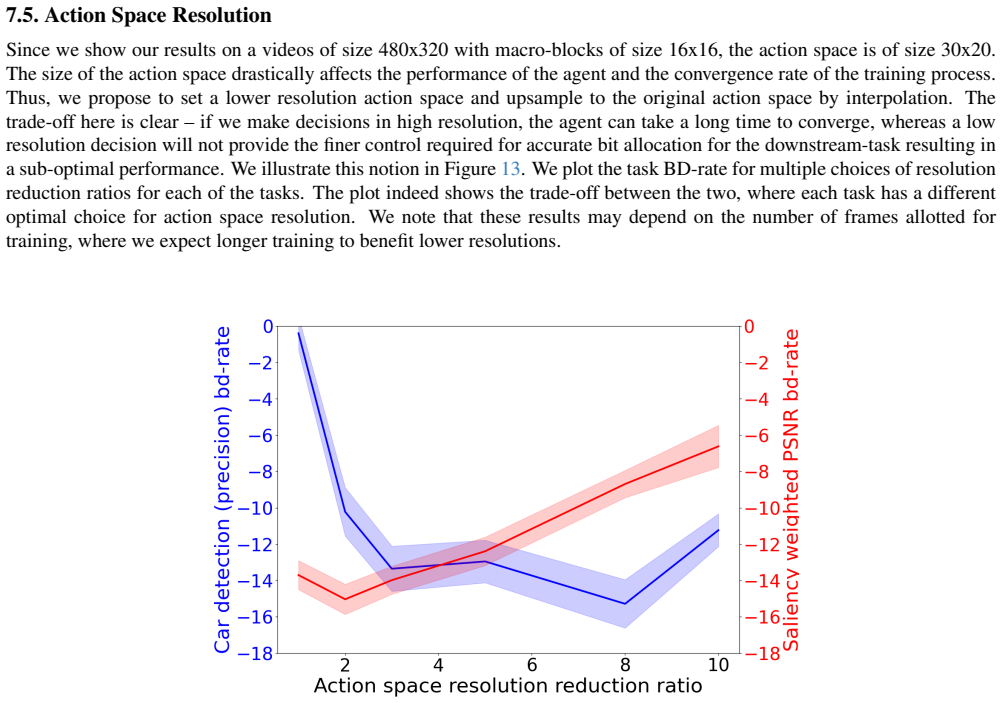
task-dependent optimum (Appendix 7.5)
assumptions (3)
- domain assumption The compression process is well-modeled as an MDP with frame-level time steps and Markovian state from encoder statistics.
- domain assumption Raw-frame task model outputs are a reliable pseudo-ground-truth for evaluating reconstructed frames.
- domain assumption The filtered subset of BDD100K streams is representative of the target deployment distribution.
Cite this review
Pith. "Pith review of RL-RC-DoT: A Block-level RL agent for Task-Aware Video Compression." pith.science (2026). https://pith.science/paper/H3IQQS4V
@misc{pith2026250112216,
  author       = {Pith},
  title        = {Pith review of: RL-RC-DoT: A Block-level RL agent for Task-Aware Video Compression},
  year         = {2026},
  howpublished = {\url{https://pith.science/paper/H3IQQS4V}},
  note         = {Machine review of arXiv:2501.12216}
}
read the original abstract
Video encoders optimize compression for human perception by minimizing reconstruction error under bit-rate constraints. In many modern applications such as autonomous driving, an overwhelming majority of videos serve as input for AI systems performing tasks like object recognition or segmentation, rather than being watched by humans. It is therefore useful to optimize the encoder for a downstream task instead of for perceptual image quality. However, a major challenge is how to combine such downstream optimization with existing standard video encoders, which are highly efficient and popular. Here, we address this challenge by controlling the Quantization Parameters (QPs) at the macro-block level to optimize the downstream task. This granular control allows us to prioritize encoding for task-relevant regions within each frame. We formulate this optimization problem as a Reinforcement Learning (RL) task, where the agent learns to balance long-term implications of choosing QPs on both task performance and bit-rate constraints. Notably, our policy does not require the downstream task as an input during inference, making it suitable for streaming applications and edge devices such as vehicles. We demonstrate significant improvements in two tasks, car detection, and ROI (saliency) encoding. Our approach improves task performance for a given bit rate compared to traditional task agnostic encoding methods, paving the way for more efficient task-aware video compression.
Figures


Figures from the paper (10 more)


Reference graph
Works this paper leans on
-
[19]
Task-driven semantic cod- ing via reinforcement learning
Xin Li, Jun Shi, and Zhibo Chen. Task-driven semantic cod- ing via reinforcement learning. IEEE Transactions on Image Processing, 30:6307–6320, 2021. 1, 2, 4, 5
work page 2021
-
[44]
Hierarchical reinforcement learn- ing based video semantic coding for segmentation
Guangqi Xie, Xin Li, Shiqi Lin, Zhibo Chen, Li Zhang, Kai Zhang, and Yue Li. Hierarchical reinforcement learn- ing based video semantic coding for segmentation. In 2022 IEEE International Conference on Visual Communications and Image Processing (VCIP), pages 1–5. IEEE, 2022. 1, 2, 4, 5
work page 2022
-
[1]
Image and video compression standards: algorithms and architec- tures
Vasudev Bhaskaran and Konstantinos Konstantinides. Image and video compression standards: algorithms and architec- tures. 1997. 1
work page 1997
-
[2]
Calculation of average psnr differences between rd-curves
Gisle Bjøntegaard. Calculation of average psnr differences between rd-curves. 2001. 5
work page 2001
-
[3]
Overview of the versatile video coding (vvc) standard and its applica- tions
Benjamin Bross, Ye-Kui Wang, Yan Ye, Shan Liu, Jianle Chen, Gary J Sullivan, and Jens-Rainer Ohm. Overview of the versatile video coding (vvc) standard and its applica- tions. IEEE Transactions on Circuits and Systems for Video Technology, 31(10):3736–3764, 2021. 1
work page 2021
-
[4]
A novel video coding strategy in hevc for object detection
Qi Cai, Zhifeng Chen, Dapeng Oliver Wu, Shan Liu, and Xiang Li. A novel video coding strategy in hevc for object detection. IEEE Transactions on Circuits and Systems for Video Technology, 31(12):4924–4937, 2021. 2
work page 2021
-
[5]
Liang-Chieh Chen, George Papandreou, Iasonas Kokkinos, Kevin Murphy, and Alan L Yuille. Deeplab: Semantic image segmentation with deep convolutional nets, atrous convolu- tion, and fully connected crfs. IEEE transactions on pattern analysis and machine intelligence, 40(4):834–848, 2017. 7
work page 2017
-
[6]
Re- inforcement learning for hevc/h
Lian-Ching Chen, Jun-Hao Hu, and Wen-Hsiao Peng. Re- inforcement learning for hevc/h. 265 frame-level bit alloca- tion. In 2018 IEEE 23rd International Conference on Digital Signal Processing (DSP), pages 1–5. IEEE, 2018. 2
work page 2018
Show all 50 references
-
[7]
Sieve: Semantically encoded video ana- lytics on edge and cloud
Tarek Elgamal, Shu Shi, Varun Gupta, Rittwik Jana, and Klara Nahrstedt. Sieve: Semantically encoded video ana- lytics on edge and cloud. In 2020 IEEE 40th International Conference on Distributed Computing Systems (ICDCS), pages 1383–1388. IEEE, 2020. 2
2020
-
[8]
Video coding for machines with feature- based rate-distortion optimization
Kristian Fischer, Fabian Brand, Christian Herglotz, and Andr´e Kaup. Video coding for machines with feature- based rate-distortion optimization. In 2020 IEEE 22nd International Workshop on Multimedia Signal Processing (MMSP), pages 1–6. IEEE, 2020. 2, 5
2020
-
[9]
Video compression for object detection al- gorithms
Leonardo Galteri, Marco Bertini, Lorenzo Seidenari, and Al- berto Del Bimbo. Video compression for object detection al- gorithms. In 2018 24th International Conference on Pattern Recognition (ICPR), pages 3007–3012. IEEE, 2018. 2
2018
-
[10]
Task-aware encoder control for deep video com- pression
Xingtong Ge, Jixiang Luo, Xinjie Zhang, Tongda Xu, Guo Lu, Dailan He, Jing Geng, Yan Wang, Jun Zhang, and Hong- wei Qin. Task-aware encoder control for deep video com- pression. In Proceedings of the IEEE/CVF Conference on Computer Vision and Pattern Recognition, pages 26036– ...
2024
-
[11]
Mask r-cnn
Kaiming He, Georgia Gkioxari, Piotr Doll ´ar, and Ross Gir- shick. Mask r-cnn. In Proceedings of the IEEE international conference on computer vision, pages 2961–2969, 2017. 5
2017
-
[12]
A dual-critic reinforcement learning frame- work for frame-level bit allocation in hevc/h
Yung-Han Ho, Guo-Lun Jin, Yun Liang, Wen-Hsiao Peng, and Xiaobo Li. A dual-critic reinforcement learning frame- work for frame-level bit allocation in hevc/h. 265. In 2021 Data compression conference (DCC), pages 13–22. IEEE,
2021
-
[13]
Neural frank-wolfe policy optimiza- tion for region-of-interest intra-frame coding with hevc/h
Yung-Han Ho, Chia-Hao Kao, Wen-Hsiao Peng, and Ping-Chun Hsieh. Neural frank-wolfe policy optimiza- tion for region-of-interest intra-frame coding with hevc/h
-
[14]
Re- inforcement learning for hevc/h
Jun-Hao Hu, Wen-Hsiao Peng, and Chia-Hua Chung. Re- inforcement learning for hevc/h. 265 intra-frame rate con- trol. In 2018 IEEE International Symposium on Circuits and Systems (ISCAS), pages 1–5. IEEE, 2018. 2
2018
-
[15]
ultralytics/yolov5
Glenn Jocher. ultralytics/yolov5. https://github. com/ultralytics/ultralytics, 2020. 4, 5, 6
2020
-
[16]
A new quality model for object detection using compressed videos
Lingchao Kong, Rui Dai, and Yuchi Zhang. A new quality model for object detection using compressed videos. In2016 IEEE International Conference on Image Processing (ICIP), pages 3797–3801. IEEE, 2016. 3
2016
-
[17]
Software and hardware hevc encoding
Jan Kufa and Tomas Kratochvil. Software and hardware hevc encoding. In 2017 International Conference on Systems, Signals and Image Processing (IWSSIP), pages 1–5. IEEE,
2017
-
[18]
Task-aware dis- tributed source coding under dynamic bandwidth
Po-han Li, Sravan Kumar Ankireddy, Ruihan Philip Zhao, Hossein Nourkhiz Mahjoub, Ehsan Moradi Pari, Ufuk Topcu, Sandeep Chinchali, and Hyeji Kim. Task-aware dis- tributed source coding under dynamic bandwidth. Advances in Neural Information Processing Systems, 36, 2024. 2
2024
-
[20]
Ssd: Single shot multibox detector
Wei Liu, Dragomir Anguelov, Dumitru Erhan, Chris- tian Szegedy, Scott Reed, Cheng-Yang Fu, and Alexan- der C Berg. Ssd: Single shot multibox detector. In Computer Vision–ECCV 2016: 14th European Conference, Amsterdam, The Netherlands, October 11–14, 2016, Proceedings, Part I 1...
2016
-
[21]
Region-of- interest based resource allocation for conversational video communication of h
Yang Liu, Zheng Guo Li, and Yeng Chai Soh. Region-of- interest based resource allocation for conversational video communication of h. 264/avc. IEEE transactions on circuits and systems for video technology, 18(1):134–139, 2008. 5
2008
-
[22]
Transalnet: Towards perceptually relevant visual saliency prediction
Jianxun Lou, Hanhe Lin, David Marshall, Dietmar Saupe, and Hantao Liu. Transalnet: Towards perceptually relevant visual saliency prediction. Neurocomputing, 2022. 5, 8, 6
2022
-
[23]
Dvc: An end-to-end deep video compression framework
Guo Lu, Wanli Ouyang, Dong Xu, Xiaoyun Zhang, Chun- lei Cai, and Zhiyong Gao. Dvc: An end-to-end deep video compression framework. In Proceedings of the IEEE/CVF conference on computer vision and pattern recognition, pages 11006–11015, 2019. 1
2019
-
[24]
Muzero with self- competition for rate control in vp9 video compression.arXiv preprint arXiv:2202.06626, 2022
Amol Mandhane, Anton Zhernov, Maribeth Rauh, Chenjie Gu, Miaosen Wang, Flora Xue, Wendy Shang, Derek Pang, Rene Claus, Ching-Han Chiang, et al. Muzero with self- competition for rate control in vp9 video compression.arXiv preprint arXiv:2202.06626, 2022. 2
2022 arXiv
-
[25]
Neural rate control for video encoding using imitation learning
Hongzi Mao, Chenjie Gu, Miaosen Wang, Angie Chen, Nevena Lazic, Nir Levine, Derek Pang, Rene Claus, Maris- abel Hechtman, Ching-Han Chiang, et al. Neural rate control for video encoding using imitation learning. arXiv preprint arXiv:2012.05339, 2020. 2
2012 arXiv
-
[26]
x264: A high per- formance h
Loren Merritt and Rahul Vanam. x264: A high per- formance h. 264/avc encoder. online] http://neuron2. net/library/avc/overview x264 v8 5. pdf, 2006. 1, 2, 5, 11
2006
-
[27]
Eigen-cam: Class activation map using principal compo- nents
Mohammed Bany Muhammad and Mohammed Yeasin. Eigen-cam: Class activation map using principal compo- nents. In 2020 international joint conference on neural networks (IJCNN), pages 1–7. IEEE, 2020. 6, 7
2020
-
[28]
Factored action spaces in deep re- inforcement learning
Thomas PIERROT, Valentin Mac ´e, Jean-Baptiste Sevestre, Louis Monier, Alexandre Laterre, Nicolas Perrin, Karim Be- guir, and Olivier Sigaud. Factored action spaces in deep re- inforcement learning. 2021. 3
2021
-
[29]
The 2017 davis challenge on video object segmentation.arXiv preprint arXiv:1704.00675, 2017
Jordi Pont-Tuset, Federico Perazzi, Sergi Caelles, Pablo Ar- bel´aez, Alex Sorkine-Hornung, and Luc Van Gool. The 2017 davis challenge on video object segmentation.arXiv preprint arXiv:1704.00675, 2017. 5
2017 arXiv
-
[30]
Stable- baselines3: Reliable reinforcement learning implementa- tions
Antonin Raffin, Ashley Hill, Adam Gleave, Anssi Kan- ervisto, Maximilian Ernestus, and Noah Dormann. Stable- baselines3: Reliable reinforcement learning implementa- tions. Journal of Machine Learning Research, 22(268):1–8,
-
[31]
Proximal policy optimization algo- rithms
John Schulman, Filip Wolski, Prafulla Dhariwal, Alec Rad- ford, and Oleg Klimov. Proximal policy optimization algo- rithms. arXiv preprint arXiv:1707.06347, 2017. 3, 2
2017 arXiv
-
[32]
Reinforced bit allocation un- der task-driven semantic distortion metrics
Jun Shi and Zhibo Chen. Reinforced bit allocation un- der task-driven semantic distortion metrics. In 2020 IEEE international symposium on circuits and systems (ISCAS), pages 1–5. IEEE, 2020. 1, 5, 3
2020
-
[33]
The need for medically aware video compression in gastroenterology.arXiv preprint arXiv:2211.01472, 2022
Joel Shor and Nick Johnston. The need for medically aware video compression in gastroenterology.arXiv preprint arXiv:2211.01472, 2022. 2
2022 arXiv
-
[34]
Video- analytics task-aware quad-tree partitioning and quantization for hevc
Praneet Singh, Edward J Delp, and Amy R Reibman. Video- analytics task-aware quad-tree partitioning and quantization for hevc. In 2022 IEEE International Conference on Image Processing (ICIP), pages 2936–2940. IEEE, 2022. 2
2022
-
[35]
Overview of the high efficiency video coding (hevc) standard
Gary J Sullivan, Jens-Rainer Ohm, Woo-Jin Han, and Thomas Wiegand. Overview of the high efficiency video coding (hevc) standard. IEEE Transactions on circuits and systems for video technology, 22(12):1649–1668, 2012. 1
2012
-
[36]
Sutton and Andrew G
Richard S. Sutton and Andrew G. Barto. Reinforcement Learning: An Introduction. The MIT Press, Cambridge, MA,
-
[37]
Converting video formats with ffmpeg
Suramya Tomar. Converting video formats with ffmpeg. Linux Journal, 2006(146):10, 2006. 11
2006
-
[38]
Reinforce- ment learning in continuous action spaces
Hado Van Hasselt and Marco A Wiering. Reinforce- ment learning in continuous action spaces. In 2007 IEEE International Symposium on Approximate Dynamic Programming and Reinforcement Learning, pages 272–279. IEEE, 2007. 3
2007
-
[39]
Image quality assessment: from error visibility to structural similarity
Zhou Wang, Alan C Bovik, Hamid R Sheikh, and Eero P Si- moncelli. Image quality assessment: from error visibility to structural similarity. IEEE transactions on image processing, 13(4):600–612, 2004. 3
2004
-
[40]
Stephan Wenger. H. 264/avc over ip. IEEE transactions on circuits and systems for video technology, 13(7):645–656,
-
[41]
Overview of the h
Thomas Wiegand, Gary J Sullivan, Gisle Bjontegaard, and Ajay Luthra. Overview of the h. 264/avc video coding stan- dard. IEEE Transactions on circuits and systems for video technology, 13(7):560–576, 2003. 5, 3
2003
-
[42]
On annotation-free optimization of video coding for machines
Marc Windsheimer, Fabian Brand, and Andr ´e Kaup. On annotation-free optimization of video coding for machines. arXiv preprint arXiv:2406.07938, 2024. 2
2024 arXiv
-
[43]
Qs- nerv: Real-time quality-scalable decoding with neural repre- sentation for videos
Chang Wu, Guancheng Quan, Gang He, Xin-Quan Lai, Yun- song Li, Wenxin Yu, Xianmeng Lin, and Cheng Yang. Qs- nerv: Real-time quality-scalable decoding with neural repre- sentation for videos. In ACM Multimedia 2024, 2024. 2
2024
-
[45]
Mastering atari games with limited data
Weirui Ye, Shaohuai Liu, Thanard Kurutach, Pieter Abbeel, and Yang Gao. Mastering atari games with limited data. Advances in neural information processing systems, 34: 25476–25488, 2021. 4
2021
-
[46]
Bdd100k: A diverse driving dataset for heteroge- neous multitask learning
Fisher Yu, Haofeng Chen, Xin Wang, Wenqi Xian, Yingy- ing Chen, Fangchen Liu, Vashisht Madhavan, and Trevor Darrell. Bdd100k: A diverse driving dataset for heteroge- neous multitask learning. In Proceedings of the IEEE/CVF conference on computer vision and pattern recognition,...
2020
-
[47]
Competitive learning for achieving content-specific filters in video coding for machines
Honglei Zhang, Jukka I Ahonen, Nam Le, Ruiying Yang, and Francesco Cricri. Competitive learning for achieving content-specific filters in video coding for machines. arXiv preprint arXiv:2406.12367, 2024. 2
2024 arXiv
-
[48]
Bytetrack: Multi-object tracking by associating every detection box
Yifu Zhang, Peize Sun, Yi Jiang, Dongdong Yu, Fucheng Weng, Zehuan Yuan, Ping Luo, Wenyu Liu, and Xinggang Wang. Bytetrack: Multi-object tracking by associating every detection box. In European conference on computer vision, pages 1–21. Springer, 2022. 5
2022
-
[50]
Environment and agent details 7.1.1
Appendix 7.1. Environment and agent details 7.1.1. Environment details Global encoder statistics used as state information Next frame x264 selected QP value Next frame number Current bitstream size Current frame x264 selected QP value Average QP Percentages of I type Macro Blo...
-
[265]
IEEE, 2022
In 2022 IEEE International Conference on Visual Communications and Image Processing (VCIP), pages 1–5. IEEE, 2022. 2
2022
Reviewed August 10, 2026 · model on record in the stance chip above.
Discussion (0). Continue with ORCID to comment.