REVIEW 4 major objections 4 minor 12 references
This paper claims that summing token-level predictive entropy over a single generation—the Entropy Area Score—tracks sampling-based answer uncertainty and selects better math training data than Pass Rate filtering.
Reviewed by Pith at T0; open to challenge. T0 means a machine referee read the full paper against a public rubric. the ladder, T0–T4 →
Entropy Area Score sums token-level predictive entropy across a reasoning sequence, correlates with answer entropy, and selects SFT training data better than Pass Rate filtering in limited AIME experiments.
T0 review reviewed 2026-08-05 challenge →
load-bearing objection The metric leaks the ground-truth answer into the context at every step, so the central uncertainty claim doesn't hold as stated, but the data-selection idea is worth a proper test. the 4 major comments →
Uncertainty Under the Curve: A Sequence-Level Entropy Area Metric for Reasoning LLM
The pith
A machine-rendered reading of the paper's core claim, the machinery that carries it, and where it could break.
The reading
Core claim
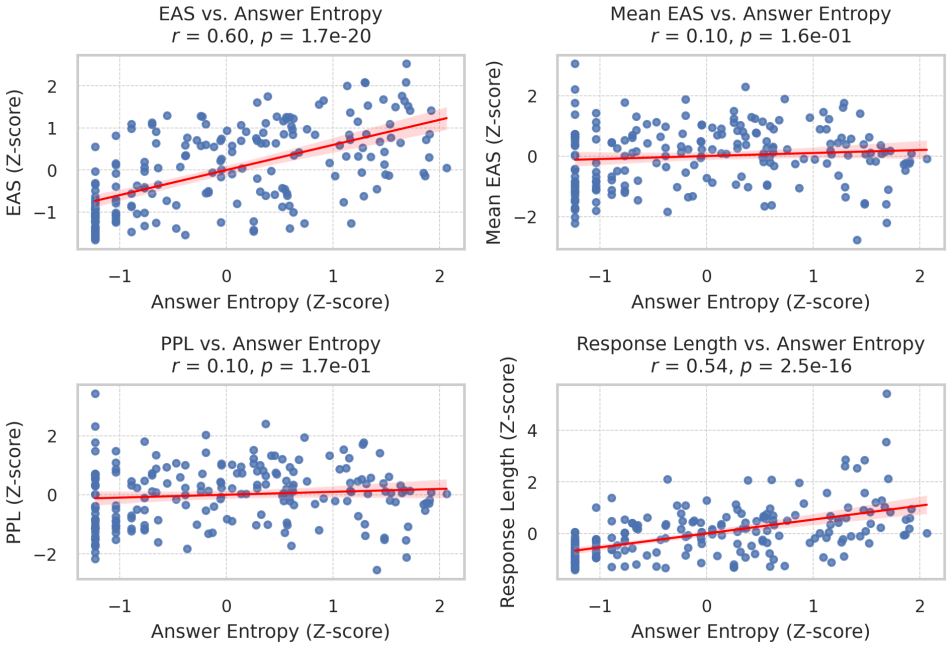
EAS is defined as the sum, over all token positions before the final answer, of the predictive entropy the model assigns to the next token, computed under a context that appends '\boxed{' plus the first L-1 tokens of the ground-truth answer to the generated prefix. The paper's central claim is that this area under the token-entropy curve tracks the variability of the model's answers under repeated inference: questions where the model hesitates early and often have high EAS and high answer entropy, while questions where one option dominates from early on have low EAS. Empirically, EAS shows Pearson correlations above 0.54 with answer entropy across DeepSeek-R1-Distill-Qwen-14B and DeepSeek-R1
What carries the argument
The central object is the Entropy Area Score (EAS), the sum of token-level predictive entropies over the generated sequence before the answer. At each position, the model's next-token distribution is computed under a context consisting of the generated prefix plus a '\boxed{' marker and the first L-1 tokens of the ground-truth answer; EAS is the integral of the resulting entropy curve. This object connects a single forward pass to sampling-based uncertainty by accumulating both the depth and the duration of the model's hesitation, which the paper shows distinguishes stable, revised, and indecisive generations.
Load-bearing premise
EAS assumes that appending '\boxed{' and the first L-1 tokens of the correct answer to every context makes the model's token-by-token predictive entropy reflect how unsure the model is about producing its own answer; if that constructed context changes what the entropy measures, the correlations with sampling-based answer entropy would not be evidence about generation-time uncertainty.
What would settle it
Compute EAS and answer entropy on a set of questions where the model visibly wavers early but commits to a correct final answer; the paper predicts high EAS should accompany high answer entropy. A dataset of such 'revised-to-correct' cases with high EAS but near-zero answer entropy would falsify the correlation. A cleaner test: recompute EAS without the '\boxed{...}' answer prefix and compare correlations; if prefix-free EAS correlates equally well, the constructed context is not load-bearing.
If this is right
- EAS can replace repeated-sampling uncertainty estimation in reasoning benchmarks, cutting the cost from dozens of inferences to one.
- Training-data pipelines can rank samples by EAS instead of Pass Rate, avoiding the expense of multi-sample correctness checks while improving student accuracy.
- EAS offers a continuous, fine-grained score that separates confidently-wrong samples from genuinely ambivalent ones, something Pass Rate's coarse buckets cannot.
- Because EAS is computed from the base model's own distribution, it can be recomputed at any training checkpoint to support curriculum scheduling.
Where Pith is reading between the lines
- The use of ground-truth answer tokens in the context makes EAS a teacher-forced uncertainty measure; a natural extension is to test EAS with the label prefix removed, which would measure self-conditional uncertainty and could extend the method to settings without known answers.
- Because EAS depends on the tokenization of answers, questions with verbose or multi-form correct answers may inflate the score; adapting EAS to compare semantic-equivalence classes, as semantic entropy does, is a plausible next step the paper leaves open.
- The paper's own scope note suggests EAS will degrade on free-form generation; one testable extension is to pair EAS with a verifier that maps free-form outputs to canonical options, preserving the single-pass advantage.
Editorial analysis
A structured set of objections, weighed in public.
Referee Report
Summary. The paper introduces Entropy Area Score (EAS), a metric that sums token-level predictive entropy over a generation trajectory to quantify an LLM's uncertainty when producing an answer. The authors claim EAS is computed in a single forward pass, requires no external models or repeated sampling, correlates strongly with sampling-based answer entropy across models and benchmarks, and is effective for selecting high-potential SFT training data, outperforming Pass Rate filtering. The central contribution is the definition of EAS and its empirical validation on AIME and GPQA-Diamond with DeepSeek-R1-Distill models.
Significance. If validated, EAS would fill a practical gap: an efficient, interpretable uncertainty signal for reasoning LLMs that avoids repeated sampling. The paper also makes a concrete empirical contribution by comparing EAS with mean entropy, perplexity, and response length, and by proposing a training-data-selection application. However, the significance is substantially weakened by a load-bearing design flaw: as defined, EAS conditions on a prefix of the ground-truth answer, so the reported correlations and selection results reflect a label-conditioned score rather than the model's own generation-time uncertainty. The unsupervised, single-forward-pass framing in the abstract and contributions is therefore not supported by the current experiments.
major comments (4)
- [Section 2, Step 1] EAS as defined and evaluated is label-conditioned, not a generation-time uncertainty score. Step 1 constructs the context as (x1,...,xt, '\boxed{', prefix(L-1)_ans), and Section 3.1 explicitly states that this uses the first L-1 tokens of the ground-truth answer. Thus every entropy H_t is the entropy of a token following a context that already contains most of the correct answer when L>1. On AIME, where answers are multi-token integers, the model is effectively asked to continue a known answer string. Consequently, the correlations in Table 2 and the data-selection results in Table 3 are computed under teacher forcing with answer leakage, contradicting the claim that EAS 'integrates token-level predictive entropy from the model itself' and requires no external supervision. This is the central issue and must be resolved, either by redefining EAS with the model's own generated prefix (and
- [Table 2] The paper's main evidence for EAS as a reliable uncertainty proxy is the Pearson correlation with answer entropy, but no experiment tests whether this correlation survives without answer leakage. A necessary control is to compute EAS with a context that does not include the ground-truth answer prefix—for example, using the model's own sampled continuation, a neutral suffix, or no suffix—and report the correlation against answer entropy. Without such an ablation, the strong r values in Table 2 could be driven largely by the model recognizing and continuing a canonical answer string, rather than by genuine uncertainty about its own generation. This is directly load-bearing for the paper's central claim.
- [Section 4.1] The training-data-selection experiment uses EAS computed with known correct answers for each training sample, making EAS a supervised data-quality score in this setting. The abstract's statement that EAS 'requires neither external models nor repeated sampling' omits the fact that it requires answer labels. This also weakens the conceptual contrast with Pass Rate filtering: while Pass Rate uses labels to score correctness, EAS uses labels to condition the entropy computation. The paper should state this supervision requirement explicitly and discuss whether EAS retains its advantage when the answer prefix is not ground truth (e.g., using the base model's own pass@1 output). Without this, the claim that EAS identifies 'high-potential' samples via 'single-pass uncertainty' is overstated.
- [Table 3] The practical recommendation that EAS-based selection consistently outperforms Pass Rate rests on small differences (e.g., +0.0 to +2.3 points) with no variance estimates, confidence intervals, or significance tests. Only the top-3 validation checkpoints are reported, and no random seeds or repeated selection runs are described. Given the controlled setting (identical hyperparameters, only data selection varied), the observed improvements may be within noise. The authors should provide error bars, multiple seeds, or at least a paired analysis across checkpoints to support the claim of consistent superiority.
minor comments (4)
- [Section 2, Step 1] The notation 'prefix(L-1)_ans' is not formally defined at first use. Define L (the token length of the answer) and specify that 'ans' refers to the ground-truth answer. This is not just a notation issue—it is the source of the label-conditioning problem raised in the major comments.
- [Table 1] Typo: 'Mertic' should be 'Metric'. Also, the table's row labels ('All Tokens Average', '90th Percentile Average', etc.) are somewhat unclear; clarify whether these are averages over positions or over questions, and define the percentile in relation to what distribution.
- [Section 4.2] The phrase 'under Pass Rate = 4 setting' is confusing. It should likely be 'under Pass Rate = 0.25' or 'under a Pass@4 setting'. Please rephrase for clarity.
- [Figures] The manuscript references Figures 1-3, but the provided text does not include the actual figures, only captions. Ensure the final version embeds the figures and that the curves in Figures 2 and 3 are legible and reproducible.
Circularity Check
No equation-level circularity: EAS and answer entropy are independently computed; the ground-truth answer prefix is a leakage concern, not a definitional reduction.
full rationale
The paper's central claims are not circular. EAS is defined in §2 as a sum of token-level entropies over a context that appends '\boxed{' and the first L-1 tokens of the ground-truth answer; the reference answer entropy is computed in §3.1 from 64 independent samples. The Pearson correlations in Table 2 are empirical and not forced: no parameter of EAS is fitted to answer entropy, and EAS does not contain answer entropy in its definition. The data-selection experiment (§4) uses EAS as a filter and measures downstream Pass@1; no selection criterion is defined in terms of the eval metric. The only self-citation (Sun et al. 2025) in §1 is motivational, not load-bearing. A real weakness, but not a circularity, is that EAS conditions on the ground-truth answer prefix, so it is a supervised, answer-informed score rather than purely 'from the model itself'; this may weaken construct validity, especially on multi-token math answers, but it does not make the correlation with sampling-based answer entropy a tautology. Therefore score 2 for a minor, non-load-bearing self-citation, with no circular steps.
Axiom & Free-Parameter Ledger
free parameters (2)
- Top-k token truncation K=20
- Answer prefix length L-1
axioms (5)
- domain assumption Token-level predictive entropy from a language model reflects that model's internal uncertainty about the next token.
- domain assumption Answer entropy from repeated sampling is a valid reference for 'true' output uncertainty in unique-answer math/science tasks.
- ad hoc to paper Appending '\boxed{' and a prefix of the known answer to the context yields a faithful measure of answer-generation uncertainty.
- domain assumption The truncated top-20 distribution captures enough probability mass (99.87%) that the entropy approximation is negligible.
- domain assumption Samples with high EAS are 'high-potential' training samples that improve student models.
Cite this review
Pith. "Pith review of Uncertainty Under the Curve: A Sequence-Level Entropy Area Metric for Reasoning LLM." pith.science (2026). https://pith.science/paper/H3N3DTWV
@misc{pith2026250820384,
  author       = {Pith},
  title        = {Pith review of: Uncertainty Under the Curve: A Sequence-Level Entropy Area Metric for Reasoning LLM},
  year         = {2026},
  howpublished = {\url{https://pith.science/paper/H3N3DTWV}},
  note         = {Machine review of arXiv:2508.20384}
}
read the original abstract
In this work, we introduce Entropy Area Score (EAS), a simple yet effective metric to quantify uncertainty in the answer generation process of reasoning large language models (LLMs). EAS requires neither external models nor repeated sampling, it integrates token-level predictive entropy from the model itself to capture the evolution of uncertainty during generation. Empirical results show that EAS is strongly correlated with answer entropy across models and datasets. In training data selection, EAS identifies high-potential samples and consistently outperforms Pass Rate filtering under equal sample budgets, improving student model accuracy on math benchmarks. EAS is both efficient and interpretable, offering a practical tool for uncertainty modeling and data quality assessment in LLM training.
Figures


Reference graph
Works this paper leans on
-
[2]
Hochlehnert, A.; Bhatnagar, H.; Udandarao, V .; Albanie, S.; Prabhu, A.; and Bethge, M
Do LLMs estimate uncertainty well in instruction- following? arXiv:2410.14582. Hochlehnert, A.; Bhatnagar, H.; Udandarao, V .; Albanie, S.; Prabhu, A.; and Bethge, M
-
[3]
A Sober Look at Progress in Language Model Reasoning: Pitfalls and Paths to Repro- ducibility. arXiv:2504.07086. Jelinek, F.; Mercer, R. L.; Bahl, L. R.; and Baker, J. K
-
[5]
Teaching Models to Express Their Uncertainty in Words. arXiv:2205.14334. Liu, L.; Pan, Y .; Li, X.; and Chen, G
-
[7]
Exploring the Limit of Outcome Reward for Learning Mathematical Reasoning. arXiv:2502.06781. Malinin, A.; and Gales, M
-
[8]
Evaluation is All You Need: Strategic Overclaiming of LLM Reasoning Capabilities Through Evaluation Design. arXiv:2506.04734. Team, K.; Bai, Y .; Bao, Y .; and et al
- [9]
-
[11]
Light-R1: Curriculum SFT, DPO and RL for Long COT from Scratch and Beyond. arXiv:2503.10460. Zhao, Y .; Huang, J.; Hu, J.; Wang, X.; Mao, Y .; Zhang, D.; Jiang, Z.; Wu, Z.; Ai, B.; Wang, A.; Zhou, W.; and Chen, Y
-
[12]
SWIFT:A Scalable lightWeight Infrastructure for Fine-Tuning. arXiv:2408.05517
-
[2022]
Language Mod- els (Mostly) Know What They Know. arXiv:2207.05221. Kapoor, S.; Gruver, N.; Roberts, M.; Collins, K.; Pal, A.; Bhatt, U.; Weller, A.; Dooley, S.; Goldblum, M.; and Wil- son, A. G
-
[2023]
Just Ask for Calibration: Strategies for Eliciting Calibrated Confidence Scores from Language Models Fine-Tuned with Human Feedback. In Bouamor, H.; Pino, J.; and Bali, K., eds., Pro- ceedings of the 2023 Conference on Empirical Methods in Natural Language Processing , 5433–5442. Singapore: As- sociation for Computational Linguistics. Wen, L.; Cai, Y .; X...
work page 2023
-
[2024]
Uncertainty Es- timation and Quantification for LLMs: A Simple Supervised Approach. arXiv:2404.15993. Lyu, C.; Gao, S.; Gu, Y .; Zhang, W.; Gao, J.; Liu, K.; Wang, Z.; Li, S.; Zhao, Q.; Huang, H.; Cao, W.; Liu, J.; Liu, H.; Liu, J.; Zhang, S.; Lin, D.; and Chen, K
-
[2025]
DeepSeek-R1: Incentivizing Rea- soning Capability in LLMs via Reinforcement Learning. arXiv:2501.12948. Farquhar, S.; Kossen, J.; Kuhn, L.; and Gal, Y
This paper was first reviewed by deepseek-v4-flash on August 5, 2026.
discussion (0)
Sign in with ORCID, Apple, or X to comment. Anyone can read and Pith papers without signing in.