REVIEW 2 major objections 5 minor 1 cited by
Gravitational perturbations of a regular T-duality inspired black hole: Quasinormal modes, excitation factors, and time-domain evolution
T0 review · 2 major / 5 minor · reviewed 2026-08-02 · deepseek-v4-flash
Pith's one-line read For a regular black hole built from a zero-point length, gravitational ringdown oscillates faster as the core size grows, with damping staying nearly flat.
desk verdict A clean, honest numerical data product for axial gravitational QNMs of one regular black hole; main caveat is the S=U=0 closure, which the authors themselves flag, and the absence of a continued-fraction check for overtones. read the letter →
The pith
A machine-rendered reading of the paper's core claim, the machinery that carries it, and where it could break.
The reading
What carries the argument
The load-bearing object is the effective potential for axial gravitational waves, V_ℓ(r) = f(r)[ℓ(ℓ+1)/r² − 6m(r)/r³ + 4π(ρ − p_r)], whose shape is set by the metric function f(r) and mass function m(r) of the regularized geometry; these are built from a smeared matter density plus a gravitational self-energy density, both controlled by the zero-point length. The reduction to a single potential relies on closing the odd-parity matter variables by assuming the effective medium has no independent axial motion. The spectrum is obtained from a high-order expansion around the potential peak with rational-function resummation, cross-checked by a null-grid time-domain integration and a damped-expon
What would settle it
An independent calculation of the ℓ=2 overtones using a continued-fraction method (or a direct solution of the coupled axial matter-gravity system) would settle whether the third-overtone turnover near the largest zero-point length is physical. Observationally, a detected ringdown whose quadrupole frequency does not increase with respect to the inferred mass would contradict the monotonic shift predicted here.
Extended reading notes
Core claim
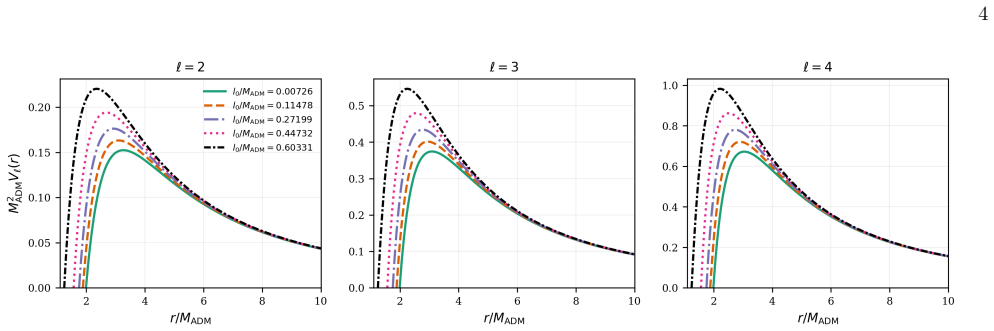
The central claim is that odd-parity gravitational perturbations of the T-duality-inspired regular black hole reduce to a single wave equation with an effective potential built from the regularized metric function and mass profile, and that turning on the zero-point length raises the height of that potential barrier. Consequently, in ADM-mass units the real parts of the fundamental quasinormal frequencies for ℓ=2,3,4 increase monotonically with the zero-point length up to the near-extremal value, the damping rates reach a shallow maximum and then decrease, and the excitation factors (the residues of the Green function at the poles) change only mildly, preserving the ordering |B20|>|B30|>|B40
Load-bearing premise
The paper assumes that the smeared matter distribution responsible for the regular core cannot move on its own in the odd-parity sector, which allows the perturbation to be compressed into a single wave equation; if that distribution has independent axial dynamics, the single-equation description is incomplete.
Editorial extensions
If this is right
- If the claim is right, the gravitational ringdown of this regular black hole is unambiguously faster than Schwarzschild's for the same mass as measured at infinity, with the frequency shift growing monotonically with the zero-point length up to near extremality.
- The damping rate is not a monotonic probe: it rises slightly for small deformations and then falls as the horizon approaches extremality, so damping alone would not cleanly distinguish the model from Schwarzschild.
- The excitation factors stay nearly constant over the deformation range, so the relative strength of the ℓ=2 fundamental mode (the strongest of the three) is preserved, and amplitude priors for ringdown searches would barely shift.
- The late-time decay exponent is unchanged, t^{-(2ℓ+3)}, meaning the regular core leaves no imprint on the asymptotic tail within the simulated window.
- For ℓ=2, the first two overtones keep the monotonic real-part trend, while the third overtone turns over near extremality, suggesting higher overtones become sensitive to the shape of the barrier near the horizon.
Reading between the lines
- Because the quadrupole gravitational mode is the dominant ringdown observable, the monotonic frequency shift is a candidate fingerprint for testing singularity resolution with gravitational waves; a Bayesian analysis using the tabulated frequencies could set upper bounds on the zero-point length from a detected ringdown.
- The single-potential reduction rests on a modeling closure; if the smeared matter source has its own independent axial motion, the true spectrum could differ, especially for overtones. A full coupled matter-gravity perturbation calculation would test whether the tabulated values describe the physical branch.
- The third-overtone turnover near extremality, if confirmed by an independent method, would provide a sharper near-horizon probe than the fundamental mode, since it depends on higher-derivative details of the potential barrier.
- A natural next step is to compute the polar gravitational sector or the transmission probabilities (grey-body factors) for the same background, to see whether the zero-point length's imprint is universal across perturbation channels or specific to axial modes.
Signed reviews
Editorial analysis
A structured set of objections, weighed in public.
Referee Report
Summary. The paper studies axial gravitational perturbations of the regular black hole constructed by Jusufi and Singleton, in which a non-local, T-duality-inspired zero-point length l0 regularizes the source and the gravitational self-energy. The authors derive a Regge–Wheeler-type master equation (Eq. 19) with the effective potential of Eq. (20), using the explicit closure δs_μ = 0 (S = U = 0) for the axial perturbations of the effective anisotropic fluid. They compute quasinormal frequencies for ℓ = 2,3,4 fundamentals and ℓ = 2 overtones with 14th- and 16th-order WKB–Padé methods, cross-check two fundamental modes against time-domain Prony extraction, and compute the corresponding excitation factors. In ADM-scaled variables, they find that the real oscillation frequencies increase monotonically with l0/MADM up to the near-extremal value 0.85, while the damping rates first increase slightly and then decrease; the n = 3 overtone real part turns over between l0 = 0.80 and 0.85. The near-Schwarzschild limit reproduces the standard Regge–Wheeler frequencies to about 0.36%, and the late-time tails follow Price's law.
Significance. If the S = U = 0 closure is accepted, the paper provides a concrete, internally consistent prediction for the gravitational ringdown of this regular black-hole model. The numerical work is careful: two high-order WKB–Padé orders agree to better than 0.6% (usually far less), the time-domain Prony extraction matches the WKB fundamentals to ~10^-3%, and the Schwarzschild limit is correctly recovered. The excitation factors are a useful complementary dataset with a clearly stated normalization convention. However, the central physical claim — that the zero-point length makes gravitational ringdown oscillate faster — rests on a modeling choice, the δs_μ = 0 closure, that is explicitly acknowledged but not derived from the non-local theory. The paper is transparent about this limitation, but the abstract and conclusions present the results as the gravitational-mode spectrum without the caveat. This conditional status is the main factor limiting the strength of the conclusion.
major comments (2)
- [Sec. II, Eq. (20); Abstract] The central claim that l0 raises the axial barrier and shifts the gravitational QNM spectrum monotonically is established only under the closure δs_μ = 0 (S = U = 0). The manuscript itself states that if the effective anisotropic fluid has independent axial dynamics, S and U must be retained, leading to a coupled matter–gravity eigenvalue problem rather than the single potential in Eq. (20). Since the background source is an effective fluid representing gravitational self-energy, this closure is not a consequence of the non-local action Eq. (5) or of the background equations; it is an ansatz. Yet the abstract and conclusions present the results as 'gravitational modes' without this caveat. Because every reported frequency, the monotonic trend, and the excitation factors depend on this potential, this is a load-bearing point. I recommend either deriving the closure from the underlying the
- [Sec. IV, Fig. 4, Table II] The n = 3 overtone real part turns over between l0 = 0.80 and 0.85, and the authors attribute this to near-extremal barrier shape. The two Padé orders agree to about 0.16% at l0 = 0.85, which is larger than the agreement for the fundamental modes, and the effect itself is 2.5%. The manuscript already notes that an independent continued-fraction calculation would be a useful check. Given that the overtone turnover is presented as a finding, the statement would be strengthened by actually performing the Leaver calculation or by explicitly labeling the turnover as provisional pending an independent method. This is not blocking for the fundamental-mode claim, but it should be addressed in revision.
minor comments (5)
- [Title] Typo: 'T-dulatiy' should be 'T-duality' in the title.
- [Figs. 5 and 6] The y-axis labels appear as '10/Minus15', '10/Minus12', etc., which is a rendering artifact. The figures should use standard scientific notation (e.g., 10^-15).
- [References] References [50] and [156] are the same work (Skvortsova, arXiv:2606.15785). Please merge or disambiguate.
- [Table I] In several rows of the 'difference' column the entry is formatted as '0. × 10-4%' or '0. × 10-4%' with a leading zero and no digit after the decimal; this is likely a display artifact and should be cleaned.
- [Sec. V, Eq. (32)] The tortoise-coordinate normalization convention is clearly stated, which is good. It would help the reader to explicitly note that the excitation factors in Table III are dimensionless only after this convention is fixed, as is done in the text.
Circularity Check
No significant circularity: QNMs are computed from a fixed externally sourced potential, benchmarked against the Schwarzschild limit; self-citations are peripheral.
full rationale
The derivation chain is self-contained in the sense that matters for circularity. The metric is imported from Jusufi and Singleton [48] (not a self-citation), and the axial potential in Eq. (20) is taken from the external derivations [63-66] as a direct specialization to g_tt = -1/g_rr = -f(r). The WKB-Pade and time-domain algorithms are standard methods cited to [74-81] and [108]. No component of the target spectrum - neither the quasinormal frequencies nor the excitation factors - is used as an input or fitted parameter. Eq. (19) is solved with a fixed potential V_l(r), and Tables I-III report the resulting eigenvalues and residues. The time-domain/Prony evolution integrates the same master equation, so it is a numerical cross-check of the same boundary-value problem rather than an independent physical datum; that is not circularity. The Schwarzschild-limit comparison in Sec. V ('we recover the Schwarzschild values of excitation factors') is an external benchmark. The one genuinely load-bearing caveat is the explicit closure in Sec. II: 'The approximation used here is precisely delta s_mu = 0, or S(r) = 0' and later 'If the effective anisotropic medium has independent axial dynamics, S and U must be retained and supplemented by constitutive equations, leading to a coupled matter-gravity eigenvalue problem rather than the single potential in Eq. (20).' That is a stated modeling assumption/scope limitation, not a circular reduction: it limits the gravitational claim to the metric-led branch with S = U = 0, but it does not make the computed frequencies equal by construction to any fitted quantity. The self-citations ([49], [71], [72], [85], [102], [107], [120], [125], [139], [154], [155], [158]) are methodological or follow-up references; none supplies a uniqueness theorem or the central potential. Score 2 reflects peripheral self-citations and the explicit but non-circular closure; no prediction reduces to an input.
Assumptions & free parameters
free parameters (1)
- zero-point length l0 =
scanned 0.05-0.85 M (M=1); extremal at ~0.8581
assumptions (5)
- domain assumption The Jusufi-Singleton line element (Eq. 11) with mass function (Eq. 10) is the correct spacetime for the non-local T-duality-inspired zero-point-length model.
- ad hoc to paper Axial potential V_l(r) = f/r^2 [l(l+1)-2+2f-r f'] from Refs. [63,64] describes the gravitational axial sector for this anisotropic-fluid background with S=U=0 closure.
- standard math High-order WKB with Pade resummation (16th/14th order) yields accurate QNMs for this single-barrier potential.
- standard math The Gundlach-Price-Pullin characteristic integration and Prony analysis correctly extract the fundamental frequency from the same master equation.
- standard math The Price-law tail t^{-(2l+3)} holds for this asymptotically flat axial perturbation.
Cite this review
Pith. "Pith review of Gravitational perturbations of a regular T-duality inspired black hole: Quasinormal modes, excitation factors, and time-domain evolution." pith.science (2026). https://pith.science/paper/H3XNOZY5
@misc{pith2026260707715,
  author       = {Pith},
  title        = {Pith review of: Gravitational perturbations of a regular T-duality inspired black hole: Quasinormal modes, excitation factors, and time-domain evolution},
  year         = {2026},
  howpublished = {\url{https://pith.science/paper/H3XNOZY5}},
  note         = {Machine review of arXiv:2607.07715}
}
abstract
We study axial gravitational perturbations of the neutral regular black hole generated by a non-local, T-duality-inspired zero-point length and the associated gravitational self-energy. In this geometry, the usual point source is replaced by a regular core, and the zero-point length controls the departure from the Schwarzschild limit. We compute the fundamental quasinormal modes and several overtones using high-order WKB--Pad\'e methods, and we verify the dominant mode via direct time-domain evolution. When the zero-point length is turned on, the real parts of the ADM-scaled frequencies increase for the gravitational modes with $\ell=2,3,4$, so the ringdown oscillates faster than in the Schwarzschild limit. The damping rates change more gradually: they initially increase slightly and then decrease near the largest deformation values considered here. This behavior is consistent with the effective potential, whose barrier becomes higher as the deformation parameter increases. We also compute the corresponding excitation factors and find that their magnitudes vary much less strongly than the quasinormal frequencies.
Figures


Figures from the paper (6 more)


Forward citations
Cited by 1 Pith paper
-
Two-scale magnetically charged regular black holes from nonlinear electrodynamics and a T-duality-inspired zero-point length
A two-parameter regular black hole family is constructed, with an explicit nonlinear electrodynamics source, exact thermodynamic identities, and analytic shadow and plasma-lensing predictions.
Reference graph
Works this paper leans on
- [1]
-
[2]
R. A. Konoplya and A. Zhidenko, Rev. Mod. Phys. 83, 793 (2011) , arXiv:1102.4014 [gr-qc]
arXiv 2011
-
[3]
Nollert, Class
H.-P. Nollert, Class. Quant. Grav. 16, R159 (1999)
1999
-
[4]
K. D. Kokkotas and B. G. Schmidt, Living Rev. Rel. 2, 2 (1999) , arXiv:gr-qc/9909058
arXiv 1999
-
[5]
S. V. Bolokhov and M. Skvortsova, Grav. Cosmol. 31, 423 (2025)
2025
-
[6]
R. A. Konoplya and A. Zhidenko, JHEAp 44, 419 (2024), arXiv:2209.00679 [gr-qc]
arXiv 2024
-
[7]
V. Cardoso, A. S. Miranda, E. Berti, H. Witek, and V. T. Zanchin, Phys. Rev. D 79, 064016 (2009) , arXiv:0812.1806 [hep-th]
arXiv 2009
-
[8]
E. Ayon-Beato and A. Garcia, Phys. Rev. Lett. 80, 5056 (1998), arXiv:gr-qc/9911046
arXiv 1998
Show all 157 references
-
[9]
K. A. Bronnikov, Phys. Rev. D 63, 044005 (2001) , arXiv:gr-qc/0006014
2001 arXiv
-
[10]
Bonanno and M
A. Bonanno and M. Reuter, Phys. Rev. D 62, 043008 (2000), arXiv:hep-th/0002196
2000 arXiv
-
[11]
R. A. Konoplya and A. Zhidenko, Phys. Lett. B 856, 138945 (2024) , arXiv:2404.09063 [gr-qc]
2024 arXiv
-
[12]
S. A. Hayward, Phys. Rev. Lett. 96, 031103 (2006) , arXiv:gr-qc/0506126
2006 arXiv
-
[13]
Dymnikova, Gen
I. Dymnikova, Gen. Rel. Grav. 24, 235 (1992)
1992
-
[14]
Nicolini, A
P. Nicolini, A. Smailagic, and E. Spallucci, Phys. Lett. B 632, 547 (2006) , arXiv:gr-qc/0510112
2006 arXiv
-
[15]
K. A. Bronnikov, Phys. Rev. D 110, 024021 (2024) , arXiv:2404.14816 [gr-qc]
2024 arXiv
-
[16]
R. A. Konoplya and A. Zhidenko, Phys. Rev. D 113, 043011 (2026) , arXiv:2511.03066 [gr-qc]
2026
-
[17]
Spina, Int
A. Spina, Int. J. Grav. Theor. Phys. 1, 8 (2025) , arXiv:2510.14552 [gr-qc]
2025
-
[18]
A. M. Bonanno, R. A. Konoplya, G. Oglialoro, and A. Spina, JCAP 12, 042 (2025) , arXiv:2509.12469 [gr- qc]
2025
-
[19]
S. V. Bolokhov, K. A. Bronnikov, and M. V. Skvortsova, Grav. Cosmol. 30, 265 (2024) , arXiv:2405.09124 [gr-qc]
2024 arXiv
-
[20]
C. F. B. Macedo, L. C. B. Crispino, and E. S. de Oliveira, Int. J. Mod. Phys. D 25, 1641008 (2016) , 13 arXiv:1605.00123 [gr-qc]
2016 arXiv
-
[21]
Mahdavian Yekta, M
D. Mahdavian Yekta, M. Karimabadi, and S. A. Alavi, Annals Phys. 434, 168603 (2021) , arXiv:1912.12017 [hep-th]
2021 arXiv
-
[22]
R. A. Konoplya, Z. Stuchlik, A. Zhidenko, and A. F. Zinhailo, Phys. Rev. D 107, 104050 (2023) , arXiv:2303.01987 [gr-qc]
2023 arXiv
-
[23]
Y. Guo, H. Xie, and Y.-G. Miao, Phys. Lett. B 855, 138801 (2024) , arXiv:2402.10406 [gr-qc]
2024 arXiv
-
[24]
J. Li, K. Lin, and N. Yang, Eur. Phys. J. C 75, 131 (2015), arXiv:1409.5988 [gr-qc]
2015 arXiv
- [25]
-
[26]
Pedraza, L
O. Pedraza, L. A. López, R. Arceo, and I. Cabrera- Munguia, Mod. Phys. Lett. A 37, 2250057 (2022) , arXiv:2111.06488 [gr-qc]
2022 arXiv
-
[27]
S. V. Bolokhov, Annals Phys. 488, 170416 (2026) , arXiv:2511.12859 [gr-qc]
2026
-
[28]
S. V. Bolokhov, Phys. Rev. D 109, 064017 (2024)
2024
-
[29]
Skvortsova, (2026), arXiv:2603.28415 [gr-qc]
M. Skvortsova, (2026), arXiv:2603.28415 [gr-qc]
2026
-
[30]
Pedrotti and S
D. Pedrotti and S. Vagnozzi, Phys. Rev. D 110, 084075 (2024), arXiv:2404.07589 [gr-qc]
2024 arXiv
-
[31]
Vagnozzi et al
S. Vagnozzi et al. , Class. Quant. Grav. 40, 165007 (2023), arXiv:2205.07787 [gr-qc]
2023 arXiv
-
[32]
Calzà, D
M. Calzà, D. Pedrotti, and S. Vagnozzi, Phys. Rev. D 111, 024010 (2025) , arXiv:2409.02807 [gr-qc]
2025 arXiv
-
[33]
R. A. Konoplya, JCAP 07, 001 (2023) , arXiv:2305.09187 [gr-qc]
2023 arXiv
-
[34]
Flachi and J
A. Flachi and J. P. S. Lemos, Phys. Rev. D 87, 024034 (2013), arXiv:1211.6212 [gr-qc]
2013 arXiv
-
[35]
Arbey, J
A. Arbey, J. Auffinger, M. Geiller, E. R. Livine, and F. Sartini, Phys. Rev. D 103, 104010 (2021) , arXiv:2101.02951 [gr-qc]
2021 arXiv
-
[36]
S. V. Bolokhov, (2026), arXiv:2603.22310 [gr-qc]
2026
-
[37]
A. Held, R. Gold, and A. Eichhorn, JCAP 06, 029 (2019), arXiv:1904.07133 [gr-qc]
2019 arXiv
-
[38]
D. M. Gingrich, Phys. Rev. D 110, 084045 (2024) , arXiv:2404.04447 [gr-qc]
2024 arXiv
-
[39]
Panotopoulos and Á
G. Panotopoulos and Á. Rincón, Eur. Phys. J. Plus 134, 300 (2019) , arXiv:1904.10847 [gr-qc]
2019 arXiv
-
[40]
Dubinsky, Int
A. Dubinsky, Int. J. Grav. Theor. Phys. 2, 6 (2026) , arXiv:2603.17644 [gr-qc]
2026
-
[41]
Skvortsova, EPL 154, 49001 (2026) , arXiv:2509.18061 [gr-qc]
M. Skvortsova, EPL 154, 49001 (2026) , arXiv:2509.18061 [gr-qc]
2026
-
[42]
Huang, H.-W
B.-H. Huang, H.-W. Hu, and L. Zhao, JCAP 03, 053 (2024), arXiv:2311.12286 [gr-qc]
2024 arXiv
-
[43]
Y. Yang, D. Liu, Z. Xu, Y. Xing, S. Wu, and Z.-W. Long, Phys. Rev. D 104, 104021 (2021) , arXiv:2107.06554 [gr-qc]
2021 arXiv
-
[44]
Arbey, J
A. Arbey, J. Auffinger, M. Geiller, E. R. Livine, and F. Sartini, Phys. Rev. D 104, 084016 (2021) , arXiv:2107.03293 [gr-qc]
2021 arXiv
-
[45]
K. Lin, J. Li, and S. Yang, Int. J. Theor. Phys. 52, 3771 (2013)
2013
-
[46]
L. A. López and V. Ramírez, Eur. Phys. J. Plus 138, 120 (2023) , arXiv:2205.10166 [gr-qc]
2023 arXiv
-
[47]
Arbey, M
A. Arbey, M. Calzà, L. Malacher, D. Pedrotti, and Y. F. Perez-Gonzalez, Phys. Dark Univ. 53, 102407 (2026) , arXiv:2606.06355 [gr-qc]
2026 arXiv
-
[48]
Jusufi and D
K. Jusufi and D. Singleton, Eur. Phys. J. C 86, 530 (2026), arXiv:2509.13335 [gr-qc]
2026 arXiv
-
[49]
B. C. Lütfüoğlu, A. Shermatov, S. Murodov, R. Javlon, and M. Umaraliyev, 10.13140/RG.2.2.34442.22726
-
[51]
Padmanabhan, Phys
T. Padmanabhan, Phys. Rev. Lett. 78, 1854 (1997) , arXiv:hep-th/9608182
1997 arXiv
- [52]
-
[53]
Nicolini, E
P. Nicolini, E. Spallucci, and M. F. Wondrak, Phys. Lett. B 797, 134888 (2019) , arXiv:1902.11242 [gr-qc]
2019 arXiv
-
[54]
Gaete, K
P. Gaete, K. Jusufi, and P. Nicolini, Phys. Lett. B 835, 137546 (2022) , arXiv:2205.15441 [hep-th]
2022 arXiv
-
[55]
Jusufi and P
K. Jusufi and P. Nicolini, Eur. Phys. J. C 85, 1291 (2025), arXiv:2410.19613 [hep-th]
2025
-
[56]
Regular black holes in three dimensions and the zero point length,
K. Jusufi, “Regular black holes in three dimensions and the zero point length,” (2022), arXiv:2209.04433 [gr- qc]
2022 arXiv
-
[57]
Jusufi, Universe 9, 41 (2023) , arXiv:2301.03590 [gr- qc]
K. Jusufi, Universe 9, 41 (2023) , arXiv:2301.03590 [gr- qc]
2023 arXiv
-
[58]
F. W. Hehl and B. Mashhoon, Phys. Lett. B 673, 279 (2009), arXiv:0812.1059 [gr-qc]
2009 arXiv
-
[59]
Jusufi, D
K. Jusufi, D. Singleton, and F. S. N. Lobo, Phys. Lett. B 877, 140475 (2026) , arXiv:2512.15393 [gr-qc]
2026 arXiv
-
[60]
Regge and J
T. Regge and J. A. Wheeler, Phys. Rev. 108, 1063 (1957)
1957
-
[61]
Ashtekar, J
A. Ashtekar, J. Olmedo, and P. Singh, Phys. Rev. D 98, 126003 (2018) , arXiv:1806.02406 [gr-qc]
2018 arXiv
-
[62]
Ashtekar, J
A. Ashtekar, J. Olmedo, and P. Singh, Phys. Rev. Lett. 121, 241301 (2018) , arXiv:1806.00648 [gr-qc]
2018 arXiv
-
[63]
Bouhmadi-López, S
M. Bouhmadi-López, S. Brahma, C.-Y. Chen, P. Chen, and D.-h. Yeom, JCAP 07, 066 (2020) , arXiv:2004.13061 [gr-qc]
2020 arXiv
-
[64]
R. A. Konoplya and O. S. Stashko, Phys. Rev. D 111, 104055 (2025) , arXiv:2408.02578 [gr-qc]
2025 arXiv
-
[65]
R. A. Konoplya and O. S. Stashko, Phys. Rev. D 111, 084031 (2025) , arXiv:2502.05689 [gr-qc]
2025 arXiv
-
[66]
S. V. Bolokhov and M. Skvortsova, Eur. Phys. J. C 86, 374 (2026) , arXiv:2508.19989 [gr-qc]
2026 arXiv
-
[67]
K. A. Bronnikov, R. A. Konoplya, and A. Zhidenko, Phys. Rev. D 86, 024028 (2012) , arXiv:1205.2224 [gr- qc]
2012 arXiv
-
[68]
Chen and P
C.-Y. Chen and P. Chen, Phys. Rev. D 99, 104003 (2019), arXiv:1902.01678 [gr-qc]
2019 arXiv
-
[69]
Chakraborty, G
S. Chakraborty, G. Compère, and L. Machet, Phys. Rev. D 112, 024015 (2025) , arXiv:2412.14831 [gr-qc]
2025 arXiv
-
[70]
S. V. Bolokhov and M. Skvortsova, Int. J. Grav. Theor. Phys. 1, 3 (2025) , arXiv:2507.07196 [gr-qc]
2025 arXiv
-
[71]
B. C. Lütfüoğlu, J. Rayimbaev, S. Murodov, J. Kur- banov, and M. Matyoqubov, (2026), arXiv:2605.11364 [gr-qc]
2026 arXiv
-
[72]
B. C. Lütfüoğlu, J. Rayimbaev, S. Murodov, M. Ab- dullaev, and M. Akhmedov, (2026), arXiv:2602.20601 [gr-qc]
2026
-
[73]
Quasinormal modes and tidal responses of black holes in generic anisotropic matter environments,
Y.-Q. Zhao and P. Pani, “Quasinormal modes and tidal responses of black holes in generic anisotropic matter environments,” (2026), arXiv:2606.11380 [gr-qc]
2026 arXiv
-
[74]
R. A. Konoplya, A. Zhidenko, and A. F. Zinhailo, Class. Quant. Grav. 36, 155002 (2019) , arXiv:1904.10333 [gr- qc]
2019 arXiv
-
[75]
Iyer and C
S. Iyer and C. M. Will, Phys. Rev. D 35, 3621 (1987)
1987
-
[76]
R. A. Konoplya, Phys. Rev. D 68, 024018 (2003) , arXiv:gr-qc/0303052
2003 arXiv
-
[77]
Matyjasek and M
J. Matyjasek and M. Opala, Phys. Rev. D 96, 024011 (2017), arXiv:1704.00361 [gr-qc] . 14
2017 arXiv
-
[78]
Matyjasek and M
J. Matyjasek and M. Telecka, Phys. Rev. D 100, 124006 (2019), arXiv:1908.09389 [gr-qc]
2019 arXiv
- [79]
-
[80]
Matyjasek, R
J. Matyjasek, R. A. Konoplya, and A. Zhidenko, Int. J. Grav. Theor. Phys. 2, 5 (2026) , arXiv:2603.12466 [gr- qc]
2026
-
[81]
R. A. Konoplya, J. Matyjasek, and A. Zhidenko, (2026), arXiv:2605.25705 [gr-qc]
2026 arXiv
-
[82]
Dubinsky and A
A. Dubinsky and A. Zinhailo, Eur. Phys. J. C 84, 847 (2024), arXiv:2404.01834 [gr-qc]
2024 arXiv
-
[83]
R. A. Konoplya and A. Zhidenko, Phys. Lett. B 686, 199 (2010) , arXiv:0909.2138 [hep-th]
2010 arXiv
-
[84]
R. A. Konoplya and A. Zhidenko, Class. Quant. Grav. 40, 245005 (2023) , arXiv:2309.02560 [gr-qc]
2023 arXiv
-
[85]
B. C. Lütfüoğlu, Phys. Lett. B 872, 140082 (2026) , arXiv:2510.25969 [gr-qc]
2026
-
[86]
R. A. Konoplya and A. Zhidenko, Phys. Rev. D 82, 084003 (2010) , arXiv:1004.3772 [hep-th]
2010 arXiv
- [87]
- [88]
-
[89]
Kodama, R
H. Kodama, R. A. Konoplya, and A. Zhidenko, Phys. Rev. D 81, 044007 (2010) , arXiv:0904.2154 [gr-qc]
2010 arXiv
-
[90]
Malik, EPL 147, 69001 (2024) , arXiv:2410.04306 [gr- qc]
Z. Malik, EPL 147, 69001 (2024) , arXiv:2410.04306 [gr- qc]
2024 arXiv
- [91]
-
[92]
H. Guo, H. Liu, X.-M. Kuang, and B. Wang, Phys. Rev. D 102, 124019 (2020) , arXiv:2007.04197 [gr-qc]
2020 arXiv
-
[93]
Albuquerque, I
S. Albuquerque, I. P. Lobo, and V. B. Bezerra, Class. Quant. Grav. 40, 174001 (2023) , arXiv:2301.07746 [gr- qc]
2023 arXiv
- [94]
-
[95]
R. A. Konoplya and R. D. B. Fontana, Phys. Lett. B 659, 375 (2008) , arXiv:0707.1156 [hep-th]
2008 arXiv
-
[96]
Dubinsky, Int
A. Dubinsky, Int. J. Mod. Phys. D 35, 2650009 (2026) , arXiv:2510.11643 [gr-qc]
2026
-
[97]
Dubinsky, Int
A. Dubinsky, Int. J. Theor. Phys. 65, 45 (2026) , arXiv:2511.00778 [gr-qc]
2026
-
[98]
R. A. Konoplya, Phys. Lett. B 550, 117 (2002) , arXiv:gr-qc/0210105
2002 arXiv
-
[99]
Tan, W.-D
Q. Tan, W.-D. Guo, and Y.-X. Liu, Phys. Rev. D 106, 044038 (2022) , arXiv:2205.05255 [gr-qc]
2022 arXiv
-
[100]
K. D. Kokkotas, R. A. Konoplya, and A. Zhidenko, Phys. Rev. D 83, 024031 (2011) , arXiv:1011.1843 [gr- qc]
2011 arXiv
-
[101]
R. A. Konoplya and A. F. Zinhailo, Phys. Rev. D 99, 104060 (2019) , arXiv:1904.05341 [gr-qc]
2019 arXiv
-
[102]
B. C. Lütfüoğlu, JCAP 07, 003 (2026) , arXiv:2604.24349 [gr-qc]
2026 arXiv
-
[103]
Skvortsova, Annals Phys
M. Skvortsova, Annals Phys. 492, 170587 (2026) , arXiv:2604.25471 [gr-qc]
2026 arXiv
-
[104]
S. V. Bolokhov, (2026), arXiv:2605.11013 [gr-qc]
2026 arXiv
-
[105]
S. V. Bolokhov, (2026), arXiv:2605.21533 [gr-qc]
2026 arXiv
-
[106]
Skvortsova, (2026), arXiv:2605.12113 [gr-qc]
M. Skvortsova, (2026), arXiv:2605.12113 [gr-qc]
2026 arXiv
-
[107]
B. C. Lütfüoğlu, Phys. Lett. B 880, 140754 (2026) , arXiv:2606.08351 [gr-qc]
2026 arXiv
-
[108]
Gundlach, R
C. Gundlach, R. H. Price, and J. Pullin, Phys. Rev. D 49, 883 (1994) , arXiv:gr-qc/9307009
1994 arXiv
- [109]
- [110]
-
[111]
Aneesh, S
S. Aneesh, S. Bose, and S. Kar, Phys. Rev. D 97, 124004 (2018), arXiv:1803.10204 [gr-qc]
2018 arXiv
-
[112]
Abdalla, O
E. Abdalla, O. P. F. Piedra, F. S. Nuñez, and J. de Oliveira, Phys. Rev. D 88, 064035 (2013) , arXiv:1211.3390 [gr-qc]
2013 arXiv
-
[113]
R. A. Konoplya and A. Zhidenko, Phys. Rev. D 90, 064048 (2014) , arXiv:1406.0019 [hep-th]
2014 arXiv
-
[114]
Dubinsky, EPL 147, 19003 (2024) , arXiv:2403.01883 [gr-qc]
A. Dubinsky, EPL 147, 19003 (2024) , arXiv:2403.01883 [gr-qc]
2024 arXiv
-
[115]
R. A. Konoplya, A. Zhidenko, and C. Molina, Phys. Rev. D 75, 084004 (2007) , arXiv:gr-qc/0602047
2007 arXiv
-
[116]
S. V. Bolokhov, Eur. Phys. J. C 84, 634 (2024) , arXiv:2404.09364 [gr-qc]
2024 arXiv
-
[117]
Malik, Grav
Z. Malik, Grav. Cosmol. 32, 122 (2026)
2026
-
[118]
R. A. Konoplya and A. Zhidenko, Phys. Rev. D 89, 024011 (2014) , arXiv:1309.7667 [hep-th]
2014 arXiv
-
[119]
Bolokhov, Eur
S. Bolokhov, Eur. Phys. J. C 85, 1166 (2025)
2025
-
[120]
B. C. Lütfüoğlu, E. U. Saka, A. Shermatov, J. Ray- imbaev, I. Ibragimov, and S. Muminov, Annals Phys. 487, 170360 (2026) , arXiv:2509.24633 [gr-qc]
2026
-
[121]
Dubinsky, Annals Phys
A. Dubinsky, Annals Phys. 485, 170299 (2026) , arXiv:2509.11017 [gr-qc]
2026
-
[122]
R. A. Konoplya, Z. Stuchlík, and A. Zhidenko, Phys. Rev. D 99, 024007 (2019) , arXiv:1810.01295 [gr-qc]
2019 arXiv
-
[123]
Malik, Z
Z. Malik, Z. Naturforsch. A 79, 1063 (2024)
2024
-
[124]
Dubinsky, Mod
A. Dubinsky, Mod. Phys. Lett. A 39, 2450108 (2024) , arXiv:2404.18004 [gr-qc]
2024 arXiv
-
[125]
B. C. Lütfüoğlu, J. Rayimbaev, B. Rahmatov, F. Shayi- mov, and I. Davletov, Phys. Lett. B 876, 140392 (2026), arXiv:2601.17906 [gr-qc]
2026 arXiv
-
[126]
R. A. Konoplya and C. Molina, Phys. Rev. D 71, 124009 (2005), arXiv:gr-qc/0504139
2005 arXiv
-
[127]
R. A. Konoplya and A. Zhidenko, Phys. Lett. B 853, 138685 (2024) , arXiv:2307.01110 [gr-qc]
2024 arXiv
- [128]
-
[129]
R. H. Price, Phys. Rev. D 5, 2419 (1972)
1972
-
[130]
E. W. Leaver, Phys. Rev. D 34, 384 (1986)
1986
-
[131]
Nollert and B
H.-P. Nollert and B. G. Schmidt, Phys. Rev. D 45, 2617 (1992)
1992
-
[132]
O. J. C. Dias, M. Godazgar, J. E. Santos, G. Carullo, W. Del Pozzo, and D. Laghi, Phys. Rev. D 105, 084044 (2022), arXiv:2109.13949 [gr-qc]
2022 arXiv
-
[133]
Onozawa, Phys
H. Onozawa, Phys. Rev. D 55, 3593 (1997) , arXiv:gr- qc/9610048
1997
-
[134]
S. V. Bolokhov, Phys. Rev. D 110, 024010 (2024) , arXiv:2311.05503 [gr-qc]
2024 arXiv
-
[135]
S. V. Bolokhov, Phys. Lett. B 856, 138879 (2024) , arXiv:2310.12326 [gr-qc]
2024 arXiv
-
[136]
A. F. Zinhailo, Fortsch. Phys. 73, e70038 (2025)
2025
-
[137]
Kanti, R
P. Kanti, R. A. Konoplya, and A. Zhidenko, Phys. Rev. D 74, 064008 (2006) , arXiv:gr-qc/0607048
2006 arXiv
-
[138]
R. A. Konoplya and A. Zhidenko, JHEP 06, 037 (2004) , arXiv:hep-th/0402080
2004 arXiv
-
[139]
B. C. Lütfüoğlu, A. Shermatov, J. Rayimbaev, M. Maty- oqubov, and O. Sirajiddin, Eur. Phys. J. C 85, 1484 (2025), arXiv:2511.22366 [gr-qc]
2025
-
[140]
Han and B
H. Han and B. Gwak, Phys. Rev. D 113, 064058 (2026) , arXiv:2508.12989 [gr-qc]
2026
-
[141]
Dubinsky, Mod
A. Dubinsky, Mod. Phys. Lett. A 40, 2550111 (2025) , arXiv:2412.00625 [gr-qc] . 15
2025
-
[142]
R. A. Konoplya and A. Zhidenko, JCAP 09, 068 (2024) , arXiv:2406.11694 [gr-qc]
2024 arXiv
-
[143]
R. A. Konoplya and A. Zhidenko, Phys. Lett. B 861, 139288 (2025) , arXiv:2408.11162 [gr-qc]
2025 arXiv
- [144]
-
[145]
Malik, JCAP 04, 042 (2025) , arXiv:2412.19443 [gr- qc]
Z. Malik, JCAP 04, 042 (2025) , arXiv:2412.19443 [gr- qc]
2025 arXiv
- [146]
-
[147]
S. V. Bolokhov and M. Skvortsova, JCAP 04, 025 (2025), arXiv:2412.11166 [gr-qc]
2025 arXiv
-
[148]
Ohashi and M.-a
A. Ohashi and M.-a. Sakagami, Class. Quant. Grav. 21, 3973 (2004) , arXiv:gr-qc/0407009
2004 arXiv
-
[149]
Koyama and A
H. Koyama and A. Tomimatsu, Phys. Rev. D 65, 084031 (2002), arXiv:gr-qc/0112075
2002 arXiv
-
[150]
R. A. Konoplya and A. Zhidenko, Phys. Rev. D 76, 084018 (2007) , [Erratum: Phys.Rev.D 90, 029901 (2014)], arXiv:0707.1890 [hep-th]
2007 arXiv
-
[151]
Moderski and M
R. Moderski and M. Rogatko, Phys. Rev. D 64, 044024 (2001), arXiv:gr-qc/0105056
2001 arXiv
-
[152]
Rogatko and A
M. Rogatko and A. Szyplowska, Phys. Rev. D 76, 044010 (2007)
2007
-
[153]
R. A. Konoplya and A. Zhidenko, Phys. Rev. D 97, 084034 (2018) , arXiv:1712.06667 [gr-qc]
2018 arXiv
-
[154]
B. C. Lütfüoğlu, (2026), arXiv:2603.24424 [gr-qc]
2026
-
[155]
B. C. Lütfüoğlu, Eur. Phys. J. C 86, 515 (2026) , arXiv:2603.10844 [gr-qc]
2026 arXiv
-
[156]
Skvortsova, (2026), arXiv:2606.15785 [gr-qc]
M. Skvortsova, (2026), arXiv:2606.15785 [gr-qc]
2026
- [157]
-
[158]
B. C. Lütfüoğlu, R. Javlon, M. Abdullaev, P. Satimbay, and S. Zoirov, (2026), 10.13140/RG.2.2.33969.54881
2026
Reviewed August 2, 2026 · model on record in the stance chip above.
Discussion (0). Continue with ORCID to comment.