REVIEW 4 major objections 5 minor 40 references
Machine-learning based three-qubit gate for realization of a Toffoli gate with cQED-based transmon systems
T0 review · 4 major / 5 minor · reviewed 2026-08-14 · deepseek-v4-flash
Pith's one-line read Machine learning designs a 50 ns three-qubit gate with >99.99% simulated fidelity
desk verdict Plausible ML-designed 50 ns CCPhase pulse for nearest-neighbor transmons, but the paper's own QPT table reports 99.9% no-decoherence fidelity, not the >99.99% claimed. read the letter →
The pith
A machine-rendered reading of the paper's core claim, the machinery that carries it, and where it could break.
The reading
What carries the argument
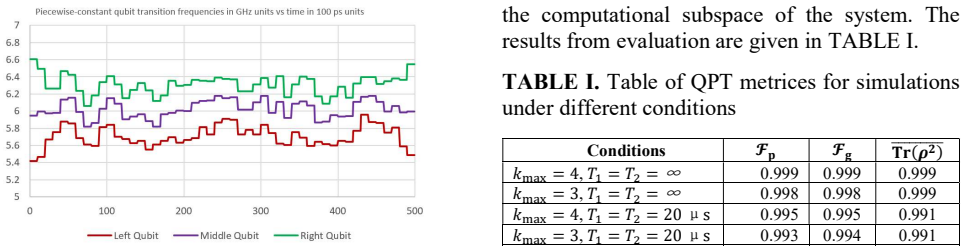
The machinery is the effective Hamiltonian of three transmons coupled through resonators (Eqs. 2-6): each transmon contributes dressed transition frequencies from a four-level model, adjacent transmons are coupled directly by a strength that depends on those frequencies, and the time evolution is computed by Trotter steps of 100 ps. To make the search tractable, the 64-dimensional Hamiltonian is projected to a 20-state subspace containing at most three excitations, and the final unitary is projected to the 8-dimensional computational subspace and corrected by a diagonal single-qubit phase-compensation matrix. The controls are piecewise-constant flux-detuning sequences: 50 amplitudes per qubit over 50 ns. SUSSADE, a differential-evolution method, performs the global search with fidelity as the fitness function, and the new local search algorithm refines the result by sweeping a window across the sequence and shrinking the step size from 100 MHz down to 1 kHz, which raises the fidelity from 98.8% to 99.99%.
What would settle it
Run the learned 50-point detuning waveforms through the full 64-dimensional four-level Hamiltonian, or through a simulation that explicitly includes the two resonator modes, and compute the process fidelity. The paper predicts essentially the same performance as its 20-state projection; if the process fidelity drops substantially below 0.995 at 20 microsecond coherence times, or below 0.999 with decoherence turned off, the truncated model is carrying the result and the claimed fidelity does not transfer.
Extended reading notes
Core claim
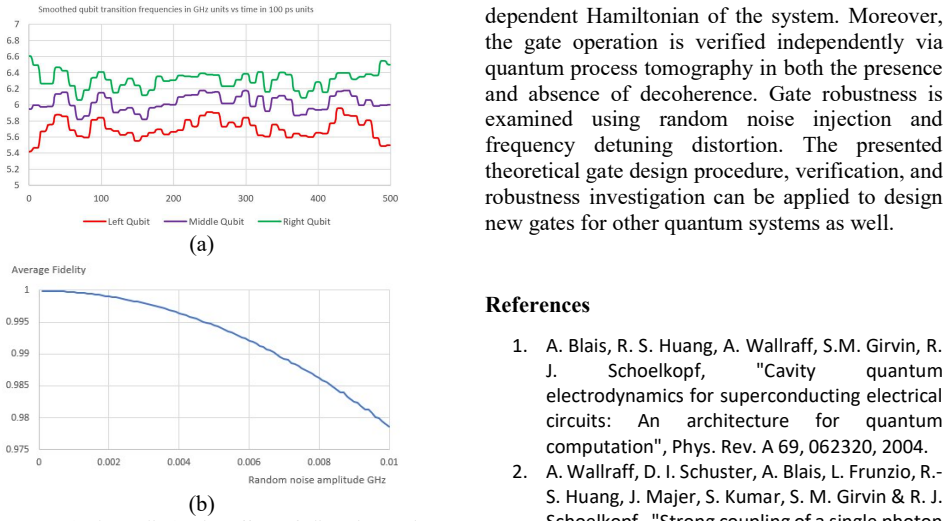
The central claim is that piecewise-constant flux-detuning waveforms learned by a differential-evolution search and then refined by a local search implement a three-qubit CCPhase gate on flux-tunable transmons with simulated average gate fidelity above 99.99% after single-qubit phase compensation. The target operation is identity on all computational basis states except $|111\rangle$, which receives a $\pi$ phase. Independent simulated quantum process tomography gives process fidelity 0.999 in the four-level model without decoherence and 0.995 with both coherence times set to 20 microseconds; dropping the fourth level changes these to 0.998 and 0.993, indicating a limited role for the $|3\rangle$ level. The gate keeps average fidelity above 99% under random flux noise up to 6.7 MHz and retains 98.79% average fidelity under first-order pulse distortion. The authors conclude that, together with two 20 ns single-qubit gates, this gives a 90 ns Toffoli gate under realistic experimental constraints.
Load-bearing premise
The load-bearing premise is that the simplified model used to design and test the pulse, keeping only four energy levels per qubit and ignoring populated resonators, matches the real superconducting hardware closely enough that the fidelity computed inside the model is the fidelity the physical gate would achieve.
Editorial extensions
If this is right
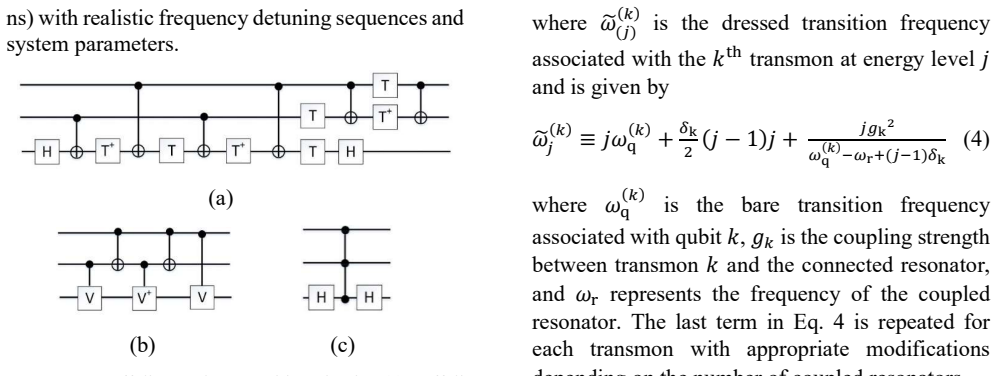
- Because the CCPhase gate is native to the nearest-neighbor architecture, a Toffoli gate can be executed in 90 ns without decomposing it into CNOTs and SWAPs.
- The gate meets the paper's stated limits on pulse slew rate and adjacent-qubit frequency separation, so it is compatible with realistic control electronics rather than idealized waveforms.
- With both coherence times at 20 microseconds, the simulated process fidelity is 99.5%, illustrating that the gate can operate usefully before full error correction is available.
- The same supervised-learning scheme, using the target unitary as the training set and fidelity as the cost, can be applied to design other multi-qubit gates in the same hardware.
Reading between the lines
- Because the pulses are learned and verified inside the same projected Hamiltonian model, an independent check in a larger state space, for instance all 64 four-level states plus populated resonator modes, would be the sharpest test of whether the 99.99% figure survives model refinement.
- The local search's jump from 98.8% to 99.99% suggests that for small control spaces, combining a global optimizer with fine-grained local refinement is a practical recipe; I would expect similar gains if the same two-stage search is applied to other gates.
- If real flux-tunable transmons have coherence times that degrade when flux-biased, the 99.5% decoherence-limited process fidelity will not transfer directly to hardware; using these learned waveforms as the starting point for closed-loop optimization could recover much of the loss.
Signed reviews
Editorial analysis
A structured set of objections, weighed in public.
Referee Report
Summary. This manuscript proposes a machine-learning design procedure for a 50 ns controlled-controlled-phase (CCPhase) gate acting on three nearest-neighbor flux-tunable transmons coupled through resonators, with the stated goal of realizing a Toffoli gate in 90 ns when combined with two single-qubit gates. The authors model the system with an effective Hamiltonian retaining four transmon levels, projected to a 20-state subspace with at most three excitations, and optimize frequency detuning sequences using SUSSADE followed by a new local-search refinement. They report a fidelity greater than 99.99% for the CCPhase gate, and they include verification by simulated quantum process tomography (QPT) under ideal and decohering conditions, as well as robustness studies under pulse distortion and random noise. The central numerical machinery and the explicit robustness checks are valuable, but the paper's own verification results in Table I and Section VI appear to contradict the headline fidelity claim, which is a load-bearing issue that must be resolved.
Significance. If substantiated, a native 50 ns three-qubit CCPhase gate at 99.99% fidelity would be a significant advance for cQED architectures: it would be considerably faster than compiled Toffoli circuits and would demonstrate that a supervised machine-learning approach can discover practical multi-qubit control waveforms. The manuscript also provides a concrete optimization pipeline, an independent QPT verification module, and a robustness analysis, all of which are useful methodological contributions. However, the central quantitative claim is not currently supported by the paper's own verification numbers, and the robustness section shows a large fidelity drop under first-order distortion. These are internal inconsistencies in the evidence for the main claim, not merely presentation issues, so the result needs major revision before it can be considered established.
major comments (4)
- [Section V, Table I] The no-decoherence QPT row reports process fidelity F_p = 0.999 and average gate fidelity F_g = 0.999, which is 99.9%, not the >99.99% claimed in the abstract, Section IV, and Section VII. Since Eq. (11) is already the average gate fidelity for a unitary process, a pulse that reaches 99.99% in the learning procedure should also yield F_g close to 0.9999 in the no-decoherence QPT row if the same model and metric are used. The authors should report unrounded values, identify the source of the 0.1% discrepancy (for example, leakage out of the computational subspace, the phase-compensation step, or a difference between the 20-state projected model and the full 64-dimensional evolution used in QPT), and then either revise the headline fidelity claim or modify the verification so that it is consistent with the optimization objective.
- [Section VI] The distortion analysis using Eq. (16) is reported to reduce the average fidelity by 1.21%, resulting in 98.79%. This means the headline >99.99% fidelity applies only to the ideal piecewise-constant pulses evaluated in the projected model, not to the distorted control waveforms that the same paper studies. The authors should clearly restate the fidelity claim as applying to the undistorted, idealized pulse only, and they should either incorporate distortion into the learning procedure or explicitly present the 98.79% value as the realistic robustness estimate. As written, the robustness section undermines the abstract's unqualified fidelity statement.
- [Section III, Eqs. (2)-(6)] The frequency detuning sequences are optimized, verified in QPT, and tested for robustness using the same truncated effective Hamiltonian projected to the 20-state subspace (at most three excitations). No independent simulation includes higher transmon levels beyond |3>, resonator population, or crosstalk, so the truncation error is not quantified. Since the paper's claim is about a physical cQED gate, the authors should provide at least a partial check in a larger Hilbert space (for example, a 64-dimensional simulation for a subset of the learned pulses, or inclusion of the resonator mode) to confirm that neglected levels do not invalidate the reported fidelities.
- [Section V, discussion of Table I] The statement that comparing the k_max=3 and k_max=4 rows indicates that the fourth level |3> plays a limited role is not supported by the rounded numbers in Table I: the differences in F_p and F_g are only 0.001, and the manuscript does not report unrounded values or a quantitative measure of the level's effect. Please provide exact numerical values and a precise bound on the contribution of the fourth level, or qualify the statement accordingly.
minor comments (5)
- [Eq. (11)] The fidelity formula in Eq. (11) contains garbled symbols in the rendered text; the authors should write the expression explicitly for the reader, for example as F = (|Tr(U^\dagger V)|^2 + d)/(d(d+1)) for unitary target V.
- [Table I caption] The word 'metrices' in the table caption should be 'metrics'.
- [Reference [10]] Reference [10] (Versluis et al.) is cited with a DOI but no journal name, volume, or pages; please complete the bibliographic information.
- [Section IV] The sentence stating that the three transmons with reference frequencies 5, 6, and 7 GHz 'realize an identity operation with fidelity 99.9%' is unclear: it should be explained why these frequencies yield identity and how the 99.9% fidelity was evaluated.
- [Fig. 3(b)] The vertical axis of Fig. 3(b) should be labeled explicitly as the average gate fidelity, matching the metric defined in Eq. (11) or Eq. (14), so that the plot is self-contained.
Circularity Check
No significant circularity: the gate fidelity is an optimized objective against an external ideal unitary, not a self-derived prediction.
full rationale
The paper's chain is a standard optimal-control design. The learned frequency detuning sequences are optimized by maximizing the gate fidelity in Eq. (11) with respect to the ideal CCPhase unitary in Eq. (1). That ideal unitary is an external benchmark, so the reported '>99.99%' is the value of the training objective at convergence, not a quantity derived from the assumptions. The verification via quantum process tomography in Table I is a separate calculation using the same physical Hamiltonian, which limits the independence of the model but does not reduce the claim to its inputs by construction. The only self-citation, Ref. [35] (Premaratne et al.), is used for the standard constraint that the process matrix be positive-Hermitian; it is methodological and not load-bearing. The Toffoli decomposition in Fig. 1(c) is a known circuit identity. Hence no circular step can be exhibited: each load-bearing result is either an optimization against an external target, a known identity, or a numerical simulation with stated assumptions. The discrepancy between the abstract's >99.99% and Table I's 0.999 process fidelity is an internal-consistency/correctness problem, not circularity, and is outside this pass.
Assumptions & free parameters
free parameters (3)
- Frequency detuning sequences for left, middle, and right qubits (50 values each) =
Not provided numerically
- Search reference frequencies f_L, f_M, f_R =
5.61 GHz, 6 GHz, 6.39 GHz
- Constraint thresholds for detuning variation and adjacent qubit separation =
220 MHz point-to-point, 500 MHz endpoint, 0.21 GHz minimum adjacent difference
assumptions (5)
- domain assumption Effective Hamiltonian for resonator-coupled transmons (Eqs. 2-6, from ref [26])
- domain assumption Truncation to four transmon levels and a 20-state subspace with at most three excitations
- domain assumption Markovian Lindblad decoherence with T1 = T2 = 20 microseconds, independent of flux tuning
- domain assumption Nearest-neighbor coupling only via resonators, with no crosstalk or additional control imperfections
- standard math Schrodinger equation and Trotterization for time evolution (Eqs. 7-8)
Cite this review
Pith. "Pith review of Machine-learning based three-qubit gate for realization of a Toffoli gate with cQED-based transmon systems." pith.science (2026). https://pith.science/paper/H53IV7B7
@misc{pith2026190801092,
  author       = {Pith},
  title        = {Pith review of: Machine-learning based three-qubit gate for realization of a Toffoli gate with cQED-based transmon systems},
  year         = {2026},
  howpublished = {\url{https://pith.science/paper/H53IV7B7}},
  note         = {Machine review of arXiv:1908.01092}
}
read the original abstract
We use machine learning techniques to design a 50 ns three-qubit flux-tunable controlled-controlled-phase gate with fidelity of >99.99% for nearest-neighbor coupled transmons in circuit quantum electrodynamics architectures. We explain our gate design procedure where we enforce realistic constraints, and analyze the new gate's robustness under decoherence, distortion, and random noise. Our controlled-controlled-phase gate in combination with two single-qubit gates realizes a Toffoli gate which is widely used in quantum circuits, logic synthesis, quantum error correction, and quantum games.
Figures
Reference graph
Works this paper leans on
-
[1]
A. Blais, R. S. Huang, A. Wallraff, S.M. Girvin, R. J. Schoelkopf, "Cavity quantum electrodynamics for superconducting electrical circuits: An architecture for quantum computation", Phys. Rev. A 69, 062320, 2004
work page 2004
-
[2]
Strong coupling of a single photon to a superconducting qubit using circuit quantum electrodynamics
A. Wallraff, D. I. Schuster, A. Blais, L. Frunzio, R.- S. Huang, J. Majer, S. Kumar, S. M. Girvin & R. J. Schoelkopf , "Strong coupling of a single photon to a superconducting qubit using circuit quantum electrodynamics", Nature 431, 162– 167, 2004
work page 2004
-
[3]
Quantum-information processing with circuit quantum electrodynamics
A. Blais, J. Gambetta, A. Wallraff, D. I. Schuster, S. M. Girvin, M. H. Devoret, and R. J. Schoelkopf, "Quantum-information processing with circuit quantum electrodynamics", Phys. Rev. A 75, 032329 – Published 22 March 2007, 2007
work page 2007
-
[4]
Charge-insensitive qubit design derived from the Cooper pair box
J. Koch, T. M. Yu, J. Gambetta, A. A. Houck, D. I. Schuster, J. Majer, A. Blais, M. H. Devoret, S. M. Girvin, R. J. Schoelkopf , "Charge-insensitive qubit design derived from the Cooper pair box", Phys. Rev. A 76, 042319 (2007).," Phys. Rev. A 76, 042319, 2007
work page 2007
-
[5]
Coherent Josephson Qubit Suitable for Scalable Quantum Integrated Circuits
R. Barends, J. Kelly, A. Megrant, D. Sank, E. Jeffrey, Y. Chen, Y. Yin, B. Chiaro, J. Mutus, C. Neill, P. O’Malley, P. Roushan, J. Wenner, T. C. White, A. N. Cleland, and John M. Martinis, "Coherent Josephson Qubit Suitable for Scalable Quantum Integrated Circuits", Phys. Rev. Lett. 111, 080502 (2013).," Phys. Rev. Lett. 111, 080502, 2013
work page 2013
-
[6]
Building logical qubits in a superconducting quantum computing system
J. M. Gambetta, J. M. Chow, J. M. Steffen, "Building logical qubits in a superconducting quantum computing system", npj Quantum Inf. 3, 2, 2017
work page 2017
-
[7]
H. Paik, D. I. Schuster, L. S. Bishop, G. Kirchmair, G. Catelani, A. P. Sears, B. R. Johnson, M. J. Reagor, L. Frunzio, L. I. Glazman, S. M. Girvin, M. H. Devoret, R. J. Schoelkopf, "Observation of High Coherence in Josephson Junction Qubits Measured in a Three-Dimensional Circuit QED Architecture", Phys. Rev. Lett. 107, 240501, 2011. 7
work page 2011
-
[8]
J. Preskil, "Quantum Error Correction," Physics 219, lecture notes chapter 7, Caltech, http://theory.caltech.edu/people/preskill/ph2 29/notes/chap7.pdf
Show all 40 references
-
[9]
Quantum Error Correction for Quantum Memories
B. M. Terhal, "Quantum Error Correction for Quantum Memories", Rev. Mod. Phys. 87, 307 – Published 7 April 2015., 2015
2015
-
[10]
Scalable Quantum Circuit and Control for a Superconducting Surface Code
R. Versluis, S. Poletto, N. Khammassi, N. Haider, D. J. Michalak, A. Bruno, K. Bertels, L. DiCarlo, "Scalable Quantum Circuit and Control for a Superconducting Surface Code", 10.1103/PhysRevApplied.8.034021
-
[11]
Demonstration of two-qubit algorithms with a superconducting quantum processor
L. DiCarlo, J. M. Chow, J. M. Gambetta, Lev S. Bishop, B. R. Johnson, D. I. Schuster, J. Majer, A. Blais, L. Frunzio, S. M. Girvin, R. J. Schoelkopf, "Demonstration of two-qubit algorithms with a superconducting quantum processor", Nature 460, 240–244 (2009)., 2009
2009
-
[12]
Quantum Logic Gates for Coupled Superconducting Phase Qubits
F. W. Strauch, Ph. R. Johnson, A. J. Dragt, C. J. Lobb, J. R. Anderson, and F. C. Wellstood, "Quantum Logic Gates for Coupled Superconducting Phase Qubits", Phys. Rev. Lett. 91, 167005, 2003
2003
-
[13]
Superconducting quantum circuits at the surface code threshold for fault tolerance
R. Barends et. al., "Superconducting quantum circuits at the surface code threshold for fault tolerance", Nature 508, 500–503, 2014
2014
-
[14]
High-fidelity controlled-σ Z gate for resonator- based superconducting quantum computers
J. Ghosh, A. Galiautdinov, Z. Zhou, A. N. Korotkov, J. M. Martinis, and M. R. Geller, "High-fidelity controlled-σ Z gate for resonator- based superconducting quantum computers", Phys. Rev. A.87.022309, 2013
2013
-
[15]
Realization of three-qubit quantum error correction with superconducting circuits
M. D. Reed, L. DiCarlo, S. E. Nigg, L. Sun, L. Frunzio, S. M. Girvin & R. J. Schoelkopf, "Realization of three-qubit quantum error correction with superconducting circuits", Nature. 2012 10.1038/nature10786, 2012
2012 doi
-
[16]
Implementation of a Toffoli gate with superconducting circuits
A. Fedorov, L. Steffen, M. Baur, M. P. da Silva, A. Wallraff, "Implementation of a Toffoli gate with superconducting circuits", Nature. 2011 10.1038/nature10713, 2011
2011 doi
-
[17]
High- Fidelity Single-Shot Toffoli Gate via Quantum Control
E. Zahedinejad, J. Ghosh, B. C. Sanders , "High- Fidelity Single-Shot Toffoli Gate via Quantum Control", 10.1103/ PhysRevLett. 114.200502
-
[18]
Designing High-Fidelity Single-Shot Three- Qubit Gates: A Machine-Learning Approach
E. Zahedinejad, J. Ghosh, B. C. Sanders, "Designing High-Fidelity Single-Shot Three- Qubit Gates: A Machine-Learning Approach", 10.1103/PhysRevApplied.6.054005
-
[19]
Charting the circuit QED design landscape using optimal control theory
M. H. Goerz, F. Motzoi, K. B. Whaley, C. P. Koch, "Charting the circuit QED design landscape using optimal control theory", npj Quantum Information (2017) 3:37 ; doi:10.1038/s41534- 017-0036-0, 2017
2017 doi
-
[20]
Quantum control for high-fidelity multi-qubit gates,
R. J. Spiteri, M. Schmidt, J. Ghosh, E. Zahedinejad, and B. C. Sanders, "Quantum control for high-fidelity multi-qubit gates," 2018 New J. Phys. 20 113009, 2018
2018
-
[21]
Comparing, optimizing, and benchmarking quantum-control algorithms in a unifying programming framework
S. Machnes, U. Sander, S.J. Glaser, P. de Fouquières, A. Gruslys, S. Schirmer, and T. Schulte-Herbrüggen, "Comparing, optimizing, and benchmarking quantum-control algorithms in a unifying programming framework", 10.1103/PhysRevA.84.022305 (2011), 2011
2011 doi
-
[22]
Optimal control of coupled spin dynamics: design of NMR pulse sequences by gradient ascent algorithms
N. Khaneja, T. Reiss, C. Kehlet, T. Schulte- Herbrüggen, and S. J. Glaser, J. Magn. Reson, "Optimal control of coupled spin dynamics: design of NMR pulse sequences by gradient ascent algorithms", https://doi.org/10.1016/j.jmr.2004.11.004, 2004
-
[23]
Dressing the chopped-random- basis optimization: A bandwidth-limited access to the trap-free landscape
N. Rach, M. M. Müller, T. Calarco, and S. Montangero, "Dressing the chopped-random- basis optimization: A bandwidth-limited access to the trap-free landscape", Phys. Rev. A. 92, 062343 (2015). doi:10.1103/PhysRevA.92.062343, 2015
2015 doi
-
[24]
On the CNOT-cost of TOFFOLI gates
V. V. Shende, I. L. Markov, "On the CNOT-cost of TOFFOLI gates", Vols. Volume 9 Issue 5, May 2009 Pages 461-486
2009
-
[25]
Elementary gates for quantum computation
A. Barenco, C. H. Bennett, R. Cleve, D. P. DiVincenzo,N. Margolus,P. Shor, T. Sleator, J. A. Smolin, and H. Weinfurter, "Elementary gates for quantum computation", PHYSICAL REVIEW A VOLUME 52, NUMBER 5, 1995
1995
-
[26]
Perturbative analysis of two-qubit gates on Transmon qubits
S. Richer, "Perturbative analysis of two-qubit gates on Transmon qubits", Masters thesis, RWTH Aachen Univer, 2013
2013
-
[27]
Finding Exponential Product Formulas of Higher Orders,
N. Hatano, M. Suzuki, "Finding Exponential Product Formulas of Higher Orders," In: Das A., K. Chakrabarti B. (eds) Quantum Annealing and Other Optimization Methods. Lecture Notes in Physics, vol 679. Springer, Berlin, Heidelberg, 2005
2005
-
[28]
Introduction to Quantum Algorithms for Physics and Chemistry
M. H. Yung, J. D. Whitfield, S. Boixo, D. G. Tempel, A. Aspuru-Guzik, "Introduction to Quantum Algorithms for Physics and Chemistry", Quantum Physics (quant- ph);Mesoscale and Nanoscale Physics, Advances in Chemical Physics Volume 154 (ed S. Kais), John Wiley & Sons, Inc., Hob...
2014
-
[29]
Fidelity of quantum operations
L. H. Pedersen, K. Molmer, N. M.Moller, , "Fidelity of quantum operations", Phys Lett. A, 367, 47 (2007), 2007
2007
-
[30]
Differential Evolution – A Simple and Efficient Heuristic for global Optimization over Continuous Spaces
R. Storn, K. Price, "Differential Evolution – A Simple and Efficient Heuristic for global Optimization over Continuous Spaces", Journal of Global Optimization (1997) 11: 341. 8 https://doi.org/10.1023/A:1008202821328, 1997
1997 doi
-
[31]
A fast, low-leakage, high-fidelity two-qubit gate for a programmable superconducting quantum computer
M. A. Rol, F. Battistel, F. K. Malinowski, C. C. Bultink, B. M. Tarasinski, R. Vollmer, N. Haider, N. Muthusubramanian, A. Bruno, B. M. Terhal, and L. DiCarlo, "A fast, low-leakage, high-fidelity two-qubit gate for a programmable superconducting quantum computer", arXiv:1903.02...
1903 arXiv
-
[32]
Coeus Cluster,
"Coeus Cluster," [Online]. Available: http://www.pi4cs.org/equipment
-
[33]
Quantum Computation and Quantum Information
M. A. Nielsen, I.L. Chuang, "Quantum Computation and Quantum Information", CambridgeUniversity Press, Cambridge, 2001
2001
-
[34]
Quantum Process Tomography of a Controlled-NOT Gate
J. L. O'Brien, G. J. Pryde, A. Gilchrist, D. F. V. James, N. K. Langford, T. C. Ralph, A. G. White, "Quantum Process Tomography of a Controlled-NOT Gate", Phys. Rev. Lett., vol. 93, no. 8, p. 080502, Aug. 2004, 2004
2004
-
[35]
Implementation of a generalized controlled-NOT gate between fixed-frequency transmons
S. P. Premaratne, J. H. Yeh, F. C. Wellstood, B. S. Palmer, "Implementation of a generalized controlled-NOT gate between fixed-frequency transmons", Phys. Rev. A, vol. 99, no. 1, p. 012317, Jan. 2019, 2019
2019
-
[36]
On the generators of quantum dynamical semigroups
G. Lindblad, "On the generators of quantum dynamical semigroups", Commun. Math. Phys., vol. 48, no. 2, pp. 119–130, Jun. 1976, 1976
1976
-
[37]
On quantum statistical mechanics of non-Hamiltonian systems Reports
A. Kossakowski, "On quantum statistical mechanics of non-Hamiltonian systems Reports", Math. Phys., vol. 3, no. 4, pp. 247– 274, Dec. 1972, 1972
1972
-
[38]
Disentanglement and decoherence in a pair of qutrits under dephasing noise
G. Jaeger, and K. Ann, "Disentanglement and decoherence in a pair of qutrits under dephasing noise", J. Mod. Opt., vol. 54, no. 16– 17, pp. 2327–2338, 2007, 2007
2007
-
[39]
Quantum discord for a qutrit-qutrit system under depolarizing and dephasing noise
Y. Yang, andA. M. Wang, "Quantum discord for a qutrit-qutrit system under depolarizing and dephasing noise", Chinese Phys. Lett., vol. 30, no. 8, 2013, 2013
2013
-
[40]
Tunable Superconducting Qubits with Flux-Independent Coherence
M. D. Hutchings, Jared B. Hertzberg, Yebin Liu, Nicholas T. Bronn, George A. Keefe, M. Blink, Jerry M. Chow, B. L. T. Plourde, "Tunable Superconducting Qubits with Flux-Independent Coherence", Phys. Rev. Appl., vol. 8, no. 4, p. 044003, Oct. 2017, 2017. Acknowledgements This w...
2017
Reviewed August 14, 2026 · model on record in the stance chip above.
Discussion (0). Continue with ORCID to comment.