REVIEW 3 major objections 5 minor 1 cited by
Agent Semantics, Semantic Spacetime, and Graphical Reasoning
T0 review · 3 major / 5 minor · reviewed 2026-08-07 · deepseek-v4-flash
Pith's one-line read The paper claims a finite $\gamma(3,4)$ type system—three node kinds, four arrow types—is a closed scaffolding for all semantic graph reasoning.
desk verdict A clear, honest exposition of a typed graph framework whose central closure claim is unproven and explicitly admitted as a hypothesis. read the letter →
The pith
A machine-rendered reading of the paper's core claim, the machinery that carries it, and where it could break.
The reading
What carries the argument
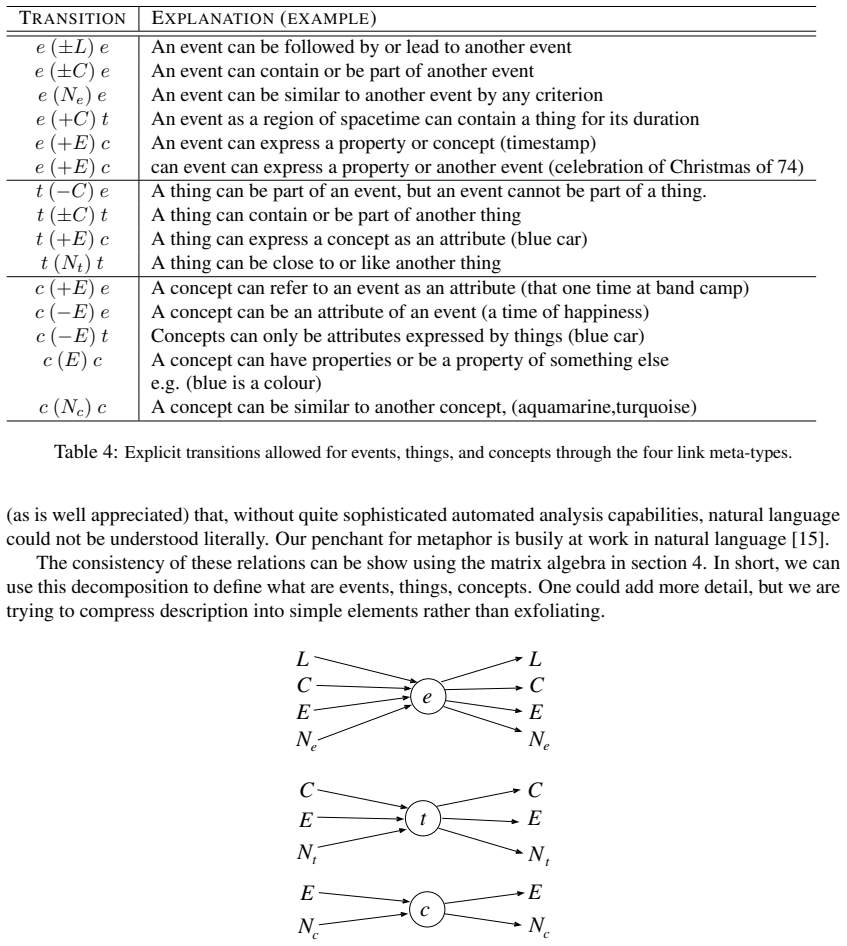
The load-bearing device is the type skeleton $\gamma(3,4)$: three node meta-types $e$ (events), $t$ (things), $c$ (concepts) and four arrow types $N$ (near), $L$ (leads to), $C$ (contains), and $E$ (expresses). It is carried by the allowed-transition table between these types, the incidence and adjacency matrices that encode which arrows may join which nodes, and the path-join matrix that decides when two arrows can be chained. In this machinery the key algebraic fact is that absorbing nodes appear as zero rows, zero columns, and zero eigenvalues, which makes directed graph matrices non-invertible and connects semantic information loss to the arithmetic impossibility of division by zero.
What would settle it
Take an everyday relation outside the paper's examples, such as 'Alice sold Bob a car for five thousand dollars' or 'Alice believes Bob', and try to rewrite it as a finite $\gamma(3,4)$ subgraph obeying the allowed transitions; if any such relation cannot be decomposed without losing an inference that natural language preserves, the closure claim is false.
Extended reading notes
Core claim
On the paper's own terms, the discovery is that all semantic distinctions in a knowledge graph can be typed by three node meta-types and four arrow types, with a short table of allowed transitions settling the ambiguities that natural language leaves open. The $\gamma(3,4)$ skeleton is offered as a universal ontology: things may be contained but not expressed, concepts may be expressed but not contained, and events are the only nodes that 'lead to' other events; a verb anchored to a subject or object becomes an event, an unanchored verb stays a dangling concept. The paper also argues that graph processes are generically non-invertible: sinks, confluences, and appointed nodes are absorbing, give the adjacency matrix zero eigenvalues, and erase the history of what flowed into them, so reversing a process requires boundary information from outside. That absorbing-state phenomenon is identified with division by zero in arithmetic, giving a semantic reading of $0/0$ and $x/0$ as dimension-dependent and policy-dependent rather than undefined.
Load-bearing premise
The load-bearing premise is that four relation types and three node types are enough to express any semantic description; the paper itself labels this 'a hypothesis for now' and offers no derivation or empirical survey that would rule out a fifth relation type.
Editorial extensions
If this is right
- All knowledge-graph reasoning could be carried out with four arrow types and three node types, making ontologies and first-order logic unnecessary for the covered semantics.
- Graph processes that pass through sink or confluence nodes erase information; reversing them requires injecting new boundary data, so a reasoning system must flag where policy or intention enters.
- Division by zero acquires a finite, context-dependent reading in finite graph semantics, such as x/L for a graph with L possible shares, rather than an undefined or infinite operation.
- Inference becomes approximate rather than deductive: shared linkage to a common node supports 'might be true' conclusions and allows equivalent nodes to be collapsed into supernodes.
Reading between the lines
- A natural next test would compile a large catalogue of everyday relations, map each into $\gamma(3,4)$ form using the transition rules, and measure how many decompose without intervention; the paper offers no such coverage measurement.
- If the closure claim holds, the four arrow types could serve as a semantic instruction set for graph databases, with an explicit absorbing-state flag telling the system where an external answer must be supplied.
- The division-by-zero analogy suggests treating each sink as a boundary node whose incoming flow is a policy decision; information loss would then be documented instead of silently discarded.
- Because the arrow types are spacetime metaphors, a corpus study of metaphorical language could test whether everyday conceptual relations actually align with the four types, giving the hypothesis an empirical handle.
Editorial analysis
A structured set of objections, weighed in public.
Referee Report
Summary. The paper presents Semantic Spacetime (SST) as a graph-based knowledge representation built from three node meta-types (events, things, concepts) and four link types (near, leads-to, contains, expresses), called the γ(3,4) representation. It claims in the abstract and in §2.4 that this finite typing 'form[s] a closed scaffolding set of operations that can scale to any degree of semantic complexity,' and argues that this removes the need for ontologies or first-order logic. The rest of the paper discusses allowed type transitions, absorbing states and information loss in directed graphs, matrix representations, and a graph-semantic reinterpretation of arithmetic operations, especially division by zero. The exposition is largely programmatic: the central completeness claim is explicitly called a hypothesis in §2.2, the type rules are stipulations, and the formal sections contain mathematical statements that are not proved and, in the Perron-Frobenius section, are not correct as stated.
Significance. If the γ(3,4) representation were genuinely closed and complete, it would be a significant contribution to knowledge representation and graph-based reasoning: a fixed, finite typing scheme that subsumes arbitrary semantic relations would simplify triple stores, inference, and process modelling. The paper also contains a useful concrete target: the worked examples in §2.5 and Appendix A could in principle be turned into a decomposition test against a broad relation inventory, and the author makes a software implementation available. The discussion of sink nodes as information-destroying absorbing states and the connection to non-invertibility of graph matrices is interesting and partially supported by elementary linear algebra. However, the central closure claim is not established; the examples are selected and do not constitute a completeness argument. Furthermore, §4.4 misstates a standard theorem in a way that affects the matrix-based conclusions. As it stands, the paper is a position/program document rather than a supported formal result.
major comments (3)
- [Abstract and §2.2] The central claim that γ(3,4) 'form[s] a closed scaffolding set of operations that can scale to any degree of semantic complexity' is not established. Section 2.2 explicitly says that the sufficiency of the four arrow types 'remains a hypothesis for now,' and no formal definition of 'closed' or of the relevant class of 'semantic complexity' is given. No encoding from a generic knowledge-graph relation inventory into e/t/c nodes and N/L/C/E links is provided, and no completeness argument follows from the stipulated rules in §2.4 and Table 4. Because this closure is the premise for the paper's conclusion that ontologies and first-order logic can be dispensed with, the abstract overstates what the paper supports. A concrete minimum would be a formal translation from a defined class (e.g., RDF triples or a fragment of description logic) into γ(3,4) with a proof that the image respects the type rules and that the translation is semantics-preserving.
- [§4.4] The Perron-Frobenius theorem is misstated and misapplied. The statement that 'the largest or principal eigenvector of any such graph will be entirely positive' is false for a general non-negative adjacency matrix: strict positivity of the principal eigenvector requires irreducibility, and convergence of power iteration to a unique positive eigenvector requires primitivity. A directed graph with sinks, which is exactly the case developed in §4.3, has a reducible adjacency matrix, and its principal eigenvector typically has zero components. The subsequent assertion that repeated multiplication of any non-zero vector by A 'will converge v towards the principal eigenvector' is therefore not valid for the very absorbing-node setting the paper emphasizes. This matters because §4.3–4.4 present this argument as the formal basis for the division-by-zero and information-loss analogy.
- [§3.4 / Table 4] The transition table contains an internal inconsistency that weakens the claimed coherence of the type system. The row 'e(+E)c' says an event can express 'a property or another event,' but the surrounding text argues that a reference to another event in attribute position must be re-encoded as a concept (the Olympics example), and no e(+E)e transition appears in Table 4 or Figure 4. Either events are allowed as attribute targets, contradicting the stated rules, or the table entry is mislabelled. The paper also says that 'the consistency of these relations can be shown using the matrix algebra in section 4,' but section 4 merely encodes the rules in matrices; it does not prove consistency or closure.
minor comments (5)
- [§4.3, Eqs. (33) and (35)] The backward operator \(\hat B\) is written with b1 in both nonzero entries in Eq. (33) but with b1 and b2 in Eq. (35); the two presentations should be made consistent, since the example depends on distinct restoration coefficients.
- [§4.4 heading] The heading spells 'Frobenius' as 'Frobenious'; the correct spelling appears elsewhere in the text.
- [Various] There are numerous typographical errors that should be corrected: 'A alternative tabulation' in Table 2, 'tangible*' in §2.2, 'obstable' in §1.1, 'Arithemetic' in §5.1, 'Relativitsic' in reference [50], 'Causal sers' in reference [27], and 'adn' in reference [11].
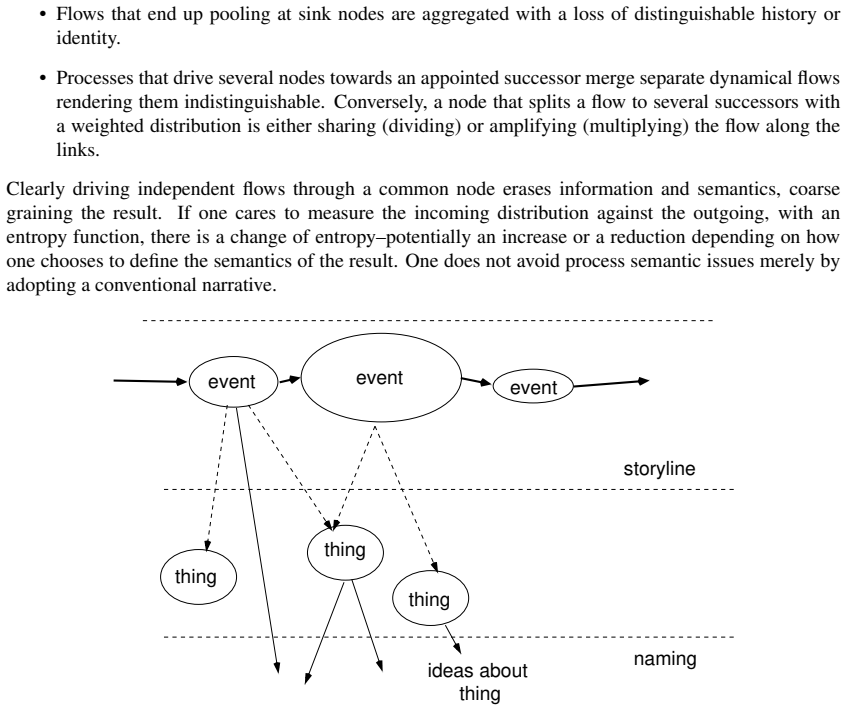
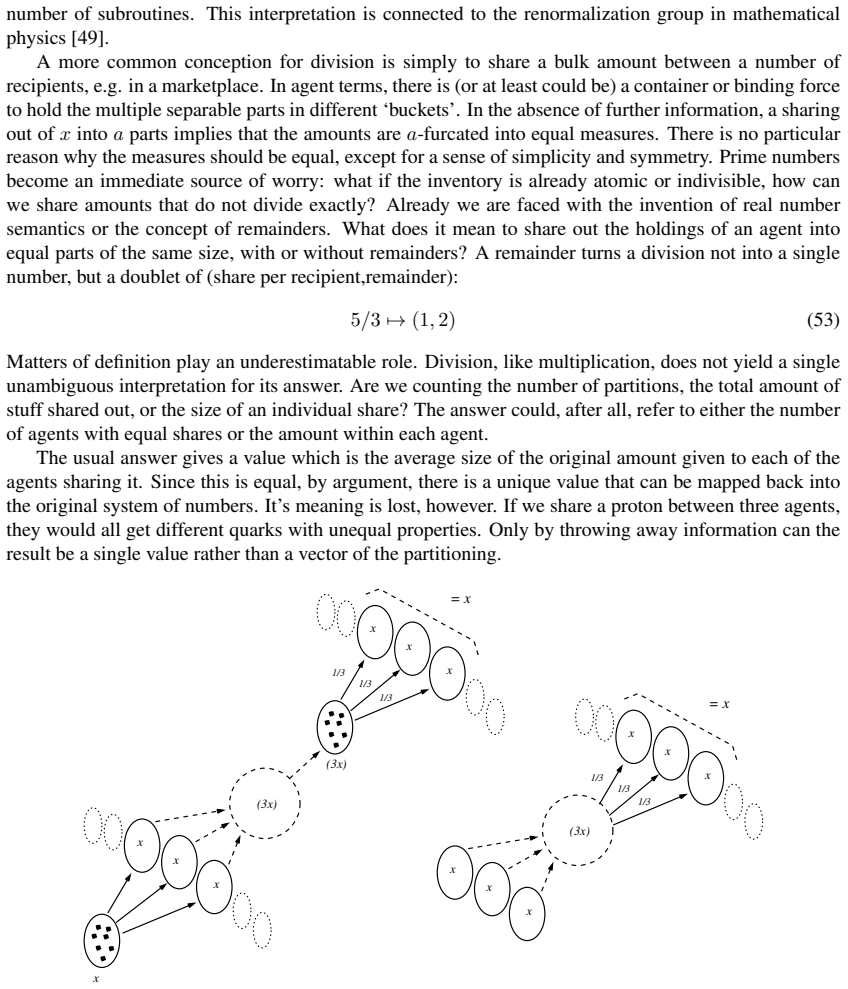
- [Figures 1 and 2] The hand-lettered labels in Figures 1 and 2 are very small and difficult to read; since these figures are the main demonstration of how the γ(3,4) decomposition works, they should be redrawn or enlarged.
- [§5.7, Eqs. (61)–(65)] The discussion of division by zero mixes formal claims with interpretive proposals (e.g., 0/0 = 1 derived from Fock-space ladder operators). The paper should clearly separate the stated conventions from the proposed semantics, and should not present the Fock-space analogy as a derivation of a value for 0/0 in ordinary arithmetic.
Circularity Check
Central 'closed scaffolding' claim is the paper's own sufficiency postulate restated, with matrix 'consistency' checking only the stipulated rules.
-
self definitional
[Abstract; §2.2 'The 4 relationship types']
"A finite γ(3,4) representation is defined to form a closed scaffolding set of operations that can scale to any degree of semantic complexity ... the semantic spacetime model settles on four basic arrows between nodes in a graph that are postulated to be sufficient for any semantic description [1–3]. This remains a hypothesis for now"
The paper's advertised result—that γ(3,4) is closed and can scale to any semantic complexity—is not derived from an independent argument. It is exactly the paper's own postulate that four arrow types are sufficient for any semantic description. The abstract states this as a definition ('is defined to form'), while §2.2 concedes the same content 'remains a hypothesis.' No completeness proof or test against an external inventory of relations is supplied, so the conclusion is the input assumption restated. The examples in §2.5 are encoded using the very four types whose sufficiency is at issue, so they cannot independently confirm closure.
-
self citation load bearing
[§2.2; Table 1 caption]
"Based on the semantics of agents, and the model of intent developed by Promise Theory, the semantic spacetime model settles on four basic arrows between nodes in a graph that are postulated to be sufficient for any semantic description [1–3] ... See table 1, which originally appeared in earlier papers [3, 4] with some errors."
The load-bearing premise—that four association types are sufficient for arbitrary semantics—is anchored exclusively to the author's own prior SST papers [1–3] and Promise Theory [5], with Table 1 explicitly reproduced from those papers. The citation chain does not supply independent evidence: the cited works are part of the same research program and, as the current paper itself says, the sufficiency claim remains a hypothesis. Thus the central universal-ontology claim rests on a self-citation chain rather than on an externally verified theorem, machine-checked proof, or independent empirical result.
1 more flagged steps
-
other
[§3.4 'Allowed type transitions'; §4.1 'Matrices for γ(3,4) skeleton']
"The consistency of these relations can be show using the matrix algebra in section 4. ... The γ(3,4) skeleton graph can be represented, without explicit nodes only type names, as a set of matrices ... Certain rules about process semantics mean that transitions between certain node types are limited to specific kinds of arrow: A=..."
The matrix 'consistency' check in §4.1 is a restatement of the stipulated transition rules. The adjacency and incidence matrices are constructed directly from the allowed transitions of Table 4 and the node-type rules of §2.4. Showing that a matrix reproduces the rules that were used to build it is a tautology, not a verification that the type system is complete or closed over arbitrary semantics. The paper presents this as confirming the coherence of the decomposition, but it cannot establish the advertised closure or scalability of γ(3,4).
full rationale
The paper contains genuinely independent material: the sink/source matrix analysis, the entropy-of-aggregation discussion, and the division-by-zero semantics are not fitted to the type system and stand on their own. However, the paper's central claim—that γ(3,4) is a closed scaffolding for arbitrary semantic complexity—reduces by construction to the paper's own postulate that four arrow types are sufficient. The abstract states this as a definition, §2.2 labels it an unproved hypothesis, and the only cited support is the author's own prior SST/Promise Theory work. The matrix consistency check in §4.1 is a further tautology because the matrices are built from the very transition table they purport to verify. These steps are load-bearing because the advertised conclusion that ontologies and first-order logic can be replaced by γ(3,4) depends entirely on this closure. Since the closure is neither derived nor empirically tested, and since the paper itself flags it as a hypothesis, the circularity burden is significant but not maximal: the independent formal sections keep the score at 6 rather than 8 or 10.
Assumptions & free parameters
free parameters (2)
- Number of node meta-types, N=3 (e,t,c) =
3
- Number of link types, L=4 (N, L, C, E) =
4
assumptions (4)
- ad hoc to paper Four arrow types (near, leads to, contains, expresses) are sufficient for any semantic description.
- ad hoc to paper Node types partition into events, things, and concepts with the rules in §2.4 (e.g., things may be contained but not expressed).
- domain assumption Semantic processes are governed by graph flow and information conservation rather than by logic.
- domain assumption Absorbing states in any partial graph imply information loss and correspond to division by zero.
invented entities (3)
-
γ(3,4) typed graph representation
-
SST four link types (N,L,C,E)
-
Node meta-types (e,t,c)
Cite this review
Pith. "Pith review of Agent Semantics, Semantic Spacetime, and Graphical Reasoning." pith.science (2026). https://pith.science/paper/H53VIQ3V
@misc{pith2026250607756,
  author       = {Pith},
  title        = {Pith review of: Agent Semantics, Semantic Spacetime, and Graphical Reasoning},
  year         = {2026},
  howpublished = {\url{https://pith.science/paper/H53VIQ3V}},
  note         = {Machine review of arXiv:2506.07756}
}
abstract
Some formal aspects of the Semantic Spacetime graph model are presented, with reference to its use for directed knowledge representations and process modelling. A finite $\gamma(3,4)$ representation is defined to form a closed set of operations that can scale to any degree of semantic complexity. The Semantic Spacetime postulates bring predictability with minimal constraints to pathways in graphs. The ubiquitous appearance of absorbing states in any partial graph means that a graph process leaks information. The issue is closely associated with the issue of division by zero, which signals a loss of closure and the need for manual injection of remedial information. The Semantic Spacetime model (and its Promise Theory) origins help to clarify how such absorbing states are associated with boundary information where intentionality can enter.
Figures


Figures from the paper (8 more)



Forward citations
Cited by 1 Pith paper
-
On The Role of Intentionality in Knowledge Representation: Analyzing Scene Context for Cognitive Agents with a Tiny Language Model
A work-and-repetition scoring method, calibrated by a cognitive attention constant, separates intended phrases from ambient context in narrative text without language-specific training.
Reference graph
Works this paper leans on
-
[1]
M. Burgess. Spacetimes with semantics (i).arXiv:1411.5563, 2014
arXiv 2014
-
[2]
M. Burgess. Spacetimes with semantics (ii).arXiv.org:1505.01716, 2015
arXiv 2015
-
[3]
M. Burgess. Spacetimes with semantics (iii).arXiv:1608.02193, 2016
arXiv 2016
-
[4]
M. Burgess. A spacetime approach to generalized cognitive reasoning in multi-scale learning. arXiv:1702.04638, 2017
arXiv 2017
-
[5]
J.A. Bergstra and M. Burgess.Promise Theory: Principles and Applications (second edition). χtAxisPress, 2014,2019
work page 2014
-
[6]
Defining n-ary relations on the semantic web: use with individuals
W3C. Defining n-ary relations on the semantic web: use with individuals. http://www.w3.org/TR/2004/WD-swbp-n-aryRelations-20040721/
2004
-
[7]
Mark Burgess. Testing the quantitative spacetime hypothesis using artificial narrative comprehen- sion (i) : Bootstrapping meaning from episodic narrative viewed as a feature landscape, 2020
work page 2020
-
[8]
Mark Burgess. Testing the quantitative spacetime hypothesis using artificial narrative comprehen- sion (ii) : Establishing the geometry of invariant concepts, themes, and namespaces, 2020
work page 2020
Show all 60 references
-
[9]
Watt.Programming language syntax and semantics
D. Watt.Programming language syntax and semantics. Prentice Hall, New York, 1991
1991
-
[10]
Pierce.Basic Category Theory for Computer Scientists
B.C. Pierce.Basic Category Theory for Computer Scientists. MIT Press, 1991. 39
1991
-
[11]
Coecke adn A
B. Coecke adn A. Kissinger.Picturing Quantum Processes. Cambridge, 2017
2017
-
[12]
Langacker.Cognitive Grammar , A Basic Introduction
R.W. Langacker.Cognitive Grammar , A Basic Introduction. Oxford, Oxford, 2008
2008
-
[13]
Heim and A
I. Heim and A. Kratzer.Semantics in Generative Grammar. Blackwell, 1998
1998
-
[14]
Strassner.Handbook of Network and System Administration, chapter Knowledge Engineering Using Ontologies
J. Strassner.Handbook of Network and System Administration, chapter Knowledge Engineering Using Ontologies. Elsevier Handbook, 2007
2007
-
[15]
Deutsche.The Unfolding of Language
G. Deutsche.The Unfolding of Language. Academic Press, 2005
2005
-
[16]
Hesse.F orces and Fields: The Concept of Action at a Distance in the History of Physics
M.B. Hesse.F orces and Fields: The Concept of Action at a Distance in the History of Physics. Dover, 1962
1962
-
[17]
Grimmett and D.R
G.R. Grimmett and D.R. Stirzaker.Probability and random processes (3rd edition). Oxford scien- tific publications, Oxford, 2001
2001
-
[18]
Bishop and H
C.M. Bishop and H. Bishop.Deep Learning. Springer, 2023
2023
-
[19]
Cirone, A
N.M. Cirone, A. Orvieto, B. Walker, C. Salvi, and T. Lyons. Theoretical foundations of deep selective state-space models, 2025
2025
-
[20]
J. A. Bergstra. Division by zero, a survey of options.Transmathematica, pages 1–20, 2019
2019
-
[21]
Burgess.Smart Spacetime.χtAxis Press, 2019
M. Burgess.Smart Spacetime.χtAxis Press, 2019
2019
-
[22]
R.P. Feynman. Space-time approach to quantum electrodynamics.Physical Review, 76:769, 1949
1949
-
[23]
F.J. Dyson. The radiation theories of tomonaga, schwinger and feynman.Physical Review, 75:486, 1949
1949
-
[24]
L.F. Abbott. Introduction to the background field method.Acta Physica Polonica, B13:33, 1992
1992
-
[25]
Reif.Fundamentals of statistical mechanics
F. Reif.Fundamentals of statistical mechanics. McGraw-Hill, Singapore, 1965
1965
-
[26]
J. Myrheim. Statistical geometry. CERN preprint TH.2538, August 1978
1978
-
[27]
R.D. Sorkin. Causal sers: Discrete gravity.arXiv:gr-qc/0309009, 2003
2003 arXiv
-
[28]
S. Surya. The causal set approach to quantum gravity.arXiv:1903.11544 [gr-qc], 2019
1903 arXiv
-
[29]
Robertson
E.L. Robertson. Triadic relations: An algebra for the semantic web.Lecture Notes in Computer Science, 3372:91–108, 2005
2005
-
[30]
Fanizzi, C
N. Fanizzi, C. d’Amato, and F. Esposito. Evolutionary clustering in description logics: Controlling concept formation and drift in ontologies. pages 808–821, 09 2008
2008
-
[31]
Ontology and database schema: What’s the difference?Applied Ontology, 10:243–258, 2015
Michael Uschold. Ontology and database schema: What’s the difference?Applied Ontology, 10:243–258, 2015
2015
-
[32]
Milner.The space and motion of communicating agents
R. Milner.The space and motion of communicating agents. Cambridge, 2009
2009
-
[33]
Mark Burgess.In Search of Certainty - The Science of Our Information Infrastructure.χtAxis Press, November 2013
2013
-
[34]
Couch and M
A. Couch and M. Burgess. Compass and direction in topic maps.(Oslo University College preprint), 2009. 40
2009
-
[35]
Couch and M
A. Couch and M. Burgess. Human-understandable inference of causal relationships. InProc. 1st In- ternational Workshop on Knowledge Management for Future Services and Networks, Osaka, Japan, 2010
2010
-
[36]
Kleinberg
Jon M. Kleinberg. Authoritative sources in a hyperlinked environment.Journal of the ACM, 46(5):604–632, 1999
1999
-
[37]
Bjelland, M
J. Bjelland, M. Burgess, G. Canright, and K. Engø-Monsen. Eigenvectors of directed graphs and importance scores: dominance, t-rank, and sink remedies.Data Mining and Knowledge Discovery, 20(1):98–151, 2010
2010
-
[38]
Burgess and A
M. Burgess and A. Couch. On system rollback and totalized fields: An algebraic approach to system change.J. Log. Algebr . Program., 80(8):427–443, 2011
2011
-
[39]
Shannon and W
C.E. Shannon and W. Weaver.The Mathematical Theory of Communication. University of Illinois Press, Urbana, 1949
1949
-
[40]
Cover and J.A
T.M. Cover and J.A. Thomas.Elements of Information Theory. (J.Wiley & Sons., New York), 1991
1991
-
[41]
Expressing entropy and cross-entropy in expansions of common meadows, 2025
Jan A Bergstra and John V Tucker. Expressing entropy and cross-entropy in expansions of common meadows, 2025
2025
-
[42]
Bergstra and Alban Ponse
Jan A. Bergstra and Alban Ponse. Division by zero in common meadows, 2021
2021
-
[43]
Anderson
J.A.D.W. Anderson. Perspex machine ix: Transreal analysis. InElectronic Imaging. San Jos ´, 2007
2007
-
[44]
Anderson, N
J.A.D.W. Anderson, N. V ¨olker, and A. A. Adams. Perspex machine viii, axioms of transreal arith- metic. InProc. SPIE 6499. Vision Geometry XV, 2007
2007
-
[45]
Bergstra and J.V
J.A. Bergstra and J.V . Tucker. The rational numbers as an abstract datatype.Journal of the ACM, 54:1–25, 2007
2007
-
[46]
J. A. Bergstra and J. V . Tucker. The data type variety of stack algebras.Annals of Pure and Applied Logic, 73(1):11–36, 1995
1995
-
[47]
J. A. Bergstra and J. V . Tucker. Division safe calculation in totalised fields.Theory of Computing Systems, 43:410–424, 2008
2008
-
[48]
J. A. Bergstra, Y . Hirshfield, and J. V . Tucker. Meadows and the equational specification of division. Theoretical Computer Science, 410:1261–1271, 2009
2009
-
[49]
Barenblatt.Scaling, self-similarity, and intermediate asymptotics
G.I. Barenblatt.Scaling, self-similarity, and intermediate asymptotics. Cambridge, 1996
1996
-
[50]
Schweber.Relativitsic Quantum Field Theory
S. Schweber.Relativitsic Quantum Field Theory. Harper & Row, 1961
1961
-
[51]
Jones.Groups, Representations, and Physics
H.F. Jones.Groups, Representations, and Physics. Institute of Physics, 1998
1998
-
[52]
M. Burgess. Notes on trust as a causal basis for social science.SSRN Archive, available at http://dx.doi.org/10.2139/ssrn.4252501 (DOI: 10.2139/ssrn.4252501), August 2022
2022 doi
-
[53]
M. Burgess. Trust and trustability: An idealized operational theory of economic attentiveness. preprint paper (DOI: 10.13140/RG.2.2.26862.28480/1), April 2023
2023
-
[54]
M. Burgess. Motion of the third kind (i) notes on the causal structure of virtual processes for privileged observers. DOI: 10.13140/RG.2.2.30483.35361 (notes available on Researchgate), 2021
2021
-
[55]
M. Burgess. Sstorytime project.https://github.com/markburgess/SSTorytime/ tree/main, 2025. 41 A Examples Only events can lead to events
2025
-
[56]
The activity of hammering
Hammering leads to noise Possible: “The activity of hammering” L(leads to) “the event of noise” Wrong: “The activity of hammering” C(contains) “noise” Possible: “The concept of hammering” E(may have property) “noise”
-
[57]
The event in which he was stubborn
His stubbornness led to indignation Possible: “The event in which he was stubborn” (led to) “An event in which there was indignation” Wrong: “The concept of stubbornness” E(has the property) “the concept of indignation”
-
[58]
The cake (thing)
That cake is just like your house! Unlikely: “The cake (thing)” N(is similar to) “your house (thing)” Likely: “The appearance of the cake (concept)” E(has property of mapping to) “the appearance of your house”
-
[59]
The virus concept or thing
The virus caused his death Impossible: “The virus concept or thing” L(led to) “the event of his death” Possible: “the viral infection event” L(led to) “the event of his death”
-
[60]
The event of plumb murders scarlet
Professor Plumb murders Ms Scarlet in the library “The event of plumb murders scarlet” (is an example of) “concept of murder” “The event of plumb murders scarlet” E(has the attribute) “concept of murder” “The concept of plumb murders scarlet” E(is an example of) “concept of murder” 42
Reviewed August 7, 2026 · model on record in the stance chip above.
Discussion (0). Sign in to comment.