REVIEW 2 major objections 5 minor 77 references
Disordering a permutation symmetric system: revivals, thermalization and chaos
T0 review · 2 major / 5 minor · reviewed 2026-08-07 · deepseek-v4-flash
Pith's one-line read Symmetry-breaking disorder leaks the kicked top from its (N+1)-dimensional symmetric subspace into the full 2^N Hilbert space, killing revivals at w≈2 and driving entanglement and level statistics to random-matrix values.
desk verdict A worthwhile study of disorder-induced symmetry breaking in the kicked top, with new quantitative results and one load-bearing ambiguity about how S1 is computed. read the letter →
The pith
A machine-rendered reading of the paper's core claim, the machinery that carries it, and where it could break.
The reading
What carries the argument
The load-bearing object is the single-qubit linear entropy $S_1$, which for permutation-symmetric states equals $S_1 = \frac{1}{2}\left[1 - \frac{\langle J_x\rangle^2 + \langle J_y\rangle^2 + \langle J_z\rangle^2}{j^2}\right]$, so it can be evaluated from collective spin expectation values and has an exact classical counterpart: the variance of a Gaussian ensemble of phase-space points evolved under the classical kicked-top map. The paper derives closed-form variance formulas for this observable in three regimes — near-integrable quadratic saturation $\sim e^{-\sigma^2 \omega'(I_0)^2 t^2}$, chaotic exponential saturation $\sim e^{-\sigma^2 e^{2\lambda t}}$, and a linear diffusive form $\sim e^{-Dt}$ when disorder is modeled as noise — and fits them to the quantum growth of $S_1$. Two auxiliary quantities carry the Hilbert-space-spreading argument: the overlap $\chi$ of the time-evolved state with the $(N+1)$-dimensional permutation-symmetric subspace, and the effective dimension $D_{\rm eff}$ of spin-coherent states in the Floquet eigenbasis, both flowing from $N+1$ toward $2^N$ as disorder grows.
What would settle it
Evolve the disordered kicked top (for example $N=14$, $k=1$, $w=5$) from a coherent state and compute the single-qubit linear entropy two ways: from the reduced density matrix of one qubit, $1 - \mathrm{Tr}\,\rho_1^2$, and from the collective-spin formula $S_1 = \frac{1}{2}[1 - (\langle J_x\rangle^2 + \langle J_y\rangle^2 + \langle J_z\rangle^2)/j^2]$; if the two disagree, the saturation curves and the noise-model comparison do not measure the claimed entanglement.
Extended reading notes
Core claim
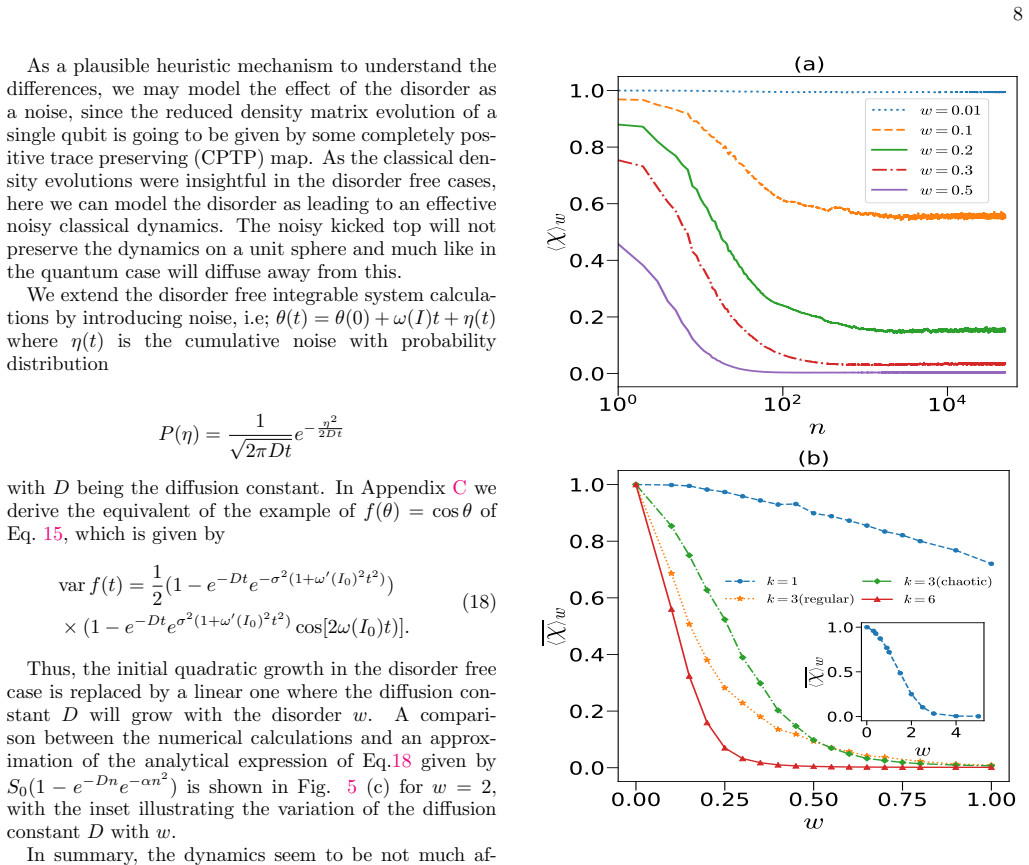
The paper's central claim is that disorder in the interaction term of a permutation-symmetric quantum kicked top breaks the conservation of $J^2$, forcing states that start in the (N+1)-dimensional symmetric subspace to spread over the full $2^N$-dimensional Hilbert space, and that this spreading is itself a route to chaos. At a small disorder of $w=0.01$ the revivals of the clean regular system survive, with the Ehrenfest time still scaling as $\sqrt{N}$ and the revival time as $t_r \sim N$, but they are destroyed at $w \approx 2$; for larger disorder the long-time single-qubit linear entropy saturates to the Wishart (random pure state) value $\approx 0.5$ of the full Hilbert space, and the $N/2$-qubit entropy to $\approx 0.984$, rather than to the permutation-symmetric random values $\approx 0.464$ and $\approx 0.766$. Spectral statistics confirm the crossover, with level spacing changing from Poisson to COE Wigner-Dyson as $w$ grows, while the overlap with the symmetric subspace and the effective dimension of eigenstates flow from $N+1$ toward $2^N$. The paper further establishes that in the clean limit the quantum single-qubit entanglement matches a purely classical ensemble calculation to order $10^{-3}$, and that the disordered case is captured by a noisy classical model with an effective diffusion constant.
Load-bearing premise
The paper measures single-qubit entanglement after disorder with a formula that is proven only inside the permutation-symmetric subspace, and it never states whether it switched to tracing out a single qubit directly once that symmetry is broken; if the formula was used throughout, the disorder-phase curves rest on an unjustified equality.
Editorial extensions
If this is right
- Disorder acts as a proxy for chaos: a kicked top that is regular when clean develops chaotic signatures — no revivals, Wigner-Dyson level statistics, random-state entanglement — once the disorder strength is large enough, for any value of the clean chaos parameter k.
- Weak symmetry-breaking disorder at w=0.01 leaves the near-integrable dynamics essentially unchanged, so the square-root-N Ehrenfest time and the revival time t_r ~ N persist almost as in the clean system.
- In the large-disorder phase the long-time entanglement matches the Wishart random-pure-state ensemble of the full 2^N Hilbert space, so the disordered Floquet system thermalizes toward states that look random for these observables.
- Pseudo-phase-space maps of the long-time linear entropy keep distinct spots at the classical fixed points and period-4 orbits even at w=6, indicating that some classical structures survive as many-body quantum scars in the disordered system.
- Spectral statistics cross from Poisson to COE Wigner-Dyson with increasing w, passing through an intermediate band structure in the quasienergy density that reflects the partially broken permutation symmetry.
Reading between the lines
- The paper fits a diffusion constant D(w) to its noisy classical model but never states how D scales with w; if the disorder acts as a sum of independent per-kick fluctuations, D should grow like w², a short numerical check that would turn the noise model from a fit into a prediction.
- The mechanism — a conserved collective quantity destroyed by static randomness — should produce the same disorder-driven crossover in any all-to-all permutation-symmetric Floquet model, with the required disorder strength set by how chaotic the clean dynamics is; the k-dependence of the time-averaged overlap already points in this direction.
- Defining a crossover disorder w* where revivals lose half their peak height would allow a quantitative test: if w* scales like 1/sqrt(N) it tracks the Ehrenfest scale, whereas an N-independent w* would point to a true chaos threshold rather than perturbative broadening.
Editorial analysis
A structured set of objections, weighed in public.
Referee Report
Summary. The paper studies how disorder that breaks particle-permutation symmetry affects the dynamics of an N-qubit kicked top. Starting from a spin-coherent state in the (N+1)-dimensional permutation-symmetric subspace, disorder in the interaction term lets the dynamics spread into the full 2^N-dimensional Hilbert space. The authors analyze the single-qubit linear entropy, its short-time growth and revivals, the overlap with the symmetric subspace, the effective dimension of Floquet eigenstate decompositions, and spectral statistics. Their main claims are: (i) a parameter-free classical ensemble calculation reproduces the disorder-free quantum single-qubit linear entropy to order 10^-3; (ii) small disorder preserves the Ehrenfest scaling tau_h ~ sqrt(N) and revivals at t_r ~ N, while w ~ 2 destroys the revivals; and (iii) with increasing disorder the system enters a chaotic phase in the full Hilbert space, signaled by saturation of S_1 to the Wishart value ~0.5, vanishing overlap chi, D_eff -> 2^N, and a Poisson-to-COE spectral transition.
Significance. If the central claims hold, the paper provides a useful bridge between dynamical entanglement, disorder, and chaos in a many-qubit Floquet system. The clean-limit classical ensemble correspondence in Fig. 2(b) is a genuine quantitative result, and the paper includes direct numerical evidence from FWHT simulations up to N=16 as well as spectral statistics. The main weakness is that the entropy-based evidence for full-Hilbert-space thermalization is under-specified: the manuscript does not state how S_1 is computed once permutation symmetry is broken, and the disordered-regime 'analytical' comparison is partly a fit. These issues are load-bearing for the claimed disorder-induced chaotic phase, but they are resolvable within revision.
major comments (2)
- [Secs. IV A and IV D; Eq. (9)] The manuscript never states whether S_1 in the disordered regime is computed from the exact one-qubit reduced density matrix or from Eq. (9). Eq. (9) is derived in Sec. III under permutation symmetry, where all single-qubit Bloch vectors are identical. Once disorder breaks this symmetry, the exact disorder-averaged single-qubit linear entropy is (1/N) sum_i (1 - |<sigma_i>|^2)/2, whereas Eq. (9) evaluates 1/2 (1 - |sum_i <sigma_i>|^2 / N^2). By convexity the latter is a lower bound whenever local Bloch vectors are unequal. If Eq. (9) was used for Figs. 5, 8(a), 9, 12, and 14, the reported values understate the true entropy, the fitted diffusion constants in Fig. 5(c) are not well-defined, and the saturation to the Wishart value ~0.5 reflects only vanishing collective magnetization rather than uniform single-qubit mixedness. If the reduced density matrix was traced directly, that should be stated. This is load-bearing because the thermalization-from-disorder claim rests on these curves. Please clarify the numerical procedure and, if Eq. (9) was used, repeat the analysis with the exact S_1 or justify the approximation quantitatively.
- [Sec. IV A; Eq. (18), Fig. 5(c)] The comparison between numerics and the 'analytical' disordered curve uses the fitted form S0 (1 - e^{-D n} e^{-alpha n^2}) with S0, D, and alpha extracted from the same numerical data it is compared with; no independent measurement or closed-form prediction of D(w) is given. The inset shows that D grows with w, but neither the fitting procedure nor the associated errors are reported. As presented, this fit supports the functional form of Eq. (18) but not the specific identification of D as a diffusion constant or the quantitative validity of the noise model. Please either provide a parameter-free comparison, derive D(w) from the disorder strength, or clearly label the curve as a heuristic fit and provide residuals or error bars.
minor comments (5)
- [Eqs. (1) and (17)] Eq. (1) and Eq. (5) use sums over i,j from 1 to N, which include self-terms sigma_i^x sigma_i^x, while the Floquet operator in Eq. (17) uses l < l'. Please reconcile the notation or explain why the self-terms are irrelevant.
- [Sec. VII] The summary states that for small disorder 'we continue to observe the revivals at a time scale tau_h ~ N'; this should read t_r ~ N, since tau_h is the Ehrenfest time defined earlier with sqrt(N) scaling.
- [Sec. IV A, Fig. 5(a)] The fitted curve in Fig. 5(a) is 0.35(1 - e^{-0.22 n^{1.93}/N}), whereas Eq. (11) predicts an n^2/N dependence. The slight deviation of the exponent from 2 is not discussed and should be addressed.
- [Sec. V A, Fig. 13] The level-spacing analysis does not describe the unfolding procedure, which matters because the inset shows a clustered, non-uniform density of quasienergies at w = 0.5. Please specify the unfolding method and, ideally, report the level-spacing ratio as a more parameter-free statistic.
- [Sec. IV C, Fig. 7] The effective dimension D_eff is defined with a threshold alpha = 0.0001 on the cumulative coefficient weight. Please comment on the sensitivity of the reported D_eff values to this cutoff, especially for the intermediate-disorder regime where the approach to 2^N is gradual.
Circularity Check
The disordered and chaotic growth curves are fitted analytical forms rather than parameter-free predictions, but the central 'disorder drives full-Hilbert-space chaos' claim is supported by independent quantities.
-
fitted input called prediction
[Section IV A, Eq. (18) and Fig. 5(c)]
"A comparison between the numerical calculations and an approximation of the analytical expression of Eq.18 given by S0(1−e^{−Dn}e^{−α n^2}) is shown in Fig. 5 (c) for w=2, with the inset illustrating the variation of the diffusion constant D with w."
The function compared with the numerics contains three free constants, S0, D, and α. The paper gives no independent prescription for computing D from the disorder strength w, and S0 and α are not specified at all. The 'analytical' curve in Fig. 5(c) is therefore a fit to the very data it is compared with, not a prediction derived from the noisy-channel model. The agreement shown is, by construction, the agreement of a fitted curve, so the claim that the noise model 'fits well with the numerical calculations' is partly a statement about the flexibility of the fitting form rather than about the model's predictive content.
-
fitted input called prediction
[Section III B 1, Eq. (16) and Fig. 3 inset]
"The form of the time evolution may also be inferred from general arguments to be approximately varf(t)≈ 1/2 (1−exp(−ασ² e^{2λt})), where α>0 is a constant, and λ>0 is the Lyapunov exponent. ... The inset shows comparison of analytical expression given in Eq.16 with the numerics for N=1000."
For the chaotic kicked top, Eq. (16) introduces an unspecified constant α and a Lyapunov exponent λ whose numerical values are not stated or independently determined in the paper. The comparison in the inset of Fig. 3 is thus a two-parameter fit to the same S1 data it is used to validate. This does not invalidate the qualitative log-time saturation, but the claimed 'analytical expression' is not a parameter-free derivation; its agreement with numerics is enforced by the free constants rather than produced by the semiclassical argument.
full rationale
The paper's main conclusions—escape from the permutation-symmetric subspace, growth of the effective dimension, destruction of revivals, and the Poisson-to-COE spectral crossover—are numerical observations compared against external benchmarks (the Wishart random-state value, full Hilbert-space dimension, and COE prediction). These do not reduce to the fitted quantities. The disorder-free classical variance formula, Eq. (15), is derived from a Gaussian ensemble in action-angle variables and compared with quantum S1 without adjustable parameters; that comparison is a legitimate first-principles prediction. The partially circular elements are confined to the 'analytical' growth curves: Eq. (16) for the chaotic clean case and the noisy-channel expression behind Eq. (18) for the disordered case are used with free fitting constants (S0, D, α) that are not determined a priori, so the displayed agreement is partly a fit. The self-citation to the authors' earlier work [45] is not load-bearing because the present paper supplies independent measures (χ, D_eff, spectral statistics). One important caveat is not counted as demonstrated circularity under the hard-rule standard: Eq. (9) is derived under permutation symmetry, and Section IV never states whether S1 is computed by direct partial trace or by reusing Eq. (9) after disorder breaks the symmetry. If Eq. (9) were reused, the saturation to 0.5 would be a statement about vanishing collective magnetization rather than genuine single-qubit entanglement; but the text does not exhibit that reduction, so it is a correctness/definition question rather than a provable circular step.
Assumptions & free parameters
free parameters (5)
- α (Eq. 11 regular-regime exponent) =
≈0.25
- S∞ (Eq. 11 saturation value) =
≈0.35
- α and λ (Eq. 16 chaotic variance form) =
not stated
- D (diffusion constant, Eq. C4) =
varies with w; e.g. ≈0.13 for w=2
- S0 and α in approximation 0.37(1-e^{-0.13n-0.01n^2}) =
S0≈0.37, α≈0.01
assumptions (5)
- domain assumption Near-integrability: for k=1 the kicked top admits good action-angle variables (I, θ) with ω'(I0) ≠ 0.
- ad hoc to paper Single-qubit linear entropy equals the collective spin variance expression of Eq. 9 in the disordered regime.
- ad hoc to paper Disorder can be modeled as additive Gaussian phase noise with diffusion constant D.
- domain assumption Standard RMT formulas: Wishart average Eq. 20 and COE level-spacing describe the large-w limit.
- standard math Fourier and Gaussian integral manipulations in Appendices A-C are valid.
invented entities (1)
-
Effective noise/diffusion model for disorder
Cite this review
Pith. "Pith review of Disordering a permutation symmetric system: revivals, thermalization and chaos." pith.science (2026). https://pith.science/paper/H6C6G2CN
@misc{pith2026250524453,
  author       = {Pith},
  title        = {Pith review of: Disordering a permutation symmetric system: revivals, thermalization and chaos},
  year         = {2026},
  howpublished = {\url{https://pith.science/paper/H6C6G2CN}},
  note         = {Machine review of arXiv:2505.24453}
}
abstract
This study explores the effects of introducing a symmetry breaking disorder on the dynamics of a system invariant under particle permutation. The disorder forces quantum states, confined to the $N+1$ dimensional completely symmetric space to penetrate the exponentially large $2^N$ dimensional Hilbert space of $N$ particles. In particular, we focus on the quantum kicked top as a Floquet system of $N$ qubits, and use linear entropy, measuring single qubit entanglement, to investigate the changes in the time scales and values of saturation when disorder is introduced. In the near-integrable regime of the kicked top, we study the robustness of quantum revivals to disorder. We also find that a classical calculation yields the quantum single qubit entanglement to remarkable accuracy in the disorder free limit. The disorder, on the other hand, is modeled in the form of noise which again fits well with the numerical calculations. We measure the extent to which the dynamics is retained within the symmetric subspace and its spreading to the full Hilbert space using different quantities. We show that increasing disorder drives the system to a chaotic phase in full Hilbert space, as also supported by the spectral statistics. We find that there is robustness to disorder in the system, and this is a function of how chaotic the kicked top is.
Figures


Figures from the paper (10 more)



Reference graph
Works this paper leans on
-
[1]
Temporal behavior of linear entropy: Ehrenfest and Revival time scales Ehrenfest time scale [21, 58–60] denoted asτℏ is defined as the time scale over which the classical and quantum dynamics of a system remains comparable, i.e., till the time when quantum interference effects start manifest- ing. In the near-integrable regime whenk≪3, apart from the Ehre...
-
[2]
Long time averaged linear entropy Fig. 4. shows the long time averaged linear entropy calculated for different initial states|θ, ϕ⟩, and different kvalues. We see localized structures in Fig.4 (a) resem- bling classical phase space fork= 1 around the fixed points (π/2, π/2) and (π/2,−π/2) where the linear en- tropy is minimum. A similar resemblance is see...
-
[3]
A comparison between numerics and the analytics forw= 2,N= 16
(c). A comparison between numerics and the analytics forw= 2,N= 16. The inset shows the increase inDwith disorderwfor the same system parameters. All the figures correspond tok= 1 with initial state set to|θ, ϕ⟩=|2.25,1.1⟩. 8 As a plausible heuristic mechanism to understand the differences, we may model the effect of the disorder as a noise, since the red...
-
[4]
J. N. Bandyopadhyay and A. Lakshminarayan, Physical review letters89, 060402 (2002)
work page 2002
-
[5]
in the chaotic limit using the permutation symmetric ensemble ofN+ 1 dimension is given as [22]: ⟨SQ⟩P SS= Q(N−Q) (Q+ 1)(N−Q+ 1) (21) Thus forN= 14,⟨S 1⟩W,2 = 0.499 and⟨S 7⟩W,2N/2 = 0.984, which are the observed saturation values for all kfor sufficiently largew. The corresponding values in PSS is given by⟨S 1⟩P SS= 0.464 and⟨S 7⟩P SS= 0.766. While there ...
-
[6]
W. H. Zurek and J. P. Paz, Physica D: Nonlinear Phe- nomena83, 300 (1995)
work page 1995
-
[7]
Georgeot and D
B. Georgeot and D. L. Shepelyansky, Phys. Rev. E62, 3504 (2000)
2000
-
[8]
P. A. Miller and S. Sarkar, Physical Review E60, 1542 (1999)
work page 1999
Show all 77 references
-
[9]
P. H. Song and D. L. Shepelyansky, Physical Review Let- ters86, 2162 (2001)
2001
-
[10]
J. N. Bandyopadhyay and A. Lakshminarayan, Physical Review E69, 016201 (2004)
2004
-
[11]
Lakshminarayan, Physical Review E64, 036207 (2001)
A. Lakshminarayan, Physical Review E64, 036207 (2001). 16
2001
-
[12]
Hou and B
X.-W. Hou and B. Hu, Physical Review A69, 042110 (2004)
2004
-
[13]
V. V. Flambaum, Australian Journal of Physics53, 489 (2000)
2000
-
[14]
A. Piga, M. Lewenstein, and J. Q. Quach, Physical Re- view E99, 032213 (2019)
2019
-
[15]
Georgeot and D
B. Georgeot and D. L. Shepelyansky, Physical Review E 62, 6366 (2000)
2000
-
[16]
Braun, Physical Review A65, 042317 (2002)
D. Braun, Physical Review A65, 042317 (2002)
2002
-
[17]
Madhok, S
V. Madhok, S. Dogra, and A. Lakshminarayan, Optics Communications420, 189 (2018)
2018
-
[18]
Shepelyansky, Physica Scripta2001, 112 (2001)
D. Shepelyansky, Physica Scripta2001, 112 (2001)
2001
-
[19]
Wang and M
Q. Wang and M. Robnik, Physical Review E107, 054213 (2023)
2023
-
[20]
Chinni, P
K. Chinni, P. M. Poggi, and I. H. Deutsch, Physical Review Research3, 033145 (2021)
2021
-
[21]
Haake,Quantum signatures of chaos(volume 54
F. Haake,Quantum signatures of chaos(volume 54. Springer Science and Business, 2013)
2013
-
[22]
Wimberger,Non Linear dynamics and Quantum Chaos - An Introduction(Springer International Publish- ing Switzerland, 2014)
S. Wimberger,Non Linear dynamics and Quantum Chaos - An Introduction(Springer International Publish- ing Switzerland, 2014)
2014
-
[23]
P. R. Zangara, A. D. Dente, E. Torres-Herrera, H. M. Pastawski, A. Iucci, and L. F. Santos, Physical Review E—Statistical, Nonlinear, and Soft Matter Physics88, 032913 (2013)
2013
-
[24]
Wang and K
X. Wang and K. Mølmer, The European Physical Journal D-Atomic, Molecular, Optical and Plasma Physics18, 385 (2002)
2002
-
[25]
Sreeram, V
P. Sreeram, V. Madhok, and A. Lakshminarayan, Jour- nal of Physics D: Applied Physics54, 274004 (2021)
2021
-
[26]
Lerose and S
A. Lerose and S. Pappalardi, Physical Review A102, 032404 (2020)
2020
-
[27]
Seshadri, V
A. Seshadri, V. Madhok, and A. Lakshminarayan, Phys- ical Review E98, 052205 (2018)
2018
-
[28]
X. Wang, S. Ghose, B. C. Sanders, and B. Hu, Physical Review E70, 016217 (2004)
2004
-
[29]
Baguette, T
D. Baguette, T. Bastin, and J. Martin, Physical Review A90, 032314 (2014)
2014
-
[30]
Chaudhury, A
S. Chaudhury, A. Smith, B. Anderson, S. Ghose, and P. S. Jessen, Nature461, 768 (2009)
2009
-
[31]
Berke, E
C. Berke, E. Varvelis, S. Trebst, A. Altland, and D. P. DiVincenzo, Nature Communications13, 2495 (2022)
2022
-
[32]
Braiman, J
Y. Braiman, J. F. Lindner, and W. L. Ditto, Nature 378, 465 (1995)
1995
-
[33]
Hauke, F
P. Hauke, F. M. Cucchietti, L. Tagliacozzo, I. Deutsch, and M. Lewenstein, Reports on Progress in Physics75, 082401 (2012)
2012
-
[34]
Russomanno, R
A. Russomanno, R. Fazio, and G. E. Santoro, Euro- physics Letters110, 37005 (2015)
2015
-
[35]
A. U. Devi, Sudha, and A. Rajagopal, Quantum Infor- mation Processing11, 685 (2012)
2012
-
[36]
D. J. Markham, Physical Review A83, 042332 (2011)
2011
-
[37]
Popkov and M
V. Popkov and M. Salerno, International Journal of Mod- ern Physics B26, 1243009 (2012)
2012
-
[38]
Ribeiro, J
P. Ribeiro, J. Vidal, and R. Mosseri, Physical review letters99, 050402 (2007)
2007
-
[39]
U. T. Bhosale and M. Santhanam, Physical Review E98, 052228 (2018)
2018
-
[40]
Russomanno, M
A. Russomanno, M. Fava, and M. Heyl, Physical Review B104, 094309 (2021)
2021
-
[41]
Vidal, R
J. Vidal, R. Mosseri, and J. Dukelsky, Physical Review A69, 054101 (2004)
2004
-
[42]
Ghose, R
S. Ghose, R. Stock, P. Jessen, R. Lal, and A. Silberfarb, Physical Review A78, 042318 (2008)
2008
-
[43]
J. B. Ruebeck, J. Lin, and A. K. Pattanayak, Physical Review E95, 062222 (2017)
2017
-
[44]
L. J. Fiderer and D. Braun, Nature communications9, 1351 (2018)
2018
-
[45]
U. T. Bhosale and M. Santhanam, Physical Review E95, 012216 (2017)
2017
-
[46]
Y. S. Weinstein and L. Viola, Europhysics Letters76, 746 (2006)
2006
-
[47]
Neill, P
C. Neill, P. Roushan, M. Fang, Y. Chen, M. Kolodru- betz, Z. Chen, A. Megrant, R. Barends, B. Campbell, B. Chiaro,et al., Nature Physics12, 1037 (2016)
2016
-
[48]
Krithika, V
V. Krithika, V. Anjusha, U. T. Bhosale, and T. Mahesh, Physical Review E99, 032219 (2019)
2019
-
[49]
X. Wang, J. Ma, L. Song, X. Zhang, and X. Wang, Physical Review E82, 056205 (2010)
2010
- [50]
-
[51]
G. J. Milburn, arXiv preprint quant-ph/9908037 (1999)
1999 arXiv
-
[52]
Haake, M
F. Haake, M. Ku´ s, and R. Scharf, Zeitschrift f¨ ur Physik B Condensed Matter65, 381 (1987)
1987
-
[53]
Sanders and G
B. Sanders and G. Milburn, Zeitschrift f¨ ur Physik B Con- densed Matter77, 497 (1989)
1989
-
[54]
Lombardi and A
M. Lombardi and A. Matzkin, Physical Review E83, 016207 (2011)
2011
-
[55]
Kumari and S
M. Kumari and S. Ghose, Phys. Rev. E97, 052209 (2018)
2018
-
[56]
Dogra, V
S. Dogra, V. Madhok, and A. Lakshminarayan, Physical Review E99, 062217 (2019)
2019
-
[57]
Madhok, V
V. Madhok, V. Gupta, D.-A. Trottier, and S. Ghose, Physical Review E91, 032906 (2015)
2015
-
[58]
Zou and J
Z. Zou and J. Wang, Entropy24, 1092 (2022)
2022
-
[59]
R. M. Angelo, L. Sanz, and K. Furuya, Physical Review E68, 016206 (2003)
2003
-
[60]
Lee Loh and M
Y. Lee Loh and M. Kim, American Journal of Physics 83, 30 (2015)
2015
-
[61]
R. J. Glauber and F. Haake, Physical Review A13, 357 (1976)
1976
-
[62]
M. H. Mu˜ noz-Arias, P. M. Poggi, and I. H. Deutsch, Physical Review E103, 052212 (2021)
2021
-
[63]
M. V. Berry, Journal of Physics A: Mathematical and General12, 625 (1979)
1979
-
[64]
Tomsovic and J
S. Tomsovic and J. H. Lefebvre, Physical review letters 79, 3629 (1997)
1997
-
[65]
Lerose and S
A. Lerose and S. Pappalardi, Phys. Rev. Res.2, 012041 (2020)
2020
-
[66]
R. W. Robinett, Physics reports392, 1 (2004)
2004
-
[67]
Bakman, H
A. Bakman, H. Veksler, and S. Fishman, Physics Letters A381, 2298 (2017)
2017
-
[68]
Zhao and B
Y. Zhao and B. Wu, Science China Physics, Mechanics & Astronomy62, 997011 (2019)
2019
-
[69]
Lubkin, Journal of Mathematical Physics19, 1028 (2008)
E. Lubkin, Journal of Mathematical Physics19, 1028 (2008)
2008
-
[70]
Modak, V
R. Modak, V. Alba, and P. Calabrese, Journal of Statis- tical Mechanics: Theory and Experiment2020, 083110 (2020)
2020
-
[71]
R. F. Fox and T. C. Elston, Physical Review E50, 2553 (1994)
1994
-
[72]
Sierant, G
P. Sierant, G. Chiriac` o, F. M. Surace, S. Sharma, X. Turkeshi, M. Dalmonte, R. Fazio, and G. Pagano, Quantum6, 638 (2022)
2022
-
[73]
D. N. Page, Physical review letters71, 1291 (1993)
1993
-
[75]
Wishart, Biometrika , 32 (1928)
J. Wishart, Biometrika , 32 (1928). 17
1928
-
[76]
Mehta,Random Matrices, ISSN (Elsevier Science, 2004)
M. Mehta,Random Matrices, ISSN (Elsevier Science, 2004)
2004
-
[77]
Chen, K.-w
F. Chen, K.-w. Wong, X. Liao, and T. Xiang, Theoretical Computer Science552, 13 (2014)
2014
-
[210]
Forw= 0,D eff ∼11 for allk−values. andk= 6. The study of ⟨χ⟩w shows that indeed aswis increased for a givenk, the system evolves more and more out of the PSS. Also, smallkrequires larger disorder to be taken out of PSS whereas largekcan be taken out of PSS even by small disord...
Reviewed August 7, 2026 · model on record in the stance chip above.
Discussion (0). Sign in to comment.