REVIEW 3 major objections 6 minor 66 references
Billions of Sketches Reveal Hidden Cultural Variation in Human Concepts
T0 review · 3 major / 6 minor · reviewed 2026-08-03 · deepseek-v4-flash
Pith's one-line read Common concepts unfold into multiple visual exemplars, and sketch-based similarity tracks cultural differences better than word-based similarity does.
desk verdict Impressive scale and honest analysis, but the headline 32% result is undercut by an unfair language baseline that collapses same-language countries. read the letter →
The pith
A machine-rendered reading of the paper's core claim, the machinery that carries it, and where it could break.
The reading
What carries the argument
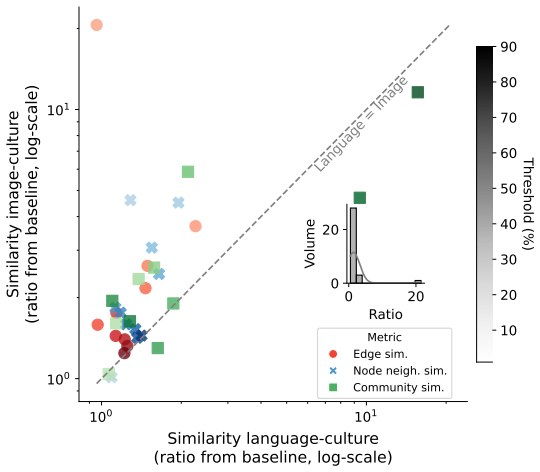
The central mechanism is the one-to-many mapping from a concept word to multiple visual exemplar clusters. Drawings are embedded in a visual similarity space, clustered into stable forms with noise separated, and each country is represented by its odds-ratio profile of cluster usage across concepts; these profiles yield a country similarity network that is compared with a language-based network built from translated concept names in multilingual word embeddings and with a cultural network built from survey-based value distances. The comparison uses edge, neighborhood, and community overlap measures relative to a null model. The load-bearing quantity is the 32% median ratio of image-culture s
What would settle it
A falsifying test is to recompute the country similarity network after matching or reweighting participants across countries on age, education, and internet access (or controlling for GDP per capita); if the image-culture alignment drops to the language-culture level, the cultural signal is an artifact of participation bias. Alternatively, a controlled drawing study with representative national samples could check whether the same 32% advantage appears when demographics are balanced.
Extended reading notes
Core claim
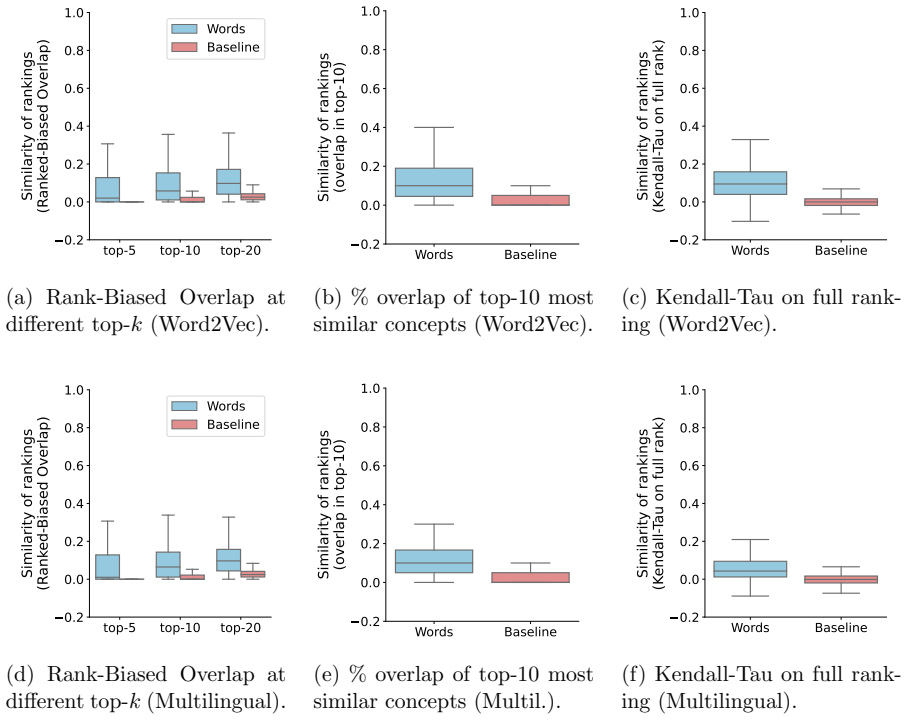
The discovery is that collective visual representations of common concepts are organized into multiple recurrent exemplars (median of two per concept; e.g., pizza drawn as a slice or a whole pie, fish facing left or right), that these visual geometries are nearly uncorrelated with word-based semantic geometries (rank correlation around 0.098), and that sketch-derived cross-national similarities match established cultural distances more closely than word-derived similarities do — a median improvement of 32% across network metrics and thresholds. The authors present this as evidence that conceptual universality depends on measurement modality: language compresses rich experiential variation in
Load-bearing premise
The central claim rests on the assumption that country-level drawing pools, though dominated by US and anglophone users and biased toward digitally privileged participants, still represent each country's culture well enough that sketch similarity tracks conceptual culture rather than shared participation demographics or development levels.
Editorial extensions
If this is right
- Concepts that look universal in word-based analyses may show substantial variation when measured through drawing, so universality claims should specify the modality of measurement.
- Text-only embedding models are likely to under-represent the cultural and embodied structure of human concepts, motivating multimodal training that includes visual or sensory data.
- Large-scale sketch data can serve as a complementary tool for mapping cultural distances between countries, at least for the digitally connected populations represented in the data.
- The visual-exemplar clustering of concepts provides a quantitative way to study within-concept cultural variability and its links to embodied experience.
- Concepts strongly tied to hand/arm interaction are more visually coherent, suggesting embodied interaction shapes shared visual representations.
Reading between the lines
- If the modality-dependence result holds, other non-linguistic modalities — emoji use, product images, gestures, sound — might be equally informative, and combining modalities could map cultural conceptual structure more completely than any single channel.
- A direct testable extension is to re-weight or stratify the drawing sample by demographics (age, education, internet access) or to control for GDP and connectivity; if the image-culture alignment survives those controls, the cultural-signal interpretation is much stronger.
- The 32% advantage may partly reflect that both drawings and the cultural survey come from people, whereas word embeddings come from text corpora with different population biases; aligning all measures to the same respondent population would sharpen the comparison.
Signed reviews
Editorial analysis
A structured set of objections, weighed in public.
Referee Report
Summary. The paper analyzes 2.6 billion QuickDraw sketches of 344 concepts from 236 countries. It first shows that sketches of a concept form multiple distinct visual exemplar clusters rather than a single prototype, and that clusterability correlates selectively with haptic and hand/arm sensorimotor properties. It then compares image-based concept embeddings with word embeddings, reporting low rank correspondence (macro-average 0.098) between visual and linguistic similarity rankings. Finally, it constructs country networks from sketch behavior and from primary-language word embeddings, and reports that the image-based country network aligns 32% more closely (median across conditions) with World Values Survey cultural distances than the language-based network does. The paper's central claim is that apparent conceptual universality is modality-dependent: visual representations preserve cultural variation that word embeddings compress away.
Significance. If the central comparison were fair, this would be an important contribution. The empirical scale is exceptional, and the robustness program is genuinely thorough: multiple embedding models, several edge thresholds, three node counts, two WVS matching criteria, WVS sub-dimensions, disparity filtering, partial Mantel tests, and code availability all strengthen the descriptive claims about sketch structure. The paper also makes a falsifiable prediction—image-based country similarities should track cultural distances better than word-based similarities—which is the right kind of claim to test. However, the language baseline is currently too coarse to support the headline 32% claim: it assigns each country one primary national language, so countries sharing a language receive identical profiles. The comparison therefore pits a rich behavioral measure against a drastically simplified linguistic label, and the main quantitative conclusion is at risk. The sampling bias acknowledged in the Discussion is also not controlled for, further threatening the cultural-inference component. With a fairer language baseline and demographic controls, the paper's thesis could be established; without the
major comments (3)
- [Methods, Networks; Results, Fig. 4; Table 3] The language-based network is built from each country's primary national language, so countries sharing a primary language (US, UK, Australia, Canada, India, Nigeria, Philippines for English) receive identical language profiles. The image-based network, by contrast, uses country-specific sketch behavior. The reported 32% image-over-language improvement and the partial Mantel result therefore compare a rich behavioral matrix against a country-level language label. This does not establish that 'words compress cultural variation'; it may only show that a single national-language label discards within-language cultural variation. The authors run extensive robustness checks on thresholds and node counts, but no robustness check on this baseline construction. A fairer baseline should use country-specific word usage, multilingual per-country distributions, or at least a language-family/area-lev
- [Discussion, Limitations; Methods, Data Processing; Table 1] The dataset is 41.3% US, the game interface is English, and the authors concede that participation is likely biased toward socioeconomically privileged cohorts (Discussion, Limitations). Country-level sketch similarity could therefore reflect shared participation demographics, internet penetration, or development gradients rather than conceptual structure. The alignment between image-based country networks and WVS cultural distances could be an artifact of the same demographic gradient driving both. The authors acknowledge the bias but do not control for it—there is no robustness check against GDP per capita, internet penetration, or English proficiency. At minimum, the paper should report partial correlations of the image-culture alignment with these variables, or show that the result survives when restricting to high-participation countries or to countries above a participation thresho
- [Methods, Clustering and Grid Components Clustering; SI Figs. 6, 9] The image-based network and all exemplar-cluster analyses depend on the cluster definitions, but these definitions are not independently validated. The grid-based high-density threshold is selected by maximizing precision against DBSCAN cluster labels on the same dataset (SI, Grid Components Clustering), and the clusterability noise threshold is the local minimum of the same data's noise distribution. This internal tuning risks overfitting the cluster solution to the specific clustering algorithm and dataset. The robustness checks cover embedding choice, edge thresholds, node counts, and filtering methods, but not the clustering pipeline itself. The authors should demonstrate cluster stability under subsampling and alternative clustering algorithms, or validate a sample of clusters against human judgments. This is less central than the language-baseline issue, but it is load-bearing for
minor comments (6)
- [SI Table 1] The country code for Latvia appears as 'L V' (with a space); it should be 'LV'.
- [Fig. 2 caption] The caption says 'The density distribution of property scores is reported on the x-axis,' but it is unclear what is being plotted. Please clarify whether this is a histogram, a density curve, or something else.
- [Data and Code Availability] The full dataset was shared under an NDA, and only a 50M sample is publicly available. Please state explicitly whether the released code can reproduce the main analyses on the public sample, and what exactly differs when using the full 2.6B dataset.
- [Word vs. Image Semantics] The macro-average 0.098 is described as a rank correlation across multiple metrics, but Rank-Biased Overlap, top-10 overlap, and Kendall's tau are not directly comparable. Please report each metric separately with confidence intervals, or clarify which single metric the 0.098 refers to.
- [SI, Clusterability robustness] The robustness of clusterability to embedding choice is tested on only ten sampled concepts (SI). The small sample should be acknowledged in the main text, and the 0.833 Spearman correlation should be accompanied by a confidence interval.
- [SI Fig. 13 caption] The caption says the word-based network is 'mapped to the coordinates of the image-based one,' but the word-based network is not initially embedded in a coordinate space. Please clarify how the coordinates were assigned.
Circularity Check
No significant circularity: central claims are empirical comparisons against external benchmarks; minor self-citation and internal tuning do not force the results.
full rationale
The paper's load-bearing claims—multiple visual exemplars per concept, haptic-related clusterability, low image–word rank agreement (0.098), and the 32% higher alignment of sketch-based country networks with WVS cultural distances—are not defined into existence. Each is computed from sketch statistics and then compared with independent external benchmarks (Brysbaert/Lynott psycholinguistic norms, Word2Vec/BERT embeddings, and Cultural Fixation scores from WVS). No equation equates a fitted parameter with the reported outcome. The grid-clustering threshold is tuned against DBSCAN labels from the same dataset, but this is model selection for an auxiliary method, and the clusterability correlations use external concept-property ratings; it does not constitute a prediction forced by construction. The only self-citation appearing in a conceptual premise (ref. 13, Guilbeault–Baronchelli–Centola, 'words are a lossy medium') is not load-bearing: the paper's own empirical divergence measures carry the argument. The language-based country network uses only each country's primary national language, making same-language countries identical. This is a legitimate fairness/validity concern about the baseline, but the observed image–culture alignment is an external empirical outcome, not an equivalence-by-construction. The score reflects one minor non-load-bearing self-citation and an internal parameter-tuning step, not a circular derivation.
Assumptions & free parameters
free parameters (8)
- DBSCAN epsilon (per concept) =
not reported per category (selected via DBCV)
- Minimum cluster size (1% of concept sketches) =
1%
- Grid high-density percentile =
60th percentile
- Clusterability noise threshold =
local minimum of bimodal noise distribution
- PCA dimensionality =
40
- Per-country sketch cap =
10,000 per category-country
- UMAP hyperparameters (n_neighbors, min_dist) =
not stated
- Disparity-filter alpha_t =
0.25
assumptions (7)
- domain assumption A sketch produced in response to an English concept label directly reflects the concept's mental representation rather than ambiguity of the (English) stimulus
- domain assumption Users aggregated by IP-inferred country code represent that country's culture
- domain assumption The QuickDraw participant pool within each country is representative of that country's general population
- domain assumption Each country can be represented by a single primary national language for word-based similarity
- domain assumption WVS-based Cultural Fixation distances are an appropriate external benchmark of cultural similarity for comparison with sketch and word networks
- domain assumption Clusterability (fraction of sketches assigned to substantive clusters) measures how unambiguously a concept is visually represented, not other properties such as how easy the object is to draw
- domain assumption Pretrained self-supervised visual embeddings (DINOv2, CLIP) provide a valid similarity space for human sketches
invented entities (1)
-
Visual exemplar attractor clusters
Cite this review
Pith. "Pith review of Billions of Sketches Reveal Hidden Cultural Variation in Human Concepts." pith.science (2026). https://pith.science/paper/H6I2WMPQ
@misc{pith2026260707267,
  author       = {Pith},
  title        = {Pith review of: Billions of Sketches Reveal Hidden Cultural Variation in Human Concepts},
  year         = {2026},
  howpublished = {\url{https://pith.science/paper/H6I2WMPQ}},
  note         = {Machine review of arXiv:2607.07267}
}
read the original abstract
Claims about the universality of human concepts have been predominantly assessed through linguistic similarity across languages and cultures. However, words are effective as communication devices because they compress rich experiential variation into shared conventions, potentially obscuring hidden individual and cultural differences in how concepts are mentally represented. Here, we analyse 2.6 billion human-made sketches of common concepts from 236 countries and territories to examine conceptual structure through people's visual imagination. Consistent with recent work on image-based cognition, we find that single concepts unfold into multiple distinct visual exemplars, revealing latent information about similarities and differences in conceptual structure across cultures. This variation is strongest for concepts involving haptic interaction, suggesting that visual imagery reflects variation in embodied experience as much as conventional definitions. Comparing embedding models of sketches with word embedding models across languages, we find that their geometries diverge, with visual representations preserving rich semantic and cultural structure that language models compress. Cross-cultural similarities derived from sketches align 32% more closely with established cultural distances than do text-based measures. Together, these results suggest that patterns of human conceptual universality may depend critically on the modality through which concepts are measured, with large-scale sketching providing a direct, high-resolution probe of conceptual diversity across embodied and cultural dimensions of thought.
Figures


Figures from the paper (19 more)




Reference graph
Works this paper leans on
-
[1]
& Kay, P
Berlin, B. & Kay, P. Basic color terms: Their universality and evolution (Univ of Cali- fornia Press, 1969)
1969
-
[2]
& Regier, T
Kemp, C., Xu, Y. & Regier, T. Semantic typology and efficient communication. Annual Review of Linguistics 4, 109–128 (2018)
2018
-
[3]
& Evans, J
Lewis, M., Cahill, A., Madnani, N. & Evans, J. Local similarity and global variabil- ity characterize the semantic space of human languages. Proceedings of the National Academy of Sciences 120, e2300986120 (2023)
2023
-
[4]
C., Jiang, S
Xu, Y., Duong, K., Malt, B. C., Jiang, S. & Srinivasan, M. Conceptual relations predict colexification across languages. Cognition 201, 104280 (2020)
2020
-
[5]
& Ran, Q
Liang, Y., Xu, K. & Ran, Q. Shared structure of fundamental human experience revealed by polysemy network of basic vocabularies across languages. Scientific Reports 14, 5877 (2024)
2024
-
[6]
& Tishby, N
Zaslavsky, N., Kemp, C., Regier, T. & Tishby, N. Efficient compression in color naming and its evolution. Proceedings of the National Academy of Sciences 115, 7937–7942 (2018)
2018
-
[7]
H., Norcliffe, E
San Roque, L., Kendrick, K. H., Norcliffe, E. & Majid, A. Universal meaning exten- sions of perception verbs are grounded in interaction. Cognitive Linguistics 29, 371–406 (2018)
2018
-
[8]
& Regier, T
Kemp, C. & Regier, T. Kinship categories across languages reflect general communica- tive principles. Science 336, 1049–1054 (2012)
2012
Show all 66 references
-
[9]
Thompson, B., Roberts, S. G. & Lupyan, G. Cultural influences on word meanings revealed through large-scale semantic alignment. Nature Human Behaviour 4, 1029– 1038 (2020). 23
2020
-
[10]
Jackson, J. C. et al. Emotion semantics show both cultural variation and universal structure. Science 366, 1517–1522 (2019)
2019
-
[11]
& List, J.-M
Tjuka, A., Forkel, R. & List, J.-M. Universal and cultural factors shape body part vocabularies. Scientific Reports 14, 10486 (2024)
2024
-
[12]
Thompson, B., Roberts, S. G. & Lupyan, G. Quantifying semantic similarity across languages in Annual Meeting of the Cognitive Science Society (2018), 2554–2559
2018
-
[13]
& Centola, D
Guilbeault, D., Baronchelli, A. & Centola, D. Experimental evidence for scale-induced category convergence across populations. Nature communications 12, 327 (2021)
2021
-
[14]
Barsalou, L. W. Grounded cognition: Past, present, and future. Topics in cognitive science 2, 716–724 (2010)
2010
-
[15]
Explaining embodied cognition results
Lakoff, G. Explaining embodied cognition results. Topics in cognitive science 4, 773–785 (2012)
2012
-
[16]
Bergen, B. K. Louder than words: The new science of how the mind makes meaning (Basic Books, New York, 2012)
2012
-
[17]
& Lupyan, G
Lewis, M., Balamurugan, A., Zheng, B. & Lupyan, G. Characterizing variability in shared meaning through millions of sketches in Proceedings of the Annual Meeting of the Cognitive Science Society 43 (2021)
2021
-
[18]
Fedorenko, E., Piantadosi, S. T. & Gibson, E. A. Language is primarily a tool for communication rather than thought. Nature 630, 575–586 (2024)
2024
-
[19]
Malt, B. C. Representing the world in language and thought. Topics in Cognitive Science 16, 6–24 (2024)
2024
-
[20]
Guilbeault, D. et al. Color associations in abstract semantic domains. Cognition 201, 104306 (2020). 24
2020
-
[21]
Nadler, E. O. et al. Statistical or embodied? Comparing colorseeing, colorblind, painters, and Large Language Models in their processing of color metaphors. Cognitive Science 49, e70083 (2025)
2025
-
[22]
Hand and Mind: What Gestures Reveal about Thought (University of Chicago Press, Chicago, 1992)
McNeill, D. Hand and Mind: What Gestures Reveal about Thought (University of Chicago Press, Chicago, 1992)
1992
-
[23]
J., Emmorey, K., Smith, J
Xu, J., Gannon, P. J., Emmorey, K., Smith, J. F. & Braun, A. R. Symbolic gestures and spoken language are processed by a common neural system. Proceedings of the National Academy of Sciences 106, 20664–20669 (2009)
2009
-
[24]
M., ¨Ozy¨ urek, A
Willems, R. M., ¨Ozy¨ urek, A. & Hagoort, P. When language meets action: The neural integration of gesture and speech. Cerebral Cortex 17, 2322–2333 (2007)
2007
-
[25]
M., Kita, S
¨Ozy¨ urek, A., Willems, R. M., Kita, S. & Hagoort, P. On-line integration of semantic in- formation from speech and gesture: Insights from event-related brain potentials.Journal of Cognitive Neuroscience 19, 605–616 (2007)
2007
-
[26]
L., Humphries, C
Fernandino, L., Tong, J.-Q., Conant, L. L., Humphries, C. J. & Binder, J. R. Decoding the information structure underlying the neural representation of concepts. Proceedings of the National Academy of Sciences 119, e2108091119 (2022)
2022
-
[27]
Bechtold, L. et al. Brain signatures of embodied semantics and language: A consensus paper. Journal of cognition 6, 61 (2023)
2023
-
[28]
Mukherjee, K. et al. Drawings of THINGS: A large-scale drawing dataset of 1,854 object concepts. Behavior Research Methods 58, 57 (2025)
2025
-
[29]
N., Zhu, L
Zhu, R., Kilonzo, T. N., Zhu, L. Z., Fan, J. E. & Frank, M. C. Cross-Contextual Vari- ability in Children’s Early Understanding of Visual Media. Topics in Cognitive Science (2025)
2025
-
[30]
Long, B., Wang, Y., Christie, S., Frank, M. C. & Fan, J. E. Developmental changes in drawing production under different memory demands in a US and Chinese sample. Developmental Psychology 59, 1784 (2023). 25
2023
-
[31]
E., Huey, H., Chai, Z
Long, B., Fan, J. E., Huey, H., Chai, Z. & Frank, M. C. Parallel developmental changes in children’s production and recognition of line drawings of visual concepts. Nature Communications 15, 1191 (2024)
2024
-
[32]
Yu, Q. et al. Sketch me that shoe in Proceedings of the IEEE Conference on Computer Vision and Pattern Recognition (2016), 799–807
2016
-
[33]
Xu, P. et al. Deep learning for free-hand sketch: A survey.IEEE Transactions on Pattern Analysis and Machine Intelligence 45, 285–312 (2022)
2022
-
[34]
G., Estevez, D
Fernandez-Fernandez, R., Victores, J. G., Estevez, D. & Balaguer, C. Quick, stat!: A statistical analysis of the quick, draw! dataset. arXiv preprint arXiv:1907.06417 (2019)
1907 arXiv
-
[35]
& Eck, D
Ha, D. & Eck, D. A neural representation of sketch drawings. arXiv preprint arXiv:1704.03477 (2017)
2017 arXiv
-
[36]
Xu, P. et al. Sketchmate: Deep hashing for million-scale human sketch retrieval in Pro- ceedings of the IEEE conference on computer vision and pattern recognition (2018), 8090–8098
2018
-
[37]
Xu, P., Joshi, C. K. & Bresson, X. Multigraph transformer for free-hand sketch recog- nition. IEEE Transactions on Neural Networks and Learning Systems 33, 5150–5161 (2021)
2021
-
[38]
Lamb, A., Ozair, S., Verma, V. & Ha, D. Sketchtransfer: A new dataset for exploring detail-invariance and the abstractions learned by deep networks in Proceedings of the IEEE/CVF Winter Conference on Applications of Computer Vision (2020), 963–972
2020
-
[39]
Murphy, G. L. Is there an exemplar theory of concepts? Psychonomic bulletin & review 23, 1035–1042 (2016)
2016
-
[40]
Goldstein, E. B. Cognitive psychology: Connecting mind, research, and everyday expe- rience (Cengage learning Stamford, CT, 2015). 26
2015
-
[41]
& Mervis, C
Rosch, E. & Mervis, C. B. Family resemblances: Studies in the internal structure of categories. Cognitive psychology 7, 573–605 (1975)
1975
-
[42]
Rogers, T. T. et al. Structure and deterioration of semantic memory: a neuropsycholog- ical and computational investigation. Psychological review 111, 205 (2004)
2004
-
[43]
Medin, D. L. & Schaffer, M. M. Context theory of classification learning. Psychological review 85, 207 (1978)
1978
-
[44]
Smith, E. E. & Medin, D. L. Categories and concepts (Harvard University Press, 1981)
1981
-
[45]
Six views of embodied cognition
Wilson, M. Six views of embodied cognition. Psychonomic bulletin & review 9, 625–636 (2002)
2002
-
[46]
Brysbaert, M., Warriner, A. B. & Kuperman, V. Concreteness ratings for 40 thousand generally known English word lemmas. Behavior research methods 46, 904–911 (2014)
2014
-
[47]
& Carney, J
Lynott, D., Connell, L., Brysbaert, M., Brand, J. & Carney, J. The Lancaster Sensori- motor Norms: multidimensional measures of perceptual and action strength for 40,000 English words. Behavior research methods 52, 1271–1291 (2020)
2020
-
[48]
D., Guillaume, J.-L., Lambiotte, R
Blondel, V. D., Guillaume, J.-L., Lambiotte, R. & Lefebvre, E. Fast unfolding of commu- nities in large networks. Journal of statistical mechanics: theory and experiment 2008, P10008 (2008)
2008
-
[49]
A., Waltman, L
Traag, V. A., Waltman, L. & Van Eck, N. J. From Louvain to Leiden: guaranteeing well-connected communities. Scientific reports 9, 5233 (2019)
2019
-
[50]
Muthukrishna, M. et al. Beyond Western, Educated, Industrial, Rich, and Democratic (WEIRD) psychology: Measuring and mapping scales of cultural and psychological dis- tance. Psychological science 31, 678–701 (2020)
2020
-
[51]
J., Park, P
Atari, M., Xue, M. J., Park, P. S., Blasi, D. E. & Henrich, J. Which Humans? 2023
2023
-
[52]
Michel, J.-B. et al. Quantitative analysis of culture using millions of digitized books. science 331, 176–182 (2011). 27
2011
-
[53]
Watching a language model learning chess in Proceedings of the International Conference on Recent Advances in Natural Language Processing (RANLP 2021) (2021), 1369–1379
St¨ ockl, A. Watching a language model learning chess in Proceedings of the International Conference on Recent Advances in Natural Language Processing (RANLP 2021) (2021), 1369–1379
2021
-
[54]
& Hoyos-Idrobo, A
Loyola, P., Marrese-Taylor, E. & Hoyos-Idrobo, A. Perceptual structure in the absence of grounding: the impact of abstractedness and subjectivity in color language for LLMs in Findings of the Association for Computational Linguistics: EMNLP 2023 (2023), 1536–1542
2023
-
[55]
Piantadosi, S. T. et al. Why concepts are (probably) vectors. Trends in Cognitive Sci- ences 28, 844–856 (2024)
2024
-
[56]
Frank, M. C. & Goodman, N. D. Cognitive modeling using artificial intelligence. Annual Review of Psychology 777:543-566 (2026)
2026
-
[57]
& Griffiths, T
Marjieh, R., Sucholutsky, I., van Rijn, P., Jacoby, N. & Griffiths, T. L. Large language models predict human sensory judgments across six modalities. Scientific Reports 14, 21445 (2024)
2024
-
[58]
Oquab, M. et al. Dinov2: Learning robust visual features without supervision. arXiv preprint arXiv:2304.07193 (2023)
2023 arXiv
-
[59]
Radford, A. et al. Learning transferable visual models from natural language supervision in International conference on machine learning (2021), 8748–8763
2021
-
[60]
& Melville, J
McInnes, L., Healy, J. & Melville, J. Umap: Uniform manifold approximation and pro- jection for dimension reduction. arXiv preprint arXiv:1802.03426 (2018)
2018 arXiv
-
[61]
A density-based algorithm for dis- covering clusters in large spatial databases with noise in kdd 96 (1996), 226–231
Ester, M., Kriegel, H.-P., Sander, J., Xu, X., et al. A density-based algorithm for dis- covering clusters in large spatial databases with noise in kdd 96 (1996), 226–231
1996
-
[62]
A., Campello, R
Moulavi, D., Jaskowiak, P. A., Campello, R. J., Zimek, A. & Sander, J. Density-based clustering validation in Proceedings of the 2014 SIAM international conference on data mining (2014), 839–847. 28
2014
-
[63]
& Dean, J
Mikolov, T., Chen, K., Corrado, G. & Dean, J. Word2Vec Google News 300-dimensional embeddings Pre-trained model, accessed 2025-03-01. https://huggingface.co/fse/ word2vec-google-news-300
2025
-
[64]
GTE Multilingual Base Pre-trained BERT-based model, accessed 2025- 03-01
Alibaba-NLP. GTE Multilingual Base Pre-trained BERT-based model, accessed 2025- 03-01. https://huggingface.co/Alibaba-NLP/gte-multilingual-base
2025
-
[65]
´A., Bogun´ a, M
Serrano, M. ´A., Bogun´ a, M. & Vespignani, A. Extracting the multiscale backbone of complex weighted networks. Proceedings of the national academy of sciences 106, 6483– 6488 (2009)
2009
-
[66]
E., Strogatz, S
Newman, M. E., Strogatz, S. H. & Watts, D. J. Random graphs with arbitrary degree distributions and their applications. Physical review E 64, 026118 (2001). Acknowledgements A.P. and L.M.A. acknowledge funding from Carlsberg Foundation Project COCOONS (Grant ID: CF21-0432). Au...
2001
Reviewed August 3, 2026 · model on record in the stance chip above.
Discussion (0). Continue with ORCID to comment.