Channel-Correlation-Enabled Transmit Optimization for MISO Wiretap Channels
Pith reviewed 2026-05-25 13:25 UTC · model grok-4.3
The pith
Correlation between main and wiretap channels enables more precise eavesdropper modeling and higher secrecy rates in MISO systems.
A machine-rendered reading of the paper's core claim, the machinery that carries it, and where it could break.
Core claim
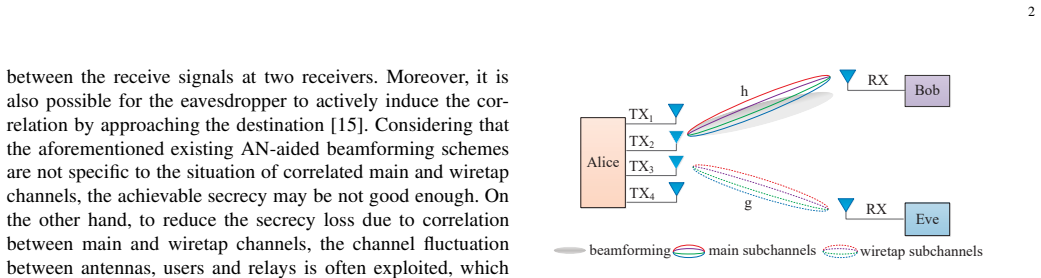
By viewing receiver-side correlation as a resource to acquire more knowledge about the wiretap channel, the statistical distribution of the wiretap channel is described more precisely than standard models allow; this permits non-uniform artificial-noise power allocation and an elaborate information-beamformer design, which together raise the achievable secrecy rate under joint transmit-power and secrecy-outage constraints.
What carries the argument
The channel-correlation-enabled transmit optimization that refines the wiretap-channel distribution from main-channel correlation to guide artificial-noise placement and beamforming.
If this is right
- Artificial-noise power can be placed non-uniformly rather than uniformly in the null space of the main channel.
- An efficient iterative algorithm solves the joint power-allocation and beamforming problem.
- The scheme applies to slow-fading MISO channels with a passive single-antenna eavesdropper and statistical wiretap information.
- Secrecy rate improves relative to correlation-ignorant baselines under the same constraints.
Where Pith is reading between the lines
- The same correlation-exploitation idea could be tested in multi-antenna eavesdropper or fast-fading settings where only partial statistical information is available.
- If the correlation coefficient can be estimated at the transmitter, the approach may reduce reliance on perfect instantaneous wiretap-channel knowledge.
Load-bearing premise
The correlation between main and wiretap channels can be viewed as a resource to acquire more knowledge about the wiretap channel and thereby describe its statistical distribution more precisely than standard models allow.
What would settle it
A direct comparison, under identical power and outage constraints, showing that secrecy rates achieved with the correlation-refined distribution are no higher than those achieved with a conventional independent-channel model.
Figures
read the original abstract
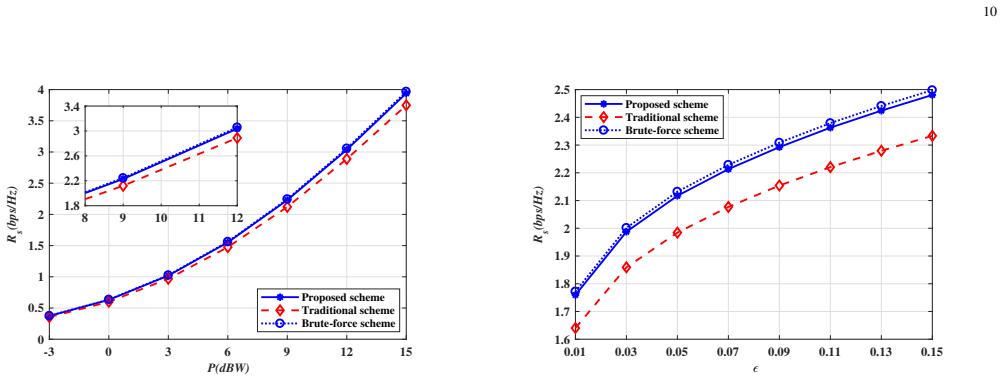
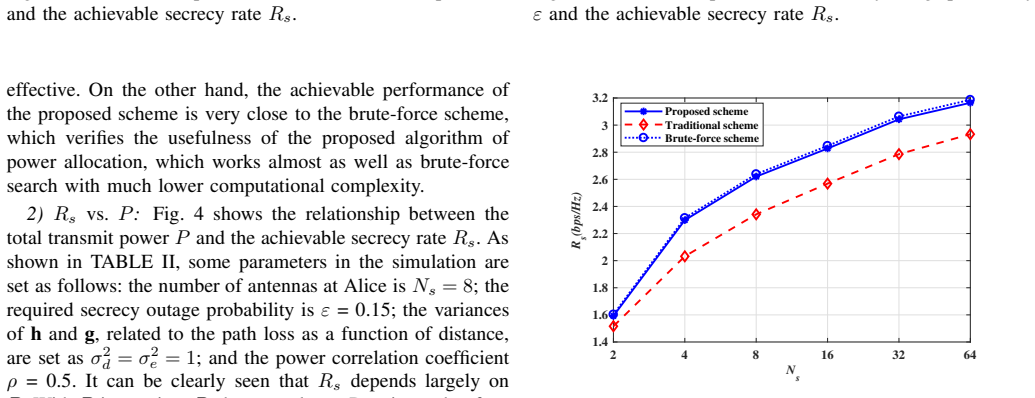
An artificial-noise (AN)-aided beamformer specific to correlated main and wiretap channels is designed in this paper. We consider slow-fading multiple-input-single-output (MISO) wiretap channels with a passive single-antenna eavesdropper, in which independent transmitter-side and correlated receiver-side are assumed. Additionally, the source has accurate main channel information and statistical wiretap channel information. To reduce the secrecy loss due to receiver-side correlation, this paper proposes the scheme of channel-correlation-enabled transmit optimization. Particularly, the correlation is viewed as a resource to acquire more knowledge about wiretap channel. Based on this, the statistical distribution of wiretap channel is described more precisely. Then, the power of AN in the null space of main channel is placed more reasonably instead of simple uniform distribution and an elaborate beamformer for the information-bearing signal is designed. Finally, an efficient algorithm for power allocation between the information-bearing signal and the AN is developed. Simulation results show that the secrecy rate under transmit power and secrecy outage constraint is improved.
Editorial analysis
A structured set of objections, weighed in public.
Referee Report
Summary. The paper proposes an artificial-noise-aided beamformer for slow-fading MISO wiretap channels with a passive eavesdropper, assuming independent transmitter-side channels and correlated receiver-side channels. With perfect main-channel CSI and statistical wiretap CSI, the scheme treats receiver-side correlation as a resource to refine the wiretap channel's statistical distribution, enabling non-uniform AN power allocation in the null space of the main channel, an optimized information-bearing beamformer, and an efficient power-allocation algorithm between signal and AN. Simulations are reported to show improved secrecy rates under total transmit power and secrecy-outage constraints.
Significance. If the refined wiretap distribution is correctly obtained as the conditional law given the main-channel realization, the approach would provide a concrete way to exploit correlation for better AN placement and beamforming, yielding measurable secrecy-rate gains. The development of an efficient power-allocation algorithm is a positive technical contribution. The significance is limited by the need to confirm that the modeling step is derived from the joint statistics rather than an ad-hoc adjustment.
major comments (1)
- [Abstract (modeling step) and subsequent sections on wiretap distribution and secrecy-outage formulation] The central claim rests on obtaining a strictly more precise statistical model of the wiretap channel by exploiting receiver-side correlation. The abstract states that this refined distribution enables non-uniform AN allocation and a better beamformer, yet no explicit derivation of the conditional PDF/CDF (i.e., the proper P(h_e | h_m) under the joint channel law) is referenced. If the outage-probability expression used in the optimization is not obtained from this conditional law, the reported simulation gains become artifacts of the modeling step rather than genuine improvements.
minor comments (1)
- [Abstract] The abstract sentence 'independent transmitter-side and correlated receiver-side are assumed' is grammatically incomplete and should explicitly identify the channels (e.g., 'independent transmitter-side channels and correlated receiver-side channels').
Simulated Author's Rebuttal
We thank the referee for the careful reading and the constructive comment on the modeling of the wiretap channel distribution. We address the point below and will revise the manuscript to make the derivation fully explicit.
read point-by-point responses
-
Referee: [Abstract (modeling step) and subsequent sections on wiretap distribution and secrecy-outage formulation] The central claim rests on obtaining a strictly more precise statistical model of the wiretap channel by exploiting receiver-side correlation. The abstract states that this refined distribution enables non-uniform AN allocation and a better beamformer, yet no explicit derivation of the conditional PDF/CDF (i.e., the proper P(h_e | h_m) under the joint channel law) is referenced. If the outage-probability expression used in the optimization is not obtained from this conditional law, the reported simulation gains become artifacts of the modeling step rather than genuine improvements.
Authors: We agree that an explicit derivation strengthens the paper. The refined wiretap distribution in the manuscript is obtained from the conditional law P(h_e | h_m) under the joint circularly symmetric complex Gaussian distribution of the correlated receiver-side channels (with the given correlation coefficient). The secrecy-outage probability expression used in the optimization is derived directly from this conditional CDF. To address the concern that the derivation is not sufficiently referenced, we will insert a dedicated subsection (likely in Section III) that starts from the joint covariance matrix, applies the standard conditional-Gaussian formulas, and arrives at the PDF/CDF employed in the beamformer and power-allocation design. With this addition the simulation gains will be clearly traceable to the proper conditional statistics rather than an ad-hoc adjustment. revision: yes
Circularity Check
No circularity: correlation treated as external statistical resource; optimization uses standard conditional modeling without self-referential fits or predictions
full rationale
The derivation begins from the standard joint channel model (independent Tx-side, correlated Rx-side) and accurate main-channel CSI plus statistical wiretap info. Correlation is invoked to obtain a more precise marginal/conditional distribution for the wiretap channel, which then informs non-uniform AN allocation and beamformer design. The secrecy-rate objective and outage constraint are expressed directly in terms of these distributions and solved via power allocation; no equation defines a fitted parameter from data and then renames the same quantity a 'prediction,' nor does any step reduce to a self-citation chain that supplies the uniqueness or functional form. The central improvement is therefore an application of the joint law rather than a tautological re-expression of the paper's own inputs. This matches the reader's assessment of score 2 with no evidence of reduction by construction.
Axiom & Free-Parameter Ledger
axioms (3)
- domain assumption Slow-fading MISO wiretap channels with a passive single-antenna eavesdropper
- domain assumption Independent transmitter-side channels and correlated receiver-side channels
- domain assumption Source has accurate main channel information and statistical wiretap channel information
Reference graph
Works this paper leans on
-
[1]
D eep Learning for IoT Big Data and Streaming Analytics: A Survey,
M. Mohammadi, A. Al-Fuqaha, S. Sorour, and M. Guizani , “D eep Learning for IoT Big Data and Streaming Analytics: A Survey, ” IEEE Communications Surveys & Tutorials, vol. 20, no. 4, pp. 2923-2960, 2018
work page 2018
-
[2]
Next Generation 5G Wire less Networks: A Comprehensive Survey,
M. Agiwal, A. Roy, and N. Saxena , “Next Generation 5G Wire less Networks: A Comprehensive Survey,” IEEE Communications Surveys & Tutorials, vol. 18, no. 3, pp. 1617-1655, 2016
work page 2016
-
[3]
Dense-Device-Enabled C ooperative Networks for Efficient and Secure Transmission,
S. Han, S. Xu, W. Meng, and C. Li, “Dense-Device-Enabled C ooperative Networks for Efficient and Secure Transmission,” IEEE Network, vol. 32, no. 2, pp. 100-106, 2018
work page 2018
-
[4]
Y . Liu, H. Chen, and L. Wang, “Physical Layer Security for Next Generation Wireless Networks: Theories, Technologies, an d Challenges,” IEEE Communications Surveys & Tutorials , vol. 19, no. 1, pp. 347-376, 2017
work page 2017
-
[5]
An Agile Confidential Tra nsmission Strategy Combining Big Data Driven Cluster and OBF,
S. Han, S. Xu, W. Meng, and C. Li, “An Agile Confidential Tra nsmission Strategy Combining Big Data Driven Cluster and OBF,” IEEE Transac- tions on V ehicular Technology, vol. 66, no. 11, pp. 10259-10270, 2017
work page 2017
-
[6]
Safeguarding 5G wireless communication networks u sing physi- cal layer security,
N. Y ang, L. Wang, G. Geraci, M. Elkashlan, J. Y uan, and M. D i Renzo,“Safeguarding 5G wireless communication networks u sing physi- cal layer security,” IEEE Communications Magazine , vol. 53, no. 4, pp. 20-27, Apr. 2015
work page 2015
-
[7]
Artifi cial-Noise- Aided Secure Transmission in Wiretap Channels With Transmi tter-Side Correlation,
S. Y an, X. Zhou, N. Y ang, B. He and T. D. Abhayapala,“Artifi cial-Noise- Aided Secure Transmission in Wiretap Channels With Transmi tter-Side Correlation,” IEEE Transactions on wireless Communications , vol. 15, no. 12, Dec. 2016
work page 2016
-
[8]
P . Lin, S. Lai, S. Lin, and H. Su, “On Secrecy Rate of the Gen eralized Artificial-Noise Assisted Secure Beamforming for Wiretap C hannels,” IEEE Journal on Selected Areas in Communications , vol. 31, no. 9, pp. 1728-1740, Sep. 2013
work page 2013
-
[9]
Guaranteeing Secrecy Using Artific ial Noise,
S. Goel, and R. Negi, “Guaranteeing Secrecy Using Artific ial Noise,” IEEE Transactions on wireless Communications , vol. 7, no. 6, pp. 2180- 2189, 2008
work page 2008
-
[10]
Secrecy Outage in MISO Systems with Partial Channel Information,
S. Gerbracht, C. Scheunert, and E. Jorswieck, “Secrecy Outage in MISO Systems with Partial Channel Information,” IEEE Transactions on Information F orensics and Security , vol. 7, no. 2, pp. 704-716, Apr. 2012
work page 2012
-
[11]
J. Xiong, K. Wong, D. Ma, and J. Wei, “A Closed-Form Power Allocation for Minimizing Secrecy Outage Probability for M ISO Wiretap Channels via Masked Beamforming,” IEEE Communications Letters , vol. 16, no. 9, pp. 1496-1499, Sep. 2012
work page 2012
-
[12]
Wang, Bo, P . Mu, and Z. Li, “Secrecy Rate Maximization wi th Artificial- Noise-Aided Beamforming for MISO Wiretap Channels under Se crecy Outage Constraint,” IEEE Communications Letters , vol. 19, no. 1, pp. 18-21, 2015
work page 2015
-
[13]
Performance of Secur e Com- munications over Correlated Fading Channels,
X. Sun, J. Wang, W. Xu, and C. Zhao, “Performance of Secur e Com- munications over Correlated Fading Channels,” IEEE Signal Processing Letter, vol. 19, no. 8, pp. 479-482, Aug. 2012
work page 2012
-
[14]
Bounds on Secr ecy Capacity over Correlated Ergodic Fading Channels at High SN R,
H. Jeon, N. Kim. J. Choi, H. Lee, and J. Ha, “Bounds on Secr ecy Capacity over Correlated Ergodic Fading Channels at High SN R,” IEEE Transactions on Information Theory , vol. 75, no. 4, pp. 1975-1983,
work page 1975
-
[15]
Secure Multiuser Communications in Multiple Amplify-and -Forward Relay Networks,
L. Fan, X. Lei, T. Q. Duong, M. Elkashlan, and G. K. Karagi annidis, “Secure Multiuser Communications in Multiple Amplify-and -Forward Relay Networks,” IEEE Transactions on Communications , vol. 62, no. 9, pp. 3299-3310, Sep. 2014
work page 2014
-
[16]
N. Y ang, P . L. Y eoh, M. Elkashlan, R. Schober, and J. Y uan , “MIMO Wiretap Channels: Secure Transmission Using Transmit Ante nna Selec- tion and Receive Generalized Selection Combining,” IEEE Communica- tions Letter , vol. 17, no. 9, pp. 1754-1757, Sep. 2013
work page 2013
-
[17]
Secure Multiple Amplify-and-Forward Relaying over Correlated Fa ding Chan- nels,
L. Fan, R. Zhao, F. Gong, N. Y ang, and G. K. Karagiannidis ,“ Secure Multiple Amplify-and-Forward Relaying over Correlated Fa ding Chan- nels,” IEEE Transactions on Communications , vol. 65, no. 7, pp. 2811- 2820, 2017
work page 2017
-
[18]
Secrecy Cooperative Networks with Outdated Relay Selection over Co rrelated Fading Channels
L. Fan, X. Lei, N. Y ang, T. Q. Duong, and G. K. Karagiannid is, “Secrecy Cooperative Networks with Outdated Relay Selection over Co rrelated Fading Channels.” IEEE Transactions on V ehicular Technology, vol. 66, no. 8, pp. 7599-7603, Aug. 2017
work page 2017
-
[19]
Improving Secrecy under H igh Cor- relation via Discriminatory Channel Estimation,
Y . Du, S. Han, S. Xu, and C. Li. “Improving Secrecy under H igh Cor- relation via Discriminatory Channel Estimation,” in IEEE International Conference on Communications , Kansas City, MO, USA, May 2018, pp. 1-6
work page 2018
-
[20]
Improving Physical Layer Secrecy Using Full-Duplex Jamming Receiver s,
G. Zheng, I. Krikidis, J. Li, A. P . Petropulu, and B. Otte rsten, “Improving Physical Layer Secrecy Using Full-Duplex Jamming Receiver s,” IEEE Transactions on Signal Processing , vol. 61, no. 20, pp. 4962-4974, Oct. 2013
work page 2013
-
[21]
Multiple-Jammer -Aided Secure Transmission With Receiver-Side Correlation,
S. Xu, S. Han, W. Meng, Y . Du, and L. He, “Multiple-Jammer -Aided Secure Transmission With Receiver-Side Correlation,” IEEE Transactions on Wireless Communications , vol. 18, no. 6, pp. 3093-3103, 2019
work page 2019
-
[22]
AN-Aide d Secure Beamforming Design for Correlated MISO Wiretap Chan nels,
S. Xu, S. Han, Y . Du, W. Meng, L. He, and C. Zhang, “AN-Aide d Secure Beamforming Design for Correlated MISO Wiretap Chan nels,” IEEE Communications Letters , vol. 23, no.4, pp. 628-631, 2019
work page 2019
-
[23]
I. S. Gradshteyn and I. M. Ryzhik, Table of Integrals, Series, and Products, 7th ed. San Diego, CA, USA: Academic, 2007
work page 2007
-
[24]
J. G. Proakis and M. Salehi, Digital Communications, 5th ed. New Y ork: McGraw-Hill, 2008
work page 2008
-
[25]
Outage Const rained Robust Secure Transmission for MISO Wiretap Channels,
S. Ma, M. Hong, E. Song, X. Wang, and D. Sun, “Outage Const rained Robust Secure Transmission for MISO Wiretap Channels,” IEEE Trans- actions on Wireless Communications, vol. 13, no. 10, pp. 5558-5570, Oct. 2013
work page 2013
-
[26]
Outage Constrained Robust Secur e Transmis- sion for MISO Wiretap Channels,
J. Xu, S. Xu, and C. Xu, “Outage Constrained Robust Secur e Transmis- sion for MISO Wiretap Channels,” IEEE Access, vol. 5, pp. 10277-10284, 2017
work page 2017
discussion (0)
Sign in with ORCID, Apple, or X to comment. Anyone can read and Pith papers without signing in.