REVIEW 4 major objections 5 minor 46 references
Deep Hashing with Semantic Hash Centers for Image Retrieval
T0 review · 4 major / 5 minor · reviewed 2026-08-06 · deepseek-v4-flash
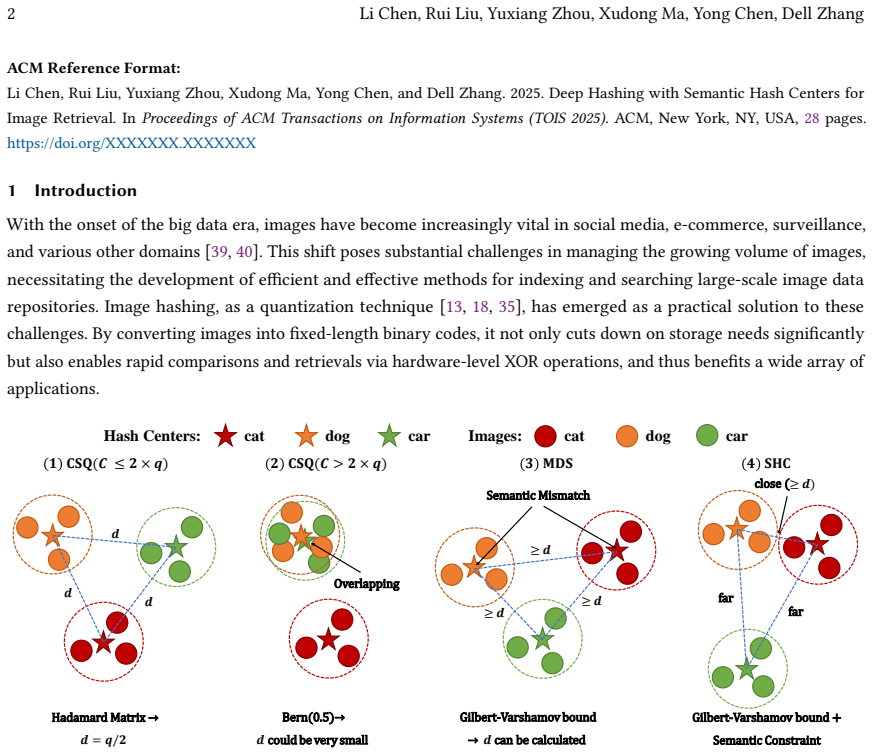
Pith's one-line read Semantic hash centers that place related classes close in Hamming space improve deep-hashing image retrieval by several points of mean average precision.
desk verdict A sensible, potentially useful extension of hash-center methods, but the core optimization is broken as printed and the central quality claim is overstated. read the letter →
The pith
A machine-rendered reading of the paper's core claim, the machinery that carries it, and where it could break.
The reading
What carries the argument
The load-bearing object is the semantic hash center: a binary vector $h_c \in \{-1,+1\}^q$ assigned to each class $c$, generated as a solution of $$\min_H \|S - \tfrac{1}{q} H^\top H\|$_F^{2}$ + \mu\sum_{i \ne j} h_i^\top h_j \quad \text{s.t. } h_i^\top h_j \le q - 2d,\; h_i \in \{-1,+1\}^q,$$ where $S$ is the Stage 1 data-dependent similarity matrix and $d$ is the minimal Hamming distance obtained from the Gilbert-Varshamov bound. The identity that makes the optimization tractable is the Hamming-Euclid relation $D(h_i, h_j) = \tfrac{1}{2}(q - h_i^\top h_j)$, which converts separation in Hamming space into an inner-product inequality. The paper solves the NP-hard binary problem by introducing proxy variables and using an Augmented Lagrangian scheme, alternating updates for the proxy, slack, center, and multiplier variables.
What would settle it
Replace the Stage 1 similarity matrix S with a random symmetric matrix that has the same diagonal and the same minimal distance d, rerun the full SHC pipeline, and compare MAP: if retrieval accuracy does not fall toward the level of the minimum-distance-only baseline, the semantic constraint is not what produces the reported gains.
Extended reading notes
Core claim
On its own terms, the paper's central claim is that the internal distance geometry of hash centers is a reusable semantic resource. Prior point-wise methods generate centers from combinatorial constructions and then treat any large separation as good; SHC instead computes, for each class pair, a data-dependent similarity score from the classifier's confusions, and then solves for centers in which normalized inner products approximate those scores while no two centers come closer than the Gilbert-Varshamov minimum distance $d$. Given those centers, a standard deep hashing network trained with a center-similarity and quantization loss produces binary codes that inherit the semantic layout. Across five dataset configurations and code lengths 16, 32, and 64, this pipeline reports the best mean average precision among the methods compared, with the interaction between class count and code length shaping how large the improvement is.
Load-bearing premise
The whole result rests on whether the Stage 1 similarity matrix really captures which classes are semantically related; if the classifier's averaged softmax similarities are mostly noise, the semantic constraint has no true signal to encode.
Editorial extensions
If this is right
- On the five dataset configurations in the paper, SHC beats all nine compared deep hashing methods, with average MAP gains of +7.26% at MAP@100, +7.62% at MAP@1000, and +11.71% at MAP@ALL over the strongest baselines.
- Ablations removing either the semantic constraint or the minimum-distance constraint lower MAP in most settings, so both terms in the center-generation objective contribute to the result.
- Swapping the data-dependent similarity matrix for a label-text embedding matrix lowers retrieval performance, supporting the claim that adapting the similarity estimate to the data distribution is a real component of the gain.
- The size of the improvement depends on how crowded the Hamming space is: gains are clearest at 32-bit codes for the 196-class Stanford Cars setting and grow with code length for the 555-class NABirds setting.
Reading between the lines
- Beyond the paper, the same three-stage construction should transfer to any retrieval domain with a pre-trained classifier and discrete codes, such as audio, text, or graph retrieval.
- Because the similarity matrix inherits the Stage 1 classifier's confusions, the hash centers will encode whatever drives those confusions; on datasets where confusions track background, pose, or lighting rather than category semantics, the centers will encode that structure too.
- The observed pattern of gains suggests a testable prediction: at a fixed code length, the advantage of semantic centers should grow with the number of classes, since a crowded Hamming space is exactly where layout-by-meaning matters most.
- A natural next experiment is to compare the learned class graph against an explicit human taxonomy; divergences on fine-grained classes would point to the similarity estimate, not the center optimization, as the bottleneck.
Signed reviews
Editorial analysis
A structured set of objections, weighed in public.
Referee Report
Summary. The paper proposes SHC, a three-stage deep hashing framework. Stage 1 builds a data-dependent inter-class similarity matrix S from the softmax probabilities of a pre-trained classifier, after masking each sample's top prediction and averaging within classes. Stage 2 generates binary semantic hash centers by optimizing a regularized objective that combines a semantic fidelity term with a minimum-Hamming-distance term, using an augmented Lagrangian scheme with alternating updates. Stage 3 trains a deep hashing network with a central similarity loss and quantization loss, following CSQ. Experiments on CIFAR-100, Stanford Cars, and NABirds (five dataset variants) compare against nine baselines and report average MAP improvements of +7.26%, +7.62%, and +11.71% over the second-best method for MAP@100, MAP@1000, and MAP@ALL, respectively.
Significance. The paper's core idea is attractive and potentially useful: unlike CSQ and MDS, which assign hash centers by data-independent constructions, SHC attempts to make centers reflect real inter-class semantic relatedness while preserving a minimum Hamming separation. The three-stage pipeline is clearly described, and the experimental suite is broad, spanning five dataset variants, three code lengths, nine baselines, ablations, and convergence plots. I found no circularity: the similarity matrix is derived from classifier outputs on training data, the centers are optimized against that matrix, and retrieval is evaluated on held-out queries; the reported MAP is not used to set constants in the method. However, the central hash-center generation step is not reproducible from the printed equations, and one of the paper's headline claims about the generated centers is contradicted by its own table. These issues are load-bearing and must be fixed before the results can be accepted as reported.
major comments (4)
- [Section 3.2.3, Eq. (29)] Equation (29) is dimensionally inconsistent and cannot be executed as written. The matrix form reads M = (2/q^2 H H^T + ρ I)^{-1}(2/q H S + Λ + ρ h_i), where h_i is a column vector of dimension q but the other two terms in the parentheses are q×C matrices. The scalar update in Eq. (28) suggests the intended matrix form should have ρ H in the last term, not ρ h_i. Because Algorithm 1 calls Eq. (29) directly, this typo blocks re-implementation of the central hash-center generation step.
- [Section 3.2.3, Eq. (35)] Equation (35) contains several apparent algebraic errors in the gradient with respect to h_i. The λ term is written as λ_i^T but should be the column vector λ_i; the α-related term appears as −2 μ Σ α_ij h_j, although differentiating ∑ α_ij(q − 2d − h_i^T h_j − k_ij) with respect to h_i gives −Σ α_ij h_j with no factor 2μ; and the β term is written as β_ij[2 h_j h_j^T h_i − 2(q − 2d − k_ij h_j)], where the second part appears to conflate the scalar (q − 2d − k_ij) with the vector h_j. As printed, this is not the gradient of the objective in Eq. (34), so the projected gradient update in Eq. (36) is not well defined. The authors should supply corrected derivations and verify them against their implementation.
- [Section 4.5.2 and Table 3] The text states that SHC 'achieves the largest d_min and the smallest S_loss across all datasets,' but Table 3 contradicts this on the d_min point. For example, on CIFAR-100 at 64 bits, MDS has d_min = 32 while SHC has d_min = 24; on Stanford Cars-A at 64 bits both have d_min = 23; on NABirds-A and NABirds-B at 64 bits both have d_min = 21. Thus the claim that SHC sets hash centers 'as far apart as possible' is not supported by the reported numbers. The authors should either correct the claim, report the full trade-off between d_min and S_loss, or explain why a lower or equal d_min with a much lower S_loss is the desirable operating point.
- [Sections 4.3–4.5 and 4.4] All MAP numbers in Tables 4–6 are reported without standard deviations or error bars, and no code or dataset release URL is provided despite the statement that 'All the curated datasets and codes will be released on Github.' Given the unresolved issues in Eqs. (29) and (35), the reported numerical results cannot currently be independently verified. The authors should report variability across runs and make the implementation available, at least as supplementary material, so that Stage 2 can be reproduced.
minor comments (5)
- [Section 3.2, heading] The heading contains the typo 'Gibert-Varshamov bound'; it should be 'Gilbert-Varshamov bound'.
- [Eq. (44)] The formula for d_min, d_min = min{(q − H^T H ⊙ (1 − I))/2}, is ambiguous because the elementwise product with (1 − I) appears inside the min without clearly indicating a minimum over off-diagonal entries. Please add the missing indexing, e.g., d_min = min_{i≠j} (q − (H^T H)_{ij})/2.
- [References [11] and [12]] References [11] and [12] cite the same BERT paper with different years and venues; one of them should be removed or both should be unified to a single canonical reference.
- [Section 4.2] The text says the Precision/Recall curves use 'a large range from 1, 5, 10, ..., to 500' for topK; Precision-Recall curves are not conventionally parameterized by topK, so this sentence needs clarification.
- [Section 4.5.3] The reported improvement ranges, e.g., '(+0.13% ~ +11.53%)' and '(+7.43% ~ +22.64%)', do not match the three metric families listed in the sentence; it would help to label which range corresponds to MAP@100, MAP@1000, and MAP@ALL.
Circularity Check
No benchmark-level circularity: MAP gains are held-out and not fitted. One internal validation metric (S_loss) equals the training objective, so the reported 'smallest S_loss' is true by construction.
-
fitted input called prediction
[Section 4.5.2, Eq. (45) and Table 3]
"S_loss = L_semantic = ||S - 1/q H^T H||^2_F; ... Evidently, our method achieves the largest d_min and the smallest S_loss across all datasets, which validates the effectiveness of our hash centers generation algorithm"
The centers H are generated in Algorithm 1 by minimizing Eq. (22), whose first term is exactly L_semantic = ||S - 1/q H^T H||^2_F. Eq. (45) then defines S_loss to be precisely that same objective. Reporting that SHC has the smallest S_loss is therefore not an independent validation of semantic preservation; it is a restatement of the objective that SHC was optimized against, while the comparison methods (random, CSQ, MDS) do not minimize this term. This is a self-referential evaluation, though it is not load-bearing for the paper's main held-out retrieval MAP claims.
full rationale
The central retrieval claim is not circular. Stage 1 builds a data-dependent similarity matrix S from a pre-trained classifier's softmax outputs on training images; Stage 2 optimizes hash centers against S plus a minimum-distance constraint; Stage 3 trains a hashing network using those fixed centers; MAP is then measured on held-out queries against a retrieval database. None of the reported MAP numbers enter any optimization constant, and no equation in the paper reduces the retrieval metric to a fitted value of the method itself. The Gilbert-Varshamov bound and ALM machinery are cited from external sources (Refs. [34], [1]), and the CSQ loss is cted from external work [42]. The only self-referential element is the S_loss comparison in Table 3, where the evaluation metric is identical to the semantic objective being minimized; that step is tautological but minor. The ablation study comparing 'SHC without L_semantic' to MDS is a legitimate baseline comparison, not circularity. The skeptics' concerns about dimensional inconsistencies in Eqs. (29) and (35) are correctness/reproducibility issues, not circularity. Overall, the paper's derivation chain does not reduce to its inputs by construction at the level of the central claim.
Assumptions & free parameters
free parameters (6)
- mu =
0.625
- rho =
0.2
- beta =
1e-6
- eta =
0.5
- gamma =
1e-4
- lambda_init =
0.1
assumptions (4)
- standard math Gilbert-Varshamov bound (Theorem 3.1) provides a feasible minimum Hamming distance d for C binary centers of length q.
- domain assumption The alternating optimization with ALM and projected gradient descent converges to a useful solution of the NP-hard binary problem (22).
- ad hoc to paper Softmax probabilities of a pre-trained classifier, after masking the maximum and averaging within classes, encode meaningful inter-class semantic similarities.
- domain assumption Closer Hamming distances between hash centers of semantically related classes improve retrieval performance.
invented entities (1)
-
Semantic hash centers
Cite this review
Pith. "Pith review of Deep Hashing with Semantic Hash Centers for Image Retrieval." pith.science (2026). https://pith.science/paper/H6NVU6PU
@misc{pith2026250708404,
  author       = {Pith},
  title        = {Pith review of: Deep Hashing with Semantic Hash Centers for Image Retrieval},
  year         = {2026},
  howpublished = {\url{https://pith.science/paper/H6NVU6PU}},
  note         = {Machine review of arXiv:2507.08404}
}
read the original abstract
Deep hashing is an effective approach for large-scale image retrieval. Current methods are typically classified by their supervision types: point-wise, pair-wise, and list-wise. Recent point-wise techniques (e.g., CSQ, MDS) have improved retrieval performance by pre-assigning a hash center to each class, enhancing the discriminability of hash codes across various datasets. However, these methods rely on data-independent algorithms to generate hash centers, which neglect the semantic relationships between classes and may degrade retrieval performance. This paper introduces the concept of semantic hash centers, building on the idea of traditional hash centers. We hypothesize that hash centers of semantically related classes should have closer Hamming distances, while those of unrelated classes should be more distant. To this end, we propose a three-stage framework, SHC, to generate hash codes that preserve semantic structure. First, we develop a classification network to identify semantic similarities between classes using a data-dependent similarity calculation that adapts to varying data distributions. Second, we introduce an optimization algorithm to generate semantic hash centers, preserving semantic relatedness while enforcing a minimum distance between centers to avoid excessively similar hash codes. Finally, a deep hashing network is trained using these semantic centers to convert images into binary hash codes. Experimental results on large-scale retrieval tasks across several public datasets show that SHC significantly improves retrieval performance. Specifically, SHC achieves average improvements of +7.26%, +7.62%, and +11.71% in MAP@100, MAP@1000, and MAP@ALL metrics, respectively, over state-of-the-art methods.
Figures


Figures from the paper (3 more)


Reference graph
Works this paper leans on
-
[1]
Ernesto G Birgin and José Mario Martínez. 2014. Practical augmented Lagrangian methods for constrained optimization . SIAM
work page 2014
-
[2]
Tom B. Brown, Benjamin Mann, Nick Ryder, Melanie Subbiah, Jared Kaplan, Prafulla Dhariwal, Arvind Neelakantan, Pranav Shyam, Girish Sastry, Amanda Askell, Sandhini Agarwal, Ariel Herbert-Voss, Gretchen Krueger, Tom Henighan, Rewon Child, Aditya Ramesh, Daniel M. Ziegler, Jeffrey Wu, Clemens Winter, Christopher Hesse, Mark Chen, Eric Sigler, Mateusz Litwin...
work page 2020
-
[3]
Jian-Feng Cai, Tianming Wang, and Ke Wei. 2018. Spectral Compressed Sensing via Projected Gradient Descent. SIAM J. Optim. 28, 3 (2018), 2625–2653
work page 2018
-
[4]
Yue Cao, Mingsheng Long, Bin Liu, and Jianmin Wang. 2018. Deep cauchy hashing for hamming space retrieval. In CVPR. 1229–1237
work page 2018
-
[5]
Zhangjie Cao, Mingsheng Long, Jianmin Wang, and Philip S Yu. 2017. Hashnet: Deep learning to hash by continuation. In ICCV. 5608–5617
work page 2017
-
[6]
Yong Chen, Yuqing Hou, Shu Leng, Qing Zhang, Zhouchen Lin, and Dell Zhang. 2021. Long-tail hashing. In SIGIR. 1328–1338. Manuscript submitted to ACM Deep Hashing with Semantic Hash Centers for Image Retrieval 27
work page 2021
-
[7]
Yong Chen, Zhibao Tian, Hui Zhang, Jun Wang, and Dell Zhang. 2020. Strongly Constrained Discrete Hashing. IEEE Trans. Image Process. 29 (2020), 3596–3611
work page 2020
-
[8]
Yong Chen, Hui Zhang, Zhibao Tian, Jun Wang, Dell Zhang, and Xuelong Li. 2022. Enhanced Discrete Multi-Modal Hashing: More Constraints Yet Less Time to Learn. IEEE Trans. Knowl. Data Eng. 34, 3 (2022), 1177–1190
work page 2022
Show all 46 references
-
[9]
Woocheol Choi and Jimyeong Kim. 2023. On the convergence analysis of the decentralized projected gradient descent. CoRR abs/2303.08412 (2023)
2023 arXiv
-
[10]
Mayur Datar, Nicole Immorlica, Piotr Indyk, and Vahab S Mirrokni. 2004. Locality-sensitive hashing scheme based on p-stable distributions. In Proceedings of the twentieth annual symposium on Computational geometry . 253–262
2004
-
[11]
Jacob Devlin, Ming-Wei Chang, Kenton Lee, and Kristina Toutanova. 2019. BERT: Pre-training of Deep Bidirectional Transformers for Language Understanding. In NAACL-HLT. 4171–4186
2019
-
[12]
Jacob Devlin, Ming-Wei Chang, Kenton Lee, and Kristina Toutanova. 2018. Bert: Pre-training of deep bidirectional transformers for language understanding. arXiv preprint arXiv:1810.04805 (2018)
2018 arXiv
-
[13]
Yunchao Gong, Svetlana Lazebnik, Albert Gordo, and Florent Perronnin. 2013. Iterative Quantization: A Procrustean Approach to Learning Binary Codes for Large-Scale Image Retrieval. IEEE Trans. Pattern Anal. Mach. Intell. 35, 12 (2013), 2916–2929
2013
-
[14]
Kaiming He, Xiangyu Zhang, Shaoqing Ren, and Jian Sun. 2016. Deep Residual Learning for Image Recognition. In CVPR. 770–778
2016
-
[15]
Kaiming He, Xiangyu Zhang, Shaoqing Ren, and Jian Sun. 2016. Deep residual learning for image recognition. In CVPR. 770–778
2016
-
[16]
Jiun Tian Hoe, Kam Woh Ng, Tianyu Zhang, Chee Seng Chan, Yi-Zhe Song, and Tao Xiang. 2021. One loss for all: Deep hashing with a single cosine similarity based learning objective. In NeurIPS. 24286–24298
2021
-
[17]
Piotr Indyk and Rajeev Motwani. 1998. Approximate nearest neighbors: towards removing the curse of dimensionality. In Proceedings of the thirtieth annual ACM symposium on Theory of computing . 604–613
1998
-
[18]
Hervé Jégou, Matthijs Douze, and Cordelia Schmid. 2011. Product Quantization for Nearest Neighbor Search. IEEE Trans. Pattern Anal. Mach. Intell. 33, 1 (2011), 117–128
2011
-
[19]
Qing-Yuan Jiang and Wu-Jun Li. 2018. Asymmetric Deep Supervised Hashing. In AAAI. 3342–3349
2018
-
[20]
Jonathan Krause, Michael Stark, Jia Deng, and Li Fei-Fei. 2013. 3d object representations for fine-grained categorization. In ICCV. 554–561
2013
-
[21]
Alex Krizhevsky, Geoffrey Hinton, et al. 2009. Learning multiple layers of features from tiny images. (2009)
2009
-
[22]
Brian Kulis and Kristen Grauman. 2009. Kernelized locality-sensitive hashing for scalable image search. In ICCV. 2130–2137
2009
-
[23]
Hanjiang Lai, Yan Pan, Ye Liu, and Shuicheng Yan. 2015. Simultaneous feature learning and hash coding with deep neural networks. In CVPR. 3270–3278
2015
-
[24]
Wu-Jun Li, Sheng Wang, and Wang-Cheng Kang. 2015. Feature learning based deep supervised hashing with pairwise labels. arXiv preprint arXiv:1511.03855 (2015)
2015 arXiv
-
[25]
Xiaoqing Liu, Huanqiang Zeng, Yifan Shi, Jianqing Zhu, Chih-Hsien Hsia, and Kai-Kuang Ma. 2023. Deep Cross-Modal Hashing Based on Semantic Consistent Ranking. IEEE Trans. Multim. 25 (2023), 9530–9542
2023
-
[26]
Xiao Luo, Haixin Wang, Daqing Wu, Chong Chen, Minghua Deng, Jianqiang Huang, and Xian-Sheng Hua. 2023. A Survey on Deep Hashing Methods. ACM Trans. Knowl. Discov. Data 17, 1 (2023), 15:1–15:50
2023
-
[27]
Mohammad Norouzi, David J Fleet, and Russ R Salakhutdinov. 2012. Hamming distance metric learning. NeurIPS, 1070–1078
2012
-
[28]
Usha Ruby and Vamsidhar Yendapalli. 2020. Binary cross entropy with deep learning technique for image classification. Int. J. Adv. Trends Comput. Sci. Eng 9, 10 (2020)
2020
-
[29]
Rumelhart, Geoffrey E
David E. Rumelhart, Geoffrey E. Hinton, and Ronald J. Williams. 1986. Learning representations by back-propagating errors. Nature 323 (1986), 533–536
1986
-
[30]
Shupeng Su, Chao Zhang, Kai Han, and Yonghong Tian. 2018. Greedy hash: Towards fast optimization for accurate hash coding in cnn. (2018), 806–815
2018
-
[31]
Christian Szegedy, Wei Liu, Yangqing Jia, Pierre Sermanet, Scott Reed, Dragomir Anguelov, Dumitru Erhan, Vincent Vanhoucke, and Andrew Rabinovich. 2015. Going deeper with convolutions. In CVPR. 1–9
2015
-
[32]
Grant Van Horn, Steve Branson, Ryan Farrell, Scott Haber, Jessie Barry, Panos Ipeirotis, Pietro Perona, and Serge Belongie. 2015. Building a bird recognition app and large scale dataset with citizen scientists: The fine print in fine-grained dataset collection. In CVPR. 595–604
2015
-
[33]
Rom Rubenovich Varshamov. 1957. Estimate of the number of signals in error correcting codes. Docklady Akad. Nauk, SSSR 117 (1957), 739–741
1957
-
[34]
Rom Rubenovich Varshamov. 1957. Estimate of the Number of Signals in Error Correcting Codes. Docklady Akad. Nauk, S.S.S.R. 177 (1957), 739–741
1957
-
[35]
Jun Wang, Wei Liu, Sanjiv Kumar, and Shih-Fu Chang. 2015. Learning to hash for indexing big data—A survey. Proc. IEEE 104, 1 (2015), 34–57
2015
-
[36]
Jingdong Wang, Ting Zhang, Jingkuan Song, Nicu Sebe, and Heng Tao Shen. 2018. A Survey on Learning to Hash. IEEE Trans. Pattern Anal. Mach. Intell. 40, 4 (2018), 769–790
2018
-
[37]
Liangdao Wang, Yan Pan, Cong Liu, Hanjiang Lai, Jian Yin, and Ye Liu. 2023. Deep hashing with minimal-distance-separated hash centers. In CVPR. 23455–23464
2023
-
[38]
Xiaofang Wang, Yi Shi, and Kris M Kitani. 2017. Deep supervised hashing with triplet labels. In ACCV. 70–84
2017
-
[39]
Rongkai Xia, Yan Pan, Hanjiang Lai, Cong Liu, and Shuicheng Yan. 2014. Supervised hashing for image retrieval via image representation learning. In AAAI, Vol. 28
2014
-
[40]
Erkun Yang, Tongliang Liu, Cheng Deng, Wei Liu, and Dacheng Tao. 2019. Distillhash: Unsupervised deep hashing by distilling data pairs. In CVPR. 2946–2955. Manuscript submitted to ACM 28 Li Chen, Rui Liu, Yuxiang Zhou, Xudong Ma, Yong Chen, Dell Zhang
2019
-
[41]
Ting Yao, Fuchen Long, Tao Mei, and Yong Rui. 2016. Deep Semantic-Preserving and Ranking-Based Hashing for Image Retrieval. In IJCAI. 3931–3937
2016
-
[42]
Li Yuan, Tao Wang, Xiaopeng Zhang, Francis EH Tay, Zequn Jie, Wei Liu, and Jiashi Feng. 2020. Central similarity quantization for efficient image and video retrieval. In CVPR. 3083–3092
2020
-
[43]
Wanqian Zhang, Dayan Wu, Yu Zhou, Bo Li, Weiping Wang, and Dan Meng. 2021. Binary neural network hashing for image retrieval. InSIGIR. 1318–1327
2021
-
[44]
Zheng Zhang, Qin Zou, Yuewei Lin, Long Chen, and Song Wang. 2019. Improved deep hashing with soft pairwise similarity for multi-label image retrieval. IEEE Transactions on Multimedia 22, 2 (2019), 540–553
2019
-
[45]
Fang Zhao, Yongzhen Huang, Liang Wang, and Tieniu Tan. 2015. Deep semantic ranking based hashing for multi-label image retrieval. In CVPR. 1556–1564
2015
-
[46]
Han Zhu, Mingsheng Long, Jianmin Wang, and Yue Cao. 2016. Deep hashing network for efficient similarity retrieval. In AAAI, Vol. 30. Manuscript submitted to ACM
2016
Reviewed August 6, 2026 · model on record in the stance chip above.
Discussion (0). Continue with ORCID to comment.