REVIEW 2 major objections 2 minor 35 references
Tropes in Friends form 15 clusters that distinguish the six main characters and occupy distinct regions in power-danger space.
Reviewed by Pith at T0; open to challenge. T0 means a machine referee read the full paper against a public rubric. the ladder, T0–T4 →
Analysis of Friends finds modest positive link between episode trope count and IMDb ratings, clusters 1954 tropes into 15 groups via TF-IDF/PCA/k-means showing character-specific profiles, and maps clusters in power-danger semantic space.
T0 review reviewed 2026-06-26 challenge →
load-bearing objection This is a clean, modest application of TF-IDF clustering and ousiometrics to Friends tropes that stays honest about effect sizes but rests on untested TVTropes coverage. the 2 major comments →
Narrative Structure in Tropes: A Computational Analysis of `Friends'
The pith
A machine-rendered reading of the paper's core claim, the machinery that carries it, and where it could break.
The reading
Core claim
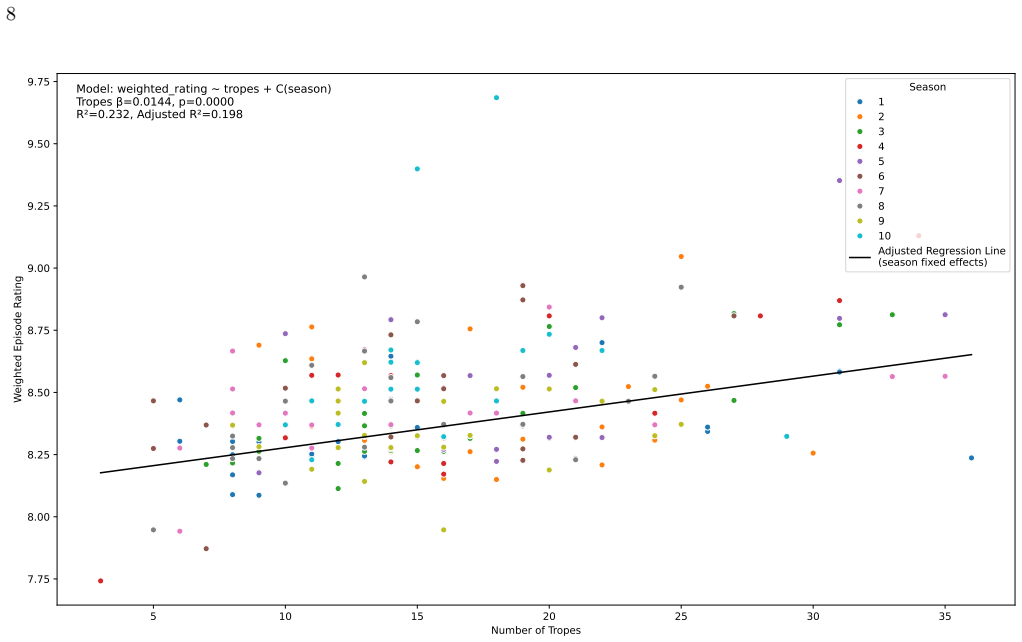
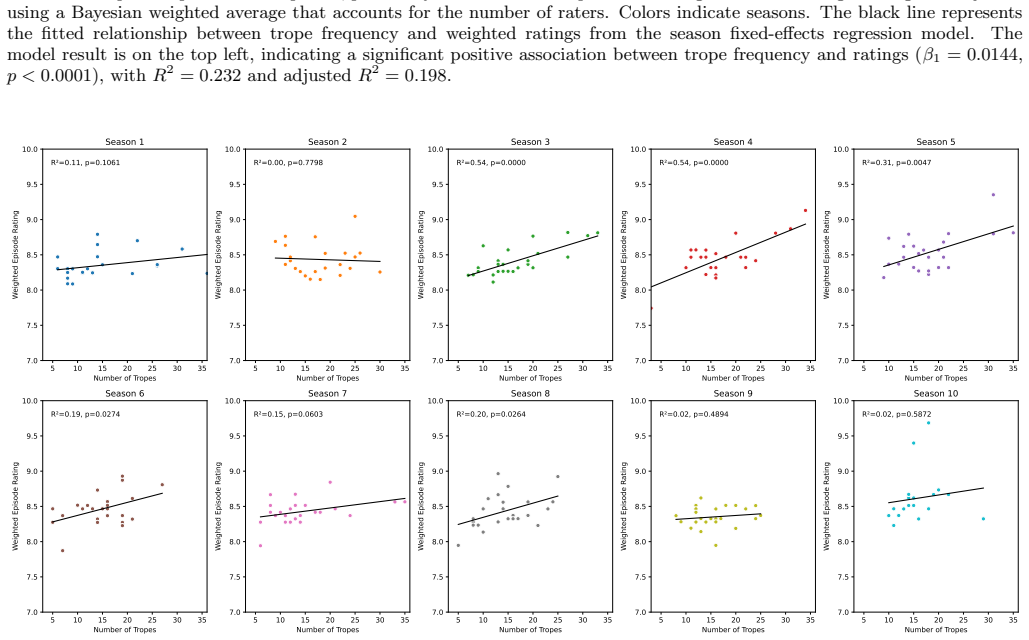
Trope annotations from TVTropes, when connected to dialogue via TF-IDF semantic features and clustered with PCA and k-means into 15 groups, yield character-specific profiles consistent with established identities and distinct placements in power-danger space, while episode trope count shows a statistically significant positive link to weighted IMDb ratings.
What carries the argument
Fifteen trope clusters obtained via k-means on TF-IDF vectors of trope-related dialogue, used to describe characters holistically and to locate narrative devices in ousiometric space.
Load-bearing premise
Human-curated trope annotations from TVTropes accurately and comprehensively capture the narrative devices in the episode transcripts without systematic bias or omission.
What would settle it
Independent re-annotation of the same episodes producing trope clusters with no statistically significant uneven distribution across the six characters or no mapping to power-danger regions would falsify the central claims.
If this is right
- Episode trope count correlates positively with IMDb ratings, though with limited explanatory power.
- The six main characters exhibit uneven membership across the 15 clusters matching their narrative identities.
- Clusters such as Physical and Sexual Comedy map to higher danger while Revelation, Surprise, and Reaction map to higher power.
- Trope clusters supply holistic distant-reading descriptions of both characters and overall stories.
Where Pith is reading between the lines
- The clustering method could be applied to other long-running series to compare narrative structures across shows.
- If trope clusters predict audience retention or plot turning points, they might serve as features for predictive media models.
- Extending the power-danger projection to additional semantic dimensions could reveal further organizational patterns in narrative devices.
Editorial analysis
A structured set of objections, weighed in public.
Referee Report
Summary. The paper claims a statistically significant positive association between episode-level trope count (from TVTropes) and weighted IMDb ratings in Friends, albeit with modest explanatory power. It represents trope-linked dialogue via TF-IDF, applies PCA and k-means to derive 15 semantically interpretable trope clusters, uses chi-square tests to show the six main characters are unevenly distributed across clusters in ways consistent with their narrative identities, and projects the clusters into ousiometric power-danger space, finding distinct positions (e.g., 'Physical and Sexual Comedy' high in danger, 'Revelation, Surprise, and Reaction' high in power).
Significance. If the central results hold under the data assumptions, the work provides a reproducible pipeline for operationalizing trope measurement and 'distant reading' of narrative structure, linking trope density to reception metrics and yielding interpretable character profiles via clustering. Strengths include reliance on external public sources (TVTropes, IMDb, transcripts) with no circularity in the statistical tests, explicit qualification of modest effect sizes, and the ousiometric projection as a novel semantic lens.
major comments (2)
- [Clustering section] Clustering section (PCA + k-means on 1,954 tropes): k=15 is listed as the sole free parameter with no reported justification (e.g., elbow plot, silhouette scores, or stability across random seeds). Different k values would directly alter cluster boundaries, the chi-square character allocations, and the ousiometric power-danger coordinates, making the specific 15-cluster structure and its interpretive claims load-bearing but under-justified.
- [Chi-square and ousiometric sections] Chi-square analyses of character-trope cluster distributions and the ousiometric projections: both rest on the assumption that the 1,954 TVTropes annotations form an unbiased, comprehensive mapping of narrative devices in the transcripts. Systematic crowd-sourced omissions (low-popularity or subtle tropes) would propagate into the TF-IDF matrix, shift cluster assignments, and produce artifactual character profiles or power-danger locations; no sensitivity analysis or discussion of annotation coverage is provided despite this being the weakest assumption for all downstream claims.
minor comments (2)
- [Methods] The abstract and methods should explicitly state the exact regression model (e.g., linear vs. ordinal) and any multiple-testing correction applied to the chi-square tests across six characters and 15 clusters.
- [Ousiometric projection figure] Figure captions for the ousiometric scatter plot should include the exact definitions or references for the power and danger axes to allow readers to interpret the reported high-danger and high-power regions.
Simulated Author's Rebuttal
We thank the referee for their detailed and constructive review. Below we provide point-by-point responses to the major comments, indicating planned revisions to the manuscript.
read point-by-point responses
-
Referee: [Clustering section] Clustering section (PCA + k-means on 1,954 tropes): k=15 is listed as the sole free parameter with no reported justification (e.g., elbow plot, silhouette scores, or stability across random seeds). Different k values would directly alter cluster boundaries, the chi-square character allocations, and the ousiometric power-danger coordinates, making the specific 15-cluster structure and its interpretive claims load-bearing but under-justified.
Authors: We acknowledge that the manuscript does not provide quantitative justification for the choice of k=15. The number of clusters was determined based on achieving a balance between granularity and the emergence of semantically meaningful groups that correspond to recognizable narrative elements in the series. We agree this choice should be better supported. In the revised manuscript, we will include an elbow method plot, silhouette score analysis, and evaluation of stability across random initializations to justify k=15 and discuss the sensitivity of results to this parameter. revision: yes
-
Referee: [Chi-square and ousiometric sections] Chi-square analyses of character-trope cluster distributions and the ousiometric projections: both rest on the assumption that the 1,954 TVTropes annotations form an unbiased, comprehensive mapping of narrative devices in the transcripts. Systematic crowd-sourced omissions (low-popularity or subtle tropes) would propagate into the TF-IDF matrix, shift cluster assignments, and produce artifactual character profiles or power-danger locations; no sensitivity analysis or discussion of annotation coverage is provided despite this being the weakest assumption for all downstream claims.
Authors: This is a fair critique of a core assumption in our methodology. The analyses depend on the TVTropes annotations being sufficiently representative, and we did not include sensitivity tests for potential missing annotations. We will revise the manuscript to include an explicit discussion of this limitation, its potential impact on the findings, and the rationale for relying on this crowdsourced resource. We note that a comprehensive sensitivity analysis would require substantial additional effort and data not available in the current study. revision: partial
- Comprehensive sensitivity analysis regarding potential missing tropes in the TVTropes annotations
Circularity Check
No significant circularity; analyses are independent of external inputs
full rationale
The paper derives all results from external TVTropes annotations (1,954 tropes), IMDb ratings, and episode transcripts. TF-IDF semantic features, PCA/k-means clustering into 15 groups, chi-square character distribution tests, and ousiometric projections are computed directly from these sources without any equations or steps that reduce by construction to fitted parameters or self-citations. No self-definitional loops, renamed predictions, or load-bearing uniqueness theorems appear. The modest statistical associations and cluster interpretations remain falsifiable against the independent annotation data.
Axiom & Free-Parameter Ledger
free parameters (1)
- number of clusters
axioms (2)
- domain assumption TF-IDF vectors derived from trope-related dialogue capture meaningful semantic similarity between tropes
- domain assumption IMDb weighted ratings serve as a reliable proxy for audience reception of individual episodes
Cite this review
Pith. "Pith review of Narrative Structure in Tropes: A Computational Analysis of `Friends'." pith.science (2026). https://pith.science/paper/H6XBACPS
@misc{pith2026260619499,
  author       = {Pith},
  title        = {Pith review of: Narrative Structure in Tropes: A Computational Analysis of `Friends'},
  year         = {2026},
  howpublished = {\url{https://pith.science/paper/H6XBACPS}},
  note         = {Machine review of arXiv:2606.19499}
}
read the original abstract
Tropes are recurring narrative devices in television and film. We carry out a computational analysis of tropes in the sitcom Friends, using human-curated trope annotations from TVTropes, episode transcripts, and IMDb ratings. Because automatic trope detection remains challenging, we treat existing trope annotations as a curated analytical layer and focus on their downstream narrative and semantic functions. We first examine the relationship between episode-level trope frequency and audience reception. We find a statistically significant positive association between trope count and weighted IMDb ratings, although the modest explanatory power suggests that more than trope density alone explains audience evaluation. We then connect trope annotations to dialogue transcripts and represent trope-related dialogue using TF-IDF-based semantic features. Using PCA and k-means clustering, we group 1,954 distinct tropes into 15 semantically interpretable clusters. Chi-square analyses show that the six main characters are unevenly distributed across these clusters, with character-specific trope profiles that are broadly consistent with their established narrative identities. Finally, we project trope clusters into the ousiometric power-danger space to examine their semantic organization. The results show that "Physical and Sexual Comedy" occupies a region associated with relatively high danger, while "Revelation, Surprise, and Reaction" occupies a region associated with relatively high power. Overall, our work demonstrates a way to operationalize trope measurement and shows that identifiable trope clusters can provide holistic "distant reading" descriptions of characters and stories.
Figures




Reference graph
Works this paper leans on
-
[1]
The corpus covers all 236 episodes aired between 1994 and 2004 and contains approximately 10 6 tokens in total, with an average of about 4,000 tokens per episode
‘Friends’ Scripts Our dataset consists of full dialogue transcripts from all ten seasons of the television sitcom Friends, which are publicly available online [17]. The corpus covers all 236 episodes aired between 1994 and 2004 and contains approximately 10 6 tokens in total, with an average of about 4,000 tokens per episode. Each episode is tran- scribed...
1994
-
[2]
For each Friends episode, community members manually doc- ument the tropes that appear, based on close reading of the episode’s narrative and dialogue
‘Friends’ Tropes The trope dataset is collected from the website ‘tvtropes.org’ [2], a community-curated repository of recurring narrative patterns in film and television. For each Friends episode, community members manually doc- ument the tropes that appear, based on close reading of the episode’s narrative and dialogue. Each identified trope is accompan...
-
[3]
Each episode has a rating from 1 to 10, accurate to one decimal place
‘Friends’ Ratings For each episode, the IMDb ratings are collected together with the total number of user votes for each episode of ‘Friends’ [13]. Each episode has a rating from 1 to 10, accurate to one decimal place. The number of raters for each episode is collected to remove rating bias, with two significant figures. All clip show episodes have been r...
-
[4]
Each trope has a paragraph of explanation
Mapping scripts to tropes For each episode, all tropes documented in the ‘TVTropes’ list are treated as candidates within each episode. Each trope has a paragraph of explanation. We employ large language models (LLMs) to annotate tropes. Their role is to map trope explanations to con- crete dialogues within scripts, following explicit and con- servative a...
1941
-
[5]
Velez-Estevez, Juan Juli´ an Merelo, and Manuel Jes´ us Cobo
Pablo Garc´ ıa-S´ anchez, A. Velez-Estevez, Juan Juli´ an Merelo, and Manuel Jes´ us Cobo. The simpsons did it: Exploring the film trope space and its large scale struc- ture. PLoS ONE, 16, 2021
2021
-
[6]
TV Tropes. Tropes. https://tvtropes.org/pmwiki/ pmwiki.php/Main/Tropes, 2025
2025
-
[7]
The narrative construction of reality
J´ erˆ ome Seymour Bruner. The narrative construction of reality. Critical Inquiry, 18:1 – 21, 1991
1991
-
[8]
In Complex TV: The Poetics of Contem- porary Television Storytelling , 2015
Jason Mittell. In Complex TV: The Poetics of Contem- porary Television Storytelling , 2015
2015
-
[9]
The hero with a thousand faces
Katharine Luomala and Joseph Campbell. The hero with a thousand faces. Journal of American Folklore , 63:121, 1949
1949
-
[10]
Reagan, Lewis Mitchell, Dilan Kiley, Christo- pher M
Andrew J. Reagan, Lewis Mitchell, Dilan Kiley, Christo- pher M. Danforth, and Peter Sheridan Dodds. The emo- tional arcs of stories are dominated by six basic shapes. EPJ Data Science , 5, 2016
2016
-
[11]
Morphology of the folktale
Vladimir Propp, Svatava Pirkova-Jakobson, and Lau- rence Scott. Morphology of the folktale. 1959
1959
-
[12]
Brick joke, 2026
TV Tropes. Brick joke, 2026. Accessed: 2026-05-01
2026
-
[13]
Tropes in films: an initial analysis
Rub´ en H´ ector Garc´ ıa-Ortega, Pablo Garc´ ıa-S´ anchez, and Juan Juli´ an Merelo Guerv´ os. Tropes in films: an initial analysis. ArXiv, abs/2006.05380, 2020
-
[14]
Automated detection of tropes in short texts
Alessandra Flaccavento, Youri Peskine, Paolo Papot- ti, Riccardo Torlone, and Rapha¨ el Troncy. Automated detection of tropes in short texts. In International Con- ference on Computational Linguistics , 2025
2025
- [15]
-
[16]
Wikipedia contributors. Friends. https://en. wikipedia.org/wiki/Friends, 2026. Accessed: 2026-02- 11
2026
-
[17]
Friends (1994–2004) episode list, 2025
IMDb. Friends (1994–2004) episode list, 2025. Accessed: 2025-06-03
1994
-
[18]
Statistical patterns in movie rating behavior
Marlon Ramos, Angelo Mondaini Calv˜ ao, and Celia Anteneodo. Statistical patterns in movie rating behavior. PLoS ONE, 10, 2015
2015
-
[19]
Zeng, Filippo Radicchi, and Lu´ ıs A
Max Wasserman, Satyam Mukherjee, Konner Scott, Xiao Han T. Zeng, Filippo Radicchi, and Lu´ ıs A. Nunes Ama- ral. Correlations between user voting data, budget, and box office for films in the internet movie database. Jour- nal of the Association for Information Science and Tech- nology, 66, 2013
2013
-
[20]
Alshaabi, Mikaela Irene D
Peter Sheridan Dodds, T. Alshaabi, Mikaela Irene D. Fudolig, Julia Witte Zimmerman, Juniper L. Lovato, Shawn Beaulieu, Joshua R. Minot, Michael V. Arnold, Andrew J. Reagan, and Christopher M. Danforth. Ousio- metrics: The essence of meaning aligns with a power- danger-structure framework instead of valence-arousal- dominance. Science Advances, 12, 2026
2026
-
[21]
Friends scripts: Transcripts of Friends by season
Corbari, Ederson de Moura. Friends scripts: Transcripts of Friends by season. https://edersoncorbari.github. io/friends/, 2025. Accessed: 2026-02-11
2025
-
[22]
Amanda D. Lotz. The television will be revolutionized. 2007. 14
2007
-
[23]
Shout-out
TV Tropes. Shout-out. https://tvtropes.org/pmwiki/ pmwiki.php/Main/ShoutOut, n.d. Accessed: 2026-04-28
2026
-
[24]
Carlin, Hal S
Andrew Gelman, John B. Carlin, Hal S. Stern, David B. Dunson, Aki Vehtari, and Donald B. Rubin. Bayesian data analysis. Technometrics, 46:363 – 364, 2004
2004
-
[25]
Term-weighting approaches in automatic text retrieval
Gerard Salton and Chris Buckley. Term-weighting approaches in automatic text retrieval. Inf. Process. Manag., 24:513–523, 1988
1988
-
[26]
Hartigan and M
John A. Hartigan and M. Anthony. Wong. A k-means clustering algorithm. 1979
1979
-
[27]
Estimating the number of clusters in a data set via the gap statistic
Robert Tibshirani, Guenther Walther, and Trevor Hastie. Estimating the number of clusters in a data set via the gap statistic. Journal of the Royal Statistical Society: Series B (Statistical Methodology) , 63, 2001
2001
-
[28]
Rousseeuw
Peter J. Rousseeuw. Silhouettes: a graphical aid to the interpretation and validation of cluster analysis. Jour- nal of Computational and Applied Mathematics , 20:53– 65, 1987
1987
-
[29]
Davies and Donald W
David L. Davies and Donald W. Bouldin. A cluster sepa- ration measure. IEEE Transactions on Pattern Analysis and Machine Intelligence , PAMI-1:224–227, 1979
1979
-
[30]
A den- drite method for cluster analysis
Tadeusz Cali´ nski and Joachim Harabasz. A den- drite method for cluster analysis. Communications in Statistics-theory and Methods , 3:1–27, 1974
1974
-
[31]
Norms of valence, arousal, and dominance for 13,915 english lemmas
Amy Beth Warriner, Victor Kuperman, and Marc Brys- baert. Norms of valence, arousal, and dominance for 13,915 english lemmas. Behavior Research Methods , 45:1191 – 1207, 2013
2013
-
[32]
Fudolig, T
Mikaela Irene D. Fudolig, T. Alshaabi, Kathryn Cramer, Christopher M. Danforth, and Peter Sheridan Dodds. A decomposition of book structure through ousiometric fluctuations in cumulative word-time. Humanities and Social Sciences Communications , 10:1–12, 2022
2022
-
[33]
Danforth, and Peter Sheridan Dodds
Tabia Tanzin Prama, Christopher M. Danforth, and Peter Sheridan Dodds. Story and essential meaning dynamics in bangladesh’s july 2024 student-people’s uprising. ArXiv, abs/2511.01865, 2025
-
[34]
Solon J. Simmons. Root narrative theory and conflict resolution: Power, justice and values. 2020. VI. APPENDIX A. Prompt Trope Annotation Prompt Instruction: You are given: 1) A TV EPISODE SCRIPT
2020
-
[35]
ANNOTATION RULES (STRICT) - Select all dialogue lines that fit a trope definition
A LIST OF TV TROPES with DEFINITIONS Your task is to identify dialogue lines that MATCH the trope definitions. ANNOTATION RULES (STRICT) - Select all dialogue lines that fit a trope definition. - A trope may appear one or more times. - A trope’s occurrences may be non-sequential. - All listed tropes are guaranteed to appear at least once. - Do not force a...
This paper was first reviewed by grok-4.3 on June 26, 2026.
discussion (0)
Sign in with ORCID, Apple, or X to comment. Anyone can read and Pith papers without signing in.