REVIEW 3 major objections 4 minor 50 references
REED-VAE: RE-Encode Decode Training for Iterative Image Editing with Diffusion Models
T0 review · 3 major / 4 minor · reviewed 2026-08-16 · deepseek-v4-flash
Pith's one-line read The paper claims that training a VAE decoder on repeated encode-decode cycles prevents the artifact buildup that blocks iterative, multi-method image editing with diffusion models.
desk verdict Novel decoder-only VAE fine-tuning that clearly fixes encode-decode artifact accumulation, but the headline editing metrics compare to x1 instead of x0, which likely inflates the quantitative gains. read the letter →
The pith
A machine-rendered reading of the paper's core claim, the machinery that carries it, and where it could break.
The reading
What carries the argument
The load-bearing object is the REED training objective, Eq. (2): $L_{\text{train}} = L_{\text{MSE}}(x_1, x_k) + \alpha L_{\text{LPIPS}}(x_1, x_k) + \beta D_{\text{KL}}(z_k, \mathcal{N}(0, I))$, evaluated after k unrolled encode-decode steps. The scheme starts at k=4 and increments k when the validation loss plateaus (up to 20), a curriculum that prevents divergence at high horizons. The first-step loss anchors the target to x_1 rather than x_0, so the model is asked only to match the vanilla VAE's one-step reconstruction while improving stability over longer chains. Only the decoder is fine-tuned; the encoder stays frozen so latent embeddings remain compatible with existing diffusion models. This combination is what lets a single swapped decoder improve artifact accumulation across many editing models.
What would settle it
Run 25 edit iterations with a pipeline in which each edit changes the image independently of VAE error—for example, applying heavy JPEG recompression or a strong conventional filter between encode-decode cycles. If REED-VAE's advantage over the vanilla decoder vanishes or reverses under these conditions, then its robustness is specific to pure reconstruction error and does not transfer to arbitrary multi-method edits, which is the paper's stated goal.
Extended reading notes
Core claim
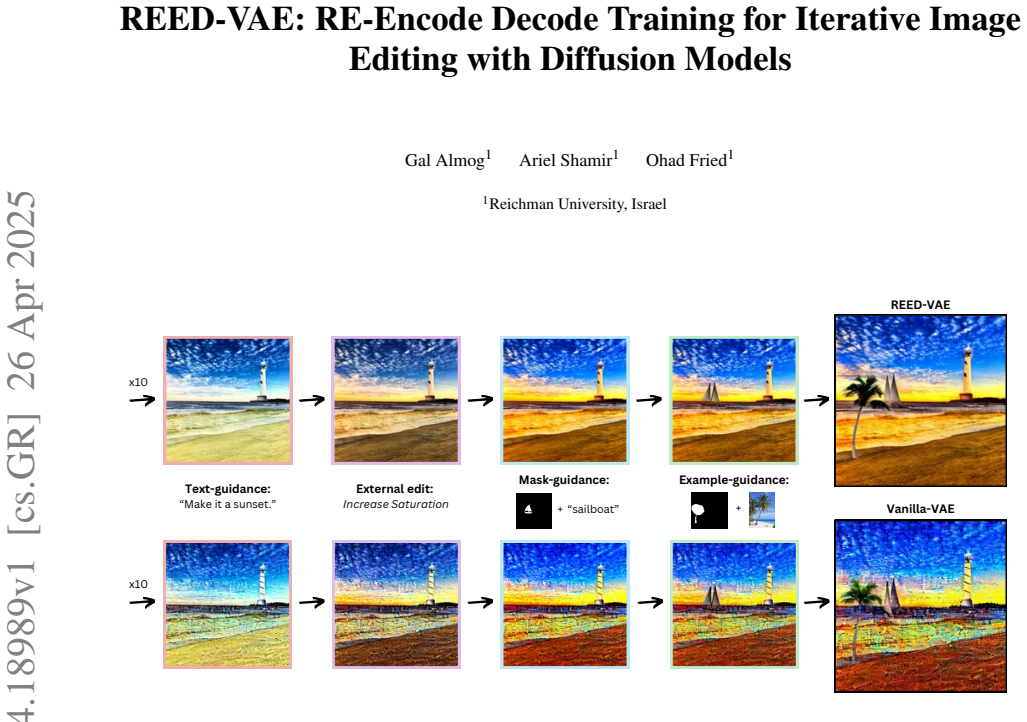
The paper's central claim is that the image degradation seen when editing the same image repeatedly is caused mainly by the VAE's decoder drifting under repeated use, and that this drift can be removed by training the decoder to reconstruct after k full encode-decode cycles rather than after one. REED training unrolls the loop D(E(x_i)) = x_{i+1} for i = 0,...,k-1, computes a perceptual plus MSE loss between the first reconstruction x_1 and the final output x_k, and adds a KL term on the final latent. The scheme starts at k=4 and increments k when validation loss plateaus, up to 20, a curriculum that prevents divergence at high horizons. Only the decoder is fine-tuned; the encoder stays frozen so the latent embeddings remain consistent with the diffusion model's training distribution. Across InstructPix2Pix, MagicBrush, DiffEdit, Paint by Example, SD Inpainting, and NTI-based inversion, swapping in the REED decoder consistently reduces quality degradation at 5, 15, and 25 iterations, with the largest gains at the highest iteration counts.
Load-bearing premise
The load-bearing premise is that training on repeated encode-decode cycles of unedited images transfers to real iterative editing, where edits and inversion routines inject their own errors that decoder-only training cannot remove.
Editorial extensions
If this is right
- Replacing the vanilla SD2.1 decoder with the REED decoder reduces MSE, LPIPS, SSIM, FID, and PSNR degradation at 5, 15, and 25 iterations across InstructPix2Pix, MagicBrush, DiffEdit, Paint by Example, and SD Inpainting, with gains largest at high iteration counts.
- Users can interleave diffusion-based edits with conventional pixel-space operations such as saturation or sharpening in the same session, because each operation starts from a cleanly reconstructed image instead of a progressively corrupted one.
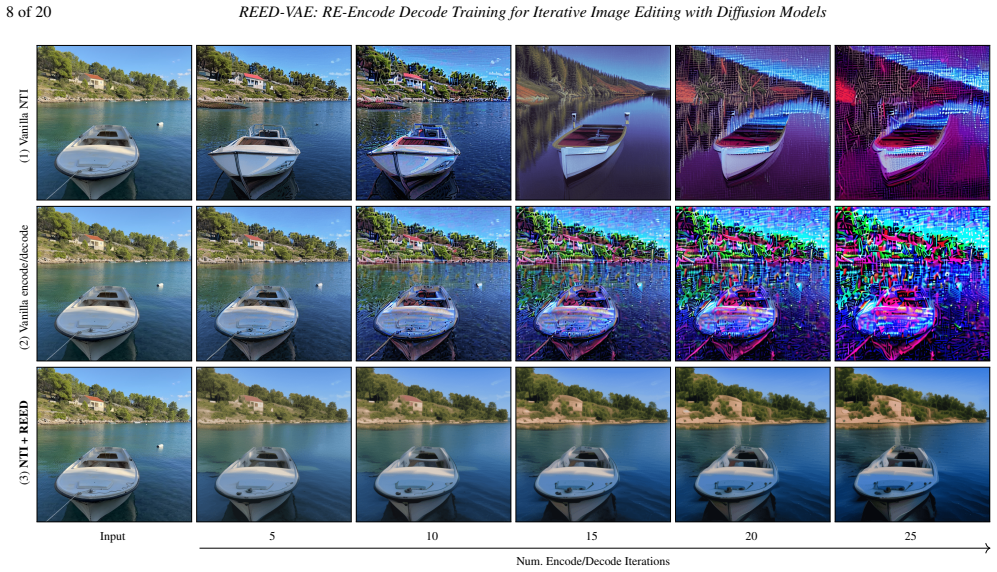
- Editing models that rely on inversion, such as NTI-based Prompt-to-Prompt, still improve when paired with REED, although inversion itself contributes noise that the decoder alone cannot fully remove.
- REED improves editability in the sense that the edited image stays close to the intended target over more iterations, increasing the likelihood that later edit operations succeed.
- The ablation results imply each component matters: iterative training needs k larger than 2, the first-step loss helps convergence, and dynamic incrementation gives the largest gains at 15 to 25 iterations.
Reading between the lines
- If the decoder-only design truly keeps the encoder's latent distribution intact, the same REED recipe should transfer to other latent diffusion models, including 16-channel VAE models, whose decoders could be trained with the same objective; the paper's supplementary experiments suggest those models also accumulate degradation.
- The frequency-domain evidence points to a more specific failure mode: repeated VAE cycles both blur high frequencies and inject new high-frequency artifacts. A REED-style objective could be paired with an explicit spectral regularizer to control which frequencies drift, a testable extension the paper does not pursue.
- The first-step-loss principle—measure iterative training against the one-step reconstruction rather than the ground truth—may generalize beyond diffusion to any lossy compression loop where the goal is stability of repeated round trips rather than absolute fidelity.
Signed reviews
Editorial analysis
A structured set of objections, weighed in public.
Referee Report
Summary. The paper introduces REED-VAE, a fine-tuning scheme for the decoder of a Stable Diffusion VAE, intended to reduce the accumulation of artifacts and noise when images are repeatedly encoded and decoded during multi-step, multi-method iterative image editing. The training objective combines iterative encode-decode rollouts, a dynamic incrementation curriculum on the number of iterations k, and a first-step loss comparing the final rollout output xk to the first reconstruction x1. The authors evaluate the approach by swapping the vanilla SD2.1 decoder for their fine-tuned decoder across InstructPix2Pix, MagicBrush, DiffEdit, Paint-by-Example, and SD Inpainting, reporting qualitative and quantitative improvements in MSE, LPIPS, SSIM, FID, and PSNR at 5, 15, and 25 iterations. They also present ablations on the iterative training, first-step loss, and dynamic incrementation components, and qualitative comparisons with Null-Text Inversion. The paper frames multi-method iterative image editing as a new problem setting and proposes the REED-trained decoder as a drop-in solution.
Significance. If the central claim holds, the contribution is practically useful: it provides a simple, architecture-compatible way to extend diffusion-based editing pipelines to long or interleaved editing sessions without changing the diffusion model. The problem framing is timely, and the qualitative evidence (Figures 1, 2, and the supplementary sequences) is visually compelling. The paper ships an apparently reproducible recipe (public code and models), and the supplementary comparison with SDXL, SD3, and Flux helps contextualize the relevance of the SD2.1-focused experiments. The main uncertainties are empirical: the editing metric protocol compares against a self-produced first edit rather than the source, and the training implementation only backpropagates through the final iteration, which weakens the mechanistic story told in Algorithm 1.
major comments (3)
- [Supplementary Material, 'Experiments and comparisons'] The central claim is that REED-VAE preserves image quality across iterative editing, but Table 1 computes editing metrics between the image at iterations 5/15/25 and x1, the first edited output, not against the source image x0 as the supplement states. This is load-bearing: x1 is itself produced by the decoder being evaluated, so a smoother, more conservative, or semantically weaker first edit will make later outputs closer to x1 even if they drift arbitrarily far from the original image. The main text (Sec. 5, 'Evaluation metrics') does not disclose this reference choice, and Sec. 4.3 says test metrics are 'still computed against x0,' which appears inconsistent with the supplement. I request that all editing metrics be recomputed against x0 (and, where applicable, against the intended target image for each edit), with the protocol stated explicitly in the main text.
- [Algorithm 1 and Supplementary Material, 'Backpropagation strategy'] Equation (2) trains against x1, and the supplement states that gradients are only computed for the final iteration. Under this scheme, gradient information does not flow through the earlier encoder-decoder steps that produce x_{k-1}, so the loss does not actually optimize the full iterative chain described by Eq. (1). As a consequence, the paper's explanation of why REED reduces cumulative artifacts is incomplete, and Algorithm 1's unconditional 'Take gradient descent step on ∇Ltrain(x1,xk,zk)' is misleading. Please clarify the exact optimization objective and provide evidence that final-iteration-only gradients suffice, for example by comparing with full backpropagation for a small k.
- [Tables 1 and 2] All quantitative results are single-run numbers on a 179-image subset of ImagenHub, reported without error bars, confidence intervals, or significance tests. Since the headline comparisons involve many small metric differences at 5, 15, and 25 iterations, the robustness of the 'consistent improvements' claims cannot be assessed without variance estimates. I request that the authors report means and standard deviations over multiple seeds (or equivalent statistical support) for the main editing and ablation tables.
minor comments (4)
- [Table 2] The row label 'IT + FSL + DI(k=5)' is confusing: DI stands for dynamic incrementation, so the effective k is not a fixed value of 5; please clarify the reported configuration and the final k used for the full model.
- [Section 5.5, Figure 5] The NTI comparison is presented only qualitatively; adding a quantitative table (e.g., LPIPS and PSNR versus iteration for vanilla NTI and NTI+REED) would strengthen the claim that inversion methods do not inherently solve the degradation.
- [Throughout] There are several typographical and formatting issues, including 'limtiations' and 'reconstrctions' in the Related Work, inconsistent spacing in 'V AE', and a stray semicolon in Sec. 4.2 ('however; past k = 6').
- [Section 5, 'Evaluation metrics'] The choice of reference image (x0 vs x1) is critical to interpreting the results and should be described in the main text rather than only in the supplement.
Circularity Check
Reported quality metrics are computed against the model's own first output x1, which is also the target of the first-step training loss; the headline improvement is therefore partly the training objective itself, not an independent measure of source-fidelity preservation.
-
fitted input called prediction
[Sec. 4.3 / Eq. (2); Supplementary 'Experiments and comparisons']
"Eq. (2): Ltrain = LMSE(x1,xk) + α·LLPIPS(x1,xk) + β·DKL. Sec. 4.3: 'we instead compute the training loss between xk and x1. ... Note that the validation loss and test metrics are still computed against x0, as this is the true performance indicator.' Supplementary: 'we compute metrics between the given target image (one of iterations 5,15, or 25) and x1 — not to the source image.'"
The decoder is trained to minimize MSE/LPIPS between the k-th iterative output xk and the first output x1 (Eq. 2). The reported quality metrics (MSE/LPIPS/SSIM/FID) are then computed between the iteration 5/15/25 output and x1, i.e., the same objective evaluated on held-out images. Because x1 is produced by the decoder under evaluation, 'quality preservation' is defined as consistency with the model's own first output, not fidelity to the source. In the encode-decode ablation (Table 2), the evaluation is exactly the training task, so improvement follows from fitting. In the editing tables, external edits add some independent content, but the metric still rewards closeness to a self-produced x1, so the measured gain is partly built into the training loss.
full rationale
This paper contains no derivation chain, no imported uniqueness theorem, and no load-bearing self-citation; its contribution is an empirical training scheme plus evaluations against existing editing models. The specific circular issue is the metric reference: the first-step loss (Eq. 2) trains the decoder to make xk close to x1, and the reported quality metrics compare iteration 5/15/25 outputs to x1. Hence the quantitative support for 'image quality preservation' is, to a substantial degree, a held-out measurement of the training objective rather than an independent check of source-image fidelity. The contradiction between Sec. 4.3 ('test metrics ... computed against x0') and the supplementary ('metrics between ... x1 — not to the source image') confirms that the source-anchored validation is not in fact used for the reported numbers. The editing-model experiments (InstructPix2Pix, MagicBrush, DiffEdit, PbE, SD Inpainting) do provide evidence outside the plain encode-decode training distribution, so the result is not fully tautological; however, because those evaluations also use the self-produced x1 as the reference, the central claim that REED preserves image quality over iterations is only partially established. The paper honestly labels the transfer from encode-decode training to editing as a hypothesis (Sec. 4.1), which is a load-bearing assumption but not a circular step. Overall, the reported improvement is partly constructed by aligning the evaluation metric with the training objective, warranting a mid-range circularity score rather than a clean non-finding.
Assumptions & free parameters
free parameters (3)
- alpha (LPIPS loss weight) =
0.01
- beta (KL loss weight) =
1
- k curriculum (initial 4, max 20, patience 5 epochs) =
4 to 20
assumptions (3)
- domain assumption Iterative editing artifacts are dominated by VAE reconstruction error.
- ad hoc to paper Improvement on repeated encode-decode cycles transfers to iterative editing.
- domain assumption Frozen encoder preserves compatibility with pretrained diffusion editing models.
Cite this review
Pith. "Pith review of REED-VAE: RE-Encode Decode Training for Iterative Image Editing with Diffusion Models." pith.science (2026). https://pith.science/paper/HAIR26TH
@misc{pith2026250418989,
  author       = {Pith},
  title        = {Pith review of: REED-VAE: RE-Encode Decode Training for Iterative Image Editing with Diffusion Models},
  year         = {2026},
  howpublished = {\url{https://pith.science/paper/HAIR26TH}},
  note         = {Machine review of arXiv:2504.18989}
}
read the original abstract
While latent diffusion models achieve impressive image editing results, their application to iterative editing of the same image is severely restricted. When trying to apply consecutive edit operations using current models, they accumulate artifacts and noise due to repeated transitions between pixel and latent spaces. Some methods have attempted to address this limitation by performing the entire edit chain within the latent space, sacrificing flexibility by supporting only a limited, predetermined set of diffusion editing operations. We present a RE-encode decode (REED) training scheme for variational autoencoders (VAEs), which promotes image quality preservation even after many iterations. Our work enables multi-method iterative image editing: users can perform a variety of iterative edit operations, with each operation building on the output of the previous one using both diffusion-based operations and conventional editing techniques. We demonstrate the advantage of REED-VAE across a range of image editing scenarios, including text-based and mask-based editing frameworks. In addition, we show how REED-VAE enhances the overall editability of images, increasing the likelihood of successful and precise edit operations. We hope that this work will serve as a benchmark for the newly introduced task of multi-method image editing. Our code and models will be available at https://github.com/galmog/REED-VAE
Figures


Figures from the paper (8 more)



Reference graph
Works this paper leans on
-
[1]
write newline
" write newline "" before.all 'output.state := FUNCTION fin.entry add.period write newline FUNCTION new.block output.state before.all = 'skip after.block 'output.state := if FUNCTION new.sentence output.state after.block = 'skip output.state before.all = 'skip after.sentence 'output.state := if if FUNCTION not #0 #1 if FUNCTION and 'skip pop #0 if FUNCTIO...
-
[2]
write newline
" write newline "" before.all 'output.state := FUNCTION fin.entry.original add.period write newline FUNCTION new.block output.state before.all = 'skip after.block 'output.state := if FUNCTION new.sentence output.state after.block = 'skip output.state before.all = 'skip after.sentence 'output.state := if if FUNCTION not #0 #1 if FUNCTION and 'skip pop #0 i...
-
[3]
: Detecting deep-fake videos from phoneme-viseme mismatches
Agarwal S., Farid H., Fried O., Agrawala M. : Detecting deep-fake videos from phoneme-viseme mismatches. In 2020 IEEE/CVF Conference on Computer Vision and Pattern Recognition Workshops (CVPRW) (2020), pp. 2814--2822. https://doi.org/10.1109/CVPRW50498.2020.00338 doi:10.1109/CVPRW50498.2020.00338
arXiv 2020
-
[4]
Avrahami O., Fried O., Lischinski D. : Blended latent diffusion. ACM Trans. Graph. 42, 4 (jul 2023). URL: https://doi.org/10.1145/3592450, https://doi.org/10.1145/3592450 doi:10.1145/3592450
doi:10.1145/3592450 2023
-
[5]
: Blended diffusion for text-driven editing of natural images
Avrahami O., Lischinski D., Fried O. : Blended diffusion for text-driven editing of natural images. In Proceedings of the IEEE/CVF Conference on Computer Vision and Pattern Recognition (2022), pp. 18208--18218
work page 2022
-
[6]
Brooks T., Holynski A., Efros A. A. : Instructpix2pix: Learning to follow image editing instructions. In Proceedings of the IEEE/CVF Conference on Computer Vision and Pattern Recognition (2023), pp. 18392--18402
2023
-
[7]
Bengio Y., Louradour J., Collobert R., Weston J. : Curriculum learning. In Proceedings of the 26th annual international conference on machine learning (2009), pp. 41--48
work page 2009
-
[8]
: Diffedit: Diffusion-based semantic image editing with mask guidance
Couairon G., Verbeek J., Schwenk H., Cord M. : Diffedit: Diffusion-based semantic image editing with mask guidance. arXiv preprint arXiv:2210.11427 (2022)
arXiv 2022
Show all 50 references
-
[9]
: Masactrl: Tuning-free mutual self-attention control for consistent image synthesis and editing
Cao M., Wang X., Qi Z., Shan Y., Qie X., Zheng Y. : Masactrl: Tuning-free mutual self-attention control for consistent image synthesis and editing. In Proceedings of the IEEE/CVF International Conference on Computer Vision (ICCV) (October 2023), pp. 22560--22570
2023
-
[10]
: Diffusion models beat gans on image synthesis
Dhariwal P., Nichol A. : Diffusion models beat gans on image synthesis. Advances in neural information processing systems 34 (2021), 8780--8794
2021
-
[11]
: Scaling rectified flow transformers for high-resolution image synthesis
Esser P., Kulal S., Blattmann A., Entezari R., M \"u ller J., Saini H., Levi Y., Lorenz D., Sauer A., Boesel F., et al. : Scaling rectified flow transformers for high-resolution image synthesis. In Forty-first International Conference on Machine Learning (2024)
2024
-
[12]
: Taming transformers for high-resolution image synthesis
Esser P., Rombach R., Ommer B. : Taming transformers for high-resolution image synthesis. In Proceedings of the IEEE/CVF conference on computer vision and pattern recognition (2021), pp. 12873--12883
2021
-
[13]
H., Chechik G., Cohen-Or D
Gal R., Alaluf Y., Atzmon Y., Patashnik O., Bermano A. H., Chechik G., Cohen-Or D. : An image is worth one word: Personalizing text-to-image generation using textual inversion, 2022. URL: https://arxiv.org/abs/2208.01618, https://doi.org/10.48550/ARXIV.2208.01618 doi:10.48550/...
-
[14]
: Diffusion model-based image editing: A survey
Huang Y., Huang J., Liu Y., Yan M., Lv J., Liu J., Xiong W., Zhang H., Chen S., Cao L. : Diffusion model-based image editing: A survey. arXiv preprint arXiv:2402.17525 (2024)
2024 arXiv
-
[15]
: Denoising diffusion probabilistic models
Ho J., Jain A., Abbeel P. : Denoising diffusion probabilistic models. Advances in neural information processing systems 33 (2020), 6840--6851
2020
-
[16]
: Prompt-to-prompt image editing with cross attention control
Hertz A., Mokady R., Tenenbaum J., Aberman K., Pritch Y., Cohen-Or D. : Prompt-to-prompt image editing with cross attention control. arXiv preprint arXiv:2208.01626 (2022)
2022 arXiv
-
[17]
: Gans trained by a two time-scale update rule converge to a local nash equilibrium
Heusel M., Ramsauer H., Unterthiner T., Nessler B., Hochreiter S. : Gans trained by a two time-scale update rule converge to a local nash equilibrium. Advances in neural information processing systems 30 (2017)
2017
-
[18]
Joseph K., Udhayanan P., Shukla T., Agarwal A., Karanam S., Goswami K., Srinivasan B. V. : Iterative multi-granular image editing using diffusion models. In Proceedings of the IEEE/CVF Winter Conference on Applications of Computer Vision (2024), pp. 8107--8116
2024
-
[19]
: Pnp inversion: Boosting diffusion-based editing with 3 lines of code
Ju X., Zeng A., Bian Y., Liu S., Xu Q. : Pnp inversion: Boosting diffusion-based editing with 3 lines of code. International Conference on Learning Representations ( ICLR ) (2024)
2024
-
[20]
: Imagenhub: Standardizing the evaluation of conditional image generation models
Ku M., Li T., Zhang K., Lu Y., Fu X., Zhuang W., Chen W. : Imagenhub: Standardizing the evaluation of conditional image generation models. In The Twelfth International Conference on Learning Representations (2024). URL: https://openreview.net/forum?id=OuV9ZrkQlc
2024
-
[21]
: Fakeout: Leveraging out-of-domain self-supervision for multi-modal video deepfake detection
Knafo G. : Fakeout: Leveraging out-of-domain self-supervision for multi-modal video deepfake detection. Master's thesis, Reichman University (Israel), 2022
2022
-
[22]
P., Welling M
Kingma D. P., Welling M. : Auto-encoding variational bayes. arXiv preprint arXiv:1312.6114 (2013)
2013 arXiv
-
[23]
: Imagic: Text-based real image editing with diffusion models
Kawar B., Zada S., Lang O., Tov O., Chang H., Dekel T., Mosseri I., Irani M. : Imagic: Text-based real image editing with diffusion models. In Conference on Computer Vision and Pattern Recognition 2023 (2023)
2023
-
[24]
Labs B. F. : Flux. https://github.com/black-forest-labs/flux, 2023. URL: https://github.com/black-forest-labs/flux
2023
-
[25]
: Repaint: Inpainting using denoising diffusion probabilistic models
Lugmayr A., Danelljan M., Romero A., Yu F., Timofte R., Van Gool L. : Repaint: Inpainting using denoising diffusion probabilistic models. In Proceedings of the IEEE/CVF conference on computer vision and pattern recognition (2022), pp. 11461--11471
2022
-
[26]
: Null-text inversion for editing real images using guided diffusion models
Mokady R., Hertz A., Aberman K., Pritch Y., Cohen-Or D. : Null-text inversion for editing real images using guided diffusion models. In Proceedings of the IEEE/CVF Conference on Computer Vision and Pattern Recognition (2023), pp. 6038--6047
2023
-
[27]
: Sdedit: Guided image synthesis and editing with stochastic differential equations
Meng C., He Y., Song Y., Song J., Wu J., Zhu J.-Y., Ermon S. : Sdedit: Guided image synthesis and editing with stochastic differential equations. arXiv preprint arXiv:2108.01073 (2021)
2021 arXiv
-
[28]
: Glide: Towards photorealistic image generation and editing with text-guided diffusion models
Nichol A., Dhariwal P., Ramesh A., Shyam P., Mishkin P., McGrew B., Sutskever I., Chen M. : Glide: Towards photorealistic image generation and editing with text-guided diffusion models. arXiv preprint arXiv:2112.10741 (2021)
2021 arXiv
-
[29]
: Sdxl: Improving latent diffusion models for high-resolution image synthesis
Podell D., English Z., Lacey K., Blattmann A., Dockhorn T., M \"u ller J., Penna J., Rombach R. : Sdxl: Improving latent diffusion models for high-resolution image synthesis. arXiv preprint arXiv:2307.01952 (2023)
2023 arXiv
-
[30]
: Effective real image editing with accelerated iterative diffusion inversion
Pan Z., Gherardi R., Xie X., Huang S. : Effective real image editing with accelerated iterative diffusion inversion. In Proceedings of the IEEE/CVF International Conference on Computer Vision (2023), pp. 15912--15921
2023
-
[31]
: Zero-shot image-to-image translation
Parmar G., Kumar Singh K., Zhang R., Li Y., Lu J., Zhu J.-Y. : Zero-shot image-to-image translation. In ACM SIGGRAPH 2023 Conference Proceedings (2023), pp. 1--11
2023
-
[32]
Park J., Kwon G., Ye J. C. : Ed-nerf: Efficient text-guided editing of 3d scene using latent space nerf. arXiv preprint arXiv:2310.02712 (2023)
2023 arXiv
-
[33]
: High-resolution image synthesis with latent diffusion models
Rombach R., Blattmann A., Lorenz D., Esser P., Ommer B. : High-resolution image synthesis with latent diffusion models. In Proceedings of the IEEE/CVF Conference on Computer Vision and Pattern Recognition (CVPR) (June 2022), pp. 10684--10695
2022
-
[34]
: Hierarchical text-conditional image generation with clip latents
Ramesh A., Dhariwal P., Nichol A., Chu C., Chen M. : Hierarchical text-conditional image generation with clip latents. arxiv 2022. arXiv preprint arXiv:2204.06125 (2022)
2022 arXiv
-
[35]
: Laion-5b: An open large-scale dataset for training next generation image-text models
Schuhmann C., Beaumont R., Vencu R., Gordon C., Wightman R., Cherti M., Coombes T., Katta A., Mullis C., Wortsman M., et al. : Laion-5b: An open large-scale dataset for training next generation image-text models. Advances in Neural Information Processing Systems 35 (2022), 252...
2022
-
[36]
L., Ghasemipour K., Gontijo Lopes R., Karagol Ayan B., Salimans T., et al
Saharia C., Chan W., Saxena S., Li L., Whang J., Denton E. L., Ghasemipour K., Gontijo Lopes R., Karagol Ayan B., Salimans T., et al. : Photorealistic text-to-image diffusion models with deep language understanding. Advances in neural information processing systems 35 (2022), ...
2022
-
[37]
: pytorch-fid: FID Score for PyTorch
Seitzer M. : pytorch-fid: FID Score for PyTorch . https://github.com/mseitzer/pytorch-fid, August 2020. Version 0.3.0. URL: https://github.com/mseitzer/pytorch-fid
2020
-
[38]
: Deep image fingerprint: Towards low budget synthetic image detection and model lineage analysis
Sinitsa S., Fried O. : Deep image fingerprint: Towards low budget synthetic image detection and model lineage analysis. In Proceedings of the IEEE/CVF Winter Conference on Applications of Computer Vision (2024), pp. 4067--4076
2024
-
[39]
: Denoising diffusion implicit models
Song J., Meng C., Ermon S. : Denoising diffusion implicit models. arXiv preprint arXiv:2010.02502 (2020)
2020 arXiv
-
[40]
Y., Bai S
Shi Y., Xue C., Pan J., Zhang W., Tan V. Y., Bai S. : Dragdiffusion: Harnessing diffusion models for interactive point-based image editing. arXiv preprint arXiv:2306.14435 (2023)
2023 arXiv
-
[41]
: Neural discrete representation learning
Van Den Oord A., Vinyals O., et al. : Neural discrete representation learning. Advances in neural information processing systems 30 (2017)
2017
-
[42]
: Diffusers: State-of-the-art diffusion models
von Platen P., Patil S., Lozhkov A., Cuenca P., Lambert N., Rasul K., Davaadorj M., Nair D., Paul S., Berman W., Xu Y., Liu S., Wolf T. : Diffusers: State-of-the-art diffusion models. https://github.com/huggingface/diffusers, 2022
2022
-
[43]
C., Sheikh H
Wang Z., Bovik A. C., Sheikh H. R., Simoncelli E. P. : Image quality assessment: from error visibility to structural similarity. IEEE transactions on image processing 13, 4 (2004), 600--612
2004
-
[44]
: Tree-rings watermarks: Invisible fingerprints for diffusion images
Wen Y., Kirchenbauer J., Geiping J., Goldstein T. : Tree-rings watermarks: Invisible fingerprints for diffusion images. Advances in Neural Information Processing Systems 36 (2024)
2024
-
[45]
: Paint by example: Exemplar-based image editing with diffusion models
Yang B., Gu S., Zhang B., Zhang T., Chen X., Sun X., Chen D., Wen F. : Paint by example: Exemplar-based image editing with diffusion models. In Proceedings of the IEEE/CVF Conference on Computer Vision and Pattern Recognition (2023), pp. 18381--18391
2023
-
[46]
: Model collapse in the self-consuming chain of diffusion finetuning: A novel perspective from quantitative trait modeling
Yoon Y., Hu D., Weissburg I., Qin Y., Jeong H. : Model collapse in the self-consuming chain of diffusion finetuning: A novel perspective from quantitative trait modeling. arXiv preprint arXiv:2407.17493 (2024)
2024 arXiv
-
[47]
Yang S., Zhou Y., Liu Z., Loy C. C. : Rerender a video: Zero-shot text-guided video-to-video translation. In SIGGRAPH Asia 2023 Conference Papers (2023), pp. 1--11
2023
-
[48]
A., Shechtman E., Wang O
Zhang R., Isola P., Efros A. A., Shechtman E., Wang O. : The unreasonable effectiveness of deep features as a perceptual metric. In Proceedings of the IEEE conference on computer vision and pattern recognition (2018), pp. 586--595
2018
-
[49]
: Magicbrush: A manually annotated dataset for instruction-guided image editing
Zhang K., Mo L., Chen W., Sun H., Su Y. : Magicbrush: A manually annotated dataset for instruction-guided image editing. In Advances in Neural Information Processing Systems (2023)
2023
-
[50]
: Hive: Harnessing human feedback for instructional visual editing
Zhang S., Yang X., Feng Y., Qin C., Chen C.-C., Yu N., Chen Z., Wang H., Savarese S., Ermon S., et al. : Hive: Harnessing human feedback for instructional visual editing. In Proceedings of the IEEE/CVF Conference on Computer Vision and Pattern Recognition (2024), pp. 9026--9036
2024
Reviewed August 16, 2026 · model on record in the stance chip above.
Discussion (0). Continue with ORCID to comment.