REVIEW 3 major objections 5 minor 61 references
TransRAD: Retentive Vision Transformer for Enhanced Radar Object Detection
T0 review · 3 major / 5 minor · reviewed 2026-08-10 · deepseek-v4-flash
Pith's one-line read The paper claims TransRAD, a retentive vision transformer detector, outperforms state-of-the-art radar object detectors on the RADDet benchmark in 3D and 2D while using fewer parameters and running faster.
desk verdict TransRAD is a real architecture contribution with a sensible Doppler-as-channel trick and a useful LA-NMS post-processor, but the SOTA comparison is compromised because most baselines run as backbones under TransRAD's own head and loss, so the accuracy claims need a fair re-run before they can be trusted. read the letter →
The pith
A machine-rendered reading of the paper's core claim, the machinery that carries it, and where it could break.
The reading
What carries the argument
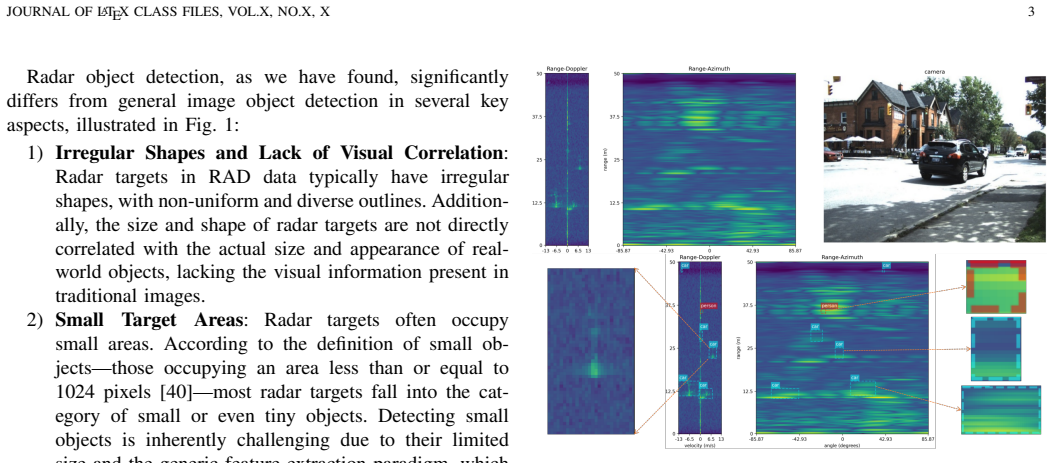
The load-bearing object is the Manhattan-decay attention matrix of MaSA, $D_{nm} = \gamma^{|x_n-x_m|+|y_n-y_m|}$, imported from the retention mechanism and extended into a bidirectional two-dimensional spatial decay, computed through decomposed horizontal and vertical attention with a depthwise-convolution local context enhancement. This matrix is what converts a generic transformer into one that concentrates attention near target centers and their immediate surroundings. A second piece of machinery is the Doppler-as-channel design: the RAD cube is treated like an image with the Doppler axis folded into the channel dimension, so the model regresses $[z_1,z_2]$ with a separate head instead of constructing 3D feature maps. That choice is what avoids 3D convolutions and keeps the model computationally cheap.
What would settle it
Retrain TransRAD on RADDet with the Manhattan decay factor set to $\gamma = 1$ (uniform attention) while keeping everything else identical; if AP0.3 stays near 61.90%, the explicit spatial prior is not the source of the claimed gain.
Extended reading notes
Core claim
TransRAD is a 3D radar object detector that takes the RAD cube as input and produces 3D bounding boxes $[x_1,y_1,z_1,x_2,y_2,z_2]$ covering range, azimuth, and Doppler. The paper's central claim is that the Retentive Manhattan Self-Attention mechanism, whose decay matrix is $D^{\text{Bi,2d}}_{nm} = \gamma^{|x_n-x_m|+|y_n-y_m|}$, matches the saliency structure of radar targets — a high-intensity center decaying toward the edges — and that this alignment is what lets a lightweight 2D-style transformer beat much heavier 3D-CNN detectors. TransRAD reports 61.90% AP0.3 on RADDet 3D detection versus 52.90% for RadarResNet and 51.12% for RODNet-CDC, with similar leads in RA and RD 2D detection, while using 5.78M parameters and 4.37 ms per frame. The paper also introduces Location-Aware NMS, which suppresses overlapping boxes of different classes, justified by radar's localization reliability and the low probability of true target overlap.
Load-bearing premise
The load-bearing premise is that the comparison protocol, which runs every model except RadarResNet as a backbone with TransRAD's neck, head, and loss, fairly represents how those models would perform with their own published detection heads and training losses.
Editorial extensions
If this is right
- If the reported numbers hold, 3D radar object detection on RADDet no longer requires 3D convolutional backbones; a 2D retentive transformer with a separate Doppler head reaches the highest AP0.3.
- The gap between TransRAD and baselines widens at stricter IoU thresholds, which the paper reads as better localization rather than merely better recall.
- LA-NMS removes overlapping boxes assigned to different classes, directly addressing the radar-specific failure mode where classification is unreliable but localization is not.
- The full model uses 5.78M parameters and 4.37 ms per frame inference on a single GPU, implying real-time radar-only detection is compatible with a lightweight architecture.
Reading between the lines
- A natural extension the paper leaves implicit: the Doppler-as-channel trick should generalize to 4D radar data by adding an elevation regression head, making the same architecture applicable to datasets with range-azimuth-elevation-Doppler annotations.
- Because LA-NMS is grounded in radar's localization reliability, a testable extension is to apply it in camera-radar fusion, letting radar boxes arbitrate class-conflicting vision detections.
- The spatial-prior argument implies a data-efficiency advantage on small radar datasets; a direct test would train on a fraction of RADDet frames and compare learning curves against a vanilla-transformer control.
- If the central claim holds, radar-only perception systems could carry more of the perception load in low-visibility conditions, with cameras and LiDAR reserved for tasks where appearance-based classification is essential.
Editorial analysis
A structured set of objections, weighed in public.
Referee Report
Summary. The paper proposes TransRAD, a radar object detection model that operates on Range-Azimuth-Doppler (RAD) cubes without 3D convolutions. The architecture uses a Retentive Vision Transformer (RMT) backbone with Manhattan self-attention, an FPN neck, anchor-free decoupled heads, a multi-term loss combining 2D and 3D box losses with center and Doppler terms, and a proposed Location-Aware NMS post-processing step. The authors evaluate on the RADDet dataset and report that TransRAD outperforms several previous radar detectors in 2D and 3D mAP while having lower parameter count and faster inference. The paper also includes an ablation study showing contributions of the FPN neck, decoupled heads, 2D/center losses, and LA-NMS.
Significance. If the reported results are reliable, the paper would make a useful empirical contribution: it demonstrates that a transformer-based 2D architecture can process 3D RAD data for joint range-azimuth-Doppler detection more efficiently than 3D-CNN-based detectors, and the LA-NMS idea is a plausible way to handle classification errors in radar. The main weakness is that the headline comparison against state-of-the-art methods is not actually a comparison against those published systems, because most baselines contribute only their backbones and inherit TransRAD's neck, head, loss, and post-processing. The paper is an empirical architecture study rather than a derivation, so I do not see a circularity problem; the concern is whether the central empirical claim is supported by the evaluation protocol. The code link and ablation study are positive aspects, but the missing statistical reliability measures and unspecified data split further weaken the current support for the claimed superiority.
major comments (3)
- [Section IV.D, Tables I and II] The comparison against state-of-the-art methods is not a comparison against the published detectors. The text states that except for RadarResNet (and DAROD in 2D), all compared models 'only utilize their Backbone parts, sharing the same Neck, Head, and loss functions as our proposed method.' Therefore RODNet-CDC, RODNet-HG, RAMP-CNN, T-RODNet, RadarFormer, and YOLOv8 are evaluated as backbones retrofitted with TransRAD's anchor-free decoupled heads, task-aligned assignment, multi-term loss (Eq. 22), and LA-NMS, not as the systems they were published as. The claimed gains, such as 61.90 AP0.3 versus 51.12 for RODNet-CDC, are thus not established against the original models. The authors should either evaluate the full published models with their own detection heads and losses, or clearly reframe the claim as a backbone-feature comparison and temper the abstract and conclusion accordingly.
- [Section IV.C and IV.D] No error bars, multiple-run statistics, or train/validation/test split are reported. All models are trained once with a single set of hyperparameters, and the dataset contains only 10,158 frames with 28,401 objects. Differences such as the LA-NMS ablation drop from 61.90 to 59.14 AP0.3 could easily fall within run-to-run variance on this small dataset. The authors should specify the data split, report mean and standard deviation over at least three seeds, and state how the loss weights, LA-NMS threshold, and other hyperparameters were selected (e.g., validation-set tuning) so the reader can assess the risk of overfitting to the test benchmark.
- [Section IV.E, Table III, row 4] The ablation labeled '2D and Center Loss' removes both the 2D bounding box losses and the center loss simultaneously, so it cannot attribute the observed performance drop to either component. Since the paper emphasizes center loss as a distinct contribution, separate ablations for the 2D loss and the center loss are needed to support that claim.
minor comments (5)
- [Section III.E, Eq. (22)] The symbol α is overloaded: it denotes the CIoU aspect-ratio weight in Eq. (13), the focal-loss class-balance factor in Eq. (15), and the nine loss-balance weights α1..α9 in Eq. (22). Please rename these to avoid ambiguity.
- [Section IV.A] The manuscript does not specify how RADDet is split into training, validation, and test sets, nor whether the nearest-neighbor interpolation along the Doppler dimension is applied consistently to the ground-truth annotations. This information is necessary for reproducibility.
- [Section IV.B, Eq. (25)] The mAP formula averages over IoU thresholds, but Tables I and II report AP at individual thresholds without an average row. Clarify whether the reported 'mAP' values are class-averaged AP at each IoU threshold, and if so, state this explicitly in the metric definition.
- [Section III.F, Algorithm 1] LA-NMS suppresses lower-scoring boxes of different classes whenever IoU exceeds a fixed threshold of 0.1. Because this threshold is quite low, a sensitivity analysis over the threshold would help justify the choice, especially for nearby but distinct radar targets.
- [Section IV.D.1] The text refers to 'our TransRadar' in one place; the model name should be consistently written as TransRAD.
Circularity Check
No significant circularity: TransRAD's performance claims rest on external-benchmark measurements, not on a derivation whose target equals its inputs.
full rationale
TransRAD is an empirical architecture study. Its central claim is that the proposed detector outperforms prior methods on the RADDet benchmark; that claim is supported by measured mAP, inference time, FLOPs, and parameter counts on an external dataset, not by a derivation in which the target quantity is defined through the model's own parameters. The design story that Manhattan-distance spatial decay in MaSA matches radar target saliency (Section III.A) is a motivating heuristic, not a prediction that is forced by construction. Hyperparameters such as the loss weights in Eq. (22), the LA-NMS threshold of 0.1, TAL K=10, and wmin=0.05 are tuned on the benchmark and reported as settings, not as independent predictions; tuning hyperparameters on a benchmark is standard practice and does not make the measured accuracy circular. The RMT backbone is an externally published architecture [30] with its own independent experimental support, and the other components (FPN, YOLOv8-style anchor-free heads, TAL, CIoU/DFL/Focal losses) are standard external building blocks. The authors' self-citations ([1], [3], [4], [7]) appear only in introductory motivation and are not load-bearing for the reported results. The one notable weakness is Section IV.D, where most compared models 'only utilize their Backbone parts, sharing the same Neck, Head, and loss functions as our proposed method'; this is an openly stated experimental-design limitation that could affect fairness of the SOTA comparison, but it is not circularity because the comparison still evaluates on external data with standard mAP and does not define the target through the model's own fitted values. Whether full published models with their own heads and losses would perform differently is a correctness/benchmarking concern, not a self-referential derivation. Therefore no circular step is present and the circularity score is 0.
Assumptions & free parameters
free parameters (5)
- Loss balance weights alpha_1..alpha_9 =
[30, 7.5, 7.5, 0.5, 1.5, 5.0, 5.0, 80, 40] (later alpha_1=40, alpha_2=15 for second round)
- LA-NMS IoU threshold =
0.1
- Class weight minimum w_min =
0.05
- TAL top-K =
10
- Focal loss alpha and gamma =
alpha=0.25, gamma=2
assumptions (6)
- domain assumption Radar targets in RAD data exhibit a high-intensity core that gradually diminishes towards the edges.
- domain assumption Radar object detection has higher localization accuracy than classification accuracy.
- domain assumption The probability of radar targets overlapping in RAD data is extremely low.
- domain assumption Nearest-neighbor interpolation of the Doppler axis from 64 to 256 bins preserves object shapes and centers, so original 3D annotations can be used after scaling.
- domain assumption The RMT backbone's Manhattan-distance attention prior is suitable for radar RAD data.
- domain assumption Training from scratch on RADDet with Adam, cosine schedule, and the specified hyperparameters yields a converged detector.
Cite this review
Pith. "Pith review of TransRAD: Retentive Vision Transformer for Enhanced Radar Object Detection." pith.science (2026). https://pith.science/paper/HARGMKT4
@misc{pith2026250117977,
  author       = {Pith},
  title        = {Pith review of: TransRAD: Retentive Vision Transformer for Enhanced Radar Object Detection},
  year         = {2026},
  howpublished = {\url{https://pith.science/paper/HARGMKT4}},
  note         = {Machine review of arXiv:2501.17977}
}
read the original abstract
Despite significant advancements in environment perception capabilities for autonomous driving and intelligent robotics, cameras and LiDARs remain notoriously unreliable in low-light conditions and adverse weather, which limits their effectiveness. Radar serves as a reliable and low-cost sensor that can effectively complement these limitations. However, radar-based object detection has been underexplored due to the inherent weaknesses of radar data, such as low resolution, high noise, and lack of visual information. In this paper, we present TransRAD, a novel 3D radar object detection model designed to address these challenges by leveraging the Retentive Vision Transformer (RMT) to more effectively learn features from information-dense radar Range-Azimuth-Doppler (RAD) data. Our approach leverages the Retentive Manhattan Self-Attention (MaSA) mechanism provided by RMT to incorporate explicit spatial priors, thereby enabling more accurate alignment with the spatial saliency characteristics of radar targets in RAD data and achieving precise 3D radar detection across Range-Azimuth-Doppler dimensions. Furthermore, we propose Location-Aware NMS to effectively mitigate the common issue of duplicate bounding boxes in deep radar object detection. The experimental results demonstrate that TransRAD outperforms state-of-the-art methods in both 2D and 3D radar detection tasks, achieving higher accuracy, faster inference speed, and reduced computational complexity. Code is available at https://github.com/radar-lab/TransRAD
Figures


Figures from the paper (3 more)


Reference graph
Works this paper leans on
-
[1]
L. Cheng, A. Sengupta, and S. Cao, “3d radar and camera co-calibration: A flexible and accurate method for target-based extrinsic calibration,” in 2023 IEEE Radar Conference (RadarConf23) . IEEE, 2023, pp. 1–6
work page 2023
-
[2]
A. Chougule, V . Chamola, A. Sam, F. R. Yu, and B. Sikdar, “A comprehensive review on limitations of autonomous driving and its impact on accidents and collisions,” IEEE Open Journal of Vehicular Technology, 2023
work page 2023
-
[3]
Deep learning-based robust multi- object tracking via fusion of mmwave radar and camera sensors,
L. Cheng, A. Sengupta, and S. Cao, “Deep learning-based robust multi- object tracking via fusion of mmwave radar and camera sensors,” IEEE Transactions on Intelligent Transportation Systems , pp. 1–16, 2024
work page 2024
-
[4]
Robust multiobject tracking using mmwave radar-camera sensor fusion,
A. Sengupta, L. Cheng, and S. Cao, “Robust multiobject tracking using mmwave radar-camera sensor fusion,” IEEE Sensors Letters , vol. 6, no. 10, pp. 1–4, 2022
work page 2022
-
[5]
Ramp-cnn: A novel neural net- work for enhanced automotive radar object recognition,
X. Gao, G. Xing, S. Roy, and H. Liu, “Ramp-cnn: A novel neural net- work for enhanced automotive radar object recognition,” IEEE Sensors Journal, vol. 21, no. 4, pp. 5119–5132, 2020
2020
-
[6]
K-radar: 4d radar object detection for autonomous driving in various weather conditions,
D.-H. Paek, S.-H. Kong, and K. T. Wijaya, “K-radar: 4d radar object detection for autonomous driving in various weather conditions,” Ad- vances in Neural Information Processing Systems , vol. 35, pp. 3819– 3829, 2022
2022
-
[7]
L. Cheng and S. Cao, “Online targetless radar-camera extrinsic calibra- tion based on the common features of radar and camera,” in NAECON 2023-IEEE National Aerospace and Electronics Conference . IEEE, 2023, pp. 294–299
work page 2023
-
[8]
Z. Liu, Y . Cai, H. Wang, L. Chen, H. Gao, Y . Jia, and Y . Li, “Robust target recognition and tracking of self-driving cars with radar and camera information fusion under severe weather conditions,” IEEE Transactions on Intelligent Transportation Systems , vol. 23, no. 7, pp. 6640–6653, 2021
work page 2021
Show all 61 references
-
[9]
Robust detection and tracking method for moving object based on radar and camera data fusion,
J. Bai, S. Li, L. Huang, and H. Chen, “Robust detection and tracking method for moving object based on radar and camera data fusion,” IEEE Sensors Journal, vol. 21, no. 9, pp. 10 761–10 774, 2021
2021
-
[10]
Multi- view radar semantic segmentation,
A. Ouaknine, A. Newson, P. P ´erez, F. Tupin, and J. Rebut, “Multi- view radar semantic segmentation,” in Proceedings of the IEEE/CVF International Conference on Computer Vision, 2021, pp. 15 671–15 680
2021
-
[11]
Darod: A deep automotive radar object detector on range-doppler maps,
C. Decourt, R. VanRullen, D. Salle, and T. Oberlin, “Darod: A deep automotive radar object detector on range-doppler maps,” in 2022 IEEE Intelligent Vehicles Symposium (IV) . IEEE, 2022, pp. 112–118
2022
-
[12]
Raddet: Range-azimuth- doppler based radar object detection for dynamic road users,
A. Zhang, F. E. Nowruzi, and R. Laganiere, “Raddet: Range-azimuth- doppler based radar object detection for dynamic road users,” in 2021 18th Conference on Robots and Vision (CRV). IEEE, 2021, pp. 95–102
2021
-
[13]
Radarformer: Lightweight and accurate real-time radar object detection model,
Y . Dalbah, J. Lahoud, and H. Cholakkal, “Radarformer: Lightweight and accurate real-time radar object detection model,” in Scandinavian Conference on Image Analysis . Springer, 2023, pp. 341–358
2023
-
[14]
Raw high-definition radar for multi-task learning,
J. Rebut, A. Ouaknine, W. Malik, and P. P ´erez, “Raw high-definition radar for multi-task learning,” in Proceedings of the IEEE/CVF Confer- ence on Computer Vision and Pattern Recognition , 2022, pp. 17 021– 17 030
2022
-
[15]
Deep-learning based multi-object detection and tracking using range-angle map in automotive radar sys- tems,
J.-H. Kim, M.-C. Lee, and T.-S. Lee, “Deep-learning based multi-object detection and tracking using range-angle map in automotive radar sys- tems,” in 2022 IEEE 95th Vehicular Technology Conference:(VTC2022- Spring). IEEE, 2022, pp. 1–6
2022
-
[16]
T-rodnet: Transformer for vehicular millimeter-wave radar object detection,
T. Jiang, L. Zhuang, Q. An, J. Wang, K. Xiao, and A. Wang, “T-rodnet: Transformer for vehicular millimeter-wave radar object detection,” IEEE Transactions on Instrumentation and Measurement , vol. 72, pp. 1–12, 2022
2022
-
[17]
mmwave-yolo: A mmwave imaging radar-based real-time multiclass object recognition system for adas applications,
A. Kosuge, S. Suehiro, M. Hamada, and T. Kuroda, “mmwave-yolo: A mmwave imaging radar-based real-time multiclass object recognition system for adas applications,” IEEE Transactions on Instrumentation and Measurement, vol. 71, pp. 1–10, 2022
2022
-
[18]
Rodnet: Radar object detection using cross-modal supervision,
Y . Wang, Z. Jiang, X. Gao, J.-N. Hwang, G. Xing, and H. Liu, “Rodnet: Radar object detection using cross-modal supervision,” inProceedings of the IEEE/CVF Winter Conference on Applications of Computer Vision , 2021, pp. 504–513
2021
-
[19]
Transrss: Transformer-based radar semantic segmentation,
H. Zou, Z. Xie, J. Ou, and Y . Gao, “Transrss: Transformer-based radar semantic segmentation,” in 2023 IEEE International Conference on Robotics and Automation (ICRA) . IEEE, 2023, pp. 6965–6972
2023
-
[20]
T-fftradnet: Object detection with swin vision transformers from raw adc radar signals,
J. Giroux, M. Bouchard, and R. Laganiere, “T-fftradnet: Object detection with swin vision transformers from raw adc radar signals,” in Proceed- ings of the IEEE/CVF International Conference on Computer Vision , 2023, pp. 4030–4039
2023
-
[21]
Deep radar detector,
D. Brodeski, I. Bilik, and R. Giryes, “Deep radar detector,” in 2019 IEEE Radar Conference (RadarConf) . IEEE, 2019, pp. 1–6
2019
-
[22]
Effective mmwave radar object detection pre-training based on masked image modeling,
L. Zhuang, T. Jiang, J. Wang, Q. An, K. Xiao, and A. Wang, “Effective mmwave radar object detection pre-training based on masked image modeling,” IEEE Sensors Journal , 2023
2023
-
[23]
Vehicle detec- tion with automotive radar using deep learning on range-azimuth-doppler tensors,
B. Major, D. Fontijne, A. Ansari, R. Teja Sukhavasi, R. Gowaikar, M. Hamilton, S. Lee, S. Grzechnik, and S. Subramanian, “Vehicle detec- tion with automotive radar using deep learning on range-azimuth-doppler tensors,” in Proceedings of the IEEE/CVF International Conference on...
2019
-
[24]
Rodnet: A real-time radar object detection network cross-supervised by camera- radar fused object 3d localization,
Y . Wang, Z. Jiang, Y . Li, J.-N. Hwang, G. Xing, and H. Liu, “Rodnet: A real-time radar object detection network cross-supervised by camera- radar fused object 3d localization,” IEEE Journal of Selected Topics in Signal Processing, vol. 15, no. 4, pp. 954–967, 2021
2021
-
[25]
Yolo-ore: A deep learning-aided object recognition approach for radar systems,
T.-Y . Huang, M.-C. Lee, C.-H. Yang, and T.-S. Lee, “Yolo-ore: A deep learning-aided object recognition approach for radar systems,” IEEE Transactions on Vehicular Technology , vol. 72, no. 5, pp. 5715–5731, 2022. JOURNAL OF LATEX CLASS FILES, VOL.X, NO.X, X 15
2022
-
[26]
Danet: Dimension apart network for radar object detection,
B. Ju, W. Yang, J. Jia, X. Ye, Q. Chen, X. Tan, H. Sun, Y . Shi, and E. Ding, “Danet: Dimension apart network for radar object detection,” in Proceedings of the 2021 International Conference on Multimedia Retrieval, 2021, pp. 533–539
2021
-
[27]
Object detection and heading estimation from radar raw data,
R. Kothari, A. Kariminezhad, C. Mayr, and H. Zhang, “Object detection and heading estimation from radar raw data,” in 2023 IEEE Intelligent Vehicles Symposium (IV). IEEE, 2023, pp. 1–7
2023
-
[28]
Transradar: Adaptive- directional transformer for real-time multi-view radar semantic seg- mentation,
Y . Dalbah, J. Lahoud, and H. Cholakkal, “Transradar: Adaptive- directional transformer for real-time multi-view radar semantic seg- mentation,” in Proceedings of the IEEE/CVF Winter Conference on Applications of Computer Vision , 2024, pp. 353–362
2024
-
[29]
Recent advances in vision transformer: A survey and outlook of recent work,
K. Islam, “Recent advances in vision transformer: A survey and outlook of recent work,” arXiv preprint arXiv:2203.01536 , 2022
2022 arXiv
-
[30]
Rmt: Retentive networks meet vision transformers,
Q. Fan, H. Huang, M. Chen, H. Liu, and R. He, “Rmt: Retentive networks meet vision transformers,” in Proceedings of the IEEE/CVF Conference on Computer Vision and Pattern Recognition , 2024, pp. 5641–5651
2024
-
[31]
Feature pyramid networks for object detection,
T.-Y . Lin, P. Doll´ar, R. Girshick, K. He, B. Hariharan, and S. Belongie, “Feature pyramid networks for object detection,” in Proceedings of the IEEE conference on computer vision and pattern recognition , 2017, pp. 2117–2125
2017
-
[32]
G. Jocher. (2023) Yolov8. Accessed: 2024. [Online]. Available: https://github.com/ultralytics/ultralytics
2023
-
[33]
Freeanchor: Learning to match anchors for visual object detection,
X. Zhang, F. Wan, C. Liu, R. Ji, and Q. Ye, “Freeanchor: Learning to match anchors for visual object detection,” Advances in neural information processing systems , vol. 32, 2019
2019
-
[34]
Corner pro- posal network for anchor-free, two-stage object detection,
K. Duan, L. Xie, H. Qi, S. Bai, Q. Huang, and Q. Tian, “Corner pro- posal network for anchor-free, two-stage object detection,” in European Conference on Computer Vision . Springer, 2020, pp. 399–416
2020
-
[35]
An anchor-free detector with channel-based prior and bottom-enhancement for underwater object detection,
W. Ouyang and Y . Wei, “An anchor-free detector with channel-based prior and bottom-enhancement for underwater object detection,” IEEE Sensors Journal, 2023
2023
-
[36]
Fcos: Fully convolutional one- stage object detection. arxiv 2019,
Z. Tian, C. Shen, H. Chen, and T. He, “Fcos: Fully convolutional one- stage object detection. arxiv 2019,” arXiv preprint arXiv:1904.01355 , 2019
2019 arXiv
-
[37]
Yolox: Exceeding yolo series in 2021,
Z. Ge, S. Liu, F. Wang, Z. Li, and J. Sun, “Yolox: Exceeding yolo series in 2021,” arXiv preprint arXiv:2107.08430 , 2021
2021 arXiv
-
[38]
Radar perception in autonomous driving: Exploring different data representations,
S. Yao, R. Guan, Z. Peng, C. Xu, Y . Shi, Y . Yue, E. G. Lim, H. Seo, K. L. Man, X. Zhu et al., “Radar perception in autonomous driving: Exploring different data representations,” arXiv preprint arXiv:2312.04861 , 2023
2023 arXiv
-
[39]
Deep learning-based object classification on automotive radar spectra,
K. Patel, K. Rambach, T. Visentin, D. Rusev, M. Pfeiffer, and B. Yang, “Deep learning-based object classification on automotive radar spectra,” in 2019 IEEE Radar Conference (RadarConf) . IEEE, 2019, pp. 1–6
2019
-
[40]
Towards large-scale small object detection: Survey and benchmarks,
G. Cheng, X. Yuan, X. Yao, K. Yan, Q. Zeng, X. Xie, and J. Han, “Towards large-scale small object detection: Survey and benchmarks,” IEEE Transactions on Pattern Analysis and Machine Intelligence , 2023
2023
-
[41]
Salient object detection in the deep learning era: An in-depth survey,
W. Wang, Q. Lai, H. Fu, J. Shen, H. Ling, and R. Yang, “Salient object detection in the deep learning era: An in-depth survey,” IEEE Transactions on Pattern Analysis and Machine Intelligence , vol. 44, no. 6, pp. 3239–3259, 2021
2021
-
[42]
Transformers meet visual learning understanding: A comprehensive review,
Y . Yang, L. Jiao, X. Liu, F. Liu, S. Yang, Z. Feng, and X. Tang, “Transformers meet visual learning understanding: A comprehensive review,” arXiv preprint arXiv:2203.12944 , 2022
2022 arXiv
-
[43]
Retentive network: A successor to transformer for large language models,
Y . Sun, L. Dong, S. Huang, S. Ma, Y . Xia, J. Xue, J. Wang, and F. Wei, “Retentive network: A successor to transformer for large language models,” arXiv preprint arXiv:2307.08621 , 2023
2023 arXiv
-
[44]
Salient object detection by fusing local and global contexts,
Q. Ren, S. Lu, J. Zhang, and R. Hu, “Salient object detection by fusing local and global contexts,” IEEE Transactions on multimedia , vol. 23, pp. 1442–1453, 2020
2020
-
[45]
A survey and performance evaluation of deep learning methods for small object detection,
Y . Liu, P. Sun, N. Wergeles, and Y . Shang, “A survey and performance evaluation of deep learning methods for small object detection,” Expert Systems with Applications , vol. 172, p. 114602, 2021
2021
-
[46]
Gcwnet: A global context-weaving network for object detection in remote sensing images,
Y . Wu, K. Zhang, J. Wang, Y . Wang, Q. Wang, and X. Li, “Gcwnet: A global context-weaving network for object detection in remote sensing images,” IEEE Transactions on Geoscience and Remote Sensing, vol. 60, pp. 1–12, 2022
2022
-
[47]
Global context-aware progres- sive aggregation network for salient object detection,
Z. Chen, Q. Xu, R. Cong, and Q. Huang, “Global context-aware progres- sive aggregation network for salient object detection,” in Proceedings of the AAAI conference on artificial intelligence , vol. 34, no. 07, 2020, pp. 10 599–10 606
2020
-
[48]
Condi- tional positional encodings for vision transformers,
X. Chu, Z. Tian, B. Zhang, X. Wang, and C. Shen, “Condi- tional positional encodings for vision transformers,” arXiv preprint arXiv:2102.10882, 2021
2021 arXiv
-
[49]
The role of context for object detection and semantic segmentation in the wild,
R. Mottaghi, X. Chen, X. Liu, N.-G. Cho, S.-W. Lee, S. Fidler, R. Urtasun, and A. Yuille, “The role of context for object detection and semantic segmentation in the wild,” in Proceedings of the IEEE conference on computer vision and pattern recognition , 2014, pp. 891– 898
2014
-
[50]
Bridging the gap between anchor-based and anchor-free detection via adaptive training sample selection,
S. Zhang, C. Chi, Y . Yao, Z. Lei, and S. Z. Li, “Bridging the gap between anchor-based and anchor-free detection via adaptive training sample selection,” in Proceedings of the IEEE/CVF conference on computer vision and pattern recognition , 2020, pp. 9759–9768
2020
-
[51]
Tood: Task- aligned one-stage object detection,
C. Feng, Y . Zhong, Y . Gao, M. R. Scott, and W. Huang, “Tood: Task- aligned one-stage object detection,” in 2021 IEEE/CVF International Conference on Computer Vision (ICCV). IEEE Computer Society, 2021, pp. 3490–3499
2021
-
[52]
Revisiting the sibling head in object detector,
G. Song, Y . Liu, and X. Wang, “Revisiting the sibling head in object detector,” in Proceedings of the IEEE/CVF conference on computer vision and pattern recognition , 2020, pp. 11 563–11 572
2020
-
[53]
A comprehensive survey of loss functions in machine learning,
Q. Wang, Y . Ma, K. Zhao, and Y . Tian, “A comprehensive survey of loss functions in machine learning,” Annals of Data Science , pp. 1–26, 2020
2020
-
[54]
Enhancing geometric factors in model learning and inference for object detection and instance segmentation,
Z. Zheng, P. Wang, D. Ren, W. Liu, R. Ye, Q. Hu, and W. Zuo, “Enhancing geometric factors in model learning and inference for object detection and instance segmentation,” IEEE transactions on cybernetics, vol. 52, no. 8, pp. 8574–8586, 2021
2021
-
[55]
Generalized focal loss: Learning qualified and distributed bounding boxes for dense object detection,
X. Li, W. Wang, L. Wu, S. Chen, X. Hu, J. Li, J. Tang, and J. Yang, “Generalized focal loss: Learning qualified and distributed bounding boxes for dense object detection,” Advances in Neural Information Processing Systems, vol. 33, pp. 21 002–21 012, 2020
2020
-
[56]
Focal loss for dense object detection,
T.-Y . Lin, P. Goyal, R. Girshick, K. He, and P. Doll ´ar, “Focal loss for dense object detection,” in Proceedings of the IEEE international conference on computer vision , 2017, pp. 2980–2988
2017
-
[57]
Fast r-cnn,
R. Girshick, “Fast r-cnn,” in Proceedings of the IEEE international conference on computer vision , 2015, pp. 1440–1448
2015
-
[58]
Neural attention-driven non-maximum suppression for person detection,
C. Symeonidis, I. Mademlis, I. Pitas, and N. Nikolaidis, “Neural attention-driven non-maximum suppression for person detection,” IEEE transactions on image processing , vol. 32, pp. 2454–2467, 2023
2023
-
[59]
Survey: interpolation methods in medical image processing,
T. Lehmann, C. Gonner, and K. Spitzer, “Survey: interpolation methods in medical image processing,” IEEE Transactions on Medical Imaging , vol. 18, no. 11, pp. 1049–1075, 1999
1999
-
[60]
A survey on performance metrics for object-detection algorithms,
R. Padilla, S. L. Netto, and E. A. Da Silva, “A survey on performance metrics for object-detection algorithms,” in 2020 international confer- ence on systems, signals and image processing (IWSSIP) . IEEE, 2020, pp. 237–242
2020
-
[61]
How not to give a flop: combin- ing regularization and pruning for efficient inference,
T. Vu, E. Wen, and R. Nehoran, “How not to give a flop: combin- ing regularization and pruning for efficient inference,” arXiv preprint arXiv:2003.13593, 2020
2003 arXiv
Reviewed August 10, 2026 · model on record in the stance chip above.
Discussion (0). Continue with ORCID to comment.