REVIEW 2 major objections 4 minor 1 cited by
Ion-Specific Anomalous Water Diffusion in Aqueous Electrolytes: A Machine-Learned Many-Body Force Field Study with MACE
T0 review · 2 major / 4 minor · reviewed 2026-07-12 · grok-4.5
Pith's one-line read A many-body machine-learned force field trained on revPBE-D3 data reproduces the experimental ion-specific anomaly of water diffusion and shows that Na+ retards while I− accelerates.
desk verdict Solid MACE-revPBE-D3 work that improves the NaCl Dw/D0 curve over DeePMD and supplies a clean pure-shell/overlap decomposition; the functional limitation is already flagged and does not break the internal claim. read the letter →
The pith
A machine-rendered reading of the paper's core claim, the machinery that carries it, and where it could break.
The reading
What carries the argument
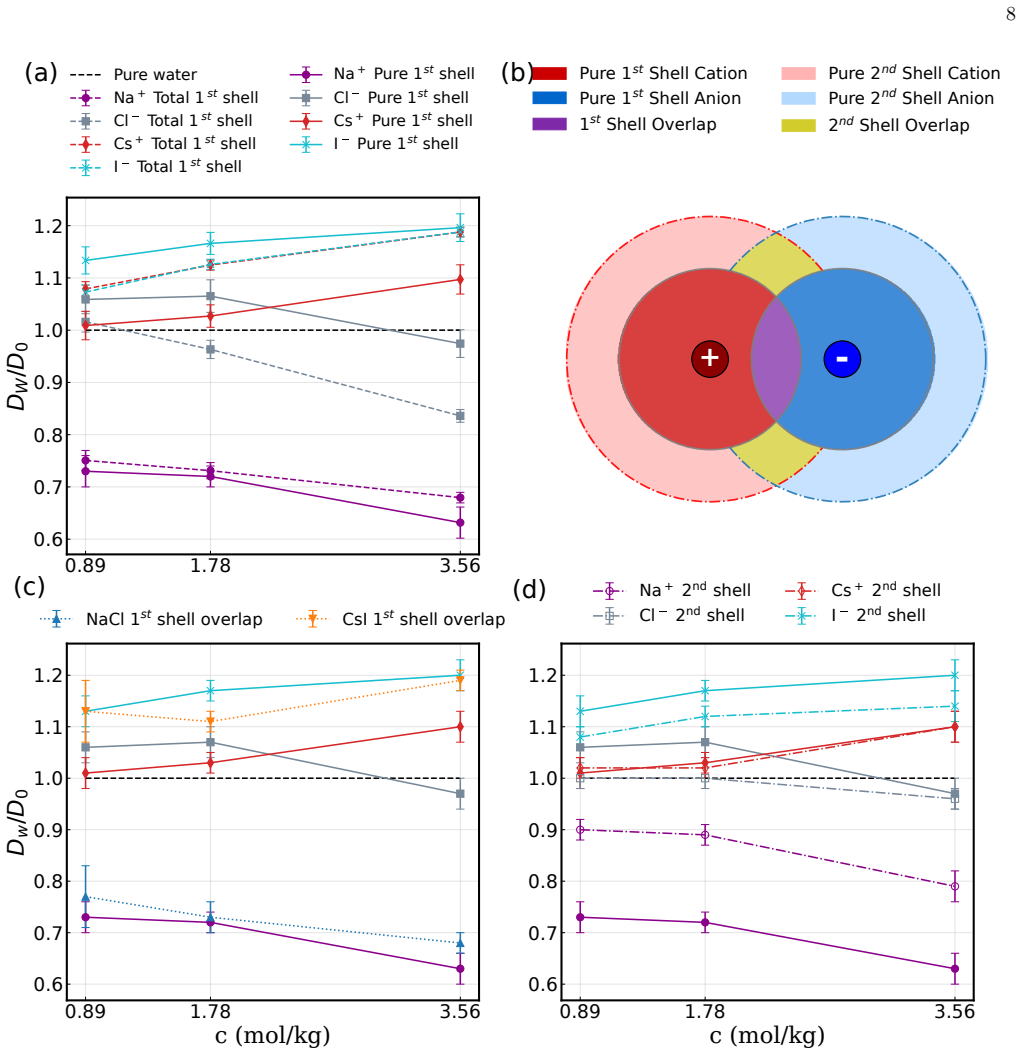
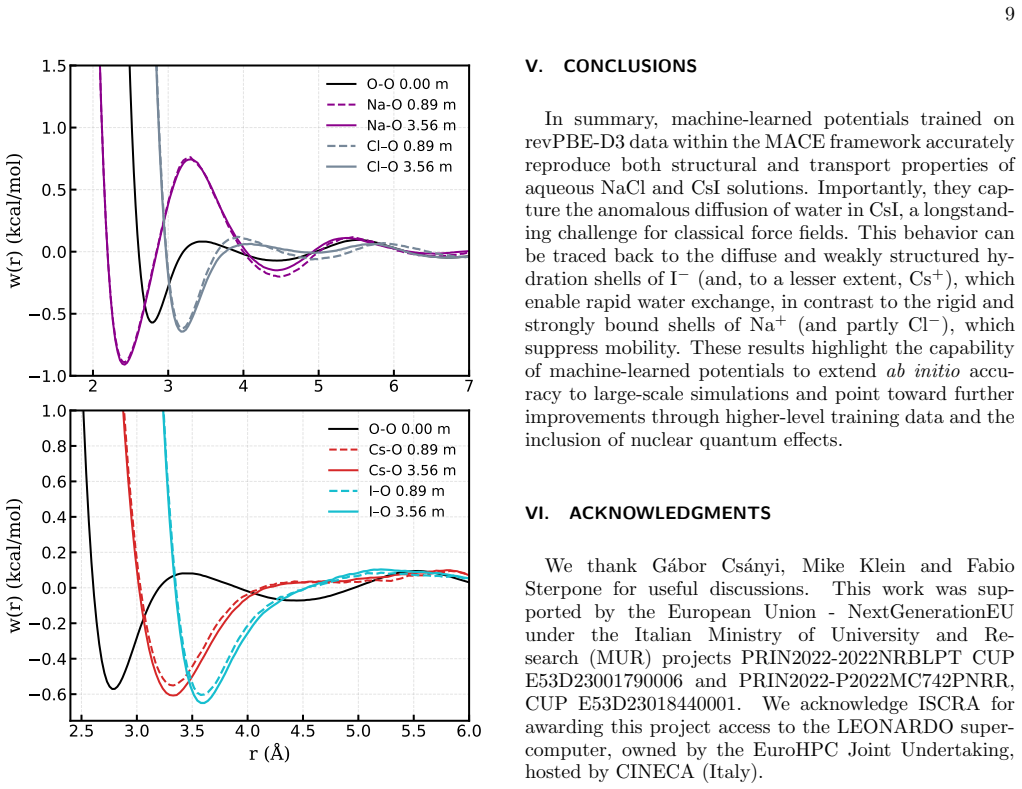
Shell-decomposition of short-time water diffusivities (pure first shells, overlapping shells, and second shells) together with the corresponding ion–oxygen potentials of mean force; these quantities map local free-energy barriers onto the measured mobility changes.
What would settle it
Recompute the same concentration series of relative water diffusion coefficients with a MACE (or equivalent) force field trained on RPA or MP2 data for the same ions; if the NaCl slowdown or CsI speedup disappears or reverses relative to experiment, the central claim fails.
Extended reading notes
Core claim
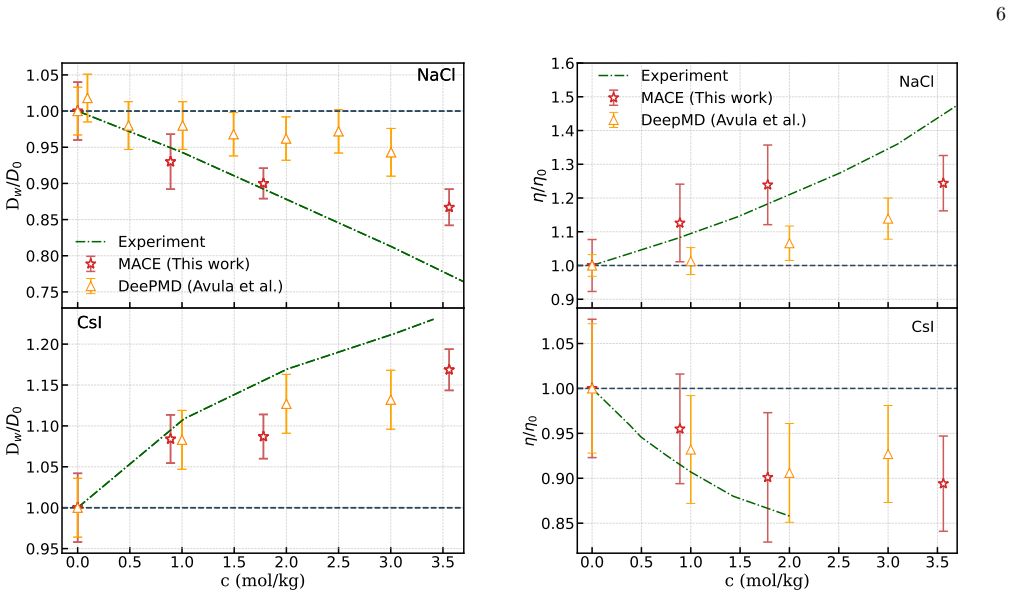
Classical molecular dynamics driven by a MACE force field trained on revPBE-D3 energies, forces and stresses quantitatively reproduces the experimentally observed concentration dependence of the relative water diffusion coefficient—suppression in NaCl, enhancement in CsI—and improves on DeePMD results obtained with the same functional, the gain arising from a stronger Na+–water interaction in the first shell plus a non-negligible retarding contribution of the second hydration shell of Na+, while the CsI acceleration is primarily driven by the diffuse hydration shell of I−.
Load-bearing premise
The claim rests on the premise that the revPBE-D3 functional, known to underestimate the height of the Na–O first peak relative to higher-level electronic-structure methods, is still accurate enough that residual errors do not reverse the sign or ranking of the ion-specific diffusion anomalies.
Signed reviews
Editorial analysis
A structured set of objections, weighed in public.
Referee Report
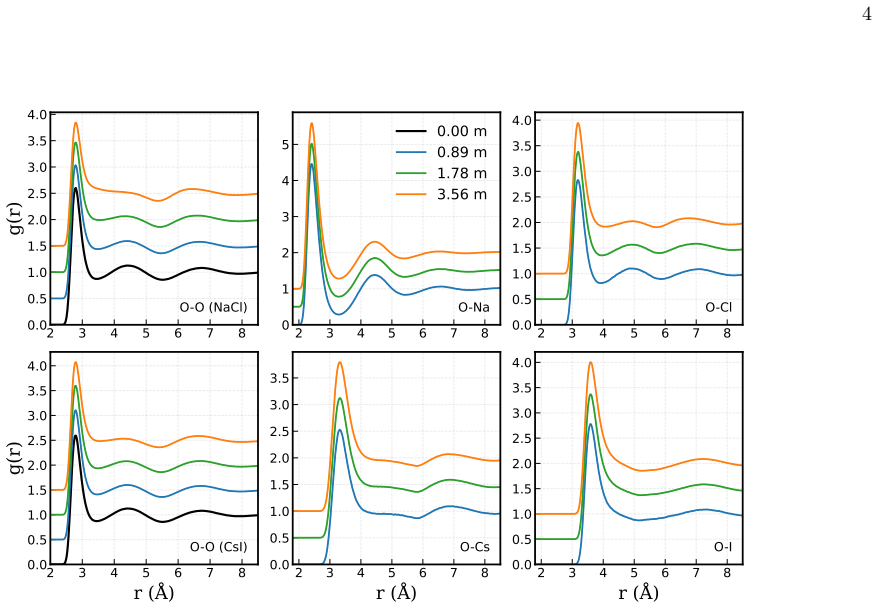
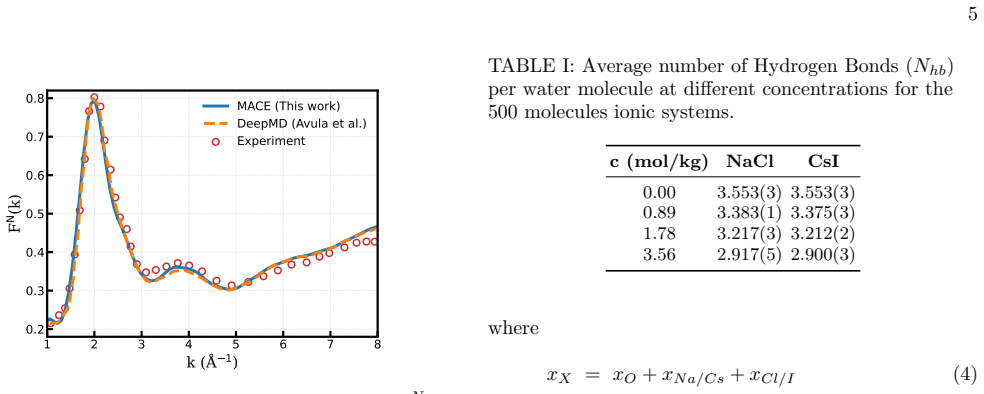
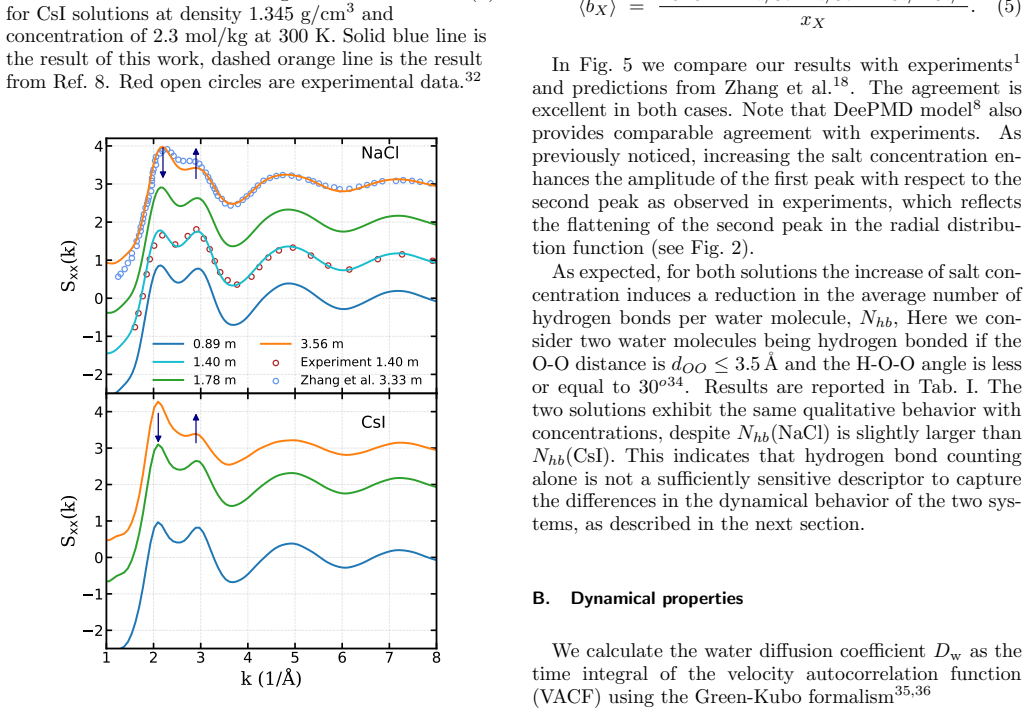
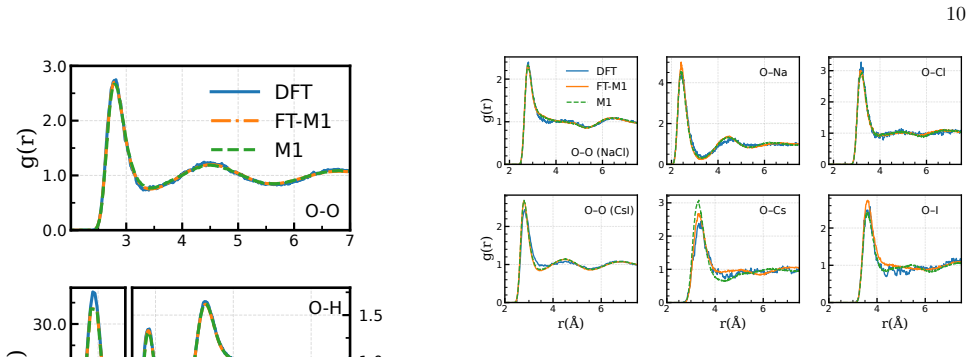
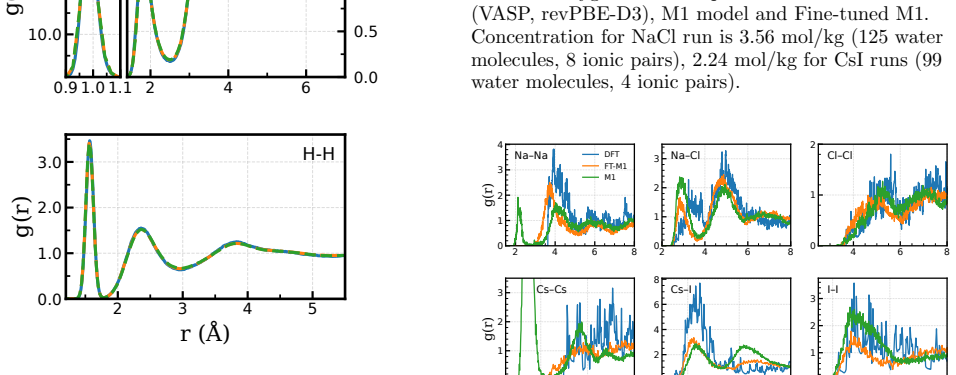
Summary. The manuscript trains a MACE equivariant ML force field on revPBE-D3 energies, forces and stresses for pure water and aqueous NaCl/CsI, then uses classical MD (size-extrapolated Green–Kubo) to compute water self-diffusion and shear viscosity over 0.89–3.56 mol/kg. It reproduces the experimental ion-specific anomaly (Dw/D0 < 1 for NaCl, > 1 for CsI) and reports quantitative improvement over DeePMD trained on the same functional, especially for NaCl. The improvement is attributed to a deeper Na+–O free-energy well and a measurable retarding contribution from Na+’s second hydration shell; for CsI the acceleration is assigned primarily to the diffuse I− shell. Supporting evidence includes RDFs, neutron structure factors, hydrogen-bond counts, shell-decomposed short-time diffusivities, and ion–oxygen PMFs.
Significance. If the results hold, the work supplies a concrete, architecture-level demonstration that higher-order equivariant message-passing (MACE) can improve ion–water free-energy landscapes relative to DeePMD at fixed DFT theory, and that this improvement is dynamically consequential for the long-standing anomalous-diffusion problem. The size-extrapolated transport coefficients, block-error analysis, and direct side-by-side comparison with experiment and with DeePMD on the same functional constitute a reproducible benchmark that future MLFFs (including those trained beyond GGA) can be measured against. The shell-decomposition and PMF analysis also give a clear microscopic picture that classical non-polarizable models have systematically missed.
major comments (2)
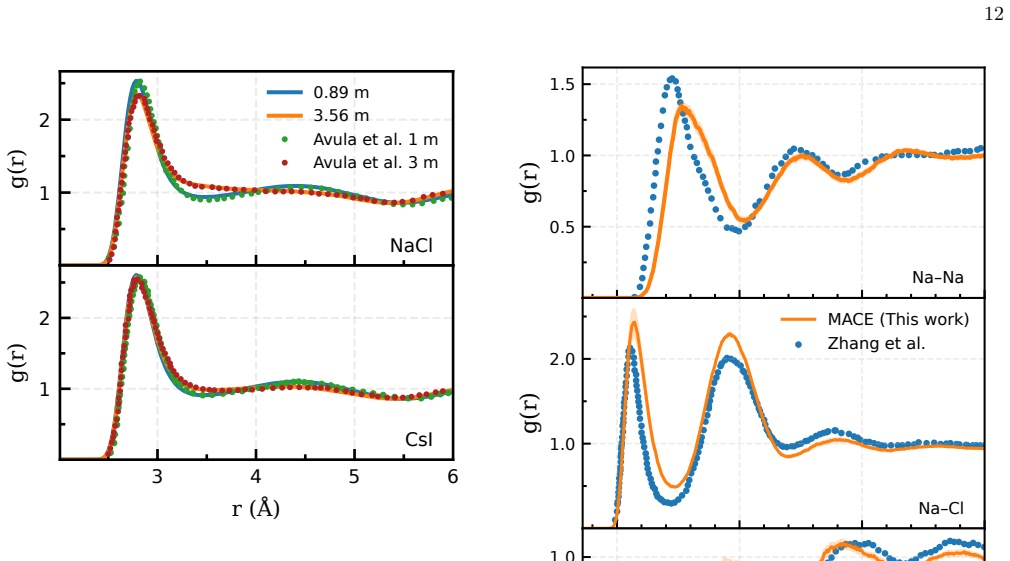
- The central claim of quantitative improvement over DeePMD rests on a deeper Na+–O PMF (Fig. 17, Tables S6–S7) and second-shell retardation (Fig. 8d, Table S12). The manuscript itself cites O’Neill et al. that revPBE-D3 underestimates the Na–O first-peak height relative to RPA/MP2. Because the training data and the DeePMD reference share this functional, the residual error could still reverse the NaCl ranking once higher-level data are used. A short, explicit discussion of this risk (or a limited higher-level single-point check on representative Na–O configurations) is needed to bound the claim.
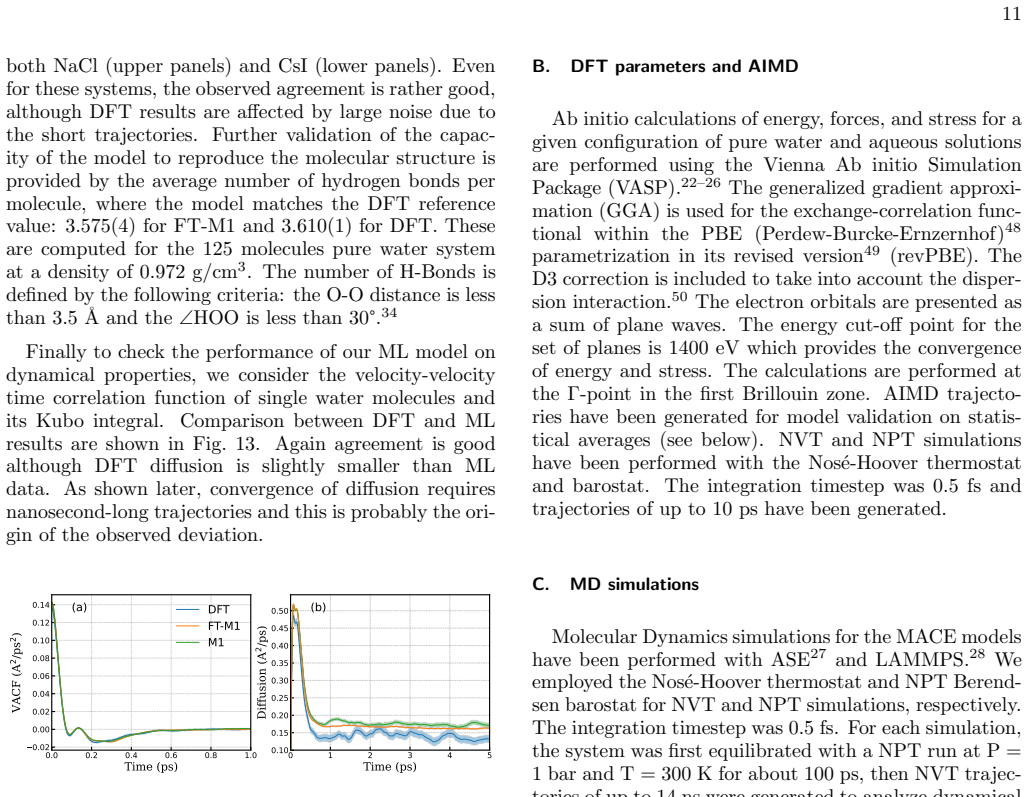
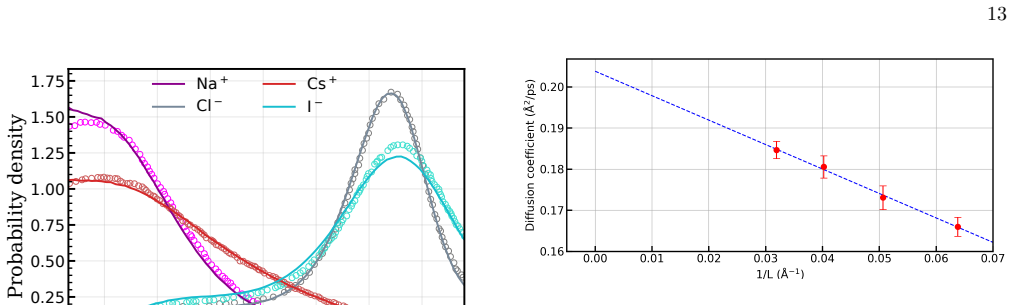
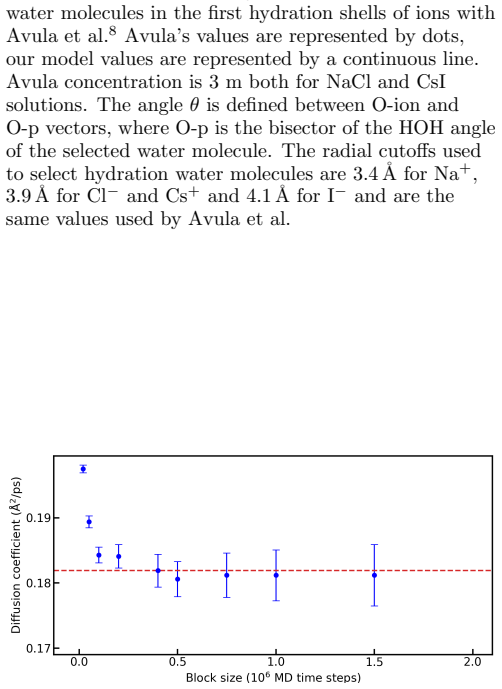
- AIMD validation trajectories are only ~10 ps (Appendix B). While structural RDFs and short-time VACFs are compared (Figs. 10–13), the transport coefficients that form the paper’s main result require nanosecond sampling. The authors should state more clearly that the AIMD comparison validates only local structure and short-time dynamics, not the long-time Dw/D0 values themselves.
minor comments (4)
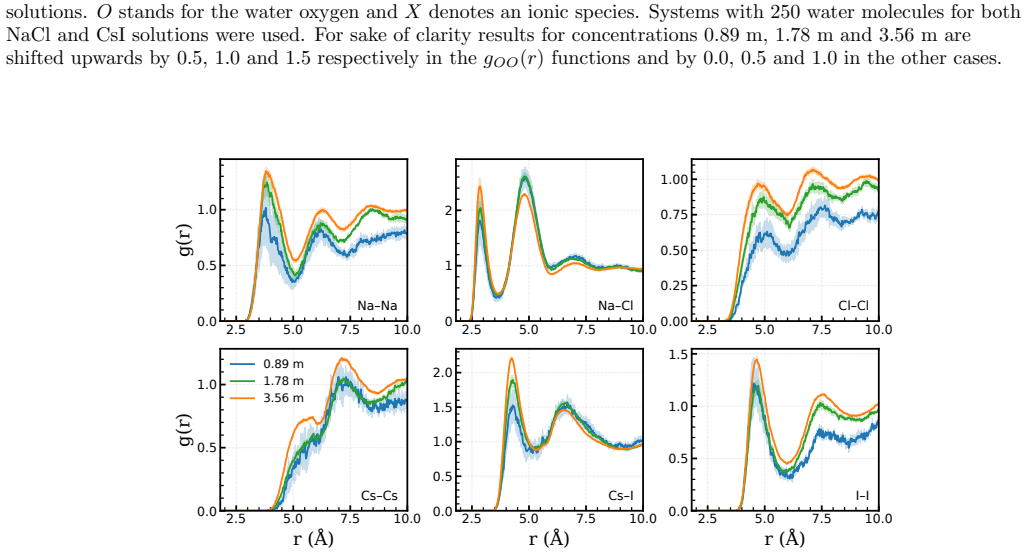
- Fig. 3 ion–ion RDFs at low concentration are noisy; a brief note that the noise is statistical (few ions) would help readers.
- Hydration-shell cut-offs are defined via the inflection of n(r) (Fig. S3). The numerical values should also appear in the main text or a table for reproducibility.
- The multi-head fine-tuning protocol (30 epochs, 10 k foundation configurations) is described only in the Appendix; a one-sentence summary in §II would improve accessibility.
- Typographical inconsistencies appear in a few places (e.g., “Nos´ e-Hoover”, “˚A”); a light copy-edit pass is warranted.
Circularity Check
No significant circularity: DFT-trained MACE MD yields independent transport predictions benchmarked on external experiment and prior DeePMD.
full rationale
The force field is trained exclusively on revPBE-D3 energies, forces and stresses (Appendix A/C); water diffusion and viscosity are then obtained from Green–Kubo integrals of independent NVT trajectories (Eqs. 6–7) that were never used in training or fine-tuning. Experimental Dw/D0 and η/η0 (Müller & Hertz, Jones & Fornwalt, etc.) serve only as external benchmarks (Figs. 6–7, Tables S3–S5). The claimed improvement over DeePMD (same functional) is a post-hoc structural comparison of Na–O PMFs and shell-resolved diffusivities (Figs. 8–9, 17; Tables S6–S7, S12), not a quantity fitted to the target anomaly. Self-citations to Avula et al. and Ding et al. supply context and baselines but are not load-bearing uniqueness claims; the derivation chain remains open and falsifiable against higher-level theory or experiment. No self-definitional identities, fitted-input-as-prediction steps, or ansatz-smuggling appear.
Assumptions & free parameters
free parameters (3)
- MACE architecture hyper-parameters (128 channels, L=1, correlation order 3, lmax=3, 6 Å cutoff, energy/force/stress weig
- Hydration-shell cut-offs (Na 3.2 Å, Cl 3.8 Å, Cs 4.0 Å, I 4.3 Å) defined via inflection of n(r)
- Fine-tuning protocol (30 epochs multi-head replay with 10 k foundation-model configurations)
assumptions (3)
- domain assumption revPBE-D3 DFT energies, forces and stresses constitute a sufficiently accurate ground truth for ion–water interactions that the sign of the diffusion anomaly is preserved.
- domain assumption Classical nuclear dynamics on the ML potential surface is adequate; nuclear quantum effects may be neglected for the relative diffusivities.
- standard math Green–Kubo integrals of VACF and stress autocorrelation, after finite-size extrapolation, equal the macroscopic transport coefficients.
Cite this review
Pith. "Pith review of Ion-Specific Anomalous Water Diffusion in Aqueous Electrolytes: A Machine-Learned Many-Body Force Field Study with MACE." pith.science (2026). https://pith.science/paper/HCBNR4AY
@misc{pith2026260413659,
  author       = {Pith},
  title        = {Pith review of: Ion-Specific Anomalous Water Diffusion in Aqueous Electrolytes: A Machine-Learned Many-Body Force Field Study with MACE},
  year         = {2026},
  howpublished = {\url{https://pith.science/paper/HCBNR4AY}},
  note         = {Machine review of arXiv:2604.13659}
}
abstract
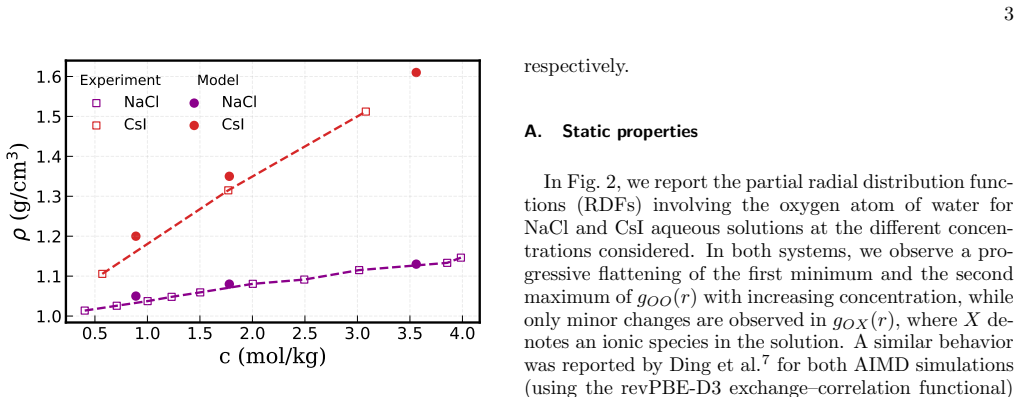
The dynamics of water in electrolyte solutions exhibits a striking, ion-specific anomaly: the diffusion coefficient of water is enhanced relative to the neat liquid in chaotropic CsI solutions, yet suppressed in kosmotropic NaCl solutions. This phenomenon, long challenging for classical force-field-based molecular dynamics, is studied here using classical molecular dynamics simulations with a many-body machine-learned force field (MLFF) trained within the MACE equivariant graph neural network framework. The force field is trained on energies, forces, and stresses computed at the density functional theory level with the revPBE-D3 exchange--correlation functional, which provides a reliable balance between accuracy and computational efficiency for aqueous systems. Simulations of NaCl and CsI aqueous solutions at ambient conditions over a concentration range of 0.89--3.56 mol/kg reproduce the experimentally observed anomalous diffusion and show a quantitative improvement over previous results obtained with the DeePMD framework, trained on the same theory, particularly for NaCl solutions. This improvement is traced to a stronger Na$^{+}$--water interaction in the first hydration shell and the non-negligible retarding contribution of the second hydration shell of Na$^{+}$. For CsI solutions, the water acceleration is shown to be primarily driven by the anion I$^{-}$, whose diffuse and weakly structured hydration shell facilitates rapid water exchange with the bulk. These results are rationalised through a shell-decomposition analysis of time-dependent water diffusivities and ion--oxygen potentials of mean force providing a coherent microscopic picture of the acceleration--retardation mechanism in the studied aqueous electrolytes.
Figures
Figures from the paper (13 more)
Forward citations
Cited by 1 Pith paper
-
VASP Plugins: Linking the Vienna ab-initio Simulation Package with Python
A C++/pybind11 shared-memory plugin layer exposes VASP SCF and ionic data as NumPy arrays so Python can modify structure, forces, local potential, and occupancies in place.
Reference graph
Works this paper leans on
-
[1]
Dissolving salt is not equivalent to applying a pressure on water
Zhang, Chunyi and Yue, Shuwen and Panagiotopoulos, Athanassios Z. and Klein, Michael L. and Wu, Xifan, “Dissolving salt is not equivalent to applying a pressure on water”, Nat. Commun.��1, 822 (2022)
2022
-
[2]
Importance of van der Waals effects on the hydration of metal ions from the Hofmeister series
Zhou, Liying and Xu, Jianhang and Xu, Limei and Wu, Xifan, “Importance of van der Waals effects on the hydration of metal ions from the Hofmeister series”, J. Chem. Phys.���12, 124505 (2019)
2019
-
[3]
Understanding the Anomalous Diffusion of Water in Aqueous Electrolytes Using Machine Learned Potentials
Avula, Nikhil V. S. and Klein, Michael L. and Balasubramanian, Sundaram, “Understanding the Anomalous Diffusion of Water in Aqueous Electrolytes Using Machine Learned Potentials”, J. Phys. Chem. Lett.��, 9500-9507 (2023)
2023
Reviewed July 12, 2026 · model on record in the stance chip above.
Discussion (0). Continue with ORCID to comment.