REVIEW 3 major objections 5 minor 25 references
Scaling of wetting and pre-wetting transitions on nano-patterned walls
T0 review · 3 major / 5 minor · reviewed 2026-08-14 · deepseek-v4-flash
Pith's one-line read Shrinking the dry gaps between wet stripes to a spacing proportional to the logarithm of the stripe width triggers a first-order wetting transition at bulk coexistence.
desk verdict First microscopic DFT evidence for bridging-induced wetting and pre-wetting collapse on striped walls, though the phase search is restricted to one period and the L=10 sigma outlier is not explained. read the letter →
The pith
A machine-rendered reading of the paper's core claim, the machinery that carries it, and where it could break.
The reading
What carries the argument
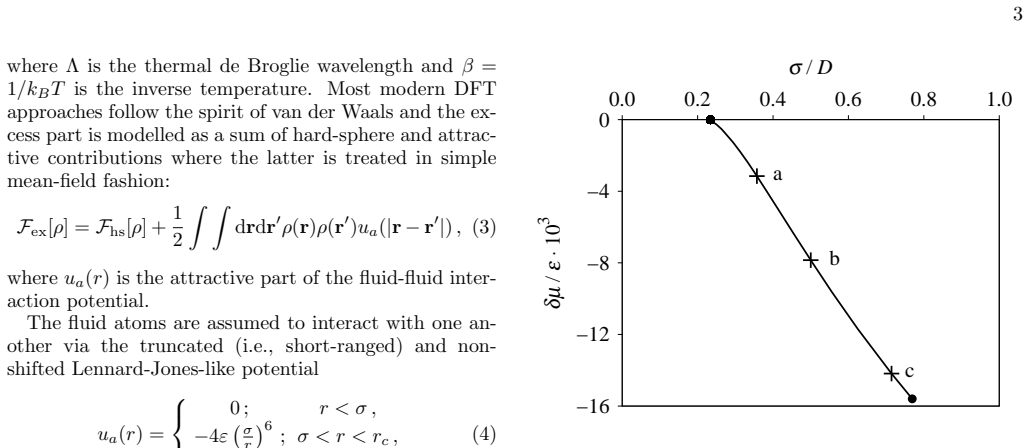
The load-bearing object is the grand-potential balance between two periodic configurations: a low-adsorption phase made of isolated droplets sitting above each wet stripe, and a high-adsorption phase in which a liquid slab covers the whole wall, with bubbles above the dry gaps. The transition is located by equating the grand potentials of these states, an application of Antonoff's rule γ_wg = γ_wl + γ, which replaces the usual vanishing-contact-angle criterion. The computations use classical density-functional theory with a fundamental-measure hard-sphere functional for short-range repulsion and a mean-field attractive tail, integrated over one period L + D with periodic boundary conditions. The scaling collapse of the pre-wetting lines is the signature of the universal logarithmic singularity in the finite-size surface free energy; the microscopic details of the fluid enter only through non-universal constants.
What would settle it
Run the same density-functional model on a super-cell spanning several stripe periods and numerically minimize with initial guesses for states that bridge only a subset of stripes; if any such state has a grand potential below the two states used in the paper for D near D_w, the predicted transition line is not the equilibrium phase boundary. Conversely, an experimental adsorption isotherm on a lithographically defined stripe pattern should show a jump in adsorbed amount when D crosses σ ln(L/σ), and the absence of that jump at the predicted scaling would refute the claim.
Extended reading notes
Core claim
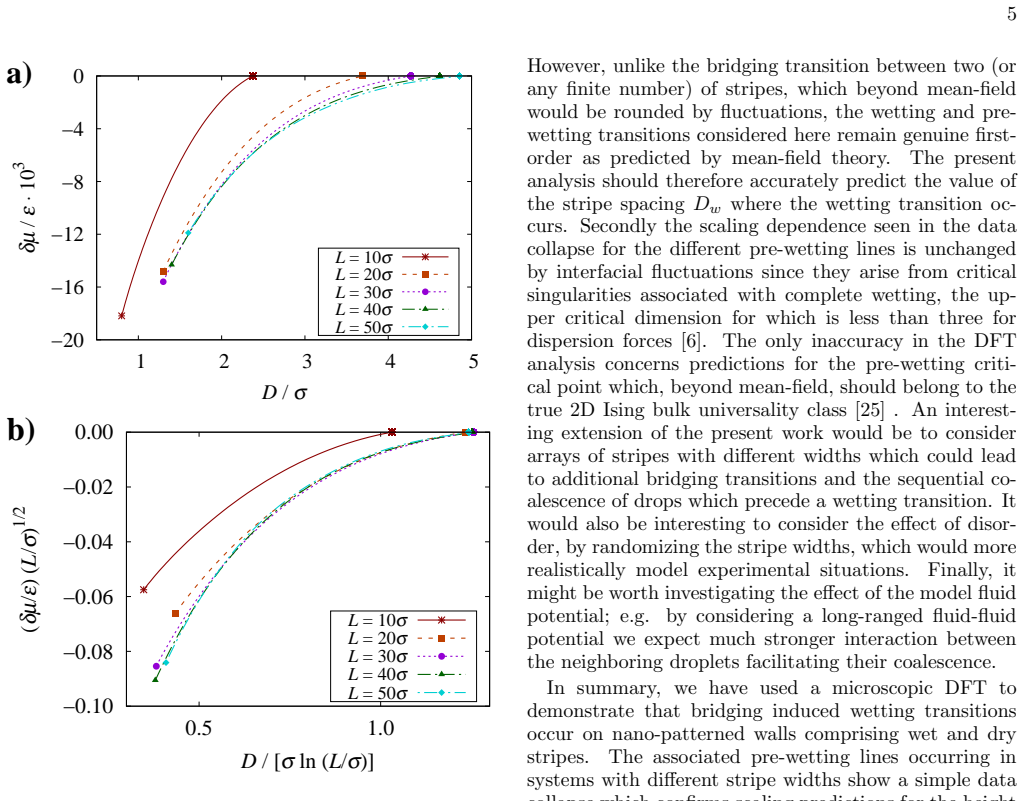
The paper's central discovery is a bridging-induced first-order wetting transition on a periodically striped wall. When the completely wet stripes are far apart, each one nucleates an isolated liquid droplet and the wall behaves as effectively dry. As the dry-gap width D is lowered to D_w ∝ ln L, the droplets bridge across the gaps and the wall–gas interface unbinds discontinuously into a uniform liquid film, even though the gap regions are completely non-wetting. Off coexistence, the transition becomes a pre-wetting line D_pw(δμ) that leaves D_w with a power-law form D_pw − D_w ∝ (δμ)^{2/3}, and the computed lines for stripe widths L = 10σ, 20σ, 30σ, 40σ, 50σ collapse onto a single curve under the rescalings D/[σ ln(L/σ)] and (δμ/ε)√(L/σ). This establishes at a microscopic level that the logarithmic finite-size contribution to the surface free energy controls the location of the wetting and pre-wetting transitions.
Load-bearing premise
The transition is located by balancing the grand potentials of only two configurations—isolated droplets and a uniform film with bubbles—so the reported D_w and pre-wetting line are the true phase boundary only if no other periodic arrangement (for instance a drop bridging only some of the stripes) has lower free energy.
Editorial extensions
If this is right
- If D is below D_w, the wall is wetting even though only a fraction L/(L+D) of its area is wetting, so the Cassie equation's prediction of zero effective contact angle only at full hydrophilic coverage is violated at the nanoscale.
- A line of thin–thick film coexistence should be observable slightly below saturation, and its location can be tuned by changing the stripe width without altering the chemistry.
- Because D_w grows only logarithmically with L, gaps of only a few molecular diameters are enough to switch wetting even for micron-sized stripes.
- Beyond mean field, the pre-wetting critical point should belong to the 2D Ising universality class, whereas the first-order wetting transition itself remains sharp.
Reading between the lines
- A computation that compares only the two chosen configurations could miss a periodic state in which droplets bridge a subset of stripes; a search over super-cells with period several times L+D would test whether D_w is the true phase boundary.
- Realistic lithographic disorder in stripe widths would replace the single sharp transition by a range of local bridging thresholds, likely rounding the jump; the paper lists randomized stripes as an open extension.
- Because the scaling collapse is tied to the long-ranged dispersion tail, switching to a shorter-ranged fluid–fluid potential should change or destroy the collapse, giving a test of universality.
Signed reviews
Editorial analysis
A structured set of objections, weighed in public.
Referee Report
Summary. This manuscript uses classical density functional theory (mean-field FMT for hard-sphere repulsion plus Lennard-Jones attractions) to study a periodic planar wall composed of completely wet stripes of width L separated by completely dry stripes of width D. At bulk coexistence and T=0.92Tc, the authors report a first-order transition from isolated droplets over the wet stripes to a macroscopic liquid film with bubbles over the dry stripes as D is reduced to D_w; for L=30σ they report D_w=4.27σ. Off coexistence they locate a line of pre-wetting transitions terminating at a critical point. For five stripe widths L=10–50σ, the pre-wetting lines collapse after rescaling D by ln(L/σ) and δμ by (L/σ)^{1/2}, with the exception of the smallest width. This is interpreted as microscopic verification of mesoscopic scaling predictions for bridging and complete wetting, in particular D_w∝ln L and droplet height h_m∝√L.
Significance. The result is significant because it goes beyond mesoscopic interfacial Hamiltonians and provides a microscopic DFT demonstration that a structural drying/wetting transition on a chemically patterned wall obeys the predicted finite-size scaling with dispersion forces. The main strengths are that the scaling collapse uses theoretically fixed rescalings rather than fitted exponents, the DFT model is a standard and well-tested framework, and the phase diagrams and representative density profiles are clearly presented. The central claim is, however, conditional on the completeness of the phase search and on the numerical robustness of the reported coexistence data; both need to be addressed before the scaling verification can be considered conclusive.
major comments (3)
- [Section III, first paragraph] The wetting and pre-wetting transitions are located by comparing only two P-periodic configurations in a cell of width L+D: isolated drops over the wet stripes and a liquid film with bubbles over the dry stripes. The wall potential is P-periodic, but the equilibrium state need not be P-periodic; states with period 2P, such as droplets bridging only a subset of stripes, are excluded by the imposed periodic boundary conditions. Because D_w is defined by balancing the grand potentials of only these two branches, the reported value of D_w and the resulting pre-wetting line are not yet established as the true equilibrium phase boundary. I request a supercell DFT calculation for at least one representative stripe width (e.g., L=30σ) that scans D around the reported D_w and compares grand potentials of P-periodic and 2P-periodic (and possibly 3P-periodic) solutions, or a rigorous argument ruling out lower-energy broken-symmetry states. This is load-bearing for the central claim that a genuine first-order wetting transition occurs at D_w∝ln L.
- [Section III, Fig. 4] No numerical convergence or uncertainty analysis is reported. The stated value D_w=4.27σ for L=30σ carries two decimals, and the pre-wetting lines in Figs. 2 and 4 are presented without any indication of grid spacing, iterative convergence criterion, or dependence on the cell height z_m=50σ. Without such information, the quantitative claim of universal scaling collapse in Fig. 4b is difficult to assess. Please state the numerical grid spacings in x and z, the convergence threshold for the Euler–Lagrange equation (Eq. 11), and demonstrate that D_w and the pre-wetting line are stable under grid refinement and for larger z_m.
- [Section III, Fig. 4b] The scaling collapse is assessed visually and is explicitly imperfect for L=10σ, yet the paper does not quantify the deviation or explain it. Since the verification of D_w∝ln L rests on only five stripe widths spanning a factor of five in L, the evidence for the logarithmic law is limited. Please plot D_w as a function of L on a log-linear scale with estimated uncertainties, quantify the L=10σ outlier (for example, the relative difference in D/D_w at fixed rescaled δμ), and state whether this deviation is attributed to a finite-size crossover or to a limitation of the assumed scaling form.
minor comments (5)
- [Figs. 2 and 4] The axis labels such as δμ/ε⋅10^3 are ambiguous; please write (δμ/ε)×10^3 instead.
- [Section II, after Eq. (7)] The infinite sum over n in Eq. (7) is presumably truncated in the numerical implementation; please state the number of stripe periods included and confirm that the results do not depend on this truncation.
- [Section II] Please specify the reduced units used in the calculation and the numerical values of ρ_w and ε_w, or state explicitly that ε_w=ε and give ρ_w in terms of σ.
- [Section III, paragraph on Clausius–Clapeyron] The relation D_pw−D_w∝(δμ)^{2/3} is asserted as an analogue of the homogeneous pre-wetting result; a short derivation or an explicit citation for this patterned-wall case would improve the readability.
- [Section IV] The statement that fluctuations do not alter the scaling exponents should be supported by a more specific citation than the broad reference [6]; please point to the relevant result on the upper critical dimension for complete wetting with dispersion forces.
Circularity Check
No significant circularity: the DFT data collapse uses a priori theoretical rescalings, and the mesoscopic self-citations are the predictions being tested rather than inputs that force the result.
full rationale
The paper's central task is to test mesoscopic scaling predictions against a microscopic DFT calculation. The DFT minimization (Eqs. 1-3 and 11) is a self-contained numerical solution of a free-energy functional for a wall-fluid potential obtained by integrating a Lennard-Jones tail over the stripe pattern (Eqs. 7-10). No parameter in this calculation is tuned to reproduce D_w ~ ln L or the pre-wetting collapse; the phase boundaries are located by matching grand potentials of coexisting configurations, as stated in Section III: "The value D_w is determined by balancing the grand-potentials of these configurations." The scaling collapse in Fig. 4b is presented with the rescalings fixed in advance ("when D is rescaled with ln L/σ (as predicted for the value of D_w) and δμ by L^{1/2}"), not obtained by fitting the DFT data. Thus the central claim is an independent numerical test of the predicted universal rescaling, not an identity. The self-citations [21,22] supply the predictions under test, but the DFT is a different, microscopic level of description; citing them is not load-bearing in the sense of replacing evidence. The acknowledged restriction to two candidate configurations in Section III is a possible completeness limitation of the phase search, not an input-output equivalence; similarly, the Section IV caveats about mean-field fluctuations are honest limitations and do not make the derivation circular. I find no step in which an output is defined to equal its input or in which a fitted parameter is renamed as a prediction.
Assumptions & free parameters
assumptions (5)
- domain assumption The DFT free-energy functional with FMT hard-sphere and mean-field attractive terms accurately describes the wetting behaviour of this model fluid.
- domain assumption The wall-fluid and fluid-fluid potentials used generate the long-ranged dispersion-force regime assumed by the mesoscopic scaling predictions.
- domain assumption The chosen parameters, epsilon_w=epsilon and T=0.92 T_c, put the system in the regime where stripes are completely wet and interstitial gaps are completely dry.
- domain assumption Translational invariance along the stripes means a two-dimensional calculation is sufficient and stripe-end effects are negligible.
- domain assumption Mean-field DFT determines the first-order character and the scaling exponents despite neglected thermal fluctuations.
Cite this review
Pith. "Pith review of Scaling of wetting and pre-wetting transitions on nano-patterned walls." pith.science (2026). https://pith.science/paper/HDDHH2QI
@misc{pith2026190808508,
  author       = {Pith},
  title        = {Pith review of: Scaling of wetting and pre-wetting transitions on nano-patterned walls},
  year         = {2026},
  howpublished = {\url{https://pith.science/paper/HDDHH2QI}},
  note         = {Machine review of arXiv:1908.08508}
}
abstract
We consider a nano-patterned planar wall consisting of a periodic array of stripes of width $L$, which are completely wet by liquid (contact angle $\theta=0$), separated by regions of width $D$ which are completely dry (contact angle $\theta=\pi)$. Using microscopic Density Functional Theory we show that in the presence of long-ranged dispersion forces, the wall-gas interface undergoes a first-order wetting transition, at bulk coexistence, as the separation $D$ is reduced to a value $D_w\propto\ln L$, induced by the bridging between neighboring liquid droplets. Associated with this is a line of pre-wetting transitions occurring off coexistence. By varying the stripe width $L$ we show that the pre-wetting line shows universal scaling behaviour and data collapse. This verifies predictions based on mesoscopic models for the scaling properties associated with finite-size effects at complete wetting including the logarithmic singular contribution to the surface free-energy.
Figures


Figures from the paper (1 more)
Reference graph
Works this paper leans on
-
[1]
J. W. Cahn, J. Chem. Phys. 66, 3667 (1977)
work page 1977
-
[2]
Ebner and W
C. Ebner and W. F. Saam, Phys. Rev. Lett. 38, 1486 (1977)
1977
-
[3]
Dietrich, in Phase Transitions and Critical Phenom- ena, edited by C
S. Dietrich, in Phase Transitions and Critical Phenom- ena, edited by C. Domb and J. L. Lebowitz (Academic press, New York, 1988), Vol. 12
work page 1988
-
[4]
Schick, in Liquids and Interfaces , edited by J
M. Schick, in Liquids and Interfaces , edited by J. Chor- volin, J. F. Joanny, and J. Zinn-Justin (Elsevier, New York, 1990)
work page 1990
-
[5]
D. Bonn, J. Eggers, J. Indekeu, J. Meunier, and E. Rolley, Rev. Mod. Phys. 81, 739 (2009)
work page 2009
-
[6]
G. Forgacs, R. Lipowsky, and T.M. Nieuwenhuizen. in Phase Transitions and Critical Phenomena , edited by C. Domb and J. L. Lebowitz, (Academic press, London, 1991), Vol. 14
work page 1991
-
[7]
E. H. Hauge and M. Schick, Phys. Rev. B 27, 4288 (1983)
work page 1983
-
[8]
M. Napiorkowski, W. Koch, and S. Dietrich, Phys. Rev. 6 A 45, 5760 (1992)
work page 1992
Show all 25 references
-
[9]
A. O. Parry, C. Rasc´ on, and A. J. Wood, Phys. Rev. Lett. 85, 345 (2000)
2000
-
[10]
Bauer, T
C. Bauer, T. Bieker, and S. Dietrich, Phys. Rev. E 62, 5324 (2000)
2000
-
[11]
A. O. Parry, C. Rasc´ on, N. B. Wilding, and R. Evans, Phys. Rev. Lett. 98, 226101 (2007)
2007
-
[12]
Malijevsk´ y, J
A. Malijevsk´ y, J. Chem. Phys.137, 214704 (2012)
2012
-
[13]
Malijevsk´ y and A
A. Malijevsk´ y and A. O. Parry, Phys. Rev. Lett. 110 166101 (2013)
2013
-
[14]
Malijevsk´ y and A
A. Malijevsk´ y and A. O. Parry, J. Phys: Condens. Matter 26, 355003 (2014)
2014
-
[15]
A. O. Parry, A. Malijevsk´ y, and C. Rasc´ on, Phys. Rev. Lett. 113 146101 (2014)
2014
-
[16]
Malijevsk´ y, Phys
A. Malijevsk´ y, Phys. Rev. E99, 040801(R) (2019)
2019
-
[17]
Tewes, O
W. Tewes, O. Buller, A. Heuer, U. Thiele, and S. V. Gurevich, J. Chem. Phys. 146, 094704 (2017)
2017
-
[18]
R. N. Wenzel, Ind. Eng. Chem. 28, 988 (1936)
1936
-
[19]
A. B. D. Cassie, Discuss. Faraday Soc. 3, 11 (1948)
1948
-
[20]
Yatsyshin, A
P. Yatsyshin, A. O. Parry, and S. Kalliadasis, J. Phys. Condens. Matter 28, 275001 (2016)
2016
-
[21]
Malijevsk´ y, A
A. Malijevsk´ y, A. O. Parry, and M. Posp´ ıˇ sil, Phys. Rev. E 96, 032801 (2017)
2017
-
[22]
Malijevsk´ y, A
A. Malijevsk´ y, A. O. Parry, and M. Posp´ ıˇ sil, Phys. Rev. E 99, 042804 (2019)
2019
-
[23]
Evans, Adv
R. Evans, Adv. Phys. 28, 143 (1979)
1979
-
[24]
Rosenfeld, Phys
Y. Rosenfeld, Phys. Rev. Lett. 63, 980 (1989)
1989
-
[25]
Nakanishi and M
H. Nakanishi and M. E. Fisher, Phys. Rev. Lett. 49, 1565 (1982)
1982
Reviewed August 14, 2026 · model on record in the stance chip above.
Discussion (0). Continue with ORCID to comment.