REVIEW 2 major objections 4 minor 14 references
Development and testing of an unstructured mesh method for whole plasma gyrokinetic simulations in realistic tokamak geometry
T0 review · 2 major / 4 minor · reviewed 2026-08-14 · deepseek-v4-flash
Pith's one-line read A mixed unstructured-mesh finite-element/Fourier gyrokinetic scheme brings whole-volume tokamak simulations into reach, with particle positioning accelerated about 30-fold.
desk verdict A credible numerical methods paper with a useful speedup and a fair ORB5 benchmark, but the whole-volume physics claim rests on an asserted scale-separation inequality that needs explicit verification. read the letter →
The pith
A machine-rendered reading of the paper's core claim, the machinery that carries it, and where it could break.
The reading
What carries the argument
The central machinery is the mixed FEM-Fourier discretization on an unstructured triangular mesh: the poloidal plane is meshed with Delaunay-refined triangles, the perturbed potential is represented by piecewise-linear finite elements in (R, Z) and by a single toroidal Fourier harmonic, and the gyrokinetic Poisson equation becomes a sparse linear system solved with a parallel library. The companion mechanism is an intermediate rectangular box grid that precomputes, for each box, the list of triangles overlapping it; a marker's triangle is found by one box lookup plus a small local scan, reducing charge deposition and field gathering from O(N N_t) to O(N) and producing the reported speed-up.
What would settle it
Run TRIMEG on a diverted equilibrium with a pedestal-like profile where L_A is no longer much larger than 1/(n dq/dr), and compare the ITG growth rate and mode structure against a whole-volume code that includes the same physics without the simplifications; if the results differ substantially, or if the mode structure extends outside the assumed envelope, the leading-order claim and the general usefulness of the whole-volume extension are falsified. A simpler performance check: rerun the stated medium-size case with the brute-force search (Nx=2) and with the optimal box size; failure to observe the reported ~30x speed-up would falsify the particle-positioning claim.
Extended reading notes
Core claim
TRIMEG formulates the gyrokinetic Vlasov-Poisson system in right-handed (R, phi, Z) coordinates with the magnetic field built from a B-spline equilibrium, solves the field equation with finite elements on triangular cells, and Fourier-decomposes only the toroidal direction. This avoids the safety-factor singularity at the X point that complicates flux-coordinate formulations. The accompanying intermediate-box particle-triangle mapping finds the containing triangle for each marker in near-linear time; in a test with 25.6 million markers and 90 radial grid points it is about 30 times faster than checking every triangle for every marker. The paper reports reasonable agreement with ORB5 for the Cyclone ITG test case, and shows that with an ASDEX Upgrade equilibrium the same code can run both core-only and whole-volume simulations, with the open-field-line region affecting a radially localized core mode only weakly.
Load-bearing premise
The argument that the simplified TRIMEG model captures the leading-order ITG solution rests on the scale separation L_E >> L_A >> 1/(n dq/dr), where L_E is the equilibrium-profile scale, L_A is the mode's radial envelope width, and 1/(n dq/dr) is a single poloidal harmonic's width; the paper asserts this ordering for the Cyclone case but does not verify it for the ASDEX Upgrade whole-volume and edge cases, so benchmark agreement would not automatically extend if steep edge gradients invalidate the ordering.
Editorial extensions
If this is right
- Whole-volume gyrokinetic particle-in-cell simulations become practical in realistic diverted geometry, covering the core and open-field-line regions without a flux-aligned grid or a coordinate singularity at the X point.
- The box-indexed particle-triangle mapping is a reusable primitive: any particle-in-cell code using unstructured meshes could adopt it to cut particle-positioning cost from O(N N_t) to O(N).
- Reasonable agreement with ORB5 on Cyclone parameters suggests that the simplified linear model, built from dominant drift terms, adiabatic electrons, and a single toroidal harmonic, captures the leading-order ITG growth rate and frequency when the stated scale ordering holds.
- For the ASDEX Upgrade equilibrium, core-only and whole-volume runs give nearly identical results when the ITG envelope is narrow, so edge and open-field-line physics need not be resolved for such core-localized modes; shifting the gradient region toward the separatrix changes the mode through finite-Larmor-radius and magnetic-shear effects.
- The convergence studies supply practical resolution criteria for linear ITG simulations: roughly seven poloidal grid points per wavelength, more than four markers per triangle, and a time step below about 0.5 in the normalization used here.
Reading between the lines
- If the ~30x speed-up holds at production resolution, the dominant cost bottleneck for unstructured-mesh PIC shifts from particle positioning to the sparse field solve and parallel communication, so future performance work should target the solver as core counts grow.
- The scale-ordering justification implies the method is most reliable for radially localized modes; testing steep-pedestal equilibria against a full edge model would map where the leading-order approximation begins to break.
- Because the marker distribution is loaded as Maxwellian and equilibrium density and temperature variations are omitted from the Poisson equation, the AUG results are a capability demonstration rather than a quantitative transport prediction; adding the neoclassical radial electric field and zonal-flow physics would likely alter edge-region mode structure.
- The same mixed FEM-Fourier treatment could extend naturally to electromagnetic perturbations and multiple species, since the unstructured field solver and the particle-triangle search are largely independent of the precise form of the field equation.
Signed reviews
Editorial analysis
A structured set of objections, weighed in public.
Referee Report
Summary. The paper presents TRIMEG, a gyrokinetic particle-in-cell code that combines a two-dimensional finite-element discretization on an unstructured triangular mesh in the (R, Z) plane with a Fourier decomposition in the toroidal angle. The main numerical contribution is an intermediate-box indexing scheme that accelerates particle positioning for charge deposition and field gathering, with a measured speedup of roughly 30 relative to brute-force triangle searching. The physics model is a simplified electrostatic gyrokinetic Vlasov-Poisson system, and the paper reports convergence scans, a strong-scaling study, a benchmark against ORB5 for the DIII-D Cyclone ITG case, and whole-volume ITG simulations using an ASDEX Upgrade equilibrium, including a case with the gradient peak at the separatrix.
Significance. If the claims hold, the paper is a useful contribution to whole-volume gyrokinetic simulation methodology. The mixed FEM-Fourier scheme is a natural way to combine the geometric flexibility of unstructured meshes with the efficiency of a toroidal spectral representation, and the intermediate-grid particle positioning scheme is simple and evidently effective; the reported speedup of about 30 is a direct measurement. The convergence scans and strong-scaling results are also clear and support the numerical claims. The ORB5 benchmark is a genuine external code comparison, even though the ORB5 data come from the authors' previous work. The principal weakness is that the simplified physics model is justified by a scale-separation argument that is asserted rather than verified, and this matters most for the whole-volume AUG cases, which are presented as physics demonstrations but are not validated against any other code or local dispersion calculation.
major comments (2)
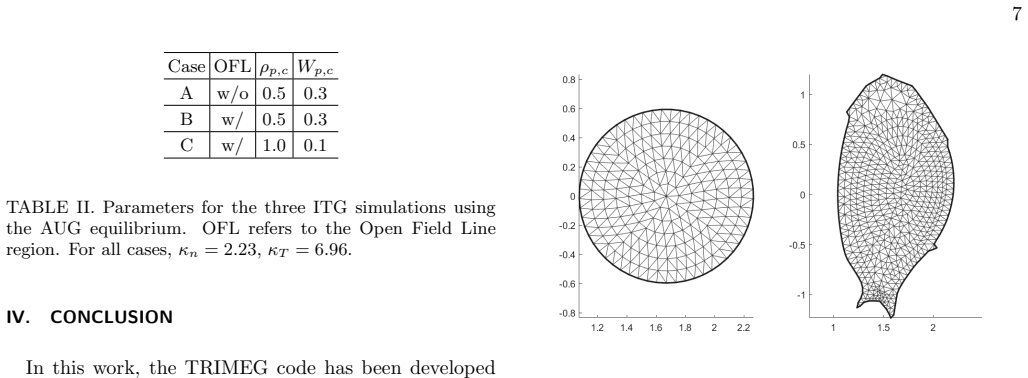
- [Sec. III.C] The statement 'LE >> LA >> 1/(n dq/dr), the simulation from TRIMEG already captures the leading order solution' is load-bearing because the simplified model of Sec. III.A (items 1-3: only dominant drift/parallel terms, constant n, B, T in the field and weight equations) is otherwise not justified. The inequality is asserted, not computed, for the Cyclone case, and it is not verified for the AUG cases in Sec. III.D. In particular, for Case C (Table II), rho_p,c=1.0 and W_p,c=0.1 place the gradient peak at the separatrix, where LA may be comparable to 1/(n dq/dr). Please compute or estimate LE, LA, and 1/(n dq/dr) for each of the cases presented, or alternatively reframe the AUG runs as numerical capability demonstrations rather than physics-validated ITG simulations.
- [Sec. III.D] The paper states that 'a benchmark with other codes with the treatment of the whole plasma geometry will be studied in the future.' Since no cross-code or local-dispersion validation is provided for the AUG cases, the claim of demonstrating 'ITG simulations' in the whole volume with open field lines is stronger than the evidence supports. The ORB5 benchmark validates the simplified model only in the Cyclone parameter regime, and only if the scale-separation condition holds there. A concrete way to strengthen the paper is to include, for each AUG case, a local or semi-local dispersion calculation using the actual q, magnetic shear, and profiles, showing that the simplified model captures the predicted growth rate and frequency.
minor comments (4)
- [Abstract and Sec. III.B] The abstract reports a speedup 'by a factor of ~30', while Sec. III.B reports optimal speedups of 35.5, 35.7, and 36.3 for Nx = 256, 512, 1024 and 32.7 for Nx = 8192. Please reconcile the abstract value with the measured values.
- [Fig. 6] The ORB5 comparison reports only growth rate and frequency values without error bars or a quantitative agreement metric. Reporting relative deviations for each n would make the 'reasonable agreement' claim more precise.
- [Fig. 1 caption] There is a typo: 'Cylone' should be 'Cyclone'.
- [Conclusion] The word 'Futher' in the first sentence of Section IV should be 'Further'.
Circularity Check
No circularity found: the ORB5 benchmark and the measured speed-up are independent evidence; the scale-separation and FE-detail self-citations are not load-bearing, though the ordering is asserted rather than verified.
full rationale
TRIMEG's central claims—the mixed FE-Fourier discretization, the box-indexed particle-triangle positioning, the roughly 30x speed-up, and the Cyclone ITG benchmark—do not reduce to their inputs. The growth-rate and frequency comparisons in Fig. 6 are obtained from an independent ORB5 simulation reported in the authors' prior work [36]; ORB5 solves a more complete gyrokinetic model, and TRIMEG's simplified equations (Sec. III.A) are not fitted to those ORB5 values. The speed-up in Fig. 3 is a direct wall-clock measurement against the brute-force scheme. The main self-citations are (i) the ORB5 reference data from [36] and (ii) the scale-separation ordering L_E >> L_A >> 1/(n dq/dr) cited to [27] and invoked in Sec. III.C to argue that the simplified model "already captures the leading order solution." The latter is a regime/validity argument, not a quantity fitted to the benchmark; however, the inequality is asserted rather than verified for the Cyclone and AUG equilibria, and the AUG whole-volume cases are explicitly stated to lack a cross-code benchmark ("a benchmark with other codes with the treatment of the whole plasma geometry will be studied in the future"). The paper also delegates FE/unstructured-mesh details to a same-author manuscript [23] described as "to be submitted." These are self-citation and verification gaps, but no claimed prediction is equivalent by construction to a fitted input or to a self-cited theorem; hence no circular step is established. The score of 1 reflects one minor, non-load-bearing self-citation rather than any circular derivation.
Assumptions & free parameters
assumptions (6)
- domain assumption Gyrokinetic Vlasov-Poisson model in the long wavelength limit (Eq. 33) with adiabatic electrons and zero non-adiabatic electron response (simplification 6).
- domain assumption Only dominant terms in the equations of motion are kept (Eqs. 17, 21, 23), omitting terms of order rho* and B_theta/B (Section II.C.1).
- domain assumption Equilibrium variation of n, T and B in the gyrokinetic Poisson equation is ignored (simplification 2).
- domain assumption Spatial scale separation LE >> LA >> 1/(ndq/dr) holds (Section III.C).
- standard math B-spline interpolation of equilibrium fields gives divergence error nabla dot B / B below 1e-4 in the simulation domain (Section II.B).
- domain assumption Simulations are linear with a single toroidal harmonic and no zonal flows (simplification 4).
Cite this review
Pith. "Pith review of Development and testing of an unstructured mesh method for whole plasma gyrokinetic simulations in realistic tokamak geometry." pith.science (2026). https://pith.science/paper/HDY54QRE
@misc{pith2026190803824,
  author       = {Pith},
  title        = {Pith review of: Development and testing of an unstructured mesh method for whole plasma gyrokinetic simulations in realistic tokamak geometry},
  year         = {2026},
  howpublished = {\url{https://pith.science/paper/HDY54QRE}},
  note         = {Machine review of arXiv:1908.03824}
}
abstract
In this work, we have formulated and implemented a mixed unstructured mesh-based finite element (FE)-Fourier decomposition scheme for gyrokinetic simulations in realistic tokamak geometry. An efficient particle positioning (particle-triangle mapping) scheme for the charge deposition and field scattering using an intermediate grid as the search index for triangles has been implemented and a significant speed-up by a factor of $\sim30$ is observed as compared with the brute force scheme for a medium-size simulation. The TRIMEG (TRIangular MEsh based Gyrokinetic) code has been developed. As an application, the ion temperature gradient (ITG) mode is simulated using the simplified gyrokinetic Vlasov-Poisson model. Our simulation and that using the ORB5 code for the DIII-D Cyclone case show reasonable agreement. As an additional application, ITG simulations using an ASDEX Upgrade equilibrium have been performed with density and temperature gradient profiles similar to the Cyclone case. Capabilities of the TRIMEG code for simulations with realistic experimental equilibria in the plasma core and in the whole plasma volume with open field lines are demonstrated.
Figures


Figures from the paper (5 more)


Reference graph
Works this paper leans on
-
[1]
Equations of motion In this work, we focus on electrostatic simulations. In order to describe the particle guiding center motion, we follow the canonical Hamiltonian equations 28. Using (R,ρ‖,µ ) as the guiding center coordinates, the equa- tions of motion are as follows, ˙R = 1 ZeB· B‖ ∗ [Z2e2B2ρ‖ m B‖ ∗ + B×∇H ] , (8) ˙ρ‖ =− 1 ZeB· B‖ ∗ ( B∗ ‖·∇H ) , (9...
-
[2]
Magnetic drift vd0 vR d0 = v2 ‖ +v2 ⊥/2 ωc bϕ B∗ ‖ ∂ZB , (14) vZ d0 =− v2 ‖ +v2 ⊥/2 ωc bϕ B∗ ‖ ∂RB , (15) vϕ d0 = v2 ‖ +v2 ⊥/2 ωc 1 RB∗ ‖ (−bR∂ZB +bZ∂RB) . (16) The dominant terms of the equations of motion are obtained by omitting the terms of the order of ρ∗ =ρth/a and ofBθ/B, whereρth =mvth/(ZeB), vth = √ 2T/m. In (R,ϕ,Z ) coordinates, the domi- nant t...
-
[3]
E× B drift vE. Generally, E× B drift vE is contributed from the equilibrium scalar potential δφeq and the perturbed scalar potential δφ, i.e., vE = vE,eq +δvE. In this work, we only consider the latter one, i.e., δvR E = 1 B∗ ‖ (bϕ∂Z⟨δφ⟩− bZ R∂ϕ⟨δφ⟩) , (18) δvZ E = 1 B∗ ‖ (−bϕ∂R⟨δφ⟩ + bR R∂ϕ⟨δφ⟩) , (19) δvϕ E = 1 RB∗ ‖ (−bR∂Z⟨δφ⟩ +bZ∂R⟨δφ⟩) , (20) where⟨....
-
[4]
(22) The dominant term is ˙v‖0≈−µ(bR∂RB +bZ∂ZB)
Parallel acceleration ˙v‖0 ˙v‖0 =− µ B∗ ‖ (B∗ R∂RB +B∗ Z∂ZB). (22) The dominant term is ˙v‖0≈−µ(bR∂RB +bZ∂ZB). (23) The simplification of other terms such as v‖ and ˙v‖E is trivial and is omitted
-
[5]
Weight equation The gyrokinetic Vlasov equation for the evolution of the perturbed distribution function δf (R,v‖,µ ) is dδf dt =τ(E) , (24) where τ(E) =−f0δR·∇ lnf0 +f0 e m⟨E⟩· dR dt ⏐⏐⏐⏐ 0 . The weight of the markers is defined to represent the perturbed distribution function, δf (R,v‖,µ ) = Nph N N∑ p=1 1 2πB∗ ‖ wp(t)δ(R− Rp(t)) ×δ(v‖−v‖,p(t))δ(µ−µp(t))...
-
[6]
The field equation is solved using the finite element method for unstructured meshes
General description This gyrokinetic Poisson-Vlasov system is imple- mented in Fortran. The field equation is solved using the finite element method for unstructured meshes. The sparse matrix corresponding to the gyrokinetic Poisson equation is solved using PETSc (Portable, Extensible Toolkit for Scientific Computation)29. The Runge-Kutta fourth order integr...
-
[7]
Particle positioning (deposition/gathering) scheme When calculating the toroidal component of the charge density perturbation δnn(R,Z ) in Eq. 32 using marker weights wp in the so-called “charge deposition” stage, or when interpolating the field value at the particle posi- tion using the grid field value during the “field gathering” stage, the marker-triangl...
-
[8]
Only the dominant terms in the equations of mo- tion, Eqs. 17, 21 and 23, are solved
Show all 14 references
-
[9]
33, is ignored
The equilibrium variation of n, B and T in the gyrokinetic Poisson equation, Eq. 33, is ignored
-
[10]
40 for the weight equation is kept but the equilibrium variation in n, T and B is omitted
The ITG instability drive in Eq. 40 for the weight equation is kept but the equilibrium variation in n, T and B is omitted
-
[11]
A single toroidal harmonic is simulated without the nonlinear terms, even though the dominant nonlin- ear termδvE·∇δf for the ITG saturation is imple- mented in TRIMEG
-
[12]
absorbing boundary condition
The Dirichlet boundary condition is adopted for the gyrokinetic Poisson equation withδφ = 0 at the boundary. The “absorbing boundary condition” for markers are adopted, i.e., the markers hitting the boundary are removed from the system
-
[13]
Adiabatic electron approximation is adopted, i.e., δnNA e = 0 in Eq. 34
-
[14]
NAT” and “MET
As the initial condition, markers with Maxwellian distribution are loaded in the simulation domain. Markers hitting the wall are removed (absorbing boundary condition). Since in this work, we only performed linear simulations, the marker distribu- tion does not change after al...
Reviewed August 14, 2026 · model on record in the stance chip above.
Discussion (0). Continue with ORCID to comment.