REVIEW 3 major objections 4 minor 48 references
A single LLM agent can evolve into a specialized team by co-optimizing prompts and collaboration graph from feedback, beating static and reactive baselines by 5-10%.
Reviewed by Pith at T0; open to challenge. T0 means a machine referee read the full paper against a public rubric. the ladder, T0–T4 →
HiVA co-evolves agent prompts and graph topology from a single LLM agent using textual gradients from environment feedback, reporting consistent accuracy improvements over static and reactive agent baselines.
T0 review reviewed 2026-08-05 challenge →
load-bearing objection Interesting co-evolution framework, but the evaluation doesn't yet support the transferability claim — the gains may be per-sample fitting on the test set. the 3 major comments →
HiVA: Self-organized Hierarchical Variable Agent via Goal-driven Semantic-Topological Evolution
The pith
A machine-rendered reading of the paper's core claim, the machinery that carries it, and where it could break.
The reading
Core claim
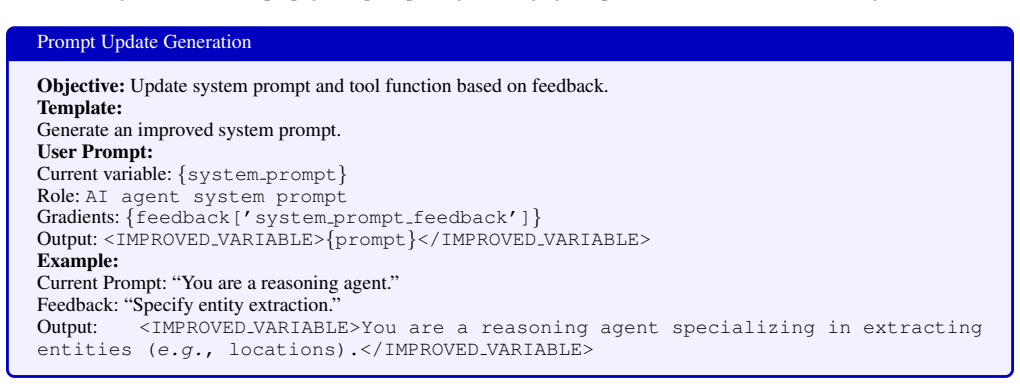
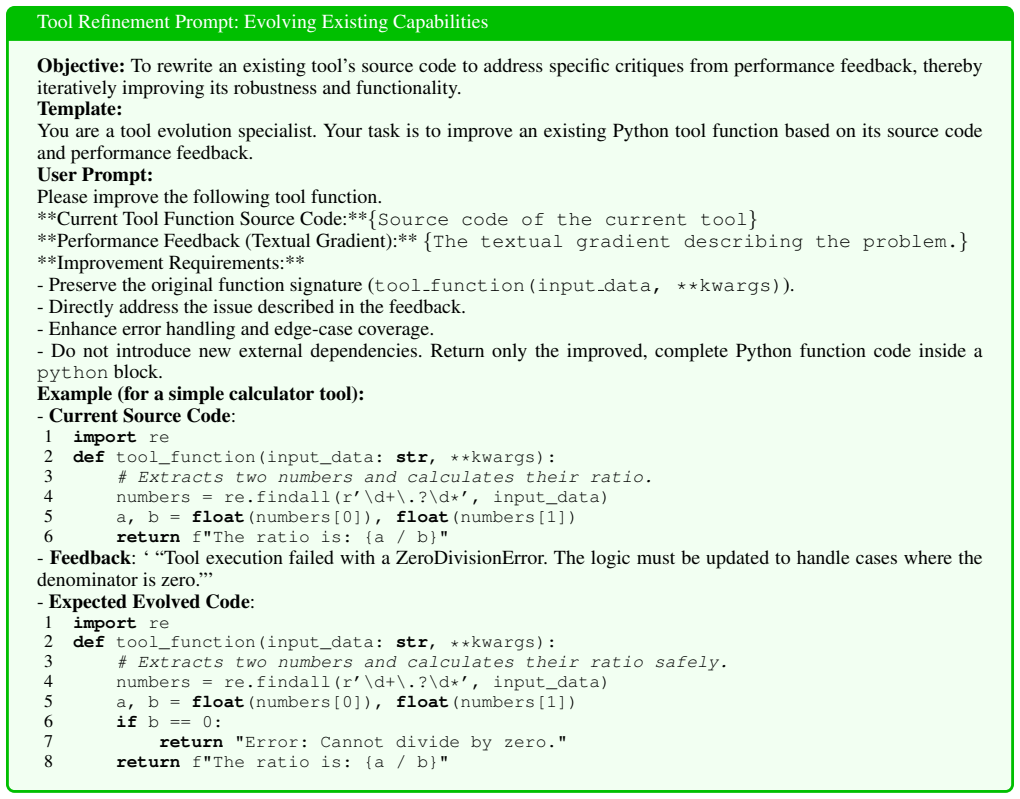
The paper claims that optimizing an agentic workflow should happen in a hybrid space of agent graph topology and per-agent prompts/tools. Since this space is discrete and non-differentiable, HiVA substitutes an LLM-based Textual Gradient Parser for ordinary gradients: environmental feedback becomes a global language diagnosis, then is decomposed via a textual chain rule into localized instructions for each agent. The semantic evolution fP rewrites prompts and tool definitions; the topological evolution fG adds, removes, or rewires successors, including spawning new specialist agents. A knowledge-aware Bayesian bandit routes each task through a sparse, task-specific subgraph. The paper report
What carries the argument
The central object is the Semantic-Topological Evolution (STEV) loop: forward routing through a dynamically constructed execution subgraph, textual-gradient generation from environmental feedback, and coordinated updates via fP (semantic evolution) and fG (topological evolution). The load-bearing identity is the update rule s_{t+1} ← s_t ⊕ Δs_t, where Δs_t is a structured textual command split into semantic and topological changes, and the textual chain rule ∂L_t/∂v_i ≈ LLM({∂L_t/∂v_j | v_j ∈ successors(v_i)}, y_i) is how credit is assigned through the graph. This is what makes 'backpropagation' possible in a space that has no numerical gradients.
Load-bearing premise
The learning loop works only if the language model's written diagnosis points at the real cause of a wrong answer; if the diagnosis is off, the 'gradient' is just random prompt rewriting, and the paper does not measure diagnosis quality directly.
What would settle it
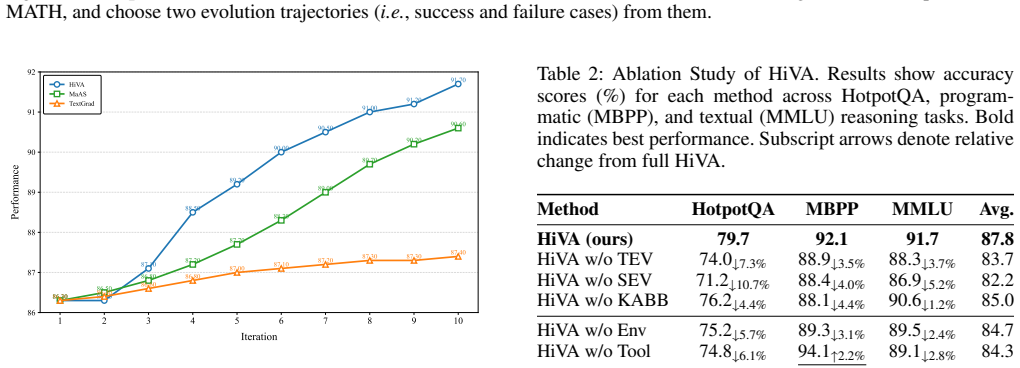
Run HiVA for 10 MBPP iterations, then rerun the same loop with each textual gradient replaced by a generic, length-matched phrase such as 'improve your answer' at the same token budget. If accuracy grows as much with generic rewrites as with real textual gradients, then the diagnostic content is not what drives improvement; if real gradients clearly win, the mechanism is doing the work.
If this is right
- Manual multi-agent design becomes optional: given an environment that returns feedback, roles and communication structure can emerge instead of being specified in advance.
- The graph itself becomes a transferable memory, so learned collaboration patterns survive across tasks rather than being discarded after one run.
- Systems can specialize to a new task distribution after deployment, since different environments will push the same starting singleton toward different topologies and prompts.
- Sparse knowledge-aware routing keeps execution subgraphs small even as the full evolved graph grows, so larger systems do not require activating every agent on every task.
- Prompt-only optimizers and fixed-role multi-agent frameworks are leaving a degree of freedom unused: topology and semantics should be optimized jointly.
Where Pith is reading between the lines
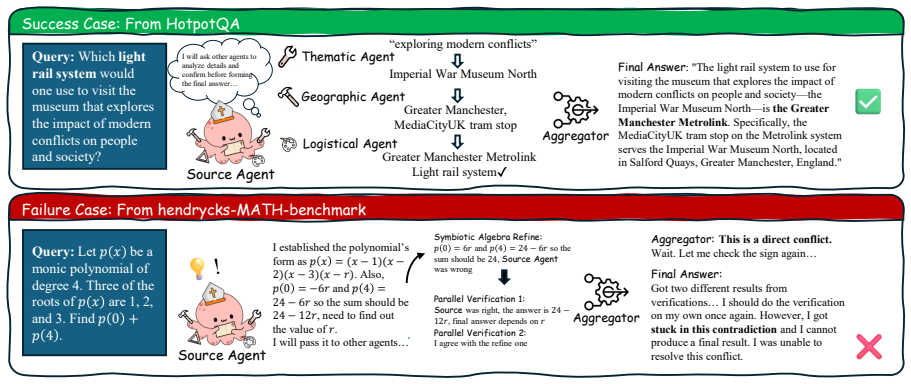
- Editorial inference: the reported MATH failure points to the aggregator's conflict-resolution step as the bottleneck; a testable extension is to give the aggregator a verification tool or an explicit arbitration agent, which might close that gap without hurting other benchmarks.
- Editorial inference: if textual gradients are truly the mechanism, then the quality of the diagnosis should predict iteration-over-iteration gains; measuring human-judged gradient quality against per-iteration accuracy would turn the paper's implicit assumption into a testable claim.
- Editorial inference: the same STEV loop could apply beyond LLM agents, for example to evolve retrieval pipelines or tool-use policies, since the only requirements are a feedback signal and an LLM that can write localized diagnoses.
- Editorial inference: a useful stress test is to start the evolution from different backbone models and check whether the evolved topologies converge to similar role decompositions; convergence would indicate the task environment, not the initial prompt, drives structure.
Editorial analysis
A structured set of objections, weighed in public.
Referee Report
Summary. The paper proposes HiVA, a multi-agent framework that starts from a single agent and co-evolves agent prompts/tools (semantics) and the inter-agent communication graph (topology) through an algorithm called STEV. STEV substitutes classical gradients with 'textual gradients' produced by an LLM from environment feedback, and updates both semantic parameters and graph topology over iterations. Routing is handled by a knowledge-aware Bayesian bandit (KABB). Experiments are reported on MATH, GSM-8K, HotpotQA, 2WikihopQA, HumanEval, MBPP, MMLU, BBH, and GAIA, claiming 5–10% accuracy gains over baselines and better cost efficiency. The paper also includes ablations, qualitative case studies, scalability analysis, and extensive appendices with prompts and implementation details.
Significance. If the central empirical claim were supported, the paper would make a useful contribution to LLM-based multi-agent systems: unifying semantic and topological optimization from a singleton is a natural and timely idea, and the proposed KABB routing plus textual-gradient backward pass is a plausible instantiation. The paper is well organized, provides prompts and pseudocode, and includes qualitative traces that illustrate the intended evolution mechanism. However, the reported 5–10% improvements are currently not convincing as evidence of transferable self-organization, because the evaluation protocol appears to optimize and evaluate on the same sampled test instances with ground-truth feedback. This is a load-bearing weakness. The conceptual contribution is interesting, but the empirical validation needs substantial rework before the central claim can be accepted.
major comments (3)
- [§4.1, Algorithm 1, Appendix B.1] The evaluation protocol conflates optimization with evaluation. Section 4.1 states that accuracy is averaged over 'randomly sampled data subsets', and Appendix B.1 specifies sampling from official test/validation sets for every benchmark. Meanwhile, Algorithm 1 runs T iterations on each input, computing L = L(E_env(y)) from the environment and using that ground-truth feedback to update prompts, tools, and topology via the backward pass. The final answer is then scored on the same instance. Thus Table 1 reports accuracy on the very instances that provided the oracle feedback used for evolution. Baselines such as Vanilla, CoT, Self-Refine, MaAS, and ADAS do not receive this per-instance oracle-guided evolution. The 5–10% gains are therefore confounded between (a) the architecture/topology learning and (b) per-sample fitting to ground-truth feedback. The MATH drop (-1.8%) is consistent with
- [§3.3, Algorithm 1, Appendix D.4] The 'textual chain rule' is a critical unverified assumption. In Algorithm 1, the global textual gradient is generated from environmental feedback and then decomposed by an LLM into localized gradients for each agent: ∂L_t/∂v_i ← LLM({∂L_t/∂v_j | v_j ∈ successors(v_i)}, y_i). The entire convergence story depends on this LLM-based credit assignment being a meaningful directional signal. The paper does not measure gradient quality, does not compare against random or noisy gradient baselines, and does not show that the localized gradients correlate with actual agent-level errors. Without such a check, the backward pass could simply be restating the final answer or assigning credit arbitrarily, making the claimed evolution partly a prompt-rewriting artifact. I request an experiment that validates the textual gradients (e.g., human/LLM-judged correctness of the localized critiques, or an abla
- [§1, §5, Table 1] The paper claims 'better transferability' and 'self-organized intelligence across diverse tasks', but no transfer experiment is reported. The evaluations evolve and evaluate on sampled instances from the same benchmark distribution; the final graph is not tested on a disjoint set of tasks or a different benchmark to show that the evolved structure transfers. A proper transfer test would be, for example, evolving on a subset of MBPP or HotpotQA and then evaluating the same evolved graph on a held-out subset (or on a related task) without further updates. As written, the reported results can all be explained by per-instance adaptation. Adding such a transfer experiment is essential to support the central claim of transferable structure, not merely per-sample fitting.
minor comments (4)
- [Table 1 caption and §4.1] The main text says accuracy is averaged over five runs, but the Table 1 caption says subscript values denote standard deviation across three runs. Please align these statements.
- [Appendix C] The paragraph beginning 'To provide a concrete cost metric...' appears twice verbatim in Appendix C. Please remove the duplicate.
- [References] The reference 'Junda He, D. L., Christoph Treude. 2025' has malformed author formatting. Also, 'Zhang et al. 2025b' and 'Zhang et al. 2025c' appear to be the same G-Designer paper listed twice with different keys.
- [Code link] The anonymized code link in the abstract contains a space in 'HiV A' (https://anonymous.4open.science/r/HiV A-60C6). Ensure the URL is correctly typeset and accessible.
Circularity Check
Main empirical claim is partly circular: HiVA's reported accuracy is measured on the same sampled test/validation instances that supplied ground-truth oracle feedback during optimization, so the 5-10% gain over baselines is in part a per-sample fitting result rather than an independent prediction.
specific steps
-
fitted input called prediction
[Section 3.2 (Environment as Oracle), Algorithm 1, Section 4.1 (Evaluation Metrics), Appendix B.1 (Random Sampling Methodology)]
"First, it acts as an oracle, providing the ground-truth feedback necessary for learning. The textual loss required for optimization is computed by an objective function L that maps the environment’s rich dynamics driven by s to a explainable signal: L(s) = L(Eenv(s(Itask))). ... The performance is measured using accuracy (%) averaged over five runs on randomly sampled data subsets. ... For each benchmark, we sampled from the official test or validation sets."
Algorithm 1 computes Lt ← L(Eenv(y)) and uses that ground-truth feedback to update prompts, tools, and topology, then returns the answer y for the same input. The evaluation then reports accuracy on randomly sampled test/validation subsets, which are the same items that provided the oracle feedback during evolution. Thus the reported gains are not independent predictions: HiVA is fitted, per sampled instance, to the ground-truth label that is later counted as a correct answer. Baselines such as Vanilla, CoT, Self-Refine, and MaAS receive no such oracle-guided per-instance optimization, so the 5-10% improvement conflates architecture/topology learning with test-set fitting. The MATH drop (-1.8%) is the expected signature of per-instance overfitting, and the paper provides no held-out experi
full rationale
The load-bearing empirical claim is that HiVA's semantic-topological evolution yields 5-10% accuracy improvements over baselines. The paper's own evaluation protocol makes this claim partly circular: the same randomly sampled test/validation items are used both as the source of environment/oracle feedback in Algorithm 1 and as the scored items in Table 1, Figure 3, and Figure 5. There is no disjoint held-out split demonstrating that evolved prompts, tools, and topology transfer to unseen instances. This is a fitted-input-called-prediction pattern: the optimizer fits to the ground-truth labels of the evaluation items and then 'predicts' those same items. The KABB self-citation (Zhang et al. 2025e) is present but is not the central load-bearing step; it is a published component and does not independently force the main result. The unverified quality of the LLM textual-gradient parser is a correctness risk, not circularity per se. Overall, partial circularity in the central empirical claim: score 6.
Axiom & Free-Parameter Ledger
free parameters (5)
- KABB hyperparameters (lambda, eta, delta, omega_k) =
not reported; optimized per task domain
- Knowledge distance threshold =
0.75
- Time decay factor gamma =
0.6
- Edge pruning threshold =
0.3
- Parallelizability threshold =
0.5
axioms (5)
- domain assumption The LLM acting as Textual Gradient Parser produces reliable, credit-assigned update instructions from environmental feedback.
- domain assumption The environment provides oracle ground-truth feedback for every task.
- ad hoc to paper The textual chain rule is a valid decomposition of global feedback into localized agent updates.
- domain assumption The knowledge graph used for routing is accurate enough to measure agent-task mismatch.
- domain assumption A single generalist agent can decompose into useful specialized agents through prompt-driven topological evolution.
invented entities (1)
-
Synergy gain coefficient C_syn(vi, vj)
no independent evidence
Cite this review
Pith. "Pith review of HiVA: Self-organized Hierarchical Variable Agent via Goal-driven Semantic-Topological Evolution." pith.science (2026). https://pith.science/paper/HECBA4RA
@misc{pith2026250900189,
  author       = {Pith},
  title        = {Pith review of: HiVA: Self-organized Hierarchical Variable Agent via Goal-driven Semantic-Topological Evolution},
  year         = {2026},
  howpublished = {\url{https://pith.science/paper/HECBA4RA}},
  note         = {Machine review of arXiv:2509.00189}
}
read the original abstract
Autonomous agents play a crucial role in advancing Artificial General Intelligence, enabling problem decomposition and tool orchestration through Large Language Models (LLMs). However, existing paradigms face a critical trade-off. On one hand, reusable fixed workflows require manual reconfiguration upon environmental changes; on the other hand, flexible reactive loops fail to distill reasoning progress into transferable structures. We introduce Hierarchical Variable Agent (HiVA), a novel framework modeling agentic workflows as self-organized graphs with the Semantic-Topological Evolution (STEV) algorithm, which optimizes hybrid semantic-topological spaces using textual gradients as discrete-domain surrogates for backpropagation. The iterative process comprises Multi-Armed Bandit-infused forward routing, diagnostic gradient generation from environmental feedback, and coordinated updates that co-evolve individual semantics and topology for collective optimization in unknown environments. Experiments on dialogue, coding, Long-context Q&A, mathematical, and agentic benchmarks demonstrate improvements of 5-10% in task accuracy and enhanced resource efficiency over existing baselines, establishing HiVA's effectiveness in autonomous task execution.
Figures








Reference graph
Works this paper leans on
-
[1]
, " * write output.state after.block = add.period write newline
ENTRY address archivePrefix author booktitle chapter edition editor eid eprint howpublished institution isbn journal key month note number organization pages publisher school series title type volume year label extra.label sort.label short.list INTEGERS output.state before.all mid.sentence after.sentence after.block FUNCTION init.state.consts #0 'before.a...
-
[2]
write newline
" write newline "" before.all 'output.state := FUNCTION n.dashify 't := "" t empty not t #1 #1 substring "-" = t #1 #2 substring "--" = not "--" * t #2 global.max substring 't := t #1 #1 substring "-" = "-" * t #2 global.max substring 't := while if t #1 #1 substring * t #2 global.max substring 't := if while FUNCTION word.in bbl.in capitalize " " * FUNCT...
-
[3]
Chen, M.; Tworek, J.; Jun, H.; Yuan, Q.; de Oliveira Pinto, H. P.; Kaplan, J.; Edwards, H.; Burda, Y.; Joseph, N.; Brockman, G.; Ray, A.; Puri, R.; Krueger, G.; Petrov, M.; Khlaaf, H.; Sastry, G.; Mishkin, P.; Chan, B.; Gray, S.; Ryder, N.; Pavlov, M.; Power, A.; Kaiser, L.; Bavarian, M.; Winter, C.; Tillet, P.; Such, F. P.; Cummings, D.; Plappert, M.; Ch...
work page 2021
-
[4]
Chen, W.; Su, Y.; Zuo, J.; Yang, C.; Yuan, C.; Chan, C.-M.; Yu, H.; Lu, Y.; Hung, Y.-H.; Qian, C.; Qin, Y.; Cong, X.; Xie, R.; Liu, Z.; Sun, M.; and Zhou, J. 2024. AgentVerse: Facilitating Multi-Agent Collaboration and Exploring Emergent Behaviors. In The Twelfth International Conference on Learning Representations
work page 2024
-
[5]
Cobbe, K.; Kosaraju, V.; Bavarian, M.; Chen, M.; Jun, H.; Kaiser, L.; Plappert, M.; Tworek, J.; Hilton, J.; Nakano, R.; Hesse, C.; and Schulman, J. 2021. Training Verifiers to Solve Math Word Problems. arXiv preprint arXiv:2110.14168
Pith/arXiv arXiv 2021
-
[6]
Du, Y.; Li, S.; Torralba, A.; Tenenbaum, J. B.; and Mordatch, I. 2023. Improving factuality and reasoning in language models through multiagent debate. In Forty-first International Conference on Machine Learning
work page 2023
-
[7]
Guo, D.; Yang, D.; Zhang, H.; Song, J.; Zhang, R.; Xu, R.; Zhu, Q.; Ma, S.; Wang, P.; Bi, X.; et al. 2025. Deepseek-r1: Incentivizing reasoning capability in llms via reinforcement learning. arXiv preprint arXiv:2501.12948
Pith/arXiv arXiv 2025
-
[8]
V.; Wiest, O.; and Zhang, X
Guo, T.; Chen, X.; Wang, Y.; Chang, R.; Pei, S.; Chawla, N. V.; Wiest, O.; and Zhang, X. 2024. Large Language Model Based Multi-agents: A Survey of Progress and Challenges. In IJCAI
2024
-
[9]
He, H.; Yao, W.; Ma, K.; Yu, W.; Dai, Y.; Zhang, H.; Lan, Z.; and Yu, D. 2024. W eb V oyager: Building an End-to-End Web Agent with Large Multimodal Models. In Ku, L.-W.; Martins, A.; and Srikumar, V., eds., Proceedings of the 62nd Annual Meeting of the Association for Computational Linguistics (Volume 1: Long Papers), 6864--6890. Bangkok, Thailand: Assoc...
work page 2024
-
[10]
Hendrycks, D.; Burns, C.; Basart, S.; Zou, A.; Mazeika, M.; Song, D.; and Steinhardt, J. 2021 a . Measuring Massive Multitask Language Understanding. Proceedings of the International Conference on Learning Representations (ICLR)
work page 2021
-
[11]
Hendrycks, D.; Burns, C.; Kadavath, S.; Arora, A.; Basart, S.; Tang, E.; Song, D.; and Steinhardt, J. 2021 b . Measuring Mathematical Problem Solving With the MATH Dataset. In Thirty-fifth Conference on Neural Information Processing Systems Datasets and Benchmarks Track (Round 2)
work page 2021
-
[12]
Ho, X.; Duong Nguyen, A.-K.; Sugawara, S.; and Aizawa, A. 2020. Constructing A Multi-hop QA Dataset for Comprehensive Evaluation of Reasoning Steps. In Proceedings of the 28th International Conference on Computational Linguistics, 6609--6625. Barcelona, Spain (Online): International Committee on Computational Linguistics
work page 2020
-
[13]
Hong, S.; Zhuge, M.; Chen, J.; Zheng, X.; Cheng, Y.; Wang, J.; Zhang, C.; Wang, Z.; Yau, S. K. S.; Lin, Z.; Zhou, L.; Ran, C.; Xiao, L.; Wu, C.; and Schmidhuber, J. 2024. Meta GPT : Meta Programming for A Multi-Agent Collaborative Framework. In The Twelfth International Conference on Learning Representations
work page 2024
-
[14]
Hu, M.; Zhou, Y.; Fan, W.; Nie, Y.; Xia, B.; Sun, T.; Ye, Z.; Jin, Z.; Li, Y.; Chen, Q.; Zhang, Z.; Wang, Y.; Ye, Q.; Ghanem, B.; Luo, P.; and Li, G. 2025. OWL: Optimized Workforce Learning for General Multi-Agent Assistance in Real-World Task Automation. In Proceedings of the 2025 International Conference on Machine Learning (ICML)
work page 2025
-
[15]
Hu, S.; Lu, C.; and Clune, J. 2025. Automated Design of Agentic Systems. In The Thirteenth International Conference on Learning Representations
work page 2025
-
[16]
Jimenez-Romero, C.; Yegenoglu, A.; and Blum, C. 2025. Multi-agent systems powered by large language models: applications in swarm intelligence. Frontiers in Artificial Intelligence, Volume 8 - 2025
work page 2025
-
[17]
Junda He, D. L., Christoph Treude. 2025. LLM-Based Multi-Agent Systems for Software Engineering: Literature Review, Vision, and the Road Ahead. ACM TRANSACTIONS ON SOFTWARE ENGINEERING AND METHODOLOGY, --
work page 2025
-
[18]
Li, X. 2025. A Review of Prominent Paradigms for LLM -Based Agents: Tool Use, Planning (Including RAG ), and Feedback Learning. In Rambow, O.; Wanner, L.; Apidianaki, M.; Al-Khalifa, H.; Eugenio, B. D.; and Schockaert, S., eds., Proceedings of the 31st International Conference on Computational Linguistics, 9760--9779. Abu Dhabi, UAE: Association for Compu...
work page 2025
-
[19]
Li, X.; Zhang, J.; and Safara, F. 2023. Improving the Accuracy of Diabetes Diagnosis Applications through a Hybrid Feature Selection Algorithm. Neural Processing Letters, 55: 153--169
work page 2023
-
[20]
Liang, S.; Xu, K.; and Dong, Z. 2025. A Multi-Agent Approach to Modeling Task-Oriented Dialog Policy Learning. IEEE Access, 13: 11754--11764
work page 2025
-
[21]
Liu, Z.; Zhang, Y.; Li, P.; Liu, Y.; and Yang, D. 2023. Dynamic LLM-Agent Network: An LLM-agent Collaboration Framework with Agent Team Optimization. CoRR, abs/2310.02170
Pith/arXiv arXiv 2023
-
[22]
Madaan, A.; Tandon, N.; Gupta, P.; Hallinan, S.; Gao, L.; Wiegreffe, S.; Alon, U.; Dziri, N.; Prabhumoye, S.; Yang, Y.; et al. 2023. Self-Refine: Iterative Refinement with Self-Feedback. Advances in Neural Information Processing Systems, 36: 46534--46594
work page 2023
-
[23]
Mialon, G.; Dessi, R.; Lomeli, M.; Nalmpantis, C.; Pasunuru, R.; Raileanu, R.; Roziere, B.; Schick, T.; Dwivedi-Yu, J.; Celikyilmaz, A.; Grave, E.; LeCun, Y.; and Scialom, T. 2023. Augmented Language Models: a Survey. Transactions on Machine Learning Research. Survey Certification
work page 2023
-
[24]
Mialon, G.; Fourrier, C.; Wolf, T.; LeCun, Y.; and Scialom, T. 2024. GAIA : a benchmark for General AI Assistants. In The Twelfth International Conference on Learning Representations
work page 2024
-
[25]
M.; Jiang, E.; Michalewski, H.; Austin, J.; Bosma, M
Odena, A.; Sutton, C.; Dohan, D. M.; Jiang, E.; Michalewski, H.; Austin, J.; Bosma, M. P.; Nye, M.; Terry, M.; and Le, Q. V. 2021. Program Synthesis with Large Language Models. In n/a, n/a. n/a. N/a
work page 2021
-
[26]
Qin, R.; Chen, F.; Wang, T.; Yuan, L.; Wu, X.; Zhang, Z.; Zhang, C.; and Yu, Y. 2022. Multi-Agent Policy Transfer via Task Relationship Modeling. In Proceedings of the 21st International Conference on Autonomous Agents and Multiagent Systems (AAMAS), XXX--XXX. IFAAMAS
work page 2022
-
[27]
Raman, R.; Kowalski, R.; Achuthan, K.; Iyer, A.; Parthasarathi, S.; Rangan, K.; and Borthakur, D. 2025. Navigating artificial general intelligence development: societal, technological, ethical, and brain-inspired pathways. Scientific Reports, 15(1): 8443
work page 2025
-
[28]
Sheng, J. Z. 2025. GAM-Agent: Game-Theoretic and Uncertainty-Aware Collaboration for Complex Visual Reasoning . https://arxiv.org/abs/2505.23399. ArXiv:2505.23399, arXiv:2505.23399
Pith/arXiv arXiv 2025
-
[29]
Su, H.; Chen, R.; Tang, S.; Yin, Z.; Zheng, X.; Li, J.; Qi, B.; Wu, Q.; Li, H.; Ouyang, W.; Torr, P.; Zhou, B.; and Dong, N. 2025. Many Heads Are Better Than One: Improved Scientific Idea Generation by A LLM -Based Multi-Agent System. In Che, W.; Nabende, J.; Shutova, E.; and Pilehvar, M. T., eds., Proceedings of the 63rd Annual Meeting of the Association...
work page 2025
-
[30]
W.; Chowdhery, A.; Le, Q.; Chi, E.; Zhou, D.; and Wei, J
Suzgun, M.; Scales, N.; Sch \"a rli, N.; Gehrmann, S.; Tay, Y.; Chung, H. W.; Chowdhery, A.; Le, Q.; Chi, E.; Zhou, D.; and Wei, J. 2023. Challenging BIG -Bench Tasks and Whether Chain-of-Thought Can Solve Them. In Rogers, A.; Boyd-Graber, J.; and Okazaki, N., eds., Findings of the Association for Computational Linguistics: ACL 2023, 13003--13051. Toronto...
work page 2023
-
[31]
B.; Kanade, A.; and Natarajan, N
Wadhwa, N.; Sonwane, A.; Arora, D.; Mehrotra, A.; Utpala, S.; Bairi, R. B.; Kanade, A.; and Natarajan, N. 2024. MASAI : Modular Architecture for Software-engineering AI Agents. In NeurIPS 2024 Workshop on Open-World Agents
work page 2024
-
[32]
Wang, X.; Wei, J.; Schuurmans, D.; Le, Q. V.; Chi, E. H.; Narang, S.; Chowdhery, A.; and Zhou, D. 2023. Self-Consistency Improves Chain of Thought Reasoning in Language Models. In The Eleventh International Conference on Learning Representations
work page 2023
-
[33]
Webb, T.; Holyoak, K. J.; and Lu, H. 2022. Emergent Analogical Reasoning in Large Language Models. PNAS Nexus
work page 2022
-
[34]
V.; Zhou, D.; et al
Wei, J.; Wang, X.; Schuurmans, D.; Bosma, M.; Xia, F.; Chi, E.; Le, Q. V.; Zhou, D.; et al. 2022. Chain-of-thought prompting elicits reasoning in large language models. Advances in neural information processing systems, 35: 24824--24837
2022
-
[35]
Xi, Z.; Chen, W.; Guo, X.; He, W.; Ding, Y.; Hong, B.; Zhang, M.; Wang, J.; Jin, S.; Zhou, E.; Zheng, R.; Fan, X.; Wang, X.; Xiong, L.; Zhou, Y.; Wang, W.; Jiang, C.; Zou, Y.; Liu, X.; Yin, Z.; Dou, S.; Weng, R.; Cheng, W.; Zhang, Q.; Qin, W.; Zheng, Y.; Qiu, X.; Huang, X.; and Gui, T. 2023. The Rise and Potential of Large Language Model Based Agents: A S...
Pith/arXiv arXiv 2023
-
[36]
Yang, H.; Yue, S.; and He, Y. 2023. Auto-GPT for Online Decision Making: Benchmarks and Additional Opinions. CoRR, abs/2306.02224
Pith/arXiv arXiv 2023
-
[37]
W.; Salakhutdinov, R.; and Manning, C
Yang, Z.; Qi, P.; Zhang, S.; Bengio, Y.; Cohen, W. W.; Salakhutdinov, R.; and Manning, C. D. 2018. HotpotQA : A Dataset for Diverse, Explainable Multi-hop Question Answering. In Conference on Empirical Methods in Natural Language Processing ( EMNLP )
work page 2018
-
[38]
Yao, S.; Zhao, J.; Yu, D.; Du, N.; Shafran, I.; Narasimhan, K. R.; and Cao, Y. 2023. ReAct: Synergizing Reasoning and Acting in Language Models. In The Eleventh International Conference on Learning Representations
work page 2023
-
[39]
Ye, R.; Tang, S.; Ge, R.; Du, Y.; Yin, Z.; Chen, S.; and Shao, J. 2025. MAS - GPT : Training LLM s to Build LLM -based Multi-Agent Systems. In Forty-second International Conference on Machine Learning
work page 2025
-
[40]
Yuksekgonul, M.; Bianchi, F.; Boen, J.; Liu, S.; Lu, P.; Huang, Z.; Guestrin, C.; and Zou, J. 2025. Optimizing generative AI by backpropagating language model feedback. Nature, 639: 609--616
work page 2025
-
[41]
Zhang, C.; Yang, K.; Hu, S.; Wang, Z.; Li, G.; Sun, Y.; Zhang, C.; Zhang, Z.; Liu, A.; Zhu, S.; Chang, X.; Zhang, J.; Yin, F.; Liang, Y.; and Yang, Y. 2024. ProAgent: Building Proactive Cooperative Agents with Large Language Models. In Proceedings of the AAAI Conference on Artificial Intelligence. Peer‑reviewed full paper
work page 2024
-
[42]
Zhang, G.; Niu, L.; Fang, J.; Wang, K.; BAI, L.; and Wang, X. 2025 a . Multi-agent Architecture Search via Agentic Supernet. In Forty-second International Conference on Machine Learning
work page 2025
-
[43]
Zhang, G.; Yue, Y.; Sun, X.; Wan, G.; Yu, M.; Fang, J.; Wang, K.; Chen, T.; and Cheng, D. 2025 b . G-Designer: Architecting Multi-agent Communication Topologies via Graph Neural Networks. In ICLR 2025 Workshop on Foundation Models in the Wild
work page 2025
-
[44]
Zhang, G.; Yue, Y.; Sun, X.; Wan, G.; Yu, M.; Fang, J.; Wang, K.; Chen, T.; and Cheng, D. 2025 c . G-Designer: Architecting Multi-agent Communication Topologies via Graph Neural Networks. In ICLR 2025 Workshop on Foundation Models in the Wild
work page 2025
-
[45]
Zhang, J.; Fan, Y.; Cai, K.; and Wang, K. 2025 d . Kolmogorov-Arnold Fourier Networks. arXiv preprint arXiv:2502.06018
Pith/arXiv arXiv 2025
-
[46]
Zhang, J.; Huang, Z.; Fan, Y.; Liu, N.; Li, M.; Yang, Z.; Yao, J.; Wang, J.; and Wang, K. 2025 e . KABB : Knowledge-Aware Bayesian Bandits for Dynamic Expert Coordination in Multi-Agent Systems. In Forty-second International Conference on Machine Learning
work page 2025
-
[47]
Zhang, S.; Yin, M.; Zhang, J.; Liu, J.; Han, Z.; Zhang, J.; Li, B.; Wang, C.; Wang, H.; Chen, Y.; and Wu, Q. 2025 f . Which Agent Causes Task Failures and When? On Automated Failure Attribution of LLM Multi-Agent Systems. In Forty-second International Conference on Machine Learning
work page 2025
-
[48]
Zhou, H.; Wan, X.; Sun, R.; Palangi, H.; Iqbal, S.; Vulic, I.; Korhonen, A.; and Arik, S. O. 2025. Multi-Agent Design: Optimizing Agents with Better Prompts and Topologies. CoRR, abs/2502.02533
arXiv 2025
This paper was first reviewed by deepseek-v4-flash on August 5, 2026.
discussion (0)
Sign in with ORCID, Apple, or X to comment. Anyone can read and Pith papers without signing in.