REVIEW 2 major objections 4 minor 39 references
This paper proves that local quantum scrambling, pattern-conditioned recovery, and a fixed GJC receiver convert approximate logical recovery into a guaranteed bound on the classical Fisher information of stored astronomical visibility, and
Reviewed by Pith at T0; open to challenge. T0 means a machine referee read the full paper against a public rubric. the ladder, T0–T4 →
T0 review · deepseek-v4-flash
2026-08-01 18:22 UTC pith:HEDRRYAN
load-bearing objection A careful, unusually honest finite-size study whose verified analytical core does not support the advertised certified operational guarantee, and whose only gain over bare memory evaporates under its own conservative throughput normalization. the 2 major comments →
Protecting Astronomical Interferometry through Quantum-Memory Scrambling
The pith
A machine-rendered reading of the paper's core claim, the machinery that carries it, and where it could break.
Core claim
The central claim is Theorem 1 / Corollary 3: for a fixed GJC receiver, uniform control of the recovered logical channel's diamond-norm error implies uniform control of the receiver-accessible classical Fisher information over compact visibility regions, with explicit constant C_F(g_max)=16/(1-g_max)+16/(1-g_max)^2. Combined with finite-size numerics, the paper claims that a local number-conserving scramble-recover chain with fixed readout constitutes a certified operational erasure-protection mechanism for stored complex visibility: at n=5, depth-2 brickwork encoding with pattern-conditioned recovery attains all-pattern GJC-CFI retention R_C=0.561 at p=0.30, versus 0.49 for bare storage. Th
What carries the argument
The load-bearing object is Theorem 1 (Fisher-information stability under a fixed receiver): a parameter-independent CPTP map with half-diamond distance epsilon from identity bounds the operator-norm deviation of the classical Fisher matrix of any fixed POVM, with a constant involving q0, H_max, and S_rho. Specialized to the GJC parity receiver, it yields Corollary 3, converting logical-channel diamond error to uniform GJC-CFI control on |g|<=g_max<1. The finite-size mechanism is a U(1)-covariant, number-conserving nearest-neighbor brickwork encoder on n=5 qubits with two fixed ancillary excitations (codewords in charge sectors 2 and 3), a tangent-weighted semidefinite-program recovery condit
Load-bearing premise
The reported conditional gain over bare storage is computed inside a synthetic output-coherence attenuation envelope whose two parameters (e and r) are uncalibrated, and under a per-captured-mode normalization that gives the four extra memory cells in each encoded block no alternative use; realistically calibrated values of e or r already wipe out the gain (e=3e-3 or r~0.012 at p=0.30), and a memory-only 1/n throughput comparison yields zero positive cells.
What would settle it
At the paper's operating point p=0.30, measure the two uncalibrated synthetic parameters on a real memory platform: the per-gate output-coherence attenuation e and the gate-layer time fraction r relative to the bare protocol cycle. The paper itself shows that inserting e=3e-3 (or r around 0.012) makes the conditional gain negative, so a calibrated device with those values would refute the claimed protection advantage; more broadly, a fixed-total-memory experiment comparing the n=5 encoded block against five bare memories would settle whether any throughput benefit exists.
If this is right
- Any uniform logical-channel diamond-error estimate for a covariant finite-depth code immediately yields an operational guarantee on the GJC classical Fisher information, not just on quantum Fisher information.
- Scrambling's finite-size role is risk redistribution: it suppresses high-leakage erasure-location tails and improves worst-position recovery, even though mean retention is nonmonotone in depth.
- A depth-2 brickwork encoder with pattern-conditioned recovery retains R_C=0.561 at p=0.30, above the bare (1-p)^2=0.49, at equal statistical budget and with all erasure patterns included.
- Every nontrivial recovery branch in the frozen batch (1860 branches) compiles into nearest-neighbor number-conserving two-qubit gates with Choi residuals below 1e-4, so the recovery is implementable in an abstract gate set.
- The low-rate design does not beat five parallel bare memories when total memory is fixed (0 positive simultaneous cells), so near-term gains require spare memory, a capture bottleneck, or a higher-rate code.
Where Pith is reading between the lines
- An extension left implicit: the stability theorem is POVM-agnostic, so the same diamond-to-Fisher conversion could certify other fixed receivers (homodyne, photon-counting, or mode-sorting) by recomputing the receiver-dependent constants.
- If the shallow-depth advantage survives calibration, it suggests a generic design principle for U(1)-covariant approximate codes: operator-weight spreading plus pattern-conditioned tangent recovery, rather than maximum-entanglement-fidelity recovery, is the better use of limited depth.
- A testable next step: replace the synthetic attenuation envelope with a calibrated per-gate dephasing model; the paper's own break-even table predicts the exact (e, r) curve at which scrambling stops helping, so a tabletop memory experiment could settle the mechanism before a full interferometric deployment.
- The 1/n memory-only null result points to rate, not recovery, as the true bottleneck; combining this scramble-recover chain with multi-logical-qubit charge-sector codes is the natural continuation, though the covariance-accuracy tradeoff may cap the achievable rate.
Editorial analysis
A structured set of objections, weighed in public.
Referee Report
Summary. The paper proposes a scheme for protecting the complex visibility of coherently captured starlight in a quantum-memory-assisted long-baseline interferometer. The architecture is a two-node chain: local number-conserving scrambling of a logical occupancy qubit into n=5 physical memory cells, parameter-independent pattern-conditioned recovery after flagged erasures, and a fixed Gottesman--Jennewein--Croke receiver. The main analytical result is Theorem 1 / Corollary 3, which states that a uniform half-diamond error bound on the recovered logical channel controls the operator-norm deviation of the classical Fisher information of the GJC receiver on a compact visibility region. The paper also proves a covariance obstruction to uniform exact single-memory erasure correction (Lemma 1), derives exact-recovery benchmarks, and reports finite-size simulations: scrambling suppresses high-leakage tails, a tangent-weighted decoder improves worst-position retention, a depth-2 brickwork encoder is selected among tested designs, and every nontrivial recovery branch is compiled into nearest-neighbor number-conserving gates. The paper explicitly disclaims platform-total or fixed-total-memory throughput advantage and states that Corollary 3 is not used as an a posteriori certification of the numerical CFI results.
Significance. If the central theorem is correct, it provides a rigorous, parameter-free conversion from a coding-level channel-error guarantee to an operational statement about the classical Fisher information of a fixed receiver. This is a useful contribution independent of the specific interferometric application, and the explicit constant C_F(g_max) is valuable. The finite-size study is also unusually transparent: all 1024 two-node flagged-erasure events and 1860 nonempty recovery branches are accounted for, compilation residuals are reported, the seed audit corrects an earlier independence claim, and the limitations are stated in unusual detail. However, the advertised operational guarantee is not actually instantiated for any constructed encoder, and the only positive throughput-conditional gain is computed from synthetic, uncalibrated sensitivity parameters. The paper is therefore best read as a conditional theorem plus an honest instance-level simulation study, not as a demonstrated protection protocol.
major comments (2)
- [Sec. VI / Corollary 3 (Eqs. 64-71)] The manuscript explicitly states that the simulations 'neither estimate nor report a uniform diamond-norm error for the recovered logical channel' and that Corollary 3 is 'not invoked as an a posteriori certification.' This is a load-bearing limitation: the abstract's 'operational guarantee' and the conclusion's claim that the theorem 'converts approximate logical recovery into an operational guarantee' are conditional on the existence of a uniform logical-channel diamond-norm bound. No such bound is supplied for the n=5, L=2 brickwork encoder or for any other constructed code. Direct all-pattern GJC-CFI retention (Tables VII and X) does not imply a small diamond distance, because a recovery could preserve the two-parameter visibility family while having large error on other logical operators. Moreover, C_F(g_max) = 16/(1-g_max)+16/(1-g_max)^2 is about 480 at g_max=0.8, so a useful CFI b
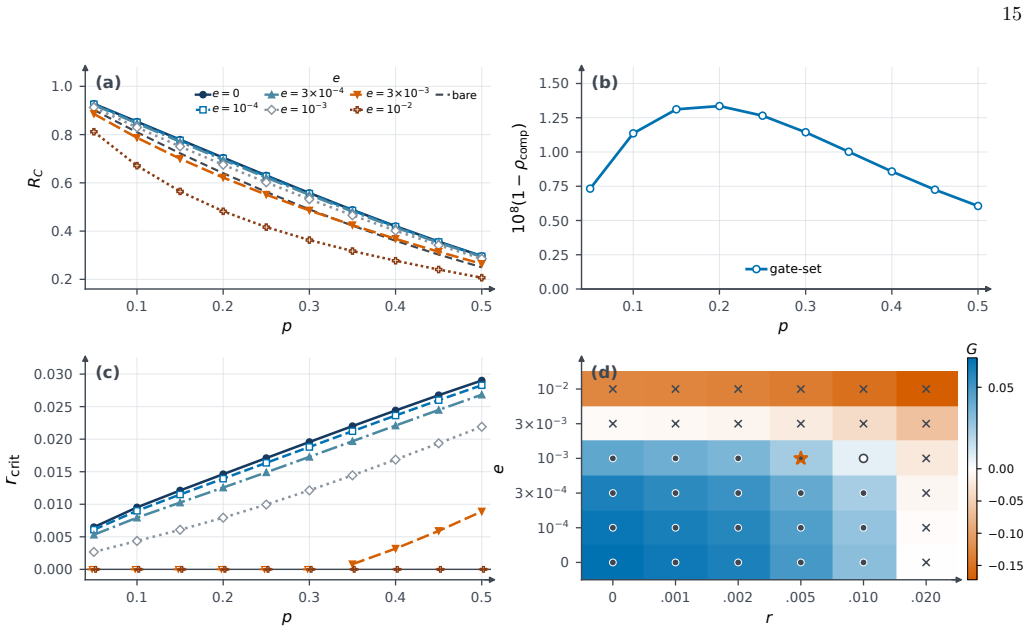
- [Sec. V, Table X, Eqs. (E41)-(E43)] The only positive excess retention over bare storage, G=+0.023976 at (p,e,r)=(0.30,10^-3,0.005), is computed under the synthetic output-coherence envelope eta_E=(1-2e)^m_E and partial-timing factor gamma(p,r)=[1+r(D_enc+E_p max(D_A,D_B))]^-1, with uncalibrated parameters e and r. The paper itself reports that at e=3e-3 the positive p-set is empty, and under the conservative memory-only 1/n=1/5 throughput estimand the same frozen batch yields zero cells with positive simultaneous lower endpoints. Because the paper explicitly disclaims a platform-total resource comparison, this is not an internal inconsistency; however, the 'blueprint for converting spare memory capacity into protection' is not supported by any evaluated parameter region under a conservative throughput accounting. The positive gain should be framed as a conditional illustrative sensitivity result, and the title/abstract sh
minor comments (4)
- [Sec. II D, Eq. (28)] The notation F^GJC is used both for the conditional accepted-event CFI and for the all-pattern CFI with zero-information patterns included. The distinction is explained in Corollary 3 and Eq. (82), but a sentence in Sec. II D clarifying that Eq. (28) is the conditional accepted-event form would prevent confusion.
- [Fig. 4(d) caption] The marker classes (filled circles, open circles, crosses) are described only in the caption text. Adding a legend directly in the figure would improve readability, especially since the classes carry inferential meaning.
- [Sec. IV B, Eq. (E36)] The gate form G(theta)=1⊕U_1(...)⊕e^{i alpha_2} is written for a two-qubit gate but the dimensions and qubit ordering are not specified. A brief statement of the basis ordering would make the compilation section self-contained.
- [Appendix E.6] Table VII labels the 'symmetrical Dicke' as a deterministic benchmark. The text later calls it 'one deterministic benchmark' and gives no interval, which is fine; the table caption could state explicitly that no uncertainty is associated with that row.
Circularity Check
No circular derivation identified: analytical theorem is conditional and proven from stated assumptions; finite-size CFI results are direct simulations explicitly not certified via the theorem.
full rationale
The paper's central analytical link (Theorem 1 / Corollary 3, Eqs. 64-71) is a conditional channel-to-classical-Fisher-information stability bound. Its proof in Appendix B starts from CPTP channels, the trace-norm inequality |p_y - q_y| <= epsilon_diamond, and the standard CFI decomposition; it does not assume the CFI bound it proves. Corollary 3 is a specialization to the GJC parity POVM with explicit constants; no fitted value enters. Critically, the paper states that the finite-size calculations do not use the theorem as certification: 'The simulations and the present numerical certification evaluate the GJC-CFI directly; they neither estimate nor report a uniform diamond-norm error for the recovered logical channel. Consequently, Corollary 3 establishes the rigorous conversion needed once such a channel estimate is available; it is not invoked as an a posteriori certification of the plotted numerical CFI.' This is a gap between a conditional theorem and instance-level simulations, not a circular reduction. The finite-size retentions (e.g., Table VII, Eq. 82) are computed by explicit enumeration of all 1024 flagged-erasure events and direct evaluation of the GJC CFI after explicit recovery SDPs; no quantity is fitted and then renamed a prediction. Hyperparameter lambda=128 was selected on a training set and frozen before held-out validation on distinct encoders. The conditional gain G in Eq. (E43) is transparently labeled a post hoc, uncalibrated sensitivity envelope, with negative results reported at higher e and under the memory-only 1/n benchmark. The covariance obstruction is proven in Lemma 1 and supported by independent prior results, not by self-citation; no load-bearing self-citation appears anywhere in the reference list. The derivation chain is therefore self-contained within its stated assumptions, and no circular step can be exhibited.
Axiom & Free-Parameter Ledger
free parameters (5)
- tangent-weight lambda (recovery SDP hyperparameter) =
128 (edge of scan grid {1,...,128})
- nominal visibility work point g_0 and five visibility points =
g_0 = 0.3 + 0.4i; radii 0.2/0.5/0.8
- synthetic output-attenuation index e and gate-layer time fraction r =
swept e in {0,...,1e-2}, r in {0,...,0.02}
- readout-mixing probability and erasure p-grid =
0.005; p in {0.05,...,0.50}
- encoder codeword charge design (two ancillary excitations; |01100>,|11100>) =
charge sectors 2 and 3
axioms (7)
- domain assumption Weak-thermal-field model: rho_s(g) = (1-epsilon)|00><00| + epsilon rho_s^(1)(g) + O(epsilon^2), with balanced kappa=1/2 known
- domain assumption Flagged erasure with perfect flags and i.i.d. Bernoulli weights
- domain assumption Photon-number superselection / strict U(1) covariance with fixed background charge (Eq. 44)
- domain assumption van Cittert-Zernike relation: g is a normalized Fourier component of the source intensity
- standard math Knill-Laflamme conditions for exact erasure correction; SLD QFI formula Eq. (8); data-processing inequality for scalar QFI
- domain assumption Common g-independent success weight s_0 for the conditional GJC channel (Corollary 3 assumptions)
- domain assumption Single-photon reference source model (eta_a, q_A, q_B, nu_a) as a fresh, undephased resource per trial
read the original abstract
Preserving the complex visibility of coherently captured starlight is essential for quantum-assisted long-baseline interferometry, because this nonlocal coherence carries the spatial information needed to form astronomical images. Yet finite memory lifetime and imperfect retrieval inevitably produce storage failures; when a failed cell is heralded, its erased subsystem can leak which-node information to the environment and dephase the stored coherence. Strict finite-dimensional (\(U(1)\)) covariance further forbids uniform exact correction of all single-memory erasures. We address this combined physical and symmetry-imposed limit using local number-conserving quantum scrambling, parameter-independent pattern-conditioned recovery, and a fixed Gottesman--Jennewein--Croke receiver. We prove a channel-to-Fisher-information stability theorem that converts approximate logical recovery into an operational guarantee on receiver-accessible information over compact visibility regions. All-pattern finite-size simulations show that scrambling redistributes erasure risk and suppresses high-leakage events, while a separate equal-budget comparison identifies a shallow design that outperforms the tested deeper and charge-sector Haar-random benchmarks at the prespecified operating point. A separate compilation resolves every nontrivial recovery branch into abstract nearest-neighbor number-conserving gates. Although the present low-rate design does not yet improve fixed-total-memory throughput, it establishes a blueprint for converting spare memory capacity into protection of astronomical coherence, opening a path toward higher-rate, erasure-resilient quantum telescope architectures.
Figures


Reference graph
Works this paper leans on
-
[1]
The map ∆ is Hermiticity preserving and trace annihilating
Proof of the operational stability theorem Proof of Theorem 1.Write ∆ = Λ−Γ. The map ∆ is Hermiticity preserving and trace annihilating. IfXis Hermitian and traceless and 0≤M≤I, the Jordan decompositionX=X + −X − gives |Tr(M X)| ≤1 2 ∥X∥ 1.(B6) Consequently, |py −q y| ≤1 2 ∥∆(ρ)∥ 1 ≤ε ⋄.(B7) Because both channels are independent ofθ, differentia- tion com...
-
[2]
QFI retention factor
After a local encoderVand a biparti- tion into erased subsystemEand retained subsystemQ, define ρREQ = (IR ⊗V)|Φ RL⟩ ⟨ΦRL|(I R ⊗V †).(A1) The decoupling error is DE(V) = 1 2 ∥ρRE −ρ R ⊗ρ E∥ 1.(A2) Exact erasure correction is equivalent toDE(V) = 0. Ap- proximate decoupling implies the existence of an approx- imate recovery channel through the standard dec...
-
[3]
It prevents a gain in one quadrature from hiding the loss of the other
W ork point and worst-direction metric The nominal visibility is g0 = 0.3 + 0.4i.(E1) For two positive-definite information matricesAandB, we use the generalized worst-direction ratio Rmin(A|B) =λ min B−1/2AB−1/2 .(E2) Equation (E2) equals the smallest retained fraction over all local directions in the (gR, gI ) plane. It prevents a gain in one quadrature...
-
[4]
Included
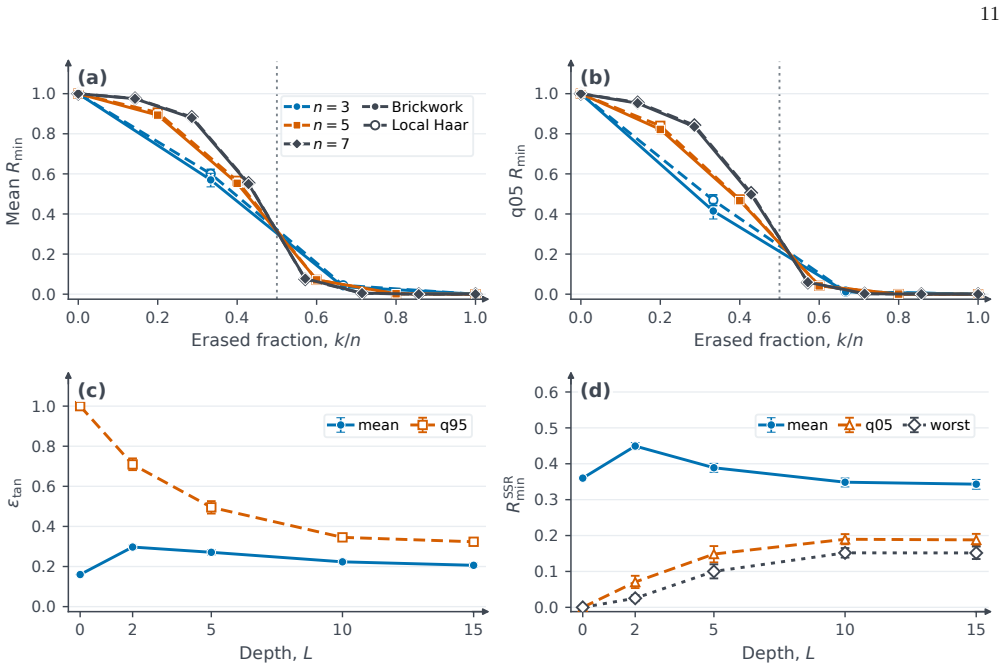
Finite depth, finite size, and the local half-erasure crossover We first use independent local brickwork encoders without imposing charge conservation. The codewords at the two nodes are generated independently, no gate connects the nodes, and erasures are flagged. For each n∈ {3,5,7}we sample 30 brickwork circuits and 60 local Haar isometries. Erasure-po...
-
[5]
more scrambling
Scrambling, tangent-leakage tails, and recovery risk LetU L be the completen-memory encoder unitary af- terLbrickwork layers,d= 2 n, andZ ℓ =I−2ˆn ℓ. The remote density out-of-time-order correlator (OTOC), a diagnostic of operator spreading, is Cdens(L) = 1 n−1 nX ℓ=2 h ULZ1U † L, Zℓ i 2 F 2d .(E8) It is evaluated on the full physical Hilbert space and av...
2061
-
[6]
SSR-covariant recovery optimized for metrology Retained QFI is not yet an operational receiver. We therefore compare three local, pattern-dependent CPTP recovery maps forn= 5,L= 10, andk A =k B = 2: the transpose, or Petz, map (the canonical recovery built from the noise channel and a reference code state), an SSR-covariant semidefinite program maximizing...
-
[7]
,1), 1X r=0 (JE)ar,br =δ ab (a, b= 0,
The entanglement fidelity for the maximally mixed logical input is Fe(ΛE) =⟨Φ 2|(id⊗Λ E)(|Φ2⟩⟨Φ2|)|Φ2⟩ = 1 4 1X i,j=0 ⟨i|ΛE(|i⟩⟨j|)|j⟩ = 1 4 Re 1X i,j=0 D−1X a,b=0 (AE ij)ab(JE)ai,bj.(E23) Consequently, the maximum-fidelity recovery is the SDP maximize JE 1 4 Re 1X i,j=0 D−1X a,b=0 (AE ij)ab(JE)ai,bj subject toJ (∆) E ⪰0 (∆ =−m, . . . ,1), 1X r=0 (JE)ar,b...
-
[8]
(29) gives atg 0 F GJC 0,π/2 = 0.274725 0 0 0.297619 ! .(E33) The matrix in Eq
GJC phase design and compatibility For ideal reference visibility and equal allocation be- tween the conventional phases 0 andπ/2, Eq. (29) gives atg 0 F GJC 0,π/2 = 0.274725 0 0 0.297619 ! .(E33) The matrix in Eq. (E33) has worst-direction efficiency 0.4314 relative to Eq. (E5). Equal allocation among 0, π/4, π/2,3π/4 raises the no-loss efficiency to 0.4...
1933
-
[9]
(82), rather than fixingkor conditioning on suc- cessful recovery
All-pattern normalized retention and the locality bottleneck We next retain every flagged event and evaluate Eq. (82), rather than fixingkor conditioning on suc- cessful recovery. Each node has 32 erasure sets, giving 1024 two-node events. All encoded designs are evalu- ated under one common protocol: the same five pre- scribed visibility points, a unifor...
-
[10]
Common abstract gate-set encoder online-gate comparison The follow-up compares encoder preparation in one common abstract gate model. The online-gate ledger includes circuit depth, two-qubit gate count, storage qubits, and synthesis work ancillas, but excludes offline compiler search and the physical precision or calibration cost of continuous gate parame...
2004
-
[11]
Residual
Abstract recovery circuits and a conditional sensitivity envelope For each of 30 separately generatedn= 5,L= 2 encoder pairs in the frozen implementation batch, ev- ery local recovery Choi matrix is first restricted to the subspace reachable after the corresponding flagged era- sure. For circuit construction, the reachable channel is truncated at fixed re...
-
[12]
Pre-storage loss LetL ηc describe signal loss before the state reaches the encoded memory. Since the encoder acts only afterL ηc , H[V ◦ Lηc (ρs(g))] =H[L ηc (ρs(g))]≤H[ρ s(g)].(G1) No subsequent parameter-independent unitary can re- store QFI carried away before capture without access to the lost environment. The factorη c in Eq. (19) is there- fore irre...
-
[13]
Loss of an entire telescope node Local codes protect erasures inside each node. If an entire node and all of its encoded block are lost, then one side of the cross-aperture coherence is traced out and the visibility cannot be reconstructed from the other node alone. Protecting node failure would require nonlocal redundancy across additional telescope node...
-
[14]
(A11) and the finite-size crossovers reported above concern known erasure locations
Unflagged amplitude damping and dephasing The unrestricted exact-code bound in Eq. (A11) and the finite-size crossovers reported above concern known erasure locations. For unflagged amplitude damping, the relevant error set includes both no-jump and jump oper- ators; for dephasing it includes phase errors that directly suppressg. Exact protection then req...
-
[15]
The standard GJC receiver probes a very restricted family of local op- tical observables
QFI without a decoder Scrambling may place parameter information in high- order correlations of the retained block. The standard GJC receiver probes a very restricted family of local op- tical observables. Without a decoder or an explicitly con- structed logical GJC POVM, high retained QFI does not imply high observed CFI. The exact-recovery benchmark in ...
-
[16]
(29) and (B4) are local asymptotic quantities
Asymptotic versus finite-sample readout The Fisher matrices in Eqs. (29) and (B4) are local asymptotic quantities. A phase design that improves their generalized eigenvalues need not improve a biased, constrained estimator at finite sample size. Any future claim of adaptive advantage must therefore include esti- mator bias, physical-boundary effects, feed...
-
[17]
Tsang, Physical Review Letters107, 270402 (2011)
M. Tsang, Physical Review Letters107, 270402 (2011)
2011
-
[18]
Gottesman, T
D. Gottesman, T. Jennewein, and S. Croke, Physical Re- view Letters109, 070503 (2012)
2012
-
[19]
E. T. Khabiboulline, J. Borregaard, K. De Greve, and M. D. Lukin, Physical Review Letters123, 070504 (2019)
2019
-
[20]
E. T. Khabiboulline, J. Borregaard, K. De Greve, and M. D. Lukin, Physical Review A100, 022316 (2019)
2019
-
[21]
Huang, G
Z. Huang, G. K. Brennen, and Y. Ouyang, Physical Re- view Letters129, 210502 (2022)
2022
-
[22]
M. M. Marchese and P. Kok, Physical Review Letters 130, 160801 (2023)
2023
-
[23]
Y. Wang, Y. Zhang, and V. O. Lorenz, Physical Review Research7, 023154 (2025)
2025
-
[24]
Padilla, A
I. Padilla, A. Sajjad, B. N. Saif, and S. Guha, Physical Review A113, 012608 (2026)
2026
-
[25]
Padilla, A
I. Padilla, A. Sajjad, B. N. Saif, and S. Guha, Physical Review Letters136, 010803 (2026)
2026
-
[26]
Y. Zhang and T. Jennewein, Criteria for optimal entanglement-assisted long baseline imaging protocols (2025), arXiv:2501.16670 [quant-ph]
arXiv 2025
-
[27]
M. R. Brown, M. Allgaier, V. Thiel, J. D. Monnier, M. G. Raymer, and B. J. Smith, Physical Review Letters131, 210801 (2023)
2023
-
[28]
P.-J. Stas, Y.-C. Wei, M. Sirotin, Y. Q. Huan, U. Yazlar, F. Abdo Arias, E. Knyazev, G. Baranes, B. Machielse, S. Grandi, D. Riedel, J. Borregaard, H. Park, M. Lonˇ car, A. Suleymanzade, and M. D. Lukin, Nature651, 326 (2026), arXiv:2509.09464 [quant-ph]
arXiv 2026
-
[29]
Wang, X.-Y
B. Wang, X.-Y. Luo, B.-F. Gao, J.-L. Liu, C.-Y. Wang, Z. Yan, Q.-M. Ke, D. Teng, M.-Y. Zheng, Y. Cao, J. Li, C.-Z. Peng, Q. Zhang, X.-H. Bao, and J.-W. Pan, Phys- 35 ical Review Letters136, 240801 (2026)
2026
-
[30]
Wysocki, J
P. Wysocki, J. Chwede´ nczuk, and M. P lodzie´ n, Physical Review Letters137, 030801 (2026)
2026
-
[31]
Eastin and E
B. Eastin and E. Knill, Physical Review Letters102, 110502 (2009)
2009
-
[32]
P. Faist, S. Nezami, V. V. Albert, G. Salton, F. Pastawski, P. Hayden, and J. Preskill, Physical Re- view X10, 041018 (2020), arXiv:1902.07714 [quant-ph]
Pith/arXiv arXiv 2020
-
[33]
L. Kong and Z.-W. Liu, PRX Quantum3, 020314 (2022), arXiv:2112.01498 [quant-ph]
Pith/arXiv arXiv 2022
-
[34]
S. L. Braunstein and C. M. Caves, Physical Review Let- ters72, 3439 (1994)
1994
-
[35]
Knill and R
E. Knill and R. Laflamme, Physical Review Letters84, 2525 (2000)
2000
-
[36]
D. N. Page, Physical Review Letters71, 1291 (1993)
1993
-
[37]
Hayden and J
P. Hayden and J. Preskill, Journal of High Energy Physics2007, 120 (2007)
2007
-
[38]
J. M. Arrazola, O. Di Matteo, N. Quesada, S. Jahangiri, A. Delgado, and N. Killoran, Quantum6, 742 (2022), arXiv:2106.13839 [quant-ph]
Pith/arXiv arXiv 2022
-
[39]
A. B¨ artschi and S. Eidenbenz, inFundamentals of Computation Theory, Lecture Notes in Computer Sci- ence, Vol. 11651 (Springer, Cham, 2019) pp. 126–139, arXiv:1904.07358 [quant-ph]
Pith/arXiv arXiv 2019
discussion (0)
Sign in with ORCID, Apple, or X to comment. Anyone can read and Pith papers without signing in.