REVIEW 5 minor 10 references
Roadmap on STIRAP applications
T0 review · 0 major / 5 minor · reviewed 2026-08-14 · deepseek-v4-flash
Pith's one-line read This roadmap argues that STIRAP, a two-photon transfer through an intermediate state that is never populated, is a portable coherent-control primitive spanning molecules, electron-EDM searches, photons, waves, ions, and circuits.
desk verdict A competent, honest roadmap that delivers on its genre's promise; no load-bearing flaws, only minor editorial cleanups. read the letter →
The pith
A machine-rendered reading of the paper's core claim, the machinery that carries it, and where it could break.
The reading
What carries the argument
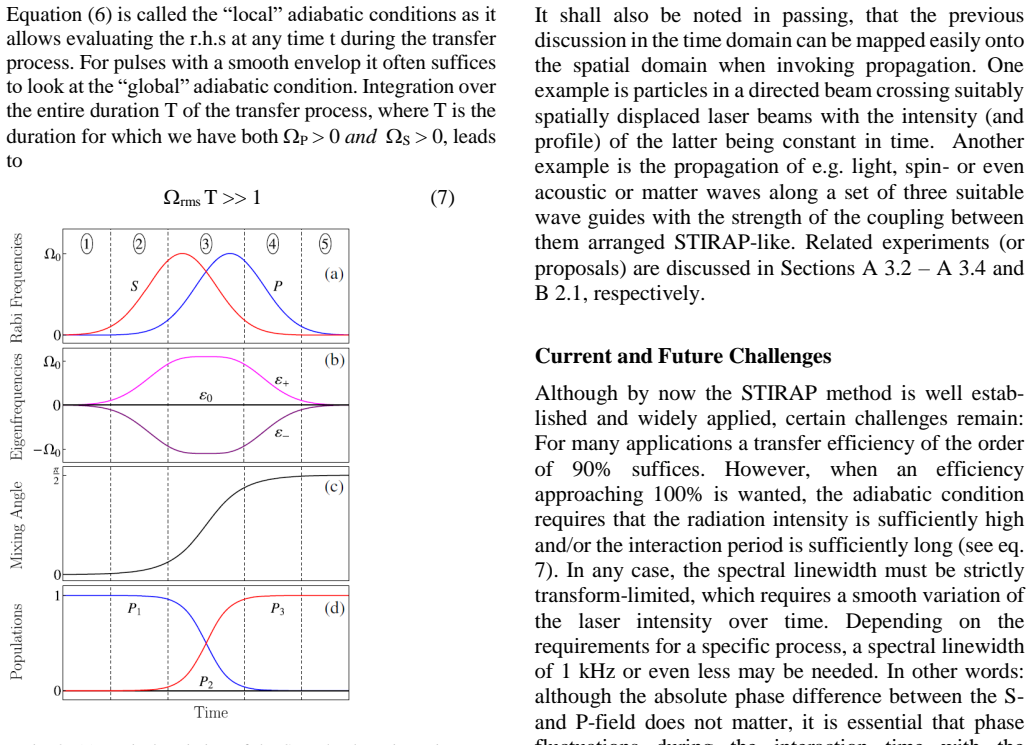
The load-bearing object is the dark state of the three-level $\Lambda$ (or ladder) system, $\Phi_0(t) = \psi_1\cos\theta(t) - \psi_3\sin\theta(t)$, with the mixing angle set by the ratio of the two Rabi frequencies, $\tan\theta(t) = \Omega_P(t)/\Omega_S(t)$. Together with the two-photon resonance condition ($\delta = 0$) and the global adiabatic condition $\Omega_{\rm rms} T \gg 1$, the dark state is the entire mechanism: because it has no component of the intermediate state $\psi_2$, the transfer is immune to that state's decay even when its lifetime is far shorter than the interaction time. In the spatial and classical-wave versions of the scheme the same object reappears: position-dependent coupling strengths between three waveguides, acoustic channels, or trapping wells replace the time-dependent laser pulses, and the dark state becomes the superposition that shuttles light, magnons, sound, or matter between the outer elements while the middle element stays unexcited — the mechanism behind spatial adiabatic passage and the photonic, magnonic, and acoustic STIRAP demonstrations.
What would settle it
A decisive test is to measure the population of the intermediate state during an attempted STIRAP transfer: if it exceeds the adiabatic-error prediction set by $\Omega_{\rm rms} T$, the dark-state mechanism is not doing the work. The roadmap already supplies the template — in NV centers, residual excited-state population produces an optically driven decoherence rate that can be compared directly against the spin decoherence rate, and the first transmon STIRAP's roughly 80 percent fidelity quantifies the remaining nonadiabatic leakage. The cleanest new experiment would drive STIRAP with deliberately degraded phase coherence, for example a chirped pulse that lets $\delta$ drift off two-photon resonance, and observe the transfer efficiency collapse as intermediate-state population grows.
Extended reading notes
Core claim
The central claim, stated on the paper's own terms, is that STIRAP's counterintuitive pulse ordering — the Stokes field coupling the final state to the intermediate state is applied before the pump field coupling the initial state to the intermediate state — keeps the system in the dark state $\Phi_0(t) = \psi_1\cos\theta(t) - \psi_3\sin\theta(t)$, a coherent superposition of initial and final states containing no component of the intermediate state. Because the system rides this dark state, population flows from state 1 to state 3 without populating the 'leaky' state 2, and spontaneous emission from the intermediate state is prevented by quantum interference. The roadmap documents this mechanism achieving high-efficiency transfer across platforms as different as ultracold molecules, cavity photons, trapped ions, diamond NV centers, and superconducting circuits, and in purely classical systems where the same Hamiltonian is realized by position-dependent coupling between waveguides for light, spin waves, or sound. The paper's boldest assertion is that STIRAP is the enabling technology for creating molecular samples in the regime of quantum degeneracy, and that its robustness to small parameter variations is what has carried it into all of these fields.
Load-bearing premise
The load-bearing premise is that each new platform can deliver phase-stable, transform-limited radiation with a linewidth of about 1 kHz or better and enough pulse area to keep two-photon resonance and the adiabatic condition ($\Omega_{\rm rms} T \gg 1$) intact for the whole transfer — a requirement the paper itself concedes is currently unmet for UV/VUV molecules such as H2, O2, and N2, and under strain in NV centers where microsecond-scale spin dephasing drives nonadiabatic excitation of the intermediate state.
Editorial extensions
If this is right
- If the roadmap's claim is right, quantum-degenerate gases of polar molecules are an available platform: STIRAP's better-than-90-percent transfer into the absolute ground state enables the study of strong dipolar interactions, spin models, and barrier-controlled ultracold chemistry, including reactions whose rates are set by quantum statistics and tunneling.
- Electron-EDM searches gain directly: STIRAP state preparation delivered a factor of 12 in signal in the thorium-monoxide experiment, and the roadmap projects another order-of-magnitude improvement in the EDM limit with the planned upgrades, extending tests of physics beyond the Standard Model.
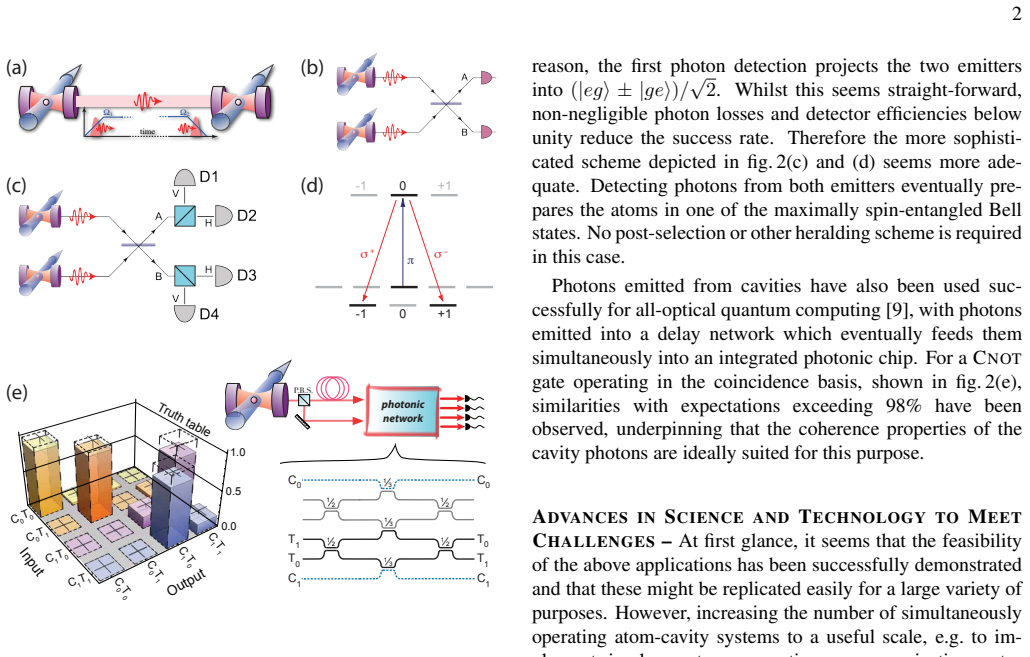
- Deterministic single photons with engineered temporal shapes, produced by STIRAP in atom-cavity systems, become usable flying qubits for quantum networking; the demonstrated photonic CNOT gate with a truth-table similarity above 98 percent marks the level of coherence already reached.
- The same dark-state transfer mapped into real space provides robust, nonreciprocal routing for classical waves: photonic, magnonic, and acoustic STIRAP offer defect-tolerant transport in integrated devices, with acoustic STIRAP already moving sound one-way between channels while the middle channel stays silent.
- Composite-pulse and shortcut-to-adiabaticity versions of STIRAP, together with pulse shaping, are the roadmap's identified route to pushing transfer errors below the 0.01 percent threshold needed for fault-tolerant quantum computing.
Reading between the lines
- The roadmap's own conceded limits imply a coherence budget for portability: platforms that cannot hold two-photon resonance over the pulse duration — UV/VUV molecules with today's sources, NV centers with microsecond-scale spin dephasing, and any nuclear isomer until suitable radiation exists — will see transfer efficiency capped by nonadiabatic excitation of the intermediate state, which turns th
- Reading the classical-wave results as evidence for a general adiabatic transport theorem on three-node networks with tunable couplings suggests STIRAP-inspired designs could extend to engineered energy-routing, isolation, and switching networks well beyond the photonic, magnonic, and acoustic settings the paper names.
- A concrete extension the roadmap leaves open: mapping spatial adiabatic passage into momentum space — for example tunneling between roton minima in spin-orbit-coupled Bose-Einstein condensates — could realize matter-wave STIRAP with complex tunneling amplitudes and thereby artificial gauge fields, a testable generalization of the central claim.
Signed reviews
Editorial analysis
A structured set of objections, weighed in public.
Referee Report
Summary. The manuscript is a multi-author 'roadmap' review of STIRAP applications. Section A1.1 sets out the standard three-level STIRAP Hamiltonian, the dark state, and the adiabatic conditions, and it carefully lists the main experimental constraints. Part A reports high-efficiency demonstrations in ultracold molecule formation (A2.1), the ACME electron-EDM measurement (A2.2), chiral-molecule parity-violation proposals (A2.3), ultracold chemistry (A2.4), cavity-QED single-photon generation and storage (A3.1), optical and acoustic wave analogues (A3.2, A3.4), trapped ions (A4.1, A4.2), and solid-state systems including rare-earth crystals, NV centers, and superconducting circuits (A5.1–A5.3); the magnonic section (A3.3) is a simulation-based proposal. Part B collects theory and proposals for quantum information, spatial adiabatic passage, molecular Rydberg-state excitation, molecular-beam control, and nuclear isomers. The overarching claim is that STIRAP is a demonstrated, portable coherent-control primitive with a documented experimental record across many platforms and with clearly identified boundary conditions.
Significance. The roadmap's value is comparative: it brings together independent experimental groups and platforms under a common formalism, and the efficiency numbers that anchor the central claim are consistent with the cited primary literature (e.g., >90% ultracold-molecule ground-state transfer, 75% ACME II spin-aligned state preparation, ~95% trapped-ion transfer, 80% transmon transfer, and 89/68/43% Fock-state fidelities). The paper is appropriately careful in several places: the classical-wave chapters explicitly present analogue phenomena rather than quantum STIRAP (A3.2–A3.4), the magnonic chapter validates its analytical model against full micromagnetic simulation, and the main coherence/source limitations are disclosed (A1.1 on UV/VUV transform-limited pulses, A5.2 on NV spin dephasing, and the abstract's nuclear-field caveat). I found no internal inconsistency in the introductory Hamiltonian, the adiabatic conditions, or the mapping between platforms; the central review claim is therefore defensible. If this roadmap succeeds in its purpose, it will be a useful cross-disciplinary reference for transferring STIRAP techniques between atomic, molecular, photonic, and solid-state systems.
minor comments (5)
- [A1.1, Eq. (1)] The Stokes Rabi frequency is written with d13, but the S field couples states |2> and |3>; it should be d23. This is a typographical error in an otherwise correct set of equations.
- [A2.1, Fig. 1] The caption is a template placeholder reading 'We allow at most two figures that are roughly the size of this box.' The actual figure is missing and must be replaced with the RbCs level scheme and STIRAP data described in the text.
- [A2.1, Current and Future Challenges] The 'about 80% of these (unpublished)' transfer efficiency is a non-verifiable claim; please either cite a preprint or report or mark it explicitly as a personal communication, since the published >90% efficiencies already support the section's conclusion.
- [Abstract and A3.3] Section A3.3 is described as a proposal whose predictions are validated by micromagnetic simulation rather than by experiment, but the abstract states that Part A documents 'experimental success' of STIRAP. This should be qualified so that readers do not infer an experimental magnonic STIRAP demonstration.
- [A2.2, A4.1, A5.3] Several quoted fidelities (75%, ~95%, and 89/68/43%) are given without uncertainties; adding error bars or an explicit pointer to the corresponding published figures would help readers judge the robustness claims.
Circularity Check
No load-bearing circularity: the roadmap's claims rest on published experimental demonstrations and standard STIRAP theory, not on fitted parameters renamed as predictions.
full rationale
The paper is a review/roadmap, not a derivation of new results from fitted inputs. Section A1.1 presents the conventional STIRAP Hamiltonian, dark state, and adiabatic conditions as standard quantum-optical theory with stated assumptions; nothing in Eqs. (1)-(7) is fitted to the later experimental efficiencies. The application chapters report measured transfer efficiencies and cite the original experimental papers; even when the cited experiments are the authors' own prior work, those results are external, falsifiable measurements rather than inputs recycled into the present text. The magnonic section's 'prediction' is checked against a full micromagnetic simulation, not against the same analytical model used to generate it. The photonic, magnonic, and acoustic chapters explicitly frame their content as classical-wave analogues of STIRAP, not as derivations that presuppose the quantum result. Self-citations to Bergmann/Vitanov review articles are contextual and not load-bearing: no uniqueness claim, universal validity claim, or central premise is imported solely from a self-citation. The limitations—lack of transform-limited UV/VUV pulses, NV spin dephasing, and the conditional nature of the nuclear proposal—are openly disclosed, so the central descriptive claim is not circularly protected. No specific reduction of a claimed result to its own inputs could be identified.
Assumptions & free parameters
assumptions (4)
- domain assumption Rotating wave approximation validity (Eq. 2)
- domain assumption Two-photon resonance delta = 0 is maintained throughout the interaction
- standard math Adiabatic theorem for finite pulses (Eqs. 6-7)
- domain assumption Coupled-mode Schrodinger equation for classical waves
Cite this review
Pith. "Pith review of Roadmap on STIRAP applications." pith.science (2026). https://pith.science/paper/HESBCKJX
@misc{pith2026190801611,
  author       = {Pith},
  title        = {Pith review of: Roadmap on STIRAP applications},
  year         = {2026},
  howpublished = {\url{https://pith.science/paper/HESBCKJX}},
  note         = {Machine review of arXiv:1908.01611}
}
read the original abstract
STIRAP (Stimulated Raman Adiabatic Passage) is a powerful laser-based method, usually involving two photons, for efficient and selective transfer of population between quantum states. A particularly interesting feature is the fact that the coupling between the initial and the final quantum states is via an intermediate state even though the lifetime of the latter can be much shorter than the interaction time with the laser radiation. Nevertheless, spontaneous emission from the intermediate state is prevented by quantum interference. Maintaining the coherence between the initial and final state throughout the transfer process is crucial. STIRAP was initially developed with applications in chemical dynamics in mind. That is why the original paper of 1990 was published in The Journal of Chemical Physics. However, as of about the year 2000, the unique capabilities of STIRAP and its robustness with respect to small variations of some experimental parameters stimulated many researchers to apply the scheme in a variety of other fields of physics. The successes of these efforts are documented in this collection of articles.
Figures


Figures from the paper (8 more)



Reference graph
Works this paper leans on
-
[1]
Walker P and Dracoulis G 1999 Energy traps in atomic nuclei Nature (London) 399, 35-40
work page 1999
-
[2]
Pálffy A, Evers J and Keitel C H 2007 Isomer triggering via nuclear excitation by electron capture Phys. Rev. Lett. 99 172501 (1-4)
work page 2007
-
[3]
Bürvenich T J, Evers E and Keitel C H 2006 Nuclear quantum optics with x -ray laser pulses Phys. Rev. Lett. 96 142501 (1-4)
work page 2006
-
[4]
Liao W-T, Pálffy A and Keitel C H 2011 Nuclear coherent population transfer with x-ray laser pulses Phys. Lett. B 705 134 -138
work page 2011
-
[5]
Liao W-T, Pálffy A and Keitel C H 2013 A three - beam setup for coherently controlling nuclear state populations Phys. Rev. C 87 054609 (1-12)
work page 2013
-
[6]
Nedaee-Shakarab B, Saadati -Niari M a nd Zolfagharpour F 2016 Nuclear -state population transfer by a train of coincident pulses Phys. Rev. C 94 054601 (1-8)
work page 2016
-
[7]
Nedaee-Shakarab B, Saadati -Niari M and Zolfagharpour F 2017 Nuclear-state engineering in tripod systems using x-ray laser pulses Phys. Rev. C 96 044619 (1-8)
work page 2017
-
[8]
Kim K -J, Shvyd’ko Y and Reiche S 2008 A Proposal for an X -Ray Free -Electron Laser Oscillator with an Energy -Recovery Linac Phys. Rev. Lett. 100 244802 (1-4)
work page 2008
Show all 10 references
-
[9]
Emma C, Lutman A, Guetg M W, Krzywinski J, Marinelli A, Wu J and Pellegrini C 2017 Experimental demonstration of fresh bunch self - seeding in an X-ray free electron laser Appl. Phys. Lett. 110 154101 (1-5)
2017
-
[10]
Macchi A, Borghesi M and Passoni M 2013 Ion acceleration by superintense laser -plasma interaction Rev. Mod. Phys. 85 751-793
2013
Reviewed August 14, 2026 · model on record in the stance chip above.
Discussion (0). Continue with ORCID to comment.