REVIEW 3 major objections 5 minor 51 references
Emergence of moir\'e magnetic chaos in twisted bilayer CrI3
T0 review · 3 major / 5 minor · reviewed 2026-08-15 · deepseek-v4-flash
Pith's one-line read Twisted bilayer CrI3 relaxes chaotically into domain patterns without any external drive.
desk verdict Undriven transient chaos in moiré magnets is a real and interesting claim, but the headline Lyapunov numbers are partly sitting in the single-precision noise floor; the controlled part of the data still supports the core phenomenon. read the letter →
The pith
A machine-rendered reading of the paper's core claim, the machinery that carries it, and where it could break.
The reading
What carries the argument
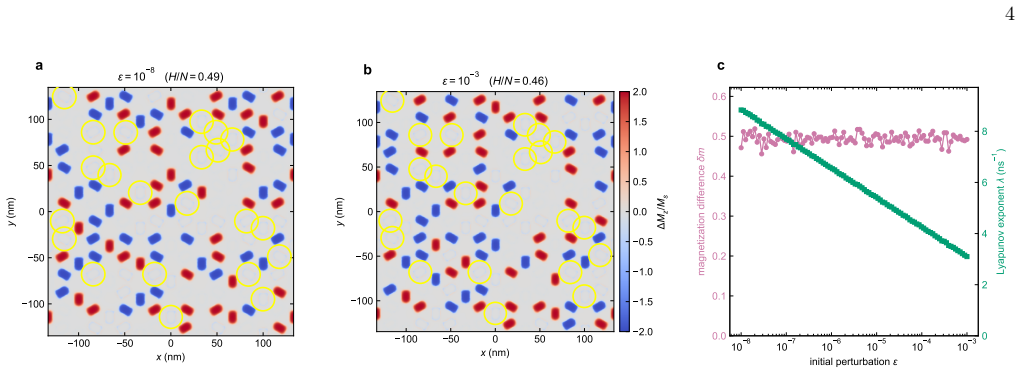
The load-bearing object is the stacking-dependent interlayer exchange map $J_{\mathrm{inter}}(\mathbf{r})$ of a $\theta=1.61^\circ$ twisted CrI3 bilayer, obtained from a first-principles spin Hamiltonian. Its spatial alternation between a ferromagnetic background and isolated antiferromagnetic patches creates frustrated local moments: each patch admits two degenerate polarizations but is coupled to the background, so local relaxation is nonlinear, while weak patch–patch coupling leaves the $N=157$ patches quasi-independent. The argument is carried by damage-spreading numerics: a reference trajectory and perturbed trajectories with a single tilted spin are compared through the RMS magnetization difference $\delta m(t)$, and the finite-amplitude Lyapunov exponent $\lambda(\varepsilon)=t^{-1}\ln(\delta m/\varepsilon)$ is seen to fall logarithmically with $\varepsilon$, exactly as expected when the separation saturates at the $|\mathbf{m}|=1$ bound. A Benettin tangent-space calculation with a renormalized perturbation $\delta_0=10^{-7}$ and a finer time step converges to $\lambda_{\max}=290.8\pm0.1\ \mathrm{ns}^{-1}$, showing that the saturation-limited main-text value is a lower bound on the true expansion rate.
What would settle it
Repeat the damage-spreading protocol in double-precision arithmetic with perturbation amplitudes $10^{-10}$ and $10^{-12}$. If the Hamming fraction at $t=2$ ns stays near 0.5, the five-decade sensitivity is physically real; if it collapses toward zero or scales with $\varepsilon$, the small-amplitude end of the claim is an artifact of single-precision noise. As a second check, vary the renormalization interval and perturbation direction in the Benettin calculation: the plateau near $291\ \mathrm{ns}^{-1}$ should be unchanged if the exponent is intrinsic.
Extended reading notes
Core claim
The central discovery is that undriven Landau–Lifshitz–Gilbert relaxation of twisted bilayer CrI3 is transiently chaotic at the mesoscopic domain level. The alternating ferromagnetic/antiferromagnetic interlayer exchange frustrates each antiferromagnetic patch against its ferromagnetic environment, producing a dense manifold of nearly degenerate metastable configurations (the total energy spread is about $\Delta E/|E|\approx 1.8\times10^{-4}$, roughly 0.3 meV per patch). Deterministic trajectories navigating this landscape amplify infinitesimal initial-state differences exponentially until the binary polarization pattern is fully decorrelated from the reference: a single-spin tilt of $\varepsilon=10^{-8}$ gives a Hamming fraction of 0.49, the maximal-decorrelation limit, and the saturation is independent of perturbation amplitude across five decades. The ensemble statistics match independent fair coins: per-patch Shannon entropy is 99.9% of its maximum, the pairwise Hamming-distance distribution coincides with $\mathrm{Bin}(N,1/2)$, and no pairwise Pearson correlation survives Bonferroni correction. The paper's stated conclusion is that this is a new form of microscopic, undriven, high-dimensional magnetic chaos, which it calls moiré magnetic chaos.
Load-bearing premise
The claim that sensitivity persists over five decades of perturbation amplitude assumes the simulation faithfully propagates single-spin tilts down to $\varepsilon=10^{-8}$, but the paper states that the solver's single-precision resolution is about $6\times10^{-8}$, so the two smallest decades lie near the floating-point noise floor and are not fully controlled; the Benettin calculation at $10^{-7}$ is better controlled, but the headline five-decade statement depends on numerical fidelity at its small end.
Editorial extensions
If this is right
- No external drive is required for magnetic chaos: the interlayer frustration itself supplies the multiple dynamical degrees of freedom needed for autonomous sensitivity to initial conditions.
- An infinitesimal single-spin perturbation is amplified to a macroscopic, half-decorrelated domain pattern within a few nanoseconds, so the final state is effectively unpredictable from the energy landscape alone.
- The chaotically selected pattern is thermally robust below about 10 K and persists under applied fields up to about 2 T, making it observable in cryogenic magnetometry measurements.
- Each quench from a random in-plane fluctuation acts as an independent draw from a $2^{157}$-state manifold, suggesting a route to hardware random-number generation at rates near 10 Gbit s$^{-1}$ per flake before reset and readout overhead.
- The fixed partition of domains into pinned and chaos-active subsets means the chaos is spatially structured by the moiré geometry and should be tunable through twist angle and stacking.
Reading between the lines
- The same frustration-based mechanism should appear in other twisted van der Waals magnets with sign-alternating interlayer coupling, such as twisted CrSBr or NiI2; this is the paper's listed extension, restated here as an editorial prediction.
- Because the manifold is nearly degenerate and the dynamics are damped, the phenomenon is best understood as transient final-state sensitivity rather than sustained chaos, so a natural test is to vary the Gilbert damping and check how the tangent-space exponent scales.
- The paper establishes pairwise independence but does not test higher-order correlations among the 157 bits, so a stricter random-bit claim would need a third-order or mutual-information test at higher sample counts.
- If the small-epsilon decades survive double-precision control, the practical consequence is that the same nominal sample behaves as a microscopic randomizer: each thermal cycle yields a different, uncorrelated pattern, which could serve as a physically unclonable source of entropy.
Signed reviews
Editorial analysis
A structured set of objections, weighed in public.
Referee Report
Summary. The paper claims that relaxation of twisted bilayer CrI3 from a polarized initial state to moiré magnetic textures exhibits transient autonomous chaos, in the sense that infinitesimal perturbations of the initial spin configuration are exponentially amplified while the moiré domain pattern forms, yielding stochastic and pairwise-uncorrelated domain configurations. The evidence is micromagnetic LLG simulations: a damage-spreading sweep over five decades of perturbation amplitude gives a finite-amplitude Lyapunov exponent λmax≈9 ns−1 from the smallest amplitude, and a supplementary Benettin tangent-space calculation reports λmax≈291 ns−1. A 1000-run ensemble is shown to have per-patch Shannon entropy at 99.9% of maximum and pairwise correlations statistically indistinguishable from independence. The authors further report that the selected pattern is robust against temperature and applied field, and they interpret the phenomenon as high-dimensional, undriven final-state sensitivity in a mesoscopic magnet.
Significance. If the central claim survives, this is a conceptually new mechanism: autonomous transient chaos in an undriven mesoscopic magnet, with the chaos living in binary domain variables rather than in a few macroscopic collective coordinates. The manuscript has real strengths: the shuffled-interlayer-coupling null control (SI S6) cleanly shows that the domain manifold requires moiré spatial coherence; the 1000-run statistical analysis with Bonferroni-corrected pairwise correlations and a mutual-information null (SI S4, S5) is careful; and the Benettin calculation includes a time-step convergence check. The authors also state important limitations explicitly, such as the single-precision noise floor in Methods B and the transient nature of the chaos in SI S7. However, the headline quantitative claims—five decades of sensitivity and the associated Lyapunov values—are not fully supported by the numerical evidence as presented, because part of the perturbation range lies at or near the solver's floating-point noise floor.
major comments (3)
- [IV B / Fig. 2c / Abstract] The abstract's 'five decades of perturbation amplitude' is not supported by the numerical evidence as presented. Methods B states that the solver runs in single precision with relative resolution ≈6×10⁻⁸ and that perturbations with ε≲10−6 approach the floating-point noise floor; nevertheless Fig. 2c plots λ(ε) down to ε=10−8, and Sec. II B quotes λmax≈9 ns−1 from that smallest value. The two smallest decades of the sweep may therefore be measuring amplification of roundoff rather than of the applied tilt. These points should either be re-computed in double precision or explicitly excluded from the headline 'five decades' and λmax≈9 ns−1 statements; the controlled claim over ε≈10−6 to 10−3 (three decades) appears robust and should be presented as such.
- [SI S7, Benettin calculation] The tangent-space perturbation δ0=10−7 is only about 1.6 times the quoted single-precision relative resolution of 6×10⁻⁸, so the reported λmax=290.8±0.1 ns−1 is not cleanly separated from the numerical noise floor. The fixed-step convergence check between Δt=0.1 ps and 0.05 ps validates discretization error but not floating-point precision, since all runs are single precision. I recommend repeating the Benettin calculation in double precision, or at least adding a zero-perturbation control in which two identical trajectories are evolved and the damage arising from roundoff alone is measured; the exponent should be reported only if it lies well above that control.
- [II B, Eq. (4)] Equation (4), λ(ε)≈t−1(ln δm_sat − ln ε), is a direct rearrangement of the definition in Eq. (3) after substituting the observed saturation value δm≈δm_sat. It is therefore not an independent prediction, and the statement that it gives 'quantitative agreement with the data' is circular. The genuine physical content is the amplitude independence of the saturated δm and the Hamming fraction near 0.5, which should be presented as the primary observations; the logarithmic form of λ(ε) should not be used as additional evidence for chaos.
minor comments (5)
- [Abstract and Discussion] The word 'chaos' appears throughout the main text, while SI S7 correctly explains that the asymptotic Lyapunov exponent is non-positive and that the phenomenon is transient final-state sensitivity. Please use consistent terminology such as 'transient moiré magnetic chaos' or 'final-state sensitivity' in the abstract and Discussion to avoid implying a sustained chaotic attractor.
- [II B, Fig. 2c] Fig. 2c shows no error bars or confidence intervals for λ(ε). Given that the smallest amplitudes are near the precision limit, adding error estimates or at least marking the noise-floor boundary would help the reader interpret the five-decade sweep.
- [IV E, layer-resolved implementation] The statement that 'any spatially-homogeneous, neighbour-to-neighbour interlayer term is set to zero' is a modeling choice that should be justified explicitly, since interlayer exchange in a bilayer is not obviously captured only by a vertical on-site coupling in the continuum mapping.
- [II C] The paper is appropriately cautious in stating that higher-order correlations and full access to all 2^N configurations are not demonstrated; this caution should be retained in the abstract, which currently says only 'pairwise uncorrelated.'
- [SI S6] The shuffled-coupling null control is a strong addition, but the text says 'A spatially uniform-coupling control is left for completeness.' Adding that uniform-control result, even qualitatively, would further strengthen the claim that the moiré pattern, not just the presence of AFM patches, is necessary.
Circularity Check
Equation (4) is a rearrangement of the defining formula for λ(ε), but the central chaos claim is upheld by independent damage-spreading, Benettin, and ensemble-statistics evidence.
-
self definitional
[Section II B, Eq. (4), built from Eqs. (2)-(3)]
"Because |m|= 1 caps the separation at δm≤√2, every perturbation is amplified until the two trajectories fully decorrelate, so δm saturates at a common value δm sat≈0.5 (Fig. 2a,b) independent of ε. Substituting into λ(ε) =t −1 ln(δm/ε) gives λ(ε)≈ 1/t (lnδm sat−lnε), (4) which falls linearly in lnε, in quantitative agreement with the data."
Equation (4) is obtained by inserting the observed saturation value δm_sat into the defining expression Eq. (3). The claimed logarithmic decrease of λ(ε) with slope −1/t is therefore an algebraic consequence of the definition plus the empirical constancy of δm, not a dynamical prediction; the 'quantitative agreement' with Fig. 2c is forced by construction. This step is descriptive rather than load-bearing for the main claim: the sensitivity evidence comes from the amplitude-independent Hamming saturation, the Benettin tangent-space calculation (SI S7), and the shuffled-coupling null control (SI S6), none of which reduces to Eq. (4).
full rationale
The core claim—autonomous, transient, high-dimensional sensitivity of the relaxing moiré texture to initial conditions—is generated by direct simulation and is not equivalent to its inputs. The damage-spreading saturation H/N_d≈0.5 across ε, the Benettin exponent λ_max=290.8±0.1 ns^-1 with a 0.05 ps step, the 1000-run entropy and pairwise-correlation statistics, and the shuffled-J_inter null control are all independent observables. The only circular step found is the derivation of Eq. (4), which is just Eq. (3) with δm replaced by the measured saturation value; it adds no independent support and is not the basis of the central conclusion. Self-citations to earlier K.-M. Kim papers supply the DFT-derived exchange map and prior metastability observations; these are first-principles, externally checkable inputs, and the present paper independently corroborates the near-degenerate manifold through its own energy density of states (SI S2) and controls. The Methods B admission that single precision makes ε≲10^-6 perturbations approach the floating-point noise floor is a numerical-robustness concern for the two smallest decades, not a circularity; it does not raise the circularity score.
Assumptions & free parameters
free parameters (4)
- Interlayer coupling calibration factor zeta =
-5.38e-13 J m^-1 per meV
- Gilbert damping alpha =
0.02
- Initial in-plane fluctuation scale =
sigma = 1 before normalization
- Initial out-of-plane magnetization m_z(0) =
0.99
assumptions (5)
- domain assumption The continuum LLG model in mumax+ faithfully represents the relaxational dynamics of twisted bilayer CrI3 at theta = 1.61 degrees.
- domain assumption The interlayer exchange map J_inter(r) from the DFT magnetic force theorem in Ref. [40] is quantitatively accurate.
- ad hoc to paper Single-precision mumax+ integration can resolve perturbation amplitudes down to 1e-8.
- domain assumption A finite-time positive Lyapunov exponent during transient relaxation is sufficient to call the phenomenon 'chaos'.
- ad hoc to paper The 1000-run ensemble with O(1) random in-plane initial textures is representative of the dynamics' sensitivity near the reference state.
Cite this review
Pith. "Pith review of Emergence of moir\'e magnetic chaos in twisted bilayer CrI3." pith.science (2026). https://pith.science/paper/HF5N4IPK
@misc{pith2026260813062,
  author       = {Pith},
  title        = {Pith review of: Emergence of moir\'e magnetic chaos in twisted bilayer CrI3},
  year         = {2026},
  howpublished = {\url{https://pith.science/paper/HF5N4IPK}},
  note         = {Machine review of arXiv:2608.13062}
}
read the original abstract
The study of magnetic chaos has traditionally focused on macroscopic variables under external driving. Here we demonstrate a new type of magnetic chaos, termed moir\'e magnetic chaos, associated with mesoscopic magnetic domain variables in twisted bilayer CrI3 without external driving. The domains are stabilized by a characteristic interlayer exchange frustration, which supplies the multiple dynamical degrees of freedom required for autonomous chaos. Through micromagnetic simulations, we show that relaxation toward moir\'e magnetic textures is extremely sensitive to minute local perturbations of the initial state, characterized by substantial finite-time Lyapunov exponents and a final-state sensitivity that persists over five decades of perturbation amplitude. Statistical analysis further reveals that the resulting domain configurations are stochastic and pairwise uncorrelated. Our results identify a form of microscopic, undriven chaos in twisted magnets that extends nonlinear magnetism beyond the conventional driven regime.
Figures


Figures from the paper (2 more)


Reference graph
Works this paper leans on
-
[1]
Z. Li, Y. C. Li, and S. Zhang, Dynamic magnetization states of a spin valve in the presence of dc and ac currents: Synchronization, modification, and chaos, Phys. Rev. B74, 054417 (2006)
work page 2006
-
[2]
Z. Yang, S. Zhang, and Y. C. Li, Chaotic dynamics of spin-valve oscillators, Phys. Rev. Lett.99, 134101 (2007)
work page 2007
-
[3]
E. A. Montoya, S. Perna, Y.-J. Chen, J. A. Katine, M. d’Aquino, C. Serpico, and I. N. Krivorotov, Magnetization reversal driven by low dimensional chaos in a nanoscale ferromagnet, Nat. Commun.10, 543 (2019)
work page 2019
-
[4]
T. Yamaguchi, N. Akashi, K. Nakajima, S. Tsunegi, H. Kubota, and T. Taniguchi, Synchronization and chaos in a spin- torque oscillator with a perpendicularly magnetized free layer, Phys. Rev. B100, 224422 (2019)
work page 2019
-
[5]
T. Taniguchi, Synchronized, periodic, and chaotic dynamics in spin torque oscillator with two free layers, J. Magn. Magn. Mater.483, 281 (2019)
work page 2019
-
[6]
Taniguchi, Chaotic magnetization dynamics driven by feedback magnetic field, Phys
T. Taniguchi, Chaotic magnetization dynamics driven by feedback magnetic field, Phys. Rev. B109, 214412 (2024)
work page 2024
-
[7]
T. Taniguchi, Bifurcation to complex dynamics in largely modulated voltage-controlled parametric oscillator, Sci. Rep.14, 2891 (2024)
work page 2024
-
[8]
S. Petit-Watelot, J.-V. Kim, A. Ruotolo, R. M. Otxoa, K. Bouzehouane, J. Grollier, A. Vansteenkiste, B. Van de Wiele, V. Cros, and T. Devolder, Commensurability and chaos in magnetic vortex oscillations, Nat. Phys.8, 682 (2012)
work page 2012
Show all 51 references
-
[9]
O. V. Pylypovskyi, D. D. Sheka, V. P. Kravchuk, F. G. Mertens, and Y. Gaididei, Regular and chaotic vortex core reversal by a resonant perpendicular magnetic field, Phys. Rev. B88, 014432 (2013)
2013
-
[10]
Devolder, D
T. Devolder, D. Rontani, S. Petit-Watelot, K. Bouzehouane, S. Andrieu, J. L´ etang, M.-W. Yoo, J.-P. Adam, C. Chappert, S. Girod, V. Cros, M. Sciamanna, and J.-V. Kim, Chaos in magnetic nanocontact vortex oscillators, Phys. Rev. Lett.123, 147701 (2019)
2019
-
[11]
A. V. Bondarenko, E. Holmgren, Z. W. Li, B. A. Ivanov, and V. Korenivski, Chaotic dynamics in spin-vortex pairs, Phys. Rev. B99, 054402 (2019)
2019
-
[12]
Kamimaki, T
A. Kamimaki, T. Kubota, S. Tsunegi, K. Nakajima, T. Taniguchi, J. Grollier, V. Cros, K. Yakushiji, A. Fukushima, S. Yuasa, and H. Kubota, Chaos in spin-torque oscillator with feedback circuit, Phys. Rev. Res.3, 043216 (2021)
2021
-
[13]
Park and S.-K
G. Park and S.-K. Kim, Emergence of chaos in magnetic-field-driven skyrmions, Phys. Rev. B108, 174441 (2023)
2023
-
[14]
Shen and K
L. Shen and K. Shen, Skyrmion-based chaotic oscillator driven by a constant current, Phys. Rev. B109, 014422 (2024)
2024
-
[15]
Park and S.-K
G. Park and S.-K. Kim, Reconfigurable all-in-one chaotic computing with skyrmions: Leveraging periodic modulations of perpendicular magnetic anisotropy, Phys. Rev. B109, 174420 (2024)
2024
-
[16]
S. H. Strogatz,Nonlinear Dynamics and Chaos: With Applications to Physics, Biology, Chemistry, and Engineering, 1st ed. (Westview Press, Boulder, 2001)
2001
-
[17]
K. T. Alligood, T. D. Sauer, and J. A. Yorke,Chaos: An Introduction to Dynamical Systems(Springer, New York, 1997)
1997
-
[18]
Ott,Chaos in Dynamical Systems, 2nd ed
E. Ott,Chaos in Dynamical Systems, 2nd ed. (Cambridge University Press, Cambridge, England, 2002)
2002
-
[19]
G. Park, B. Kim, and S.-K. Kim, From trochoidal symmetry to chaotic vortex-core reversal in magnetic nanostructures, npj Spintronics3, 42 (2025)
2025
-
[20]
F. Xiao, K. Chen, and Q. Tong, Magnetization textures in twisted bilayer CrX 3 (X=Br, I), Phys. Rev. Research3, 013027 (2021)
2021
-
[21]
Hejazi, Z.-X
K. Hejazi, Z.-X. Luo, and L. Balents, Noncollinear phases in moir´ e magnets, Proc. Natl. Acad. Sci. U.S.A.117, 10721 (2020). 12
2020
-
[22]
Akram, H
M. Akram, H. LaBollita, D. Dey, J. Kapeghian, O. Erten, and A. S. Botana, Moir´ e skyrmions and chiral magnetic phases in twisted CrX 3 (X = I, Br, and Cl) bilayers, Nano Lett.21, 6633 (2021)
2021
-
[23]
Ghader, B
D. Ghader, B. Jabakhanji, and A. Stroppa, Whirling interlayer fields as a source of stable topological order in moir´ e CrI3, Commun. Phys.5, 192 (2022)
2022
-
[24]
Zheng, Magnetic skyrmion lattices in a novel 2D-twisted bilayer magnet, Adv
F. Zheng, Magnetic skyrmion lattices in a novel 2D-twisted bilayer magnet, Adv. Func. Mater.33, 2206923 (2023)
2023
-
[25]
K.-M. Kim, D. H. Kiem, G. Bednik, M. J. Han, and M. J. Park, Ab initio spin hamiltonian and topological noncentrosym- metric magnetism in twisted bilayer CrI3, Nano Lett.23, 6088 (2023)
2023
-
[26]
Kim and M
K.-M. Kim and M. J. Park, Controllable magnetic domains in twisted trilayer magnets, Phys. Rev. B108, L100401 (2023)
2023
-
[27]
P. S. Shaban, I. S. Lobanov, V. M. Uzdin, and I. V. Iorsh, Skyrmion dynamics in moir´ e magnets, Phys. Rev. B108, 174440 (2023)
2023
-
[28]
S. C. Ganguli, M. Aapro, S. Kezilebieke, M. Amini, J. L. Lado, and P. Liljeroth, Visualization of moir´ e magnons in monolayer ferromagnet, Nano Lett.23, 3412 (2023)
2023
-
[29]
Jabakhanji and D
B. Jabakhanji and D. Ghader, Designing layered 2d skyrmion lattices in moir´ e magnetic heterostructures, Adv. Mater. Interfaces11, 2300188 (2024)
2024
-
[30]
K.-M. Kim, G. Go, M. J. Park, and S. K. Kim, Emergence of stable meron quartets in twisted magnets, Nano Lett.24, 74 (2024)
2024
-
[31]
W. S. Lee, T. Song, and K.-M. Kim, Deep learning methods for hamiltonian parameter estimation and magnetic domain image generation in twisted van der waals magnets, Mach. Learn.: Sci. Technol.5, 025073 (2024)
2024
-
[32]
Song, Q.-C
T. Song, Q.-C. Sun, E. Anderson, C. Wang, J. Qian, T. Taniguchi, K. Watanabe, M. A. McGuire, R. St¨ ohr, D. Xiao, T. Cao, J. Wrachtrup, and X. Xu, Direct visualization of magnetic domains and moir´ e magnetism in twisted 2d magnets, Science374, 1140 (2021)
2021
-
[33]
H. Xie, X. Luo, G. Ye, Z. Ye, H. Ge, S. H. Sung, E. Rennich, S. Yan, Y. Fu, S. Tian, H. Lei, R. Hovden, K. Sun, R. He, and L. Zhao, Twist engineering of the two-dimensional magnetism in double bilayer chromium triiodide homostructures, Nat. Phys.18, 30 (2022)
2022
-
[34]
Y. Xu, A. Ray, Y.-T. Shao, S. Jiang, K. Lee, D. Weber, J. E. Goldberger, K. Watanabe, T. Taniguchi, D. A. Muller, K. F. Mak, and J. Shan, Coexisting ferromagnetic–antiferromagnetic state in twisted bilayer CrI 3, Nat. Nanotechnol.17, 143 (2022)
2022
-
[35]
H. Xie, X. Luo, Z. Ye, Z. Sun, G. Ye, S. H. Sung, H. Ge, S. Yan, Y. Fu, S. Tian, H. Lei, K. Sun, R. Hovden, R. He, and L. Zhao, Evidence of non-collinear spin texture in magnetic moir´ e superlattices, Nat. Phys.19, 1150 (2023)
2023
-
[36]
Cheng, M
G. Cheng, M. M. Rahman, A. L. Allcca, A. Rustagi, X. Liu, L. Liu, L. Fu, Y. Zhu, Z. Mao, K. Watanabe, T. Taniguchi, P. Upadhyaya, and Y. P. Chen, Electrically tunable moir´ e magnetism in twisted double bilayers of chromium triiodide, Nat. Electron.6, 434 (2023)
2023
-
[37]
S. Li, Z. Sun, N. J. McLaughlin, A. Sharmin, N. Agarwal, M. Huang, S. H. Sung, H. Lu, S. Yan, H. Lei, R. Hovden, H. Wang, H. Chen, L. Zhao, and C. R. Du, Observation of stacking engineered magnetic phase transitions within moir´ e supercells of twisted van der waals magnets, N...
2024
-
[38]
B. Yang, T. Patel, M. Cheng, K. Pichugin, L. Tian, N. Sherlekar, S. Yan, Y. Fu, S. Tian, H. Lei, M. E. Reimer, J. Okamoto, and A. W. Tsen, Macroscopic tunneling probe of moir´ e spin textures in twisted cri3, Nat. Commun.15, 4982 (2024)
2024
-
[39]
K. C. Wong, R. Peng, E. Anderson, J. Ross, B. Yang, M. Cheng, S. Jayaram, M. Lenger, X. Zhou, Y. T. Kong, T. Taniguchi, K. Watanabe, M. A. McGuire, R. St¨ ohr, A. W. Tsen, E. J. G. Santos, X. Xu, and J. Wrachtrup, Super-moir´ e spin textures in twisted two-dimensional antiferr...
2026
-
[40]
K.-M. Kim, D. H. Kiem, G. Bednik, M. J. Han, and M. J. Park, Ab initio spin hamiltonian and topological noncentrosym- metric magnetism in twisted bilayer cri 3, Nano Lett.23, 6088 (2023)
2023
-
[41]
J. L. Lado and J. Fern´ andez-Rossier, On the origin of magnetic anisotropy in two dimensional cri 3, 2D Mater.4, 035002 (2017)
2017
-
[42]
Akram and O
M. Akram and O. Erten, Skyrmions in twisted van der Waals magnets, Phys. Rev. B103, L140406 (2021)
2021
-
[43]
Huang, G
B. Huang, G. Clark, E. Navarro-Moratalla, D. R. Klein, R. Cheng, K. L. Seyler, D. Zhong, E. Schmidgall, M. A. McGuire, D. H. Cobden, W. Yao, D. Xiao, P. Jarillo-Herrero, and X. Xu, Layer-dependent ferromagnetism in a van der Waals crystal down to the monolayer limit, Nature546...
2017
-
[44]
Kim, Super-moir´ e spin textures revealed, Nat
K.-M. Kim, Super-moir´ e spin textures revealed, Nat. Nanotechnol.21, 326 (2026)
2026
-
[45]
T. V. C. Ant˜ ao, J. L. Lado, and A. O. Fumega, Electric field control of moir´ e skyrmion phases in twisted multiferroic nii2 bilayers, Nano Lett.24, 15767 (2024)
2024
-
[46]
Kim and S
K.-M. Kim and S. K. Kim, Emergence of meron kekul´ e lattices in twisted n´ eel antiferromagnets, npj Quantum Mater.10, 68 (2025)
2025
-
[47]
Y. Chen, K. Samanta, A. J. Healey, C. Fang, H. Zhang, N. A. Shahed, D. A. Broadway, A. Ernst, E. Y. Tsymbal, and S. S. P. Parkin, Twisted atomic magnetic tunnel junctions with multiple nonvolatile states, Nat. Commun.17, 2439 (2026)
2026
-
[48]
J. Liu, X. Zhang, and G. Lu, Moir´ e magnetism and moir´ e excitons in twisted crsbr bilayers, Proc. Natl. Acad. Sci. U.S.A. 122, e2413326121 (2025)
2025
-
[49]
Y. Chen, K. Samanta, N. A. Shahed, H. Zhang, C. Fang, A. Ernst, E. Y. Tsymbal, and S. S. P. Parkin, Twist-assisted all-antiferromagnetic tunnel junction in the atomic limit, Nature632, 1045 (2024)
2024
-
[50]
Moreels, I
L. Moreels, I. Lateur, D. De Gusem, J. Mulkers, J. Maes, M. V. Miloˇ sevi´ c, J. Leliaert, and B. Van Waeyenberge, mumax+: extensible GPU-accelerated micromagnetics and beyond, npj Comput. Mater.12, 71 (2026)
2026
-
[51]
Cadeˇ z and K.-M
T. Cadeˇ z and K.-M. Kim, Neural scaling laws for deep regression on domain image data of twisted magnets, Mach. Learn.: Sci. Technol.7, 025011 (2026). 13 Supplementary Information Emergence of moir´ e magnetic chaos in twisted bilayer CrI3 Gyuyoung Park, OukJae Lee, Kyoung-Mi...
2026
Reviewed August 15, 2026 · model on record in the stance chip above.
Discussion (0). Continue with ORCID to comment.