REVIEW 3 major objections 7 minor 54 references
ProtPainter: Draw or Drag Protein via Topology-guided Diffusion
T0 review · 3 major / 7 minor · reviewed 2026-08-16 · deepseek-v4-flash
Pith's one-line read ProtPainter claims that a 3D curve is a sufficient condition for controlling protein backbone topology: the pipeline sketches the curve into a scaffold, then steers a denoising diffusion sampler so the backbone fits the curve (scTF > 0.8)…
desk verdict A genuinely useful new conditioning modality for protein backbones, with strong visual demos, but the central guidance derivation (Eq. 13) is wrong and the evaluation is partly self-referential. read the letter →
The pith
A machine-rendered reading of the paper's core claim, the machinery that carries it, and where it could break.
The reading
What carries the argument
The load-bearing object is the sketch-guided interpolation rule, Eq. 13: the denoised translation at each reverse step is $$z_{t-1}=\frac{\sqrt{\alpha_{t-1}\beta_t}}{1-\alpha_t}\hat z_0+\frac{\sqrt{\alpha_t(1-\alpha_{t-1})}}{1-\alpha_t}\big((1-\$\lambda$)z'_t+\$\lambda$ y_{t-1}\big),$$ a blend of the RoseTTAFold-estimated clean structure $\hat z_0$ and an interpolation between the unguided current translation $z'_t$ and the sketch coordinates $y_{t-1}$, with $\lambda$ trading diversity against guidance. The rule is derived by adapting the low-pass-filter conditioning of Choi et al. (ILVR): a linear filter $\phi$ (here the Cα-coordinate extraction scaled by $\lambda$) is assumed to pass through the reverse posterior sample, so the conditioned sample can be written as the unconditioned sample with its filtered part replaced by the filtered sketch. A second named mechanism, Helix-Gating, schedules when the sketch is trusted: while the helix percentage of $\hat z_0$ falls below the sketch's, guidance is scaled by $\gamma\,\delta(O(\hat z_0),O(y))+\eta$ (the 'confidential' phase), and full guidance is applied once it catches up. The supporting objects are the curve representation itself — helices and sheets abstracted to central axes, loops preserved, then re-sampled and SSE-annotated — and the new evaluation metric scTF, defined as $1-\text{disparsity}$ under Procrustes alignment of the two down-sampled curves.
What would settle it
Run the base DDPM's reverse transition many times from a fixed noisy backbone $z_t$, apply the frame filter $\phi$ (Cα coordinates scaled by $\lambda$), and compare the empirical distribution of $\phi(z'_{t-1})$ with the right-hand side of Eq. 12. The reverse step injects Gaussian noise of variance $\tilde\beta_t$ that the linear filter does not remove, and the posterior mean also contains a $\phi(\hat z_0)$ term, so the two sides should differ by a measurable residual of order $\lambda\sqrt{\tilde\beta_t}$; a material residual would show that Eq. 13 is a heuristic blend rather than the claimed conditional posterior.
Extended reading notes
Core claim
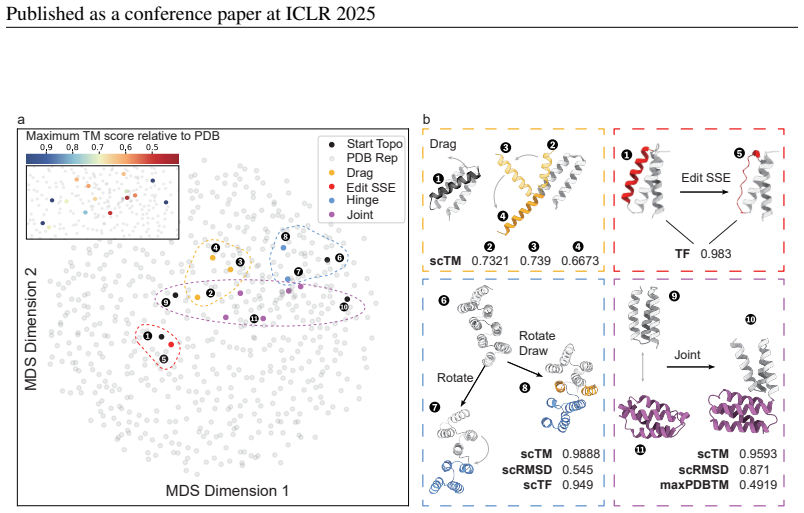
On its own terms, the discovery is that the three-dimensional topology of a protein backbone can be specified by a coarse 3D curve, and that a diffusion model can be made to honor that curve by a retraining-free mechanism. The condition curve is abstracted from helices and sheets as their central axes, with loops kept and the whole re-sampled and annotated with SSE labels. ProtPainter then (i) encodes the curve into a naive sketch whose helix pitch, loop spacing, and sheet placement follow parametric rules, and (ii) during DDPM reverse sampling replaces the filtered part of the unguided translation update with the filtered sketch coordinates, blending the two under a scaling factor λ while a Helix-Gating schedule limits guidance until the helix percentage of the current RoseTTAFold prediction catches up to the sketch's. The reported consequence is that generated backbones match the conditioning curve at the topology level — scTF above 0.8 — and remain designable through the standard ProteinMPNN and OmegaFold refolding cycle, with scTM above 0.5 in the majority of benchmark cases, outperforming the compared baselines in fit designability. Because the guidance is a post-hoc interpolation rather than a trained conditioner, the same base sampler also supports curve-based editing operations such as dragging, rotating, jointing, and local SSE editing while preserving designability.
Load-bearing premise
The steering rule assumes that the random noise added at each denoising step disappears once the backbone is smoothed down to its curve-level view, which is what lets the method replace the filtered unguided sample with the filtered sketch; if that assumption fails, the interpolation used for guidance is not drawing samples from the conditional distribution the paper claims.
Editorial extensions
If this is right
- A designer can specify a protein's fold by drawing or dragging a 3D curve and still land in the standard design cycle: the generated backbones pass through ProteinMPNN sequence design and refold to structures matching the curve, with scTM above 0.5 and high pLDDT in the reported cases.
- Curve operations — dragging, rotating, jointing, and local SSE editing — yield topology transitions between designable states, so multi-state and hinge-like scaffolds can be explored by editing a curve rather than reconfiguring a parametric blueprint.
- Because the guidance is a retraining-free interpolation into an existing DDPM sampler, adding a new condition type only requires a curve encoder and filter that align the new condition to the frame space, while the denoiser itself is untouched.
- The Protein Restoration Task and the scTF metric give the field a common yardstick: any future topology-conditioned generator can be scored by how well its backbones restore curves from reference proteins and survive refolding.
- Since scTF correlates with scTM in the paper's joint analysis, topology fitness doubles as a rough designability screen: a curve that cannot be restored with high scTF is unlikely to describe a designable backbone.
Reading between the lines
- The guidance acts only on the translation channel and leaves rotations to the unconditional model (Eqs. 9–10); an untested corollary is that Cα placement alone suffices to steer fold topology, which could be checked by comparing residue-orientation quality near the condition curve against the unguided base model.
- The interpolation rule is derived from a commutation assumption about a linear filter, not from properties specific to DDPM, so the same recipe should transfer to flow-matching backbone generators with a coordinate channel; testing that transfer would show whether the mechanism is tied to the noise schedule.
- Helix-Gating embodies a general principle — keying condition strength to a coarse geometric descriptor of the current prediction — and the paper's own deferral of β-sheet control suggests the natural extension is gating on sheet or loop content rather than helix percentage.
- The noise-perturbation results (fit designability holds up to roughly 2 Å of point noise before degrading) imply the generator behaves as an attractor that repairs small drawing errors; if deliberate user studies confirm it, curve interfaces would not need to be precise to be useful.
Signed reviews
Editorial analysis
A structured set of objections, weighed in public.
Referee Report
Summary. The paper proposes ProtPainter, a two-stage diffusion-based method for generating protein backbones conditioned on 3D curves. In the first stage, a CurveEncoder predicts secondary-structure labels from an input curve, and a naive sketch is generated parametrically. In the second stage, a DDPM backbone generator is guided by this sketch via a retraining-free interpolation rule, with a Helix-Gating schedule that controls how strongly the sketch is fused during sampling. The authors introduce the Protein Restoration Task and a self-consistency Topology Fitness (scTF) metric, and report that ProtPainter achieves scTF above 0.8 and scTM above 0.5 on their benchmark, along with demonstrations of drawing, dragging, jointing, and SSE editing.
Significance. If the method is sound, the curve-based conditioning modality is a genuinely useful interface for protein topology control, and the proposed benchmark and scTF metric could support future work in this direction. The scTM-based designability evaluation provides an independent signal that is not reducible to the conditioning objective, and the user-study results with curves drawn from scratch are a valuable practical demonstration. However, the central derivation of the guided-sampling update is incomplete, and parts of the evaluation are self-referential because scTF measures agreement with the same curve that the guidance explicitly targets and because key hyperparameters and thresholds are selected on the evaluation benchmark. The empirical results may still hold, but the paper currently does not establish the theoretical grounding claimed in Section 3.2.
major comments (3)
- [Section 3.2, Eq. (12)] Equation (12) does not follow from Equation (5). Applying any linear operation φ to a sample from the posterior in Eq. (5) gives φ(z'_{t-1}) = [√(α_{t-1}β_t)/(1−α_t)] φ(z0) + [√(α_t(1−α_{t-1}))/(1−α_t)] φ(z_t) + φ(σ_t ε), where ε is the posterior sampling noise. The derivation keeps only the middle term, silently dropping the z0 term and the filtered noise; near t=1 the z0 term is O(1) and the noise is not negligible. Since Eq. (13) is the core interpolation rule of the guidance, this omission is load-bearing: the manuscript does not establish that the procedure samples the conditional distribution announced in Eq. (7). The authors should either provide a correct derivation under explicit assumptions or explicitly present Eqs. (11)–(13) as a heuristic guidance rule supported by empirical validation.
- [Section 3.2, Eqs. (7), (11), (14)] The conditional distribution q(y_{t-1}|y, ẑ_t^0) in Eq. (7) is never defined, and the filter φ is introduced as a "linear low-pass filtering" operation but then defined as φ_λ(X_t) = λ z(X_t), which is a scalar rescaling of the Cα coordinates, not an idempotent low-pass projection. Because scalar rescaling satisfies φ(φ(z)) = λ² z rather than φ(φ(z)) = φ(z), the ILVR replacement identity in Eq. (11) does not enforce φ(x_{t-1}) = φ(y_{t-1}) as claimed. Additionally, Eq. (14) defines y_{t-1} deterministically as a scaled version of y, rather than as a draw from q. The authors should either supply a correct derivation with a clearly defined idempotent filter and conditional distribution, or reframe the whole guidance mechanism as a heuristic and move the theoretical claim to the empirical evaluation.
- [Section 4.1 and Appendices G.5/G.6] The headline evaluation is partly self-referential. scTF measures Procrustes agreement between the generated or refolded backbone curve and the same condition curve that the guidance explicitly tries to match, so high scTF is close to a construction check. The threshold scTF > 0.8 and the hyperparameters λ = 2/3, γ = 0.2, η = 0.7 are selected using the Protein Restoration Task benchmark on which the reported numbers are computed (Table G.5, Figure 13). The scTM and pLDDT results provide an independent designability signal, but the "state-of-the-art control" claim rests on scTF. Please report results with hyperparameters fixed before evaluation or on a held-out split, and show that the reported margins are insensitive to the scTF threshold and to reasonable variations of λ, γ, and η.
minor comments (7)
- [Section 3.2, Eq. (9)] The condition "if pθ(r_{t−1}|x_t) = pθ(r_{t−1}|x_t,c_T)" makes the preceding equality tautological; the intended independence assumption between rotation and translation updates should be stated explicitly and justified.
- [Section 3.2, Eq. (13)] The notation z′_t in Eq. (13) is inconsistent with z′_{t−1} in Eq. (11); please clarify whether the update uses the unconditional sample at time t−1 or the current noisy coordinate z_t.
- [Section 3.3 and Figure 2] The phrase "confidential phase" appears to be a typo for "confidence phase" (and "confphase" in Figure 2); please correct it throughout.
- [Table 1] The header of Table 1 lists six CATH IDs but seven numeric entries; the column alignment should be fixed so that each topology family has exactly one count and one set of scTF values.
- [References] The citation "Zhang et al." is ambiguous because it is used for multiple distinct works (TopoDiff and the GPCR review); please disambiguate with different citation keys or full author lists.
- [Section 3.2, first paragraph] The sentence "The translation part is generated from the 3D Gaussian noise by DDPM" should clarify that translations use the DDPM posterior in Eq. (4) while rotations are sampled by Brownian motion on SO(3); as written it could be read as applying DDPM to the full frame.
- [Figure 12.d] The axis label "Number of Inversion steps t" is unclear; please specify whether t increases from noise to clean signal or vice versa, and whether "inversion" refers to the reverse diffusion process.
Circularity Check
scTF>0.8 is largely a construction check: Eq. 13 injects the condition curve into the output and scTF measures agreement with that same curve; scTM designability is independently evaluated.
-
self definitional
[Section 3.2, Eq. 13; Section 4.1, Metrics; Appendix A.3]
"zt−1 = sqrt(α_{t−1}β_t)/(1−α_t) · zˆt_0 + sqrt(α_t(1−α_{t−1}))/(1−α_t) · (1−λ)·z′_t + λ·y_{t−1}. (13) ... scTF is calculated as the Procrustes similarity between the refolded (or un-refolded) backbone curve and the curve guidance."
The headline claim “generate topology-fit (scTF > 0.8)” is close to a construction check. Equation 13 explicitly blends the condition curve y into every denoising-translation update through the λ·y_{t−1} term, and scTF is defined as the Procrustes similarity between the generated backbone's abstracted curve and exactly that same condition curve y. Thus the metric reports whether the injected condition survived generation and refolding; a high value is partly enforced by the guidance rule itself rather than being an independent property of the generator. The 0.8 threshold is also calibrated on the authors' own scTF–scTM relationship (Figure 13), so the specific reported cutoff is self-referential. The designability component (scTM, via ProteinMPNN/OmegaFold) is external and not circular.
full rationale
The central circularity is confined to the topology-fitness claim: condition y is inserted directly into the sample path (Eq. 13), and scTF compares the output to that same y, so “scTF > 0.8” is substantially a check that the guidance mechanism does what it was constructed to do. The designability result (scTM > 0.5) is evaluated through independent refolding with ProteinMPNN and OmegaFold, so it provides non-circular evidence. I did not score the Eq. 12–13 derivation gap as circularity: dropping the z0 term and filtered noise, and identifying scalar scaling with the idempotent low-pass filter of ILVR, are correctness/derivation weaknesses rather than cases where a prediction is equivalent to its input by definition. No load-bearing self-citation or author-imported uniqueness theorem appears; the method is benchmarked against external tools and external baselines. Overall, the paper has one partially circular headline metric but retains independent designability content, hence a score of 5 rather than 0 or 8.
Assumptions & free parameters
free parameters (5)
- lambda (sketch fusion factor) =
2/3
- gamma (Helix-Gating scaling factor) =
0.2
- eta (Helix-Gating offset) =
0.7
- scTF threshold for topology fitness =
0.8
- Curve sampling rate =
40% of C-alpha count
assumptions (5)
- domain assumption RoseTTAFold provides sufficiently accurate estimates of z_0 to guide translation updates in Equation 13.
- domain assumption The pretrained unconditional diffusion model remains on the manifold of designable backbones under sketch-guided interpolation.
- domain assumption A downsampled C-alpha curve, consisting of SSE central axes plus loop coordinates, contains enough information to reconstruct a designable protein backbone.
- domain assumption Procrustes disparity after uniform resampling is a valid monotone proxy for topological similarity and designability.
- standard math Standard DDPM and SO(3) diffusion mathematics, Equations 1 through 6, are correct.
Cite this review
Pith. "Pith review of ProtPainter: Draw or Drag Protein via Topology-guided Diffusion." pith.science (2026). https://pith.science/paper/HFEDYIJT
@misc{pith2026250414274,
  author       = {Pith},
  title        = {Pith review of: ProtPainter: Draw or Drag Protein via Topology-guided Diffusion},
  year         = {2026},
  howpublished = {\url{https://pith.science/paper/HFEDYIJT}},
  note         = {Machine review of arXiv:2504.14274}
}
read the original abstract
Recent advances in protein backbone generation have achieved promising results under structural, functional, or physical constraints. However, existing methods lack the flexibility for precise topology control, limiting navigation of the backbone space. We present ProtPainter, a diffusion-based approach for generating protein backbones conditioned on 3D curves. ProtPainter follows a two-stage process: curve-based sketching and sketch-guided backbone generation. For the first stage, we propose CurveEncoder, which predicts secondary structure annotations from a curve to parametrize sketch generation. For the second stage, the sketch guides the generative process in Denoising Diffusion Probabilistic Modeling (DDPM) to generate backbones. During this process, we further introduce a fusion scheduling scheme, Helix-Gating, to control the scaling factors. To evaluate, we propose the first benchmark for topology-conditioned protein generation, introducing Protein Restoration Task and a new metric, self-consistency Topology Fitness (scTF). Experiments demonstrate ProtPainter's ability to generate topology-fit (scTF > 0.8) and designable (scTM > 0.5) backbones, with drawing and dragging tasks showcasing its flexibility and versatility.
Figures


Figures from the paper (13 more)


Reference graph
Works this paper leans on
-
[1]
Announcing the worldwide protein data bank
Helen Berman, Kim Henrick, and Haruki Nakamura. Announcing the worldwide protein data bank. Nature structural & molecular biology, 10 0 (12): 0 980--980, 2003
work page 2003
-
[2]
Se (3)-stochastic flow matching for protein backbone generation
Avishek Joey Bose, Tara Akhound-Sadegh, Kilian Fatras, Guillaume Huguet, Jarrid Rector-Brooks, Cheng-Hao Liu, Andrei Cristian Nica, Maksym Korablyov, Michael Bronstein, and Alexander Tong. Se (3)-stochastic flow matching for protein backbone generation. arXiv preprint arXiv:2310.02391, 2023
-
[3]
Stephen K Burley, Charmi Bhikadiya, Chunxiao Bi, Sebastian Bittrich, Henry Chao, Li Chen, Paul A Craig, Gregg V Crichlow, Kenneth Dalenberg, Jose M Duarte, et al. Rcsb protein data bank (rcsb. org): delivery of experimentally-determined pdb structures alongside one million computed structure models of proteins from artificial intelligence/machine learning...
work page 2023
-
[4]
Analog bits: Generating discrete data using diffusion models with self-conditioning
Ting Chen, Ruixiang Zhang, and Geoffrey Hinton. Analog bits: Generating discrete data using diffusion models with self-conditioning. arXiv preprint arXiv:2208.04202, 2022
arXiv 2022
-
[5]
Ilvr: Conditioning method for denoising diffusion probabilistic models
Jooyoung Choi, Sungwon Kim, Yonghyun Jeong, Youngjune Gwon, and Sungroh Yoon. Ilvr: Conditioning method for denoising diffusion probabilistic models. In Proceedings of the IEEE/CVF International Conference on Computer Vision, pp.\ 14367--14376, 2021
work page 2021
-
[6]
Difftopo: Fold exploration using coarse grained protein topology representations
Bruno Correia. Difftopo: Fold exploration using coarse grained protein topology representations. bioRxiv, pp.\ 2024--02, 2024
work page 2024
-
[7]
Robust deep learning--based protein sequence design using proteinmpnn
Justas Dauparas, Ivan Anishchenko, Nathaniel Bennett, Hua Bai, Robert J Ragotte, Lukas F Milles, Basile IM Wicky, Alexis Courbet, Rob J de Haas, Neville Bethel, et al. Robust deep learning--based protein sequence design using proteinmpnn. Science, 378 0 (6615): 0 49--56, 2022
2022
-
[8]
A fully automatic evolutionary classification of protein folds: Dali domain dictionary version 3
Sabine Dietmann, Jong Park, Cedric Notredame, Andreas Heger, Michael Lappe, and Liisa Holm. A fully automatic evolutionary classification of protein folds: Dali domain dictionary version 3. Nucleic acids research, 29 0 (1): 0 55--57, 2001
work page 2001
Show all 54 references
-
[9]
Subcellular organization of gpcr signaling
Kelsie Eichel and Mark von Zastrow. Subcellular organization of gpcr signaling. Trends in Pharmacological Sciences, 39 0 (2): 0 200--208, 2018
2018
-
[10]
Fast protein structure searching using structure graph embeddings
Joe G Greener and Kiarash Jamali. Fast protein structure searching using structure graph embeddings. bioRxiv, pp.\ 2022--11, 2022
2022
-
[11]
Geometrically equivariant graph neural networks: A survey
Jiaqi Han, Yu Rong, Tingyang Xu, and Wenbing Huang. Geometrically equivariant graph neural networks: A survey. arXiv preprint arXiv:2202.07230, 2022
2022 arXiv
-
[12]
A generic framework for hierarchical de novo protein design
Zander Harteveld, Jaume Bonet, St \'e phane Rosset, Che Yang, Fabian Sesterhenn, and Bruno E Correia. A generic framework for hierarchical de novo protein design. Proceedings of the National Academy of Sciences, 119 0 (43): 0 e2206111119, 2022
2022
-
[13]
e al Defferrard, Andreas Loukas, Pierre Vandergheynst, et al. Exploring “dark matter
Zander Harteveld, Alexandra Van Hall-Beauvais, Irina Morozova, Joshua Southern, Casper Goverde, Sandrine Georgeon, St \'e phane Rosset, Mich \"e al Defferrard, Andreas Loukas, Pierre Vandergheynst, et al. Exploring “dark matter” protein folds using deep learning. bioRxiv, pp.\...
2023
-
[14]
Denoising diffusion probabilistic models
Jonathan Ho, Ajay Jain, and Pieter Abbeel. Denoising diffusion probabilistic models. Advances in neural information processing systems, 33: 0 6840--6851, 2020
2020
-
[15]
Generative models for protein structures and sequences
Chloe Hsu, Clara Fannjiang, and Jennifer Listgarten. Generative models for protein structures and sequences. nature biotechnology, 42 0 (2): 0 196--199, 2024
2024
-
[16]
A backbone-centred energy function of neural networks for protein design
Bin Huang, Yang Xu, Xiuhong Hu, Yongrui Liu, Shanhui Liao, Jiahai Zhang, Chengdong Huang, Jingjun Hong, Quan Chen, and Haiyan Liu. A backbone-centred energy function of neural networks for protein design. Nature, 602 0 (7897): 0 523--528, February 2022. ISSN 0028-0836, 1476-46...
2022 doi
-
[17]
Pei, Brent L
Po-Ssu Huang, Gustav Oberdorfer, Chunfu Xu, Xue Y. Pei, Brent L. Nannenga, Joseph M. Rogers, Frank DiMaio, Tamir Gonen, Ben Luisi, and David Baker. High thermodynamic stability of parametrically designed helical bundles. Science, 346 0 (6208): 0 481--485, October 2014. ISSN 00...
2014 doi
-
[18]
Huddy, Yang Hsia, Ryan D
Timothy F. Huddy, Yang Hsia, Ryan D. Kibler, Jinwei Xu, Neville Bethel, Deepesh Nagarajan, Rachel Redler, Philip J. Y. Leung, Connor Weidle, Alexis Courbet, Erin C. Yang, Asim K. Bera, Nicolas Coudray, S. John Calise, Fatima A. Davila-Hernandez, Hannah L. Han, Kenneth D. Carr,...
2024
-
[19]
Illuminating protein space with a programmable generative model
John B Ingraham, Max Baranov, Zak Costello, Karl W Barber, Wujie Wang, Ahmed Ismail, Vincent Frappier, Dana M Lord, Christopher Ng-Thow-Hing, Erik R Van Vlack, et al. Illuminating protein space with a programmable generative model. Nature, 623 0 (7989): 0 1070--1078, 2023
2023
-
[20]
Diversity and modularity of g protein-coupled receptor structures
Vsevolod Katritch, Vadim Cherezov, and Raymond C Stevens. Diversity and modularity of g protein-coupled receptor structures. Trends in pharmacological sciences, 33 0 (1): 0 17--27, 2012
2012
-
[21]
Dynamics-informed protein design with structure conditioning
Urszula Julia Komorowska, Simon V Mathis, Kieran Didi, Francisco Vargas, Pietro Lio, and Mateja Jamnik. Dynamics-informed protein design with structure conditioning. In The Twelfth International Conference on Learning Representations, 2024
2024
-
[22]
De novo protein design—from new structures to programmable functions
Tanja Kortemme. De novo protein design—from new structures to programmable functions. Cell, 187 0 (3): 0 526--544, 2024
2024
-
[23]
Improving antibody design with force-guided sampling in diffusion models
Paulina Kulyt \.e , Francisco Vargas, Simon Valentin Mathis, Yu Guang Wang, Jos \'e Miguel Hern \'a ndez-Lobato, and Pietro Li \`o . Improving antibody design with force-guided sampling in diffusion models. arXiv preprint arXiv:2406.05832, 2024
2024 arXiv
-
[24]
Protein topology determines binding mechanism
Yaakov Levy, Peter G Wolynes, and Jos \'e N Onuchic. Protein topology determines binding mechanism. Proceedings of the National Academy of Sciences, 101 0 (2): 0 511--516, 2004
2004
-
[25]
Generating novel, designable, and diverse protein structures by equivariantly diffusing oriented residue clouds
Yeqing Lin and Mohammed Alquraishi. Generating novel, designable, and diverse protein structures by equivariantly diffusing oriented residue clouds. In International Conference on Machine Learning, pp.\ 20978--21002. PMLR, 2023
2023
-
[26]
Out of many, one: Designing and scaffolding proteins at the scale of the structural universe with genie 2
Yeqing Lin, Minji Lee, Zhao Zhang, and Mohammed AlQuraishi. Out of many, one: Designing and scaffolding proteins at the scale of the structural universe with genie 2. arXiv preprint arXiv:2405.15489, 2024
2024 arXiv
-
[27]
Zero-shot 3d drug design by sketching and generating
Siyu Long, Yi Zhou, Xinyu Dai, and Hao Zhou. Zero-shot 3d drug design by sketching and generating. Advances in Neural Information Processing Systems, 35: 0 23894--23907, 2022
2022
-
[28]
Lutz, Shunzhi Wang, Christoffer Norn, Alexis Courbet, Andrew J
Isaac D. Lutz, Shunzhi Wang, Christoffer Norn, Alexis Courbet, Andrew J. Borst, Yan Ting Zhao, Annie Dosey, Longxing Cao, Jinwei Xu, Elizabeth M. Leaf, Catherine Treichel, Patrisia Litvicov, Zhe Li, Alexander D. Goodson, Paula Rivera-Sánchez, Ana-Maria Bratovianu, Minkyung Bae...
2023 doi
-
[29]
Cath--a hierarchic classification of protein domain structures
Christine A Orengo, Alex D Michie, Susan Jones, David T Jones, Mark B Swindells, and Janet M Thornton. Cath--a hierarchic classification of protein domain structures. Structure, 5 0 (8): 0 1093--1109, 1997
1997
-
[30]
How well do multivariate data sets match? the advantages of a procrustean superimposition approach over the mantel test
Pedro R Peres-Neto and Donald A Jackson. How well do multivariate data sets match? the advantages of a procrustean superimposition approach over the mantel test. Oecologia, 129: 0 169--178, 2001
2001
-
[31]
Arvind Pillai, Abbas Idris, Annika Philomin, Connor Weidle, Rebecca Skotheim, Philip J. Y. Leung, Adam Broerman, Cullen Demakis, Andrew J. Borst, Florian Praetorius, and David Baker. De novo design of allosterically switchable protein assemblies. ISSN 0028-0836, 1476-4687. doi...
-
[32]
Design of stimulus-responsive two-state hinge proteins
Florian Praetorius, Philip JY Leung, Maxx H Tessmer, Adam Broerman, Cullen Demakis, Acacia F Dishman, Arvind Pillai, Abbas Idris, David Juergens, Justas Dauparas, et al. Design of stimulus-responsive two-state hinge proteins. Science, 381 0 (6659): 0 754--760, 2023
2023
-
[33]
The structure and function of g-protein-coupled receptors
Daniel M Rosenbaum, S ren GF Rasmussen, and Brian K Kobilka. The structure and function of g-protein-coupled receptors. Nature, 459 0 (7245): 0 356--363, 2009
2009
-
[34]
E (n) equivariant graph neural networks
V ctor Garcia Satorras, Emiel Hoogeboom, and Max Welling. E (n) equivariant graph neural networks. In International conference on machine learning, pp.\ 9323--9332. PMLR, 2021
2021
-
[35]
Cath: increased structural coverage of functional space
Ian Sillitoe, Nicola Bordin, Natalie Dawson, Vaishali P Waman, Paul Ashford, Harry M Scholes, Camilla SM Pang, Laurel Woodridge, Clemens Rauer, Neeladri Sen, et al. Cath: increased structural coverage of functional space. Nucleic acids research, 49 0 (D1): 0 D266--D273, 2021
2021
-
[36]
Deep unsupervised learning using nonequilibrium thermodynamics
Jascha Sohl-Dickstein, Eric Weiss, Niru Maheswaranathan, and Surya Ganguli. Deep unsupervised learning using nonequilibrium thermodynamics. In International conference on machine learning, pp.\ 2256--2265. PMLR, 2015
2015
-
[37]
Score-based generative modeling through stochastic differential equations
Yang Song, Jascha Sohl-Dickstein, Diederik P Kingma, Abhishek Kumar, Stefano Ermon, and Ben Poole. Score-based generative modeling through stochastic differential equations. arXiv preprint arXiv:2011.13456, 2020
2011 arXiv
-
[38]
Fast and accurate protein structure search with foldseek
Michel Van Kempen, Stephanie S Kim, Charlotte Tumescheit, Milot Mirdita, Jeongjae Lee, Cameron LM Gilchrist, Johannes S \"o ding, and Martin Steinegger. Fast and accurate protein structure search with foldseek. Nature biotechnology, 42 0 (2): 0 243--246, 2024
2024
-
[39]
Membrane-protein topology
Gunnar von Heijne. Membrane-protein topology. Nature reviews Molecular cell biology, 7 0 (12): 0 909--918, 2006
2006
-
[40]
Protein conformation generation via force-guided se (3) diffusion models
Yan Wang, Lihao Wang, Yuning Shen, Yiqun Wang, Huizhuo Yuan, Yue Wu, and Quanquan Gu. Protein conformation generation via force-guided se (3) diffusion models. arXiv preprint arXiv:2403.14088, 2024
2024 arXiv
-
[41]
De novo design of protein structure and function with rfdiffusion
Joseph L Watson, David Juergens, Nathaniel R Bennett, Brian L Trippe, Jason Yim, Helen E Eisenach, Woody Ahern, Andrew J Borst, Robert J Ragotte, Lukas F Milles, et al. De novo design of protein structure and function with rfdiffusion. Nature, 620 0 (7976): 0 1089--1100, 2023
2023
-
[42]
Protein structural topology: Automated analysis and diagrammatic representation
David R Westhead, Timothy WF Slidel, Tomas PJ Flores, and Janet M Thornton. Protein structural topology: Automated analysis and diagrammatic representation. Protein Science, 8 0 (4): 0 897--904, 1999
1999
-
[43]
High-resolution de novo structure prediction from primary sequence
Ruidong Wu, Fan Ding, Rui Wang, Rui Shen, Xiwen Zhang, Shitong Luo, Chenpeng Su, Zuofan Wu, Qi Xie, Bonnie Berger, et al. High-resolution de novo structure prediction from primary sequence. BioRxiv, pp.\ 2022--07, 2022
2022
-
[44]
Topology: a unique dimension in protein engineering
Lianjie Xu and Wen-Bin Zhang. Topology: a unique dimension in protein engineering. Science China Chemistry, 61: 0 3--16, 2018
2018
-
[45]
Fast protein backbone generation with se (3) flow matching
Jason Yim, Andrew Campbell, Andrew YK Foong, Michael Gastegger, Jos \'e Jim \'e nez-Luna, Sarah Lewis, Victor Garcia Satorras, Bastiaan S Veeling, Regina Barzilay, Tommi Jaakkola, et al. Fast protein backbone generation with se (3) flow matching. arXiv preprint arXiv:2310.0529...
-
[46]
Se (3) diffusion model with application to protein backbone generation
Jason Yim, Brian L Trippe, Valentin De Bortoli, Emile Mathieu, Arnaud Doucet, Regina Barzilay, and Tommi Jaakkola. Se (3) diffusion model with application to protein backbone generation. arXiv preprint arXiv:2302.02277, 2023 b
2023 arXiv
-
[47]
G protein-coupled receptors (gpcrs): advances in structures, mechanisms, and drug discovery
Mingyang Zhang, Ting Chen, Xun Lu, Xiaobing Lan, Ziqiang Chen, and Shaoyong Lu. G protein-coupled receptors (gpcrs): advances in structures, mechanisms, and drug discovery. Signal Transduction and Targeted Therapy, 9 0 (1): 0 88, 2024
2024
-
[48]
Topodiff: Improving protein backbone generation with topology-aware latent encoding
Yuyang Zhang, Zinnia Ma, and Haipeng Gong. Topodiff: Improving protein backbone generation with topology-aware latent encoding. In NeurIPS 2023 Generative AI and Biology (GenBio) Workshop
2023
-
[49]
Deciphering of microbial community and antibiotic resistance genes in activated sludge reactors under high selective pressure of different antibiotics
Renxin Zhao, Jie Feng, Jie Liu, Wenjie Fu, Xiaoyan Li, and Bing Li. Deciphering of microbial community and antibiotic resistance genes in activated sludge reactors under high selective pressure of different antibiotics. Water Research, 151: 0 388--402, 2019
2019
-
[50]
Scaffold-lab: Critical evaluation and ranking of protein backbone generation methods in a unified framework
Zhuoqi Zheng, Bo Zhang, Bozitao Zhong, Kexin Liu, Zhengxin Li, Junjie Zhu, Jinyu Yu, Ting Wei, and Hai-Feng Chen. Scaffold-lab: Critical evaluation and ranking of protein backbone generation methods in a unified framework. bioRxiv, pp.\ 2024--02, 2024
2024
-
[51]
write newline
" write newline "" before.all 'output.state := FUNCTION n.dashify 't := "" t empty not t #1 #1 substring "-" = t #1 #2 substring "--" = not "--" * t #2 global.max substring 't := t #1 #1 substring "-" = "-" * t #2 global.max substring 't := while if t #1 #1 substring * t #2 gl...
-
[52]
@esa (Ref
\@ifxundefined[1] #1\@undefined \@firstoftwo \@secondoftwo \@ifnum[1] #1 \@firstoftwo \@secondoftwo \@ifx[1] #1 \@firstoftwo \@secondoftwo [2] @ #1 \@temptokena #2 #1 @ \@temptokena \@ifclassloaded agu2001 natbib The agu2001 class already includes natbib coding, so you should ...
-
[53]
\@lbibitem[] @bibitem@first@sw\@secondoftwo \@lbibitem[#1]#2 \@extra@b@citeb \@ifundefined br@#2\@extra@b@citeb \@namedef br@#2 \@nameuse br@#2\@extra@b@citeb \@ifundefined b@#2\@extra@b@citeb @num @parse #2 @tmp #1 NAT@b@open@#2 NAT@b@shut@#2 \@ifnum @merge>\@ne @bibitem@firs...
-
[54]
" id="W5M0MpCehiHzreSzNTczkc9d
@open @close @open @close and [1] URL: #1 \@ifundefined chapter * \@mkboth \@ifxundefined @sectionbib * \@mkboth * \@mkboth\@gobbletwo \@ifclassloaded amsart * \@ifclassloaded amsbook * \@ifxundefined @heading @heading NAT@ctr thebibliography [1] @ \@biblabel @NAT@ctr \@bibset...
2022
Reviewed August 16, 2026 · model on record in the stance chip above.
Discussion (0). Continue with ORCID to comment.