REVIEW 4 major objections 6 minor 54 references
Hierarchical rank-evolving representation for physics-informed neural networks
T0 review · 4 major / 6 minor · reviewed 2026-08-11 · deepseek-v4-flash
Pith's one-line read HRE representation self-determines tensor ranks and structure during training, and the resulting HRE-PINN outperforms fixed-rank tensor-based PINNs across five PDE benchmarks.
desk verdict A genuinely new hierarchical tensor representation for PINNs, but the automatic rank determination claim collapses under a scale-degeneracy argument; worth refereeing if the authors fix the mechanism. read the letter →
The pith
A machine-rendered reading of the paper's core claim, the machinery that carries it, and where it could break.
The reading
What carries the argument
The load-bearing object is the HRE representation: an outer function-Tucker expansion in which each univariate network $g_n(x_n)$ is weighted by a learnable vector $r_n^{(\mathrm{out})}$ before being contracted with a core tensor $\mathcal{T}$, and an inner decomposition of that core tensor as a fully-connected tensor network in which every connection between two factors is multiplied by a learnable vector $r_{k,l}^{(\mathrm{in})}$. These rank-evolving vectors act as soft gates: an entry pushed to zero by the $\ell^1$ penalty removes that component or edge, so the remaining nonzeros define the effective rank and the surviving structure. The mechanism does the work of replacing manual rank selection with a sparsity prior, and the fully-connected inner network supplies the flexibility to represent all-mode correlations that tensor-train or tensor-ring decompositions miss.
What would settle it
Train HRE-PINN on the 5D Poisson problem and inspect the trained values of $r^{(\mathrm{in})}$ and $r^{(\mathrm{out})}$: count how many entries are exactly zero in floating point, and then vary the sparsity weights $\lambda$ and $\mu$ slightly and see whether the reported rank (the number of nonzero entries) changes discontinuously or drifts. If no exact zeros appear without a thresholding step, or if the revealed rank is highly sensitive to the penalty weight, the automatic rank determination claimed in the paper fails.
Extended reading notes
Core claim
The central discovery, on the paper's own terms, is that pairing a variable-separable outer representation with a fully-connected inner tensor network that carries per-edge learnable gate vectors makes rank selection an emergent property of optimization rather than a user decision. In HRE, each mode of the outer expansion is weighted by a vector $r^{(\mathrm{out})}$ and each connection between inner factors is weighted by a vector $r^{(\mathrm{in})}$; under $\ell^1$ regularization these weights drive unneeded degrees of freedom to zero. The authors argue that after training the number of nonzero entries directly gives the suitable rank, and a pruned edge corresponds to a removed correlation, so the representation self-selects both its size and its topology. The numerical comparisons on five PDE benchmarks, supported by ablations on the 5D Poisson equation, are used to show that this adaptive structure outperforms fixed-topology tensor-based PINNs.
Load-bearing premise
The load-bearing premise is that the $\ell^1$ penalty together with the chosen optimizer makes redundant entries of the rank-evolving vectors exactly zero, so that the ranks and topology can be read off directly without any thresholding rule; if entries end up merely small, rank selection still depends on a manual cutoff.
Editorial extensions
If this is right
- If HRE-PINN's results hold, tensor-based PINNs no longer need a user-chosen rank; setting the two sparsity weights $\lambda$ and $\mu$ is enough, and the network discovers its own capacity.
- The same hierarchy can be dropped into any PDE solver that represents the solution as a sum of separable functions, giving automatic structure selection without changing the physics-informed loss.
- The ablation results indicate that the outer layer and the inner structure contribute complementary gains, so the representation should degrade gracefully when one layer is removed and improve further on problems where both the dimension count and the cross-mode coupling are large.
- Because the inner network is fully connected, HRE-PINN should be able to represent solutions whose correlations are global rather than chain-like, which is where TT-PINN and TR-PINN are weakest.
Reading between the lines
- (Inference) The automatic rank read-out likely depends on the optimizer driving weights to precisely zero; with plain gradient-based training and an $\ell^1$ penalty, exact zeros are rare, so a practical implementer will probably need a threshold or rounding step, which is a mild extra choice the paper does not discuss.
- (Inference) The gating idea is essentially a continuous architecture search over tensor-network topologies, so it could transfer to operator learning: making the trunk and branch networks of a separable DeepONet carry the same sparse rank-evolving weights might yield adaptive operator architectures.
- (Inference) The Navier-Stokes test uses one random initial vorticity field; repeating the comparison over many random fields and seeds would clarify whether the advantage reflects a universally better low-rank representation of turbulent correlations or a favorable initialization.
- (Inference) Since the outer univariate networks are independent per coordinate, the same sparsity mechanism could be extended to prune whole univariate branches, shrinking the actual number of network evaluations and reducing inference cost beyond rank reduction.
Editorial analysis
A structured set of objections, weighed in public.
Referee Report
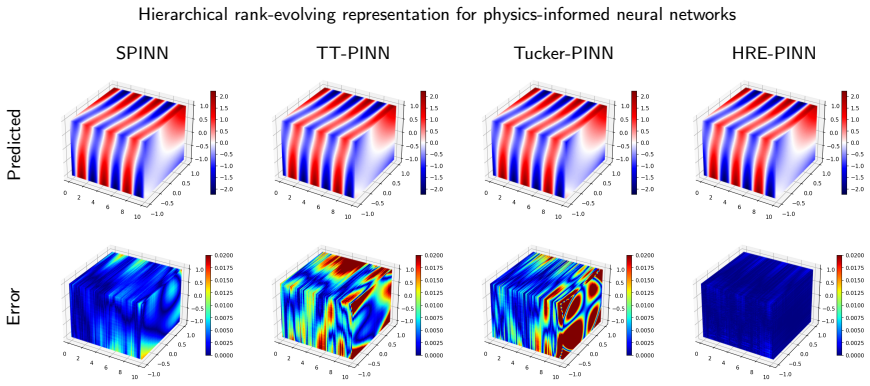
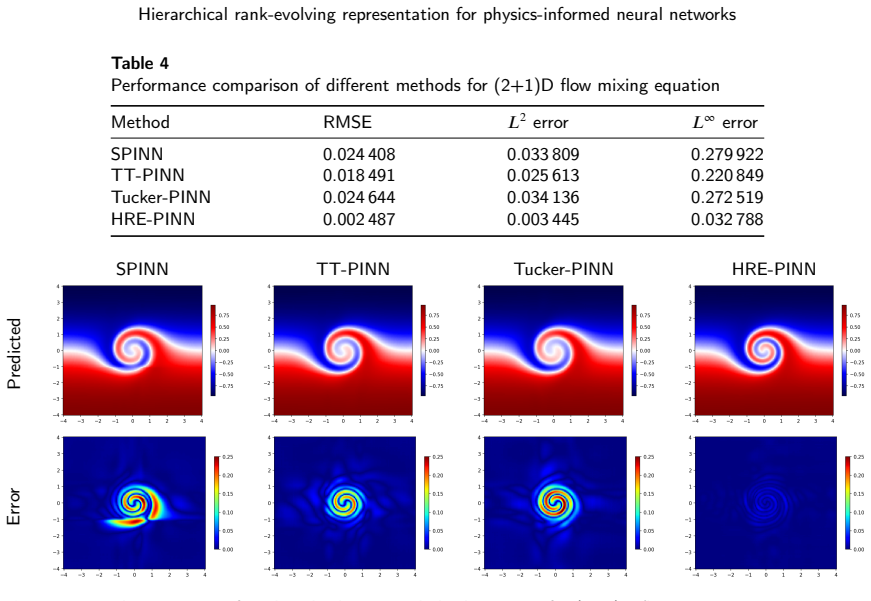
Summary. The paper introduces a hierarchical rank-evolving (HRE) representation for multivariate functions and embeds it in a physics-informed neural network (HRE-PINN). HRE combines an outer function Tucker decomposition, whose univariate basis functions are neural networks, with an inner fully-connected tensor network (FCTN) decomposition of the core tensor. Each edge of the inner network and each outer component is modulated by a learnable vector, regularized with an L1 penalty so that redundant modes are purportedly pruned during training, yielding automatic rank and structure discovery. The total loss combines PDE residual, boundary, and sparsity terms. Experiments on five PDEs (3D Helmholtz, 5D Poisson, (2+1)D Klein-Gordon, flow mixing, Navier-Stokes vorticity) compare HRE-PINN against SPINN, TT-PINN, and Tucker-PINN, reporting consistently lower RMSE and relative L2/L-infinity errors. Ablation studies on the 5D Poisson equation attribute gains to the hierarchical design, the rank-evolving mechanism, and the customized inner structure.
Significance. If the claimed results are reproducible, the paper would offer a meaningful step toward adaptive tensor representations in PINNs: the HRE structure is a natural extension of FCTN and SVDinsTN into continuous function space, and the experimental suite covers useful hard cases. The work provides explicit definitions and an algorithm, plus ablation studies that isolate components. However, the central novelty—automatic rank determination via L1-regularized rank-evolving vectors—is currently under-justified, and the empirical evidence is weakened by test-set model selection, missing baselines, and absent error bars. With fixes, the method could be a solid contribution to scientific machine learning.
major comments (4)
- [Section 4, test-set checkpoint selection] The sentence in Section 4 that 'The model checkpoint yielding the best prediction accuracy on test samples is retained to produce the final results' implies that the reported errors in Tables 1-5 are obtained by test-set model selection. This biases all reported accuracies upward and makes the claimed 'consistently outperform' unverifiable as a generalization statement. Use a validation set (disjoint from the test set used for reporting) or an early-stopping criterion based on training loss, and report the test errors computed at the selected checkpoint. In addition, because PINN training is stochastic, please report means and standard deviations over at least 3-5 random seeds.
- [Section 4, baseline selection] The comparison omits the most relevant baselines for the claimed contribution: a functional FCTN-based PINN and a functional SVDinsTN-based PINN (the structure-search method of Ref. [48] that HRE builds on). A standard (non-tensor) PINN is also not included. Since the inner layer of HRE is an FCTN decomposition with rank-evolving vectors, and since SVDinsTN is precisely a structure-search tensor network, these baselines are needed to support the abstract's claim that HRE-PINN 'consistently outperform[s] existing state-of-the-art approaches.' Without them, the improvements in Tables 1-5 could be due to the extra flexibility of the FCTN backbone rather than the rank-evolving mechanism.
- [Section 4, Eq. (3), hyperparameters] The loss in Eq. (3) involves hyperparameters eta, lambda, and mu, and the method requires initial outer widths I_n, inner bond dimensions J_{k,l}, univariate network architectures, and optimizer settings. None of these are reported per experiment; the text merely says baselines are 'configured following the original publications' and 'consistent network capacities.' This is insufficient for reproducibility and makes the claim of freeing users from 'manual rank tuning' hard to assess, since many other manual choices remain. Please provide a table of all hyperparameters and training budgets for every benchmark.
- [Section 5.3, Table 8] In Section 5.3, Table 8 compares 'Tensor directly', TT, TR, and FCTN with the 'Proposed' structure, but the fixed-structure baselines are presumably run without the inner rank-evolving vectors, whereas the Proposed row includes them. The attribution of the accuracy gain to the underlying structure is therefore confounded with the gain from rank evolution. Run the fixed structures with the same outer rank-evolving projection and report whether inner rank-evolving vectors are enabled in each row, or redesign the ablation so that only the inner graph topology varies.
minor comments (6)
- [Definition 2, Section 3.2] The index range '1 <= k <= l <= N' for the inner rank-evolving vectors is ambiguous and likely should be '1 <= k < l <= N', since FCTN edges connect distinct factors.
- [Eq. (3), Section 3.3] The boundary loss term is weighted by eta times 1/N_B, while the residual loss has no explicit outer weight; this asymmetry may bias the optimization and should be clarified.
- [Section 4.3, Klein-Gordon equation] In the PDE system, the boundary condition line reads 't in Omega' in the second line; this appears to be a typo and should be 't in Gamma' to match the time interval.
- [Section 4.4, flow mixing equation] The symbol b is used both for the spatially varying coefficient b(x,y) in the advection terms and for the boundary function b(x,y,t); please rename one of them to avoid confusion.
- [Throughout] There are typos such as 'underling structure' (end of Section 3.2), 'reveal the underlying structure' for 'reveals' (Section 3.3), and 'produces' for 'produce' (Section 4.5); a careful proofread is recommended.
- [Figure 1] The caption of Figure 1 does not explain the meaning of nodes and edges in the tensor network diagrams; a legend would help readers understand the structural differences.
Circularity Check
No circularity: HRE-PINN's claims are validated against external PDE benchmarks, and the rank-revealing mechanism is an optimization output, not a fitted quantity renamed as a prediction.
full rationale
The derivation chain is self-contained. Definition 2 introduces the HRE representation, and the training objective (3) combines the PDE residual, boundary loss, and L1 penalties on the learnable rank-evolving vectors; the "suitable ranks" are read off from the optimized vectors after training rather than fitted to precomputed target values and then reported as predictions. The empirical superiority claims in Section 4 are tested directly against exact/reference solutions of the Helmholtz, Poisson, Klein-Gordon, flow-mixing, and Navier-Stokes equations, so the central result is not an identity with the input. The authors' prior FCTN/SVDinsTN works (Refs. [46,47,48]) supply the inner tensor-decomposition building block, but this is a design choice validated by the paper's own ablations and benchmarks, not a self-citation used to prove the contribution. The main caveat, that L1 regularization with Adam may not drive entries to exact zeros and that the r vectors can be counter-scaled with g_n without changing the represented function, is a well-posedness/thresholding concern about automatic rank determination (Secs. 3.2-3.3), not a circularity: the claimed rank is neither identical to a fitted parameter nor equivalent by construction to the inputs of the PDE loss.
Assumptions & free parameters
free parameters (6)
- lambda (inner rank sparsity weight) =
not reported
- mu (outer rank sparsity weight) =
not reported
- eta (boundary loss weight) =
not reported
- initial univariate basis widths I_n =
not reported
- initial inner bond dimensions J_{k,l} =
not reported
- univariate network architecture (depth and width) =
not reported
assumptions (5)
- standard math Univariate neural networks g_n can approximate arbitrary smooth univariate functions
- domain assumption The benchmark PDEs are well posed and the manufactured solutions are exact
- domain assumption Adam optimization finds a low-enough loss in the joint parameter space
- ad hoc to paper L1 regularization drives rank-evolving vectors to exactly zero under Adam
- standard math FCTN decomposition can represent the inner core tensor given large enough ranks
Cite this review
Pith. "Pith review of Hierarchical rank-evolving representation for physics-informed neural networks." pith.science (2026). https://pith.science/paper/HFPUUNGE
@misc{pith2026260809483,
  author       = {Pith},
  title        = {Pith review of: Hierarchical rank-evolving representation for physics-informed neural networks},
  year         = {2026},
  howpublished = {\url{https://pith.science/paper/HFPUUNGE}},
  note         = {Machine review of arXiv:2608.09483}
}
read the original abstract
Recently, tensor-based physics-informed neural networks (T-PINNs) have received increasing attention. However, existing T-PINNs still face a fundamental challenge: they mainly rely on pre-specified low-rank tensor decompositions with manually tuned ranks, which limits their ability to capture the underlying structures of multivariate solution functions and hinders their practical deployment. To address this challenge, we propose a hierarchical rank-evolving (abbreviated as HRE) representation for multivariate functions, which endows us to faithfully capture the underlying structure of the targeted multivariate function accompanying with automatic rank determination. Concretely, in the hierarchical design of HRE representation, the target multivariate function is decomposed as a small-scale inner tensor with a set of univariate functions along each mode, where a customized tensor network decomposition can be readily deployed to capture the underlying structure of the small-scale inner tensor. In HRE representation, the crucial hyperparameters, ranks, can be adaptively revealed during the decomposition, freeing us from manual rank tuning and making HRE practically applicable to real-world problems. Besides, we build the HRE-PINNs correspondingly. Extensive numerical experiments, including high-dimensional static problems (Helmholtz equation and Poisson equation), nonlinear time-dependent problems (Klein-Gordon equation), and complex fluid-dynamics problems (flow mixing equation and Navier-Stokes equation), demonstrate that HRE-PINNs consistently outperform existing state-of-the-art approaches in terms of accuracy.
Figures


Figures from the paper (4 more)


Reference graph
Works this paper leans on
-
[48]
Y.-B.Zheng,X.-L.Zhao,J.Zeng,C.Li,Q.Zhao,H.C.Li,T.-Z.Huang, SVDinsTN:Atensornetworkparadigmforefficientstructuresearch from regularized modeling perspective, in: 2024 IEEE/CVF Conference on Computer Vision and Pattern Recognition (CVPR), 2024, pp. 22413–22422. doi:10.1109/CVPR52733.2024.02480
arXiv 2024
- [1]
- [2]
- [3]
-
[4]
T. Würth, N. Freymuth, C. Zimmerling, G. Neumann, L. Kärger, Physics-informed meshgraphnets (PI-MGNs): Neural finite element solvers for non-stationary and nonlinear simulations on arbitrary meshes, Computer Methods in Applied Mechanics and Engineering 429 (2024) 117102. doi:10.1016/j.cma.2024.117102
arXiv 2024
-
[5]
C.Mao,J.A.Fan, AccurateandscalabledeepMaxwellsolvers, ProceedingsoftheNationalAcademyofSciences123(2026)e2530330123. doi:10.1073/pnas.2530330123
-
[6]
A. E. Rappaport, T. Chaumont-Frelet, A. Modave, A hybridizable discontinuous Galerkin method with transmission variables for time- harmonic electromagnetic problems, SIAM Journal on Scientific Computing 48 (2026) B629–B650. doi:10.1137/25M1756818
-
[7]
J. Han, L. Zhang, W. E, Solving many-electron Schrödinger equation using deep neural networks, Journal of Computational Physics 399 (2019) 108929. doi:10.1016/j.jcp.2019.108929
arXiv 2019
Show all 54 references
-
[8]
Shang, C
H. Shang, C. Guo, Y. Wu, Z. Li, J. Yang, Solving the many-electron Schrödinger equation with a transformer-based framework, Nature Communications 16 (2025) 8464. doi:10.1038/s41467-025-63219-2
2025 doi
-
[9]
H. Wang, T. S. Basu, A fast finite difference method for two-dimensional space-fractional diffusion equations, SIAM Journal on Scientific Computing 34 (2012) A2444–A2458. doi:10.1137/12086491X
2012 doi
-
[10]
Martínez-Lera, M
P. Martínez-Lera, M. De Corato, A finite element method for stochastic diffusion equations using fluctuating hydrodynamics, Journal of Computational Physics 510 (2024) 113098. doi:10.1016/j.jcp.2024.113098
2024
-
[11]
Y. Lu, D. Xiao, R. Fu, X. Xu, S. Sun, Non-intrusive reduced order modeling of fluid flows via finite element inspired graph neural network, Journal of Computational Physics 553 (2026) 114727. doi:10.1016/j.jcp.2026.114727
2026
-
[12]
R. Li, Y. Lu, Y. Wang, H. Xu, Hermite spectral method for multi-species Boltzmann equation, Journal of Computational Physics 471 (2022) 111650. doi:10.1016/j.jcp.2022.111650
2022
-
[13]
J. Han, A. Jentzen, W. E, Solving high-dimensional partial differential equations using deep learning, Proceedings of the National Academy of Sciences 115 (2018) 8505–8510. doi:10.1073/pnas.1718942115
2018 doi
-
[14]
Hutzenthaler, A
M. Hutzenthaler, A. Jentzen, T. Kruse, Overcoming the curse of dimensionality in the numerical approximation of parabolic partial differentialequationswithgradient-dependentnonlinearities, FoundationsofComputationalMathematics22(2022)905–966.doi:10.1007/ s10208-021-09514-y
2022
-
[15]
Z. Hu, K. Shukla, G. E. Karniadakis, K. Kawaguchi, Tackling the curse of dimensionality with physics-informed neural networks, Neural Networks 176 (2024) 106369. doi:10.1016/j.neunet.2024.106369
2024
-
[16]
Raissi, P
M. Raissi, P. Perdikaris, G. Karniadakis, Physics-informed neural networks: A deep learning framework for solving forward and inverse problems involving nonlinear partial differential equations, Journal of Computational Physics 378 (2019) 686–707. doi:10.1016/j.jcp. 2018.10.045
2019 doi
-
[17]
Cuomo, V
S. Cuomo, V. S. Di Cola, F. Giampaolo, G. Rozza, M. Raissi, F. Piccialli, Scientific machine learning through physics-informed neural networks: Where we are and what’s next, Journal of Scientific Computing (2022) 88–92. doi:10.1007/s10915-022-01939-z
2022 doi
-
[18]
Z.-Q. J. Xu, L. Zhang, W. Cai, On understanding and overcoming spectral biases of deep neural network learning methods for solving PDEs, Journal of Computational Physics 530 (2025) 113905. doi:10.1016/j.jcp.2025.113905
2025
-
[19]
doi:10.1016/j.jcp.2025.114297
F.Cao,K.Fan,H.Zhang,D.Yuan,J.Liu, AdaptiveresidualsplittinginPINNsforsolvingcomplexPDEs, JournalofComputationalPhysics 540 (2025) 114297. doi:10.1016/j.jcp.2025.114297
2025
-
[20]
C. Si, M. Yan, X. Li, Z. Xia, Complex physics-informed neural network, Journal of Computational Physics 553 (2026) 114713. doi:10.1016/j.jcp.2026.114713
2026
-
[21]
Calin, Universal Approximators, Springer International Publishing, Cham, 2020, pp
O. Calin, Universal Approximators, Springer International Publishing, Cham, 2020, pp. 251–284. doi:10.1007/978-3-030-36721-3_9
2020 doi
-
[22]
X. Pan, D. Xiao, Domain decomposition for physics-data combined neural network based parametric reduced order modelling, Journal of Computational Physics 519 (2024) 113452. doi:10.1016/j.jcp.2024.113452
2024
-
[24]
doi:10.1016/j.jcp.2023.112437
F.Wang,X.Gu,J.Sun,Z.Xu, Learning-basedlocalweightedleastsquaresforalgebraicmultigridmethod, JournalofComputationalPhysics 493 (2023) 112437. doi:10.1016/j.jcp.2023.112437
2023
-
[25]
Sahli Costabal, S
F. Sahli Costabal, S. Pezzuto, P. Perdikaris,Δ-PINNs: Physics-informed neural networks on complex geometries, Engineering Applications of Artificial Intelligence 127 (2024) 107324. doi:10.1016/j.engappai.2023.107324
2024
-
[26]
L. Yang, X. Meng, G. E. Karniadakis, B-PINNs: Bayesian physics-informed neural networks for forward and inverse PDE problems with noisy data, Journal of Computational Physics 425 (2021) 109913. doi:10.1016/j.jcp.2020.109913
2021
-
[27]
Z. Zou, X. Meng, G. E. Karniadakis, Correcting model misspecification in physics-informed neural networks (PINNs), Journal of Computational Physics 505 (2024) 112918. doi:10.1016/j.jcp.2024.112918
2024
-
[28]
M.Petersen,R.Covino,PINN-MEP:Continuousneuralrepresentationsforminimumenergypathdiscoveryinmolecularsystems,in:Frontiers in Probabilistic Inference: Learning meets Sampling, 2025
2025
-
[29]
S. Wang, S. Sankaran, P. Perdikaris, Respecting causality for training physics-informed neural networks, Computer Methods in Applied Mechanics and Engineering 421 (2024) 116813. doi:10.1016/j.cma.2024.116813
2024
-
[30]
Y. Wang, H. Xie, Computing multi-eigenpairs of high-dimensional eigenvalue problems using tensor neural networks, Journal of Computational Physics 506 (2024) 112928. doi:10.1016/j.jcp.2024.112928. R. Su et al.:Preprint submitted to ElsevierPage 16 of 17 Hierarchical rank-evolv...
2024
-
[31]
26548–26560
A.Krishnapriyan,A.Gholami,S.Zhe,R.Kirby,M.W.Mahoney, Characterizingpossiblefailuremodesinphysics-informedneuralnetworks, in:M.Ranzato,A.Beygelzimer,Y.Dauphin,P.Liang,J.W.Vaughan(Eds.),AdvancesinNeuralInformationProcessingSystems,volume34, Curran Associates, Inc., 2021, pp. 26548–26560
2021
-
[32]
doi:10.1137/20M1318043
S.Wang,Y.Teng,P.Perdikaris, Understandingandmitigatinggradientflowpathologiesinphysics-informedneuralnetworks, SIAMJournal on Scientific Computing 43 (2021) A3055–A3081. doi:10.1137/20M1318043
2021 doi
-
[33]
J. Guo, Y. Yao, H. Wang, T. Gu, Pre-training strategy for solving evolution equations based on physics-informed neural networks, Journal of Computational Physics 489 (2023) 112258. doi:10.1016/j.jcp.2023.112258
2023
-
[34]
Zhang, J
Z. Zhang, J. Li, B. Liu, Annealed adaptive importance sampling method in PINNs for solving high dimensional partial differential equations, Journal of Computational Physics 521 (2025) 113561. doi:10.1016/j.jcp.2024.113561
2025
-
[35]
Q. Lin, C. Zhang, X. Meng, Z. Guo, Monte Carlo physics-informed neural networks for multiscale heat conduction via phonon Boltzmann transport equation, Journal of Computational Physics 542 (2025) 114364. doi:10.1016/j.jcp.2025.114364
2025
-
[36]
doi:10.1016/j.jcp.2026.115071
C.Zhao,X.Xie,W.Chen, Casualattention:Adaptiveenforcementofcausalityinphysics-informedneuralnetworks, JournalofComputational Physics 563 (2026) 115071. doi:10.1016/j.jcp.2026.115071
2026
-
[37]
J. Cho, S. Nam, H. Yang, S.-B. Yun, Y. Hong, E. Park, Separable physics-informed neural networks, in: A. Oh, T. Naumann, A. Globerson, K. Saenko, M. Hardt, S. Levine (Eds.), Advances in Neural Information Processing Systems, volume 36, Curran Associates, Inc., 2023, pp. 23761–23788
2023
-
[38]
S. K. Vemuri, T. Büchner, J. Niebling, J. Denzler, Functional tensor decompositions for physics-informed neural networks, in: A.Antonacopoulos,S.Chaudhuri,R.Chellappa,C.-L.Liu,S.Bhattacharya,U.Pal(Eds.),PatternRecognition,SpringerNatureSwitzerland, Cham, 2025, pp. 32–46
2025
-
[39]
Z. Liu, X. Yu, Z. Zhang, TT-PINN: A tensor-compressed neural PDE solver for edge computing, 2022. URL:https://arxiv.org/abs/ 2207.01751.arXiv:2207.01751
2022 arXiv
-
[40]
Y. Wang, H. Xie, P. Jin, Tensor neural network and its numerical integration, Journal of Computational Mathematics 42 (2024) 1714–1742. doi:10.4208/jcm.2307-m2022-0233
2024 doi
-
[41]
Y. Wang,Z. Lin, Y.Liao, H. Liu,H. Xie, Solving high-dimensional partialdifferential equations usingtensor neural networkand a posteriori error estimators, Journal of Scientific Computing 101 (2024) 67. doi:10.1007/s10915-024-02700-4
2024 doi
-
[42]
S. K. Vemuri, T. Büchner, J. Niebling, J. Denzler, Scalable and expressive physics-informed neural networks via functional tensor decomposition, Pattern Recognition Letters 207 (2026) 184–192. doi:10.1016/j.patrec.2026.06.027
2026 doi
-
[43]
Mandl, S
L. Mandl, S. Goswami, L. Lambers, T. Ricken, Separable physics-informed DeepONet: Breaking the curse of dimensionality in physics- informed machine learning, Computer Methods in Applied Mechanics and Engineering 434 (2025) 117586. doi:10.1016/j.cma.2024. 117586
2025 doi
-
[44]
I. V. Oseledets, Tensor-train decomposition, SIAM Journal on Scientific Computing 33 (2011) 2295–2317. doi:10.1137/090752286
2011 doi
-
[45]
Q. Zhao, G. Zhou, S. Xie, L. Zhang, A. Cichocki, Tensor ring decomposition, 2016. URL:https://arxiv.org/abs/1606.05535. arXiv:1606.05535
2016 arXiv
-
[46]
Zheng, T.-Z
Y.-B. Zheng, T.-Z. Huang, X.-L. Zhao, Q. Zhao, T.-X. Jiang, Fully-connected tensor network decomposition and its application to higher-order tensor completion, in: Proceedings of the AAAI Conference on Artificial Intelligence, volume 35, 2021, pp. 11071–11078. doi:10.1609/aaai...
2021 doi
-
[47]
doi:10.1007/s10915-022-01841-8
Y.-B.Zheng,T.-Z.Huang,X.-L.Zhao,Q.Zhao,Tensorcompletionviafully-connectedtensornetworkdecompositionwithregularizedfactors, Journal of Scientific Computing 92 (2022) 8. doi:10.1007/s10915-022-01841-8
2022 doi
-
[49]
Q. Li, J. Chen, An unsupervised network architecture search method for solving partial differential equations, Journal of Computational Physics 560 (2026) 114954. doi:10.1016/j.jcp.2026.114954
2026
-
[50]
doi:10.1016/j.jcp.2022.111510
A.Kashefi,T.Mukerji, Physics-informedPointNet:Adeeplearningsolverforsteady-stateincompressibleflowsandthermalfieldsonmultiple sets of irregular geometries, Journal of Computational Physics 468 (2022) 111510. doi:10.1016/j.jcp.2022.111510
2022
-
[51]
Z. Hu, Z. Yang, Y. Wang, G. E. Karniadakis, K. Kawaguchi, Bias-variance trade-off in physics-informed neural networks with randomized smoothing for high-dimensional PDEs, SIAM Journal on Scientific Computing 47 (2025) C846–C872. doi:10.1137/23M1621356
2025 doi
-
[52]
Arzani, J.-X
A. Arzani, J.-X. Wang, R. M. D’Souza, Uncovering near-wall blood flow from sparse data with physics-informed neural networks, Physics of Fluids 33 (2021) 071905. doi:10.1063/5.0055600
2021 doi
-
[53]
doi:10.1109/TPAMI.2023.3341688
Y.Luo,X.Zhao,Z.Li,M.K.Ng,D.Meng, Low-ranktensorfunctionrepresentationformulti-dimensionaldatarecovery, IEEETransactions on Pattern Analysis and Machine Intelligence 46 (2024) 3351–3369. doi:10.1109/TPAMI.2023.3341688
2024
-
[54]
D.P.Kingma,J.L.Ba, Adam:Amethodforstochasticoptimization,in:ProceedingsofInternationalConferenceforLearningRepresentations, San Diego, 2015
2015
-
[55]
Kochkov, J
D. Kochkov, J. A. Smith, A. Alieva, Q. Wang, M. P. Brenner, S. Hoyer, Machine learning–accelerated computational fluid dynamics, Proceedings of the National Academy of Sciences 118 (2021) e2101784118. doi:10.1073/pnas.2101784118. R. Su et al.:Preprint submitted to ElsevierPage...
2021 doi
Reviewed August 11, 2026 · model on record in the stance chip above.
Discussion (0). Continue with ORCID to comment.