First-Order Temporal Logic Tensor Networks
Pith reviewed 2026-06-30 06:17 UTC · model grok-4.3
The pith
FOT-LTN extends Logic Tensor Networks by adding first-order linear temporal logic syntax while preserving full differentiability.
A machine-rendered reading of the paper's core claim, the machinery that carries it, and where it could break.
Core claim
FOT-LTN joins the syntax of First-Order Linear Temporal Logic with the fuzzy (and real-valued) semantics of LTN obtaining a framework that supports both temporal operators and quantifiers and is totally differentiable.
What carries the argument
The direct lifting of LTN's fuzzy semantics and gradient computation to the temporal operators and time-indexed predicates of first-order linear temporal logic.
If this is right
- Temporal knowledge graphs can be completed with a model that respects both logical structure and continuous optimization.
- Quantifiers and temporal modalities become usable together inside one differentiable loss function.
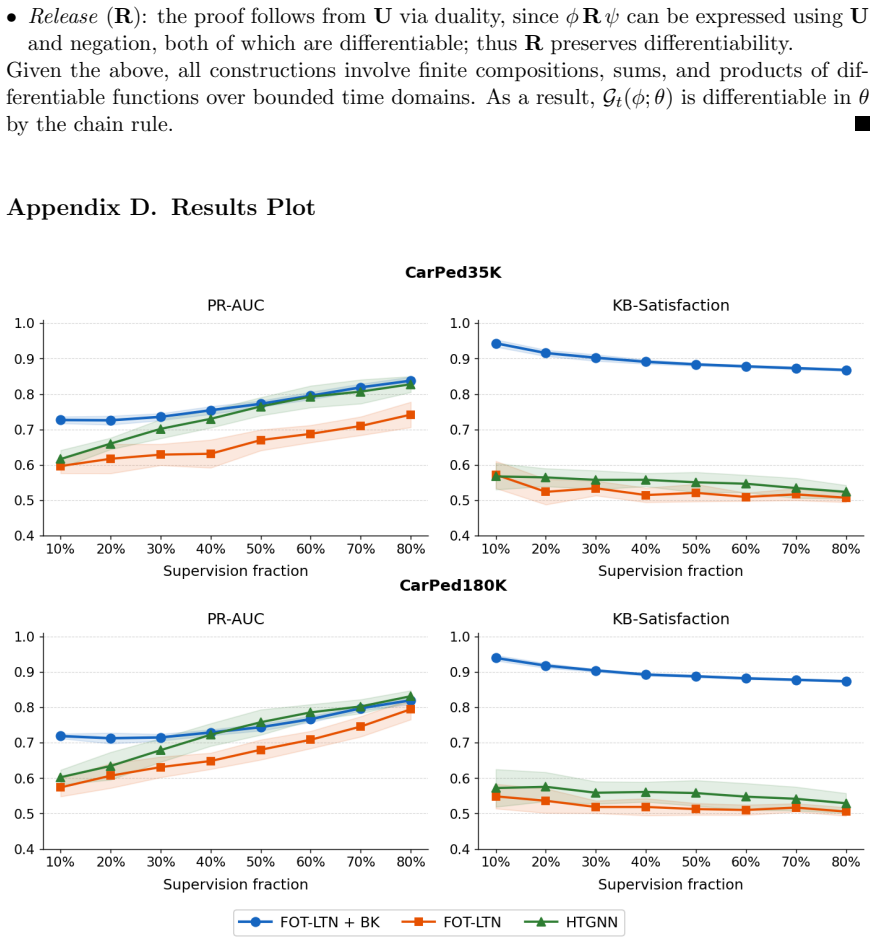
- Performance on synthetic temporal completion tasks exceeds that of dedicated neural architectures.
- The same training pipeline works for static and time-varying predicates without architectural changes.
Where Pith is reading between the lines
- The approach could be tested on real event logs or sensor streams where relations change at irregular intervals.
- Hybrid static-temporal models might be built by sharing the same tensor embedding space across both regimes.
- Gradient signals through temporal operators might reveal which time steps most influence a given logical conclusion.
Load-bearing premise
Fuzzy truth values and gradients from the static case carry over to temporal operators without creating non-differentiable points or extra constraints.
What would settle it
A temporal operator or time-indexed predicate for which the fuzzy semantics produce a non-differentiable point that blocks end-to-end gradient flow.
Figures
read the original abstract
Most of the existing neuro-symbolic AI methods focus on the scenario of static knowledge where objects do not change according to a temporal dimension. Temporal neuro-symbolic works are still under explored and are mainly developed for time-interval logic or propositional linear temporal logic. There is a lack of models studying linear temporal logics with predicates that deal with objects whose properties and relations change through the time. We present First-Order Temporal Logic Tensor Networks (FOT-LTN) that is an extension of Logic Tensor Networks (LTN) that fills this gap by considering a linear-temporal dimension. In particular, FOT-LTN joins the syntax of First-Order Linear Temporal Logic with the fuzzy (and real-valued) semantics of LTN obtaining a framework that supports both temporal operators and quantifiers and is totally differentiable. A first evaluation regards a temporal knowledge graph completion task on two synthetic datasets showing better performance of FOT-LTN with respect to dedicated (purely neural) methods.
Editorial analysis
A structured set of objections, weighed in public.
Referee Report
Summary. The manuscript introduces First-Order Temporal Logic Tensor Networks (FOT-LTN) as an extension of Logic Tensor Networks (LTN). It combines the syntax of First-Order Linear Temporal Logic with LTN's fuzzy real-valued semantics to support temporal operators (such as G, F, U) alongside quantifiers, asserting that the resulting framework is totally differentiable. The central evaluation applies FOT-LTN to a temporal knowledge graph completion task on two synthetic datasets and reports superior performance relative to dedicated neural baselines.
Significance. If the differentiability claim is substantiated and training remains stable, the framework would fill a documented gap between static neuro-symbolic methods and temporal reasoning, enabling end-to-end differentiable inference over time-varying predicates and relations. The synthetic-data results provide a minimal existence proof but do not yet establish practical advantage on realistic temporal KGs.
major comments (2)
- [Abstract] Abstract: the assertion that FOT-LTN 'is totally differentiable' is load-bearing for the central claim yet receives no supporting argument or implementation detail. Standard fuzzy semantics for the 'always' (G) and 'eventually' (F) operators employ min and max (or inf/sup) over temporal sequences; these operations are non-differentiable at ties. The manuscript must specify whether log-sum-exp approximations, subgradients, or another smoothing technique is used, and must demonstrate that gradients remain well-defined for the 'until' (U) operator as well.
- [Evaluation] Evaluation section: the reported performance advantage over 'dedicated (purely neural) methods' is presented without statistical significance tests, variance across runs, or ablation of the temporal operators themselves. Because the datasets are synthetic, it is impossible to determine whether the improvement is attributable to the logical component or to incidental differences in model capacity.
minor comments (1)
- The abstract refers to 'two synthetic datasets' without naming them or describing their generation procedure; this information should appear in the evaluation section or an appendix.
Simulated Author's Rebuttal
We thank the referee for the thoughtful and constructive feedback. The comments highlight important areas for clarification and strengthening of the empirical evaluation. We address each major comment below and will revise the manuscript accordingly.
read point-by-point responses
-
Referee: [Abstract] Abstract: the assertion that FOT-LTN 'is totally differentiable' is load-bearing for the central claim yet receives no supporting argument or implementation detail. Standard fuzzy semantics for the 'always' (G) and 'eventually' (F) operators employ min and max (or inf/sup) over temporal sequences; these operations are non-differentiable at ties. The manuscript must specify whether log-sum-exp approximations, subgradients, or another smoothing technique is used, and must demonstrate that gradients remain well-defined for the 'until' (U) operator as well.
Authors: We agree that the differentiability claim requires explicit implementation details, which were insufficiently elaborated. In the revised version we will add a dedicated subsection (likely in Section 3 or 4) describing the concrete realization: log-sum-exp smoothing with temperature parameter au for the min/max operations underlying G and F, and a differentiable soft formulation of the until operator U based on a recursive approximation that avoids hard infima. We will also include a short proof sketch or empirical gradient check confirming that the resulting computation graph remains differentiable everywhere. revision: yes
-
Referee: [Evaluation] Evaluation section: the reported performance advantage over 'dedicated (purely neural) methods' is presented without statistical significance tests, variance across runs, or ablation of the temporal operators themselves. Because the datasets are synthetic, it is impossible to determine whether the improvement is attributable to the logical component or to incidental differences in model capacity.
Authors: The referee correctly identifies gaps in the current experimental reporting. We will revise the evaluation section to report means and standard deviations over at least five independent runs, include paired t-tests or Wilcoxon tests for significance against the neural baselines, and add an ablation that disables the temporal operators (reducing FOT-LTN to a static LTN) while keeping parameter count matched. We will also explicitly state the model-capacity controls used when comparing against the neural baselines. While the synthetic construction limits direct claims about real-world KGs, the controlled setting allows isolation of temporal reasoning; we will clarify this motivation and note it as a limitation. revision: yes
Circularity Check
No circularity: direct syntactic/semantic extension of LTN with no load-bearing reductions to fits or self-citations
full rationale
The paper defines FOT-LTN explicitly as an extension that joins the syntax of First-Order Linear Temporal Logic with the fuzzy semantics of LTN, asserting total differentiability and support for temporal operators/quantifiers. No equations, fitted parameters, or self-citation chains are exhibited that would make any central claim (e.g., differentiability or performance) equivalent to its inputs by construction. The evaluation on synthetic temporal KG completion tasks is presented as empirical comparison rather than a forced prediction. This satisfies the criteria for a self-contained extension without circularity.
Axiom & Free-Parameter Ledger
free parameters (1)
- neural network parameters in LTN grounding
axioms (1)
- domain assumption Fuzzy real-valued semantics for logical connectives and quantifiers extend to temporal operators
Reference graph
Works this paper leans on
-
[1]
doi:10.1007/978-3-032-17278-5 , publisher =
Predictive Process Monitoring , author =. doi:10.1007/978-3-032-17278-5 , publisher =
-
[2]
d'Avila Garcez and Samy Badreddine and Ivan Donadello and Michael Spranger and Federico Bianchi , editor =
Luciano Serafini and Artur S. d'Avila Garcez and Samy Badreddine and Ivan Donadello and Michael Spranger and Federico Bianchi , editor =. Logic. Neuro-Symbolic Artificial Intelligence: The State of the Art , series =. 2021 , doi =
2021
-
[3]
d'Avila Garcez , title =
Luciano Serafini and Artur S. d'Avila Garcez , title =. NeSy@HLAI , series =
-
[4]
Logic Tensor Networks , volume =
Badreddine, Samy and d'Avila Garcez, Artur and Serafini, Luciano and Spranger, Michael , year =. Logic Tensor Networks , volume =. doi:10.1016/j.artint.2021.103649 , journal =
-
[5]
CoRR , volume =
Achille Frigeri and Liliana Pasquale and Paola Spoletini , title =. CoRR , volume =
-
[6]
Vardi , title =
Giuseppe De Giacomo and Moshe Y. Vardi , title =
-
[7]
Information Systems , volume =
Axel Mezini and Elena Umili and Ivan Donadello and Fabrizio Maria Maggi and Matteo Mancanelli and Fabio Patrizi , title =. Information Systems , volume =. 2026 , issn =. doi:https://doi.org/10.1016/j.is.2026.102762 , url =
-
[8]
Alman, Anti and Comuzzi, Marco and Di Francescomarino, Chiara and Donadello, Ivan and Maggi, Fabrizio Maria and Oukharijane, jamila , title =. ACM Trans. Intell. Syst. Technol. , month = apr, keywords =. 2026 , publisher =. doi:10.1145/3810944 , note =
-
[9]
Emile van Krieken and Erman Acar and Frank van Harmelen , title =. Artif. Intell. , volume =. 2022 , url =. doi:10.1016/J.ARTINT.2021.103602 , timestamp =
-
[10]
Luca Geatti and Alessandro Gianola and Nicola Gigante , title =
-
[11]
Francesco Fuggitti , title =. 2019 , publisher =. doi:10.5281/zenodo.3888410 , url =
-
[12]
TLINet: Differentiable Neural Network Temporal Logic Inference , journal =
Danyang Li and Mingyu Cai and Cristian. TLINet: Differentiable Neural Network Temporal Logic Inference , journal =
-
[13]
NeSy , series =
Riccardo Andreoni and Andrei Buliga and Alessandro Daniele and Chiara Ghidini and Marco Montali and Massimiliano Ronzani , title =. NeSy , series =
-
[14]
Nikolaos Manginas and George Paliouras and Luc De Raedt , title =
-
[15]
Process Sci
Ivan Donadello and Paolo Felli and Craig Innes and Fabrizio Maria Maggi and Marco Montali , title =. Process Sci. , volume =
-
[16]
CoRR , volume =
Emanuele Marconato and Samuele Bortolotti and Emile van Krieken and Paolo Morettin and Elena Umili and Antonio Vergari and Efthymia Tsamoura and Andrea Passerini and Stefano Teso , title =. CoRR , volume =
-
[17]
CoRR , volume =
Yujie Fan and Mingxuan Ju and Chuxu Zhang and Liang Zhao and Yanfang Ye , title =. CoRR , volume =
-
[18]
Emile van Krieken and Erman Acar and Frank van Harmelen , title =. CoRR , volume =. 2020 , url =. 2002.06100 , timestamp =
-
[19]
Ryan Riegel and Alexander G. Gray and Francois P. S. Luus and Naweed Khan and Ndivhuwo Makondo and Ismail Yunus Akhalwaya and Haifeng Qian and Ronald Fagin and Francisco Barahona and Udit Sharma and Shajith Ikbal and Hima Karanam and Sumit Neelam and Ankita Likhyani and Santosh K. Srivastava , title =. CoRR , volume =. 2020 , url =. 2006.13155 , timestamp =
-
[20]
Alessandro Artale and Andrea Mazzullo and Ana Ozaki , title =
-
[21]
D. M. Gabbay and A. Kurucz and F. Wolter and M. Zakharyaschev , journal =. Many-Dimensional Modal Logics: Theory and Applications , volume =
-
[22]
Giuseppe Marra and Sebastijan Dumancic and Robin Manhaeve and Luc De Raedt , title =. Artif. Intell. , volume =
-
[23]
NeurIPS , pages =
Robin Manhaeve and Sebastijan Dumancic and Angelika Kimmig and Thomas Demeester and Luc De Raedt , title =. NeurIPS , pages =
-
[24]
Gianluca Apriceno and Andrea Passerini and Luciano Serafini , title =
-
[25]
CoRR , volume =
Samy Badreddine and Gianluca Apriceno and Andrea Passerini and Luciano Serafini , title =. CoRR , volume =
-
[26]
2025 , eprint=
ABS: Enforcing Constraint Satisfaction On Generated Sequences Via Automata-Guided Beam Search , author=. 2025 , eprint=
2025
-
[27]
Ivan Donadello and Fabrizio Maria Maggi and Fabio Patrizi and Sergio Tessaris and Matteo Zorzi , title =. Inf. Syst. , volume =
-
[28]
Luca Salvatore Lorello and Marco Lippi and Stefano Melacci , title =
discussion (0)
Sign in with ORCID, Apple, or X to comment. Anyone can read and Pith papers without signing in.