Volume Law and Universality of Entanglement Entropy in Random Graph Fermi Systems
Pith reviewed 2026-06-30 07:30 UTC · model grok-4.3
The pith
Ground-state entanglement entropy of free fermions on random graphs follows an exact volume law with a universal density.
A machine-rendered reading of the paper's core claim, the machinery that carries it, and where it could break.
Core claim
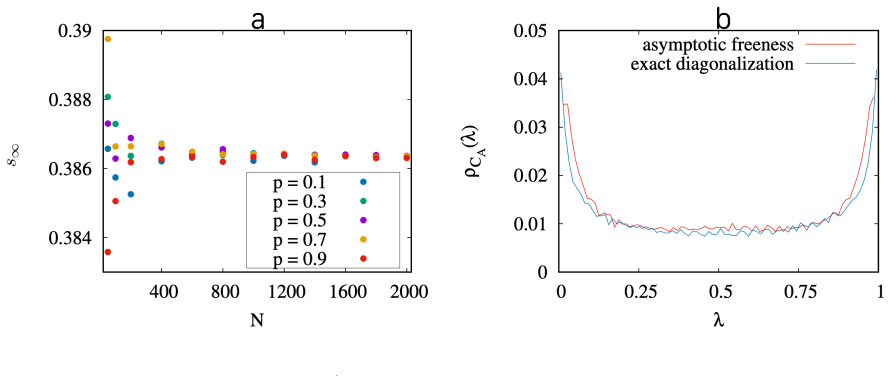
The ground-state entanglement entropy obeys an exact volume law in the thermodynamic limit. The entanglement density has a universal coefficient independent of the edge probability and the microscopic details of the graph. This coefficient is confirmed numerically to take the value approximately 0.386 nats, strictly below the Page value. The volume law therefore reflects the absence of geometric locality in the random graph.
What carries the argument
Random matrix theory combined with asymptotic freeness applied to the fermionic Hamiltonian on the Erdős–Rényi adjacency matrix, which establishes the volume law for entanglement entropy.
If this is right
- The entanglement entropy scales linearly with subsystem size instead of its boundary.
- The universal coefficient remains the same for any edge probability in the random graph.
- The numerical value of 0.386 nats lies below the Page value expected for typical random states.
- The result is a direct consequence of the random graph having no underlying geometric structure.
Where Pith is reading between the lines
- This suggests that entanglement in mean-field fermionic systems generally follows volume laws rather than area laws.
- Extensions to other random matrix ensembles or interacting cases could be checked numerically for similar universality.
- The finding connects to questions about when locality is necessary for area-law entanglement in many-body systems.
Load-bearing premise
Random matrix theory and asymptotic freeness accurately describe the fermionic Hamiltonian on the Erdős–Rényi random graph in the thermodynamic limit.
What would settle it
A calculation or simulation showing that the entanglement density depends on the edge probability for very large graph sizes would falsify the universality claim.
Figures
read the original abstract
We study the ground-state entanglement entropy of free fermions on the Erd\H{o}s--R\'enyi random graph, where each of the possible edges is present independently with some probability. Using random matrix theory and asymptotic freeness, we prove that the ground-state entanglement entropy obeys an exact volume law in the thermodynamic limit. The entanglement density, with a universal coefficient that is independent of the edge probability and the microscopic details of the graph. This coefficient is confirmed numerically to take the value approximately $0.386$ nats, strictly below the Page value. The volume law therefore reflects the absence of geometric locality in the random graph.
Editorial analysis
A structured set of objections, weighed in public.
Referee Report
Summary. The manuscript claims to prove, using random matrix theory and asymptotic freeness, that the ground-state entanglement entropy of free fermions on an Erdős–Rényi random graph obeys an exact volume law in the thermodynamic limit, with a universal entanglement density coefficient of approximately 0.386 nats that is independent of edge probability p and microscopic graph details; this is numerically confirmed and attributed to the absence of geometric locality.
Significance. If the result holds, it would establish a rigorous, parameter-free volume law for entanglement entropy in non-local random-graph fermionic systems, with the coefficient strictly below the Page value serving as a falsifiable prediction; the explicit use of asymptotic freeness to derive the universal coefficient and the numerical confirmation are strengths that would advance understanding of entanglement in disordered, non-geometric quantum systems.
major comments (2)
- [Abstract] Abstract (and the derivation invoking asymptotic freeness): the central claim of an exact volume law with p-independent coefficient rests on asymptotic freeness applying to the single-particle correlation matrix of the quadratic Hamiltonian H = c† A c with A the symmetric Bernoulli ER adjacency matrix; standard free-probability results require i.i.d. entries of finite variance, but the ER case has dependent entries due to symmetry and the fermionic anticommutators add structure, so explicit verification is needed that no truncation or regularization is required that would affect the entanglement density.
- [Numerical confirmation] Numerical section (coefficient confirmation): the value 0.386 is stated as confirmation of the universal coefficient, but without reported details on finite-size scaling, sample averaging, or extrapolation error bars in the N→∞ limit, it is difficult to assess whether the numerics independently support the exact p-independence asserted by the analytic argument.
Simulated Author's Rebuttal
We thank the referee for their careful reading and constructive comments on our manuscript. We address each major comment below and will revise the manuscript accordingly to strengthen the presentation.
read point-by-point responses
-
Referee: [Abstract] Abstract (and the derivation invoking asymptotic freeness): the central claim of an exact volume law with p-independent coefficient rests on asymptotic freeness applying to the single-particle correlation matrix of the quadratic Hamiltonian H = c† A c with A the symmetric Bernoulli ER adjacency matrix; standard free-probability results require i.i.d. entries of finite variance, but the ER case has dependent entries due to symmetry and the fermionic anticommutators add structure, so explicit verification is needed that no truncation or regularization is required that would affect the entanglement density.
Authors: We appreciate the referee's emphasis on this technical detail. The adjacency matrix A is a symmetric Wigner-type matrix whose upper-triangular entries are independent Bernoulli random variables of finite variance; standard extensions of Voiculescu's asymptotic freeness results to symmetric ensembles with this structure apply directly in the large-N limit. The single-particle correlation matrix is obtained from the spectral decomposition of A, and the fermionic anticommutation relations enter only through the definition of the Gaussian state's entanglement entropy, without introducing additional operator dependencies that violate freeness. We will add an explicit paragraph (in Section II and an appendix) confirming that the requisite conditions hold without truncation or regularization that would alter the entanglement density. revision: yes
-
Referee: [Numerical confirmation] Numerical section (coefficient confirmation): the value 0.386 is stated as confirmation of the universal coefficient, but without reported details on finite-size scaling, sample averaging, or extrapolation error bars in the N→∞ limit, it is difficult to assess whether the numerics independently support the exact p-independence asserted by the analytic argument.
Authors: We agree that expanded numerical documentation will make the confirmation more robust. In the revised manuscript we will add a dedicated subsection reporting: the system sizes used for scaling, the number of independent ER realizations averaged for each (p,N) pair, the extrapolation procedure to N→∞ together with statistical error bars, and direct numerical checks of p-independence across several edge probabilities. These additions will allow readers to assess convergence to the reported universal value. revision: yes
Circularity Check
No significant circularity; derivation relies on external RMT and freeness
full rationale
The paper states that it proves the exact volume law and p-independent entanglement density using random matrix theory and asymptotic freeness applied to the fermionic Hamiltonian on the Erdős–Rényi adjacency matrix in the thermodynamic limit. The coefficient ~0.386 is described as numerically confirmed rather than fitted or input to the proof. No self-definitional steps, fitted-input predictions, or load-bearing self-citations appear in the derivation chain. The central claim is presented as following from external mathematical results whose hypotheses are taken as given for the model.
Axiom & Free-Parameter Ledger
free parameters (1)
- entanglement density coefficient =
0.386
axioms (2)
- domain assumption Random matrix theory applies to the spectrum and eigenvectors of the Erdős–Rényi adjacency matrix
- domain assumption Asymptotic freeness holds for the relevant operators in the thermodynamic limit
Reference graph
Works this paper leans on
-
[1]
Entanglement entropy and quantum field theory,
P. Calabrese and J. Cardy, “Entanglement entropy and quantum field theory,”Journal of Statistical Mechanics: Theory and Experiment, vol. 2004, p. P06002, jun 2004
2004
-
[2]
Entanglement in many-body systems,
L. Amico, R. Fazio, A. Osterloh, and V. Vedral, “Entanglement in many-body systems,” Rev. Mod. Phys., vol. 80, pp. 517–576, May 2008
2008
-
[3]
Colloquium: Area laws for the entanglement entropy,
J. Eisert, M. Cramer, and M. B. Plenio, “Colloquium: Area laws for the entanglement entropy,”Rev. Mod. Phys., vol. 82, pp. 277–306, Feb 2010
2010
-
[4]
Many-body localization and thermalization in quantum statistical mechanics,
R. Nandkishore and D. A. Huse, “Many-body localization and thermalization in quantum statistical mechanics,”Annual Review of Condensed Matter Physics, vol. 6, no. Volume 6, 2015, pp. 15–38, 2015
2015
-
[5]
Colloquium: Many-body localization, thermalization, and entanglement,
D. A. Abanin, E. Altman, I. Bloch, and M. Serbyn, “Colloquium: Many-body localization, thermalization, and entanglement,”Rev. Mod. Phys., vol. 91, p. 021001, May 2019
2019
-
[6]
Automorphism-assisted quantum approximate optimization algorithm for efficient graph optimization,
V. N. Prakash, “Automorphism-assisted quantum approximate optimization algorithm for efficient graph optimization,” 2024
2024
-
[7]
Automorphism-induced entanglement bounds in many-body systems,
S. Sur, “Automorphism-induced entanglement bounds in many-body systems,” 2026
2026
-
[8]
On random graphs i,
P. Erdős and A. Rényi, “On random graphs i,”Publicationes Mathematicae Debrecen, vol. 6, pp. 290–297, 1959
1959
-
[9]
Asymmetric graphs,
P. Erdős and A. Rényi, “Asymmetric graphs,”Acta Mathematica Academiae Scientiarum Hungarica, vol. 14, pp. 295–315, Sep 1963
1963
-
[10]
The automorphism group of random graphs with a given number of edges,
T. Łuczak, “The automorphism group of random graphs with a given number of edges,” Mathematical Proceedings of the Cambridge Philosophical Society, vol. 104, no. 3, p. 441–449, 1988
1988
-
[11]
Abrahams,50 Years of Anderson Localization
E. Abrahams,50 Years of Anderson Localization. WORLD SCIENTIFIC, 2010
2010
-
[12]
Anderson transitions,
F. Evers and A. D. Mirlin, “Anderson transitions,”Rev. Mod. Phys., vol. 80, pp. 1355–1417, Oct 2008
2008
-
[13]
Quantum random networks,
S. Perseguers, M. Lewenstein, A. Acín, and J. I. Cirac, “Quantum random networks,”Nature Physics, vol. 6, pp. 539–543, Jul 2010. 9
2010
-
[14]
Entanglement percolation in quantum networks,
A. Acín, J. I. Cirac, and M. Lewenstein, “Entanglement percolation in quantum networks,” Nature Physics, vol. 3, pp. 256–259, Apr 2007
2007
-
[15]
Quantum internet: A vision for the road ahead,
S. Wehner, D. Elkouss, and R. Hanson, “Quantum internet: A vision for the road ahead,” Science, vol. 362, no. 6412, p. eaam9288, 2018
2018
-
[16]
Collective purification of interacting quantum networks beyond symmetry constraints,
S. Sur, P. Chattopadhyay, A. Chakrabarti, N. E. Palaiodimopoulos, Ö. E. Müstecaplıoğlu, A. Finkler, D. B. Rao Dasari, and G. Kurizki, “Collective purification of interacting quantum networks beyond symmetry constraints,”npj Quantum Information, Apr 2026
2026
-
[17]
Complex networks from classical to quantum,
J. Biamonte, M. Faccin, and M. De Domenico, “Complex networks from classical to quantum,”Communications Physics, vol. 2, p. 53, May 2019
2019
-
[18]
Spatiotemporal signal propagation in complex networks,
C. Hens, U. Harush, S. Haber, R. Cohen, and B. Barzel, “Spatiotemporal signal propagation in complex networks,”Nature Physics, vol. 15, pp. 403–412, Apr 2019
2019
-
[19]
A mathematical framework for misinformation propagation in complex networks: Topology-dependent distortion and control,
S. Sur, R. Chattopadhyay, J. C. Claussen, and A. Mukhopadhyay, “A mathematical framework for misinformation propagation in complex networks: Topology-dependent distortion and control,”Chaos: An Interdisciplinary Journal of Nonlinear Science, vol. 36, p. 033113, 03 2026
2026
-
[20]
Calculation of reduced density matrices from correlation functions,
I. Peschel, “Calculation of reduced density matrices from correlation functions,”Journal of Physics A: Mathematical and General, vol. 36, p. L205, mar 2003
2003
-
[21]
Entanglement entropy of fermions in any dimension and the widom conjecture,
D. Gioev and I. Klich, “Entanglement entropy of fermions in any dimension and the widom conjecture,”Phys. Rev. Lett., vol. 96, p. 100503, Mar 2006
2006
-
[22]
Scaling of rényi entanglement entropies of the free fermi-gas ground state: A rigorous proof,
H. Leschke, A. V. Sobolev, and W. Spitzer, “Scaling of rényi entanglement entropies of the free fermi-gas ground state: A rigorous proof,”Phys. Rev. Lett., vol. 112, p. 160403, Apr 2014
2014
-
[23]
Average entropy of a subsystem,
D. N. Page, “Average entropy of a subsystem,”Phys. Rev. Lett., vol. 71, pp. 1291–1294, Aug 1993
1993
-
[24]
Average entropy of a quantum subsystem,
S. Sen, “Average entropy of a quantum subsystem,”Phys. Rev. Lett., vol. 77, pp. 1–3, Jul 1996
1996
-
[26]
Asymptotic properties of large random matrices with independent entries,
A. M. Khorunzhy, B. A. Khoruzhenko, and L. A. Pastur, “Asymptotic properties of large random matrices with independent entries,”Journal of Mathematical Physics, vol. 37, pp. 5033–5060, 10 1996
1996
-
[27]
Sparse random matrices: the eigenvalue spectrum revisited,
G. Semerjian and L. F. Cugliandolo, “Sparse random matrices: the eigenvalue spectrum revisited,”Journal of Physics A: Mathematical and General, vol. 35, p. 4837, may 2002
2002
-
[28]
Resolvent of large random graphs,
C. Bordenave and M. Lelarge, “Resolvent of large random graphs,” 2009
2009
-
[29]
G. W. Anderson, A. Guionnet, and O. Zeitouni,An Introduction to Random Matrices, vol. 118 ofCambridge Studies in Advanced Mathematics. Cambridge: Cambridge University Press, 2010
2010
-
[30]
The local semicircle law for a general class of random matrices,
L. Erdos, A. Knowles, H.-T. Yau, and J. Yin, “The local semicircle law for a general class of random matrices,” 2013
2013
-
[31]
M. A. Nielsen and I. L. Chuang,Quantum Computation and Quantum Information. Cam- bridge University Press, 2000. 10
2000
-
[32]
Zhang,The Schur Complement and Its Applications, vol
F. Zhang,The Schur Complement and Its Applications, vol. 4. Springer Science & Business Media, 2005
2005
-
[33]
Distribution of eigenvalues for some sets of random matrices,
V. A. Marčenko and L. A. Pastur, “Distribution of eigenvalues for some sets of random matrices,”Mathematics of the USSR-Sbornik, vol. 1, p. 457, apr 1967
1967
-
[34]
Bai and J
Z. Bai and J. W. Silverstein,Spectral Analysis of Large Dimensional Random Matrices. Springer Series in Statistics, New York, NY: Springer Science & Business Media, 2nd ed., 2010
2010
-
[35]
J. A. Mingo and R. Speicher,Free Probability and Random Matrices, vol. 35 ofFields Institute Monographs. Springer New York, 2017
2017
-
[36]
Entanglement entropy of eigenstates of quantum chaotic hamilto- nians,
L. Vidmar and M. Rigol, “Entanglement entropy of eigenstates of quantum chaotic hamilto- nians,”Phys. Rev. Lett., vol. 119, p. 220603, Nov 2017
2017
-
[37]
Modeling quantum dot systems as random geometric graphs with probability amplitude-based weighted links,
L. Cuadra and J. C. Nieto-Borge, “Modeling quantum dot systems as random geometric graphs with probability amplitude-based weighted links,”Nanomaterials, vol. 11, no. 2, 2021
2021
-
[38]
The quantum internet,
H. J. Kimble, “The quantum internet,”Nature, vol. 453, pp. 1023–1030, Jun 2008
2008
-
[39]
Lattice glass models,
G. Biroli and M. Mézard, “Lattice glass models,”Phys. Rev. Lett., vol. 88, p. 025501, Dec 2001. 11 APPENDIX A Lemma 1. For allz∈C\R, the (A,A ) block of the Green functionG(z) = (zIN−hN)−1 is given by [32] GAA(z) = (zIA−HAA−ΣA(z))−1, (A1) where theself-energy matrix is ΣA(z) =HAB(zIB−HBB)−1HBA. (A2) Proof. SinceHBB is real symmetric andImz <0, the matrixz...
2001
discussion (0)
Sign in with ORCID, Apple, or X to comment. Anyone can read and Pith papers without signing in.