REVIEW 2 major objections 4 minor 60 references
Quantum dynamics of single-photon detection using functionalized quantum transport electronic channels
T0 review · 2 major / 4 minor · reviewed 2026-08-14 · deepseek-v4-flash
Pith's one-line read Functionalized quantum wire detects single photons with SNR above 4.
desk verdict A genuinely new coupled NEGF/OBE model with an appealing backaction-control idea, but the SNR>4 claim assumes radiative-limited decay and the paper's own caveats leave that assumption unprotected. read the letter →
The pith
A machine-rendered reading of the paper's core claim, the machinery that carries it, and where it could break.
The reading
What carries the argument
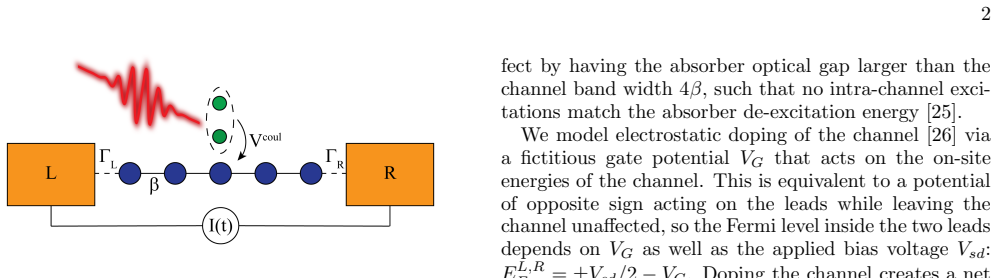
The load-bearing object is the coupled density-matrix dynamics of a two-level absorber and an $N$-site tight-binding channel, propagated by a non-equilibrium Green's function equation of motion that is closed in the wide-band limit with Coulomb interactions at the Hartree level, including lead self-energies built from the Fermi functions. The workhorse simplification is that the full NEGF simulation can be replaced by optical Bloch equations whose only modification is a time-dependent detuning $\delta E_g(t)=f(\rho_{ee}(t))$, the dynamical Stark effect: the excited molecule's permanent dipole redistributes charge in the channel, and the resulting potential shifts the absorber's optical gap while the pulse is on. This backaction nonlinearity—$\delta E_g$ multiplied by the optical coherence—is what makes the reduced equations non-linear and is the mechanism controlling the excitation probability and hence the signal-to-noise ratio.
What would settle it
Build the modeled device with the absorber about 1 nm from a short channel, drive the 7.5 eV transition with a ~10 ps pulse containing on average one photon, and time-integrate the excess current over 1.2 ns; if the integrated excess charge $\delta n$ does not exceed $\sqrt{n_0}$ (the shot-noise level of the steady current), the predicted SNR > 4 fails, and a more direct test would be to measure the absorber's non-radiative decay rate in proximity to the channel, e.g. by fluorescence quenching, to see whether it is comparable to the radiative rate $\gamma_{rad}\approx(1\,\mathrm{ns})^{-1}$.
Extended reading notes
Core claim
The central claim is that a single-photon detector can be built from a quantum transport channel functionalized by one two-level absorber, and that detection works because the absorber's permanent dipole, acquired upon excitation, changes the electrostatic potential on the channel and hence its current. The paper treats the photon field, absorption, transduction, and measurement in one fully coupled non-equilibrium quantum simulation rather than as separate steps, and finds that the current change tracks the absorber excitation probability, $\delta I(t)=c\,\rho_{ee}(t)$. The authors then show that the full time-dependent dynamics is captured by optical Bloch equations with a modified detuning $\Delta-\delta E_g(t)$, where $\delta E_g(t)=f(\rho_{ee}(t))$ is the dynamical Stark shift induced by channel backaction; this new nonlinearity is what limits the excitation probability. By choosing short pulses ($\sim$10 ps) and operating the channel with one Fermi level pinning a channel resonance and with asymmetric absorber placement or asymmetric lead coupling, they obtain an SNR larger than 4 with a reset time of about 1 ns, concluding that single-photon detection is possible with a minimal device design.
Load-bearing premise
The entire signal rests on the assumption that the absorber's excitation energy cannot be drained into the transport channel or its leads before it changes the current: the absorber's optical gap (about 7.5 eV) is assumed to exceed the channel's bandwidth (about 2 eV), so no matching intra-channel electron-hole excitations are available; if the channel or its substrate can accept that energy, the current change would be lost.
Editorial extensions
If this is right
- A functionalized quantum channel operating with one Fermi level near a channel resonance and with short pulses can detect single photons with SNR above 4 and about 1 ns reset, corresponding to count rates near 1 GHz.
- The long-time dynamics can be computed with optical Bloch equations plus a fitted backaction function $f(\rho_{ee})$, about five orders of magnitude faster than the full NEGF propagation, making multi-parameter searches practical.
- The optimal pulse duration is set by the backaction strength rather than by the isolated absorber's radiative lifetime; longer pulses work if the absorber-channel coupling is reduced (larger separation) or if the radiative lifetime is longer, at the cost of count rate.
- Asymmetric absorber placement toward one lead, or asymmetric lead coupling, increases the SNR by reducing the channel backaction through a non-equilibrium occupancy effect that opposes the static depolarization of the channel.
- Electron-correlation screening corrections in the channel and image-charge corrections to the backaction are estimated to change the optimized SNR by less than about 5%, so the central conclusion is not an artifact of the Hartree treatment.
- The absorber excitation probability reaches only a few percent, yet the current change is still resolvable because the steady current carries enough electrons in the integration window to make the shot-noise floor small.
- After the pulse passes, the absorber relaxes by spontaneous emission, giving the short reset time that sets the detector's maximum count rate.
- The channel's transient current displays oscillations on picosecond timescales, reflecting the interplay between excitation, dynamical Stark detuning, and spontaneous emission.
Reading between the lines
- Editorial inference: The same backaction-suppression mechanism could be applied to other detector geometries, such as quantum dots or single-molecule junctions, provided the absorber's optical gap exceeds the channel's electron-hole continuum—the same design rule used here.
- Editorial inference: Because $\delta I(t)=c\rho_{ee}(t)$ is linear in the excitation probability, an array of such functionalized elements could give photon-number resolution by counting how many elements fire per pulse, a natural extension toward arrayable nanoscale detectors.
- Editorial inference: The nonlinear optical Bloch equation with fitted $f(\rho_{ee})$ predicts a transient current oscillation at a Stark-shifted frequency on picosecond timescales; probing that oscillation directly would test the backaction model beyond the SNR prediction.
Signed reviews
Editorial analysis
A structured set of objections, weighed in public.
Referee Report
Summary. The paper proposes and simulates a nanoscale single-photon detector consisting of a two-level molecular absorber Coulomb-coupled to a one-dimensional quantum transport channel, with the photon field, absorption, transduction, and current measurement treated as one coupled nonequilibrium quantum system. The authors derive a quantum kinetic equation from the Kadanoff-Baym equations in the wide-band lead and Hartree-Fock approximations, project it onto the absorber and channel subspaces, and reduce the absorber dynamics to optical Bloch equations with a density-dependent detuning f(ρee) and a current-excitation proportionality c, both calibrated by steady-state NEGF calculations. Using this reduced model, they optimize the SNR over bias, gate voltage, pulse duration, and detuning for a 7-site channel, and report an SNR of 4.5 with a reset time of about 1 ns, arguing that non-equilibrium transport can control the quantum backaction that otherwise suppresses excitation.
Significance. If the central claim holds, this is an interesting and potentially important proposal: a minimal molecular device that converts a single-photon absorption event into a detectable change in transport current, with GHz-rate reset, and with the full light-matter-transport feedback loop treated in one coherent formalism. The paper's strengths include a well-documented derivation of the GKB/NEGF equations in Appendix A, explicit GW checks for intra-channel correlation effects and image-charge corrections in Appendix B, a computational speedup of about five orders of magnitude from the OBE reduction, and a conservative choice of Fano factor F=1 when a smaller value is estimated. The main quantitative claims, however, rest on two assumptions that are acknowledged only partially: that non-radiative decay of the absorber is negligible, and that the OBE reduction, validated directly for N=3, remains quantitatively accurate for the optimized N=7 asymmetric geometry. These are parameter-regime and model-validation issues rather than internal inconsistencies, but they are load-bearing for the headline SNR and reset-time numbers.
major comments (2)
- [Section II / Fig. 5] The SNR=4.5 and reset time of ~1 ns are computed with the absorber decay described exclusively by spontaneous emission at rate γrad=1/ns in Eq. (7)/Eq. (A-20). The justification given in Section II is that the 7.5 eV optical gap exceeds the 2 eV channel bandwidth, so no intra-channel excitation can accept the de-excitation energy. This argument does not eliminate the possibility of non-radiative energy transfer to the metallic leads, which are treated in the wide-band limit with a constant density of states at all energies, or to a substrate, which the paper's own note [25] concedes requires 'judiciously chosen' design to minimize losses. Because the integrated current change δn is proportional to the absorbed photon's residence time in the excited state, a non-radiative rate γnr comparable to or larger than γrad would proportionally reduce δn and hence degrade SNR, and could shorten or alter the reset response. The manuscript should provide a quantitative estimate or bound on γnr for the proposed geometry, or explicitly qualify the abstract and conclusion claims as conditional on a low-loss dielectric environment; as written, the central claim overstates the robustness of the result.
- [Section III.C / Fig. 5] The optimized N=7 SNR of 4.5 is obtained entirely from the OBE model with f(ρee) and c fitted from steady-state NEGF calculations, but the only direct NEGF-vs-OBE benchmarks shown are for N=3 (Fig. 2 and the inset of Fig. 3). The SNR enhancement for the asymmetric geometry is attributed to a subtle non-equilibrium occupancy effect (the increase δ~nch that opposes the static depopulation δ¯nch). The fidelity of this mechanism depends on the instantaneous-detuning approximation in the OBE, and the N=7 case has not been checked against the full NEGF dynamics. Since the central quantitative claim of the paper is the optimized N=7 SNR, a benchmark of the OBE against the full NEGF for at least one representative N=7 configuration (e.g., the j=2, ΓL=2ΓR case) would materially strengthen the conclusion. If such a calculation is too expensive, the paper should at least state this validation gap explicitly and discuss the expected error in the OBE reduction for the asymmetric regime.
minor comments (4)
- [Section I / Section III.C] The phrase 'single-photon detection' is used in the abstract and conclusion, but the numerical calculations are for a coherent state pulse with mean photon number one. The reported SNR is the ensemble-averaged response over the coherent-state photon number distribution, and the excitation probability is only a few percent. The authors should state this qualification explicitly rather than leaving the impression that the Fock-state single-photon response was computed; a true single-photon pulse could in principle give a different (possibly higher) excitation probability for a mode-matched pulse.
- [Section III.A / Eq. (6)] Equation (6) contains an unclear integration limit: the expression uses ∫_{\bar t} without specifying the integration variable or lower/upper limits. The notation should be corrected to indicate the integral over the intermediate time, presumably from the initial time to t.
- [Appendix A] There are typographical errors: 'non-equlibrium' in Section III.A, 'absorbtion' in Appendix A, and 'in combinations' in Section III.B. The text should be proofread.
- [Fig. 8 and text after Eq. (B-6)] The discussion of the ratio δE_im^g(t)/δE_g(t) is clear, but the sentence 'which should be as it should be from Eqs (B-4) and (B-6)' is awkwardly phrased and should be reworded for clarity.
Circularity Check
No significant circularity: the OBE is a calibrated surrogate benchmarked against full NEGF dynamics, and the SNR/reset-time claims are model outputs or transparent input consequences, not fits to the claimed result.
full rationale
The paper's central predictive quantity is the SNR, computed by integrating the time-dependent current change produced by a reduced optical-Bloch-equation model. The two reduced-model ingredients, the current-to-excitation proportionality c and the backaction-induced detuning f(rho_ee), are obtained from steady-state NEGF calculations, but this is a model-reduction calibration rather than a fit to the final prediction: the full NEGF dynamics for N=3 are independently solved and shown to agree with the OBE in Figs. 2 and 3, and the N=7 SNR and optimal pulse parameters are new outputs not contained in the steady-state calibration data. The reset time of ~1 ns is the radiative lifetime tau_rad, which the paper explicitly introduces as an input from a standard formula ('This radiative lifetime is the natural reset that determines the count rate of the detector~GHz'); reporting it as the post-pulse relaxation time is a transparent consequence of Eq. (7), not a hidden reverse-engineering of a result. The paper's own footnote [25] acknowledges that substrate-induced energy-transfer losses require additional design care, but that is a parameter-regime and materials-design limitation, not a circular step. No load-bearing self-citation, imported uniqueness theorem, or ansatz-by-citation is present; prior author works are used for motivation or well-established methods rather than to force the central conclusion. The derivation chain is therefore self-contained with respect to circularity.
Assumptions & free parameters
free parameters (7)
- OBE detuning response function f(ρee) =
Not specified; fitted to steady-state NEGF calculations
- Current-to-excitation proportionality c =
Not specified; obtained by steady-state linear-response NEGF
- Optimal pulse duration τ0 =
372 fs, 10 ps, 12 ps for different configurations
- Photon detuning Δ =
Optimized; improves excitation by less than 30% over Δ=0
- Absorber Hamiltonian parameters =
H0_abs diagonal ±3 eV, off-diagonal 2.24 eV, dabs=5 bohr
- Channel and coupling parameters =
β=0.5 eV, Γ=0.5 eV (some Γ_L=2Γ_R=1 eV), Ohno U=5 eV, d=20-35 bohr, a=5 bohr
- Bias and gate voltages (Vsd, VG) =
VG=1.125 eV, Vsd=0.5 eV for N=3; optimal E_F^R=0.86-0.92 eV for N=7
assumptions (8)
- standard math Kadanoff-Baym equations and Langreth analytic continuation provide the correct quantum transport framework.
- domain assumption Coulomb interactions are treated at mean-field Hartree-Fock level, with intra-channel Coulomb neglected (U=0) in the main results.
- domain assumption The photon field is treated classically as a coherent pulse, with spontaneous emission added via a Lindblad term.
- domain assumption No charge transfer and no initial correlations exist between absorber and channel, so the density matrix stays block-diagonal.
- domain assumption Strong-focusing regime: the pulse spatial shape matches the absorber dipole pattern.
- domain assumption Non-radiative energy transfer from absorber to channel is negligible because the absorber optical gap exceeds the channel bandwidth.
- domain assumption At T=0 and high operation frequency, thermal and 1/f noise are negligible; current noise is shot noise with Fano factor F=1.
- domain assumption Single-band tight-binding model captures transport, and the absorber is a one-electron two-level system.
Cite this review
Pith. "Pith review of Quantum dynamics of single-photon detection using functionalized quantum transport electronic channels." pith.science (2026). https://pith.science/paper/HGDUVO57
@misc{pith2026190802342,
  author       = {Pith},
  title        = {Pith review of: Quantum dynamics of single-photon detection using functionalized quantum transport electronic channels},
  year         = {2026},
  howpublished = {\url{https://pith.science/paper/HGDUVO57}},
  note         = {Machine review of arXiv:1908.02342}
}
read the original abstract
Single photon detectors have historically consisted of macroscopic-sized materials but recent experimental and theoretical progress suggests new approaches based on nanoscale and molecular electronics. Here we present a theoretical study of photodetection in a system composed of a quantum electronic transport channel functionalized by a photon absorber. Notably, the photon field, absorption process, transduction mechanism, and measurement process are all treated as part of one fully-coupled quantum system, with explicit interactions. Using non-equilibrium, time-dependent quantum transport simulations, we reveal the unique temporal signatures of the single photon detection process, and show that the system can be described using optical Bloch equations, with a new non-linearity as a consequence of time-dependent detuning caused by the backaction from the transport channel via the dynamical Stark effect. We compute the photodetector signal-to-noise ratio and demonstrate that single photon detection at high count rate is possible for realistic parameters by exploiting a novel non-equilibrium control of backaction.
Figures


Figures from the paper (3 more)


Reference graph
Works this paper leans on
-
[25]
Loudon, The Quantum Theory of Light, Third Edi- tion, Oxford Science Publications (2000)
R. Loudon, The Quantum Theory of Light, Third Edi- tion, Oxford Science Publications (2000)
work page 2000
-
[1]
Image-charge effects in the linear-response regime In the linear-reponse regime ( i.e. small absorber ex- citation probability [51]) and for an absorber with per- manent dipole in the excited state, the absorber optical level is renormalized via the image charge effect origi- nating from the interaction between the absorber excited state permanent dipole an...
-
[2]
This is due to the dynamical Stark effect: as the pho- ton excites the absorber, the associated permanent dipole changes the charge distribution in the transport channel, which in turn changes the electric field acting back on the absorber. The induced time-dependent renormalization ˜Eg(t) = Eg +δEg(t) of the optical gap leads to strong detuning ¯hω− ˜Eg(t)...
work page 2000
-
[3]
Image-charge effects in the non-linear response regime The regime addressed by our simulations belongs to the non-linear response where additional time-dependent renormalization of the absorber optical gap occurs. It is critical to capture this dynamical effect as it determines the backaction from the channel to the absorber and affects the quantum dynamics ...
-
[4]
M. Giustina, Marijn A.M. Versteegh, S. Wengerowsky, J. Handsteiner, A. Hochrainer, K. Phelan, F. Steinlech- ner, J. Kofler, J.-A. Larsson, C. Abellan, W. Amaya, V. Pruneri, M. W. Mitchell, J. Beyer, T. Gerrits, A. E. Lita, L. K. Shalm, S. W. Nam, T. Scheidl, R. Ursin, B. Wittmann, and A. Zeilinger, Phys. Rev. Lett. 115, 250401 (2015)
work page 2015
-
[5]
H. Takesue, S. D. Dyer, M. J. Stevens, V. Verma, R. P. Mirin, S. W. Nam, Optica 2, 832 (2015)
work page 2015
- [6]
- [7]
Show all 60 references
-
[8]
Rowea, E.J
M.A. Rowea, E.J. Gansen, M. Greene, R.H. Hadfield, T.E. Harvey, M.Y. Su, S.W. Nam, and R.P. Mirin, Appl. Phys. Lett. 89, 253505 (2006)
2006
-
[9]
X. Zhou, T. Zifer, Thomas, B.M. Wong, K.L. Krafcik, F. L´ eonard, A.L. Vance, Nano Lett.9, 1028 (2009)
2009
-
[10]
X. Guo, L. Huang, S. O’Brien, P. Kim, C. Nuckolls, J. Am. Chem. Soc. 127, 15045 (2005)
2005
-
[11]
Hecht, R.J.A
D.S. Hecht, R.J.A. Ramirez, M. Briman, E. Artukovic, K.S. Chichak, J.F. Studdard, G. Gruner, Nano Lett. 6, 2031-2036 (2006)
2006
-
[12]
C. Jia, A. Migliore, N. Xin, S. Huang, J. Wang, Q. Yang, S. Wang, H. Chen, D. Wang, B. Feng, Z. Liu, G. Zhang, D.-H. Qu, H. Tian, M. A. Ratner, H. Q. Xu, A. Nitzan, X. Guo, Science 352, 1443 (2016). 11
2016
-
[13]
Gao and M
Y. Gao and M. Galperin, J. Chem. Phys. 144, 174113 (2016)
2016
-
[14]
Galperin and A
M. Galperin and A. Nitzan, J. Chem. Phys. 124, 234709 (2006); B. D. Fainberg, M. Jouravlev and A. Nitzan, Phys. Rev. B 76, 245329 (2007)
2006
-
[15]
D. A. Stewart and F. L´ eonard, Phys. Rev. Lett. 93, 107401 (2004)
2004
-
[16]
L´ eonard, C.D
F. L´ eonard, C.D. Spataru, M. Goldflam, D.W. Peters, T.E. Beechem, Sci. Rep. 7 45853 (2017)
2017
-
[17]
Young, M
S.M. Young, M. Sarovar, F. L´ eonard, Phys. Rev. A 97, 033836 (2018)
2018
-
[18]
Stobi´ nska, G
M. Stobi´ nska, G. Alber, G. Leuchs, Europhys. Lett. 86, 14007 (2009)
2009
-
[19]
Y. Wang, J. Min´ aˇ r, L. Sheridan, V. Scarani Phys. Rev. A 83, 063842 (2011)
2011
-
[20]
Gough, M.R
J.E. Gough, M.R. James, H.I. Nurdin, J. Combes, Phys. Rev. A 86, 043819 (2012)
2012
-
[21]
Other configurations such as waveguides can also be treated with simple modifications. See P. Domokos, P. Horak, and H. Ritsch, Phys. Rev A, 65 033832 (2002)
2002
-
[22]
Spataru, S
C.D. Spataru, S. Ismail-Beigi, L.X. Benedict, S.G. Louie, Phys. Rev. Lett. 92, 077402 (2004)
2004
-
[23]
Capaz, C.D
R.B. Capaz, C.D. Spataru, S. Ismail-Beigi, S.G. Louie, Phys. Stat. Sol. (b) 244, 4016 (2007)
2007
-
[24]
Strickler, R.A
S.J. Strickler, R.A. Berg, J. Chem. Phys. 37, 814 (1962)
1962
-
[26]
Steck, Quantum and Atom Optics, available online at http://steck.us/teaching (2017)
D.A. Steck, Quantum and Atom Optics, available online at http://steck.us/teaching (2017)
2017
-
[27]
Ohno, Theoret
K. Ohno, Theoret. Chim. Acta 2, 219 (1964)
1964
-
[28]
Additional care needs to be paid when designing a re- alistic device where the conducting channel is placed on top of a substrate: the electronic level alignment and/or separation between absorber and substrate need to be judiciously chosen to minimize energy transfer losses
-
[29]
C. D. Spataru and F. L´ eonard, Phys. Rev. Lett. 104, 177402 (2010); ibid., Chem. Physics 413, 81 (2013)
2010
-
[30]
Latini, E
S. Latini, E. Perfetto, A.-M. Uimonen, R. van Leeuwen, and G. Stefanucci, Phys. Rev. B 89, 075306 (2014)
2014
-
[31]
Hybertsen and S.G
M.S. Hybertsen and S.G. Louie, Phys. Rev. B 34, 5390 (1986)
1986
-
[32]
Jauho, N.S
A.-P. Jauho, N.S. Wingreen and Y. Meir, Phys. Rev. B 50, 5528 (1994)
1994
-
[33]
For the particular case of a coherent light pulse the OBE approach is equivalent to more general approaches such as the quantized propagating pulse [16] or master equa- tion [17] approaches
-
[34]
This estimate however does not account for the impact of the absorber on current fluctuations
For N = 7 and the design that yields SNR ≈ 4.5 we estimate F = 0.35 from F = ∫ dE(fL−fR)T (1−T ) /∫ dE(fL−fR)T where T (E) is the calculated Landauer transmission. This estimate however does not account for the impact of the absorber on current fluctuations
-
[35]
Blanter and M
Y.M. Blanter and M. Buttiker, Phys. Rep. 336, 1 (1999)
1999
-
[36]
Levitov and G.B
L.S. Levitov and G.B. Lesovik, JETP Lett. 55, 555 (1992); ibid., JETP Lett. 58, 230 (1993)
1992
-
[37]
Yu. V. Nazarov and M. Kindermann, Eur. Phys. J. B 35, 413 (2003)
2003
-
[38]
L. V. Keldysh, Sov. Phys. JETP 20, 1018 (1965)
1965
-
[39]
Attaccalite, M
C. Attaccalite, M. Gruning, A. Marini, Phys. Rev. B 84, 245110 (2011)
2011
-
[40]
Langreth, Linear and Nonlinear Electron Transport in Solids, edited by J.T
D.C. Langreth, Linear and Nonlinear Electron Transport in Solids, edited by J.T. Devresse and E. Van Doren, Plenum, New York (1976)
1976
-
[41]
H.Haug and A.-P.Jauho, Quantum Kinetics in Transport and Optics of Semiconductors, Springer-Verlag, Berlin (1998)
1998
-
[42]
Balzer, M
K. Balzer, M. Bonitz, Nonequilibrium Greens Functions Approach to Inhomogeneous Systems, Lecture Notes in Physics, Springer-Verlag Berlin Heidelberg (2013)
2013
-
[43]
Spicka, B
V. Spicka, B. Velicky and A. Kalvova, Int. J. Mod. Phys. B 28, 1430013 (2014)
2014
-
[44]
Kadanoff and G
L.P. Kadanoff and G. Baym, Quantum Statistical Me- chanics: Greens Function Methods in Equilibrium and Nonequilibrium Problems, Addison-Wesley, (1989)
1989
-
[45]
Lipavsky, V
P. Lipavsky, V. Spicka and B. Velicky, Phys. Rev. B 34, 6933 (1986)
1986
-
[46]
Because the absorber ac- commodates a single electron there are no Coulomb in- teraction effects that need to be accounted for inside the absorber subspace
In practice, the NEGF dynamics is obtained by treating the interaction between the absorber and the transport channel at the Hartree level (the exchange self-energy vanishes in the absence of charge-transfer between ab- sorber and transport channel). Because the absorber ac- c...
-
[47]
Runge, Math
C. Runge, Math. Ann. 46, 167 1895
-
[48]
Myohanen, R
P. Myohanen, R. Tuovinen, R.; Korhonen, T.; Stefanucci, G.; van Leeuwen, R. Phys. Rev. B: Condens. Matter Mater. Phys. 2012, 85, 075105
2012
-
[49]
C. D. Spataru, M. S. Hybertsen, S. G. Louie, and A. J. Millis, Phys. Rev. B 79 155110 (2009)
2009
-
[50]
X. Wang, C. D. Spataru, M. S. Hybertsen, and A. J. Millis, Phys. Rev. B 77, 045119 (2008)
2008
-
[51]
C. D. Spataru Phys. Rev. B 82, 195111 (2010)
2010
-
[52]
Hwang, D
C. Hwang, D. A. Siegel, S.-K. Mo, W. Regan, A. Ismach, Y. Zhang, A. Zettl and A. Lanzara, Scientific Reports 2, 590 (2012)
2012
-
[53]
Bostwick, F
A. Bostwick, F. Speck, T. Seyller, K. Horn, M. Polini, R. Asgari, A. H. MacDonald and E. Rotenberg, Science 328, 21 (2010)
2010
-
[54]
2 in the main text)
By that we mean that the excited dipole is small enough such that the renormalization of the absorber optical gap remains well within the bounds set by the photon band- width (see inset of Fig. 2 in the main text)
-
[55]
Garcia-Lastra and K.S
J.M. Garcia-Lastra and K.S. Thygesen, Phys. Rev. Lett. 106, 187402 (2011)
2011
-
[56]
Spataru, Phys
C.D. Spataru, Phys. Rev. B 88, 125412 (2013))
2013
-
[57]
The absorber optical level also gets renormalized via the interaction between the absorber transition dipole and its image in the channel (see ref. [53]). In this case the renormalization is∼⟨φ∗ gφe|wch(Eg)−v|φ∗ eφg⟩ where the relevant frequency for the channel screening is th...
-
[58]
J. B. Neaton, Mark S. Hybertsen, and Steven G. Louie, Phys. Rev. Lett. 97, 216405 (2006)
2006
-
[59]
The corresponding timescale is of course larger than the ∼fs light period
By t = 0 we mean the initial times (when the photon field starts interacting with the absorber) where the renormal- ization of the absorber optical gap can be neglected. The corresponding timescale is of course larger than the ∼fs light period
-
[60]
While for the sake of brevity we do not address the change in absorber action here, we ex- pect (e.g
The inclusion of electron correlation effects between channel and absorber affects not only the channel back- 12 action but also the absorber action (the absorber renor- malizes the quasiparticle energies in the channel -hence the current- via a similar image charge effect as dis...
Reviewed August 14, 2026 · model on record in the stance chip above.
Discussion (0). Continue with ORCID to comment.