REVIEW 3 major objections 6 minor 106 references
Cell Natural Orbitals in Interacting Topological Bands
T0 review · 3 major / 6 minor · reviewed 2026-08-11 · deepseek-v4-flash
Pith's one-line read Cell natural orbitals give every topological band a ranked set of local orbitals, with Chern topology forcing the leading orbital to vanish somewhere on the Brillouin zone.
desk verdict Solid methods paper with a clean SVD core and a useful chiral-TBG demonstration; the interaction-hierarchy claim is real but established only numerically for one model, so the conclusions need recalibration. read the letter →
The pith
A machine-rendered reading of the paper's core claim, the machinery that carries it, and where it could break.
The reading
What carries the argument
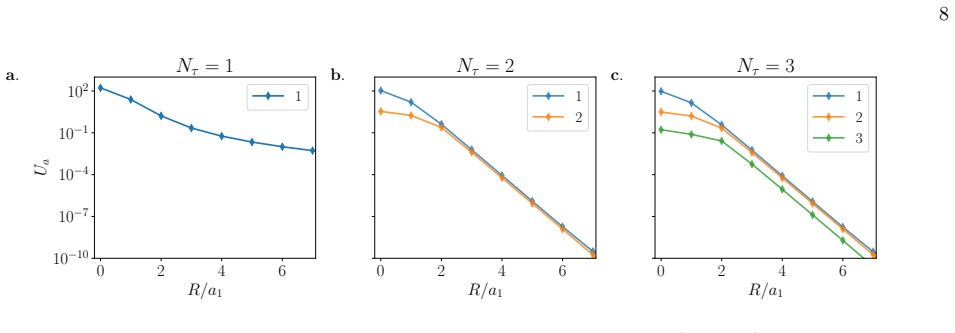
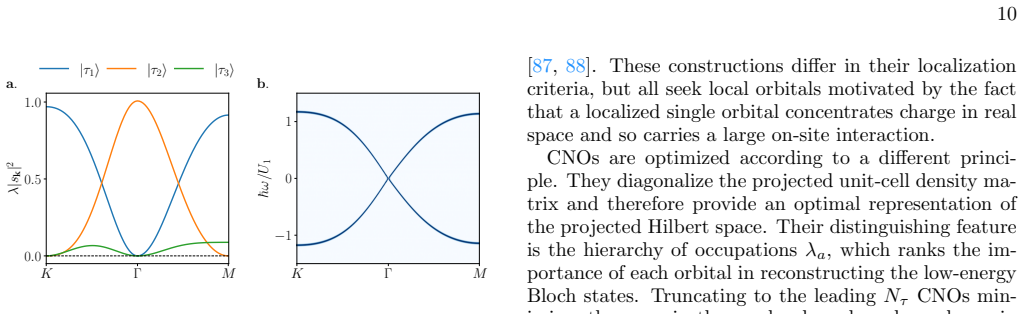
The central object is the unit-cell reduced density matrix $L=\Pi P\Pi$ (Eq. 1), the Brillouin-zone average of the band projector $P$ restricted to one unit cell by $\Pi$. Its eigenstates are the CNOs and its eigenvalues $\lambda_a$ are occupations. The same nonzero spectrum appears in $\Lambda=U^\dagger U$ through the SVD of $U=\Pi P$, so diagonalizing the small $N_\alpha\times N_\alpha$ matrix $L$ gives the singular vectors of the momentum-space overlap kernel. The argument is carried by two identities: the Eckart-Young optimality of the rank-$N_\tau$ truncation, with error $\sum_{a>N_\tau}\lambda_a^2$, and the Poincare-Hopf count that the leading envelope's zeros have total vorticity equal to the Chern number. The Gram matrix $S_k=\sum_{a\le N_\tau}\lambda_a|s_{a,k}|^2$ controls locality: where $S_k$ vanishes, the orthonormalization factor $S_k^{-1/2}$ is non-analytic and interactions develop power-law tails; adding a CNO that is finite at the zero restores exponential decay.
What would settle it
Compute the full physical form-factor matrix $\Lambda^{\mathrm{phys}}_{k,k+q}$ and the resulting onsite interaction matrix for a Chern band whose leading CNO envelope has zeros at separated momenta rather than one coincident zero, using a screened Coulomb interaction; if a single extra CNO no longer removes power-law interaction tails, or if the ordering of interaction strengths contradicts the ordering of $\lambda_a$, the central hierarchy claim fails.
Extended reading notes
Core claim
The paper's central discovery is that the unit-cell reduced density matrix $L_{\alpha\beta} = \frac{1}{N_k}\sum_{k\in BZ}\sum_{n\in P} u_{n,\alpha}(k) u^*_{n,\beta}(k)$ defines a set of local orbitals, the cell natural orbitals, that carry a singular-value decomposition of the band-projected overlap kernel $\Lambda_{km,k'n} = \frac{1}{N_k}\langle u_{k,m}|u_{k',n}\rangle$. Because $L$ and $\Lambda$ are the two adjoint products of the single rectangular operator $U=\Pi P$, they share the nonzero spectrum $\{\lambda_a\}$, and the right singular vectors $s_{a,k} = \langle u_k|\tau_a\rangle/\sqrt{\lambda_a}$ are envelope functions on the Brillouin zone. Three claims follow. First, keeping the $N_\tau$ largest occupations is the optimal rank-$N_\tau$ approximation to $\Lambda$, with exact truncation error $\sum_{a>N_\tau}\lambda_a^2$. Second, for a band with Chern number $C$, the leading envelope $s_{1,k}$ is a global section of a nontrivial line bundle and must vanish at points whose vorticities sum to $2\pi C$, so $\lambda_1<1$, $S_{\mathrm{cell}}>0$, and no single local orbital can represent a Chern band. Third, the occupations set a hierarchy in projected interactions: in chiral twisted bilayer graphene at the magic angle, the dominant CNO sits at the AA site, a second, delocalized CNO regularizes the Gram matrix at the protected zero, power-law interaction tails disappear, and the on-site interaction strengths are ordered across CNO channels so that subdominant channels can be treated as static mean fields while the leading channel requires dynamical self-energy. The paper notes that the kernel $\Lambda$ is not the exact SVD of the physical form-factor matrix $\Lambda^{\mathrm{phys}}_{k,k+q}$ entering projected interactions; the hierarchy in that physical matrix is found numerically in chiral TBG.
Load-bearing premise
The load-bearing premise is that the hierarchy found in the periodic-embedding overlap kernel survives in the physical form factor entering projected interactions, a property the paper verifies numerically for chiral twisted bilayer graphene but does not prove for general topological bands.
Editorial extensions
If this is right
- Any band with nonzero Chern number requires at least two CNOs: the leading envelope must vanish with total vorticity equal to $2\pi C$, so a single local orbital is structurally incapable of representing the band and the unit-cell entanglement entropy is strictly positive.
- Retaining the $N_\tau$ largest occupations is the optimal rank-$N_\tau$ approximation to the overlap kernel, with exact error $\sum_{a>N_\tau}\lambda_a^2$, giving a quantitative stopping rule for building local-orbital models of projected interactions.
- In chiral twisted bilayer graphene at the magic angle, including the second CNO regularizes the Gram matrix at the protected zero, turning power-law interaction tails into exponential decay while preserving the hierarchy of on-site interaction strengths.
- The single-particle spectral function inherits momentum dependence from the CNO band weights $\lambda_a|s_{a,k}|^2$: at the leading envelope's zero the correlation scale is set by the subleading channel, producing a gapless crossing within a single chiral sector whose fate is governed by coupling between the two chiral sectors.
Reading between the lines
- The truncation-error bound suggests a practical diagnostic for embedding calculations: the minimal number of impurity orbitals for a correlated band could be chosen directly from the CNO occupations, with the sum of discarded $\lambda_a^2$ as a controlled error, rather than from an ad hoc Wannierization.
- If the observed transfer of the hierarchy to the physical form factor holds beyond chiral TBG, then CNO truncation could be tested on simpler Chern bands, such as the Haldane or multifold models, by computing the onsite structure factor $F_{ab}(q)$ at rank 1 versus rank 2; a mismatch between the $\lambda_a$ ordering and the interaction ordering would falsify the general claim.
- The paper's mechanism implies that local orbitals chosen purely for real-space localization are not enough: what matters for short-ranged interactions is whether the truncated set keeps the Gram matrix bounded away from zero, reframing Wannierizability as a quantitative coverage condition on the Brillouin zone rather than exponential decay.
- The unit-cell entanglement entropy and the CNO complexity measures may serve as cheap pre-screening observables for when multi-orbital physics will be needed, for example across topological phase transitions where the entropy derivative peaks.
Editorial analysis
A structured set of objections, weighed in public.
Referee Report
Summary. The paper introduces Cell Natural Orbitals (CNOs) as eigenstates of the unit-cell reduced one-particle density matrix built from the band projector, and develops a singular-value decomposition of the band-projected overlap kernel. The formal results include: (i) the Eckart–Young optimality of the CNO truncation with Hilbert–Schmidt error equal to the sum of discarded squared occupations (Sec. III C and Appendix E); (ii) a topological obstruction theorem stating that the leading CNO envelope must vanish on a Chern band (Sec. III B); and (iii) a claimed hierarchy in band-projected interactions, with numerical evidence in chiral twisted bilayer graphene at the magic angle (Sec. IV B). The paper also studies unit-cell entanglement, complexity measures, and momentum-dependent self-energies in a Hubbard-I approximation. The central physical claim is that the CNO occupation spectrum sets a systematically improvable local-orbital hierarchy for interacting topological bands.
Significance. If the central claim holds, CNOs provide a valuable, parameter-free construction of local orbitals for topological flat bands, with a natural ranking of interaction channels. The formal parts of the paper are genuinely rigorous: the truncation-error proof (Appendix E) is self-contained, the line-bundle argument for the protected zero of the leading envelope is concise and correct, and the Peschel relation is used appropriately. The chiral TBG numerics (Figs. 1, 5, 6) are concrete and will be useful to the community, and the explicit comparison of power-law versus exponential interaction tails as a function of the Gram-matrix singularity (Sec. V, Fig. 9) is instructive. The main weakness is that the decisive transfer from the overlap-kernel SVD to the physical form factor is asserted rather than proved, and the general multi-zero argument for arbitrary Chern number is not established.
major comments (3)
- [Sec. IV B, Eq. (29)] The central claim that the CNO occupation spectrum sets a hierarchy in projected interactions is not derived from the SVD optimality of the overlap kernel. The on-site form factor F_ab(q) in Eq. (29) contains the physical form factor Λ_phys and the CNO envelopes divided by sqrt(S_k S_{k+q}); Eckart–Young optimality for Λ does not constrain this combination. The paper explicitly concedes in Sec. III A that "our decomposition is not the exact SVD of the physical form-factor matrix" and in Sec. IV B that "the origin of this hierarchy is not obvious a priori." The hierarchy observed in Fig. 6 is therefore a numerical observation in one model (chiral TBG), not a demonstrated general property. The third central result in Sec. VI should either be proved or restated as a conjecture with a precise condition under which it holds.
- [Sec. IV A, paragraph on separated zeros] The assertion that "since all bands with the same Chern number belong to the same topological class, there should exist a well-conditioned transformation mapping a band with multiple zeros to one with a single zero of higher vorticity" is not proven, and it is not sufficient for the stated conclusion. Even if such a transformation exists, it acts on the band wavefunctions, not on the CNOs, which are fixed by the unit-cell reduced density matrix L. Consequently the original CNO basis is not shown to supply the needed second mode when zeros are separated. The proof only covers the coincident-zero case via completeness; the general claim that Nτ=2 regularizes S_k for arbitrary Chern number remains unsubstantiated.
- [Sec. VI vs Appendix G] The hierarchy U_f > U_cf > U_c follows exactly in Appendix G only for the special all-to-all unit-cell-density interaction of Eq. (G7), where the interaction scales are squared CNO occupations. The paper then states in the same appendix that "the hierarchy persists for realistic Coulomb interactions" without a derivation. Since the realistic case is precisely the one used for the main physical claim in Sec. IV B, the relation between the exactly solvable limiting case and the generic case should be made explicit, and the unexplained step should be flagged as an assumption.
minor comments (6)
- [Sec. II, first paragraph] There is a typo: "We refer the read to Ref. [1]" should be "We refer the reader to Ref. [1]."
- [Sec. II, Eq. (4) text] The word "wavefucntions" in the sentence following Eq. (4) is misspelled; it should be "wavefunctions."
- [References [57,58]] References [57] and [58] appear to be the same paper (B. Mera and T. Ozawa, Phys. Rev. B 106, 245134 (2022)). The duplicate should be removed and the citation numbers adjusted.
- [Sec. IV B, Fig. 7 caption] The caption for Fig. 7 says "with (c) its imaginary part" but panels (a)–(d) are not individually labeled in the caption text; please align the caption references with the figure panel labels for readability.
- [Sec. III B, Eq. (13)] The statement that equality in Eq. (13) holds only if the band is a single k-independent orbital is correct for a single band, but for a multi-band projector the equality condition should be stated for each band separately; a one-sentence clarification would avoid ambiguity.
- [Appendix H, last paragraph] The term "Mott Semimetal phase" appears with inconsistent capitalization; please harmonize with "Mott semimetal" used elsewhere.
Circularity Check
No significant circularity: the SVD/truncation and topological-zero results are self-contained theorems, and the interaction hierarchy is a verified numerical observation with a built-in lambda-weight bias, not a forced fit.
full rationale
The claimed derivation chain is largely self-contained. The optimal-truncation statement (Sec. III C, Eqs. 12-15, Appendix E) is a direct Eckart-Young application to the kernel Lambda = U^dagger U; because Lambda is defined from the band projector and the CNOs are its singular vectors, the error formula E = sum_{a>N_tau} lambda_a^2 is a theorem, not a fitted result. The topological-zero statement (Sec. III B) invokes the standard Chern line-bundle obstruction, citing external references [3,4,59,62]; it does not depend on the authors' own prior work. The interaction-hierarchy claim (Sec. IV B) is the only place with a built-in bias: the CNO expansion in Eq. (19) inserts factors sqrt(lambda_a), so the onsite interaction U_a in Eq. (30) carries an explicit lambda_a^2 prefactor through Eq. (29). However, the envelope integrals in Eq. (29) could in principle overturn the lambda ordering, and the authors verify the ordering numerically for chiral TBG, explicitly saying the origin is 'not obvious a priori.' The hierarchy is therefore an observed property with a strong prior bias, not an equivalence forced by definition. The admitted gap between Lambda and Lambda_phys (Sec. III A) is a generalizability limitation, not circularity. Ref. [1], an unpublished companion by the same authors, is cited as the origin of CNOs, but all definitions and derivations needed here are reproduced in Sec. II and Appendix A, so the self-citation is not load-bearing. Overall, no step reduces to its own inputs by construction.
Assumptions & free parameters
free parameters (3)
- twist angle theta =
1.07 degrees
- screening length xi =
10 nm
- momentum cutoff Lambda_K =
much greater than M
assumptions (5)
- standard math Poincare-Hopf theorem: a section of a nontrivial line bundle over T^2 must vanish with vorticity equal to the Chern number.
- standard math Eckart-Young theorem: the best rank-N approximation minimizes Hilbert-Schmidt error.
- ad hoc to paper A well-conditioned transformation exists that maps a band with multiple envelope zeros to one with a single zero of higher vorticity.
- domain assumption The CNO hierarchy of the kernel Lambda transfers to the physical form factor Lambda_phys.
- domain assumption Periodic embedding of continuum Bloch states exists and is unique enough for the construction.
Cite this review
Pith. "Pith review of Cell Natural Orbitals in Interacting Topological Bands." pith.science (2026). https://pith.science/paper/HH7YONUW
@misc{pith2026260809932,
  author       = {Pith},
  title        = {Pith review of: Cell Natural Orbitals in Interacting Topological Bands},
  year         = {2026},
  howpublished = {\url{https://pith.science/paper/HH7YONUW}},
  note         = {Machine review of arXiv:2608.09932}
}
abstract
Topological bands exhibit obstruction to exponentially localized and symmetric Wannier functions, challenging the standard paradigm of representing projected interactions in terms of local orbitals with finite range. To faithfully capture the form factors and quantum geometry of topological bands we introduce a singular-value decomposition of the band-projected density form factors, enabling a geometry-based truncation scheme of the Hilbert space, exposing an intrinsic hierarchy on band-projected interactions that is determined by the underlying wavefunctions. This decomposition is most naturally described in terms of Cell Natural Orbitals (CNOs), as the eigenstates of the unit-cell reduced one-particle density matrix, whose occupation provide a measure of the minimal orbital complexity required to faithfully represent the band wavefunctions overlaps. The CNO decomposition identifies systematically the minimal number of local orbitals needed to reproduce short-ranged interactions while resolving the hierarchy of interaction strengths across CNO channels. Applied to magic-angle twisted bilayer graphene in the chiral limit, we find that the dominant CNO is centered at the AA site, resembling the $f$-fermion of the heavy-fermion model. The subdominant CNO channels carry progressively weaker interaction matrix elements, allowing them to be treated at the static mean-field level, while the dominant channel requires a dynamical self-energy. The formalism illustrates how variations of charge density within the unit cell generate momentum dependence in the CNO envelope function and, consequently, dispersion in the single-particle spectral function. More broadly, our results establish CNOs as a geometry-informed bridge between band topology and real-space correlations, providing a systematic framework for analyzing interactions and emergent phases in quantum materials.
Figures


Figures from the paper (6 more)



Reference graph
Works this paper leans on
-
[1]
=δ r0,r′ 0 ,(A8) which guarantees orthonormality of the states|e r0,l⟩= N −1/2 k P R |R+r 0, l⟩and unitarity of the transform Eq. (A7). The uc-RDM in Eq. (1) is then computed from the periodic-gauge amplitudese ik·r0 zn,k,r0,l, L(r0,l),(r′ 0,l′) = 1 Nk X k,n∈P eik·(r0−r′
-
[2]
TheN G real-space positions play the role of orbitals in direct analogy with the tight-binding case, and diagonalizingLyields the CNOs and occupations as defined in the main text
zn,k,r0,l z∗ n,k,r′ 0,l′, (A9) which is anN GNl ×N GNl Hermitian positive semidefi- nite matrix. TheN G real-space positions play the role of orbitals in direct analogy with the tight-binding case, and diagonalizingLyields the CNOs and occupations as defined in the main text. Appendix B: Cell entropy and the quantum metric The cell entropyS cell is bounde...
-
[3]
Mahalingam, N
H. Mahalingam, N. Verma, D. Mu˜ noz Segovia, and R. Queiroz, arxiv , to appear (2026)
2026
-
[4]
Song and B
Z.-D. Song and B. A. Bernevig, Phys. Rev. Lett.129, 047601 (2022)
2022
-
[5]
Brouder, G
C. Brouder, G. Panati, M. Calandra, C. Mourougane, and N. Marzari, Phys. Rev. Lett.98, 046402 (2007)
2007
-
[6]
Monaco, G
D. Monaco, G. Panati, A. Pisante, and S. Teufel, Com- munications in Mathematical Physics359, 61 (2018)
2018
-
[7]
H. C. Po, A. Vishwanath, and H. Watanabe, Nature Communications8, 50 (2017)
2017
-
[8]
H. C. Po, L. Zou, A. Vishwanath, and T. Senthil, Phys. Rev. X8, 031089 (2018)
2018
Show all 106 references
-
[9]
A. A. Soluyanov and D. Vanderbilt, Phys. Rev. B83, 035108 (2011)
2011
-
[10]
E. Y. Andrei, D. K. Efetov, P. Jarillo-Herrero, A. H. MacDonald, K. F. Mak, T. Senthil, E. Tutuc, A. Yaz- dani, and A. F. Young, Nature Reviews Materials6, 201 (2021)
2021
-
[11]
Y. Cao, V. Fatemi, S. Fang, K. Watanabe, T. Taniguchi, E. Kaxiras, and P. Jarillo-Herrero, Nature556, 43 (2018)
2018
-
[12]
Y. Cao, V. Fatemi, A. Demir, S. Fang, S. L. Tomarken, J. Y. Luo, J. D. Sanchez-Yamagishi, K. Watanabe, T. Taniguchi, E. Kaxiras, R. C. Ashoori, and P. Jarillo- Herrero, Nature556, 80 (2018)
2018
-
[13]
X. Lu, P. Stepanov, W. Yang, M. Xie, M. A. Aamir, I. Das, C. Urgell, K. Watanabe, T. Taniguchi, G. Zhang, A. Bachtold, A. H. MacDonald, and D. K. Efetov, Na- ture574, 653 (2019). 17
2019
-
[14]
Yankowitz, S
M. Yankowitz, S. Chen, H. Polshyn, Y. Zhang, K. Watanabe, T. Taniguchi, D. Graf, A. F. Young, and C. R. Dean, Science363, 1059 (2019)
2019
-
[15]
M. Z. Hasan and C. L. Kane, Reviews of Modern Physics 82, 3045 (2010)
2010
-
[16]
J. Yu, B. A. Bernevig, R. Queiroz, E. Rossi, P. T¨ orm¨ a, and B.-J. Yang, npj Quantum Materials10, 101 (2025)
2025
-
[17]
Verma, P
N. Verma, P. J. W. Moll, T. Holder, and R. Queiroz, Nature Reviews Physics8, 226 (2026)
2026
-
[18]
J. P. Provost and G. Vallee, Communications in Math- ematical Physics76, 289 (1980)
1980
-
[19]
T¨ orm¨ a, Phys
P. T¨ orm¨ a, Phys. Rev. Lett.131, 240001 (2023)
2023
-
[20]
Verma, T
N. Verma, T. Hazra, and M. Randeria, Proceedings of the National Academy of Sciences of the United States of America118, e2106744118 (2021)
2021
-
[21]
Mao and D
D. Mao and D. Chowdhury, Proceedings of the National Academy of Sciences120, e2217816120 (2023)
2023
-
[22]
Verma and R
N. Verma and R. Queiroz, Proceedings of the National Academy of Sciences122, 10.1073/pnas.2405837122 (2025)
2025 doi
-
[23]
J. M. B. Lopes dos Santos, N. M. R. Peres, and A. H. Castro Neto, Phys. Rev. Lett.99, 256802 (2007)
2007
-
[24]
Shallcross, S
S. Shallcross, S. Sharma, E. Kandelaki, and O. A. Pankratov, Phys. Rev. B81, 165105 (2010)
2010
-
[25]
Bistritzer and A
R. Bistritzer and A. H. MacDonald, Proceedings of the National Academy of Sciences108, 12233 (2011)
2011
-
[26]
J. M. B. Lopes dos Santos, N. M. R. Peres, and A. H. Castro Neto, Phys. Rev. B86, 155449 (2012)
2012
-
[27]
B. A. Bernevig, Z.-D. Song, N. Regnault, B. Lian,et al., Phys. Rev. B103, 205411 (2021)
2021
-
[28]
L. Zou, H. C. Po, A. Vishwanath, and T. Senthil, Phys. Rev. B98, 085435 (2018)
2018
-
[29]
Z. Song, Z. Wang, W. Shi, G. Li, C. Fang, and B. A. Bernevig, Phys. Rev. Lett.123, 036401 (2019)
2019
-
[30]
B. A. Bernevig, Z.-D. Song, N. Regnault, B. Lian,et al., Phys. Rev. B103, 205412 (2021)
2021
-
[31]
Koshino, N
M. Koshino, N. F. Q. Yuan, T. Koretsune, M. Ochi, K. Kuroki, and L. Fu, Phys. Rev. X8, 031087 (2018)
2018
-
[32]
Kang and O
J. Kang and O. Vafek, Phys. Rev. X8, 031088 (2018)
2018
-
[33]
B. A. Bernevig, Z.-D. Song, N. Regnault, B. Lian,et al., Phys. Rev. B103, 205413 (2021)
2021
-
[34]
Xie and A
M. Xie and A. H. MacDonald, Phys. Rev. Lett.124, 097601 (2020)
2020
-
[35]
Zhang, K
Y. Zhang, K. Jiang, Z. Wang, and F. Zhang, Phys. Rev. B102, 035136 (2020)
2020
-
[36]
Bultinck, E
N. Bultinck, E. Khalaf, S. Liu, S. Chatterjee, A. Vish- wanath, and M. P. Zaletel, Phys. Rev. X10, 031034 (2020)
2020
-
[37]
P. J. Ledwith, G. Tarnopolsky, E. Khalaf, and A. Vish- wanath, Phys. Rev. Res.2, 023237 (2020)
2020
-
[38]
Cr´ epel, P
V. Cr´ epel, P. Ding, N. Verma, N. Regnault, and R. Queiroz, arXiv preprint arXiv:2403.19656 (2024)
2024 arXiv
-
[39]
Parhizkar and V
A. Parhizkar and V. Galitski, Phys. Rev. B110, L121111 (2024)
2024
-
[40]
J. Liu, J. Liu, and X. Dai, Phys. Rev. B99, 155415 (2019)
2019
-
[41]
J. Wang, J. Cano, A. J. Millis, Z. Liu, and B. Yang, Phys. Rev. Lett.127, 246403 (2021)
2021
-
[42]
Tarnopolsky, A
G. Tarnopolsky, A. J. Kruchkov, and A. Vishwanath, Phys. Rev. Lett.122, 106405 (2019)
2019
-
[43]
J. Shi, N. Morales-Dur´ an, E. Khalaf, and A. H. Mac- Donald, Phys. Rev. B110, 035130 (2024)
2024
-
[44]
J. Kang, B. A. Bernevig, and O. Vafek, Phys. Rev. Lett. 127, 266402 (2021)
2021
-
[45]
Shi and X
H. Shi and X. Dai, Phys. Rev. B106, 245129 (2022)
2022
-
[46]
Datta, M
A. Datta, M. J. Calder´ on, A. Camjayi, and E. Bascones, Nat. Commun.14, 5036 (2023)
2023
-
[47]
C˘ alug˘ aru, M
D. C˘ alug˘ aru, M. Borovkov, L. L. Lau, P. Coleman, Z.- D. Song, and B. A. Bernevig, Low Temperature Physics 49, 640 (2023)
2023
-
[48]
Horodecki, P
R. Horodecki, P. Horodecki, M. Horodecki, and K. Horodecki, Rev. Mod. Phys.81, 865 (2009)
2009
-
[49]
Amico, R
L. Amico, R. Fazio, A. Osterloh, and V. Vedral, Rev. Mod. Phys.80, 517 (2008)
2008
-
[50]
Cheong and C
S.-A. Cheong and C. L. Henley, Phys. Rev. B69, 075111 (2004)
2004
-
[51]
S. L. Dudarev, G. A. Botton, S. Y. Savrasov, C. J. Humphreys, and A. P. Sutton, Phys. Rev. B57, 1505 (1998)
1998
-
[52]
Cococcioni and S
M. Cococcioni and S. de Gironcoli, Phys. Rev. B71, 035105 (2005)
2005
-
[53]
Peschel, J
I. Peschel, J. Phys. A: Math. Gen.36, L205 (2003)
2003
-
[54]
Peschel and V
I. Peschel and V. Eisler, J. Phys. A: Math. Theor.42, 504003 (2009)
2009
-
[55]
Ryu and Y
S. Ryu and Y. Hatsugai, Phys. Rev. B73, 245115 (2006)
2006
-
[56]
Fidkowski, Phys
L. Fidkowski, Phys. Rev. Lett.104, 130502 (2010)
2010
-
[57]
A. M. Turner, Y. Zhang, and A. Vishwanath, Phys. Rev. B82, 241102 (2010)
2010
-
[58]
Mera and T
B. Mera and T. Ozawa, Phys. Rev. B104, 045104 (2021)
2021
-
[60]
Mera and T
B. Mera and T. Ozawa, Phys. Rev. B106, 245134 (2022)
2022
-
[61]
Kohmoto, Annals of Physics160, 343 (1985)
M. Kohmoto, Annals of Physics160, 343 (1985)
1985
-
[62]
Thonhauser and D
T. Thonhauser and D. Vanderbilt, Phys. Rev. B74, 235111 (2006)
2006
-
[63]
A. A. Soluyanov and D. Vanderbilt, Phys. Rev. B85, 115415 (2012)
2012
-
[64]
D. J. Thouless, M. Kohmoto, M. P. Nightingale, and M. den Nijs, Phys. Rev. Lett.49, 405 (1982)
1982
-
[65]
J. C. Budich, J. Eisert, and E. J. Bergholtz, Phys. Rev. B89, 195120 (2014)
2014
-
[66]
Paul, Phys
N. Paul, Phys. Rev. B109, 085146 (2024)
2024
-
[67]
Kruchkov and S
A. Kruchkov and S. Ryu, Phys. Rev. B111, L241111 (2025)
2025
-
[68]
Y. H. Kwan, Z. Wang, G. Wagner, N. Bultinck, S. H. Simon, and S. A. Parameswaran, Advances in Physics 74, 11 (2025)
2025
-
[69]
P. J. Ledwith, J. Dong, A. Vishwanath, and E. Khalaf, Phys. Rev. X15, 021087 (2025)
2025
-
[70]
L¨ owdin, Phys
P.-O. L¨ owdin, Phys. Rev.97, 1474 (1955)
1955
-
[71]
Kivelson, Phys
S. Kivelson, Phys. Rev. B26, 4269 (1982)
1982
-
[72]
Resta and S
R. Resta and S. Sorella, Phys. Rev. Lett.82, 370 (1999)
1999
-
[73]
Resta, European Physical Journal B79, 121 (2011)
R. Resta, European Physical Journal B79, 121 (2011)
2011
-
[74]
Knizia, Journal of Chemical Theory and Computa- tion9, 4834 (2013)
G. Knizia, Journal of Chemical Theory and Computa- tion9, 4834 (2013)
2013
-
[75]
A. E. Reed and F. Weinhold, Journal of Chemical Physics78, 4066 (1983)
1983
-
[76]
J. M. Foster and S. F. Boys, Rev. Mod. Phys.32, 300 (1960)
1960
-
[77]
Edmiston and K
C. Edmiston and K. Ruedenberg, Rev. Mod. Phys.35, 457 (1963)
1963
-
[78]
Pipek and P
J. Pipek and P. G. Mezey, J. Chem. Phys.90, 4916 (1989)
1989
-
[79]
Marzari and D
N. Marzari and D. Vanderbilt, Phys. Rev. B56, 12847 (1997). 18
1997
-
[80]
Marzari, A
N. Marzari, A. A. Mostofi, J. R. Yates, I. Souza, and D. Vanderbilt, Rev. Mod. Phys.84, 1419 (2012)
2012
-
[81]
Souza, N
I. Souza, N. Marzari, and D. Vanderbilt, Phys. Rev. B 65, 035109 (2001)
2001
-
[82]
Damle, L
A. Damle, L. Lin, and L. Ying, J. Chem. Theory Com- put.11, 1463 (2015)
2015
-
[83]
Damle, L
A. Damle, L. Lin, and L. Ying, J. Comput. Phys.334, 1 (2017)
2017
-
[84]
F. Xie, C. Li, J. Cano, and Q. Si, arxiv (2025), arXiv:2503.21769 [cond-mat.str-el]
2025 arXiv
-
[85]
F. Xie, L. Chen, S. Sur, Y. Fang, J. Cano, and Q. Si, Phys. Rev. Lett.134, 136503 (2025)
2025
-
[86]
F. Xie, L. Chen, Y. Fang, and Q. Si, Phys. Rev. Res.7, 033093 (2025)
2025
-
[87]
Mahankali, F
M. Mahankali, F. Xie, Y. Fang, L. Chen, S. Sur, S. Paschen, J. C. Souza, M. Haim, A. Gupta, N. Avra- ham, H. Beidenkopf, H. Tan, B. Yan, and Q. Si, arxiv (2025), arXiv:2503.09706 [cond-mat.str-el]
2025 arXiv
- [88]
-
[89]
Okuma, arXiv preprint arXiv:2602.13698 10.48550/arXiv.2602.13698 (2026), arXiv:2602.13698 [cond-mat.str-el]
N. Okuma, arXiv preprint arXiv:2602.13698 10.48550/arXiv.2602.13698 (2026), arXiv:2602.13698 [cond-mat.str-el]
2026 doi
-
[90]
Q. Li, J. Dong, P. J. Ledwith, and E. Khalaf, arXiv preprint arXiv:2407.02561 (2024)
2024 arXiv
-
[91]
Georges, G
A. Georges, G. Kotliar, W. Krauth, and M. J. Rozen- berg, Rev. Mod. Phys.68, 13 (1996)
1996
-
[92]
Knizia and G
G. Knizia and G. K.-L. Chan, Phys. Rev. Lett.109, 186404 (2012)
2012
-
[93]
Inbar, J
A. Inbar, J. Birkbeck, J. Xiao, T. Taniguchi, K. Watan- abe, B. Yan, Y. Oreg, A. Stern, E. Berg, and S. Ilani, Nature614, 682 (2023)
2023
-
[94]
Birkbeck, J
J. Birkbeck, J. Xiao, A. Inbar, T. Taniguchi, K. Watan- abe, E. Berg, L. Glazman, F. Guinea, F. von Oppen, and S. Ilani, Nature641, 345 (2025)
2025
-
[95]
J. Xiao, A. Inbar, J. Birkbeck, N. Gershon, Y. Zamir, Y. Vituri, T. Taniguchi, K. Watanabe, E. Berg, and S. Ilani, Nature653, 68 (2026)
2026
-
[96]
J. Shi, J. Cano, and N. Morales-Dur´ an, arxiv (2025), arXiv:2503.15900 [cond-mat.str-el]
2025
-
[97]
Sarkar, Y
S. Sarkar, Y. Zhang, and K. Sun, arxiv (2026), arXiv:2606.07323 [cond-mat.str-el]
2026 arXiv
-
[98]
Klich, J
I. Klich, J. Phys. A: Math. Gen.39, L85 (2006)
2006
-
[99]
Klich and L
I. Klich and L. Levitov, Phys. Rev. Lett.102, 100502 (2009)
2009
-
[100]
H. F. Song, S. Rachel, C. Flindt, I. Klich, N. Laflorencie, and K. Le Hur, Phys. Rev. B85, 035409 (2012)
2012
-
[101]
B. J. Wieder, Y. Kim, A. M. Rappe, and C. L. Kane, Phys. Rev. Lett.116, 186402 (2016)
2016
-
[102]
Bradlyn, J
B. Bradlyn, J. Cano, Z. Wang, M. G. Vergniory, C. Felser, R. J. Cava, and B. A. Bernevig, Science353, aaf5037 (2016)
2016
-
[103]
Tan and T
T. Tan and T. Devakul, Phys. Rev. X14, 041040 (2024)
2024
-
[104]
J. S. Hofmann, E. Khalaf, A. Vishwanath, E. Berg, and J. Y. Lee, Phys. Rev. X12, 011061 (2022)
2022
-
[105]
Vituri and E
Y. Vituri and E. Berg, arXiv e-prints , arXiv:2604.14278 (2026), arXiv:2604.14278 [cond-mat.str-el]
2026 arXiv
-
[106]
H. Hu, Y. Shao, L. Crippa, D. C˘ alug˘ aru, G. San- giovanni, T. Wehling, L. I. Glazman, and B. A. Bernevig, arXiv e-prints , arXiv:2604.14303 (2026), arXiv:2604.14303 [cond-mat.str-el]
2026 arXiv
-
[107]
N. Wei, F. von Oppen, and L. I. Glazman, arXiv e-prints , arXiv:2604.14369 (2026), arXiv:2604.14369 [cond-mat.str-el]
2026 arXiv
Reviewed August 11, 2026 · model on record in the stance chip above.
Discussion (0). Continue with ORCID to comment.