REVIEW 3 major objections 6 minor 65 references
Ferri- and Ferro-Electric Switching in Spontaneously Chiral Polar Liquid Crystals
T0 review · 3 major / 6 minor · reviewed 2026-08-08 · deepseek-v4-flash
Pith's one-line read The unknown smectic phase below the twist-bend nematic in compound 2 is identified as the helical polar SmCH_P phase, and its field-driven tilt removal is the first hysteretic, pseudo-ferrielectric switching seen in…
desk verdict Convincing identification of the sub-NTBF smectic as SmCH_P and a new hysteresis in tilt removal; the pseudo-ferrielectric label rests on an inferential but well-supported peak assignment. read the letter →
The pith
A machine-rendered reading of the paper's core claim, the machinery that carries it, and where it could break.
The reading
What carries the argument
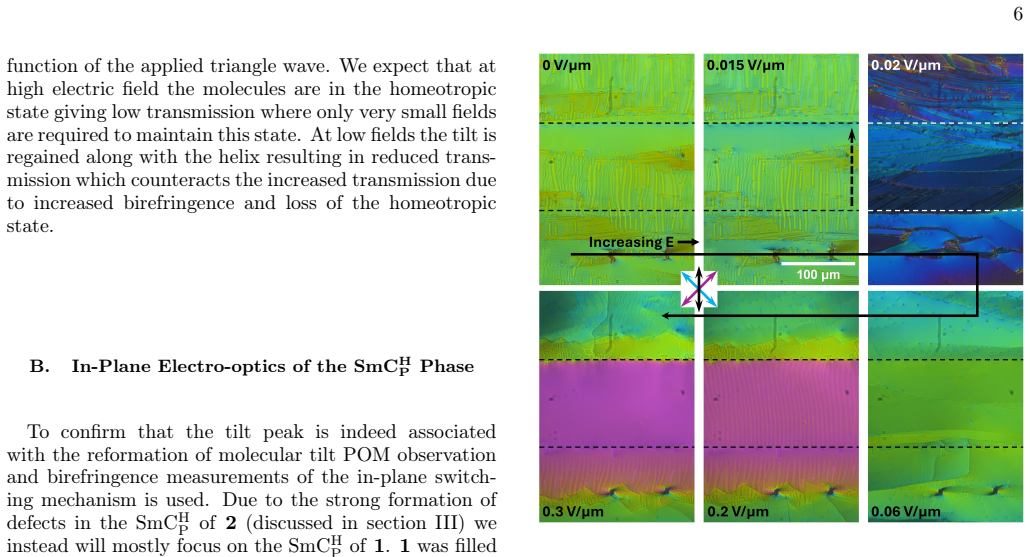
The central object is the SmCH_P phase, a polar smectic C phase whose tilted, ferroelectric-like layers are wound into a helix with a temperature-dependent pitch of roughly 400 to 1000 nm. The helix partially compensates the layer polarisation, so removing the tilt with an electric field raises the net polarisation and drives a transition into a non-helical, untilted SmAF-like state. The load-bearing measurement is the triangle-wave current-response experiment, in which a larger polarisation-reversal peak and a smaller pre-polarity tilt peak appear; the assignment of the small peak to tilt reformation is supported by simultaneous electro-optic transmission and by in-plane switching microscopy. The hysteresis loop in birefringence versus applied field, together with the three-component current structure, is the operational signature of the pseudo-ferrielectric response. A binary phase diagram between compounds 1 and 2 supplies the miscibility test that identifies the two phases as one.
What would settle it
A direct, time-resolved measurement of the molecular tilt angle during the triangle-wave cycle, for example synchrotron X-ray diffraction on a field-synchronised sample or optical measurement of the tilt-induced birefringence in an in-plane cell, would settle whether the small pre-polarity current peak coincides with tilt reformation. If the peak appears without any change in tilt, or persists in cells where the helix and tilt are prevented from reforming, the pseudo-ferrielectric interpretation would be refuted; the peak would then more plausibly be ion flow or a pitch-length effect.
Extended reading notes
Core claim
The paper's claim, stated on its own terms, is that the smectic phase of compound 2 previously labelled SmCF is actually a SmCH_P phase: a heliconical polar smectic C phase in which a ferroelectric-like, all-dipoles-aligned ground state is modulated by a molecular tilt that rotates around a helix. The evidence for structural identity is complete miscibility with the SmCH_P phase of compound 1 across the binary phase diagram, together with retention of selective reflection when the phase is formed on heating. Electro-optic current traces under a triangular field show two peaks: a large polarisation-reversal peak that corresponds to a field-induced transition into an untilted, non-helical SmAF-like state, and a smaller pre-polarity peak assigned to reformation of molecular tilt, and with it the helix. Birefringence-versus-field measurements reveal a clear threshold for tilt removal and hysteresis on field reduction, so the phase exhibits three hysteresis components: polarisation reversal plus tilt hysteresis in each polarisation state. The paper therefore calls the response pseudo-ferrielectric switching, while noting that the ground state is ferroelectric-like rather than a true two-sublattice ferrielectric. The NTBF phase in the same compounds undergoes the analogous field-induced change but threshold-lessly and without hysteresis, so it remains purely ferroelectric switching with an additional pseudo-paraelectric component.
Load-bearing premise
The entire pseudo-ferrielectric classification rests on the claim that the smaller pre-polarity current peak is the reformation of molecular tilt, inferred from concurrent electro-optic and in-plane microscope response; if that peak instead comes from ion flow or from helix pitch changes, the three-hysteresis-component interpretation would not stand.
Editorial extensions
If this is right
- The SmCH_P phase retains its heliconical order through multiple phase pathways, from SmAF, from NTBF, and from NF, so the phase's texture and defect structure depend on thermal history rather than being intrinsic to the phase alone.
- Because tilt removal has a threshold and hysteresis, SmCH_P can act as a fluid memory element: the untilted state survives at fields below the removal threshold once it has been written.
- The NTBF phase's threshold-less, hysteresis-free tilt removal means the two spontaneously chiral polar phases offer complementary switching behaviours, one memory-like and one continuously adjustable.
- A first-order transition into spontaneous heliconical order is possible, and in compound 3 it is accompanied by pre-transitional helix formation in the NF phase, implying the helix can nucleate before the smectic layers form.
Reading between the lines
- If the tilt-peak assignment is correct, then hysteresis-based memory could be written and read optically in a fluid polar phase; a testable extension would be pulse-writing experiments that measure whether the untilted, non-helical state persists after the writing field is removed.
- The same two-peak current structure reported for non-helical SmCP phases suggests pseudo-ferrielectric behaviour may be a general consequence of tilt reformation in polar smectics, not a unique property of helical order; comparing the hysteresis widths of helical and non-helical phases would test this directly.
- Pre-transitional helix formation at the first-order NF-SmCH_P boundary raises the possibility of measuring chirality amplification kinetics by fast temperature jumps or quenches across the boundary, which the present static microscopy does not resolve.
Editorial analysis
A structured set of objections, weighed in public.
Referee Report
Summary. This paper reports an experimental study of spontaneously chiral polar liquid crystals. It argues that the previously unidentified smectic phase of compound 2 is a SmCH_P phase, structurally identical to the helical polar smectic phase of compound 1, based on a binary miscibility diagram, textural comparison, and selective reflection. It further reports electro-optic and current-response measurements in which the SmCH_P phase shows two current peaks per half-cycle—a small pre-reversal peak assigned to reformation of molecular tilt and a large polarization-reversal peak—and birefringence hysteresis in field-induced tilt removal, which the authors label pseudo-ferrielectric switching, in contrast to the thresholdless, hysteresis-free response of the NT_BF phase. A third compound is used to show a first-order N_F–SmCH_P transition with a boundary region that exhibits selective reflection, interpreted as possible pre-transitional helix formation.
Significance. The phase-identity claim is well supported by complementary methods: complete miscibility in the binary diagram is the standard test, and the textural and selective-reflection observations corroborate helicity. The birefringence measurements of tilt removal and its hysteresis are quantitative and directly address the field-induced transition. If the peak assignment and the pre-transitional helix interpretation can be secured, the paper would establish a new switching phenomenology in polar heliconical smectics and provide a useful distinction between SmCH_P and NT_BF responses. The authors also provide openly available data and detailed synthetic characterization. However, the paper's headline pseudo-ferrielectric claim depends on an inferential assignment that is not yet quantitatively supported.
major comments (3)
- [Section V.A, Fig. 2a,b] The assignment of the smaller pre-polarity-reversal current peak to reformation of molecular tilt is the load-bearing step for the pseudo-ferrielectric claim. The evidence given—simultaneous electro-optic transmission changes and in-plane POM observations of striation removal—establishes a correlation but does not uniquely identify tilt reformation as the mechanism. The argument that a pitch change would not modulate polarization and that ion flow is ruled out by the coupled electro-optic response is qualitative. Because the same small peak could in principle arise from slow ion dynamics, a dielectric relaxation, or a field-induced change in helix pitch, the authors should provide a quantitative check, for example by comparing the integrated charge of the small peak with the change in polarization expected from the X-ray tilt-angle change, or by measuring the frequency dependence and cell-thickness dependence of the peak.
- [Section V.D] The paper defines ferrielectric phases by two unequal sublattices and then states that SmCH_P 'has three separate hysteresis components' because of polarization reversal plus tilt hysteresis in both polarities. This is not the standard three hysteresis loops of a ferrielectric P–E response, and the designation 'pseudo-ferrielectric' is introduced without a criterion that distinguishes it from a ferroelectric with a first-order field-induced order-parameter transition. If the term is retained, the authors should specify what observable would discriminate pseudo-ferrielectric switching from, say, a ferroelectric phase with surface-anchoring memory or a first-order tilt transition with hysteresis.
- [Section VI, Fig. 7] The abstract claims pre-transitional helix formation in the N_F phase at a first-order N_F–SmCH_P transition, but the text explicitly says the observation is 'interpreted as either' a vertical temperature-gradient artifact or a pre-transitional effect, and no experiment distinguishes these. Since this is one of the paper's advertised findings, the authors need either to resolve the ambiguity (for example, by varying the thermal gradient, measuring the spatial profile of the pitch, or using a different cell geometry) or to remove the claim from the abstract and conclusions.
minor comments (6)
- [Abstract] The sentence 'the polar smectic mesophase ... is also helical has a strongly varied textural morphology' is ungrammatical; a verb or conjunction is missing.
- [Section V.A, Fig. 2] The current-response panels are not accompanied by a quantitative current or polarization scale; reporting the integrated polarization for the two peaks would help readers assess the relative magnitude of the tilt and reversal contributions.
- [Section VI, Fig. 7] Pitch values are reported as '920 µm to less than 600 µm' and '∼800 µm' where the visible selective-reflection wavelengths indicate the values should be in nanometres; please correct the units and keep them consistent between the text and caption.
- [Table I and Section VI] Compound 4 is listed in Table I and is said to be discussed in Section VI, but the main text never discusses compound 4; the phase behavior of compound 4 should either be reported or the statement should be removed.
- [Supplementary Information, Scheme 1] The SI contains the placeholder text 'Insert scheme here' instead of the actual scheme; this must be replaced with the proper reaction scheme.
- [Section I] The phrase 'referred to aHCNF' needs spacing and formatting, and '2DX-rayscatteringimages' should be written with proper spacing and hyphenation.
Circularity Check
No circularity found: phase identity is established by miscibility and direct measurements, and the self-referential tilt-peak suggestion is re-tested experimentally.
full rationale
The paper contains no circular derivation. The identification of compound 2's SmCF phase as a SmCH_P phase is made by a binary miscibility phase diagram (Fig. 1j) between compounds 1 and 2, supported by selective reflection, pitch, and textural observations; the SmCH_P label comes from the authors' prior work, but the structural identity is independently established in this paper rather than assumed. The pseudo-ferrielectric switching claim is based on directly measured two-peak current responses, simultaneous electro-optic transmission, and in-plane POM showing striation removal and tilt hysteresis (Figs. 2, 3, 5, S3, S4); no fitted parameter is renamed as a prediction. The only self-referential element is the prior suggestion that the smaller pre-polarity current peak corresponds to tilt reformation, but this paper re-tests that suggestion with new electro-optic and POM data rather than taking it as a premise. The inferential character of the tilt-peak assignment is a possible correctness or evidence concern, not a circularity, because alternative explanations (ion flow, pitch variation) are considered and argued against on physical grounds. Accordingly, the circularity score is 0.
Assumptions & free parameters
assumptions (3)
- domain assumption Complete miscibility of two liquid crystal phases across a binary phase diagram implies the phases are structurally identical.
- domain assumption The smaller pre-polarity current peak corresponds to tilt reformation rather than ion flow or pitch variation.
- domain assumption The layer spacing of the non-tilted phase extrapolates linearly from the preceding phase to compute tilt angle.
Cite this review
Pith. "Pith review of Ferri- and Ferro-Electric Switching in Spontaneously Chiral Polar Liquid Crystals." pith.science (2026). https://pith.science/paper/HHHUIFNC
@misc{pith2026250208551,
  author       = {Pith},
  title        = {Pith review of: Ferri- and Ferro-Electric Switching in Spontaneously Chiral Polar Liquid Crystals},
  year         = {2026},
  howpublished = {\url{https://pith.science/paper/HHHUIFNC}},
  note         = {Machine review of arXiv:2502.08551}
}
read the original abstract
The recent discovery of spontaneous chiral symmetry breaking has demonstrated the possibility of discovering the exotic textures of ferromagnetic systems in liquid crystalline fluid ferro-electrics. We show that the polar smectic mesophase exhibited by the first molecule discovered to exhibit a spontaneously chiral ferroelectric nematic phase is also helical has a strongly varied textural morphology depending in its thermal history and phase ordering. Electro-optic studies demonstrate that the two spontaneously chiral phases exhibit field induced phase transitions. For the nematic variant, this process is threshold-less and has no hysteresis while for the smectic it has a clear threshold and shows hysteresis meaning this phase exhibits pseudo-ferrielectric switching, the first of its kind for ferroelectric nematic like phases. We show that helix formation can be both 1st and 2nd order but when it is 1st it is accompanied by pre-transitional helix formation in the preceding ferroelectric nematic phase.
Figures


Figures from the paper (4 more)


Reference graph
Works this paper leans on
-
[1]
D. G. Blackmond, The origin of biological homochirality, Cold Spring Harbor Perspectives in Biology2, a002147 (2010)
work page 2010
-
[2]
Z. Shen, Y. Sang, T. Wang, J. Jiang, Y. Meng, Y. Jiang, K. Okuro, T. Aida, and M. Liu, Asymmetric catalysis mediated by a mirror symmetry-broken helical nanorib- bon, Nature Communications10, 3976 (2019)
work page 2019
-
[3]
P. W. Higgs, Broken symmetries and the masses of gauge bosons, Phys. Rev. Lett.13, 508 (1964)
1964
-
[4]
F. Gu, B. Guiselin, N. Bain, I. Zuriguel, and D. Bar- tolo, Emergence of collective oscillations in massive hu- man crowds, Nature638, 112 (2025)
2025
-
[5]
Tschierske, Mirror symmetry breaking in liquids and liquid crystals, Liquid Crystals45, 2221 (2018)
C. Tschierske, Mirror symmetry breaking in liquids and liquid crystals, Liquid Crystals45, 2221 (2018)
work page 2018
-
[6]
S. T. Lagerwall, Ferroelectric and antiferroelectric liquid crystals, Ferroelectrics 301, 15 (2004)
work page 2004
-
[7]
H. Takezoe, E. Gorecka, and M. Čepič, Antiferroelectric liquid crystals: Interplay of simplicity and complexity, Rev. Mod. Phys.82, 897 (2010)
work page 2010
-
[8]
A. Eremin and A. Jákli, Polar bent-shape liquid crystals – from molecular bend to layer splay and chirality, Soft Matter 9, 615 (2013)
work page 2013
Show all 65 references
-
[9]
Jákli, O
A. Jákli, O. D. Lavrentovich, and J. V. Selinger, Physics of liquid crystals of bent-shaped molecules, Rev. Mod. Phys. 90, 045004 (2018)
2018
-
[10]
S. P. Sreenilayam, Y. P. Panarin, J. K. Vij, V. P. Panov, A. Lehmann, M. Poppe, M. Prehm, and C. Tschierske, Spontaneous helix formation in non-chiral bent-core liq- uid crystals with fast linear electro-optic effect, Nature Communications 7, 11369 (2016)
2016
-
[11]
C. T. Imrie, R. Walker, J. M. D. Storey, E. Gorecka, and D. Pociecha, Liquid crystal dimers and smectic phases fromtheintercalatedtothetwist-bend,Crystals 12,1245 (2022)
2022
-
[12]
R. J. Mandle, A ten-year perspective on twist-bend ne- matic materials, Molecules27, 2689 (2022)
2022
-
[13]
R. J. Mandle, S. J. Cowling, and J. W. Goodby, A nematic to nematic transformation exhibited by a rod- like liquid crystal, Phys. Chem. Chem. Phys.19, 11429 (2017)
2017
-
[14]
R. J. Mandle, S. J. Cowling, and J. W. Goodby, Ra- tional design of rod-like liquid crystals exhibiting two nematic phases, Chemistry – A European Journal 23, 14554 (2017)
2017
-
[15]
Nishikawa, K
H. Nishikawa, K. Shiroshita, H. Higuchi, Y. Okumura, Y. Haseba, S.-i. Yamamoto, K. Sago, and H. Kikuchi, A fluid liquid-crystal material with highly polar order, Advanced Materials29, 1702354 (2017)
2017
-
[16]
Mertelj, L
A. Mertelj, L. Cmok, N. Sebastián, R. J. Mandle, R. R. Parker, A. C. Whitwood, J. W. Goodby, and M. Čopič, Splay nematic phase, Phys. Rev. X8, 041025 (2018)
2018
-
[17]
X. Chen, E. Korblova, D. Dong, X. Wei, R. Shao, L. Radzihovsky, M. A. Glaser, J. E. Maclennan, D. Bedrov, D. M. Walba, and N. A. Clark, First- principles experimental demonstration of ferroelectricity in a thermotropic nematic liquid crystal: Polar domains and striking electro...
2020
-
[18]
Sebastián, L
N. Sebastián, L. Cmok, R. J. Mandle, M. R. de la Fuente, I. Drevenšek Olenik, M. Čopič, and A. Mertelj, Ferroelectric-ferroelastic phase transition in a nematic 11 liquid crystal, Phys. Rev. Lett.124, 037801 (2020)
2020
-
[19]
R. J. Mandle, N. Sebastián, J. Martinez-Perdiguero, and A. Mertelj, On the molecular origins of the ferroelectric splay nematic phase, Nature Communications12, 4962 (2021)
2021
-
[20]
J. Li, H. Nishikawa, J. Kougo, J. Zhou, S. Dai, W. Tang, X. Zhao, Y. Hisai, M. Huang, and S. Aya, Development of ferroelectric nematic fluids with giant-ϵ dielectricity and nonlinear optical properties, Science Advances 7, eabf5047 (2021)
2021
-
[21]
Sebastián, M
N. Sebastián, M. Čopič, and A. Mertelj, Ferroelectric ne- matic liquid-crystalline phases, Phys. Rev. E106, 021001 (2022)
2022
-
[22]
Kumari, B
P. Kumari, B. Basnet, M. O. Lavrentovich, and O. D. Lavrentovich, Chiral ground states of ferroelectric liquid crystals, Science 383, 1364 (2024)
2024
-
[23]
Cruickshank, The emergence of a polar nematic phase: A chemist’s insight into the ferroelectric nematic phase, ChemPlusChem 89, e202300726 (2024)
E. Cruickshank, The emergence of a polar nematic phase: A chemist’s insight into the ferroelectric nematic phase, ChemPlusChem 89, e202300726 (2024)
2024
-
[24]
C. J. Gibb, J. Hobbs, and R. J. Mandle, Systematic fluo- rination is a powerful design strategy toward fluid molec- ular ferroelectrics, Journal of the American Chemical So- ciety 147, 4571 (2025)
2025
-
[25]
X. Chen, E. Korblova, M. A. Glaser, J. E. Maclen- nan, D. M. Walba, and N. A. Clark, Polar in-plane sur- face orientation of a ferroelectric nematic liquid crys- tal: Polar monodomains and twisted state electro-optics, Proceedings of the National Academy of Sciences118, e21040...
2021
-
[26]
X. Chen, V. Martinez, P. Nacke, E. Korblova, A. Man- abe, M. Klasen-Memmer, G. Freychet, M. Zhernenkov, M. A. Glaser, L. Radzihovsky, J. E. Maclennan, D. M. Walba, M. Bremer, F. Giesselmann, and N. A. Clark, Observation of a uniaxial ferroelectric smectic a phase, Proceedings ...
2022
-
[27]
Kikuchi, H
H. Kikuchi, H. Matsukizono, K. Iwamatsu, S. Endo, S. Anan, and Y. Okumura, Fluid layered ferroelectrics with global C∞v symmetry, Advanced Science9, 2202048 (2022)
2022
-
[28]
X. Chen, V. Martinez, E. Korblova, G. Freychet, M. Zh- ernenkov, M. A. Glaser, C. Wang, C. Zhu, L. Radzi- hovsky, J. E. Maclennan, D. M. Walba, and N. A. Clark, The smectic zA phase: Antiferroelectric smectic order as a prelude to the ferroelectric nematic, Proceedings of the ...
2023
-
[29]
C. J. Gibb, J. Hobbs, D. I. Nikolova, T. Raistrick, S. R. Berrow, A. Mertelj, N. Osterman, N. Sebastián, H. F. Gleeson, and R. J. Mandle, Spontaneous symme- try breaking in polar fluids, Nature Communications15, 5845 (2024)
2024
-
[30]
Hobbs, C
J. Hobbs, C. J. Gibb, D. Pociecha, J. Szydłowska, E. Górecka, and R. J. Mandle, Polar order in a fluid like ferroelectric with a tilted lamellar structure – observation of a polar smectic c (SmCP) phase, Angewandte Chemie International Edition 64, e202416545 (2025)
2025
-
[31]
Kikuchi, H
H. Kikuchi, H. Nishikawa, H. Matsukizono, S. Iino, T. Sugiyama, T. Ishioka, and Y. Okumura, Ferroelectric smectic c liquid crystal phase with spontaneous polariza- tion in the direction of the director, Advanced Science 11, 2409827 (2024)
2024
-
[32]
G. J. Strachan, E. Górecka, J. Szydłowska, A. Makal, and D. Pociecha, Nematic and smectic phases with proper ferroelectric order, Advanced Science , 2409754 (2024)
2024
-
[33]
Medle Rupnik, E
P. Medle Rupnik, E. Hanžel, M. Lovšin, N. Osterman, C. J. Gibb, R. J. Mandle, N. Sebastián, and A. Mertelj, Antiferroelectric order in nematic liquids: Flexoelectric- ity versus electrostatics, Advanced Science , 2414818 (2025)
2025
-
[34]
J.Karcz, J.Herman, N.Rychłowicz, P.Kula, E.Górecka, J.Szydlowska, P.W.Majewski,andD.Pociecha,Sponta- neous chiral symmetry breaking in polar fluid–heliconical ferroelectric nematic phase, Science384, 1096 (2024)
2024
-
[35]
G. J. Strachan, E. Górecka, J. Hobbs, and D. Pociecha, Fluorination: Simple change but complex impact on ferroelectric nematic and smectic liquid crystal phases, Journal of the American Chemical Society 10.1021/jacs.4c16802 (2025)
2025 doi
-
[36]
straight
H. Nishikawa, D. Okada, D. Kwaria, A. Nihonyanagi, M. Kuwayama, M. Hoshino, and F. Araoka, Emergent ferroelectric nematic and heliconical ferroelectric nematic states in an achiral “straight” polar rod mesogen, Ad- vanced Science 11, 2405718 (2024)
2024
-
[37]
Hobbs, C
J. Hobbs, C. J. Gibb, and R. J. Mandle, Emergent an- tiferroelectric ordering and the coupling of liquid crys- talline and polar order, Small Science4, 2400189 (2024)
2024
-
[38]
K. G. Hedlund, V. Martinez, X. Chen, C. S. Park, J. E. Maclennan, M. A. Glaser, and N. A. Clark, Freely suspended nematic and smectic films and free-standing smectic filaments in the ferroelectric nematic realm, Phys. Chem. Chem. Phys. 10.1039/D4CP03425B (2025)
2025 doi
-
[39]
N. A. Clark and P. S. Pershan, Light scattering by de- formation of the plane texture of smectic and cholesteric liquid crystals, Phys. Rev. Lett.30, 3 (1973)
1973
-
[40]
Demus, S
D. Demus, S. Diele, S. Grande, and H. Sackmann, Poly- morphism in thermotropic liquid crystals, inAdvances in Liquid Crystals, Vol. 6, edited by G. H. Brown (Elsevier, 1983)
1983
-
[41]
X. Chen, Z. Zhu, M. J. Magrini, E. Korblova, C. S. Park, M. A. Glaser, J. E. Maclennan, D. M. Walba, and N. A. Clark, Ideal mixing of paraelectric and ferroelec- tricnematicphasesinliquidcrystalsofdistinctmolecular species, Liquid Crystals49, 1531 (2022)
2022
-
[42]
Walker, D
R. Walker, D. Pociecha, G. J. Strachan, J. M. D. Storey, E. Gorecka, and C. T. Imrie, Molecu- lar curvature, specific intermolecular interactions and the twist-bend nematic phase: the synthesis and characterisation of the 1-(4-cyanobiphenyl-4 ′-yl)-6-(4- alkylanilinebenzyliden...
2019
-
[43]
Pociecha, N
D. Pociecha, N. Vaupotič, M. Majewska, E. Cruickshank, R. Walker, J. M. D. Storey, C. T. Imrie, C. Wang, and E. Gorecka, Photonic bandgap in achiral liquid crys- tals—a twist on a twist, Advanced Materials33, 2103288 (2021)
2021
-
[44]
A. F. Alshammari, A. Zattarin, A. Pearson, E. Cruick- shank, M. Majewska, D. Pociecha, J. M. Storey, E. Gorecka, C. T. Imrie, and R. Walker, Heliconical ne- maticandsmecticphases: thesynthesisandcharacterisa- tion of the CB4O.m and CB8O.m series, Liquid Crystals , 1 (2024)
2024
-
[45]
tilt” peak and the larger one as the “polarisation reversal
which can be somewhat reduced when formed from a De Vries SmA phase where the randomly orientated molecular tilt reduces chevron formation [46]. V. ELECTRO-OPTICS AND FERRIELECTRIC SWITCHING A. Current Response Measurements The current response of the SmCH P of 1 in a 4µm cell...
-
[46]
T. P. Rieker, N. A. Clark, G. S. Smith, D. S. Par- mar, E. B. Sirota, and C. R. Safinya, "chevron" local layer structure in surface-stabilized ferroelectric smectic- c cells, Phys. Rev. Lett.59, 2658 (1987)
1987
-
[47]
J. P. F. Lagerwall and F. Giesselmann, Current topics in smectic liquid crystal research, ChemPhysChem7, 20 (2006). 12
2006
-
[48]
Sebastián, R
N. Sebastián, R. J. Mandle, A. Petelin, A. Eremin, and A. Mertelj, Electrooptics of mm-scale polar domains in the ferroelectric nematic phase, Liquid Crystals48, 2055 (2021)
2021
-
[49]
Basnet, M
B. Basnet, M. Rajabi, H. Wang, P. Kumari, K. Thapa, S. Paul, M. O. Lavrentovich, and O. D. Lavrentovich, Soliton walls paired by polar surface interactions in a ferroelectric nematic liquid crystal, Nature Communica- tions 13, 3932 (2022)
2022
-
[50]
Thapa, S
K. Thapa, S. Paladugu, and O. D. Lavrentovich, Mi- crosecond electro-optic switching in the nematic phase of a ferroelectric nematic liquid crystal, Opt. Express32, 40274 (2024)
2024
-
[51]
Basnet, S
B. Basnet, S. Paladugu, O. Kurochkin, O. Buluy, N. Aryasova, V. G. Nazarenko, S. V. Shiyanovskii, and O. D. Lavrentovich, Periodic splay fréedericksz transi- tions in a ferroelectric nematic, Nature Communications 16, 1444 (2025)
2025
-
[52]
S. T. Lagerwall, Ferroelectric liquid crystals, in Hand- book of Liquid Crystals (John Wiley & Sons, Ltd, 2014) Chap. 5
2014
-
[53]
Z. Fu, X. Chen, Z. Li, T. Hu, L. Zhang, P. Lu, S. Zhang, G. Wang, X. Dong, and F. Xu, Unveiling the ferrielectric nature of pbzro3-based antiferroelectric materials, Na- ture Communications 11, 3809 (2020)
2020
-
[54]
Węgłowska, M
D. Węgłowska, M. Czerwiński, R. Dzienisiewicz, P. Perkowski, J. Szydłowska, D. Pociecha, and M. Mrukiewicz, The balance between paraelectricity and ferroelectricity in non-chiral smectic homologs (2024), arXiv:2412.20508 [cond-mat.mtrl-sci]
2024 arXiv
-
[55]
Cruickshank, R
E. Cruickshank, R. Walker, G. J. Strachan, E. Górecka, D. Pociecha, J. M. D. Storey, and C. T. Imrie, The role of fluorine substituents in the formation of the ferroelectric nematic phase, J. Mater. Chem. C 10.1039/D4TC03318C (2025)
2025 doi
-
[56]
Nishikawa, Y
H. Nishikawa, Y. Okumura, D. Kwaria, A. Nihonyanagi, and F. Araoka, Spontaneous twist of ferroelectric smec- tic blocks in polar fluids (2025), arXiv:2502.03319 [cond- mat.soft]. Supplementary Information: Ferri- and Ferro-Electric Switching in Spontaneously Chiral Polar Liqui...
2025 arXiv
-
[57]
Supplementary methods
-
[58]
Supplementary results
-
[59]
Supplementary References
-
[60]
powder” samples. It should be noted that some spontaneous alignment of the LCs both within the capillaries and between the Kapton tape did occur leading to the classic “lobe
SUPPLEMENTARY METHODS 1.1. Chemical Synthesis Chemicals were purchased from commercial suppliers (Fluorochem, Merck, ChemScene, Am- beed) and used as received. Solvents were purchased from Merck and used without further purification. Reactions were performed in standard labora...
2025 arXiv
-
[61]
SUPPLEMENTARY RESULTS FIG. S1. POM images of compound1 in a 5µm thick parallel rubbed planar cell at a) 120°C in the SmAF phase on heating, b) 150°C in the SmA phase on heating and c) 120°C in the SmAF phase on cooling. The blue and purple arrows indicate the polariser axes wh...
-
[62]
The synthesis of material1 and the preparation of 2,6-difluoro-4-(5-propyl-1,3-dioxan-2-yl)benzoic acid is reported elsewhere [1,2] 3.1
ORGANIC SYNTHESIS The synthetic route and chemical characterisation data associated with intermediate prod- ucts and materials2-4 is given below. The synthesis of material1 and the preparation of 2,6-difluoro-4-(5-propyl-1,3-dioxan-2-yl)benzoic acid is reported elsewhere [1,2]...
-
[63]
SUPPLEMENTAL REFERENCES
-
[64]
Gibb, C.J., Hobbs, J., Nikolova, D.I. et al. Spontaneous symmetry breaking in polar fluids. Nat Commun, 15, 5845 (2024)
2024
-
[65]
and Mandle, R.J
Hobbs, J., Gibb, C.J. and Mandle, R.J. Emergent Antiferroelectric Ordering and the 23 Coupling of Liquid Crystalline and Polar Order. Small Sci., 4, 2400189 (2024) 24
2024
Reviewed August 8, 2026 · model on record in the stance chip above.
Discussion (0). Continue with ORCID to comment.