REVIEW 5 minor 2 cited by
Dispersion relations of relativistic radiation hydrodynamics
T0 review · 0 major / 5 minor · reviewed 2026-08-12 · deepseek-v4-flash
Pith's one-line read This paper derives analytic dispersion relations for shear, heat, and sound waves in a relativistic radiating fluid, exact to first order in the radiation-to-matter stress-energy ratio for all real wavenumbers.
desk verdict Solid, explicit dispersion relations for relativistic radiation hydrodynamics; the sound-wave result is new, and the uniform-in-k claim is slightly stronger than proven. read the letter →
The pith
A machine-rendered reading of the paper's core claim, the machinery that carries it, and where it could break.
The reading
What carries the argument
The load-bearing object is the linearized relativistic Boltzmann equation for photons with a grey BGK collision term, $p^\mu\partial_\mu f = p^\mu u_\mu (f-f_{\rm eq})/\tau$, coupled to ideal-fluid conservation laws for matter. All mode calculations reduce to angular integrals over the photon direction $\Omega$ with denominator $1 - i\omega\tau + ik\tau\Omega_1$, which are evaluated in closed form as arctangents; the small parameter is the radiation-to-matter stress-energy ratio, so each dispersion relation is a first-order expansion in the corresponding transport coefficient $D/\tau$. These integrals carry the full $k$-dependence, so the formulas remain valid in the optically thin regime where ordinary viscous hydrodynamics breaks down.
What would settle it
Measure the shear-wave damping rate in an optically thin, grey-absorbing relativistic plasma: equation (1) predicts a finite relaxation rate $-5iD_s/\tau^2$ independent of wavenumber, whereas ordinary diffusion predicts a $k^2$-dependent rate; observing the diffusive behavior would falsify the paper's central claim.
Extended reading notes
Core claim
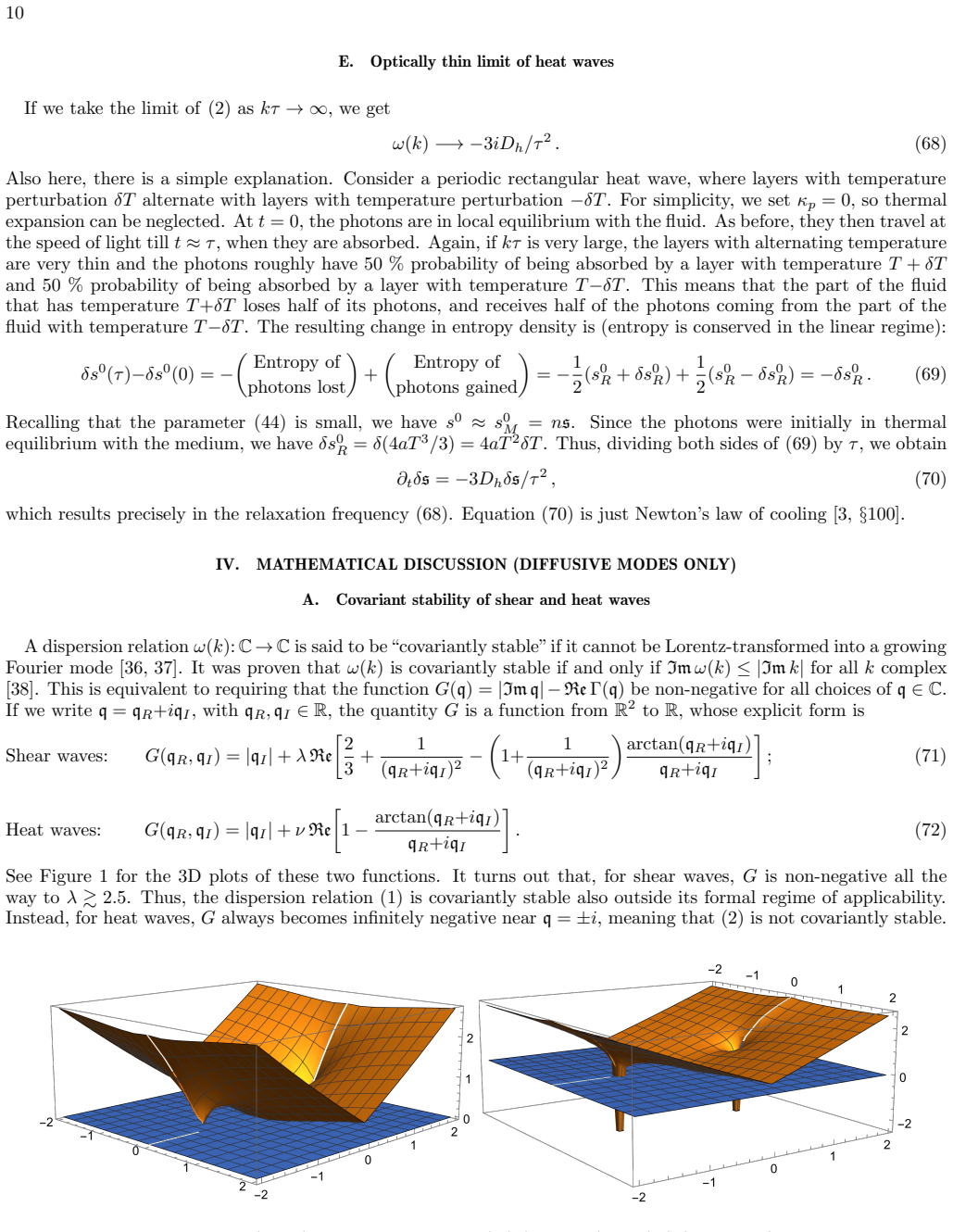
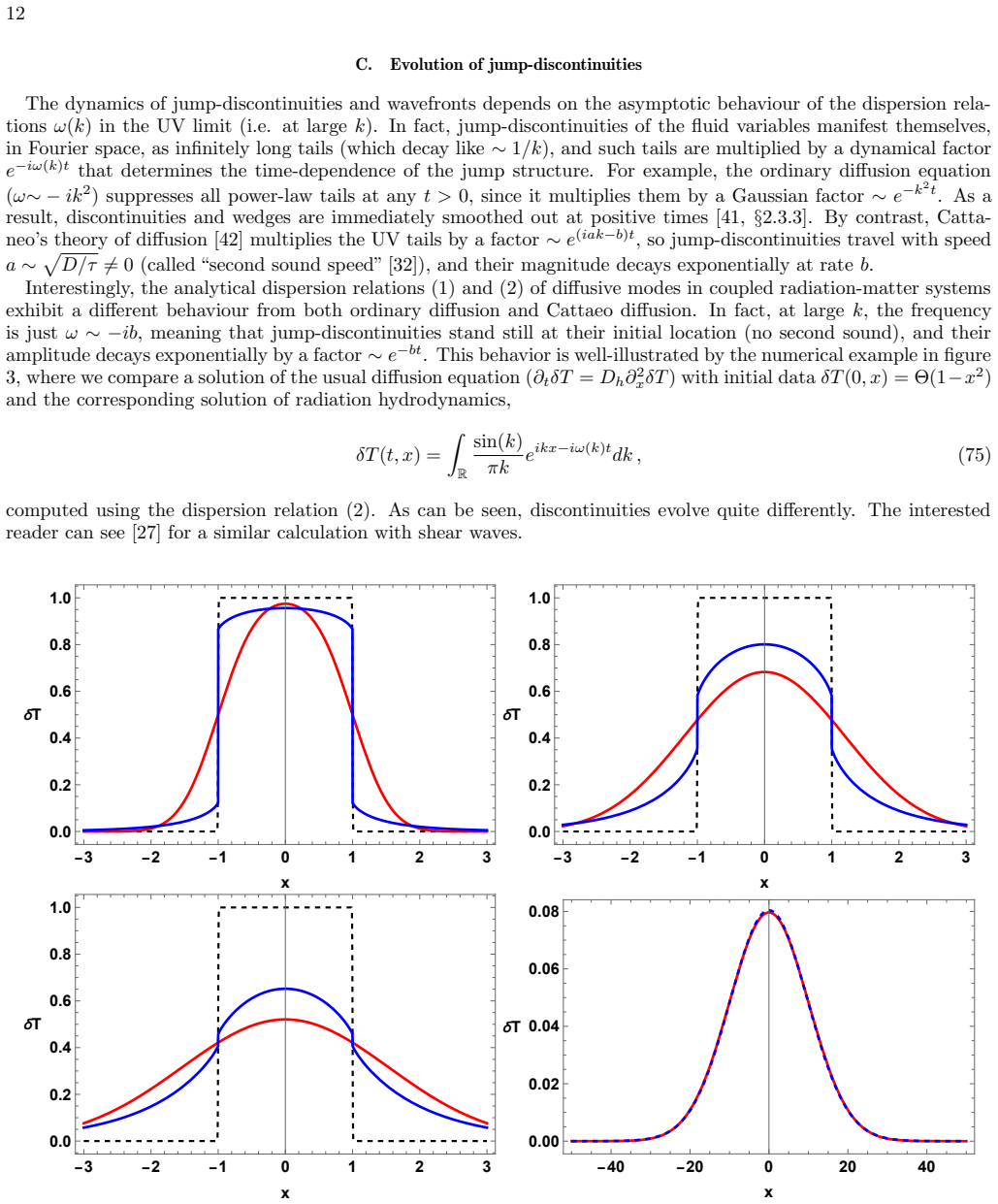
The central claim is that equations (1)–(3) give the exact-to-first-order dispersion relations for shear, heat, and sound waves in a relativistic matter-plus-radiation fluid with grey absorption, valid for all real $k$. Each $\omega(k)$ is a closed expression built from rational functions and arctangents of $k\tau$, obtained by expanding the exact linearized equations in the small parameter $\lambda \approx T^{00}_R/T^{00}_M$. The heat-wave result corrects the earlier coefficient from constant-volume to constant-pressure specific heat; the shear-wave formula reproduces a recent purely geometric derivation; and the sound-wave formula is new, derived under the additional assumption of vanishing isobaric thermal expansivity. Analytically, the formulas imply shear waves are covariantly stable for $\lambda$ up to about 2.5, heat waves are not covariantly stable at $q=\pm i$, and all three branches make jump discontinuities stand still and decay exponentially rather than propagate.
Load-bearing premise
The results hold only if the photon opacity is grey (a single constant mean free path), scattering is negligible, and radiation pressure is a small fraction of gas pressure; if any of these fails at leading order, the formulas no longer describe the system.
Editorial extensions
If this is right
- In the optically thick limit the three dispersion relations reproduce the standard relativistic Navier-Stokes transport coefficients for radiation: shear viscosity $\eta = 4aT^4\tau/15$, heat conductivity $\kappa = 4aT^3\tau/3$, and bulk viscosity $\zeta = 4aT^4\tau/9$.
- M1-closure radiation hydrodynamics misses shear-wave damping entirely, overestimates heat-wave damping at intermediate optical depths, and gets the acoustic diffusivity wrong, although it reproduces the correct conglomerate sound speed.
- Jump discontinuities in fluid velocity or temperature do not propagate as second sound; their fronts remain fixed and decay exponentially at a rate set by $D/\tau^2$.
- The Chapman-Enskog expansion has finite radius of convergence $\tau^{-1}$ for diffusive modes and $\tau^{-1}/(1+c_s)$ for sound modes, so third-order (super-Burnett) viscous hydrodynamics is unstable in radiating fluids.
- Shear-wave modes are covariantly stable for $\lambda$ up to about 2.5, while the heat-wave branch is not covariantly stable near $k\tau = \pm i$, marking where the perturbative derivation breaks down.
Reading between the lines
- Going beyond the paper: a frequency-dependent (non-grey) opacity would likely replace the constant $\tau$ by a spectrally averaged mean free path in the same arctangent structure, changing the quantitative damping but not the qualitative form; the paper does not state this.
- Going beyond the paper: the predicted non-propagating decay of discontinuities could be tested in an existing radiation-hydrodynamics code by running a Riemann problem at $R\approx 0.01$ and comparing the temperature front with Eq. (75).
- Going beyond the paper: the same perturbative machinery could be applied to neutrino radiation in core-collapse supernovae, where the grey approximation is known to be crude; the formulas here supply the baseline against which spectral opacity effects would appear.
Editorial analysis
A structured set of objections, weighed in public.
Referee Report
Summary. The manuscript derives analytic dispersion relations for the five hydrodynamic modes of a relativistic two-component system consisting of an ideal-fluid matter sector and a photon gas coupled by grey absorption/emission (a BGK-type collision term). Working at first order in the radiation-to-matter stress-energy ratio, the author obtains closed-form expressions (1)-(3) for shear, heat, and sound waves as functions of real wavenumber k. The derivation is explicit: after linearizing the coupled conservation and Boltzmann equations, each branch is obtained from an exact implicit equation [Eqs. (25), (37)-(39), (48)-(49)] by Taylor expansion in the small parameters λ or ν at fixed q=kτ. The resulting transport coefficients D_s and D_h are read off from the long-wavelength expansions and cross-checked against Weinberg's viscosity and conductivity coefficients. The paper then studies optically thick/thin limits, covariant stability, causality and localization of initial data, jump-discontinuity evolution, and the failure of the M1 closure for shear damping.
Significance. If the results are correct, this is a valuable analytic benchmark for radiation hydrodynamics: it gives explicit first-order-in-λ formulas with nonperturbative dependence on kτ, including UV relaxation rates, and it supports concrete claims about stability, causality, and discontinuity evolution. The derivation is transparent and free of fitted parameters, and the paper ships exact implicit equations that make the perturbative step checkable. The independent cross-checks against Weinberg's transport coefficients and Spiegel's heat-wave formula are strong, as is the comparison with the M1 closure, which usefully exposes the M1 model's inability to damp shear modes. The treatment of the κ_p=0 restriction is honest but should be more prominently displayed.
minor comments (5)
- [II.D and abstract] The statement that Eq. (30) is "a good approximation ... for arbitrary values of k" should be read as a first-order asymptotic expansion at fixed q=kτ. The paper does not prove a uniform-in-q bound on the O(λ²) remainder; however, inspection of the exact implicit equation (25) suggests that the remainder does not blow up as q→∞ (for example, Γ=-2λ/3+O(λ/q+λ²/q²) for large q). Please add a clarifying sentence about the fixed-q versus uniform sense of the approximation so that the claim "for any k∈R" is not over-read.
- [IV.A, Eq. (71)] The assertion that G≥0 for shear waves "all the way to λ≳2.5" appears to be based on numerical plots (Figure 1). Please state explicitly that this is numerical evidence rather than an analytic proof.
- [II.F and footnote 2] Because Eq. (3) is derived under the additional assumption κ_p=0, the abstract and Section I should state this condition next to assumptions (a)-(c). The current placement in a footnote is easy to miss, especially since the abstract promises sound-wave dispersion relations without this qualification.
- [Eq. (3) and Section III.D] The complex arctangent in Eq. (3) should specify the chosen branch, so that the formula is unambiguous for real k and its optically thin limit reproduces Eq. (64).
- [Section II heading, footnote 7, Figure 3 caption] Typos: "DISPERISON" in the Section II heading, "detials" in footnote 7, "respectivly" in the Figure 3 caption, and "affectively" in footnote 7 should be corrected.
Circularity Check
No significant circularity: the dispersion relations are obtained by explicit perturbative solution of the linearized radiative Boltzmann equation, with transport coefficients defined from the resulting Taylor coefficients rather than fitted to the target curves.
full rationale
The paper's derivation chain is self-contained. For shear waves, the exact implicit relation (25) comes directly from the linearized Boltzmann equation and conservation laws; the first-order coefficient Γ′(0) is obtained by differentiating the implicit function F(λ,Γ(λ))=0 at λ=0 (Eq. 27), and Ds is then defined from the leading Taylor coefficient (Eq. 29). For heat waves, the small-ν expansion is applied to the same linearized system, Γ′(0) is computed from an explicit angular integral (Eq. 40), and Dh is likewise defined from the k² coefficient (Eq. 44). For sound waves, w′(0) is computed from an explicit integral (Eq. 50) and then re-expressed in terms of the previously defined Ds. No dispersion relation or transport coefficient is fed back into the derivation, and no parameter is fitted to the quantities being predicted. The self-citations to [27], [38], and [39] are used for cross-checking or for invoking independently stated mathematical criteria; they do not carry the burden of the derivation. The agreement with Spiegel (1957) is explicitly acknowledged, with the difference in cp versus cv explained. The residual concern about the phrase 'valid for all real k' is a question of uniform remainder estimates in the Taylor expansion, which is a correctness/rigor issue rather than circularity.
Assumptions & free parameters
assumptions (6)
- domain assumption Matter is a relativistic ideal fluid in local thermodynamic equilibrium with ideal-fluid stress-energy tensor and baryon current (Eq. 5).
- domain assumption Photons satisfy the grey BGK Boltzmann equation with constant mean free path tau and no scattering (Eq. 6).
- domain assumption The radiation-to-matter stress-energy ratio is small, so first-order expansion in lambda or nu is valid (assumption (c)).
- ad hoc to paper The isobaric thermal expansivity of matter vanishes for the sound-wave calculation (kappa_p = 0).
- domain assumption Perturbations are sinusoidal plane waves with real wavenumber k and complex frequency omega.
- standard math Standard thermodynamic identities and relativistic kinetic theory results, including the Kirchhoff-Planck relation and blackbody integrals, are assumed.
Cite this review
Pith. "Pith review of Dispersion relations of relativistic radiation hydrodynamics." pith.science (2026). https://pith.science/paper/HHMAVAWK
@misc{pith2026241200275,
  author       = {Pith},
  title        = {Pith review of: Dispersion relations of relativistic radiation hydrodynamics},
  year         = {2026},
  howpublished = {\url{https://pith.science/paper/HHMAVAWK}},
  note         = {Machine review of arXiv:2412.00275}
}
abstract
We compute the linearised dispersion relations of shear waves, heat waves, and sound waves in relativistic ''matter+radiation'' fluids with grey absorption opacities. This is done by solving radiation hydrodynamics perturbatively in the ratio ''radiation stress-energy''/''matter stress-energy''. The resulting expressions $\omega \, {=} \, \omega(k)$ accurately describe the hydrodynamic evolution for any $k\, {\in}\, \mathbb{R}$. General features of the dynamics (e.g., covariant stability, propagation speeds, and damping of discontinuities) are argued directly from the analytic form of these dispersion relations.
Figures

Figures from the paper (2 more)


Forward citations
Cited by 2 Pith papers
-
Causality constraints on radiative transfer
Including the finite travel time of photons fixes the acausal instability of Spiegel's radiative transfer formula and yields exact, hydrohedron-compatible transport coefficients.
-
The quasi-normal modes of relativistic Fokker-Planck kinetic theory
The quasi-normal spectrum of ultrarelativistic Fokker-Planck kinetic theory consists of an exact diffusive hydrodynamic mode, continuous ballistic bands, and a hydrogenic discrete tower in three dimensions.
Reference graph
Works this paper leans on
-
[1]
D. Prialnik, An Introduction to the Theory of Stellar Structure and Evolution (Cambridge University Press, Cambridge, 2009)
work page 2009
-
[2]
G. C. Pomraning, The equations of radiation hydrodynamics (Dover Publications, Mineola, 1973)
1973
-
[3]
Mihalas and B
D. Mihalas and B. Weibel Mihalas, Foundations of radiation hydrodynamics (Oxford University Press, Oxford, 1984)
1984
-
[4]
J. I. Castor, Radiation Hydrodynamics (Cambridge University Press, 2004)
2004
-
[5]
L. H. Thomas, The Quarterly Journal of Mathematics 1, 239 (1930)
work page 1930
-
[6]
Weinberg, ApJ 168, 175 (1971)
S. Weinberg, ApJ 168, 175 (1971)
1971
- [7]
-
[8]
K. S. Thorne, MNRAS 194, 439 (1981)
work page 1981
Show all 63 references
-
[9]
A. M. Anile, S. Pennisi, and M. Sammartino, Annales de l’I.H.P. Physique th´ eorique 56, 49 (1992)
1992
-
[10]
B. D. Farris, T. K. Li, Y. T. Liu, and S. L. Shapiro, Phys. Rev. D 78, 024023 (2008), arXiv:0802.3210 [astro-ph]
2008 arXiv
-
[11]
Sadowski, R
A. Sadowski, R. Narayan, A. Tchekhovskoy, and Y. Zhu, MNRAS 429, 3533 (2013), arXiv:1212.5050 [astro-ph.HE]
2013 arXiv
-
[12]
S. R. de Groot, W. A. van Leeuwen, and C. G. van Weert, Relativistic kinetic theory: principles and applications (1980)
1980
-
[13]
C. W. Misner, K. S. Thorne, and J. A. Wheeler, Gravitation (W.H. Freeman and Co., San Francisco, 1973)
1973
-
[14]
J. A. McLennan, Physics of Fluids 8, 1580 (1965)
1965
-
[15]
Kurkela and U
A. Kurkela and U. A. Wiedemann, Eur. Phys. J. C 79, 776 (2019), arXiv:1712.04376 [hep-ph]
2019 arXiv
-
[16]
Grozdanov, A
S. Grozdanov, A. Lucas, and N. Poovuttikul, Phys. Rev. D 99, 086012 (2019), arXiv:1810.10016 [hep-th]
2019 arXiv
- [17]
-
[18]
Gavassino, M
L. Gavassino, M. Antonelli, and B. Haskell, Phys. Rev. D 106, 056010 (2022)
2022
-
[19]
Gavassino, Phys
L. Gavassino, Phys. Rev. Res. 6, L042043 (2024), arXiv:2404.12327 [nucl-th]
2024 arXiv
-
[20]
Gavassino, Phys
L. Gavassino, Phys. Rev. D 110, 094012 (2024), arXiv:2408.14316 [nucl-th]
2024 arXiv
-
[21]
E. A. Spiegel, ApJ 126, 202 (1957)
1957
-
[22]
Eckart, Phys
C. Eckart, Phys. Rev. 58, 919 (1940)
1940
-
[23]
Gavassino, M
L. Gavassino, M. Antonelli, and B. Haskell, Physical Review D 102 (2020), 10.1103/physrevd.102.043018
2020 doi
-
[24]
Israel and J
W. Israel and J. Stewart, Annals of Physics 118, 341 (1979)
1979
-
[25]
Becattini, Acta Physica Polonica B 47, 1819 (2016), arXiv:1606.06605 [gr-qc]
F. Becattini, Acta Physica Polonica B 47, 1819 (2016), arXiv:1606.06605 [gr-qc]
2016 arXiv
- [26]
-
[27]
acceleration
was based on a purely geometrical argument, while here we have solved all the equations explicitly. 5 E. Heat waves Let us now derive the dispersion relation of heat waves. To this end, we go back to the original system (16)-(20). However, this time, we consider a longitudinal...
-
[28]
Gavassino, (2024), arXiv:2411.12929 [astro-ph.HE]
L. Gavassino, (2024), arXiv:2411.12929 [astro-ph.HE]
2024 arXiv
-
[29]
M. P. Heller, A. Serantes, M. Spali´ nski, and B. Withers, Phys. Rev. Lett. 130, 261601 (2023), arXiv:2212.07434 [hep-th]
2023 arXiv
-
[30]
W. A. Hiscock and L. Lindblom, Annals of Physics 151, 466 (1983)
1983
-
[31]
Landau and E
L. Landau and E. Lifshitz, Fluid Mechanics, v. 6, Second Edition (Pergamon Press, 1987)
1987
-
[32]
Landau and E
L. Landau and E. Lifshitz, Theory of elasticity , v. 7 (Pergamon Press, 1970)
1970
-
[33]
Rezzolla and O
L. Rezzolla and O. Zanotti, Relativistic Hydrodynamics, by L. Rezzolla and O. Zanotti. Oxford University Press,
-
[34]
Rebetzky, H
A. Rebetzky, H. Herold, G. Morfill, and H. Ruder, ApJ 350, 796 (1990)
1990
-
[35]
C. W. Misner, ApJ 151, 431 (1968)
1968
-
[36]
Hiscock and L
W. Hiscock and L. Lindblom, Physical review D: Particles and fields 31, 725 (1985)
1985
-
[37]
I. D. Novikov and K. S. Thorne, in Black Holes (Les Astres Occlus) , edited by C. Dewitt and B. S. Dewitt (1973) pp. 343–450
1973
-
[38]
Gavassino, Phys
L. Gavassino, Phys. Lett. B 840, 137854 (2023), arXiv:2301.06651 [hep-th]
2023 arXiv
-
[39]
Gavassino, Phys
L. Gavassino, Phys. Rev. X 12, 041001 (2022)
2022
-
[40]
H ¨ormander, The analysis of Linear Partial Differential Operators I (second edition) (Springer-Verlag, Berlin, 1989)
L. H ¨ormander, The analysis of Linear Partial Differential Operators I (second edition) (Springer-Verlag, Berlin, 1989)
1989
-
[41]
Gavassino, M
L. Gavassino, M. Disconzi, and J. Noronha, Phys. Rev. Lett. 132, 162301 (2024)
2024
-
[42]
C. Cattaneo, Sur une forme de l’´ equation de la chaleur ´ eliminant le paradoxe d’une propagation instantan´ ee, Comptes rendus hebdomadaires des s´ eances de l’Acad´ emie des sciences (Gauthier-Villars, 1958)
1958
-
[43]
L. C. Evans, Partial Differential Equations (American Mathematical Society, Berkeley, 1997)
1997
-
[44]
C. D. Levermore, J. Quant. Spec. Radiat. Transf. 31, 149 (1984)
1984
-
[45]
G. N. Minerbo, J. Quant. Spec. Radiat. Transf. 20, 541 (1978)
1978
-
[46]
P. C. Fragile, S. M. Etheridge, P. Anninos, B. Mishra, and W. Kluzniak, Astrophys. J. 857, 1 (2018), arXiv:1803.06423 [astro-ph.HE]
2018 arXiv
-
[47]
P. C. Fragile, A. Olejar, and P. Anninos, Astrophys. J. 796, 22 (2014), arXiv:1408.4460 [astro-ph.IM]
2014 arXiv
-
[48]
Anninos and P
P. Anninos and P. C. Fragile, ApJ 900, 71 (2020), arXiv:2007.12195 [astro-ph.IM]
2020 arXiv
-
[49]
L. M. Murchikova, E. Abdikamalov, and T. Urbatsch, Mon. Not. Roy. Astron. Soc. 469, 1725 (2017), arXiv:1701.07027 [astro-ph.HE]
2017 arXiv
-
[50]
J. L. Anderson and E. A. Spiegel, ApJ 171, 127 (1972). 17
1972
-
[51]
Gavassino, M
L. Gavassino, M. Antonelli, and B. Haskell, Symmetry 12, 1543 (2020)
2020
-
[52]
G. D. Moore, JHEP 05, 084 (2018), arXiv:1803.00736 [hep-ph]
2018 arXiv
-
[53]
Gavassino and M
L. Gavassino and M. Antonelli, Front. Astron. Space Sci. 8, 686344 (2021), arXiv:2105.15184 [gr-qc]
2021 arXiv
-
[54]
Florkowski, M
W. Florkowski, M. P. Heller, and M. Spali´ nski, Reports on Progress in Physics 81, 046001 (2018), arXiv:1707.02282 [hep-ph]
2018 arXiv
-
[55]
Romatschke and U
P. Romatschke and U. Romatschke, arXiv e-prints , arXiv:1712.05815 (2017), arXiv:1712.05815 [nucl-th]
2017 arXiv
-
[56]
Dudy´ nski, Journal of Statistical Physics57, 199 (1989)
M. Dudy´ nski, Journal of Statistical Physics57, 199 (1989)
1989
-
[57]
G. S. Rocha, D. Wagner, G. S. Denicol, J. Noronha, and D. H. Rischke, (2023), arXiv:2311.15063 [nucl-th]
2023 arXiv
-
[58]
M. P. Heller, A. Serantes, M. Spali´ nski, and B. Withers, Nature Physics (2024)
2024
-
[59]
Struchtrup and P
H. Struchtrup and P. Taheri, IMA Journal of Applied Mathematics 76, 672 (2011), https://academic.oup.com/imamat/article-pdf/76/5/672/1835580/hxr004.pdf
2011
-
[60]
Czajka and S
A. Czajka and S. Jeon, Phys. Rev. C 95, 064906 (2017), arXiv:1701.07580 [nucl-th]
2017 arXiv
-
[61]
Peliti, Statistical Mechanics in a Nutshell , In a nutshell (Princeton University Press, 2011)
L. Peliti, Statistical Mechanics in a Nutshell , In a nutshell (Princeton University Press, 2011)
2011
-
[63]
M. S. Shavaliev, Prikladnaia Matematika i Mekhanika 57, 168 (1993)
1993
-
[2013]
ISBN-10: 0198528906; ISBN-13: 978-0198528906 (2013)
2013
Reviewed August 12, 2026 · model on record in the stance chip above.
Discussion (0). Continue with ORCID to comment.