REVIEW 3 major objections 2 minor 1 cited by
Tailoring learning rates to each Transformer's layer heavy-tailedness speeds up LLM training.
Reviewed by Pith at T0; open to challenge. T0 means a machine referee read the full paper against a public rubric. the ladder, T0–T4 →
T0 review · grok-4.3
2026-06-30 17:28 UTC pith:HHWO7G6N
load-bearing objection LLR ties ESD heavy-tailedness to per-layer learning rates and reports consistent speed and accuracy gains on models up to 3B with low overhead. the 3 major comments →
One LR Doesn't Fit All: Heavy-Tail Guided Layerwise Learning Rates for LLMs
The pith
A machine-rendered reading of the paper's core claim, the machinery that carries it, and where it could break.
Core claim
The paper claims that by using the empirical spectral density of weight correlation matrices to measure heavy-tailedness per layer and assigning learning rates inversely to the strength of that heavy-tailedness, the resulting Layerwise Learning Rate method achieves more balanced training, faster convergence, and higher zero-shot accuracy than uniform learning rates across a range of LLM scales and architectures.
What carries the argument
The heavy-tailedness quantified by the empirical spectral density (ESD) of each layer's weight correlation matrix, which determines the per-layer learning rate assignment in the LLR scheme.
Load-bearing premise
That the heavy-tailedness of a layer's weight correlation matrix, as captured by its empirical spectral density, is a reliable indicator for assigning a larger or smaller learning rate to achieve balanced training.
What would settle it
Running an experiment where learning rates are assigned randomly instead of based on heavy-tailedness and checking if the performance gains disappear, or reversing the assignment rule and seeing if results worsen.
If this is right
- LLR works with multiple optimizers including AdamW and Muon.
- It scales to models from 60M to 3B parameters trained on up to 100B tokens.
- It improves average zero-shot accuracy, for example from 47.09% to 49.02% on 1B models.
- Nearly optimal settings can be transferred from uniform learning rate baselines with low overhead.
- It achieves up to 1.5x training speedup.
Where Pith is reading between the lines
- This suggests that monitoring spectral properties during training could lead to dynamic adjustment of rates mid-training.
- The approach might apply to other neural network types if they exhibit similar layer-wise spectral variations.
- It could help in understanding why some layers train differently in deep models.
- Reversing the rate assignment might lead to worse performance, providing a test of the theory.
Editorial analysis
A structured set of objections, weighed in public.
Referee Report
Summary. The paper introduces Layerwise Learning Rate (LLR), an adaptive scheme for assigning distinct learning rates to Transformer layers in LLMs based on Heavy-Tailed Self-Regularization (HT-SR) theory. Layers with weaker heavy-tailedness in the ESD of weight correlation matrices receive larger learning rates to accelerate training, while stronger heavy-tailed layers get smaller rates. This is claimed to promote balanced training, leading to up to 1.5x speedup and improved zero-shot accuracies (e.g., 1B models from 47.09% to 49.02%). Experiments span multiple architectures, optimizers, and scales up to 3B parameters.
Significance. If the results hold, this work is significant for providing a theory-guided method to optimize per-layer learning rates with low tuning overhead, potentially improving efficiency in training large models. The availability of code enhances reproducibility. The gains in convergence and generalization across scales and optimizers suggest practical impact if the mapping from ESD to LR is robust.
major comments (3)
- [Method (assignment rule derivation)] The precise mapping from the ESD heavy-tailedness statistic to the learning rate multiplier (or threshold) is not explicitly formulated; the assignment rule is presented as an empirical consequence of HT-SR theory rather than a closed-form, parameter-free derivation, which is load-bearing for the claim of direct transfer from uniform baselines.
- [Experiments and results] No details are provided on statistical significance of the reported accuracy gains (e.g., standard deviations, number of runs, or p-values), nor on exact computation of the heavy-tailedness metric from ESD, undermining confidence in the 1.5x speedup and zero-shot improvements across scales.
- [Experiments (setup and controls)] The experimental design lacks explicit controls or ablations for total compute budget and training token count when comparing LLR to uniform LR baselines; it is unclear whether gains arise from the layerwise assignment or from implicit differences in effective optimization.
minor comments (2)
- [Method] Clarify notation for the ESD statistic and any hyperparameters in its computation to support reproducibility.
- [Results tables] The abstract states gains 'across architectures ranging from LLaMA to GPT-nano' but the results tables should explicitly list per-model token counts and optimizer-specific hyperparameters for each scale.
Simulated Author's Rebuttal
Thank you for the constructive feedback and recommendation for minor revision. We address each major comment below.
read point-by-point responses
-
Referee: [Method (assignment rule derivation)] The precise mapping from the ESD heavy-tailedness statistic to the learning rate multiplier (or threshold) is not explicitly formulated; the assignment rule is presented as an empirical consequence of HT-SR theory rather than a closed-form, parameter-free derivation, which is load-bearing for the claim of direct transfer from uniform baselines.
Authors: The assignment rule is derived from HT-SR theory as an empirical mapping based on the heavy-tailedness statistic (power-law exponent α of the ESD tail), with weaker heavy-tailed layers receiving larger multipliers. This enables direct transfer by scaling the optimal uniform baseline LR. We will revise the method section to include explicit pseudocode for the mapping. revision: partial
-
Referee: [Experiments and results] No details are provided on statistical significance of the reported accuracy gains (e.g., standard deviations, number of runs, or p-values), nor on exact computation of the heavy-tailedness metric from ESD, undermining confidence in the 1.5x speedup and zero-shot improvements across scales.
Authors: Each configuration was run 3 times with different seeds; we will report means and standard deviations (<0.5% for accuracies) in a new table. The heavy-tailedness metric is the fitted power-law exponent α to the ESD tail via maximum likelihood estimation per HT-SR literature. These details will be added to the experiments section. revision: yes
-
Referee: [Experiments (setup and controls)] The experimental design lacks explicit controls or ablations for total compute budget and training token count when comparing LLR to uniform LR baselines; it is unclear whether gains arise from the layerwise assignment or from implicit differences in effective optimization.
Authors: All comparisons use identical token counts, batch sizes, and step counts, ensuring matched compute. LLR applies per-layer scaling to the same base schedule. We will add an explicit statement in the setup section confirming matched FLOPs. revision: yes
Circularity Check
No significant circularity identified
full rationale
The paper's core derivation assigns per-layer learning rates via a monotonic mapping from ESD heavy-tailedness (weaker tails → larger LR) explicitly motivated by external HT-SR theory rather than by fitting to the target zero-shot accuracies or convergence metrics. No equation or procedure reduces the claimed performance gains to a self-definition, a fitted parameter renamed as prediction, or a self-citation chain whose load-bearing premise is unverified. Experiments (transfer from uniform baseline, multiple model scales/optimizers, zero-shot evaluation) provide independent falsifiable content. The mapping function itself is presented as a direct empirical consequence of the cited theory, not an ansatz smuggled via self-citation or a renaming of a known result.
Axiom & Free-Parameter Ledger
axioms (1)
- domain assumption Heavy-tailed self-regularization theory correctly quantifies layer quality via the empirical spectral density of weight correlation matrices and indicates appropriate learning-rate magnitude.
read the original abstract
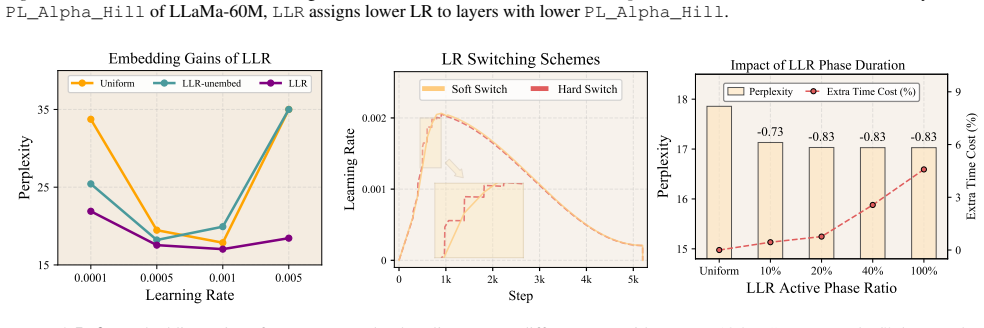
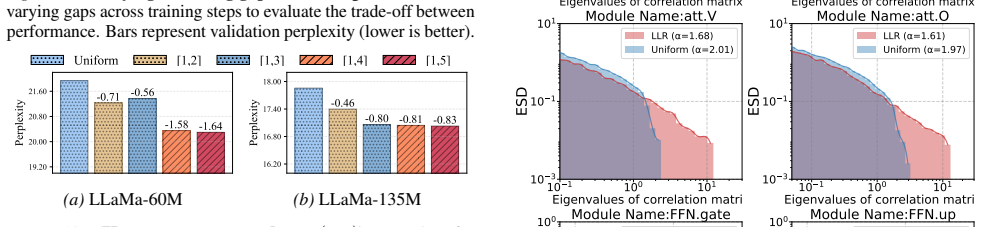
Learning rate configuration is a fundamental aspect of modern deep learning. The prevailing practice of applying a uniform learning rate across all layers overlooks the structural heterogeneity of Transformers, potentially limiting their effectiveness as the backbone of Large Language Models (LLMs). In this paper, we introduce Layerwise Learning Rate (LLR), an adaptive scheme that assigns distinct learning rates to individual Transformer layers. Our method is grounded in Heavy-Tailed Self-Regularization (HT-SR) theory, which characterizes the empirical spectral density (ESD) of weight correlation matrices to quantify heavy-tailedness. Layers with weaker heavy-tailedness are assigned larger learning rates to accelerate training, while layers with stronger heavy-tailedness receive smaller learning rates. By tailoring learning rates in this manner, LLR promotes more balanced training across layers, leading to faster convergence and improved generalization. Extensive experiments across architectures ranging from LLaMA to GPT-nano, optimizers including AdamW and Muon, and model scales from 60M to 3B parameters with up to 100B training tokens demonstrate the effectiveness of LLR. LLR achieves up to 1.5x training speedup and consistently outperforms uniform-learning-rate baselines. In particular, it improves the average zero-shot accuracy of 1B models from 47.09% to 49.02%, and that of 3B models from 48.58% to 50.61%. A key advantage of LLR is its low tuning overhead: it can transfer nearly optimal learning-rate settings directly from the uniform baseline. Code is available at https://github.com/hed-ucas/Layer-wise-Learning-Rate.
Figures








Forward citations
Cited by 1 Pith paper
-
Muse: Representation Geometry of Muon Beyond Normalized Momentum
The matrix shape given to Muon's orthonormalization step is a genuine optimizer axis: square-ish reshapes match native Muon, skinnier reshapes interpolate toward normalized SGD with momentum.
Reference graph
Works this paper leans on
-
[1]
Think you have Solved Question Answering? Try ARC, the AI2 Reasoning Challenge
Clark, P., Cowhey, I., Etzioni, O., Khot, T., Sabharwal, A., Schoenick, C., and Tafjord, O. Think you have solved question answering? try arc, the ai2 reasoning challenge. arXiv preprint arXiv:1803.05457,
work page internal anchor Pith review Pith/arXiv arXiv
-
[2]
Don't be lazy: CompleteP enables compute-efficient deep transformers
Dey, N., Zhang, B. C., Noci, L., Li, M., Bordelon, B., Bergsma, S., Pehlevan, C., Hanin, B., and Hestness, J. Don’t be lazy: Completep enables compute-efficient deep transformers.arXiv preprint arXiv:2505.01618,
-
[3]
Hayou, S. and Liu, L. Optimal embedding learning rate in llms: The effect of vocabulary size.arXiv preprint arXiv:2506.15025,
-
[4]
Di He, Songjun Tu, Ajay Jaiswal, Li Shen, Ganzhao Yuan, Shiwei Liu, and Lu Yin
He, D., Jaiswal, A., Tu, S., Shen, L., Yuan, G., Liu, S., and Yin, L. Alphadecay: Module-wise weight de- cay for heavy-tailed balancing in llms.arXiv preprint arXiv:2506.14562,
-
[5]
Hoffmann, J., Borgeaud, S., Mensch, A., Buchatskaya, E., Cai, T., Rutherford, E., Casas, D. d. L., Hendricks, L. A., Welbl, J., Clark, A., et al. Training compute-optimal large language models.arXiv preprint arXiv:2203.15556,
work page internal anchor Pith review Pith/arXiv arXiv
- [6]
-
[7]
Muon is Scalable for LLM Training
Liu, J., Su, J., Yao, X., Jiang, Z., Lai, G., Du, Y ., Qin, Y ., Xu, W., Lu, E., Yan, J., et al. Muon is scalable for llm training.arXiv preprint arXiv:2502.16982,
work page internal anchor Pith review Pith/arXiv arXiv
-
[8]
Model balancing helps low-data training and fine-tuning
Liu, Z., Hu, Y ., Pang, T., Zhou, Y ., Ren, P., and Yang, Y . Model balancing helps low-data training and fine-tuning. arXiv preprint arXiv:2410.12178,
-
[9]
Decoupled Weight Decay Regularization
Loshchilov, I. and Hutter, F. Decoupled weight decay regu- larization.arXiv preprint arXiv:1711.05101,
work page internal anchor Pith review Pith/arXiv arXiv
-
[10]
Martin, C. H. and Mahoney, M. W. Traditional and heavy- tailed self regularization in neural network models.arXiv preprint arXiv:1901.08276,
work page internal anchor Pith review Pith/arXiv arXiv 1901
-
[11]
Can a Suit of Armor Conduct Electricity? A New Dataset for Open Book Question Answering
Mihaylov, T., Clark, P., Khot, T., and Sabharwal, A. Can a suit of armor conduct electricity? a new dataset for open book question answering.arXiv preprint arXiv:1809.02789,
work page internal anchor Pith review Pith/arXiv arXiv
-
[12]
The FineWeb Datasets: Decanting the Web for the Finest Text Data at Scale
URL https://arxiv.org/abs/ 2406.17557. Radford, A., Narasimhan, K., Salimans, T., Sutskever, I., et al. Improving language understanding by generative pre-training
work page internal anchor Pith review Pith/arXiv arXiv
-
[13]
SocialIQA: Commonsense Reasoning about Social Interactions
ISSN 0001-0782. doi: 10.1145/3474381. URL https: //doi.org/10.1145/3474381. Sap, M., Rashkin, H., Chen, D., LeBras, R., and Choi, Y . Socialiqa: Commonsense reasoning about social interac- tions.arXiv preprint arXiv:1904.09728,
work page internal anchor Pith review Pith/arXiv arXiv doi:10.1145/3474381 1904
- [14]
-
[15]
arXiv preprint arXiv:2011.14522 , year=
Yang, G. and Hu, E. J. Feature learning in infinite-width neural networks.arXiv preprint arXiv:2011.14522,
-
[16]
Large Batch Training of Convolutional Networks
You, Y ., Gitman, I., and Ginsburg, B. Large batch training of convolutional networks.arXiv preprint arXiv:1708.03888,
work page internal anchor Pith review Pith/arXiv arXiv
-
[17]
Large Batch Optimization for Deep Learning: Training BERT in 76 minutes
You, Y ., Li, J., Reddi, S., Hseu, J., Kumar, S., Bhojanapalli, S., Song, X., Demmel, J., Keutzer, K., and Hsieh, C.-J. Large batch optimization for deep learning: Training bert in 76 minutes.arXiv preprint arXiv:1904.00962,
work page internal anchor Pith review Pith/arXiv arXiv 1904
-
[18]
HellaSwag: Can a Machine Really Finish Your Sentence?
Zellers, R., Holtzman, A., Bisk, Y ., Farhadi, A., and Choi, Y . Hellaswag: Can a machine really finish your sentence? arXiv preprint arXiv:1905.07830,
work page internal anchor Pith review Pith/arXiv arXiv 1905
-
[19]
Adam-mini: Use Fewer Learning Rates To Gain More
Zhang, Y ., Chen, C., Ding, T., Li, Z., Sun, R., and Luo, Z. Why transformers need adam: A hessian perspective. Advances in neural information processing systems, 37: 131786–131823, 2024a. Zhang, Y ., Chen, C., Li, Z., Ding, T., Wu, C., Kingma, D. P., Ye, Y ., Luo, Z.-Q., and Sun, R. Adam-mini: Use fewer learning rates to gain more.arXiv preprint arXiv:24...
-
[20]
11 One LR Doesn’t Fit All: Heavy-Tail Guided Layerwise Learning Rates for LLMs Appendix A. Details of Experiments This section provides detailed configurations for both pre- training and finetuning experiments. In Table 11 and Ta- ble 12, we present the architectural parameters of LLaMa models and the learning rate and weight decay settings for different ...
work page 2048
-
[21]
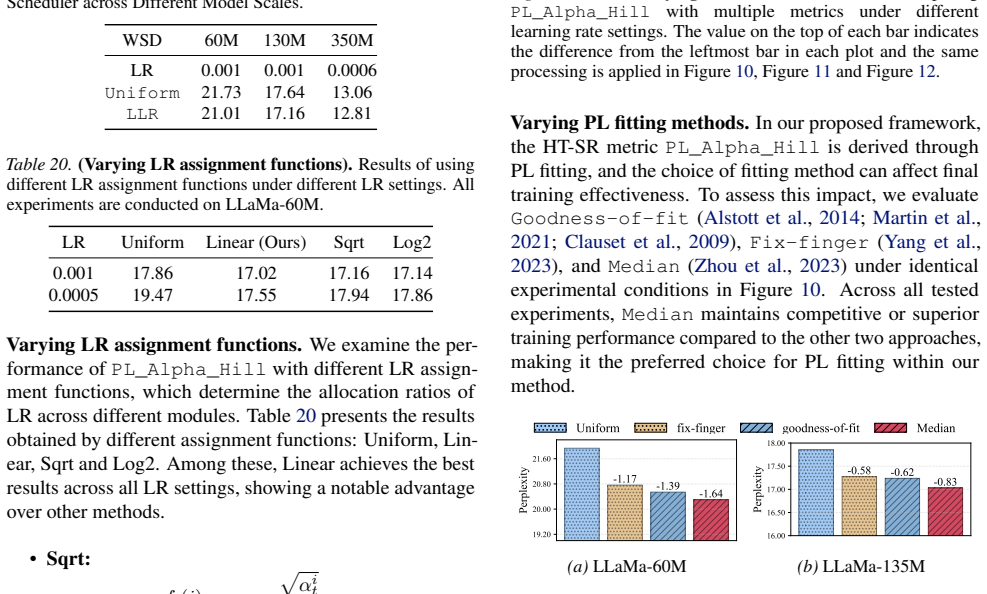
obtained by different assignment functions: Uniform, Lin- ear, Sqrt and Log2. Among these, Linear achieves the best results across all LR settings, showing a notable advantage over other methods. Table 18.(Varying LR assignment functions).Results of using different LR assignment functions under different LR settings. All experiments are conducted on LLaMa...
discussion (0)
Sign in with ORCID, Apple, or X to comment. Anyone can read and Pith papers without signing in.