REVIEW 91 references
Correlations and dynamics of tunnel-coupled one-dimensional Bose gases
T0 review · reviewed 2026-08-14 · deepseek-v4-flash
Pith's one-line read Measurements of fourth-order connected correlation functions reveal non-Gaussian relative-phase fluctuations in tunnel-coupled 1D Bose gases, consistent with sine-Gordon theory, and a first observation of Gaussification after decoupling.
The pith
A machine-rendered reading of the paper's core claim, the machinery that carries it, and where it could break.
The reading
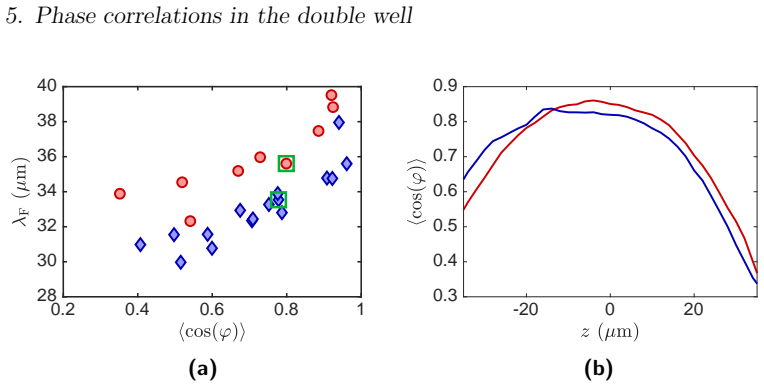
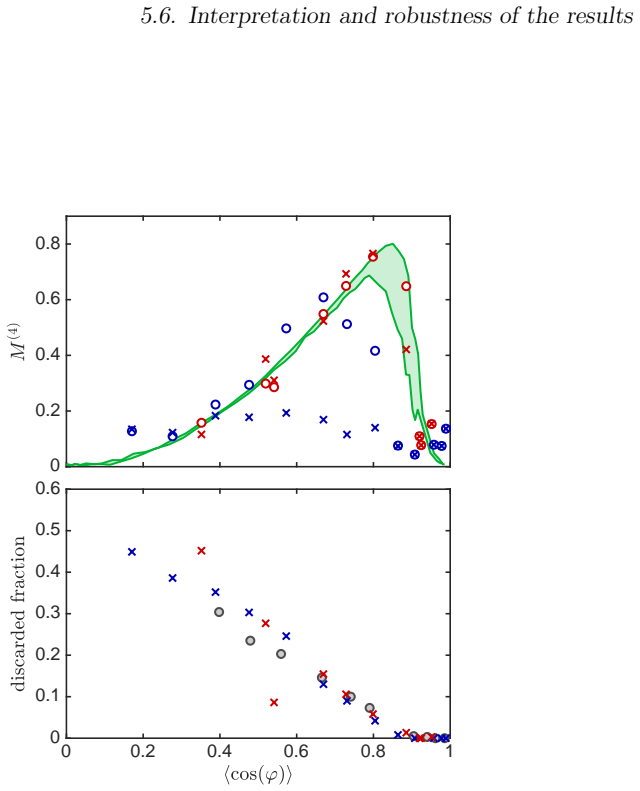
In a system with no interactions, four-point correlations are completely determined by two-point correlations; the distribution of fluctuations is Gaussian. Here, at intermediate tunneling strength, the four-point correlations deviate from this rule, and the extra connected part, a signature of interactions between the collective sound-like excitations, becomes visible. The magnitude of this effect matches the prediction of the sine-Gordon model, a standard low-energy theory for coupled superfluids, when the model parameters are taken from independent thermometry and from the measured degree of phase locking. At zero or very strong tunneling the connected part vanishes, as the sine-Gordon model also predicts.
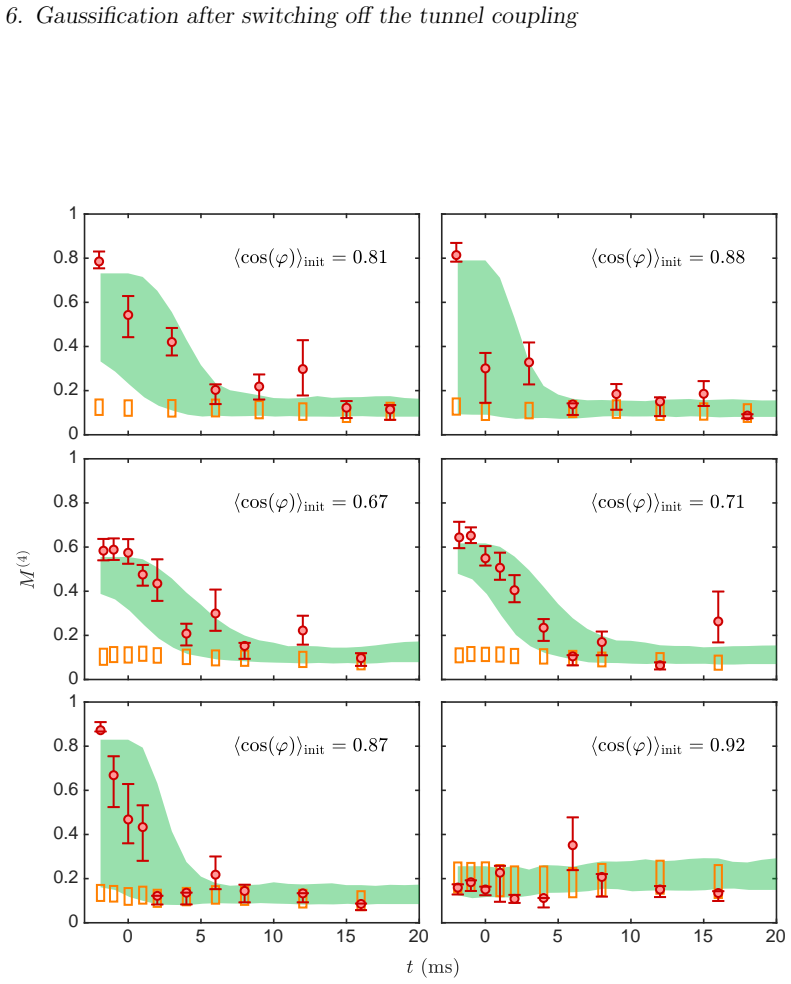
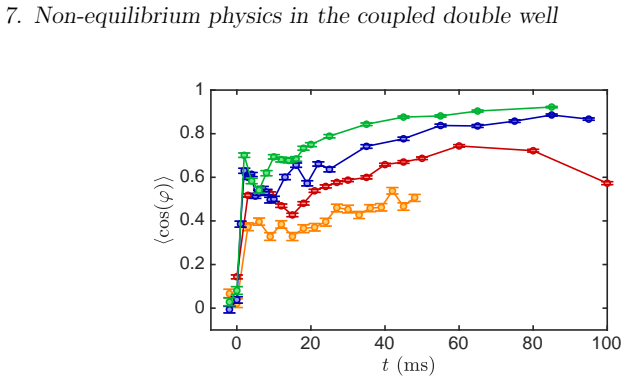
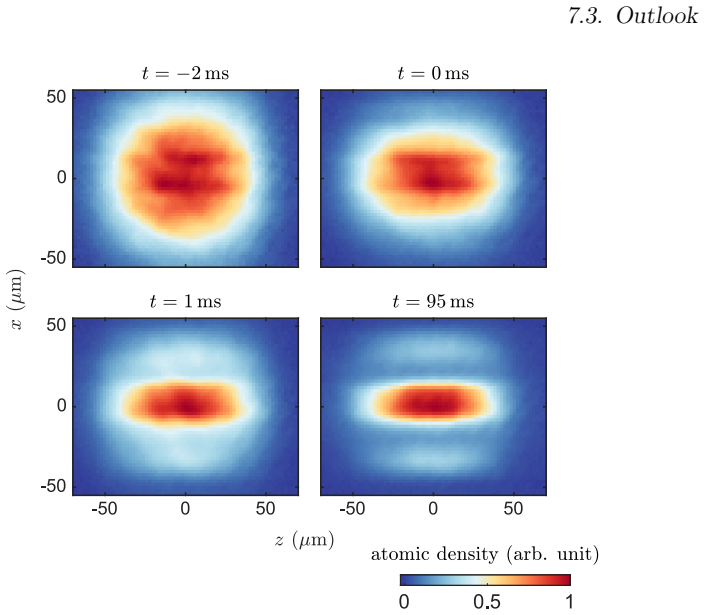
The thesis also studies dynamics. Starting with a non-Gaussian state in a tunnel-coupled double well, the tunneling is suddenly switched off; the phase fluctuations are then observed to evolve toward a Gaussian state, an effect called Gaussification. In separate experiments, the gas is split and re-coupled, and the relative phase oscillations are seen to damp as phase coherence builds up.
Extended reading notes
Core claim
The paper's load-bearing assertion is that, for intermediate phase locking, the fourth-order correlation function of the relative phase cannot be described by second-order functions alone and a substantial connected part remains, as stated in section 5.5.3: 'For intermediate phase locking the fourth-order function cannot be described by second-order functions alone, and a substantial connected part remains.' If correct, this establishes non-factorizing higher-order connected correlations as a signature of interactions between collective excitations in a tunnel-coupled 1D Bose gas, with a magnitude consistent with the thermal sine-Gordon model for slow-cooled preparations.
Load-bearing premise
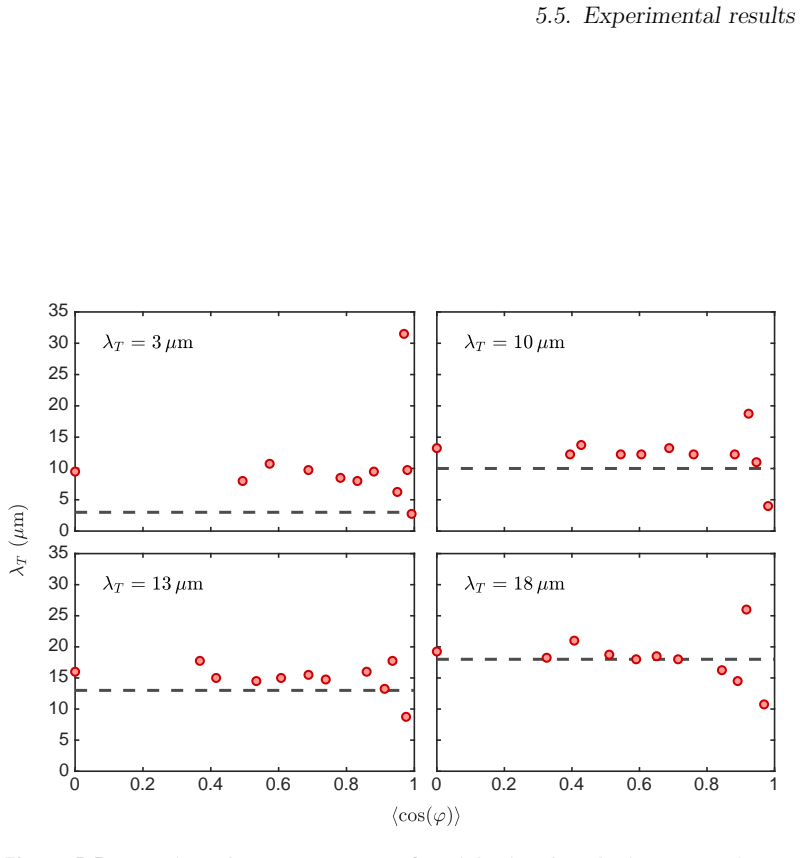
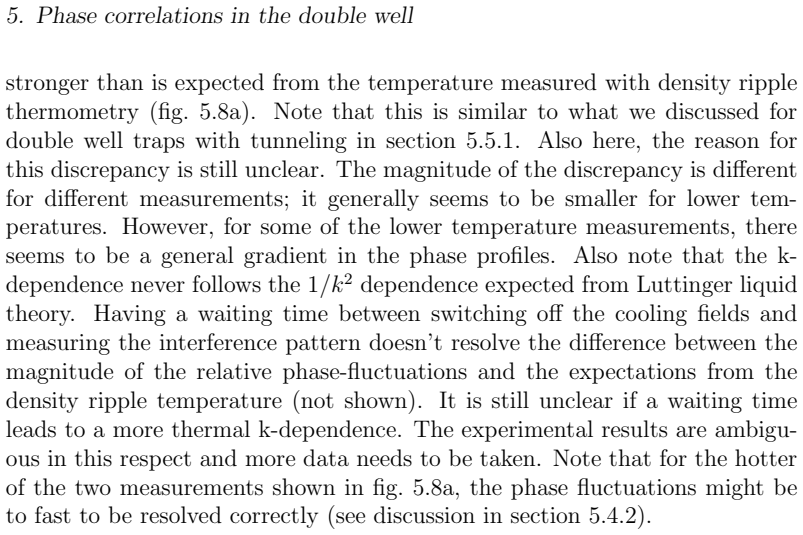
The quantitative comparison to sine-Gordon theory assumes that the relative and common motional degrees of freedom are in thermal equilibrium at a common temperature, so that the thermal coherence length extracted from density ripple thermometry (dominated by common modes, section 4.1.3) is the correct value for the relative phase. The thesis itself questions this: 'It seems like the temperature in the relative and common degrees of freedom doesn't always coincide' (section 5.5.1). If the relative modes are hotter, the fitted parameter q and the predicted fourth-order measure would change, weakening the claimed agreement. The unresolved discrepancy in the second-order fluctuation magnitude S(2) (section 5.5.1) is a direct manifestation of this risk.
Signed reviews
Editorial analysis
A structured set of objections, weighed in public.
Assumptions & free parameters
free parameters (2)
- q = lambda_T / l_J (dimensionless tunnel-coupling strength) =
0 to ~3 (range across datasets; corresponding to coherence factors from ~0.3 to ~0.96)
- sigma_PSF (Gaussian point-spread-function width for imaging) =
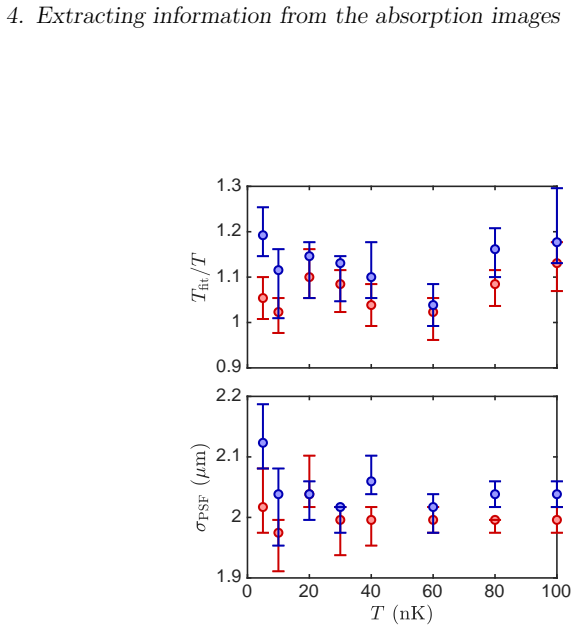
3.0 um for coupled scans, 3.5 um for uncoupled scans
assumptions (5)
- domain assumption The classical fields approximation is valid for the probed modes (mode occupation beta*epsilon << 1), so thermal phase fluctuations are described by classical statistical mechanics.
- domain assumption The sine-Gordon Hamiltonian (eq. 2.65) is the correct low-energy effective description for the tunnel-coupled double well in the quasicondensate regime.
- domain assumption The relative and common degrees of freedom are in thermal equilibrium at a common temperature when extracting the thermal coherence length from density ripple thermometry.
- ad hoc to paper The imaging process is equivalent to convolution of the phase profiles with a Gaussian of width sigma_PSF approximately 3 um.
- domain assumption The phase profiles extracted from interference images after phase unwrapping faithfully represent the in-situ relative phase modulo 2 pi.
Cite this review
Pith. "Pith review of Correlations and dynamics of tunnel-coupled one-dimensional Bose gases." pith.science (2026). https://pith.science/paper/HI4Q2SFV
@misc{pith2026190800422,
  author       = {Pith},
  title        = {Pith review of: Correlations and dynamics of tunnel-coupled one-dimensional Bose gases},
  year         = {2026},
  howpublished = {\url{https://pith.science/paper/HI4Q2SFV}},
  note         = {Machine review of arXiv:1908.00422}
}
read the original abstract
We present a series of experiments performed with two ultracold one-dimensional Bose gases (rubidium atoms) in a double well potential. Employing matter-wave interference, we can measure the spatially resolved phase difference between the two gases and consequently investigate spatial correlations. By investigating whether higher order correlation functions can be factorized into correlations of lower order, we can investigate the interaction properties of the system. For a non-interacting system, all correlation functions with orders greater than two factorize and one observes Gaussian fluctuations. Here, we present the measurement of non-factorizing fourth-order correlation functions, leading to an experimental characterization of the interactions between the collective excitations of the quantum many-body system. The degree of non-factorizibility, i.e., the degree of non-Gaussianity of the phase fluctuations, depends on the tuneable tunneling strength between the wells. Starting from such a non-Gaussian state, we are able to observe the dynamical evolution towards a state with factorizing correlation functions (Gaussian fluctuations). We start in a double well with tunneling and then abruptly decouple the two subsystems. Subsequently, we observe how the initially non-Gaussian phase fluctuations become Gaussian. Moreover, we discuss the dynamical emergence of phase coherence in a double well potential with tunneling. We experimentally investigate the evolution starting from two different initial states. In one case, we split a cloud of atoms into two and trigger global oscillations in their relative phase. The oscillations subsequently damp and phase coherence sets in. In the other case, two independent clouds are suddenly coupled by tunneling. Again, phase coherence emerges between the two subsystems.
Figures


Figures from the paper (51 more)
















Reference graph
Works this paper leans on
-
[1]
, author Dalibard, J
author Bloch, I. , author Dalibard, J. & author Zwerger, W. title Many-body physics with ultracold gases . journal Reviews of Modern Physics volume 80 , pages 885 ( year 2008 )
2008
-
[2]
, author Dalibard , J
author Bloch , I. , author Dalibard , J. & author Nascimb \`e ne , S. title Quantum simulations with ultracold quantum gases . journal Nature Physics volume 8 , pages 267 ( year 2012 )
2012
-
[3]
, author Juzeli \= u nas, G
author Goldman, N. , author Juzeli \= u nas, G. , author Öhberg, P. & author Spielman, I. B. title Light-induced gauge fields for ultracold atoms . journal Reports on Progress in Physics volume 77 , pages 126401 ( year 2014 )
2014
-
[4]
author Proukakis, N. P. , author Snoke, D. W. & author Littlewood, P. B. title Universal Themes of Bose-Einstein Condensation ( publisher Cambridge University Press , address Cambridge , year 2017 )
2017
-
[5]
title Quantum physics in one dimension ( publisher Clarendon Press , address Oxford , year 2004 )
author Giamarchi, T. title Quantum physics in one dimension ( publisher Clarendon Press , address Oxford , year 2004 )
2004
-
[6]
author Cazalilla, M. A. , author Citro, R. , author Giamarchi, T. , author Orignac, E. & author Rigol, M. title One dimensional bosons: From condensed matter systems to ultracold gases . journal Reviews of Modern Physics volume 83 , pages 1405 ( year 2011 )
2011
-
[7]
& author Mossel, J
author Caux, J.-S. & author Mossel, J. title Remarks on the notion of quantum integrability . journal Journal of Statistical Mechanics: Theory and Experiment volume 2011 , pages P02023 ( year 2011 )
2011
-
[8]
author Hodgman, S. S. , author Dall, R. G. , author Manning, A. G. , author Baldwin, K. G. H. & author Truscott, A. G. title Direct Measurement of Long-Range Third-Order Coherence in Bose-Einstein Condensates . journal Science volume 331 , pages 1046 ( year 2011 )
2011
Show all 91 references
-
[9]
author Dall, R. G. et al. title Ideal n-body correlations with massive particles . journal Nature Physics volume 9 , pages 341 ( year 2013 )
2013
-
[10]
author Endres, M. et al. title Single-site- and single-atom-resolved measurement of correlation functions . journal Applied Physics B volume 113 , pages 27 ( year 2013 )
2013
-
[11]
author Langen, T. et al. title Experimental observation of a generalized gibbs ensemble . journal Science volume 348 , pages 207 ( year 2015 )
2015
-
[12]
, author Hu, J
author Feng, L. , author Hu, J. , author Clark, L. W. & author Chin, C. title Correlations in high-harmonic generation of matter-wave jets revealed by pattern recognition . journal Science volume 363 , pages 521 ( year 2019 )
2019
-
[13]
title Quantum Field Theory and Critical Phenomena
author Zinn-Justin, J. title Quantum Field Theory and Critical Phenomena . International Series of Monographs on Physics ( publisher Clarendon Press , address Oxford , year 2002 ), edition 4 edn
2002
-
[14]
author Schweigler, T. et al. title Experimental characterization of a quantum many-body system via higher-order correlations . journal Nature volume 545 , pages 323 ( year 2017 )
2017
-
[15]
, author Sengupta, K
author Polkovnikov, A. , author Sengupta, K. , author Silva, A. & author Vengalattore, M. title Colloquium: Nonequilibrium dynamics of closed interacting quantum systems . journal Reviews of Modern Physics volume 83 , pages 863 ( year 2011 )
2011
-
[16]
, author Friesdorf, M
author Eisert, J. , author Friesdorf, M. & author Gogolin, C. title Quantum many-body systems out of equilibrium . journal Nature Physics volume 11 , pages 124 EP ( year 2015 ). note Review Article
2015
-
[17]
, author Geiger, R
author Langen, T. , author Geiger, R. & author Schmiedmayer, J. title Ultracold Atoms Out of Equilibrium . journal Annual Review of Condensed Matter Physics volume 6 , pages 201 ( year 2015 )
2015
-
[18]
& author Eisert, J
author Gogolin, C. & author Eisert, J. title Equilibration, thermalisation, and the emergence of statistical mechanics in closed quantum systems . journal Reports on Progress in Physics volume 79 , pages 056001 ( year 2016 )
2016
-
[19]
, author Krumnow, C
author Gluza, M. , author Krumnow, C. , author Friesdorf, M. , author Gogolin, C. & author Eisert, J. title Equilibration via gaussification in fermionic lattice systems . journal Physical Review Letters volume 117 , pages 190602 ( year 2016 )
2016
-
[20]
& author Martelloni, G
author Sotiriadis, S. & author Martelloni, G. title Equilibration and GGE in interacting-to-free quantum quenches in dimensions d > 1 . journal Journal of Physics A: Mathematical and Theoretical volume 49 , pages 095002 ( year 2016 )
2016
-
[21]
title Equilibration in one-dimensional quantum hydrodynamic systems
author Sotiriadis, S. title Equilibration in one-dimensional quantum hydrodynamic systems . journal Journal of Physics A: Mathematical and Theoretical volume 50 , pages 424004 ( year 2017 )
2017
-
[22]
& author Srednicki, M
author Murthy, C. & author Srednicki, M. title On relaxation to gaussian and generalized gibbs states in systems of particles with quadratic hamiltonians . journal arXiv:1809.03681 ( year 2018 )
2018 arXiv
-
[23]
, author Eisert, J
author Gluza, M. , author Eisert, J. & author Farrelly, T. title Equilibration towards generalized gibbs ensembles in non-interacting theories . journal arXiv:1809.08268 ( year 2018 )
2018 arXiv
-
[24]
author Gring, M. et al. title Relaxation and prethermalization in an isolated quantum system . journal Science volume 337 , pages 1318 ( year 2012 )
2012
-
[25]
author Kuhnert, M. et al. title Multimode Dynamics and Emergence of a Characteristic Length Scale in a One-Dimensional Quantum System . journal Physical Review Letters volume 110 , pages 090405 ( year 2013 )
2013
-
[26]
, author Geiger, R
author Langen , T. , author Geiger, R. , author Kuhnert , M. , author Rauer , B. & author Schmiedmayer, J. title Local emergence of thermal correlations in an isolated quantum many-body system . journal Nature Physics volume 9 , pages 640 ( year 2013 )
2013
-
[27]
author Rauer, B. et al. title Cooling of a one-dimensional bose gas . journal Physical Review Letters volume 116 , pages 030402 ( year 2016 )
2016
-
[28]
author Rauer, B. et al. title Recurrences in an isolated quantum many-body system . journal Science ( year 2018 )
2018
-
[29]
author Pigneur, M. et al. title Relaxation to a phase-locked equilibrium state in a one-dimensional bosonic josephson junction . journal Physical Review Letters volume 120 , pages 173601 ( year 2018 )
2018
-
[30]
author Dalla Torre, E. G. , author Demler, E. & author Polkovnikov, A. title Universal rephasing dynamics after a quantum quench via sudden coupling of two initially independent condensates . journal Physical Review Letters volume 110 , pages 090404 ( year 2013 )
2013
-
[31]
o bel, M. title Low-Dimensional Traps for Bose-Fermi Mixtures . Ph.D. thesis, school Universit \
author G \"o bel, M. title Low-Dimensional Traps for Bose-Fermi Mixtures . Ph.D. thesis, school Universit \"a t Heidelberg ( year 2008 )
2008
-
[32]
title Prethermalization in an isolated many body system
author Gring, M. title Prethermalization in an isolated many body system . Ph.D. thesis, school TU Wien ( year 2012 )
2012
-
[33]
title Evaporative cooling of one-dimensional Bose gases
author Rauer, B. title Evaporative cooling of one-dimensional Bose gases . Master's thesis, school TU Wien ( year 2012 )
2012
-
[34]
title Thermalization and Prethermalization in an ultracold Bose Gas
author Kuhnert, M. title Thermalization and Prethermalization in an ultracold Bose Gas . Ph.D. thesis, school TU Wien ( year 2013 )
2013
-
[35]
title Non-equilibrium dynamics of one-dimensional Bose gases
author Langen, T. title Non-equilibrium dynamics of one-dimensional Bose gases . Ph.D. thesis, school TU Wien ( year 2013 )
2013
-
[36]
title Non-equilibrium dynamics beyond dephasing: Recurrences and loss induced cooling in one-dimensional Bose gases
author Rauer, B. title Non-equilibrium dynamics beyond dephasing: Recurrences and loss induced cooling in one-dimensional Bose gases . Ph.D. thesis, school TU Wien ( year 2018 )
2018
-
[37]
author Pethick, C. J. & author Smith, H. title Bose–Einstein Condensation in Dilute Gases ( publisher Cambridge University Press , year 2008 ), edition 2 edn
2008
-
[38]
title Bose-Einstein condensates in magnetic double well potentials
author Schumm, T. title Bose-Einstein condensates in magnetic double well potentials . Ph.D. thesis, school Universit \"a t Heidelberg ( year 2005 )
2005
-
[39]
& editor Vuletic, V
editor Reichel, J. & editor Vuletic, V. (eds.) title Atom Chips ( publisher Wiley-VCH , address Weinheim, Germany , year 2011 )
2011
-
[40]
author Steck, D. A. title Rubidium 87 d line data ( year 2015 )
2015
-
[41]
& author Cohen-Tannoudji, C
author Dalibard, J. & author Cohen-Tannoudji, C. title Laser cooling below the doppler limit by polarization gradients: simple theoretical models . journal Journal of the Optical Society of America B volume 6 , pages 2023 ( year 1989 )
2023
-
[42]
author Schumm, T. et al. title Matter-wave interferometry in a double well on an atom chip . journal Nature Physics volume 1 , pages 57 ( year 2005 )
2005
-
[43]
author Lesanovsky, I. et al. title Adiabatic radio-frequency potentials for the coherent manipulation of matter waves . journal Physical Review A volume 73 , pages 033619 ( year 2006 )
2006
-
[44]
title Arbitrary one-dimensional optical dipole potentials on an atom chip
author Tajik, M. title Arbitrary one-dimensional optical dipole potentials on an atom chip . Master's thesis, school TU Wien ( year 2017 )
2017
-
[45]
author Lieb, E. H. & author Liniger, W. title Exact analysis of an interacting bose gas. i. the general solution and the ground state . journal Physical Review volume 130 , pages 1605 ( year 1963 )
1963
-
[46]
author Lieb, E. H. title Exact analysis of an interacting bose gas. ii. the excitation spectrum . journal Physical Review volume 130 , pages 1616 ( year 1963 )
1963
-
[47]
author Petrov, D. S. , author Shlyapnikov, G. V. & author Walraven, J. T. M. title Regimes of quantum degeneracy in trapped 1d gases . journal Physical Review Letters volume 85 , pages 3745 ( year 2000 )
2000
-
[48]
author Kheruntsyan, K. V. , author Gangardt, D. M. , author Drummond, P. D. & author Shlyapnikov, G. V. title Pair correlations in a finite-temperature 1d bose gas . journal Physical Review Letters volume 91 , pages 040403 ( year 2003 )
2003
-
[49]
, author Gangardt, D
author Petrov, D. , author Gangardt, D. & author Shlyapnikov, G. title Low-dimensional trapped gases . In booktitle Journal de Physique IV (Proceedings) , vol. volume 116 , pages 5 ( organization EDP sciences , year 2004 )
2004
-
[50]
& author Castin, Y
author Mora, C. & author Castin, Y. title Extension of Bogoliubov theory to quasicondensates . journal Physical Review A volume 67 , pages 053615 ( year 2003 )
2003
-
[51]
& author Knight, P
author Gerry, C. & author Knight, P. title Introductory Quantum Optics ( publisher Cambridge University Press , year 2004 )
2004
-
[52]
title Bose-einstein condensates in atomic gases: simple theoretical results
author Castin, Y. title Bose-einstein condensates in atomic gases: simple theoretical results . journal arXiv:cond-mat/0105058v1 ( year 2001 )
2001 arXiv
-
[53]
, author Mauser, N
author Stimming, H.-P. , author Mauser, N. J. , author Schmiedmayer, J. & author Mazets, I. E. title Fluctuations and stochastic processes in one-dimensional many-body quantum systems . journal Physical Review Letters volume 105 , pages 015301 ( year 2010 )
2010
-
[54]
title Normal forms for classical and boson systems
author Broadbridge, P. title Normal forms for classical and boson systems . journal Physica A: Statistical Mechanics and its Applications volume 99 , pages 494 ( year 1979 )
1979
-
[55]
author Gluza, M. et al. title Quantum read-out for cold atomic quantum simulators . journal arXiv:1807.04567 ( year 2018 )
2018 arXiv
-
[56]
title Statistical Physics of Particles ( publisher Cambridge University Press , year 2007 )
author Kardar, M. title Statistical Physics of Particles ( publisher Cambridge University Press , year 2007 )
2007
-
[57]
title Atomic scattering in the presence of an external confinement and a gas of impenetrable bosons
author Olshanii, M. title Atomic scattering in the presence of an external confinement and a gas of impenetrable bosons . journal Physical Review Letters volume 81 , pages 938 ( year 1998 )
1998
-
[58]
author van Kempen, E. G. M. , author Kokkelmans, S. J. J. M. F. , author Heinzen, D. J. & author Verhaar, B. J. title Interisotope determination of ultracold rubidium interactions from three high-precision experiments . journal Physical Review Letters volume 88 , pages 093201 ...
2002
-
[59]
, author Parola, A
author Salasnich, L. , author Parola, A. & author Reatto, L. title Effective wave equations for the dynamics of cigar-shaped and disk-shaped bose condensates . journal Physical Review A volume 65 , pages 043614 ( year 2002 )
2002
-
[60]
, author Parola, A
author Salasnich, L. , author Parola, A. & author Reatto, L. title Dimensional reduction in bose-einstein-condensed alkali-metal vapors . journal Physical Review A volume 69 , pages 045601 ( year 2004 )
2004
-
[61]
& author Modugno, M
author Massignan, P. & author Modugno, M. title One-dimensional model for the dynamics and expansion of elongated bose-einstein condensates . journal Physical Review A volume 67 , pages 023614 ( year 2003 )
2003
-
[62]
author Kamchatnov, A. M. & author Shchesnovich, V. S. title Dynamics of bose-einstein condensates in cigar-shaped traps . journal Physical Review A volume 70 , pages 023604 ( year 2004 )
2004
-
[63]
title Quasi-1d bose-einstein condensates in the dimensional crossover regime
author Gerbier, F. title Quasi-1d bose-einstein condensates in the dimensional crossover regime . journal Europhysics Letters ( EPL ) volume 66 , pages 771 ( year 2004 )
2004
-
[64]
& author Bouchoule, I
author Whitlock, N. & author Bouchoule, I. title Relative phase fluctuations of two coupled one-dimensional condensates . journal Physical Review A volume 68 , pages 053609 ( year 2003 )
2003
-
[65]
, author Schweigler, T
author Langen, T. , author Schweigler, T. , author Demler, E. & author Schmiedmayer, J. title Double light-cone dynamics establish thermal states in integrable 1d bose gases . journal New Journal of Physics volume 20 , pages 023034 ( year 2018 )
2018
-
[66]
, author Polkovnikov, A
author Gritsev, V. , author Polkovnikov, A. & author Demler, E. title Linear response theory for a pair of coupled one-dimensional condensates of interacting atoms . journal Physical Review B volume 75 , pages 174511 ( year 2007 )
2007
-
[67]
, author Mazets, I
author Beck, S. , author Mazets, I. E. & author Schweigler, T. title Nonperturbative method to compute thermal correlations in one-dimensional systems . journal Physical Review A volume 98 , pages 023613 ( year 2018 )
2018
-
[68]
& author Mazets, I
author Gri s ins, P. & author Mazets, I. title Coherence and Josephson oscillations between two tunnel-coupled one-dimensional atomic quasicondensates at finite temperature . journal Physical Review A volume 87 , pages 013629 ( year 2013 )
2013
-
[69]
author van Nieuwkerk, Y. D. , author Schmiedmayer, J. & author Essler, F. title Projective phase measurements in one-dimensional bose gases . journal SciPost Physics volume 5 , pages 046 ( year 2018 )
2018
-
[70]
, author Durfee , D
author Ketterle , W. , author Durfee , D. S. & author Stamper-Kurn , D. M. title Making, probing and understanding Bose-Einstein condensates . journal arXiv:cond-mat/9904034 ( year 1999 )
1999 arXiv
-
[71]
author Smith, D. A. et al. title Absorption imaging of ultracold atoms on atom chips . journal Optics Express volume 19 , pages 8471 ( year 2011 )
2011
-
[72]
title Advanced optical imaging theory , vol
author Gu, M. title Advanced optical imaging theory , vol. volume 75 ( publisher Springer , year 2000 )
2000
-
[73]
author B \"u cker, R. et al. title Single-particle-sensitive imaging of freely propagating ultracold atoms . journal New Journal of Physics volume 11 , pages 103039 ( year 2009 )
2009
-
[74]
author Manz, S. et al. title Two-point density correlations of quasicondensates in free expansion . journal Physical Review A volume 81 , pages 031610 ( year 2010 )
2010
-
[75]
title Comment on ``probing phase fluctuations in a 2d degenerate bose gas by free expansion''
author Langen, T. title Comment on ``probing phase fluctuations in a 2d degenerate bose gas by free expansion'' . journal Physical Review Letters volume 111 , pages 159601 ( year 2013 )
2013
-
[76]
, author Campbell, D
author Putra, A. , author Campbell, D. L. , author Price, R. M. , author De, S. & author Spielman, I. title Optimally focused cold atom systems obtained using density-density correlations . journal Review of Scientific Instruments volume 85 , pages 013110 ( year 2014 )
2014
-
[77]
, author Corman, L
author Chomaz, L. , author Corman, L. , author Yefsah, T. , author Desbuquois, R. & author Dalibard, J. title Absorption imaging of a quasi-two-dimensional gas: a multiple scattering analysis . journal New Journal of Physics volume 14 , pages 055001 ( year 2012 )
2012
-
[78]
author Imambekov, A. et al. title Density ripples in expanding low-dimensional gases as a probe of correlations . journal Physical Review A volume 80 , pages 033604 ( year 2009 )
2009
-
[79]
author Rohringer, W. et al. title Non-equilibrium scale invariance and shortcuts to adiabaticity in a one-dimensional bose gas . journal Scientific Reports volume 5 , pages 9820 EP ( year 2015 ). note Article
2015
-
[80]
title Far-From-Equilibrium Quantum Many-Body Systems: From Universal Dynamics to Statistical Mechanics
author Erne, S. title Far-From-Equilibrium Quantum Many-Body Systems: From Universal Dynamics to Statistical Mechanics . Ph.D. thesis, school Universität Heidelberg ( year 2018 )
2018
-
[81]
author Shiryaev, A. N. title Probability-1 , vol. volume 95 of series Graduate Texts in Mathematics ( publisher Springer, New York , year 2016 )
2016
-
[82]
author Betz, T. et al. title Two-Point Phase Correlations of a One-Dimensional Bosonic Josephson Junction . journal Physical Review Letters volume 106 , pages 020407 ( year 2011 )
2011
-
[83]
title Phase correlations of coupled one-dimensional Bose gases
author Betz, T. title Phase correlations of coupled one-dimensional Bose gases . Ph.D. thesis, school TU Wien ( year 2011 )
2011
-
[84]
author Struck, J. et al. title Quantum simulation of frustrated classical magnetism in triangular optical lattices . journal Science volume 333 , pages 996 ( year 2011 )
2011
-
[85]
author Aidelsburger, M. et al. title Experimental realization of strong effective magnetic fields in an optical lattice . journal Physical Review Letters volume 107 , pages 255301 ( year 2011 )
2011
-
[86]
title Fate of the false vacuum: Semiclassical theory
author Coleman, S. title Fate of the false vacuum: Semiclassical theory . journal Physical Review D volume 15 , pages 2929 ( year 1977 )
1977
-
[87]
author Berrada, T. et al. title Integrated mach-zehnder interferometer for bose-einstein condensates . journal Nature Communications volume 4 , pages 2077 EP ( year 2013 ). note Article
2013
-
[88]
, author Imambekov, A
author Kitagawa, T. , author Imambekov, A. , author Schmiedmayer, J. & author Demler, E. title The dynamics and prethermalization of one-dimensional quantum systems probed through the full distributions of quantum noise . journal New Journal of Physics volume 13 , pages 073018...
2011
-
[89]
author Brink, D. M. & author Satchler, G. R. title Angular momentum ( publisher Clarendon Press , year 1968 ), edition second edn
1968
-
[90]
, author Lahaye, T
author Reinaudi, G. , author Lahaye, T. , author Wang, Z. & author Gu\' e ry-Odelin, D. title Strong saturation absorption imaging of dense clouds of ultracold atoms. journal Optics letters volume 32 , pages 3143 ( year 2007 )
2007
-
[91]
author Cover, T. M. & author Thomas, J. A. title Elements of information theory ( publisher John Wiley & Sons , year 1991 )
1991
Reviewed August 14, 2026 · model on record in the stance chip above.
Discussion (0). Continue with ORCID to comment.